A dash cam is only as good as its power source. When your engine turns off, relying on your car’s battery risks a dead vehicle and gaps in coverage. A dedicated external battery pack solves both problems, keeping your camera recording and your starter battery healthy.
I’m Amir — the founder and writer behind Four Wheel Ask. I’ve spent hundreds of hours analyzing dash cam battery specifications, comparing cell chemistries, charging topologies, and aggregating owner testimonials to separate reliable designs from marketing claims.
I’ve organized this guide around seven distinct battery packs, from budget-friendly multi-voltage bricks to premium LiFePO4 units with app-based monitoring. This comprehensive guide reveals the best battery pack for dash cam to keep your camera recording in parking mode without draining your car battery.
How To Choose The Best Battery Pack For Dash Cam
Not all portable power stations are designed for the continuous discharge profile of a dash cam. Selecting the wrong unit leads to short runtimes, overheating, or premature cell degradation. Focus on three core criteria: chemistry, charging speed, and protection circuitry.
Battery Chemistry: LiFePO4 vs. Lithium-Ion
Lithium iron phosphate (LiFePO4) cells offer superior thermal stability and a cycle life rated for 2,000 charges or more, making them ideal for daily parking mode use. Standard lithium-ion packs typically deliver lower cycle counts but cost less upfront — a tradeoff worth evaluating if you run the battery only occasionally.
Charging Speed and Input Voltage
Hardwired connections typically charge at 5A to 9A, refilling a 96Wh pack in under an hour. Cigarette lighter adapters are slower due to current limits, often requiring 90 minutes or more. Faster charging ensures the pack recovers during short commutes, so match the input spec to your driving habits.
Capacity and Real-World Runtime
Manufacturers quote capacity in watt-hours (Wh) or milliamp-hours (mAh) at the cell voltage. A 96Wh pack powers a single-channel dash cam for roughly 18 to 30 hours depending on power draw and parking mode settings. Dual-channel systems cut that estimate roughly in half. Always factor in your specific camera’s consumption.
Quick Comparison
On smaller screens, swipe sideways to see the full table.
| Model | Category | Best For | Key Spec | Amazon |
|---|---|---|---|---|
| RoyPow 30W PD | Mid-Range | Dash Cam Parking Power | 86.58Wh, 30W PD Input/Output | Amazon |
| 70mai BL96NNX | Premium | 24/7 Surveillance | 96Wh LiFePO4, 60-Min Charge | Amazon |
| BlackboxMyCar PowerCell 8 | Premium | App Monitoring & Control | 96Wh, 50-Min Hardwire Charge | Amazon |
| THINKWARE iVolt Mini | Premium | Compact Installation | 20-Hour Runtime, 45-Min Recharge | Amazon |
| Blackvue B-130A | Premium | Cloud & App Integration | 96Wh, Smart Temp Protection | Amazon |
| Talentcell 12V 9Ah | Budget | Multi-Device Power Backup | 99.9Wh, 12V/9V/5V Outputs | Amazon |
| dzdarren 12V 10000mAh | Budget | Versatile Voltage Needs | 10000mAh, 12V/9V/5V USB | Amazon |
In‑Depth Reviews
1. RoyPow 30W PD Portable Charger

The RoyPow 30W PD strikes a rare balance between price, capacity, and feature density that most packs in this category miss. Its 86.58Wh total capacity translates to roughly 14 to 18 hours of continuous dash cam operation in parking mode, based on owner reports using 360-degree cameras. The regulated 13.5V cigarette lighter outlet is a standout — it delivers stable 81W power to devices that require constant voltage, unlike unregulated ports that drift with the pack’s state of charge.
What makes this unit especially practical for daily driving is the simultaneous input and output capability. You can charge the pack while it powers your dash cam, effectively creating a UPS that prevents camera reboot cycles during engine starts. The PD 30W input also refills the pack in about four hours via USB-C, though owners note that reaching the advertised three-hour charge time requires a 45W adapter. The three-in-one cable and included carrying bag add genuine out-of-box value.
Long-term reliability is the primary open question. A small number of owners report capacity degradation after eight months, with the pack failing to charge past 75% and losing fast-charge functionality. For the price point, the RoyPow delivers impressive immediate performance, but I recommend verifying your return window covers an extended evaluation period.
What works
- Regulated 12V outlet ensures stable power for sensitive dash cams
- Simultaneous charge and discharge acts as a UPS
- Compact form factor fits under most seats
What doesn’t
- Reported capacity degradation within the first year for some units
- No low-voltage auto shutoff can trickle-drain the pack
- Charger not included in the package
2. 70mai Dash Cam Battery Pack BL96NNX
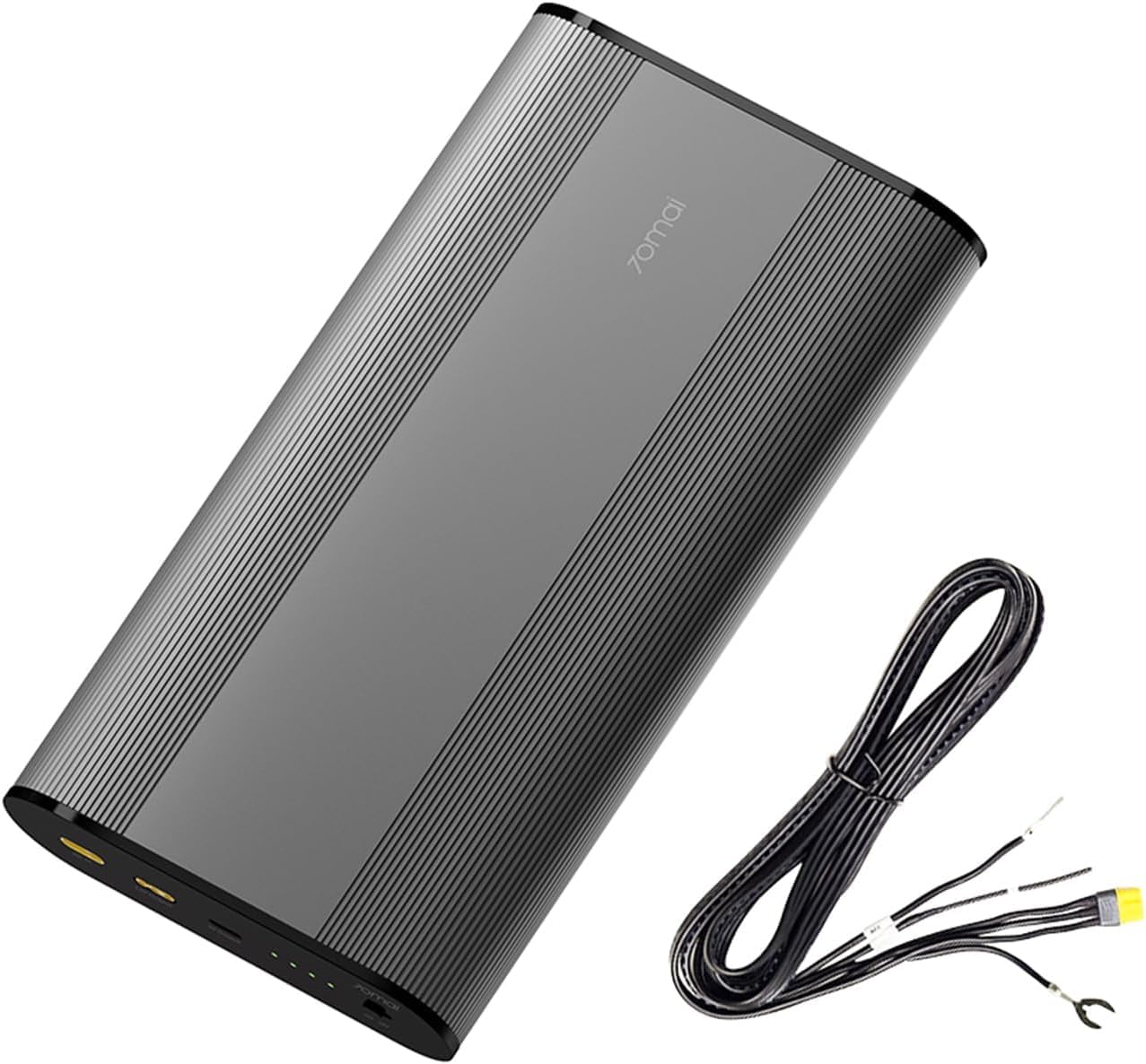
70mai built the BL96NNX around 26650 LiFePO4 cells, and that chemistry choice is the defining feature here. Rated to retain 70% of original capacity after 2,000 charge cycles, this pack is designed for daily hardwired use in a way that standard lithium-ion packs simply are not. The 96Wh capacity delivers roughly 30 hours of single-channel parking mode, and the XT30 output port simulates standard VCC/ACC/GND signals for universal dash cam compatibility.
Charging speed is genuinely impressive for the category. The hardwired connection refills the pack from zero to full in approximately 60 minutes, with a built-in 20-second delay that protects the vehicle’s electrical system during ignition. Owners report that an overnight parking session consumes about 65% of the charge, and a typical commute recharges it to 80-90%. The compact footprint fits inside most glove boxes, though under-seat installation requires careful measurement in smaller vehicles.
Installation is not trivial — some owners report frustration with the hardwire cables and fuse tap setup, noting that low-profile mini fuses must be purchased separately. The pack is also a dedicated dash cam solution, meaning you cannot easily repurpose it for other devices. For anyone committed to long-term parking mode surveillance, the BL96NNX offers chemistry-level advantages that justify the higher entry point.
What works
- LiFePO4 cells deliver 2,000+ cycle life
- 60-minute full charge via hardwire connection
- Universal XT30 output works with most dash cam brands
What doesn’t
- Hardwire installation can be complex for beginners
- Low-profile mini fuses not included
- Limited to dash cam use only
3. BlackboxMyCar PowerCell 8

The PowerCell 8 is engineered specifically for dash cam duty, and that specialization shows in every design decision. Its 96Wh capacity provides a genuine 25% increase over its predecessor, the Cellink NEO, and the hardwired charging circuit refills the pack in as little as 50 minutes. The included cigarette lighter input cable offers a simpler installation path for drivers who prefer not to tap into their fuse box, though this method charges more slowly.
Compatibility coverage is the widest in this roundup. BlackboxMyCar lists support for BlackVue, Thinkware, VIOFO, FineVu, Nextbase, Nexar, Garmin, Vantrue, 70mai, WOLFBOX, Rexing, ROVE, REDTIGER, and more. The included Thinkware spliced hardwire kit is a thoughtful addition for owners of that brand. The companion app provides real-time battery status and charge monitoring, which is genuinely useful for tracking whether your commute is long enough to refill the pack.
Owners consistently praise the build quality and reliability, with many reporting trouble-free operation after months of daily cycling. The integrated USB 3.0 port is handy for charging accessories, though it is not recommended for powering the dash cam itself due to parking mode activation quirks across different camera brands. The biggest limitation is the premium price, but the breadth of compatibility and app integration make it a compelling option for multi-camera setups.
What works
- Broad compatibility across 14+ dash cam brands
- App-based battery monitoring with real-time status
- 50-minute hardwire charge cycle
What doesn’t
- USB port not intended for dash cam power
- Premium price compared to generic alternatives
- Cigarette socket charging is slower than hardwire
4. THINKWARE iVolt Mini

Thinkware has long been a reference name in dash cam hardware, and the iVolt Mini reflects that engineering pedigree. Measuring just 5.17 by 6.51 by 1.45 inches, it is among the most space-efficient 96Wh-class packs available. The LiFePO4 chemistry provides the thermal stability needed for interior installations that experience extreme temperature swings, and the 45-minute recharge time is the fastest in this lineup when paired with the hardwire kit.
Runtime claims are realistic and well-documented: roughly 20 hours for a single-channel dash cam and about 16 hours for dual-channel setups. Owners report that the pack still delivers over 8 hours of parking recording after a full year of daily use, which aligns with the LiFePO4 cycle-life advantage. The steady 12-14.6V output eliminates the voltage droop issues that plague some camera power adapters, particularly in cold weather starts.
Customer support experience is mixed. While some owners praise Thinkware’s responsiveness and warranty service, others report frustration with the replacement process for failed units. The pack’s slim shape makes it easy to tuck under seats or in glove boxes, but the tradeoff is a slightly lower total capacity compared to bulkier competitors. For Thinkware camera owners, the iVolt Mini is the obvious pairing; for other brands, verify parking mode compatibility before purchasing.
What works
- Exceptionally compact and easy to install discreetly
- 45-minute recharge is best-in-class speed
- LiFePO4 cells withstand extreme cabin temperatures
What doesn’t
- Mixed reports on long-term customer support experience
- Lower total capacity than bulkier 96Wh competitors
- Best suited for Thinkware ecosystem
5. Blackvue B-130A Ultra Battery

Blackvue’s B-130A is the most technologically complete battery pack in this roundup, integrating smart connectivity features that go beyond simple power delivery. The 96Wh LiFePO4 pack includes a Fuel Gauge IC sensor that tracks charge and discharge with high precision, displayed through the Blackvue App for remote monitoring. When paired with a Cloud-connected dash cam, you receive push notifications about remaining battery life and low-power alerts directly on your phone.
The temperature management system is genuinely advanced for the category. If internal temperature exceeds 80°C, the unit triggers an audible beep, flashing LED, and automatically stops charging — resuming only when the pack cools below 70°C. This is a meaningful safety feature for vehicles parked in direct sunlight. Runtime for a single-channel Blackvue camera reaches up to 30 hours, with dual-channel systems delivering 15-20 hours. The 12V/24V universal input also makes it compatible with trucks and heavy-duty vehicles.
Owner reliability feedback is somewhat polarized. Several users report units that fail to charge above 73-80% within the first year, with some requiring multiple returns. The B-130A is also the most expensive option here, and it is designed exclusively for Blackvue cameras — other brands may not achieve full parking mode functionality. For Blackvue ecosystem owners who want remote monitoring and thermal protection, this pack offers features no competitor matches.
What works
- Cloud-based remote battery monitoring via Blackvue App
- Smart temperature protection auto-stops charging at 80°C
- 30-hour runtime on single-channel cameras
What doesn’t
- Reliability concerns with charging capacity over time
- Designed exclusively for Blackvue dash cams
- Highest price in this roundup
6. Talentcell 12V Lithium Ion Battery Pack

The Talentcell pack occupies a unique space as a multi-purpose power brick that happens to work well for dash cams. With a 99.9Wh capacity at 11.1V and three independent output ports — 12V DC, 9V DC, and 5V USB — it was originally designed for LED strip lights, CCTV cameras, and breast pumps, but owners have successfully adapted it for dash cam parking mode. The price point undercuts dedicated dash cam packs by a wide margin while delivering comparable raw capacity.
Owner reports reveal impressive real-world versatility. One user powered four watch winders for over ten weeks on a single charge, while another ran a CPC 11 telescope for eight hours of continuous tracking. For dash cam use, the 12V DC 5521 output provides a stable power source, though you will need to supply your own USB cable and ensure correct polarity orientation — the center pin is positive, which is standard for most dash cams but worth verifying before connection.
The main compromises are obvious when compared to purpose-built dash cam batteries. There is no low-voltage shutoff, no hardwire charging kit, and the standard lithium-ion cells have a shorter cycle life than LiFePO4 alternatives. The pack is also noticeably heavy and bulky for a 99.9Wh unit. For buyers on a strict budget who do not mind a DIY approach to wiring, the Talentcell delivers exceptional capacity per dollar spent.
What works
- Excellent capacity per dollar among all options tested
- Triple voltage output works with many 12V devices
- Proven reliability from long-term owner reports
What doesn’t
- No hardwire charging or low-voltage protection
- Bulky and heavy compared to dedicated dash cam packs
- Shorter cycle life from standard lithium-ion cells
7. dzdarren 12V Rechargeable Battery Pack 10000mAh
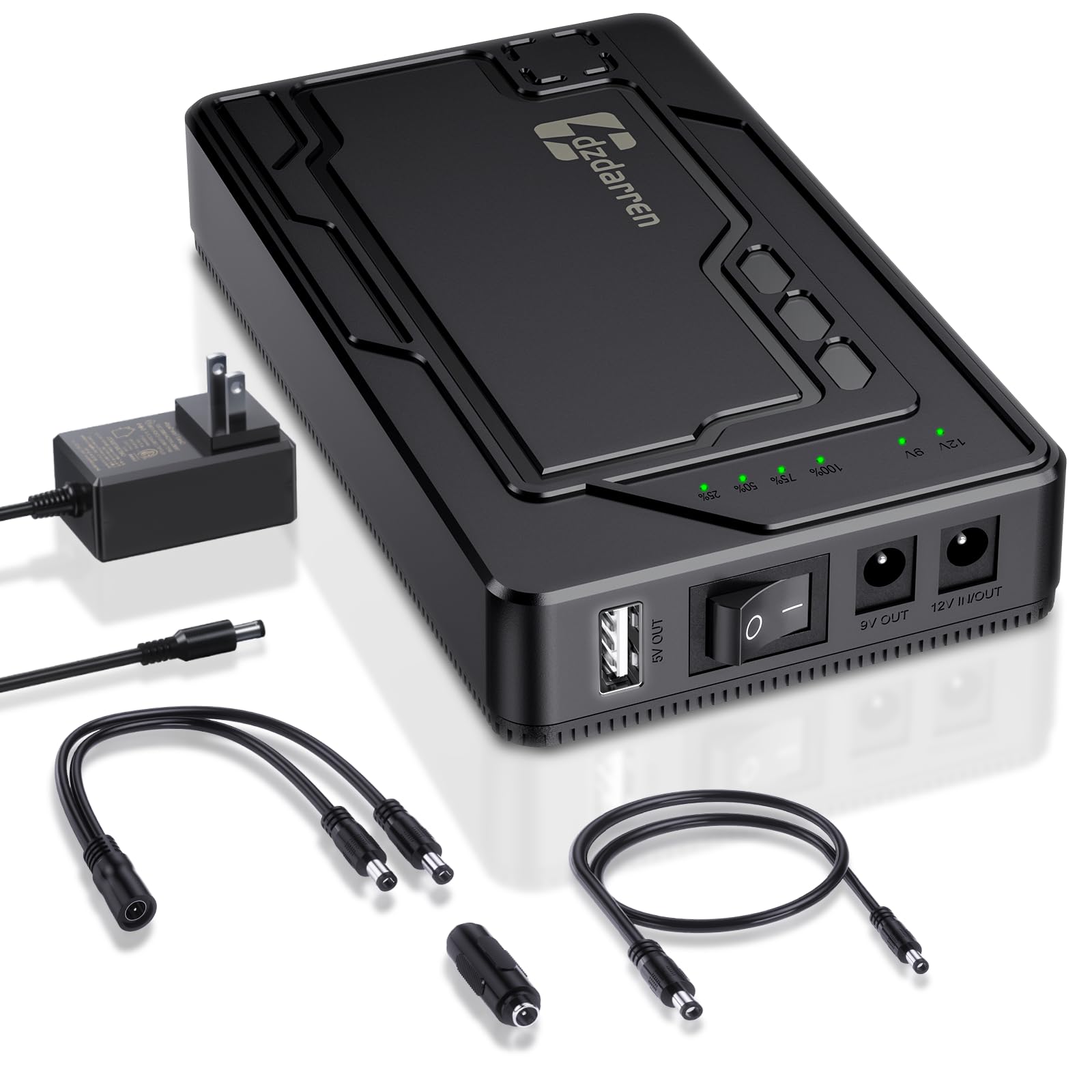
The dzdarren 12V pack delivers genuinely impressive capacity figures for its price tier: 12V at 10,000mAh, 9V at 13,000mAh, and 5V at a theoretical 24,000mAh across its USB port. The multi-voltage design makes it adaptable for dash cams, LED strips, routers, and speakers — essentially any 12V or 9V device that draws up to 3A. The five-LED battery indicator is a practical touch that helps you monitor remaining charge at a glance, and the included 12.6V/2A fast charger replenishes the pack in about four hours.
Owner feedback highlights strong real-world performance for the price. One reviewer used it to power a 15.6-inch smart TV for six hours on a single charge, while another runs outdoor WiFi cameras for extended testing sessions. For dash cam parking mode, the 12V DC5521 output at center-positive polarity works with most standard cameras, though the 12V/3A maximum current means this pack is best suited for single-camera setups rather than multi-channel systems.
The most significant drawback is quality control. Multiple owners report receiving units with defective 9V outputs, and the included documentation fails to specify DC polarity — a frustrating omission that caused at least one user to damage a homemade amp. The replacement process appears reliable, but the initial inconsistency is worth noting. For buyers who want a low-cost, multi-purpose backup battery that can serve double duty as a dash cam power source, the dzdarren pack offers solid value if you receive a fully functional unit.
What works
- High capacity across multiple voltage outputs
- Five-LED gauge for accurate charge monitoring
- Includes fast charger and Y-splitter cable
What doesn’t
- Quality control issues with some output ports
- Polarity not clearly marked on the unit
- 3A max current limits use with multi-camera setups
Hardware & Specs Guide
LiFePO4 vs. Standard Lithium-Ion
Lithium iron phosphate cells are the gold standard for dash cam battery packs because they tolerate 2,000+ charge cycles before dropping to 70% capacity. Standard lithium-ion cells, found in budget packs like the Talentcell and dzdarren, typically last 300-500 cycles. LiFePO4 also handles higher temperatures without thermal runaway, a genuine advantage for cars parked in summer sun. The tradeoff is higher upfront cost and slightly lower energy density per volume.
Charging Architecture and Input Speed
Hardwired connections bypass the vehicle’s 12V socket current limit, enabling charge rates of 5A to 9A that refill a 96Wh pack in 45-60 minutes. Cigarette lighter charging is typically limited to 3-5A, extending charge time to 90 minutes or more. Some packs like the RoyPow support simultaneous charge and discharge, creating a UPS effect that prevents camera reboot on engine start — a subtle but valuable feature for parking mode continuity.
Capacity Ratings and Real Runtime
Manufacturers advertise watt-hours (Wh) or milliamp-hours (mAh) at the cell voltage. A 96Wh pack running a single-channel dash cam drawing 5W consumes roughly 5Wh per hour of recording, yielding about 19 hours. Dual-channel systems drawing 8-10W cut runtime to 10-12 hours. Power-saving parking modes that reduce frame rate or enter event-only recording can extend runtime by 30-50% depending on the camera model.
Protection Circuitry Essentials
Low-voltage protection prevents the pack from deep-discharging its cells below safe thresholds, which permanently damages lithium-based batteries. Over-temperature protection, found on the Blackvue B-130A, stops charging when internal temps exceed 80°C. Short-circuit and over-current protection are standard on reputable packs. Budget units may omit some of these safeguards, so check the spec sheet if you plan to leave the battery connected long-term.
FAQ
How long does a dash cam battery pack last in parking mode?
Can I use a regular power bank for my dash cam?
How do I install a hardwired dash cam battery pack?
Final Thoughts: The Verdict
For most buyers, the best battery pack for dash cam winner is the RoyPow 30W PD because it delivers reliable regulated power, simultaneous charge and discharge, and a compelling price-to-performance ratio that suits daily driving. If you want the longest cycle life and fastest hardwired charging, grab the 70mai BL96NNX with its LiFePO4 cells and 60-minute full recharge. And for the ultimate in remote monitoring and thermal protection, nothing beats the Blackvue B-130A if you are already invested in the Blackvue ecosystem.

Certification: BSc in Mechanical Engineering
Education: Mechanical engineer
Lives In: 539 W Commerce St, Dallas, TX 75208, USA
Md Amir is an auto mechanic student and writer with over half a decade of experience in the automotive field. He has worked with top automotive brands such as Lexus, Quantum, and also owns two automotive blogs autocarneed.com and taxiwiz.com.