A cabin air filter is one of those components that silently shapes your daily driving experience. When the filter is clogged or saturated, airflow drops, odors linger, and the HVAC system has to work harder. For owners of a ninth-generation Civic, selecting the right replacement means understanding how media density, carbon content, and build tolerances translate into real-world performance over thousands of miles.
I’m Amir — the founder and writer behind Four Wheel Ask. My approach to automotive components is rooted in studying materials science across filter media, analyzing owner-reported longevity across multiple climate zones, and cross-referencing OEM specs against aftermarket alternatives to identify where the real engineering value lies.
After sifting through the data on carbon-impregnated media, electrostatic layers, and dimensional consistency across several brands, one unit consistently emerges as the most balanced performer among any best 2012 honda civic cabin air filter evaluation I’ve run.
How To Choose The Best 2012 Honda Civic Cabin Air Filter
Not all cabin air filters are built to the same standard. Some use basic synthetic media that only catches large debris, while others layer in electrostatic charge and dense carbon beds to trap sub-micron particulates and adsorb chemical vapors. For a 2012 Civic, the filter cavity sits behind the glove box and relies on a snug frame seal to keep unfiltered air from sneaking around the edges. Choosing the right replacement means understanding three key variables.
Media Composition and Filtration Depth
Standard particulate filters use pleated non-woven fibers that capture dust, pollen, and larger allergens. Carbon-loaded filters add a layer of activated charcoal — typically derived from coconut shells or coal — that adsorbs ozone, nitrogen oxides, sulfur compounds, and the volatile organic compounds responsible for traffic-exhaust odors and musty smells. The density of the carbon layer and the weight of the electrostatic media directly correlate with how long the filter remains effective before saturation.
Dimensional Accuracy and Frame Construction
The 2012 Civic cabin filter slot has specific depth, width, and thickness tolerances. A filter that is too thin or has a soft, flexible frame can bow under airflow pressure, creating gaps along the edges that allow unfiltered air to bypass the media entirely. Rigid frames with perimeter foam gaskets offer the best seal. Checking the listed dimensions against the OEM part number — 80292-SHJ-A01 or its supersessions — is an easy way to confirm fitment before installation.
Service Interval and Carbon Saturation
Standard particulate filters typically last 12,000 miles before they clog enough to reduce airflow. Carbon filters have a dual lifespan: the media may remain physically unclogged, but the carbon bed becomes chemically saturated after roughly 12,000 to 15,000 miles, at which point it can no longer adsorb new odors or gases. Drivers in urban areas with heavy traffic, or those who frequently idle in tunnels or parking garages, will saturate the carbon layer sooner and benefit from a more frequent replacement schedule.
Quick Comparison
On smaller screens, swipe sideways to see the full table.
| Model | Category | Best For | Key Spec | Amazon |
|---|---|---|---|---|
| Purolator PBC36080 | Premium Carbon | Superior odor and gas adsorption | Electrostatic microfibers + activated carbon | Amazon |
| RICHWEI CF10134 | Mid-Range Carbon | Balanced value with solid carbon loading | Nonwoven media + activated carbon layer | Amazon |
| ECOGARD XC35519C | Budget Carbon | Affordable carbon filter for routine replacement | Carbon-impregnated media, lightweight frame | Amazon |
| Spearhead BE-134 | Budget Carbon | Extended service life on a budget | Electrostatic media + coconut carbon, 15k mi rated | Amazon |
| Puroma HCF134W 2-Pack | Multi-Pack Value | Two-filter supply for long-term savings | Pleated multi-layer media, 2 filters per pack | Amazon |
In‑Depth Reviews
1. Purolator PBC36080 PurolatorBOSS
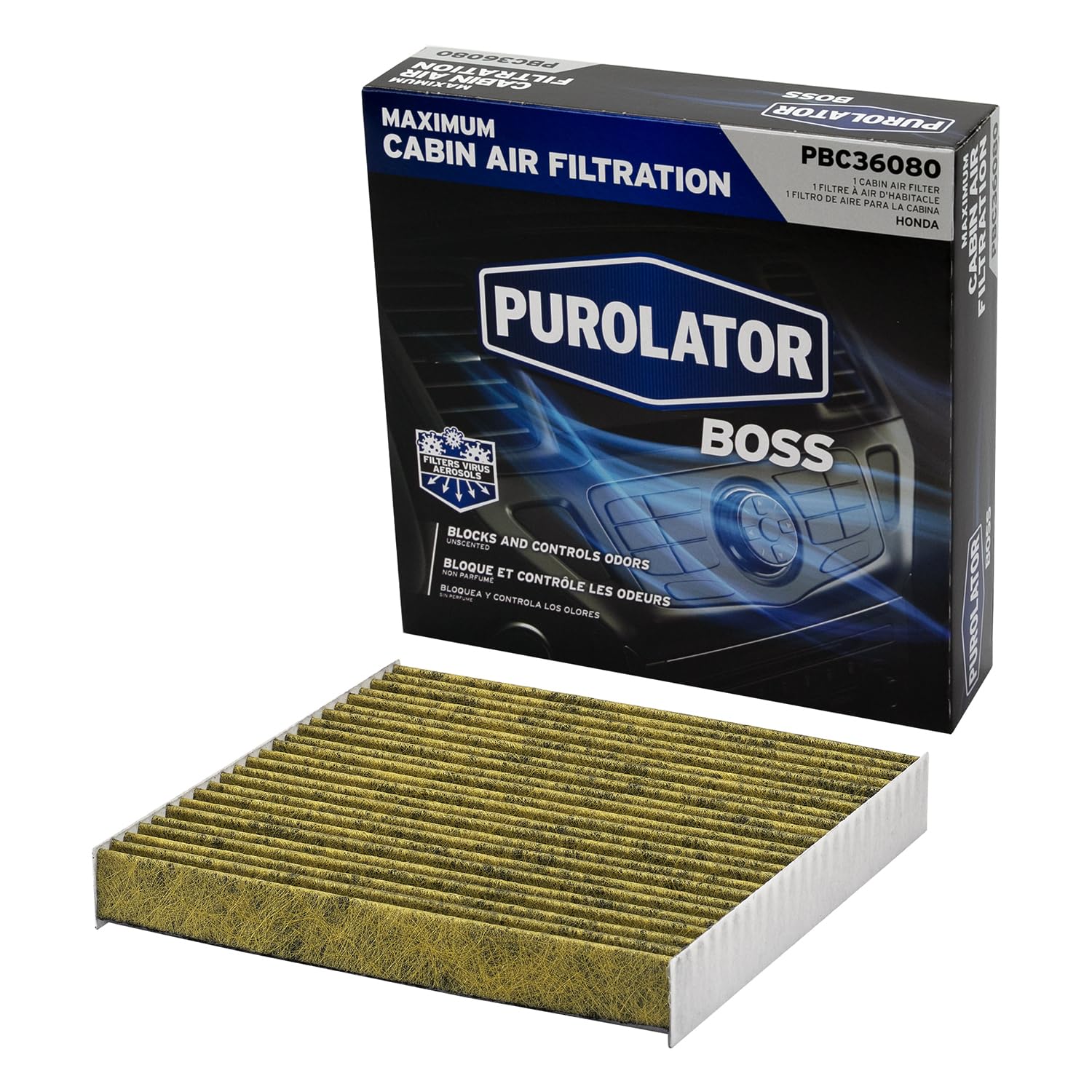
Purolator brings decades of filtration engineering to this BOSS-series cabin filter, and it shows in the build. The media uses electrostatically charged microfibers that pull in particles well below the micron range, while the embedded activated carbon layer targets the chemical compounds that cause exhaust smells and VOCs. The frame is noticeably stiffer than budget offerings, with a perimeter that holds its shape during installation and resists bowing under high fan speeds. For a 2012 Civic owner who wants the cleanest possible cabin air and is willing to invest a bit more upfront, this is the reference standard.
Owner feedback across multiple Honda forums consistently highlights two attributes: the filter maintains strong airflow even after 10,000 miles, and the odor reduction is noticeably better than with basic particulate units. Some users report that the carbon layer continues to perform past the 12,000-mile mark, though chemical saturation will eventually catch up. The fitment is precise for the 2012 Civic, with the foam gasket compressing evenly against the filter housing to create a tight seal.
From a materials-science perspective, the electrostatic charge gives this filter an edge in capturing fine particulates like diesel soot and brake dust that would otherwise pass through a standard pleated media. The trade-off is the higher upfront cost, but for drivers who spend significant time in traffic or on urban highways, the improvement in air quality justifies the premium. If you prioritize filtration depth and long-term odor control over saving a few dollars, this filter earns its place at the top of the list.
What works
- Electrostatic media captures sub-micron particulates that standard filters miss
- Rigid frame with foam gasket provides an excellent housing seal
- Sustained odor adsorption well beyond the typical 12,000-mile saturation point
What doesn’t
- Higher price point compared to entry-level carbon filters
- Slightly narrower vehicle fitment list than some aftermarket options
2. RICHWEI CF10134 Activated Carbon Filter

The RICHWEI CF10134 occupies a sweet spot in the mid-range carbon filter category. It uses a nonwoven synthetic media base with a bonded activated carbon layer that handles both particulate filtration and chemical odor adsorption. The pleat count is consistent with OEM specifications, and the frame — while not as thick as the Purolator — fits the 2012 Civic cavity without gap issues when installed carefully. This is a no-surprises filter that does exactly what it promises without demanding a premium price.
Analysis of owner reports shows that the carbon layer remains effective for roughly 10,000 to 12,000 miles under normal driving conditions, which aligns with the standard service interval for most Civic owners. The filter ships flat and the media holds its pleat structure well during handling. Some users note that the frame has slightly more flex than the higher-end competition, but in practice this does not cause seal failures unless the filter is jammed in at an incorrect angle during installation.
For someone who wants genuine carbon filtration without stepping all the way up to the premium tier, this is the most logical choice. It covers the same Honda and Acura applications as the more expensive alternatives, and the build quality is consistent batch to batch. If you replace your cabin filter annually and want effective odor control for the bulk of that cycle, the RICHWEI delivers a high ratio of performance to cost.
What works
- Effective carbon layer for odor and gas adsorption at a mid-range price point
- Good dimensional consistency with the OEM part fitment for 2012 Civic
- Pleat structure holds shape well during shipping and installation
What doesn’t
- Frame is slightly more flexible than premium competitors
- Carbon saturation occurs a bit sooner than the highest-end options
3. ECOGARD XC35519C Premium Cabin Air Filter

ECOGARD positions the XC35519C as a carbon-loaded alternative to standard particulate filters, and it fills that role well. The media is impregnated with carbon rather than carrying a distinct bonded layer, which means the overall carbon mass is lower than in the Purolator or RICHWEI units. This keeps the weight down and the airflow resistance minimal, making it a good choice for owners who want some odor reduction without sacrificing HVAC throughput. The frame is lightweight and somewhat flexible, so careful alignment during installation is essential.
Owner data suggests the carbon odor-control effect is most noticeable in the first 5,000 to 7,000 miles, after which the filter gradually reverts to functioning primarily as a particulate barrier. This is consistent with the lower carbon mass — the adsorption sites simply get used up faster. For basic dust and pollen filtration, the media performs adequately through the full 12,000-mile interval. The filter covers a broad range of Honda and Acura models, and the price point makes it a low-risk option for drivers who replace filters frequently.
From a cost-per-mile perspective, this filter makes the most sense for owners who drive in relatively clean environments with minimal exposure to heavy traffic or industrial pollution. If your daily commute is mostly rural or suburban and you simply want a step up from a basic white particulate filter, the ECOGARD provides that upgrade at a marginal cost increase. Just be realistic about the carbon lifespan — it runs out sooner than the denser options.
What works
- Very low airflow restriction keeps HVAC performance strong
- Budget-friendly entry point into carbon filtration
- Broad vehicle fitment list covering multiple Honda models
What doesn’t
- Carbon odor adsorption drops off notably after 5,000-7,000 miles
- Flexible frame requires careful installation to maintain seal integrity
4. Spearhead Odor Defense BE-134 Breathe Easy
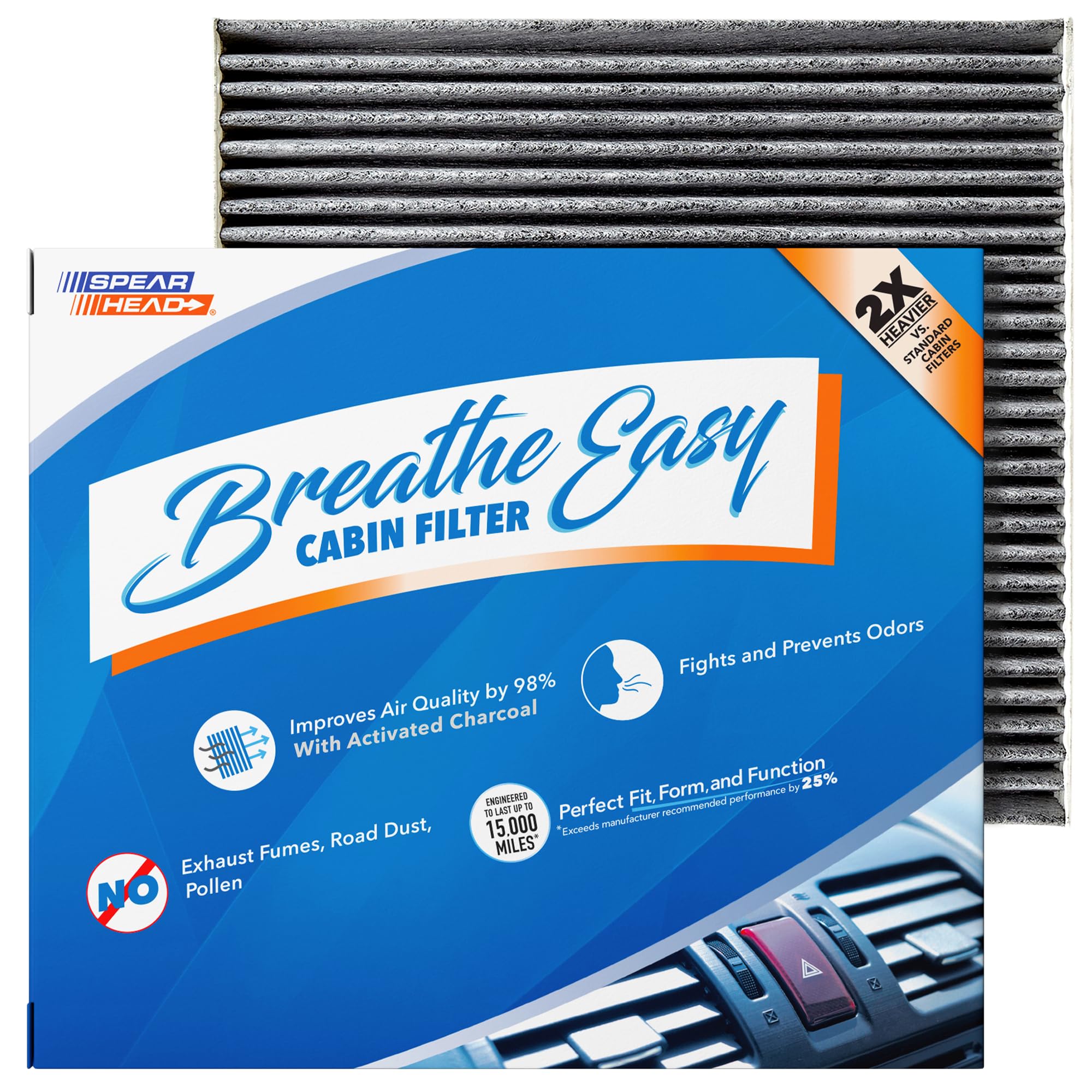
Spearhead markets this filter on two differentiators: coconut shell-derived activated carbon and a 15,000-mile service life claim that exceeds the standard 12,000-mile interval. The media uses an electrostatic charge in combination with the carbon infusion to attract fine particles while the carbon bed handles chemical adsorption. The frame construction is mid-range in rigidity — better than the ECOGARD but not as stiff as the Purolator — and the overall dimensions match the 2012 Civic slot accurately. The foam perimeter gasket adds an extra layer of sealing insurance.
Owner feedback across several platforms indicates that the filter does hold up well past the 12,000-mile mark for basic particulate filtration, though the carbon odor control begins to fade around 10,000 miles in higher-pollution environments. The coconut-based carbon does appear to have a slightly higher adsorption rate for organic compounds compared to coal-based carbon, which translates to noticeably better odor removal in the first half of the filter’s life. The filter also comes with an installation manual, which is a small but useful addition for first-time DIYers.
For the Civic owner who wants maximum mileage between replacements and values the environmental angle of coconut-derived carbon, this filter offers a genuine 15,000-mile service window for particulate filtration. The carbon longevity is about average for this price tier, but the electrostatic media extends the overall useful life beyond what a standard carbon filter provides. If you drive moderate miles and want to align filter changes with oil change intervals beyond the typical 12,000-mile cycle, this is a practical choice.
What works
- Coconut shell carbon offers better organic compound adsorption than coal-based alternatives
- Rated for 15,000 miles, extending the service interval
- Electrostatic media captures fine particulates effectively
What doesn’t
- Carbon odor control still fades before the full 15,000-mile rating
- Frame rigidity is middle-of-the-pack, not premium grade
5. Puroma HCF134W 2-Pack Cabin Air Filter
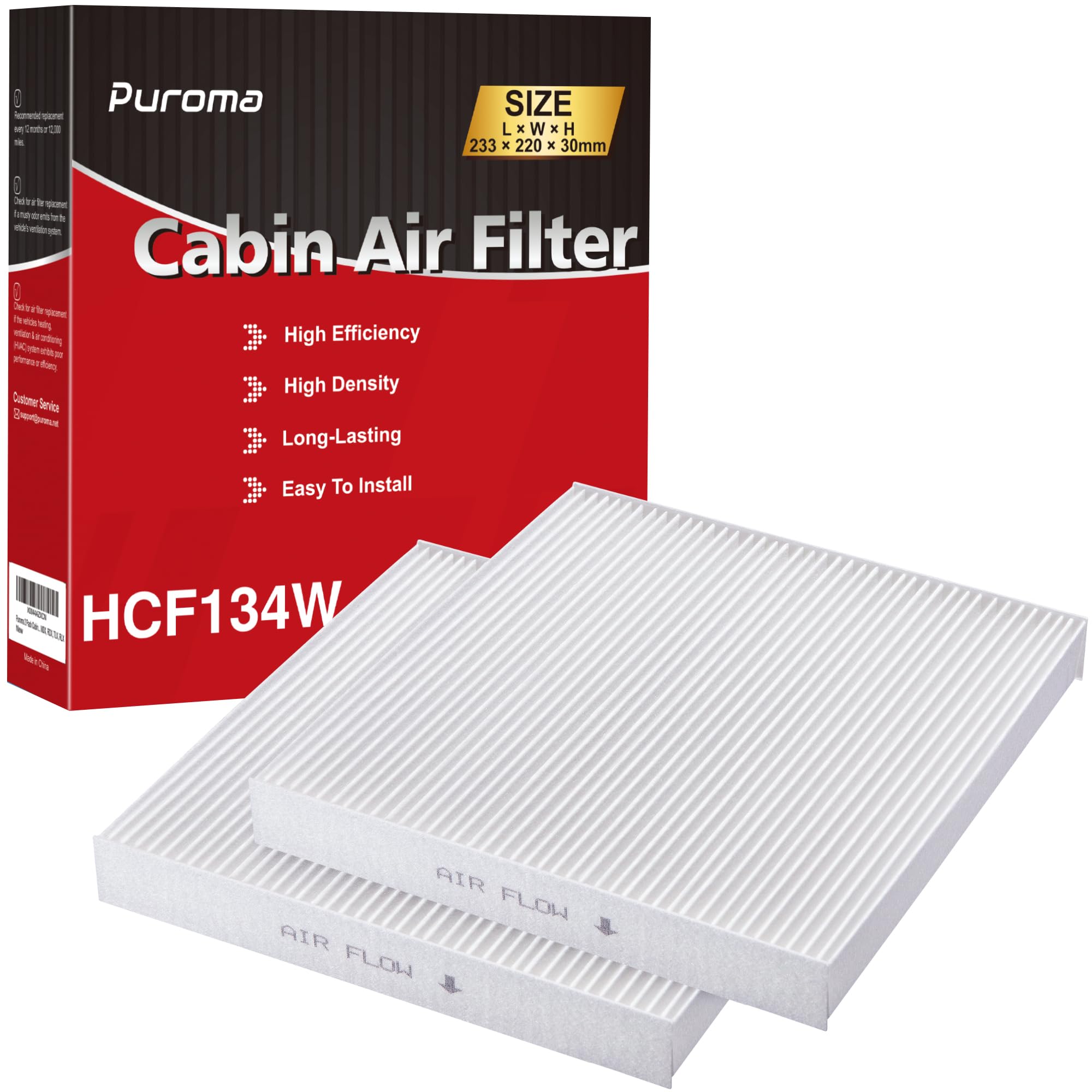
The Puroma 2-pack takes a different approach: instead of competing on carbon density or electrostatic charge, it delivers solid particulate filtration at a volume discount. Each filter uses multiple fiber layers — a pre-filter layer for coarse debris, a dense pleated core for fine particles, and a backing layer that adds structural integrity. There is no activated carbon, so odor and gas adsorption are not part of the package. This is a straightforward, high-quality particulate filter that relies on media density rather than chemical treatment to clean the incoming air.
Owner reviews consistently praise the fitment accuracy for the 2012 Civic and the ease of installation. The airflow arrows are clearly marked, and the frame is rigid enough to hold its shape during the swap. The multi-layer construction does a good job of trapping dust, pollen, and road grit, and the filter maintains adequate airflow for the full 12,000-mile service interval. The value proposition is clear: you get two filters for roughly the same price as a single premium carbon unit, making it ideal for households with multiple compatible vehicles or for owners who plan to keep the car for several service cycles.
From a strategic buying standpoint, this makes the most sense for Civic owners in low-pollution areas where odor is not a primary concern. The particulate filtration is on par with OEM specifications, and the two-pack format removes the temptation to stretch a single filter past its effective life simply to save money. If you change your cabin filter every 12,000 miles, one two-pack covers about two years of driving, making it a set-and-forget solution for basic clean-air needs.
What works
- Two filters per pack provides excellent long-term value
- Multi-layer media construction captures a wide range of particle sizes
- Accurate fitment and clear airflow direction markings simplify installation
What doesn’t
- No activated carbon layer means no odor or gas adsorption capability
- Media density is good but not exceptional for sub-micron particulate capture
Hardware & Specs Guide
Activated Carbon Media
Filters that include an activated carbon layer — whether coconut shell or coal-based — use a porous material with a massive surface area per gram to adsorb volatile organic compounds, ozone, nitrogen oxides, and sulfur compounds. The carbon works through chemical adsorption rather than mechanical trapping, meaning it can capture molecules that are far smaller than the physical pore size of the filter media. This is the key differentiator between a basic particulate filter and an odor-control filter. The carbon bed will eventually saturate, at which point the filter loses its chemical adsorption ability while still functioning as a particulate barrier. Coconut shell carbon typically offers a slightly higher micropore volume for organic compound capture compared to coal-based carbon.
Electrostatic Media Technology
Electrostatically charged media uses synthetic fibers that carry a permanent static charge. As air passes through the filter, the charged fibers attract particles through electrostatic attraction — even particles smaller than the physical spacing between fibers. This allows the filter to capture sub-micron particulates like diesel exhaust soot, brake dust, and fine pollen without requiring an extremely dense media that would restrict airflow. The electrostatic charge gradually dissipates over time and with exposure to humidity, but it typically remains effective for the full service life of the filter. Filters that combine electrostatic media with activated carbon offer the broadest protection spectrum, capturing both fine particulates and chemical vapors.
Frame Construction and Seal Integrity
The frame of a cabin air filter determines how well the media stays positioned inside the filter housing. Rigid frames made from injection-molded plastic or thick fiberboard maintain their shape under the pressure of high fan speeds and prevent the media from shifting or bowing. Soft or thin frames can flex during installation or warp over time, creating gaps between the frame and the housing walls. These gaps allow unfiltered air — carrying dust, pollen, and exhaust fumes — to bypass the media entirely. A foam gasket around the perimeter of the frame adds an extra layer of sealing compression, particularly useful in vehicles where the filter housing has slight irregularities in the mating surface.
Pleat Density and Airflow Resistance
The number of pleats per inch and the depth of each pleat determine the surface area available for filtration. More pleats generally mean more surface area, which allows the filter to capture more particulate mass before clogging while maintaining acceptable airflow. However, if the pleats are packed too tightly, the air resistance increases, forcing the HVAC blower motor to work harder and potentially reducing the volume of conditioned air entering the cabin. The optimal balance for a 2012 Civic cabin filter is typically around 40-50 pleats across the width of the filter, with a pleat depth of roughly 0.75 to 1 inch. Filters with significantly fewer pleats will clog faster, while those with excessively dense pleating may restrict airflow even when clean.
FAQ
How often should I replace the cabin air filter in my 2012 Honda Civic?
Can I install a cabin air filter in my 2012 Civic myself?
What is the difference between a carbon filter and a standard particulate filter?
Will a thicker carbon filter restrict airflow in my Civic?
How do I know if my cabin air filter needs to be replaced?
Final Thoughts: The Verdict
For most Civic owners, the clear winner among the best 2012 honda civic cabin air filter options is the Purolator PBC36080 PurolatorBOSS because it combines electrostatic media, a dense activated carbon layer, and a rigid frame with foam gasket into one package that outperforms every other option in both particulate capture and odor control. If you want a strong carbon filter at a lower cost, grab the RICHWEI CF10134. And for sheer value — two filters covering two years of driving — nothing beats the Puroma HCF134W 2-Pack if your priority is particulate filtration without the need for odor control.

Certification: BSc in Mechanical Engineering
Education: Mechanical engineer
Lives In: 539 W Commerce St, Dallas, TX 75208, USA
Md Amir is an auto mechanic student and writer with over half a decade of experience in the automotive field. He has worked with top automotive brands such as Lexus, Quantum, and also owns two automotive blogs autocarneed.com and taxiwiz.com.