Factory mirrors on most motorcycles are a compromise of cost, aesthetics, and regulation compliance — often delivering a view of your own shoulders rather than the lane beside you. Upgrading to aftermarket units is the single most effective visual and functional transformation for any bike, but the market is flooded with flimsy clones that vibrate apart at highway speeds.
I’m Amir — the founder and writer behind Four Wheel Ask. My research approach combines deep specification analysis, material science evaluation, and aggregation of owner-experience data from thousands of real-world miles to separate precision-engineered gear from cheap knockoffs.
That’s why we’ve analyzed over a thousand user reviews and spec sheets to identify the current crop of best aftermarket motorcycle mirrors on the market.
How To Choose The Best Aftermarket Motorcycle Mirrors
Selecting the correct mirror isn’t about picking the best-looking option. It’s about matching your handlebar diameter, riding position, and vibration tolerance to a specific build quality tier. Here are the critical factors to evaluate before hitting buy.
Mounting Type: Bar End vs. Stem Mount
Bar-end mirrors clamp inside the handlebar tube using expanding sleeves or wedges, shifting the reflection point outward for a wider view free of elbows. Stem-mount mirrors attach directly to the factory threaded holes on the handlebar or clutch perch. Bar ends are the modern standard for sport and naked bikes, while stem mounts suit cruisers and retro builds.
Material and Construction
Billet aluminum (CNC-machined from a solid block) offers the highest rigidity-to-weight ratio and damps vibration far better than die-cast zinc or plastic housings. Look for full aluminum stems and mounting hardware — steel or zinc hardware will corrode and gall the threads over time. Cheaper units often use painted aluminum that chips, revealing raw metal beneath.
Lens Type and Coating
Convex glass provides a wider field of view at the cost of reduced image size — ideal for lane awareness. Flat glass gives a more accurate distance perception. Blue anti-glare lenses reduce headlight dazzle from trailing vehicles, a genuine safety advantage for night riders. Smoke lenses look aggressive but cut light transmission, making them less suitable after dark.
Quick Comparison
On smaller screens, swipe sideways to see the full table.
| Model | Category | Best For | Key Spec | Amazon |
|---|---|---|---|---|
| CRG Arrow Bar End Mirror | Premium | Sport & naked bike riders wanting zero vibration | Billet aluminum, convex lens | Amazon |
| Seizmik Pursuit Side View Mirror | Premium | Adventure & utility vehicle durability | Cast aluminum, fold-in detents | Amazon |
| FENRIR Cafe Racer Bar End Mirror | Mid-Range | Style-focused cafe & street builds | CNC aluminum, diamond shape | Amazon |
| MZS Adventure Motorcycle Mirrors | Mid-Range | Dual-sport & ADV bikes | Foldable ABS housing, HD glass | Amazon |
| KEMIMOTO Bar End Mirrors (Round) | Mid-Range | Universal fit with anti-glare blue lens | Billet aluminum, 3.5″ round | Amazon |
| KEMIMOTO Bar End Mirror (Oval) | Value | Budget-conscious riders wanting solid build | CNC aluminum, blue lens | Amazon |
| Rich Choices Rectangle Mirrors | Budget | Entry-level cruiser upgrade | Aluminum housing, 4 adapters | Amazon |
In‑Depth Reviews
1. CRG Arrow Bar End Mirror Black (AO-100)

The CRG Arrow is the benchmark that most aftermarket mirror designs attempt to clone. Its CNC-machined billet aluminum body and unique multi-position mounting system deliver an aerodynamic, minimalist silhouette that disappears into the bike’s lines while providing a panoramic view. Owner data consistently reports zero vibration or image blur even at triple-digit speeds, a feat that eludes virtually every sub- competitor.
The convex lens provides a semi-wide angle view that eliminates the rider’s elbows from the reflection — a persistent annoyance with stock mirrors. Multiple mounting positions (three discrete angles) allow the rider to dial in the exact orientation rather than relying on ball-joint friction alone. The clamp hardware is precision-ground, requiring no additional shims or threadlocker on most modern sport and naked bikes.
Some riders report that objects appear smaller compared to OEM flat-glass mirrors, which takes a brief adaptation period. The price point places it firmly in the premium tier, but the build quality — described by multiple owners as “like a fine watch” — justifies the investment for riders who prioritize function over flash.
What works
- Virtually vibration-free up to high speeds
- Superior field of view with no elbow blockage
- Precision machined finish with secure clamping
What doesn’t
- Reflected image appears smaller than flat glass
- Limited discrete adjustment angles (1, 3, 5 o’clock)
- Premium price compared to replicas
2. Seizmik 18071 Pursuit Side View Mirror
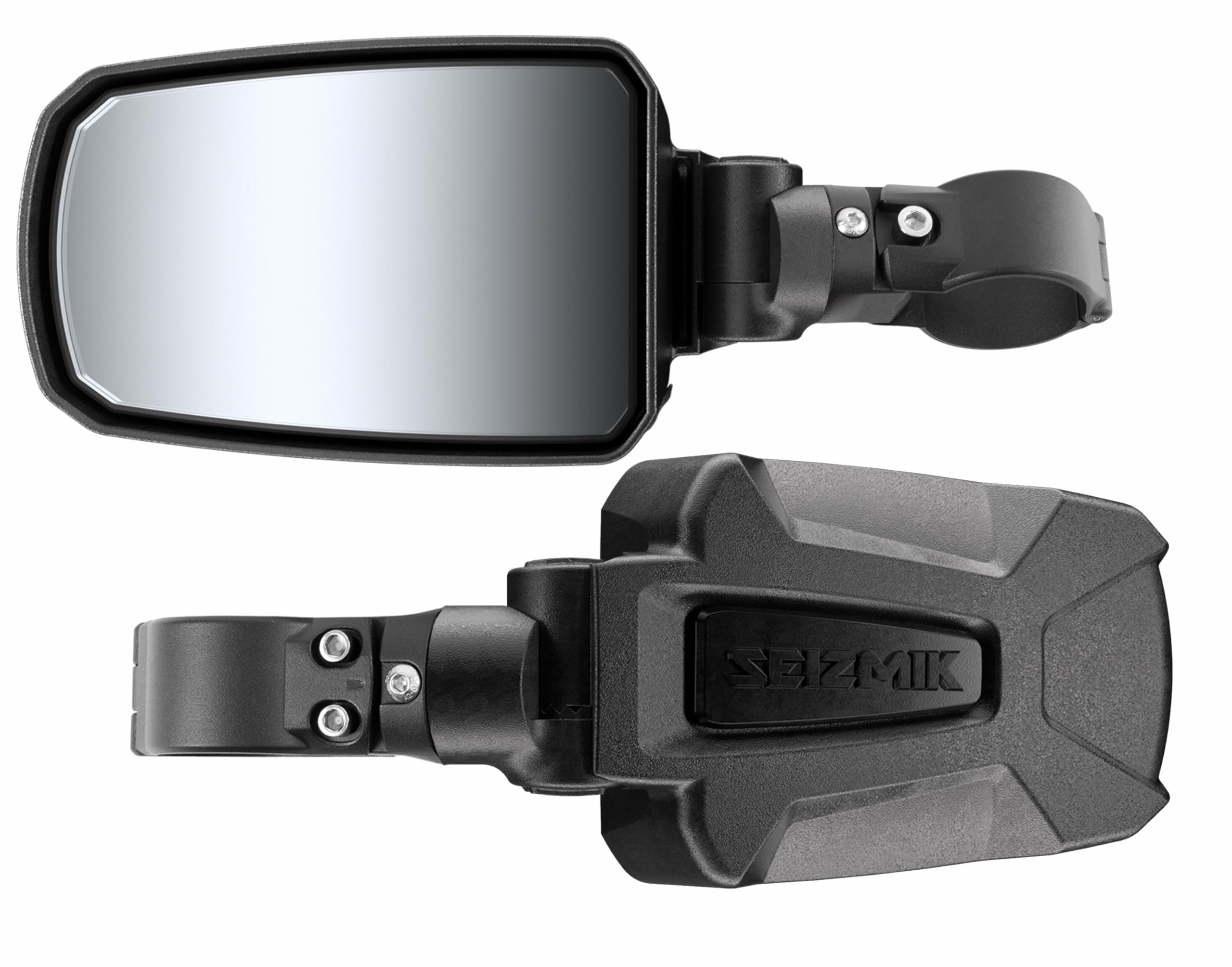
The Seizmik Pursuit is engineered for abuse rather than café racer aesthetics. Its cast aluminum housing and heavy-duty steel clamps are built to survive the extreme vibration and impact loads of adventure touring and UTV use. The convex safety glass provides a super wide viewing range, and the notched Delrin detents allow the mirror to fold when struck — then snap back to its original position without needing adjustment.
Owner reports from Honda Talon and Polaris General users highlight the ease of installation and the absence of shake even on rough trails. The color-matched weather-seal caps prevent water intrusion at the clamp interface, a detail often overlooked on cheaper units. The 100% unlimited lifetime warranty from Seizmik adds a layer of confidence absent from generic imports.
The trade-off is weight and visual bulk. These mirrors are noticeably heavier than bar-end designs, and the industrial look won’t suit a minimalist sport bike. The price also reflects commercial-grade construction, making it a targeted purchase for those who genuinely need the durability rather than a casual style upgrade.
What works
- Extremely durable construction for off-road use
- Fold-in detent system prevents damage
- Lifetime warranty from manufacturer
What doesn’t
- Heavier and bulkier than bar-end designs
- Industrial appearance not suited to street bikes
- Premium price point
3. FENRIR CNC Aluminum Cafe Racer Bar End Mirror

The FENRIR mirror occupies a sweet spot where aesthetics and structural integrity meet at a reasonable cost. The diamond-shaped CNC aluminum body with a glossy black coating provides a sleek upgrade for cafe racers, street nakeds, and sport bikes that transforms the front profile. Owner feedback from BMW F900R and Kawasaki Z500 riders confirms the finish matches factory paint quality.
Installation requires a deliberate approach: the three locking screws must be tightened firmly — even if they exceed the flush point — to prevent stem rotation during rides. Using blue threadlocker is recommended by the manufacturer and echoed by experienced owners. The convex white glass delivers a clear, wide view behind the rider with no distortion, though some vibration appears around 6500 RPM, consistent with OEM behavior on parallel-twin engines.
Multiple adapters are included for M6 and M8 threaded bars, but some models may require additional adapters not in the box. The mirror’s shape is slightly narrower than round units, which improves aerodynamics but narrows the vertical field of view. Overall, it’s a high-value choice for riders who want the CRG aesthetic without the CRG price.
What works
- Excellent build quality for the price
- Sleek diamond shape transforms bike appearance
- Clear glass with wide horizontal view
What doesn’t
- Some vibration at certain RPMs
- Installation requires threadlocker for security
- Additional adapters may be needed for some bikes
4. MZS Adventure Motorcycle Mirrors

The MZS Adventure mirrors are a direct functional alternative to the premium Doubletake brand at a fraction of the cost. The impact-resistant ABS housing surrounds HD glass with an aluminum adjustable stem and aluminum mount, creating a vibration-resistant assembly that holds position over rough terrain. Owners of Honda Transalp 750 and various dual-sport bikes report exceptional rear visibility and a clean, purposeful aesthetic.
The 360-degree swivel at the stem joint allows precise angle adjustment, and the larger arrow-shaped glass provides a high-definition view that performs well in both daylight and low-light conditions. Rain beads off the glass naturally, maintaining clarity during wet rides. The foldable stem is a critical safety feature for off-road riders who may catch branches or drop the bike.
While the ABS housing lacks the premium feel of full billet aluminum, it withstands abuse without cracking. Some owners note slight vibration at idle on single-cylinder thumpers, but the image remains clear enough for safe lane checks. The 8mm and 10mm adapter set covers most Asian and European bikes, though Harley-style 10mm reverse-thread bolts are not compatible.
What works
- Foldable stem protects against trail damage
- Clear, wide-angle view with minimal distortion
- Excellent value compared to brand-name ADV mirrors
What doesn’t
- ABS housing not as premium as billet aluminum
- Slight vibration at idle on single-cylinder bikes
- Not compatible with Harley reverse-thread bolts
5. KEMIMOTO Motorcycle Bar End Mirrors (Round, 3.5″)

KEMIMOTO’s round bar-end mirror is a consistent top performer in the mid-range category. The full billet aluminum construction extends from the clamp through the stem to the housing, delivering a solid feel that belies the price. The 3.5-inch round convex glass with blue anti-glare coating reduces headlight flare from trailing vehicles while maintaining a clear, undistorted view of the road behind.
Installation is straightforward on handlebars with an internal diameter between 13-19mm, using the included expanding sleeves. Owners report zero movement after hundreds of miles on bikes including Ducati Monster 1000 and Royal Enfield Bear 650, contradicting some compatibility notes. The blue tint adds a subtle aesthetic touch without being overly dark, preserving usable visibility at night.
A small subset of buyers on the Yamaha MT-07 platform had interference issues with the bar-end weight design, requiring either removal of the stock weights or alternative adapters. The instructions are printed small and rely heavily on pictures, but the installation video on the product page clears up confusion. For the price, this is one of the most reliable bar-end choices for riders wanting anti-glare protection.
What works
- Rock-solid aluminum build with no wobble
- Blue anti-glare lens improves night comfort
- Easy installation on most standard bars
What doesn’t
- May interfere with certain bar-end weights
- Blue tint reduces brightness in low light
- Instructions are picture-only and sparse
6. KEMIMOTO Motorcycle Handlebar Bar End Mirror (Oval)

The oval KEMIMOTO bar-end mirror offers the same billet aluminum quality as its round sibling in a more aerodynamic shape. The 3.86-by-1.93-inch mirror surface provides an extended horizontal field of view, making it well-suited for riders who prioritize lane-check awareness. The blue anti-glare lens is identical to the round version, offering the same headlight-dimming benefit.
Owner feedback consistently praises the value proposition — riders on BMW R9T Scrambler and Honda Grom note that the mirror looks and feels as premium as units costing two to three times more. The expanding aluminum mounting system uses three different plastic sleeve thicknesses to accommodate varying internal handlebar diameters, a thoughtful inclusion that improves fitment accuracy.
The expanding aluminum mounting design has drawn criticism from a minority of buyers who found it difficult to seat properly without stripping the threads. The manufacturer advises using extra tightening force or blue loctite to ensure the stem stays put. For most riders, once installed correctly, the mirrors remain stable and clear, making this a strong budget-friendly recommendation.
What works
- Looks and feels like premium units at a lower cost
- Wide horizontal view aids lane checks
- Includes multiple sleeve sizes for fitment
What doesn’t
- Expanding mount can be tricky to install correctly
- Some owners report stripping if over-tightened
- Packaging may allow minor cosmetic damage in transit
7. Rich Choices Black Rectangle Motorcycle Side Mirrors

The Rich Choices rectangle mirrors represent the entry-level tier for cruiser and chopper owners wanting a custom look without significant investment. The aluminum housing and stem have a black finish that matches bare-barrel cruiser aesthetics, and the included 8mm and 10mm adapter set covers most metric cruiser applications. The smoke blue glass adds a subtle tint that reduces glare.
Owner reviews from Honda Phantom and Kawasaki cruiser riders note that the mirrors are significantly smaller than stock units — roughly 2 by 4 inches — which limits the field of view to a basic awareness tool rather than a primary safety device. The ball joint tension is adjustable via a screw, but riders report the mirrors can shift out of position under highway vibration if not tightened sufficiently.
The paint on the threads is a known weak point; steel fittings into the aluminum can gall and strip if not threaded carefully by hand. Some units arrive with bent nuts or cosmetic defects, reflecting the budget-tier quality control. For the price, these serve as an inexpensive cosmetic upgrade, but riders should not rely on them as their sole rearward visibility solution.
What works
- Very affordable entry-level price
- Includes adapters for most metric cruisers
- Lightweight aluminum construction
What doesn’t
- Small mirror size limits field of view
- Threads may strip if over-tightened
- Vibration can shift mirror position over time
Hardware & Specs Guide
Billet vs. Die-Cast Construction
Billet aluminum is machined from a solid block, resulting in a homogenous grain structure that resists fatigue and vibration better than die-cast parts. Die-cast aluminum can contain micro-porosity that leads to cracking under stress. For motorcycle mirrors, billet construction directly correlates with longer service life and reduced image blur at highway speeds.
Expanding Sleeve vs. Wedge Mount
Bar-end mirrors use either an expanding aluminum sleeve that presses against the inside of the handlebar when a bolt is torqued, or a wedge that pulls into a tapered seat. Expanding sleeves are more forgiving of slight diameter variations but can slip if the handlebar inner wall is worn. Wedge mounts provide a more positive lock but require precise installation.
Convex vs. Flat Lens Geometry
Convex lenses curve outward to provide a wider field of view, typically 30-50% more than flat glass. The trade-off is that objects appear smaller and farther away, requiring the rider to recalibrate depth perception. Flat glass provides accurate distance representation but narrower coverage. Most aftermarket performance mirrors use a subtle convex curve that balances both priorities.
Thread Pitch Compatibility
Japanese and European motorcycles generally use M10x1.25 or M8x1.25 threads, while Harley-Davidson uses a 10mm reverse-thread (counter-clockwise) on the left side. Some Chinese mirrors ship with coarse-thread adapters that do not match standard bike specs. Always verify thread pitch against your bike’s service manual before ordering to avoid cross-threading damage to the handlebar.
FAQ
Bar-end mirrors vs stem-mount mirrors: which is better?
Why do my aftermarket mirrors vibrate at highway speed?
Do I need a special adapter for my Harley-Davidson?
Final Thoughts: The Verdict
For most riders seeking the best balance of function, build quality, and value, the best aftermarket motorcycle mirrors overall is the CRG Arrow Bar End Mirror because it delivers zero vibration, a wide view free of elbow obstruction, and precision machining that justifies its premium cost. If you want exceptional anti-glare protection and a solid all-rounder, the KEMIMOTO Round Bar End Mirror offers fantastic value. And for adventure riders who need foldable durability and clear off-road performance, the MZS Adventure Mirrors provide a capable, cost-effective solution.

Certification: BSc in Mechanical Engineering
Education: Mechanical engineer
Lives In: 539 W Commerce St, Dallas, TX 75208, USA
Md Amir is an auto mechanic student and writer with over half a decade of experience in the automotive field. He has worked with top automotive brands such as Lexus, Quantum, and also owns two automotive blogs autocarneed.com and taxiwiz.com.