A dead battery is never convenient, but the right charger turns a headache into a routine fix. The difference between a unit that extends battery life and one that cooks it comes down to amperage control, charging algorithms, and build quality — details most spec sheets gloss over.
I’m Amir — the founder and writer behind Four Wheel Ask. I’ve spent years dissecting product specifications, cross-referencing owner reports, and analyzing construction quality across the automotive aftermarket to separate genuine performers from marketing fluff.
Whether you need a simple maintainer or a diagnostic charger, the market has clear leaders for every need when choosing a best car battery charger.
How To Choose The Best Car Battery Charger
The market is flooded with chargers that claim to do everything, but the real differentiators are amperage control, battery chemistry support, and safety architecture. Understanding these three pillars will save you money and extend your battery’s service life.
Amperage and Charging Speed
Amperage determines how fast the charger can replenish a battery. A low-amperage unit — around 0.75 to 2 amps — is ideal for maintaining a stored vehicle or topping off a battery overnight. Higher-amperage chargers, such as 5 to 12 amps, can revive a deeply discharged battery in a few hours but require more robust thermal management to avoid overheating. The sweet spot for most daily drivers is a unit that offers multiple amperage settings so you can match the charge rate to the battery’s state of health.
Battery Chemistry Compatibility
Not all chargers work with all batteries. Lead-acid, AGM, gel cell, and lithium (LiFePO4) each require different voltage profiles and absorption stages. Using the wrong charging algorithm can damage the battery or reduce its lifespan. Look for a charger that explicitly lists compatibility with your battery type — universal doesn’t always mean safe. Some modern units auto-detect the chemistry and adjust accordingly, removing guesswork from the equation.
Safety and Protection Features
A charger that lacks spark-proof circuitry, reverse polarity protection, and overcharge prevention is a liability in your garage. Spark-proof connections prevent ignition of hydrogen gas released during charging, while reverse polarity protection prevents damage if you accidentally swap the clamps. Overcharge protection automatically switches to float or pulse maintenance once the battery reaches full capacity, allowing safe long-term connection without risk of boiling the electrolyte.
Quick Comparison
On smaller screens, swipe sideways to see the full table.
| Model | Category | Best For | Key Spec | Amazon |
|---|---|---|---|---|
| CTEK 4.3 Test & Charge | Smart Charger | Diagnostic charging & long-term storage | 8-step charging, alternator test, 160Ah | Amazon |
| CRAFTSMAN CMXCESM258 | 4-in-1 Charger | Multi-battery household use | 12A charging, recondition, tester | Amazon |
| NOCO Boost GB40 | Jump Starter | Emergency roadside power | 1000A peak, 6.0L gas / 3.0L diesel | Amazon |
| ECO-WORTHY 5A | Smart Maintainer | Budget LiFePO4 compatibility | 5A output, LCD display, SAE connector | Amazon |
| Battery Tender Junior 021-0123 | Maintainer | Powersports & seasonal storage | 0.75A float mode, 4-step program | Amazon |
In‑Depth Reviews
1. CTEK 4.3 Test & Charge

The CTEK 4.3 Test & Charge is a precision instrument disguised as a simple box. Its eight-step charging algorithm — desulfation, soft start, bulk, absorption, analysis, recondition, float, and pulse — treats each battery as an individual diagnostic case rather than a one-size-fits-all load. The unit also includes three dedicated test programs that measure battery condition and alternator output, giving you actionable data about the health of your entire charging system.
Build quality is exceptional, with a fully potted electronics assembly that resists vibration and moisture ingress. The spark-free operation and clean voltage delivery — no surges or spikes — make it safe for prolonged connection during seasonal storage. It handles all lead-acid types including AGM, gel, and flooded, and supports batteries up to 160Ah, covering everything from compact cars to full-size SUVs.
The trade-off is that CTEK does not support lithium (LiFePO4) chemistry, and the 4.3 amp output is moderate — not ideal for rapidly reviving a deeply discharged large battery. The interface is straightforward but lacks a backlit display, making it harder to read in dim garage lighting. Still, for owners who prioritize battery longevity and diagnostic insight over raw speed, this is the most thoughtfully engineered unit in its class.
What works
- Patented 8-step charging restores deeply sulfated batteries
- Integrated alternator and battery health testing
- Spark-free and reverse polarity protected for safe unattended use
What doesn’t
- No lithium battery support
- 4.3 amp output is modest for rapid recovery of large batteries
- Display lacks backlight for low-light readability
2. CRAFTSMAN CMXCESM258
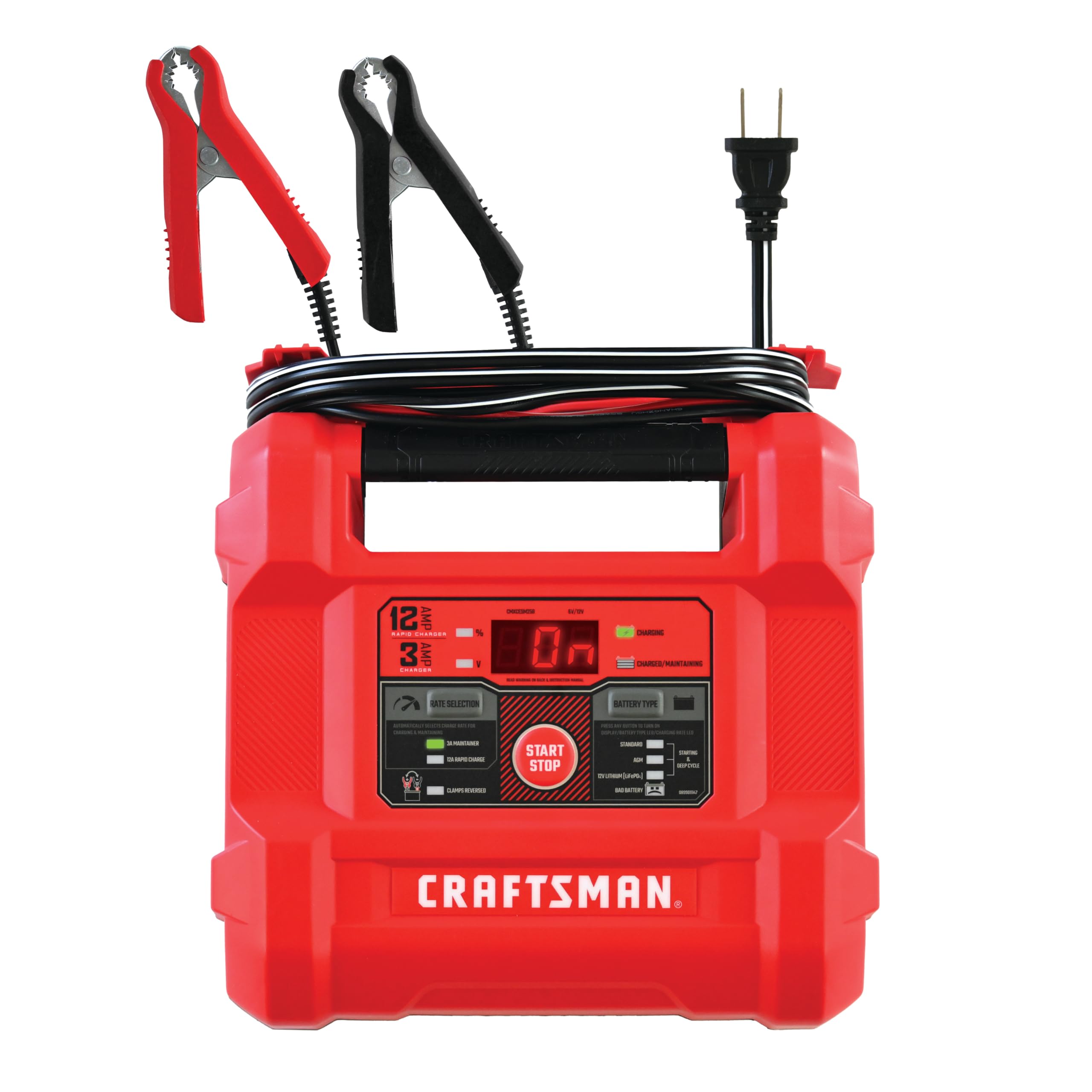
The CRAFTSMAN CMXCESM258 delivers serious amperage for a price that undercuts most competitors with similar output. With 12 amps of 12V charging capability, it can bring a depleted car battery back to life in a fraction of the time a standard maintainer would require. The 4-in-1 design — charger, maintainer, tester, and reconditioner — removes the need for separate diagnostic tools in a home garage setting.
What sets this unit apart is the built-in battery reconditioning mode. Using a controlled desulfation pulse, it can break down sulfate crystals that accumulate on lead plates during deep discharge cycles, potentially restoring capacity in batteries that a standard charger would declare dead. The reverse polarity protection prevents accidental clamp swaps from damaging the unit or the vehicle, a critical safety net for less experienced users.
Some owners note that the clamps are serviceable rather than premium — they work but lack the heavy-duty feel of more expensive units. The unit is also physically larger than compact maintainers, taking up more bench or wall space. It does support lithium (LiFePO4) alongside standard, AGM, and deep-cycle batteries, making it one of the most chemistry-flexible options in this price bracket.
What works
- 12-amp charging rapidly recovers deeply discharged batteries
- Recondition mode extends the life of aging lead-acid batteries
- Broad compatibility with standard, AGM, lithium, and deep-cycle types
What doesn’t
- Clamps feel adequate but not heavy-duty
- Larger footprint than compact maintainer-style chargers
- User interface is functional but not premium
3. NOCO Boost GB40

The NOCO Boost GB40 is not a traditional battery charger — it is a portable lithium jump starter designed for emergency use when your battery is already dead. Its 1000-amp peak output can start engines up to 6.0 liters gasoline and 3.0 liters diesel, making it suitable for most passenger cars, trucks, and SUVs. The compact 2.5-pound form factor fits easily in a glove box or under a seat, which is where a jump starter belongs — accessible, not bolted to a wall.
The patented UltraSafe technology includes spark-proof circuitry and reverse polarity protection, so even a rushed connection in a dark parking lot won’t cause arcing or damage. Beyond jump starting, the integrated 100-lumen LED flashlight offers seven modes including SOS and strobe, adding practical utility for nighttime roadside repairs or emergencies. The internal lithium battery recharges in roughly three hours via USB-C and doubles as a power bank for smartphones and tablets.
This is not a device for maintaining or topping off a battery during storage — it is purely a recovery tool. The 2150 mAh internal battery provides up to 20 starts per charge, but repeated use without recharging the host battery through other means will eventually drain the GB40. Owners looking for a comprehensive charging solution should pair this with a dedicated maintainer rather than relying on it as a primary charger.
What works
- UltraSafe spark-proof and reverse polarity protection
- Compact enough for glove box storage at 2.5 pounds
- Integrated power bank and multi-mode LED flashlight
What doesn’t
- Not a substitute for a dedicated battery maintainer
- Limited to jump starting and emergency power — no charging algorithm
- Internal battery requires periodic recharging when not in use
4. ECO-WORTHY 5A Smart Charger

The ECO-WORTHY 5A Smart Charger occupies a rare intersection of affordability and modern battery support. It handles both 12V lead-acid (flooded, AGM, gel) and 12V lithium (LiFePO4) chemistries, a feature set typically reserved for units costing significantly more. The built-in LCD display provides real-time voltage and charging status feedback, which is genuinely useful for monitoring a battery’s recovery trajectory without needing a separate multimeter.
The fully automated charging logic transitions through bulk, absorption, and float stages without user intervention. When it detects low voltage or sulfation, it prompts the user with a repair suggestion rather than blindly applying a damaging charge profile. The included SAE connector with a 10-amp fuse, along with both alligator clips and O-ring terminals, covers most connection scenarios out of the box. At 5 amps, it strikes a practical balance between speed and safety for batteries up to around 90Ah.
Owner reports indicate reliable long-term performance for seasonal vehicle storage, though the build quality of the housing and cables does not match the heft of premium European or domestic brands. The LCD screen, while informative, is not backlit, making it difficult to read in low-light garage environments. For budget-conscious owners who need lithium compatibility, this is the most cost-effective entry point currently available.
What works
- Supports both lead-acid and LiFePO4 chemistries at a budget-friendly price
- LCD display offers clear voltage and status readout
- Automatic charging with intelligent sulfation detection
What doesn’t
- Casing and cables feel less robust than premium alternatives
- LCD lacks backlight for dim garage use
- 5 amp output is moderate for large or deeply discharged batteries
5. Battery Tender Junior 021-0123
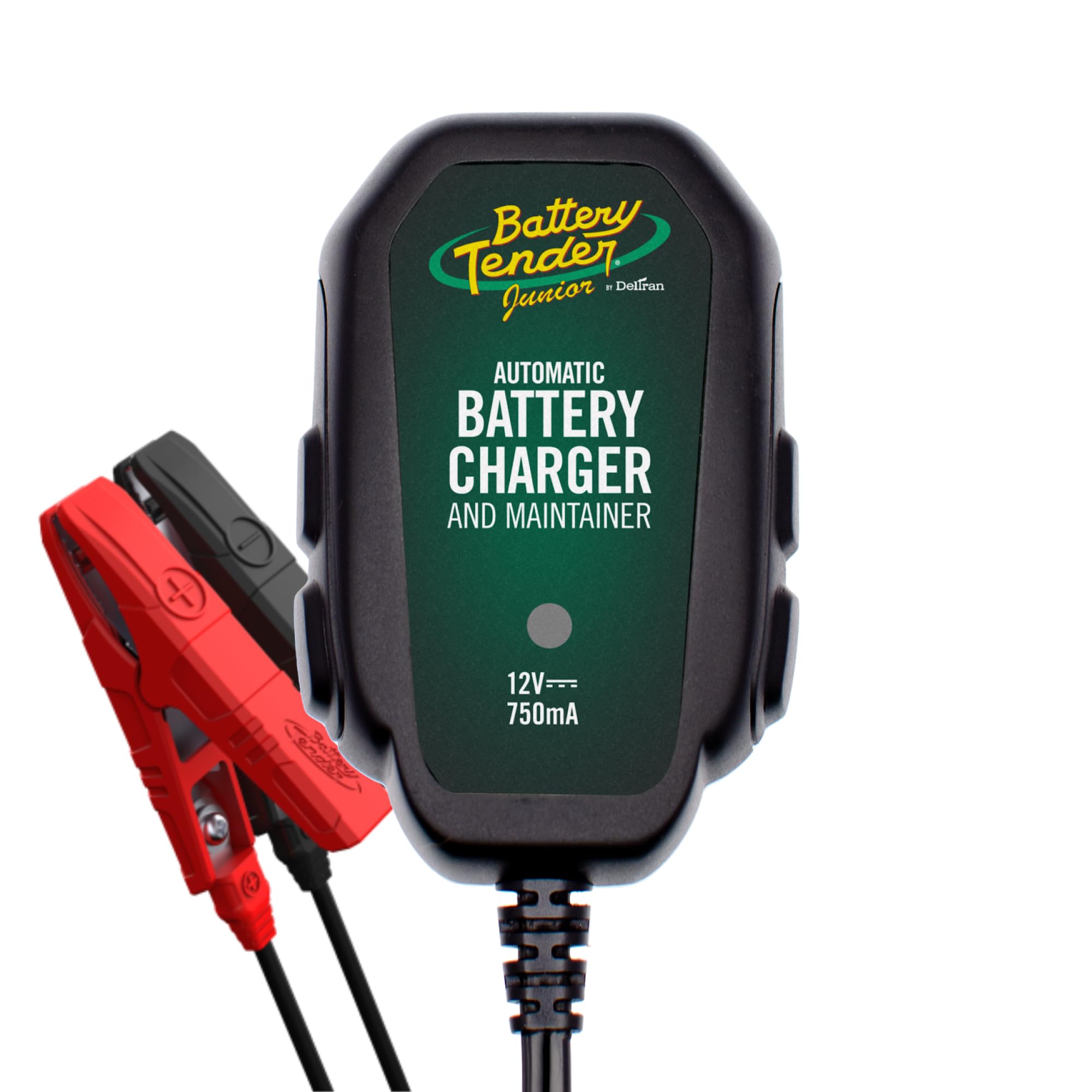
The Battery Tender Junior is the gold standard for entry-level battery maintenance for a reason — it has been doing one thing well for decades. Its 750 milliamp output is deliberately low, making it unsuitable for charging a dead battery quickly but ideal for maintaining a fully charged battery during storage. The four-step charging program — initialization, bulk charge, absorption mode, and float mode — ensures the battery receives a controlled charge without the risk of overcharging that plagues older trickle chargers.
Spark-proof circuitry and automatic reverse hook-up detection eliminate the two most common user errors: connecting clamps to the wrong terminals and creating sparks near battery hydrogen gas. The 12-foot output cable provides generous reach, and the included fused ring terminal harness allows permanent connection to hard-to-reach batteries on motorcycles, ATVs, and lawn tractors. The two-color LED indicates charging status and will resume full output automatically if the battery voltage drops under load.
The limitation is clear — at 0.75 amps, this is not a tool for reviving a deeply discharged car battery in a hurry. It excels as a long-term maintainer for seasonal vehicles and powersports equipment where the battery is already in good condition. The housing is compact at just over 3 inches in any dimension, making it easy to mount near a storage area. For its intended role, it remains one of the most reliable and widely recommended entry-level options on the market.
What works
- Proven 4-step charging prevents overcharge during long-term storage
- Spark-proof circuitry and reverse polarity detection enhance safety
- Compact size with 12-foot cable for flexible mounting
What doesn’t
- 0.75 amp output is too slow for charging a deeply depleted car battery
- Not compatible with lithium (LiFePO4) batteries
- No display or diagnostic feedback beyond a two-color LED
Hardware & Specs Guide
Amperage and Charge Rate
Amperage directly controls how quickly a charger replenishes a battery. Low-amperage units (0.75–2A) are designed for maintenance — they counteract self-discharge during storage but lack the current to recover a deeply discharged battery in a reasonable timeframe. Mid-range units (4–5A) offer a practical balance, reviving a standard car battery in several hours while remaining safe for overnight connection. High-amperage units (10–12A) deliver rapid recovery but generate more heat and require robust thermal management to avoid plate damage. Smart chargers automatically adjust amperage based on battery voltage and internal resistance, reducing the risk of overheating while maximizing charge speed for the given condition.
Battery Compatibility and Safety
Lead-acid, AGM, gel cell, and lithium (LiFePO4) batteries each demand distinct voltage thresholds and absorption profiles. A charger without explicit LiFePO4 support should never be used with lithium batteries, as the higher absorption voltage can trigger the battery management system’s protection cutoff or cause permanent damage. Safety features — spark-proof circuitry, reverse polarity protection, and overcharge prevention — are non-negotiable for unattended charging. Spark-proof technology prevents ignition of hydrogen off-gassing, while reverse polarity protection safeguards both the charger and the vehicle if clamps are accidentally swapped. Overcharge protection automatically transitions to float or pulse maintenance at full charge, allowing indefinite connection without damage.
FAQ
What is the difference between a battery charger and a battery maintainer?
Can I charge a lithium battery with a lead-acid charger?
How long does it take to charge a car battery with a 12 amp charger?
Final Thoughts: The Verdict
For most buyers, the best car battery charger winner is the CTEK 4.3 Test & Charge because it combines diagnostic intelligence with precision charging algorithms that extend battery life rather than just replenishing voltage. If you need raw charging speed and chemistry flexibility across lead-acid and lithium, grab the CRAFTSMAN CMXCESM258. And for emergency roadside readiness, nothing beats the portable NOCO Boost GB40.

Certification: BSc in Mechanical Engineering
Education: Mechanical engineer
Lives In: 539 W Commerce St, Dallas, TX 75208, USA
Md Amir is an auto mechanic student and writer with over half a decade of experience in the automotive field. He has worked with top automotive brands such as Lexus, Quantum, and also owns two automotive blogs autocarneed.com and taxiwiz.com.