Rust never sleeps, and once it digs into bare metal, the clock starts ticking on structural integrity. The difference between a temporary cover-up and a genuine long-term cure comes down to one factor: the chemistry behind the coating and how well it bonds to the surface you treat.
I’m Amir — the founder and writer behind Four Wheel Ask. Over the years I’ve analyzed hundreds of corrosion products, sifted through thousands of verified owner reviews, and compared chemical formulations, cure mechanisms, and real-world durability data to understand what truly stops rust at the molecular level.
Surface preparation and the right formulation make or break any rust-fighting effort. After analyzing dozens of products and owner feedback, finding the best rust stabilizer for your application depends on surface prep and durability needs.
How To Choose The Best Rust Stabilizer
Rust stabilizers fall into two broad camps: converters that chemically neutralize iron oxide into a stable compound, and inhibitors that seal moisture out with a physical barrier. Understanding which approach suits your metal and environment is the first step toward a lasting fix.
Converter vs. Inhibitor — Know the Chemistry
A rust converter uses tannic or phosphoric acid to react with iron oxide, turning it into a black, inert layer that can be painted over. This works well on surfaces with moderate rust where mechanical removal isn’t complete. An inhibitor, by contrast, forms a waterproof film that blocks oxygen and moisture but does not chemically alter existing rust. Some products combine both functions, offering conversion plus a protective topcoat in one step.
Application Method and Surface Prep
Sprays reach cavities, box sections, and underbody nooks that brushes cannot touch, but they tend to lay down thinner films. Brush-on formulas give you control over thickness and are ideal for frames, suspension parts, and flat panels. Regardless of method, all rust stabilizers demand a clean, oil-free surface. Degreasing and wire-brushing loose scale before application directly determines whether the coating bonds or delaminates within months.
Cure Mechanism and Longevity
Moisture-cured urethanes, like those used in POR-15, polymerize faster when humidity is present and form a brittle, rock-hard shell. Solvent-based waxes and lanolin sprays remain flexible and self-heal if scratched, making them better for areas that see stone chips or flexing. Epoxy and urethane primers offer hardness but require careful topcoating if exposed to UV, as they chalk and degrade in direct sunlight.
Quick Comparison
On smaller screens, swipe sideways to see the full table.
| Model | Category | Best For | Key Spec | Amazon |
|---|---|---|---|---|
| POR-15 Gray | Premium Coating | Frame & chassis restoration | Moisture-cured urethane, 50–100 sq ft coverage | Amazon |
| CorrosionX Heavy Duty | Spray Inhibitor | Saltwater marine & electrical | Self-healing film, 5-year indoor protection | Amazon |
| Meuvcol 2 in 1 Converter | Converter + Primer | Metal furniture & light automotive | 35 oz black matte, brush-on, includes gloves | Amazon |
| Rust-Oleum Rusty Metal Primer | Oil-Based Primer | Heavily rusted outdoor metal | Matte flat brown, dries in 2–4 hours | Amazon |
| JENOLITE Waxoil | Aerosol Wax | Cavity waxing & underbody | Self-sealing waxy film, 16 oz spray | Amazon |
In‑Depth Reviews
1. POR-15 Rust Preventive Coating

POR-15 stands alone in the rust-coating world because its chemistry works opposite to ordinary paints. Instead of evaporating solvents to dry, it cures by absorbing moisture from the air, which means it actually sets faster in humid conditions. The result is a glossy, glass-hard urethane shell that bonds aggressively to rusted and bare metal alike, forming a barrier that feels closer to epoxy than traditional enamel.
Owner reports consistently highlight the ten-year lifespan on truck frames and off-road sliders when applied using the three-step system of degreaser, metal prep, and coating. The self-leveling nature eliminates brush strokes, and the cured film resists chemicals, salt, and abrasion. However, this is not a product you slap on without discipline — the can lid will weld itself shut if any residue dries in the threads, and spills require lacquer thinner to remove before cure completes.
For frame-off restorations, chassis work, and any steel that needs to outlast the vehicle itself, POR-15 delivers unmatched permanence. It does not tolerate UV exposure without a topcoat, and the price reflects true industrial-grade formulation rather than weekend-warrior pricing. Users who follow the prep protocol to the letter report no rust breakthrough even after years of winter driving.
What works
- Forms an indestructible moisture-cured urethane barrier that stops rust permanently
- Self-levels smoothly and covers up to 100 square feet per can
- Proven ten-year track record on frames and heavy equipment in owner communities
What doesn’t
- Requires strict three-step prep — degrease, etch, then coat — for proper adhesion
- Can lid seals permanently if residue dries; must be stored in a mason jar
- Chalky in direct sun; must be topcoated for UV-exposed surfaces
2. CorrosionX Heavy Duty Anti Rust Spray

CorrosionX Heavy Duty takes a fundamentally different approach from hard-cured coatings. Its polar-bonding formula uses a thick, dripless carrier that locks onto metal at the molecular level and remains flexible for years. The film actually self-heals — if a stone chips the surface, the surrounding material flows back into the gap rather than leaving bare metal exposed to moisture.
Owner feedback from marine and agricultural users is emphatic: this spray holds up against pressure washing, seawater immersion, and salt spray for up to five years indoors and two years outdoors. The non-conductive formula makes it a go-to for battery terminals, grounding lugs, and electrical connections where corrosion causes intermittent failures. The thick, goopy consistency does attract dust and grime, and it stains fabric instantly, so careful application is a must.
Where CorrosionX truly shines is in environments where flexibility matters more than hardness. Trailers, boat motors, farm equipment, and underbody panels that flex and vibrate benefit from a coating that moves with the metal rather than cracking. The aerosol application reaches into box sections and behind brackets without disassembly, making it a practical choice for ongoing maintenance rather than one-shot restoration.
What works
- Self-healing barrier reseals after scratches and stone chips
- Polar bonding chemistry prevents electrolysis on mixed-metal assemblies
- Lasts up to five years indoors and two years outdoors per owner reports
What doesn’t
- Thick, tacky residue attracts dust and requires glove application for even coverage
- Premium pricing per can compared to basic lanolin or wax sprays
- Strong odor during application; needs adequate ventilation
3. Meuvcol 2 in 1 Rust Converter & Metal Primer
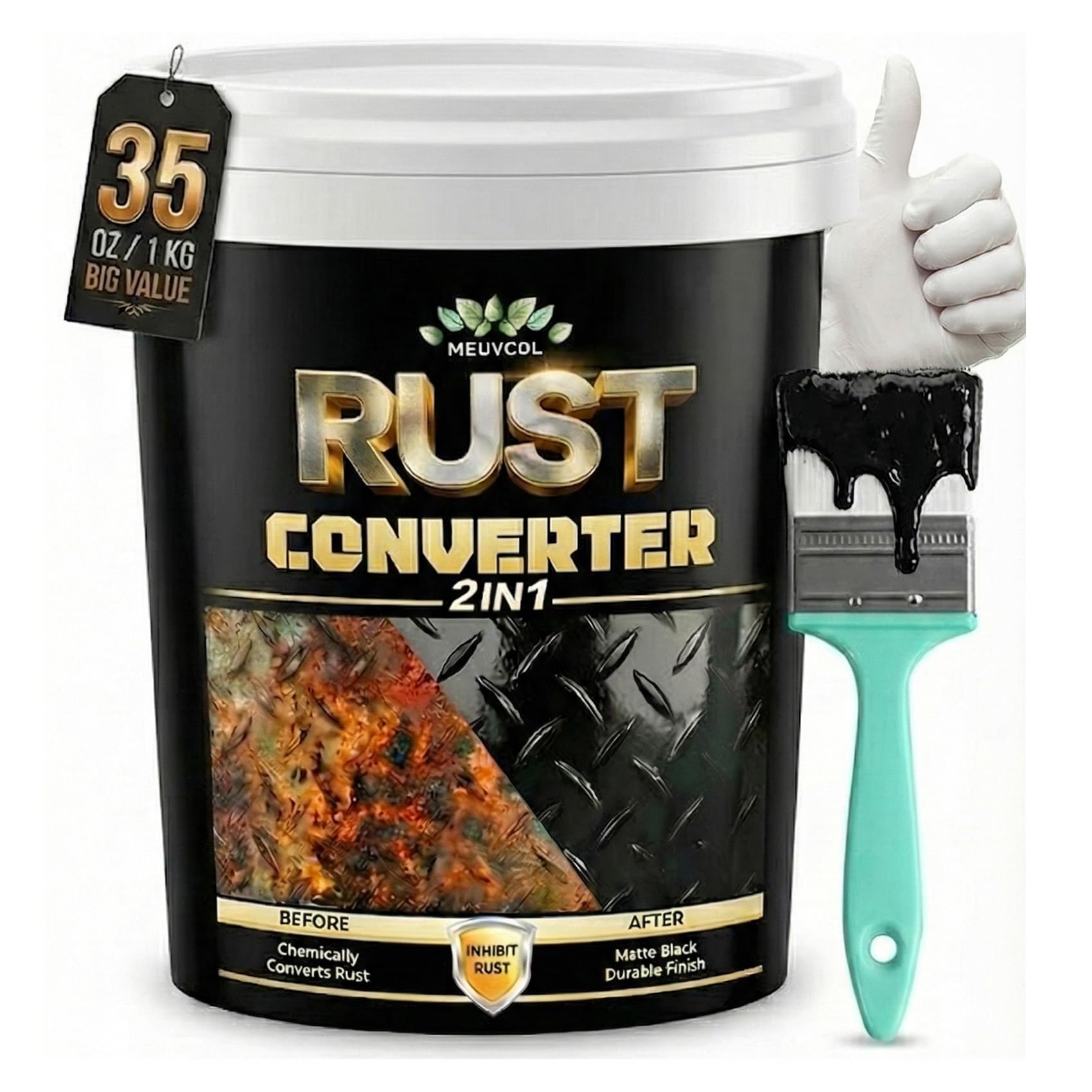
Meuvcol bridges the gap between chemical conversion and barrier protection by combining a rust converter with a pigmented primer in a single can. The active agents neutralize iron oxide while the black matte resin forms a sealed, waterproof topcoat that accepts further painting or can stand alone. Owner reports note that it dries fast to a hard satin finish that resists chipping on metal furniture, trailer components, and light automotive parts.
The 35-ounce can provides generous coverage for the price, and the kit includes a brush and gloves, which removes friction for first-time users. Reviews highlight its performance on antique metal statues, non-potable water tanks, and chassis sections where moderate rust was present. The matte finish hides surface imperfections better than gloss coatings, and the water cleanup before cure simplifies application compared to solvent-based alternatives.
This product works best on surfaces where rust is present but not deeply pitted. Users treating heavy flaking or multi-layer corrosion should mechanically remove loose scale first. The film thickness builds well with two thin coats, and the 24-hour cure time before full exposure is standard for converter-type products. For cost-conscious DIYers who want a single-step solution that converts and seals, this represents strong value without corner-cutting on film integrity.
What works
- Combines rust conversion and primer in one application step
- Large 35-ounce can with included brush and gloves
- Fast-drying matte finish hides surface irregularities well
What doesn’t
- Not ideal for heavily pitted rust without mechanical removal first
- Container seal can leak during shipping if damaged
- Full cure takes 24 hours; not a quick-touch-up product
4. Rust-Oleum Stops Rust Rusty Metal Primer
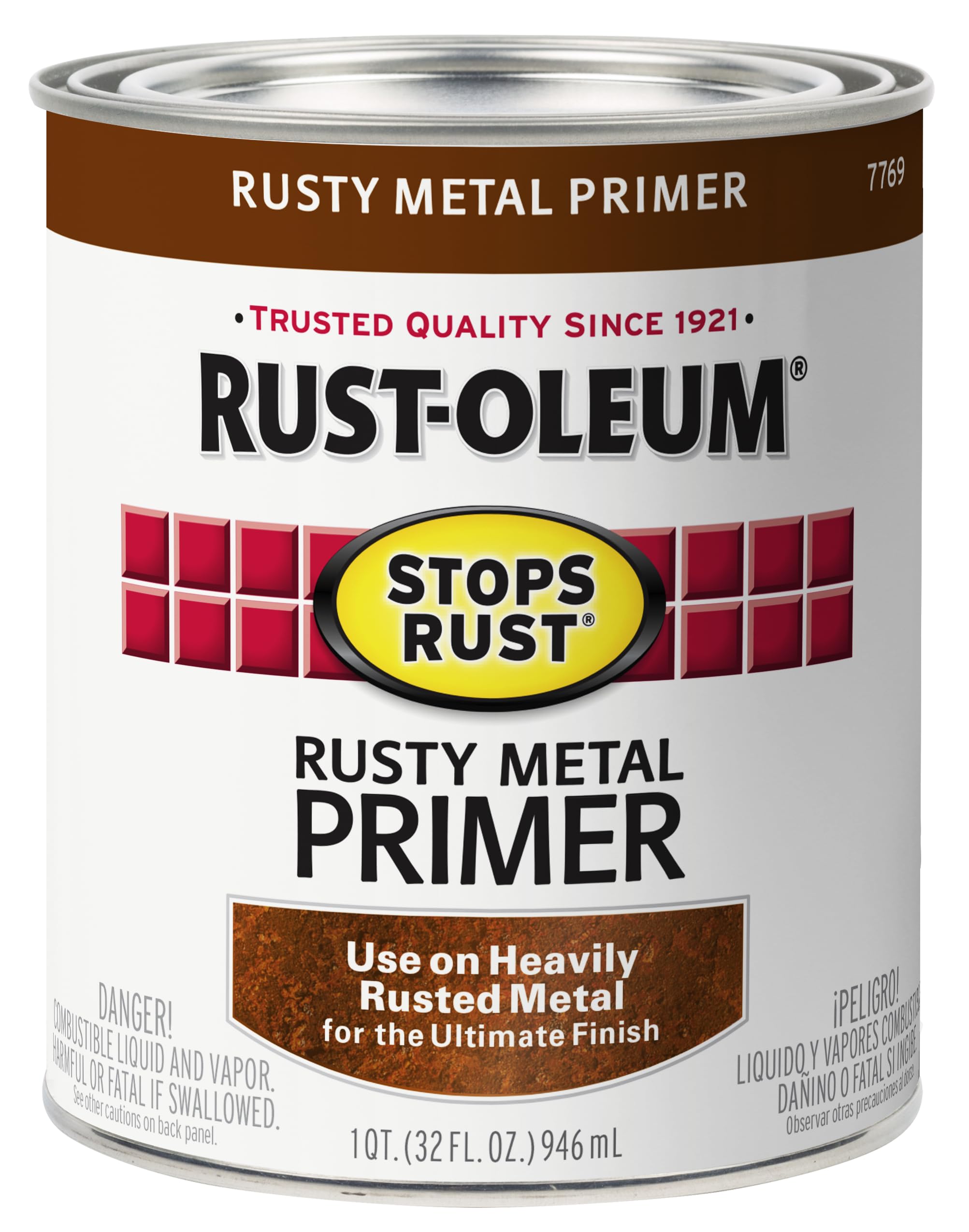
Rust-Oleum’s Stops Rust Rusty Metal Primer is an oil-based workhorse that has been a staple in metal restoration for decades. Its formulation is designed specifically for heavily rusted exterior and interior surfaces where other primers struggle to bond. The flat brown color indicates active rust-inhibiting pigments that neutralize remaining oxides while creating a mechanical key for topcoat adhesion.
Owner reports from motorcycle builders and DIY restorers confirm that brushed or sprayed application yields a smooth, sandable base that holds up to demanding environments. Users who pair it with the Rust-Oleum protective enamel topcoat report multi-year durability on outdoor furniture, railings, and chassis components. The 32-ounce quart covers roughly 12 square feet per coat, and the dry-to-touch time of one hour with full cure in four hours keeps projects moving at a practical pace.
The primer’s biggest limitation is that it is a primer — not a standalone stabilizer. For surfaces that remain exposed, a topcoat is mandatory. Some buyers report packaging damage during shipping, with dented cans and leaks, though the paint itself remains usable. This product rewards careful surface preparation and should be considered the foundation layer of a multi-coat system rather than a one-step solution.
What works
- Oil-based formula provides excellent adhesion on heavily rusted metal
- Dries to touch in one hour and sands smoothly between coats
- Decades of proven performance across automotive and marine applications
What doesn’t
- Requires a separate topcoat for UV and abrasion resistance
- Quart can is prone to denting and leaking during shipping
- Limited coverage at roughly 12 square feet per can
5. JENOLITE Waxoil Rust Prevention Aerosol

JENOLITE Waxoil brings a thick, waxy protective film in an aerosol can that reaches every crevice, box section, and inner panel. Unlike lanolin-based sprays that leave a greasy residue, this formulation dries to a clear waxy layer that remains flexible and self-healing if scratched or punctured. The spray nozzle delivers a wide pattern that coats evenly, making it ideal for doors, sills, wheel arches, and chassis underbody sections.
British automotive enthusiasts have trusted this formulation for years, and owner reviews confirm its performance on suspension components and camper slide rails. The wax film actively drives moisture away from metal surfaces and contains rust-killing agents that treat light surface corrosion while preventing new formation. One can treats the front suspension of a full-size SUV, and the clear finish leaves no sticky residue that attracts dirt.
Where Waxoil fits best is as a cavity wax and underbody maintenance product rather than a structural restoration coating. It is not designed to bridge heavy rust or replace metal, but it excels at protecting factory finishes and lightly rusted internal cavities from further corrosion. Users report no unpleasant odor compared to lanolin-based alternatives, and the self-sealing property means minor scratches in the film repair themselves over time.
What works
- Self-sealing waxy film repairs minor scratches without reapplication
- Clear, non-greasy finish does not attract dirt like lanolin sprays
- Excellent reach into box sections and cavity areas via aerosol nozzle
What doesn’t
- Not suitable for structural rust repair or heavily pitted metal
- Single 16-ounce can only covers one suspension set or small underbody area
- Wax film thickness is thinner than brush-on converters or urethanes
Hardware & Specs Guide
Cure Mechanism
Rust stabilizers cure through one of three mechanisms: moisture absorption, solvent evaporation, or chemical crosslinking. Moisture-cured urethanes like POR-15 polymerize by pulling water vapor from the air, creating a dense thermoset plastic that bonds aggressively to rust. Solvent-based waxes and primers dry as the carrier evaporates, leaving behind a flexible or hard film depending on the resin system. Converter-type products use acid reactions to transform iron oxide into an inert ferric phosphate or tannate layer that becomes part of the surface.
Coverage & Film Thickness
Coverage varies widely by product type and application method. Brush-on urethanes typically yield 50 to 100 square feet per quart depending on film thickness, while aerosol sprays cover less due to overspray and thinner deposition. For long-term protection, a dry film thickness of 4 to 8 mils is recommended on chassis and frame components. Converter primers lay down thinner films in the 2 to 4 mil range and benefit from two coats. Waxy cavity sprays rely on creep and capillary action to coat internal seams rather than building measurable thickness.
FAQ
What is the difference between a rust converter and a rust inhibitor?
Can I apply rust stabilizer over existing paint or undercoating?
How long does a rust stabilizer treatment last before reapplication is needed?
Do I need to remove all rust before applying a stabilizer?
Final Thoughts: The Verdict
For most buyers, the best rust stabilizer winner is the POR-15 Rust Preventive Coating because its moisture-cured urethane chemistry delivers permanent, rock-hard protection that no other single-step coating can match when applied correctly. If you need a self-healing flexible film that survives saltwater and pressure washing, grab the CorrosionX Heavy Duty. And for a budget-friendly single-can solution that converts rust and primes in one pass, nothing beats the value of the Meuvcol 2 in 1 Rust Converter.

Certification: BSc in Mechanical Engineering
Education: Mechanical engineer
Lives In: 539 W Commerce St, Dallas, TX 75208, USA
Md Amir is an auto mechanic student and writer with over half a decade of experience in the automotive field. He has worked with top automotive brands such as Lexus, Quantum, and also owns two automotive blogs autocarneed.com and taxiwiz.com.