A dead heater core or a frigid morning cab can turn any drive into a survival test. Many aftermarket heating solutions promise warmth but deliver lukewarm air, excessive battery drain, or complicated installations that leave you stranded in the cold. The difference between shivering and comfortable often comes down to understanding heat output ratings, power draw, and whether your vehicle needs coolant-based heat or a standalone fuel-fired system.
I’m Amir — the founder and writer behind Four Wheel Ask. I spend my days analyzing product specifications, comparing build quality across brands, and synthesizing thousands of owner reports to separate genuine performance from marketing claims in the automotive heating space.
Understanding the differences between coolant-based heaters and diesel-powered units is essential when shopping for the best 12 volt electric heater to match your vehicle’s specific needs and winter conditions.
How To Choose The Best 12 Volt Electric Heater
Selecting a 12V heater requires matching the unit type to your vehicle’s electrical system, available space, and heating demands. Coolant-based heaters use engine heat and a blower motor, while diesel-fired units burn fuel for higher output independent of the engine. Understanding the trade-offs between installation complexity, runtime, and heat volume is the first step toward a reliable cold-weather setup.
Heater Type and Heat Source
Coolant heaters (also called auxiliary heaters) tap into your engine’s coolant loop. They require hose connections and a 12V fan but produce warm air from the engine’s residual heat. Diesel air heaters, by contrast, burn diesel fuel in a combustion chamber and blow hot air directly into the cabin. They deliver far more BTUs but require venting of exhaust and a fuel source. For short trips or mild climates, a simple coolant-based unit often suffices. For extended cold-weather camping or work truck use, a diesel heater provides consistent warmth regardless of engine temperature.
Power Draw and Electrical Load
Every 12V heater draws current from your battery or alternator. A typical coolant fan pulls 8 to 15 amps, which is manageable for most vehicles with a healthy charging system. Diesel heaters draw less than 5 amps during the burn phase but need a brief higher draw during glow plug ignition. Always verify that your battery reserve capacity and alternator output can support the continuous load, especially if you plan to run the heater overnight without the engine running.
Heat Output and Coverage Area
Heat output is measured in watts or BTUs. For a standard pickup cab or small RV, 5,000 to 8,000 BTUs (roughly 1.5 to 2.5 kW) provides adequate warmth in freezing conditions. Larger vans or truck campers benefit from 8,000 to 12,000 BTUs. Oversizing can lead to short cycling and uneven temperatures, while undersizing leaves you cold. Match the heater’s rated coverage area to your vehicle’s interior volume for the best balance of comfort and fuel efficiency.
Installation Complexity and Space
Under-dash coolant heaters are relatively simple to install with basic hand tools and hose clamps. Diesel heaters require routing an exhaust pipe, mounting a fuel tank, and often cutting holes for intake and outlet vents. All-in-one diesel units reduce installation effort by integrating the tank and combustion chamber into a single portable box, but they still need proper venting. Measure your available mounting space — many diesel heater kits are bulky and may not fit under a standard truck seat.
Altitude Compensation and Safety Features
If you travel through mountainous terrain, altitude compensation is critical. At higher elevations, thinner air causes incomplete combustion and sooting. Heaters with automatic altitude adjustment maintain clean burn and consistent output up to 18,000 feet. Safety features like overheat protection, tip-over shutoff, and ceramic glow plugs prevent fire hazards and extend the unit’s lifespan. These factors separate reliable winter gear from units that fail after a single season.
Quick Comparison
On smaller screens, swipe sideways to see the full table.
| Model | Category | Best For | Key Spec | Amazon |
|---|---|---|---|---|
| TURBRO T8BP 9kW | Diesel | All-in-one smart control | 9kW / 12/24/110V | Amazon |
| VEVOR 8kW Bluetooth | Diesel | App-controlled value | 8kW / 12V / 5L tank | Amazon |
| HCALORY TB-MAX 8kW | Diesel | Remote temp sensing | 8kW / 7.5L / 110/12/24V | Amazon |
| Fiberfly 8kW 15L | Diesel | Large tank extended run | 8kW / 15L / 12V | Amazon |
| WAYSKA 8kW 15L | Diesel | Plateau altitude use | 8kW / 15L / 12V | Amazon |
| SILVEL 8kW 9L | Diesel | Multi-voltage flexibility | 8kW / 9L / 110/12/24V | Amazon |
| RDXTIK 8kW 9L | Diesel | 3-in-1 mounting bases | 8kW / 9L / 12/24/110V | Amazon |
| LF Bros 5kW 5L | Diesel | Compact portable design | 5kW / 5L / 110/12/24V | Amazon |
| Dura Heat 240V | Electric | Shop/garage stationary | 3,750W / 240V / 500 sq ft | Amazon |
| Roadpro RPSL-681 | Electric | Simple supplemental heat | 300W / 12V / ceramic | Amazon |
| Sallurmose Underdash | Coolant | Budget auxiliary heat | 12V / 4-port / 11x9x3.9in | Amazon |
In‑Depth Reviews
1. TURBRO 9kW Diesel Heater T8BP
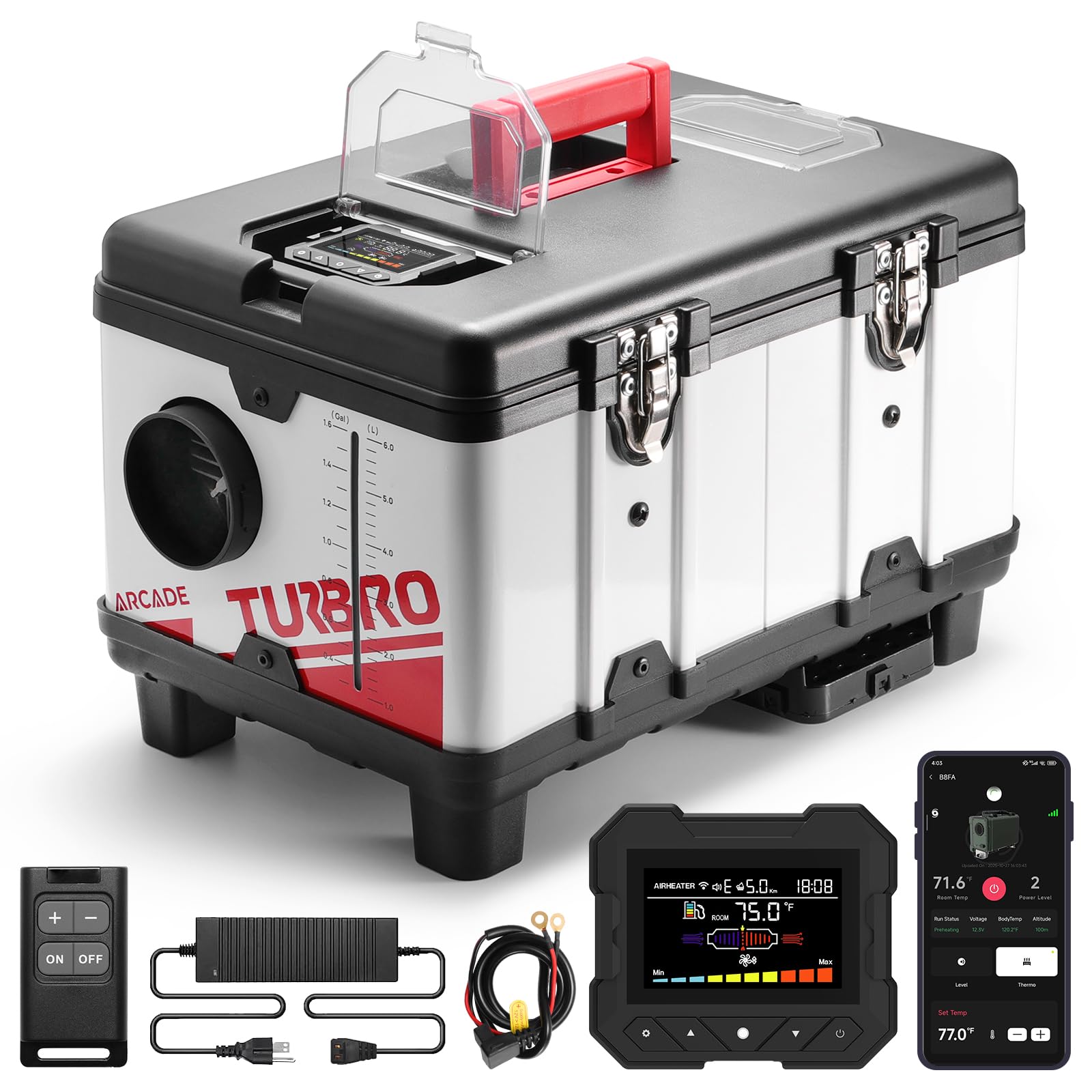
The TURBRO T8BP delivers the most complete package for anyone needing a portable diesel heater that works across multiple power sources. Its 9kW output is among the highest in the all-in-one category, and the toolbox-style enclosure makes it easy to carry from truck to tent to garage. The fast-ignition glow plug fires up even at negative 40 degrees Fahrenheit, which is a meaningful advantage for those who work or camp in extreme cold.
What sets this unit apart is the control flexibility. The colored smart LCD is intuitive, the remote works from a generous distance, and the Bluetooth app adds scheduling and temperature monitoring that eliminates the need to walk outside to adjust settings. The programmable timer lets you preheat the cabin before you leave work or wake up to a warm van. With altitude compensation reaching 16,400 feet, it handles mountain passes without hiccups.
The built-in 1.6-gallon tank delivers all-night runtime at the lowest fuel consumption settings, and the low-noise fuel pump means you won’t lose sleep. The advanced protection system with error code diagnostics takes the guesswork out of troubleshooting. For anyone who wants a single heater that transitions between vehicle, home, and workshop use without compromise, this is the top recommendation.
What works
- Excellent multi-voltage support (12V/24V/110V)
- App, remote, and LCD control options
- Fast ignition in extreme cold
- Altitude mode up to 16,400 ft
What doesn’t
- Premium price point
- Exhaust must be vented outside
- Not truly “install and forget” for permanent vehicle mounting
2. VEVOR 8kW All-in-One Diesel Heater
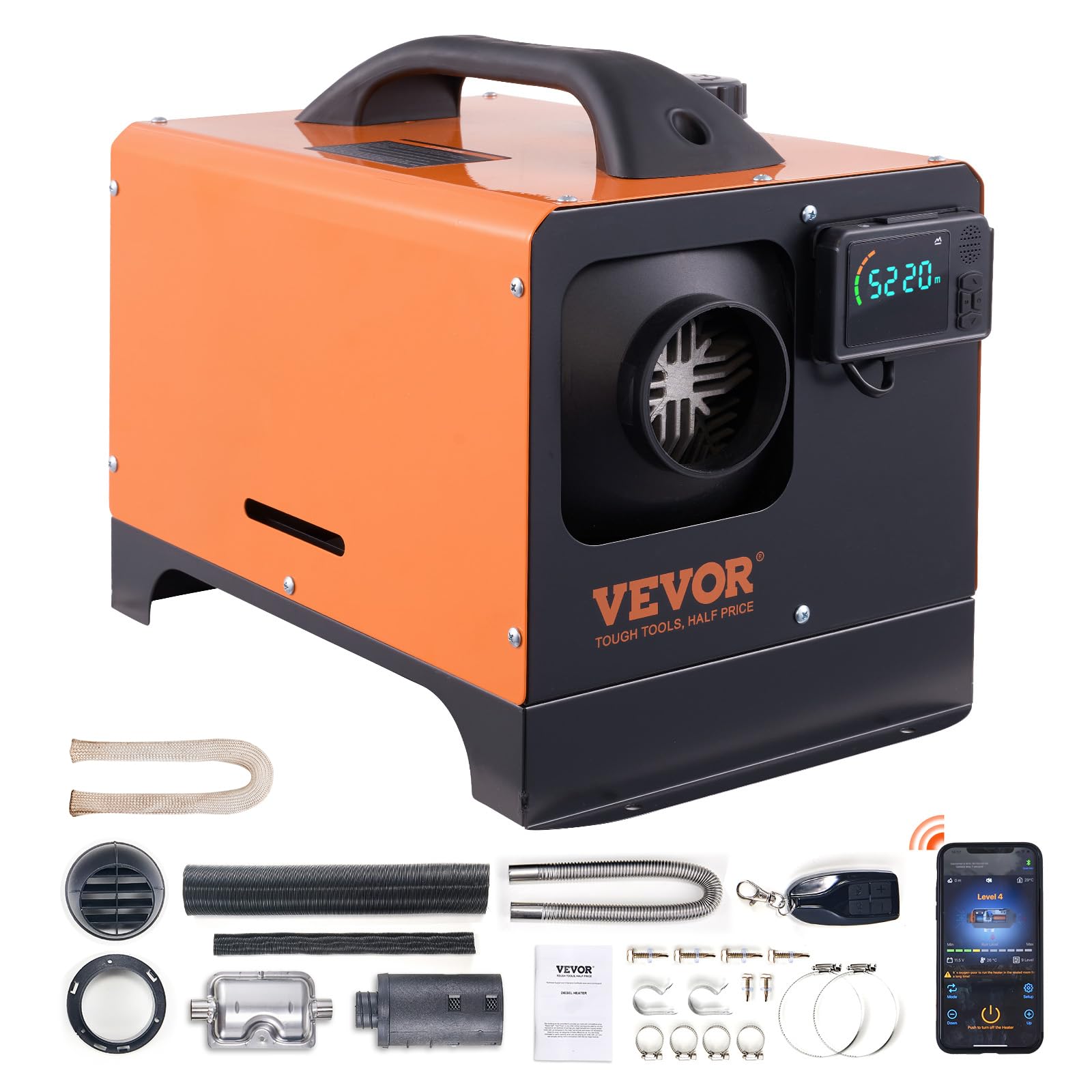
VEVOR brings its usual blend of feature density and approachable pricing with this 8kW Bluetooth-enabled diesel heater. The all-in-one design requires no permanent installation — just set it up, connect the exhaust vent, and start heating. The sandblasted aluminum heat exchanger transfers warmth quickly, and the unit can raise a 215- to 269-square-foot space to a comfortable temperature in about ten minutes.
The Bluetooth app control is a standout at this price tier. Preheating from up to 98 feet away means you can warm the RV or cabin before stepping outside. The automatic altitude compensation works up to 18,045 feet, making it one of the best options for those who frequently travel through high mountain passes. The 5-liter tank provides up to eight hours of continuous heat on a single fill, and the low-noise fuel pump keeps consumption between 0.16 and 0.62 liters per hour.
Safety is well-covered with overheating protection that kicks in at 518 degrees Fahrenheit, plus a constant temperature control mode and timing function. The voice broadcasting feature is a nice touch for confirming settings without looking at the display. For buyers who want modern smart features without stepping up to the highest price bracket, this unit offers the best balance of capability and cost.
What works
- Bluetooth control at a mid-range price
- Excellent altitude compensation
- Quick heat-up time
- Low fuel consumption
What doesn’t
- No 110V transformer included
- Fuel tank smaller than some competitors
- Orange color may not suit all setups
3. HCALORY 8kW Toolbox MAX Diesel Heater
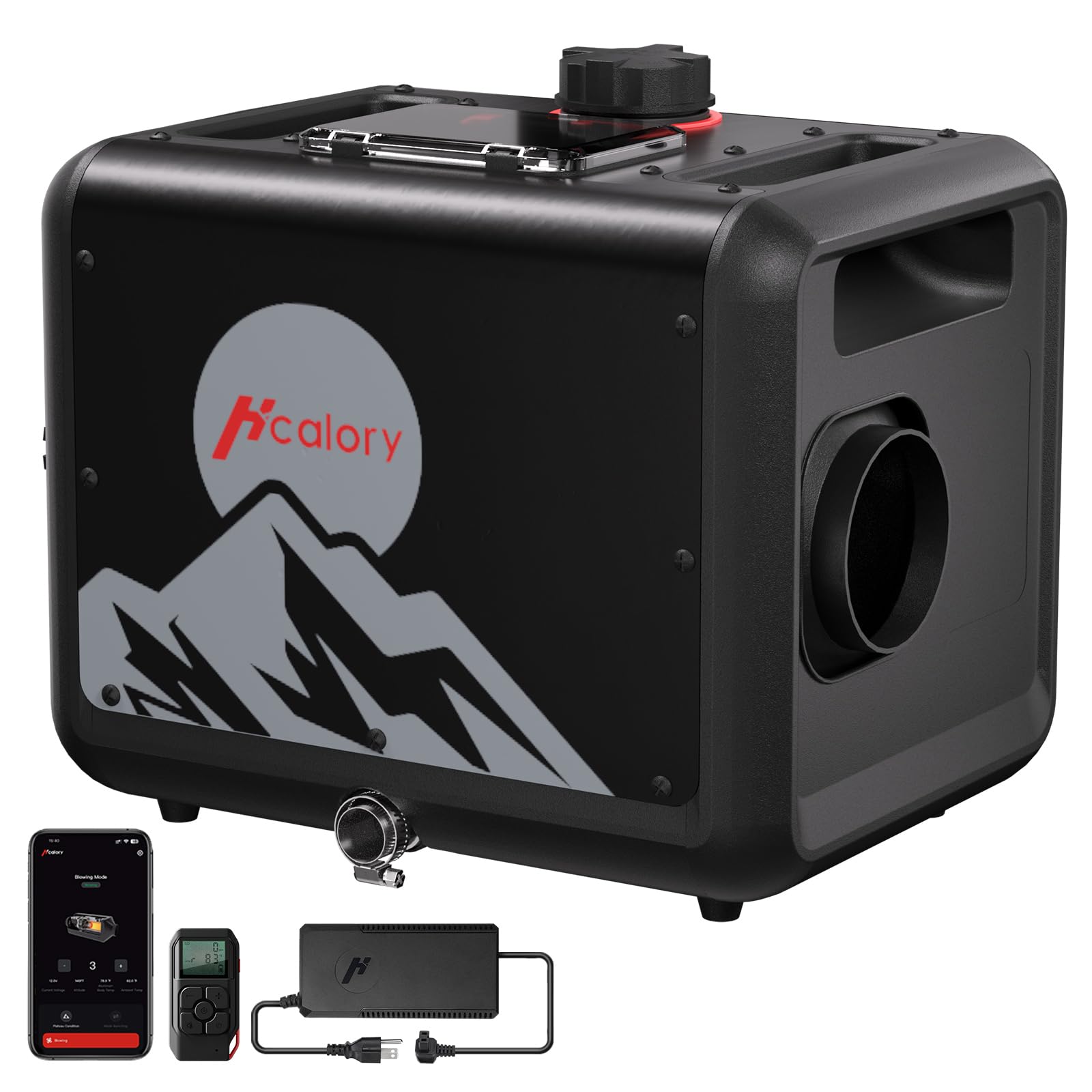
The HCALORY TB-MAX solves a common frustration with diesel heaters: the thermostat measures temperature at the unit itself rather than where you actually sit. Its wireless remote doubles as a remote temperature sensor, so the heater modulates output based on the actual cabin temperature rather than the hot air right next to the exhaust. This is a genuinely useful innovation for van dwellers and campers who place the heater outside and run a duct inside.
Heat-up time is rapid — about three minutes to reach full output even in sub-zero conditions. The advanced aluminum body and optimized combustion system deliver 36 percent better fuel efficiency than typical budget units, according to the manufacturer’s claims. The 7.5-liter fuel tank provides up to 62.5 hours of continuous heat on the lowest setting, which covers multiple nights without refueling. The silent fuel pump eliminates the rhythmic ticking that bothers light sleepers.
Altitude compensation extends to 18,000 feet, and the all-terrain adaptive performance maintains clean combustion regardless of elevation. The multi-voltage support (110V, 12V, and 24V) makes it equally usable at home and on the road. For those who prioritize temperature accuracy, quiet operation, and extended runtime in a premium package, this is a compelling choice.
What works
- Wireless remote temperature sensing
- Very quiet fuel pump
- Up to 62.5 hours runtime
- Multi-voltage input
What doesn’t
- Higher upfront investment
- Heavier than basic models
- App setup requires initial pairing
4. Fiberfly 8kW Diesel Heater 15L

The Fiberfly 8kW diesel heater focuses on long-duration heating with its generous 15-liter fuel tank. At a fuel consumption rate of 0.2 to 0.5 liters per hour, this unit can run continuously for 30 to 75 hours on a single tank, depending on the heat setting. That makes it a strong candidate for extended off-grid stays, commercial truck sleeper cabs, or remote worksites where refueling opportunities are scarce.
The ceramic glow plug technology vaporizes fuel for rapid ignition and complete combustion, which reduces soot buildup and extends maintenance intervals. The emissions profile meets Euro IV standards, meaning it burns cleaner than many older diesel heater designs. The automatic control system manages fuel delivery and air intake to maintain a stable temperature without constant manual adjustments.
Installation requires a bit more effort than all-in-one toolbox units since the tank and heater body are separate components. However, the compact heater body itself is relatively small, giving you flexibility in mounting locations. The working temperature range of minus 40 to plus 122 degrees Fahrenheit covers virtually any climate where you’d need supplemental heat. For users who prioritize maximum runtime between refills above all else, this delivers.
What works
- Very large 15L fuel capacity
- Clean Euro IV emissions
- Ceramic glow plug for reliable ignition
- Wide operating temperature range
What doesn’t
- Separate tank requires more installation work
- No Bluetooth or app control
- Limited customer reviews available
5. WAYSKA 8kW Diesel Heater 15L

The WAYSKA 8kW diesel heater shares the same 15-liter tank capacity as the Fiberfly but distinguishes itself with a dedicated plateau-version thermostat designed for high-altitude operation above 5,500 meters. For those who regularly drive or camp in the Rockies, Andes, or similar elevations, this thermostat ensures stable combustion and consistent heat output when thin air would cause lesser heaters to soot up or fail.
The working principle relies on volatile technology — the ceramic spark plug heats the diesel fuel until it vaporizes into a gas, which then ignites quickly and burns completely. This approach minimizes unburned fuel residues and keeps the combustion chamber cleaner over time. The fuel consumption range of 0.2 to 0.5 liters per hour is standard for an 8kW unit, and the 15-liter tank provides multi-day autonomy.
Compact structure and light weight (16.22 pounds) make installation straightforward in trucks, trailers, boats, and motorhomes. The heater operates independently of the vehicle’s engine, so you can run it while parked without idling. The environmental benefits include low emissions and low power consumption, which translates to less strain on your battery during overnight use. For high-altitude travelers, the plateau thermostat alone justifies the consideration.
What works
- Dedicated high-altitude thermostat
- Large 15L fuel tank
- Independent of engine operation
- Lightweight for the output
What doesn’t
- No multi-voltage support
- Limited smart features
- Separate components need more installation space
6. SILVEL 8kW Diesel Heater 9L
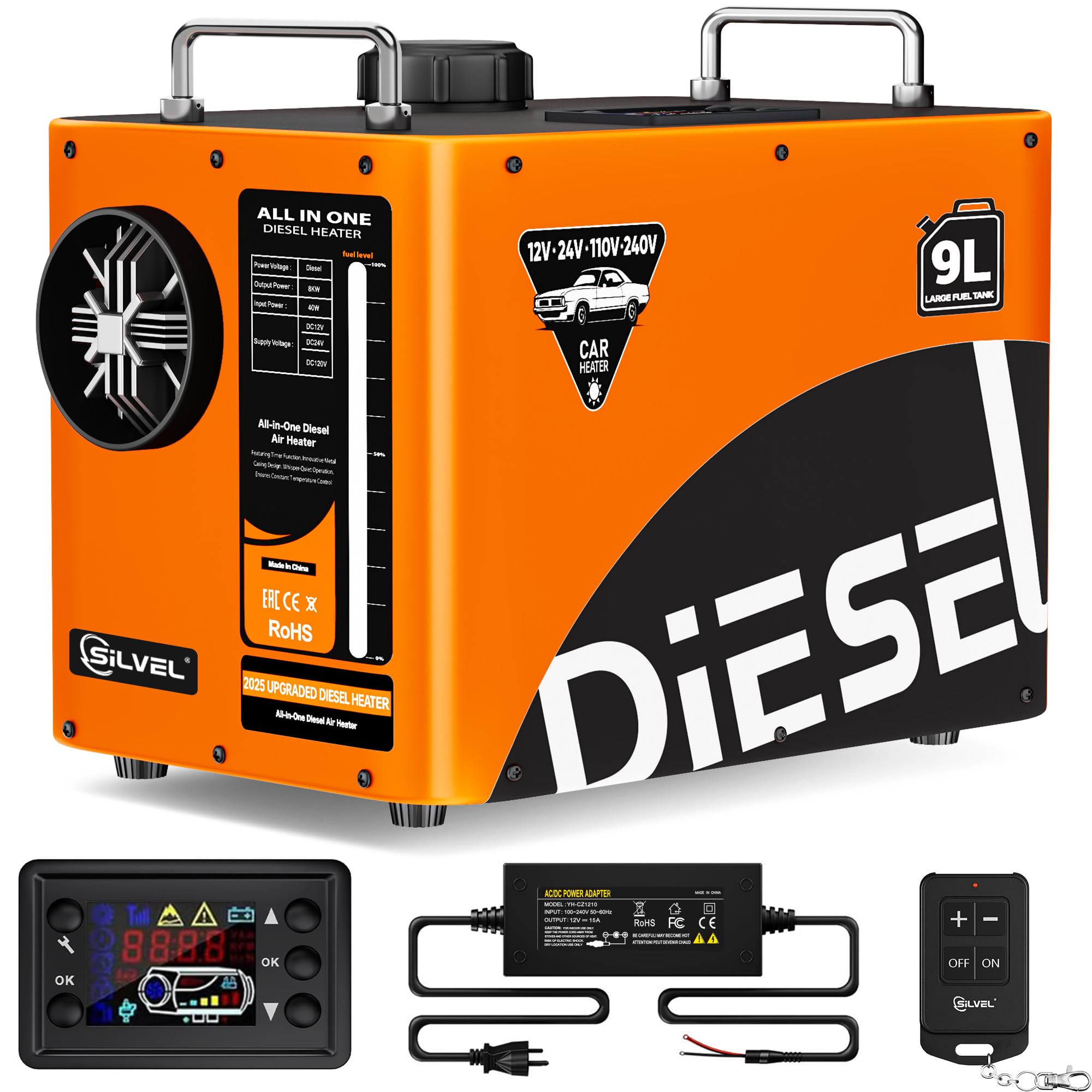
The SILVEL 8kW diesel heater is designed for users who need one unit that works in both vehicle and stationary settings. It supports 12V and 24V for mobile use in RVs, cars, and campers, and includes a 110V transformer so you can plug it directly into a standard wall outlet at home, in the garage, or at the workshop. No extra parts or DIY conversions are needed to switch between power sources.
The 2025 upgraded model features an internal thread design on the fuel tank cap that prevents oil spillage during rough travel — a practical improvement for off-road use. The 9-liter to 10-liter tank provides up to 24 hours of continuous heating, with fuel consumption as low as 0.12 liters per hour on the minimum setting. The LCD display and remote control make temperature and timer adjustments straightforward, and the automatic altitude compensation handles elevations up to 11,483 feet.
The heating coverage is rated at approximately 200 square feet, which suits smaller RVs, truck campers, and tent setups. The forced air method circulates warmth evenly, and the included installation kit contains everything needed to get started. For buyers who want a single heater that moves between their vehicle and home without modification, this is the most straightforward solution.
What works
- Includes 110V transformer for home use
- Anti-leak fuel tank design
- Up to 24 hours continuous run
- Comprehensive installation kit
What doesn’t
- Coverage area limited to 200 sq ft
- No Bluetooth app control
- 9L tank is mid-range capacity
7. RDXTIK 8kW Diesel Heater 9L
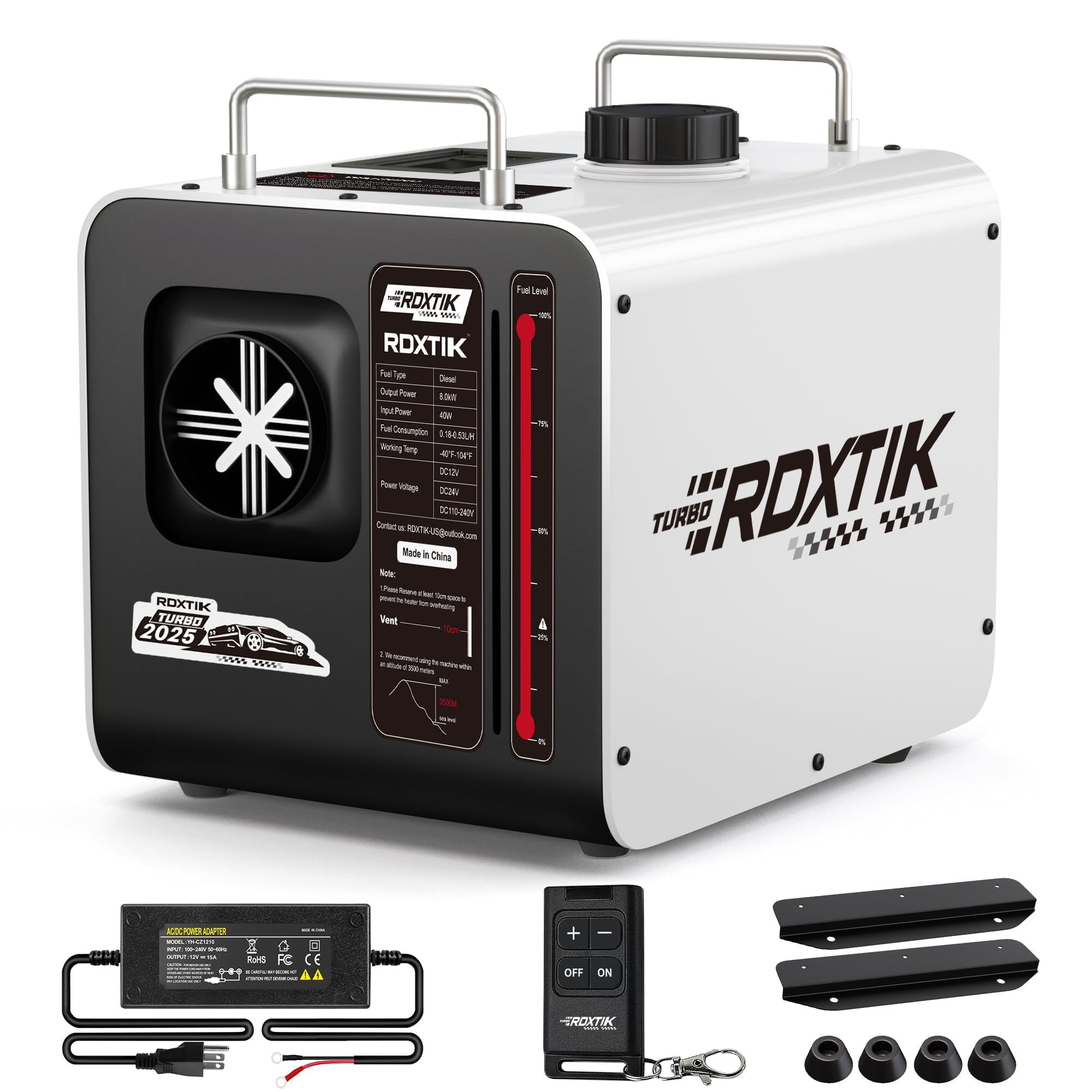
The RDXTIK 8kW diesel heater addresses a common pain point: finding a stable mounting solution for uneven surfaces. It includes three different base options — one with a rubber bottom and one with a metal bottom, plus the option to use no base at all. This flexibility lets you adapt the heater to carpeted RV floors, metal truck beds, or concrete garage slabs without custom fabrication.
Like the SILVEL unit, this model supports 12V, 24V, and 110V power inputs via an included transformer, making it equally useful on the road and at home. The 9-liter fuel tank delivers up to 24 hours of continuous heat, and the consumption rate of 0.18 to 0.53 liters per hour keeps operating costs low. The 2025 upgraded anti-oil leakage design uses an internal thread and additional rubber ring to prevent spills during transit.
The temperature control range spans 46.4 to 96.8 degrees Fahrenheit, with a thermostat that maintains your set point automatically. Overheat protection triggers at 518 degrees Fahrenheit for safety, and the timing function lets you schedule preheating. The LCD display is clear and readable, and the remote control works at a practical distance. For those who need versatile mounting options and multi-voltage capability in a single package, this is a solid pick.
What works
- Three mounting base options
- Multi-voltage with transformer
- Anti-leak fuel cap design
- Good safety features
What doesn’t
- No app or Bluetooth
- 9L tank adequate but not huge
- Limited brand history
8. LF Bros 5kW Diesel Heater 5L
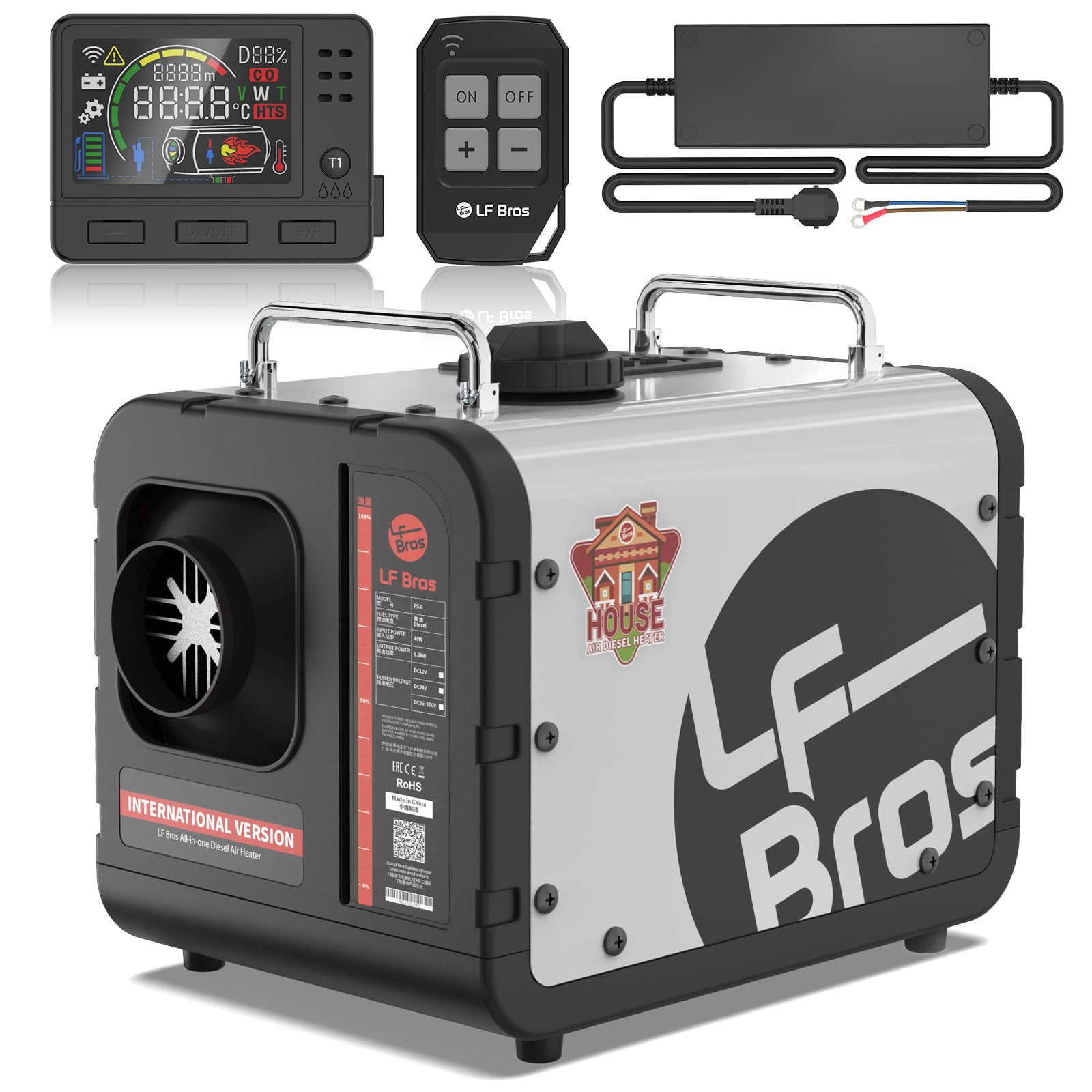
The LF Bros 5kW diesel heater takes a smaller, more portable approach without sacrificing essential features. The 5kW output (approximately 17,000 BTUs) is sufficient for small RVs, truck campers, tents, garages, and workshops up to 269 square feet. The compact dimensions (15 x 9.6 x 11.6 inches) and included carrying box make it easy to store and transport between locations.
The internal thread fuel tank cap prevents oil spillage on rough roads, addressing a common complaint with portable heaters. The kit includes a 110V transformer alongside 12V and 24V support, so you can use it at home without extra purchases. The LCD switch displays working status clearly, and the remote control operates up to 100 feet away. The detailed instruction booklet includes a QR code for video installation guidance.
Fuel consumption ranges from 0.18 to 0.53 liters per hour, and the 5-liter tank provides adequate runtime for overnight use. The working temperature range of minus 40 to plus 104 degrees Fahrenheit covers virtually all winter camping scenarios. The black-and-white aesthetic is clean and professional. For those who want a smaller, lighter unit that still offers multi-voltage flexibility and reliable heat, this is a well-executed option.
What works
- Compact and portable form factor
- Multi-voltage with transformer included
- Anti-leak fuel cap
- Detailed installation guide
What doesn’t
- 5kW output is lower than 8kW competitors
- 5L tank needs more frequent refills
- No Bluetooth or app control
9. Dura Heat 240V Electric Garage Heater
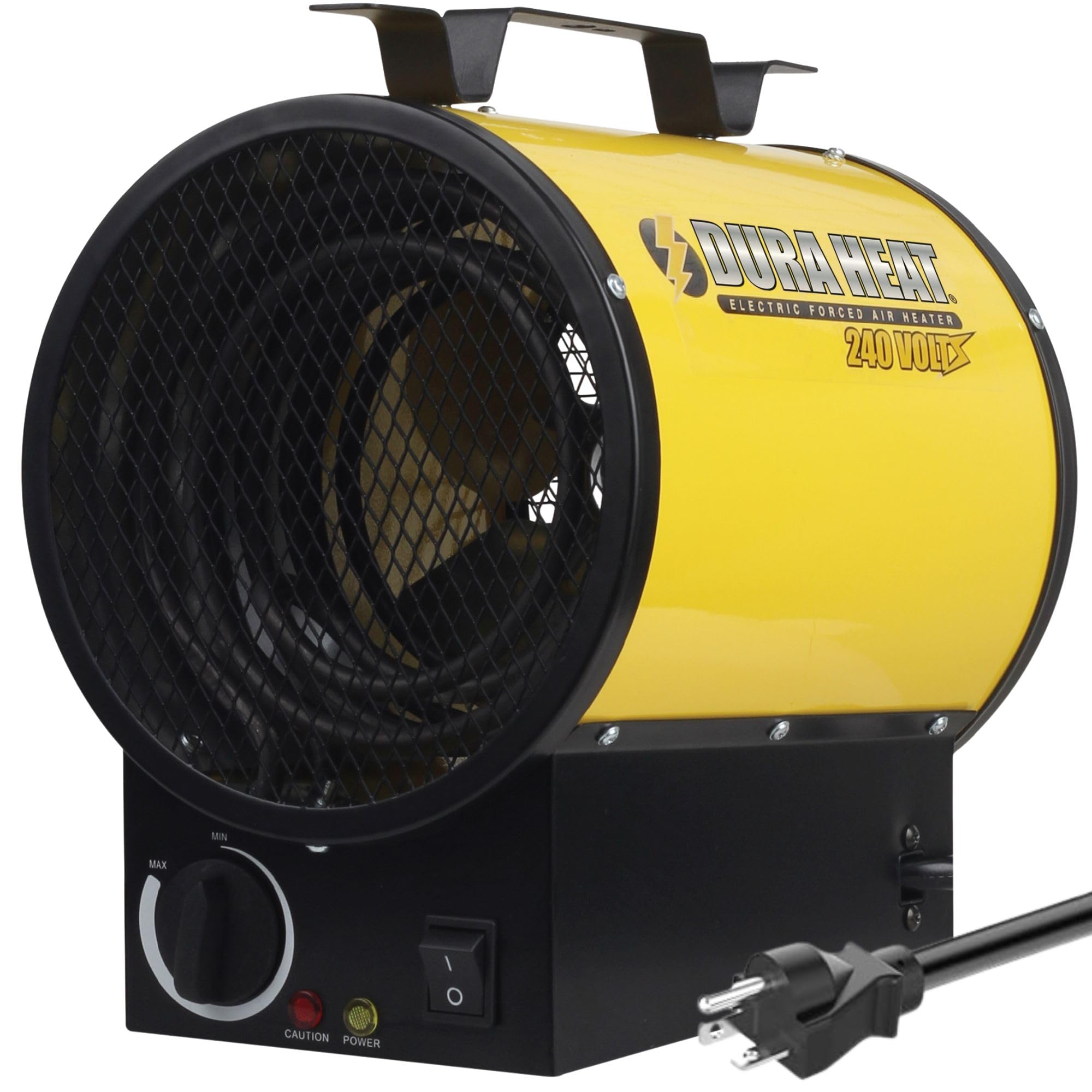
The Dura Heat 240V electric heater occupies a different category from the 12V units on this list — it is a stationary forced-air heater designed for workshops, garages, and warehouses where 240V power is available. With 3,750 watts of heating power (approximately 12,800 BTUs), it can warm up to 500 square feet, making it suitable for home shops and construction sites rather than vehicle cabs.
The wall- and ceiling-mount design keeps the heater out of the way, and the included mounting bracket simplifies installation. The forced air method circulates heat quickly, and the overheat protection ensures safe operation in dusty or cluttered environments. The yellow cabinet is highly visible and built from durable materials that withstand the bumps and knocks of a busy workspace.
This unit runs on 240V at 20 amps, which means it requires a dedicated circuit in most cases. It is not portable in the same sense as the diesel or 12V coolant heaters — it is best suited for a fixed location. For anyone who needs to heat a garage or workshop and already has 240V wiring in place, this is a robust, no-nonsense solution with proven Dura Heat reliability.
What works
- Powerful 3,750W output
- Covers up to 500 sq ft
- Wall/ceiling mount saves floor space
- Overheat protection
What doesn’t
- Requires 240V circuit — not 12V
- Not portable or vehicle-mountable
- No thermostat or remote control
10. Roadpro 12V Ceramic Heater RPSL-681

The Roadpro RPSL-681 is a straightforward 12-volt ceramic heater that plugs directly into your vehicle’s battery via included 15-foot leads with ring terminals. At 300 watts, it provides supplemental warmth rather than primary heat — think of it as a way to take the edge off a cold cab or defog windows without running the engine. It is not designed to heat a large space but works well for directed foot-level warmth.
The burn-guard material covering the heating element adds a layer of safety compared to exposed-coil designs. A simple switch lets you toggle between heat mode and fan-only mode, giving you year-round utility. The adjustable fan speed (low and high) allows some control over airflow intensity, and the compact dimensions (6.6 x 8 x 6.2 inches) make it easy to position on the floor or center console.
Direct battery hookup means no cigarette lighter adapter that could overheat. The 12-gauge wire is thick enough to handle the current without voltage drop. This is the most budget-friendly way to add a small amount of heat to a vehicle, but expectations must be realistic — it will not replace a functioning heater core or compete with diesel-fired units. For minimal investment, it delivers targeted warmth on short trips.
What works
- Simple battery hookup with included leads
- Burn-guard safety material
- Fan-only mode for summer use
- Compact and easy to position
What doesn’t
- 300W output is very low for full cabin heat
- No thermostat control
- Only suitable as supplemental heat
11. Sallurmose 12V Underdash Coolant Heater
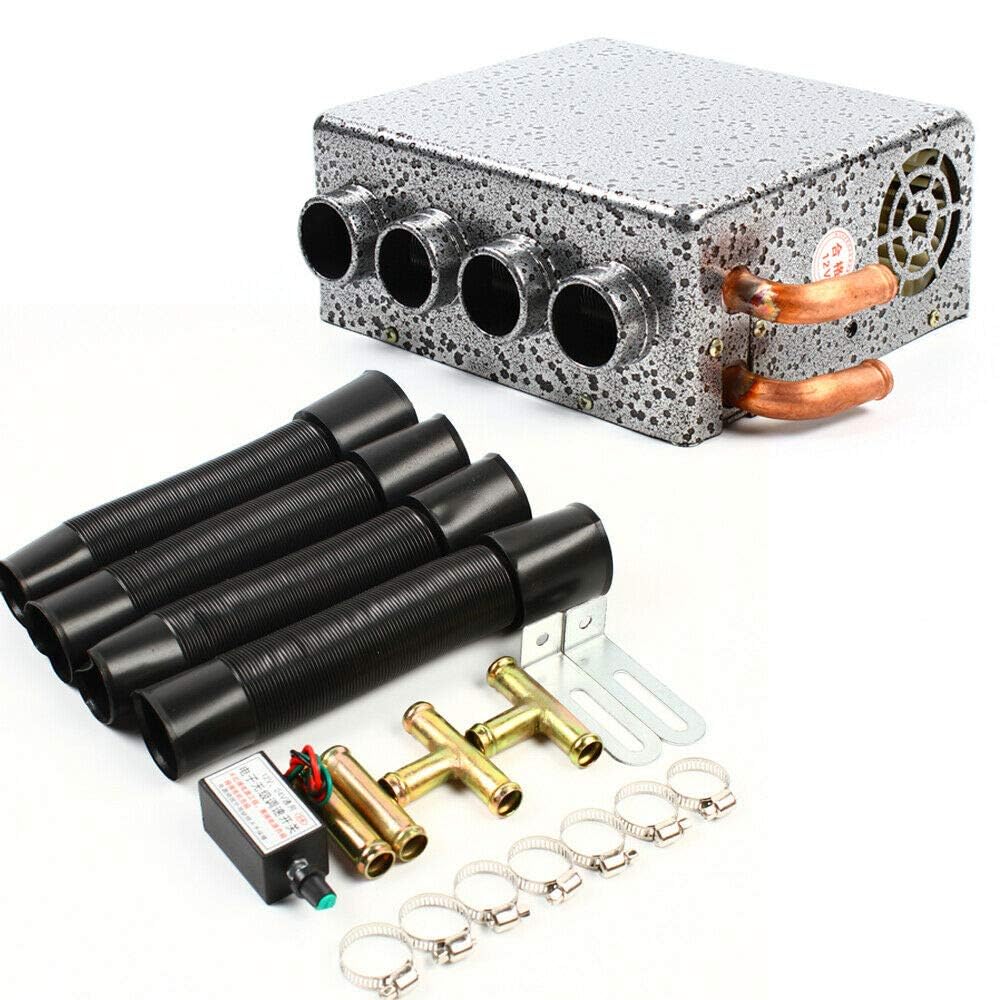
The Sallurmose 12V underdash heater is an energy-efficient coolant-based unit that connects to your vehicle’s engine coolant loop. It draws hot coolant from the engine, passes it through a heater core, and uses a 12V fan to blow warm air into the cabin. This design consumes minimal electricity — only enough to run the fan — and does not burn any additional fuel because it uses waste heat from the engine.
Installation is straightforward for anyone comfortable with basic automotive work. The compact size (11 x 9 x 3.93 inches) fits under most dashboards, and the included mounting brackets and speed control switch make setup simple. The unit uses copper and thickened iron construction for durability in harsh environments. Owners report successful installations on trucks, SUVs, excavators, and even UTVs like the CFMOTO ZFORCE 950.
Owner feedback highlights the easy installation and good heat output for the price, though some note that the included hose clamps are low quality and should be replaced. The stepless adjustment knob allows variable fan speed, and the smooth metal surface cleans easily. This is the most budget-friendly way to restore cabin heat when the factory heater core is bypassed or insufficient, but it requires an engine at operating temperature to produce warmth.
What works
- Uses waste engine heat — no extra fuel
- Compact underdash design
- Simple installation with basic tools
- Stepless fan speed control
What doesn’t
- Requires warm engine coolant to work
- Included hose clamps are weak
- Not effective as a standalone heater when engine is cold
Hardware & Specs Guide
Coolant-Based Heaters
These units tap into the engine’s coolant loop and use a 12V fan to blow heat into the cabin. They require no additional fuel and draw low electrical current (8–15 amps), making them ideal for daily drivers with a functioning cooling system. The trade-off is that they only produce heat when the engine is warm, so they are ineffective immediately after a cold start. Typically constructed from copper and steel with a brushed or painted finish, these heaters measure around 11 x 9 x 4 inches and weigh 6–7 pounds. Installation involves splicing into heater hoses and mounting under the dashboard.
Diesel Air Heaters
These self-contained units burn diesel fuel in a combustion chamber and blow hot air directly into the space. Outputs range from 5kW to 9kW (17,000–30,700 BTUs), sufficient to heat small to medium RVs, truck cabs, and campers. They operate independently of the engine, so they work whether the vehicle is running or parked. Key specifications include fuel consumption (0.12–0.62 L/h), tank capacity (5L–15L), and voltage support (12V, 24V, or 110V). Features like altitude compensation, Bluetooth control, and overheat protection separate premium units from basic models. Weight ranges from 16 to 27 pounds depending on tank size and enclosure type.
Ceramic 12V Heaters
These plug-and-play units use a ceramic heating element and a 12V fan to produce low-level supplemental heat. Typical output is 300W (about 1,024 BTU), which is enough for foot-level warmth or windshield defogging but insufficient for full cabin heating in freezing conditions. They draw 25–30 amps from the battery, so they are best used with the engine running to prevent battery drain. Construction is simple plastic housing with a fan and heating core. At 3–4 pounds, they are highly portable but limited in real-world heat output.
Stationary Electric Garage Heaters
These are high-voltage (240V) forced-air heaters designed for fixed installation in workshops, garages, and warehouses. Output ranges from 3,750W to 5,000W (12,800–17,000 BTUs) and covers 300–500 square feet. They require a dedicated 20-amp circuit and professional wiring. Features include wall/ceiling mounting brackets, overheat protection, and durable metal construction. These are not 12V products and cannot be used in a vehicle, but they are included here for readers who need to heat their garage or shop while working on vehicles.
FAQ
Can a 12V electric heater replace a broken factory heater core?
How long can I run a diesel heater on a single tank?
Do I need to vent a diesel heater if I use it in a tent or vehicle?
What size diesel heater do I need for my RV or truck camper?
Will a 300W ceramic heater drain my car battery?
Final Thoughts: The Verdict
For most buyers, the 12 volt electric heater winner is the TURBRO T8BP 9kW because it combines the highest heat output with Bluetooth app control, multi-voltage support, and altitude compensation in a portable toolbox form factor. If you want smart phone control at a more accessible price, grab the VEVOR 8kW Bluetooth. And for extreme extended runtime with a 15-liter tank and plateau-rated altitude performance, nothing beats the WAYSKA 8kW.

Certification: BSc in Mechanical Engineering
Education: Mechanical engineer
Lives In: 539 W Commerce St, Dallas, TX 75208, USA
Md Amir is an auto mechanic student and writer with over half a decade of experience in the automotive field. He has worked with top automotive brands such as Lexus, Quantum, and also owns two automotive blogs autocarneed.com and taxiwiz.com.