A battery tester with a built-in printer eliminates guesswork, giving you a hard-copy record of voltage, internal resistance, and state of health that customers and warranty desks can trust. Without printed proof, you are left arguing over a screen reading that disappears the moment you disconnect the clamps.
I’m Amir — the founder and writer behind Four Wheel Ask. I have spent years analyzing product specifications, studying owner feedback across hundreds of forums, and comparing the engineering trade-offs that separate a reliable diagnostic tool from a frustrating one.
Managing a busy shop or maintaining your own fleet means the right best battery tester with printer delivers accurate diagnostics and professional printed reports.
How To Choose The Best Battery Tester With Printer
Selecting a battery tester that also prints is about more than just checking voltage. You need a tool that integrates into your workflow, produces readable receipts, and covers the battery chemistries and CCA ranges you encounter daily. Here are the critical factors to evaluate before buying.
Print Technology and Paper Availability
The printer is the entire reason you are looking at this category. Thermal printers are the standard because they have no ink or ribbon to replace, but not all thermal mechanisms are equal. Look for jam-free feed, fast print speed, and easy paper reload. Standard 58 mm thermal paper is widely available and inexpensive, while proprietary rolls can become a hassle and a hidden cost over time.
Battery Chemistry and CCA Range
Modern vehicles use flooded lead-acid, AGM, EFB, Gel, and lithium chemistries. Your tester must support the specific types you service. CCA range matters just as much — a unit rated for 100-2000 CCA covers most cars and light trucks, but heavy-duty commercial work may require 3000 CCA or more. Check that the tester also handles 6V, 12V, and 24V systems if you work on motorcycles, marine, or fleet vehicles.
Diagnostic Depth Beyond the Battery
A tester that only gives a good-or-bad verdict is not enough. Look for units that measure internal resistance, state of charge (SOC), state of health (SOH), and perform separate cranking and charging system tests. These metrics tell you whether the battery is aging, the alternator is underperforming, or the starter is drawing too much current. The best tools combine all these into a single printed report.
Build Quality and Cable Design
Shops and mobile techs put testers through daily abuse. Reinforced cables, spark-free clamps, reverse polarity protection, and a rugged housing separate professional-grade tools from consumer toys. Cable length also matters — a 6-foot or longer lead makes in-vehicle testing much easier without having to balance the unit on the engine bay.
Quick Comparison
On smaller screens, swipe sideways to see the full table.
| Model | Category | Best For | Key Spec | Amazon |
|---|---|---|---|---|
| FOXWELL BT780 | Premium | Professional Shop Diagnostics | 6V/12V/24V, 100-2000 CCA, built-in power supply | Amazon |
| KONNWEI KW720 | Mid-Range | Voltage Waveform Analysis | 6V/12V/24V, 8.8 ft cable, large color screen | Amazon |
| TOPDON BT300P | Mid-Range | Value-Conscious Shops | 12V/24V, 100-2000 CCA, spark-free clamps | Amazon |
| Autel BT506 | Mid-Range | Bluetooth + Scanner Pairing | 6V/12V, 100-2000 CCA, adaptive conductance | Amazon |
| Acclope BT90 PRO | Value | Cloud-Based Reporting | 6V/12V/24V, 30-3800 CCA, ambient temp feed | Amazon |
| Autel BT608 (E) | Premium | Full System + Battery Diagnostics | 6V/12V, 100-3000 CCA, OE-level scan tool | Amazon |
| VDIAGTOOL VD31 | Budget | DIY with Key Fob Testing | OBD2 scanner + battery + key fob tester | Amazon |
| ELMCONFIG BM550U | Budget | Entry-Level Professional Reports | 6V/12V/24V, 100-2000 CCA, built-in printer | Amazon |
| Clore Solar BA327 | Premium | High-Volume Shop Durability | 6V/12V, 40-2000 CCA, 1.5-30V operating range | Amazon |
| TopDiag M300 | Specialty | Motorcycle Full Diagnostics | 5-inch Android, 17+ services, built-in printer | Amazon |
| ANCEL X7HD | Heavy-Duty | Semi-Truck Fleet Maintenance | 10.1-inch Android, 42+ resets, full system scan | Amazon |
In-Depth Reviews
1. FOXWELL BT780
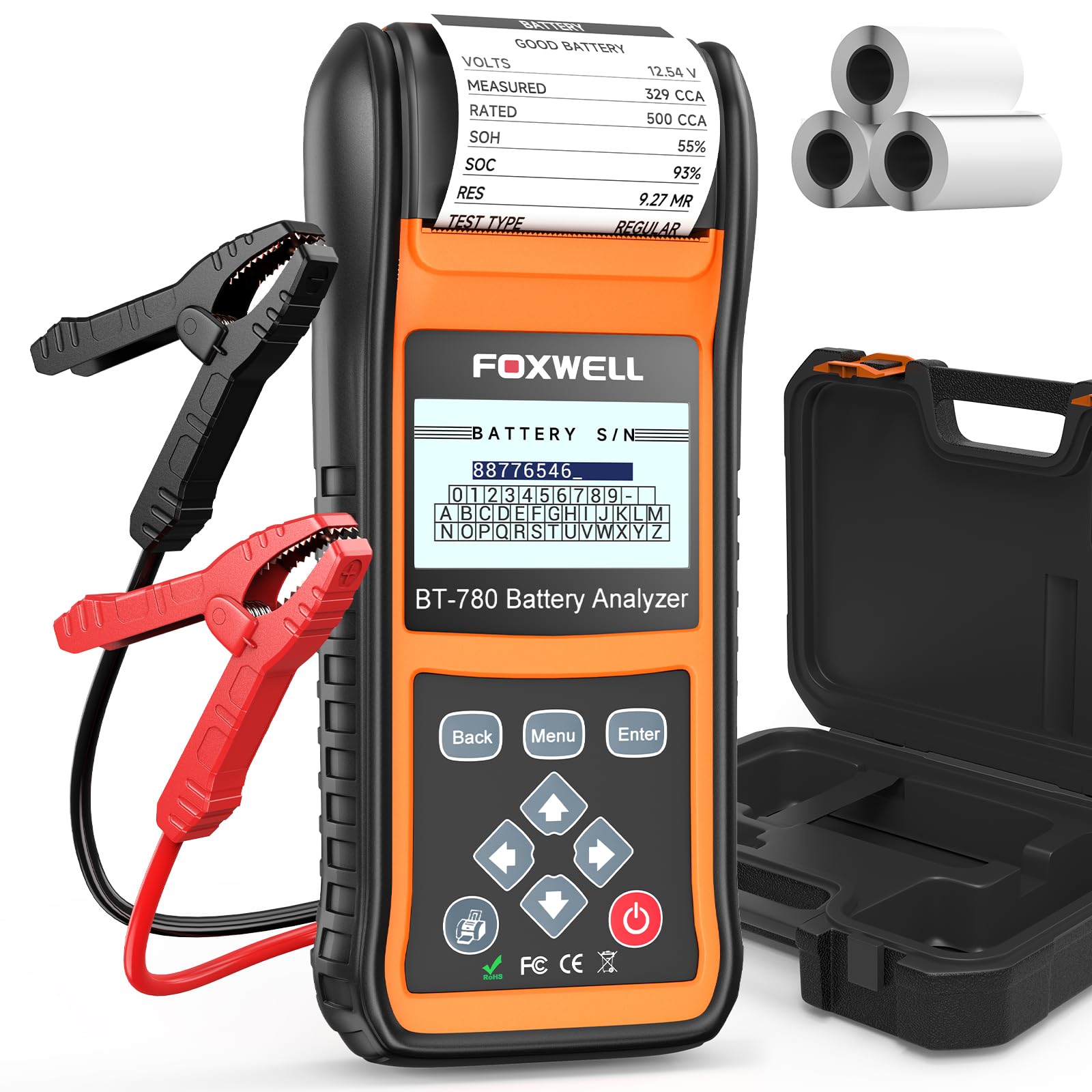
The FOXWELL BT780 sits at the top of this category because it solves the single biggest accuracy problem in battery testing: power source interference. Most testers draw power from the battery being tested, which skews readings on weak or low-voltage units. The BT780 has its own internal power supply, delivering stable, interference-free diagnostics every time.
Its thermal printer is engineered for jam-free operation, producing clean receipts in seconds without needing an app or subscription. The unit supports up to 4 user profiles and customizable report headers, which makes it a natural fit for shops that need to assign tests to specific technicians or track results by vehicle. The 6.5-foot reinforced cables and heavy-duty clamps handle daily professional use without fraying or losing contact.
Covering 6V, 12V, and 24V systems with a 100-2000 CCA range, the BT780 works on flooded, AGM, EFB, and gel batteries across cars, trucks, motorcycles, marine, and commercial fleet vehicles. Owner reports consistently highlight the 99.9 percent accuracy claim as legitimate, with many stating it performs like units costing several times more.
What works
- Internal power supply eliminates false readings on weak batteries
- Jam-free thermal printer with 4 user profiles for shop tracking
- Reinforced 6.5 ft cables and heavy-duty clamps built for daily use
What doesn’t
- Cable connector screw cap can be difficult to tighten by hand
- Date and time settings are not adjustable, affecting report accuracy
2. KONNWEI KW720

The KONNWEI KW720 stands out for its voltage waveform graphing capability, a feature rarely found at this price tier. Instead of delivering a single pass-fail verdict, it captures voltage changes over time with up to 20 data points per second and displays them as a waveform. This allows a technician to spot intermittent dips, regulator issues, or starter draw problems that a static test would miss.
The large color screen is genuinely readable in bright daylight, which matters for mobile techs working outside. The 8.8-foot cable is the longest in this roundup, making in-vehicle testing much more convenient without having to hold the unit or find a place to perch it. The thermal printer is built-in and ready to go out of the box with paper included.
Owner reviews frequently mention the unit’s ability to predict battery failure before it happens, catching weak cells that conventional testers call good. The 6V, 12V, and 24V coverage with 100-2000 CCA support makes it versatile across car, truck, and motorcycle applications. Life software updates keep the algorithms current without additional cost.
What works
- Voltage waveform graphing catches intermittent electrical faults
- 8.8 ft cable allows easy in-vehicle testing without awkward positioning
- Color screen remains readable in direct sunlight
What doesn’t
- Carrying case requires disconnecting cables to zip closed, risking connector wear
- Menu navigation has a slight learning curve for new users
3. TOPDON BT300P

The TOPDON BT300P delivers professional-grade battery diagnostics at a price that undercuts most competitors with built-in printers. It uses TOPDON’s conductive testing technology, which the company rates at 99.5 percent accuracy, and tests 12V and 24V systems across flooded, AGM, EFB, and gel batteries from 100 to 2000 CCA. The 2.4-inch color screen presents results clearly in any lighting.
Safety is a strong selling point here. The copper clamps are spark-free, the wiring is PVC-coated, and the unit has automatic reverse polarity protection. The insulated ABS shell prevents current leaks and withstands drops common in busy shop environments. The thermal printer uses standard paper rolls, with three included out of the box.
Real-world owner feedback confirms the accuracy claim. Multiple users report that printouts from the BT300P were accepted as proof for warranty battery replacements at auto parts stores. The unit also performs cranking and charging system tests for both 12V and 24V vehicles, covering cars, trucks, RVs, boats, and lawn equipment.
What works
- Spark-free clamps and reverse polarity protection improve shop safety
- Printed results accepted by parts stores for warranty replacement
- Covers 12V and 24V systems with 100-2000 CCA range
What doesn’t
- Menu system takes time to learn fully
- Some units required replacement due to low-voltage reading errors
4. Autel MaxiBAS BT506
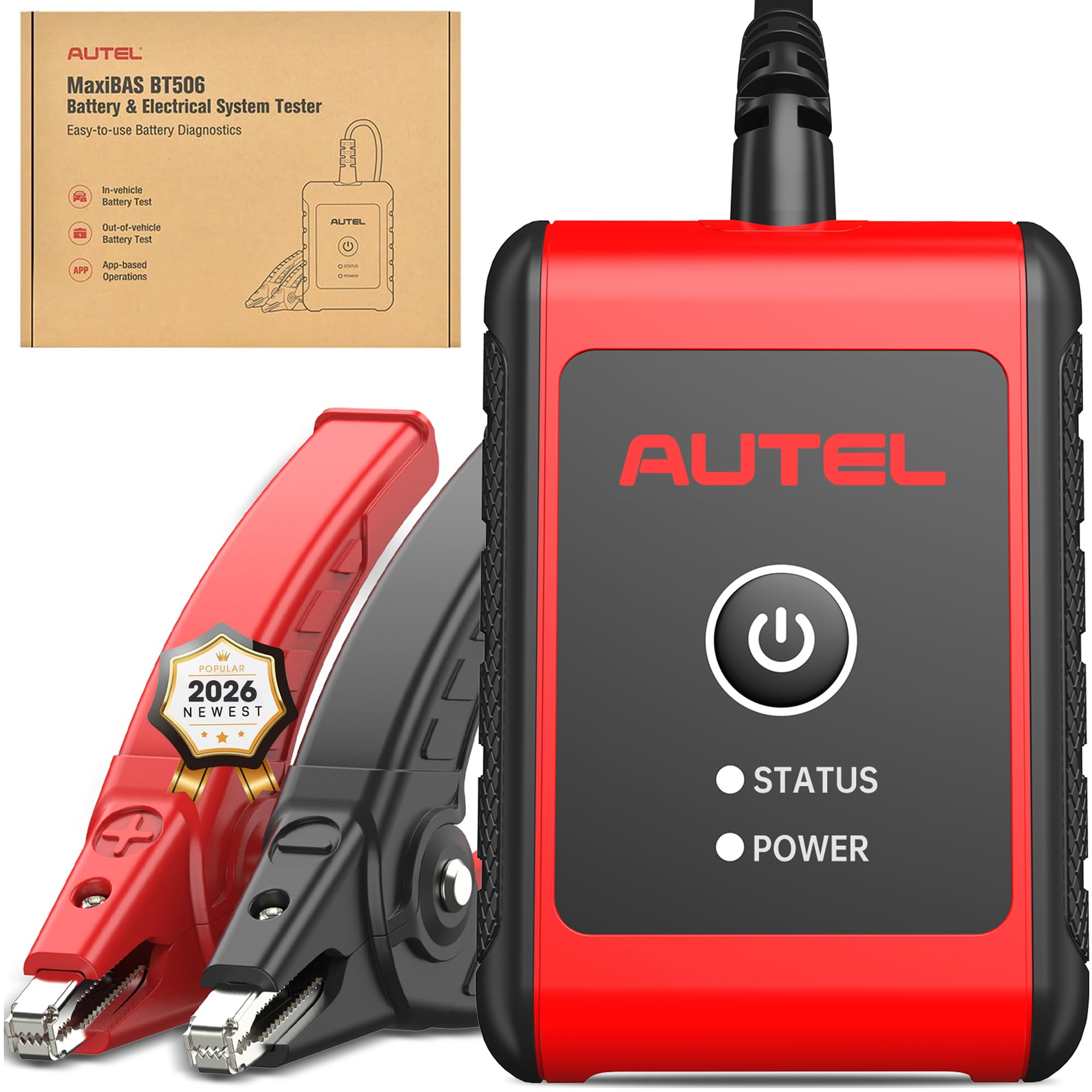
The Autel BT506 brings adaptive conductance technology to a compact, Bluetooth-enabled format that pairs seamlessly with both smartphones and Autel diagnostic scanners. This approach gives you battery test results on a larger screen with richer data visualization than a standalone unit can offer. The tester covers 6V and 12V batteries from 100 to 2000 CCA across flooded, AGM, EFB, and gel types.
Beyond battery health, the BT506 performs cranking and charging system tests that measure starting voltage, current, run-up time, and alternator ripple. These combined tests help isolate whether the issue is the battery, the starter, or the charging system in a single workflow. The ability to pair with Autel’s MaxiAP200 App means you can view, share, and print reports without needing a dedicated printer module.
Owner reviews consistently praise the accuracy of the adaptive conductance method, with many noting that it caught failing batteries that simpler testers called good. The unit also stores test history for trend tracking over time. For shops already invested in the Autel ecosystem, the BT506 adds battery-specific diagnostics without adding another screen to manage.
What works
- Adaptive conductance reduces misdiagnosis on weak or sulfated batteries
- Bluetooth pairing with smartphone and Autel scanners for flexible reporting
- Compact form factor fits easily in a tool bag
What doesn’t
- Requires external device for printing; no built-in printer
- Not compatible with Autel wired scanners or IM Series tools
5. Acclope BT90 PRO
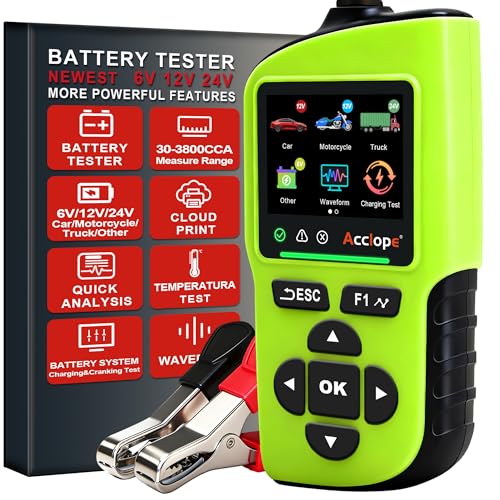
The Acclope BT90 PRO introduces cloud-based reporting that eliminates the need to photograph screens or save paper slips. After a test, a QR code appears on screen that links to a cloud report containing SOH, SOC, voltage, resistance, and cranking data. This makes sharing results with customers or fleet managers seamless and time-stamped for traceability.
What sets the BT90 PRO apart is its ambient temperature feed, which feeds real-time temperature data directly into the testing algorithm. Temperature swings are a known cause of false readings — cold batteries test weaker, hot batteries test stronger — and this unit corrects for that bias. The result is more accurate cold-start assessments and fewer warranty disputes.
The CCA range is exceptionally wide at 30 to 3800 CCA, covering everything from small motorcycle batteries to heavy-duty commercial packs. It supports 6V, 12V, and 24V systems with chemistry-specific algorithms for flooded, AGM, EFB, gel, and lithium. The 4-metric diagnosis view gives a cohesive decision of Good, Recharge, or Replace, reducing unnecessary battery swaps.
What works
- Cloud report via QR code simplifies customer documentation
- Ambient temperature correction prevents seasonal misdiagnosis
- Wide 30-3800 CCA range covers motorcycles to heavy trucks
What doesn’t
- Requires a smartphone to access cloud reports on site
- Temperature mismatch between battery and ambient air can still cause minor shifts
6. Autel MaxiBAS BT608 (E)
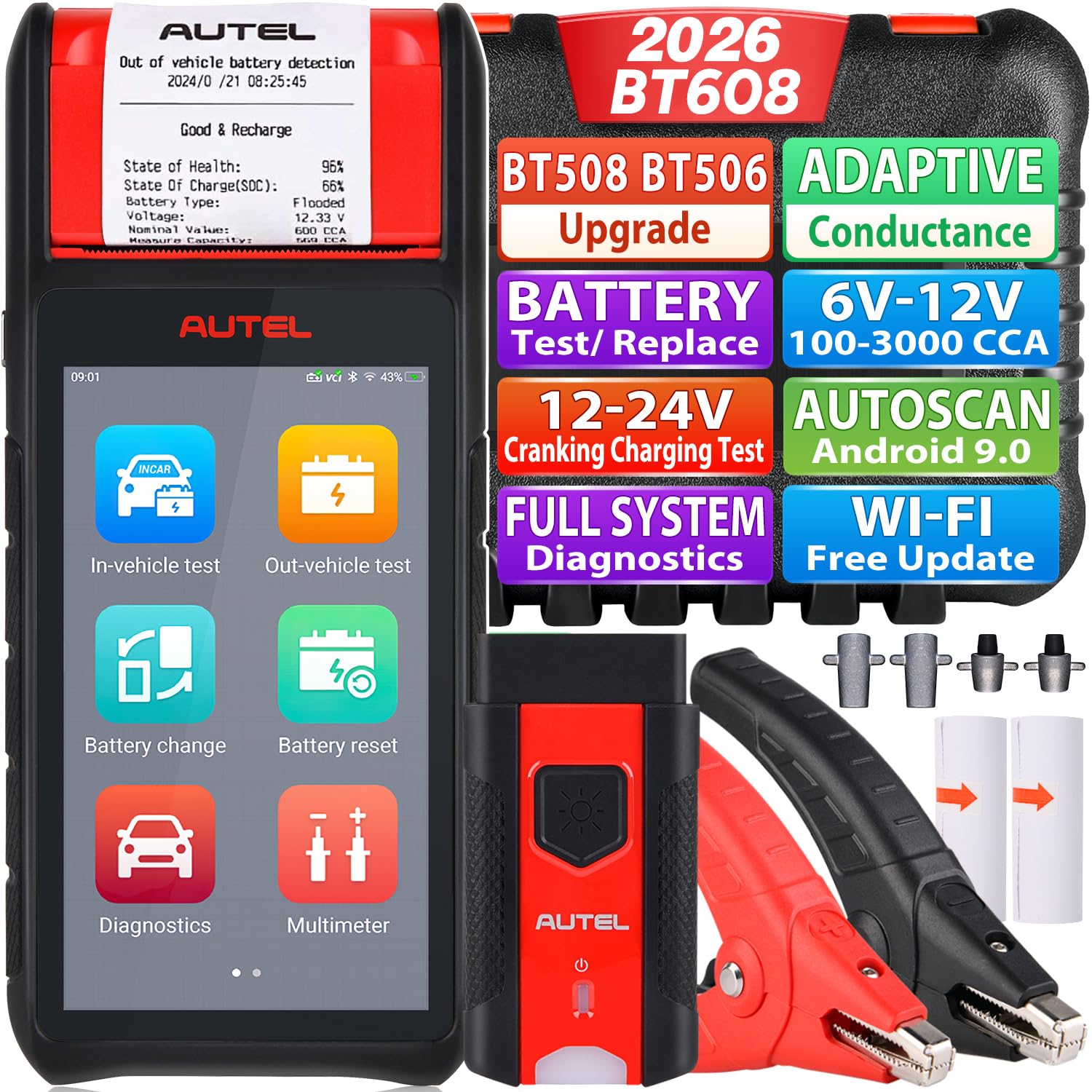
The Autel BT608 (E) is a 2-in-1 tool that combines professional battery load testing with full-vehicle system diagnostics. It covers 6V and 12V batteries from 100 to 3000 CCA, using adaptive conductance technology to evaluate cold cranking performance and reserve capacity. The same unit also functions as a scan tool for 80-plus vehicle brands, reading and clearing DTCs, accessing live data, and viewing freeze frames.
This device supports cranking and charging system analysis for 12V and 24V systems, plus electrical reset functions for 53-plus vehicle makes. The built-in thermal printer produces instant reports, while the cloud-based report management system lets you share PDFs via QR code, email, or text message. The integrated Wi-Fi and Bluetooth connectivity enable lifetime free software updates.
Owner feedback highlights the BT608’s ability to test 48V hybrid batteries and guide battery registration and reset procedures. The main critique involves occasional Wi-Fi connection issues that require a power cycle to resolve. Overall, the BT608 replaces both a dedicated battery tester and a separate scan tool, making it a cost-effective option for professional workshops.
What works
- Combines battery tester and full system scan tool in one unit
- 100-3000 CCA range covers cars, SUVs, trucks, and commercial vehicles
- Cloud-based report management with QR code sharing
What doesn’t
- Wi-Fi connection can be unreliable and require power cycle
- Screen may freeze under heavy use, needing reboot
7. VDIAGTOOL VD31
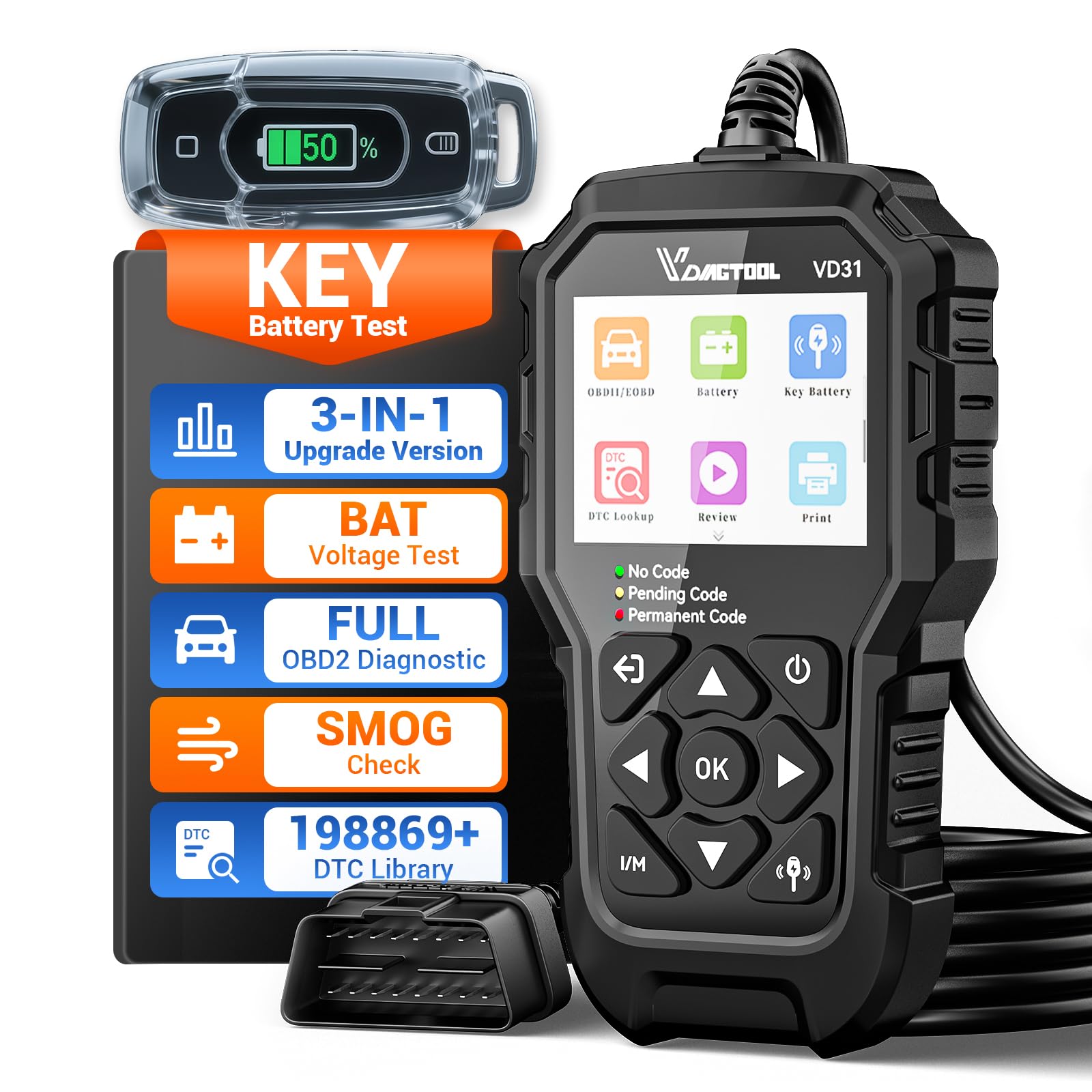
The VDIAGTOOL VD31 is a 3-in-1 device that functions as an OBD2 code reader, a car battery tester, and a remote key fob battery tester. The key fob feature is genuinely useful — it includes a dedicated hotkey and a 9V battery for standalone operation, so you can check key battery voltage without having the vehicle nearby. Simply enter the key frequency or select the car model from the menu for an instant reading.
As an OBD2 scanner, it performs all 10 essential test modes including live data with 4-in-1 graphing, freeze frame, I/M readiness, and Mode 6 data. The car battery test checks health and voltage directly through the OBD2 port, while the key fob test adds a layer of preventive diagnostics that most scanners ignore. The 2.8-inch display is clear and the menu is intuitive enough for non-mechanics.
Owner reviews consistently mention the value of the key fob tester for diagnosing intermittent remote issues. The unit supports 1996 and newer US vehicles plus 2000 and newer European and Asian models. Life updates via USB ensure the tool stays current without requiring new hardware.
What works
- Key fob battery testing prevents surprise dead remotes
- Graphing live data and Mode 6 access are rare at this price
- Plug-and-play OBD2 operation with no battery needed for scanning
What doesn’t
- Does not support ABS, SRS, TPMS, or airbag diagnostics
- Validation code process for updates can time out
8. ELMCONFIG BM550U
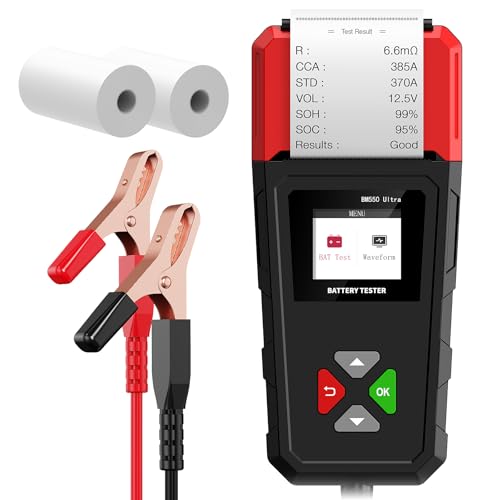
The ELMCONFIG BM550U is the most accessible entry point for anyone who needs printed battery reports without spending heavily. It covers 6V, 12V, and 24V systems with a 100-2000 CCA range and supports flooded, AGM, gel, and lithium chemistries. The built-in thermal printer generates standardized paper reports immediately after each test, making it easy to archive or share results.
Despite its budget-friendly positioning, the unit includes high-precision sensors and a stable system that minimizes human error. The impedance testing method provides readings for internal resistance, SOH, SOC, and CCA values. Owner reviews note that the tester accurately identified failing batteries that other tools called good, and the printed output was accepted for warranty claims.
The build uses industrial-grade materials intended to withstand harsh workshop environments, and the unit includes protective safeguards against short circuits and overvoltage. The main trade-off is a plastic-heavy feel that some owners describe as toy-like, but functionality remains solid for the price point. Two rolls of thermal paper are included to get started.
What works
- Built-in printer at a highly accessible price point
- Accurate impedance testing detected failing batteries competitors missed
- Wide chemistry support including lithium
What doesn’t
- Plastic housing feels less durable than professional-grade alternatives
- Does not detect gradual battery failure, only usable versus dead
9. Clore Solar BA327

The Clore Solar BA327 has been a staple in professional shops for years, and its longevity in the market speaks to its build quality. It tests 6V and 12V batteries from 40 to 2000 CCA with an operating voltage range of 1.5 to 30V, covering conventional flooded, AGM, gel cell, spiral wound, and deep cycle batteries. The built-in thermal printer uses standard paper and produces two copies per test for client documentation.
The BA327 also performs 6V and 12V battery testing alongside 6V, 12V, and 24V system testing, giving it broader coverage than many newer competitors. The diode ripple test is reasonably accurate for alternator diagnostics, and the unit uses standard CCA, DIN, IEC, EN, and JIS rating systems. The long lead can be slightly inconvenient for storage, but the overall durability is well-documented.
Owner reviews from high-volume shops report units lasting 2.5 years of heavy daily use — over 20 tests per week — before any issues arise. The thermo paper is easy to replace and widely available. While it lacks the smartphone connectivity of newer models, the BA327 remains a reliable workhorse for shops that prioritize repeatable accuracy over flashy features.
What works
- Proven durability with years of daily shop use reported
- Tests conventional, AGM, gel, spiral wound, and deep cycle batteries
- Prints two copies per test for customer and shop records
What doesn’t
- Long lead is inconvenient for storage and cable management
- No Bluetooth or cloud features for digital reporting
10. TopDiag M300
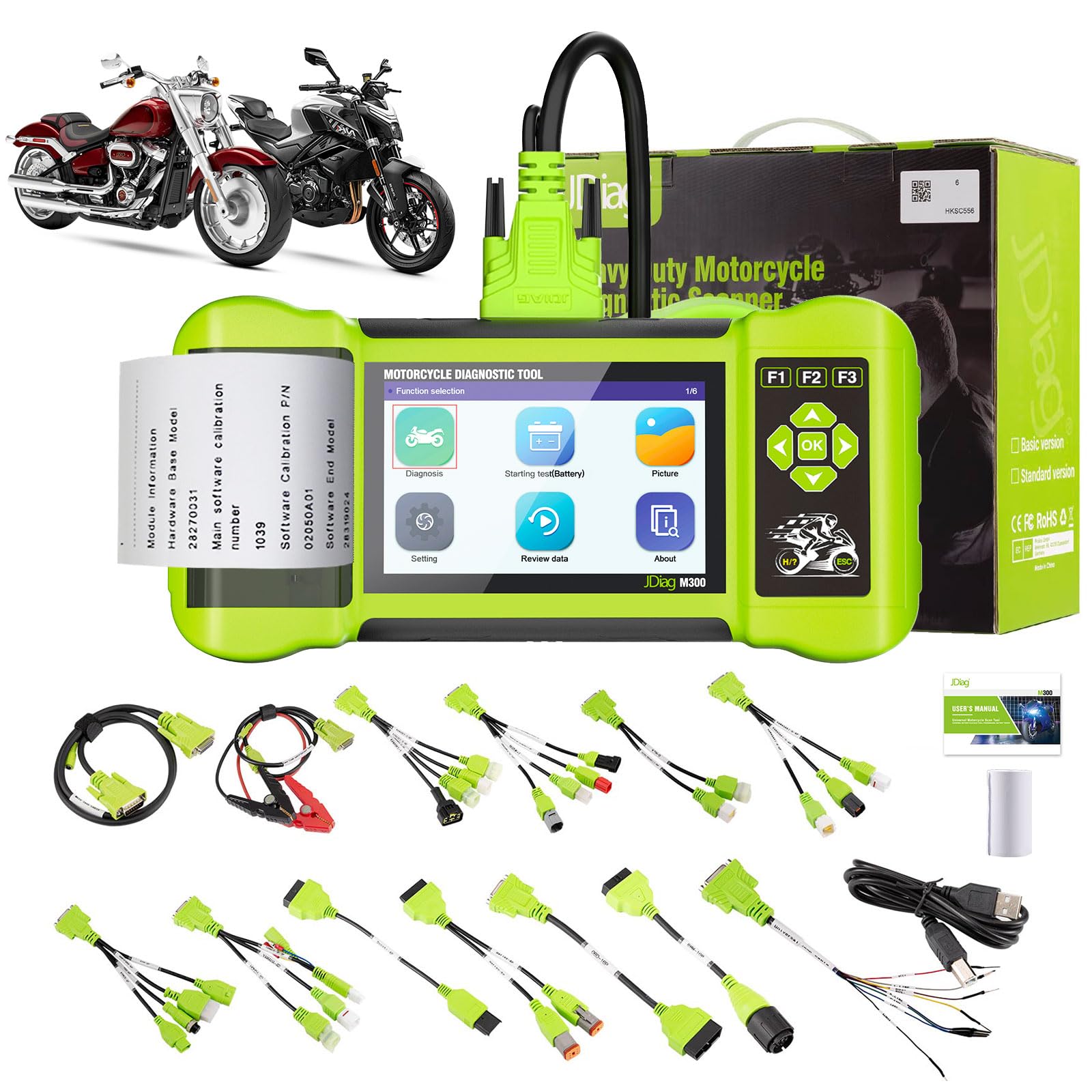
The TopDiag M300 is a specialized diagnostic tool built primarily for motorcycles, with a built-in printer for generating test reports. It runs on Android 11 with a 5-inch color screen and performs full system diagnostics including engine, ABS, TPMS, suspension, ignition, EPS, and traction control. The battery test function measures voltage, CCA, and SOC, and prints the results directly for documentation.
Beyond battery testing, the M300 supports 17-plus service functions such as CO idle speed adjustment, throttle valve position sensor adjustment, actuator testing, and freeze frame data. The universal cable kit includes 4-pin and 6-pin connectors to fit various motorcycle makes. The printer output includes test results for battery, starting, and charging systems, which is useful for shop record-keeping and customer handoffs.
User reviews highlight easy plug-and-play setup and accurate real-time data. The main concern is durability in cold environments — storing the unit in unheated spaces during winter can damage the electronics. The M300 fills a specific niche for motorcycle specialists who need both diagnostic scanning and printed battery reports in one device.
What works
- Built-in printer with battery health documentation for motorcycle service
- 17+ service functions including CO idle and TPS adjustment
- Universal cable kit with 4-pin and 6-pin connectors
What doesn’t
- Cold storage kills the unit; must be kept in climate-controlled space
- Some units experience intermittent communication errors
11. ANCEL X7HD
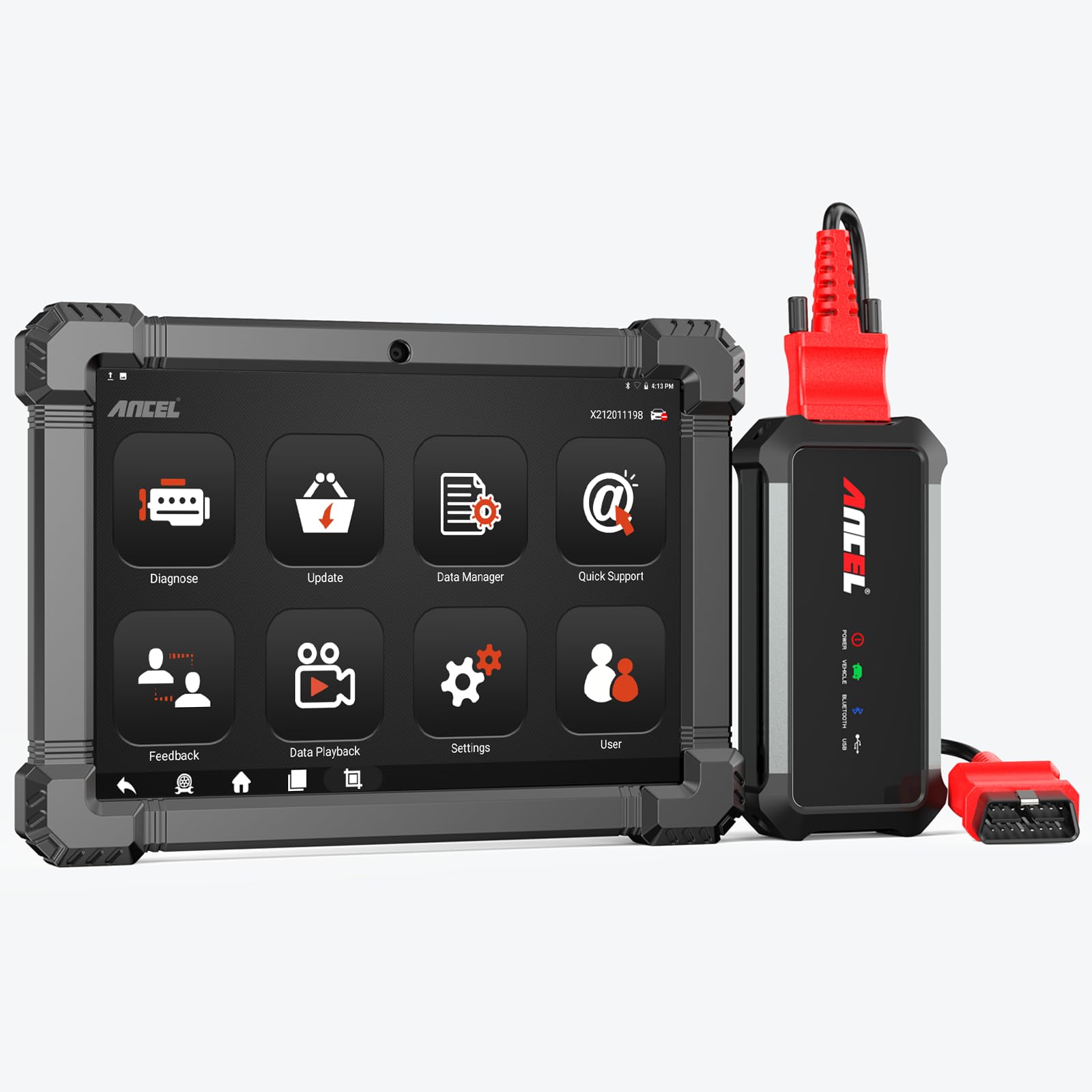
The ANCEL X7HD is a heavy-duty truck scanner that includes battery testing capabilities as part of its comprehensive diagnostic suite. It runs on Android with a 10.1-inch display and supports full system diagnostics for semi trucks, light trucks, buses, and commercial vehicles. The battery test is performed via dedicated clamps, and results can be printed using the included printer lead.
With 42-plus reset functions including DPF forced regeneration, injector coding, ECU coding, and speed limit reset, the X7HD is built for heavy-duty shop environments. It covers over 100 brands and supports bidirectional control, active tests, and graphing live data. The 6000 mAh battery and Bluetooth 5.0 connectivity make it portable for mobile diagnostics.
Owner feedback is mixed for Volvo trucks specifically, with some functions reported as non-functional. However, for mixed-brand fleets including Cummins, Detroit, and Caterpillar, performance is rated highly. The X7HD is not a dedicated battery tester with printer in the traditional sense, but it serves fleet operators who need both heavy-duty diagnostics and battery documentation in a single platform.
What works
- Comprehensive heavy-duty diagnostics with 42+ reset services
- Large 10.1-inch Android display with Bluetooth 5.0
- DPF forced regeneration and ECU coding for commercial vehicles
What doesn’t
- Volvo truck compatibility has significant functional gaps
- Battery test is an add-on function, not the primary design focus
Hardware & Specs Guide
Conductance vs. Load Testing
Conductance testing measures a battery’s ability to conduct current by applying a small AC signal and measuring internal resistance. It is faster, safer (no heat generation), and works on partially charged batteries. Load testing applies a high current draw for a set time, which stresses the battery and requires a full charge for accurate results. Most modern battery testers with printers use conductance technology because it allows in-vehicle testing without disconnecting the battery and produces repeatable results without draining the battery.
Thermal Printer Types and Paper
Two main thermal printer mechanisms exist: direct thermal and thermal transfer. Direct thermal printers use heat-sensitive paper that darkens where the print head applies heat. This is the standard for automotive battery testers because the mechanism is simple, requires no ink or toner, and produces durable receipts. Paper width is typically 58 mm, and roll diameter varies between 20-50 mm. Refill paper is widely available and inexpensive. Avoid testers that use proprietary paper cartridges, as ongoing supply costs can exceed the tool’s value within months.
Internal Resistance and Its Meaning
Internal resistance measured in milliohms is the single most informative metric for battery health. As a battery ages, its internal resistance rises due to sulfation and plate degradation. A new battery typically has very low internal resistance (2-8 mOhms depending on size and chemistry). A value above 10-12 mOhms often indicates a battery nearing end of life. Measuring resistance allows a tester to predict failure before it happens, which is why conductance-based testers are preferred for preventative maintenance programs.
CCA Standards and Conversions
CCA (Cold Cranking Amps) measures a battery’s ability to start an engine at 0°F. Multiple rating standards exist: SAE (USA), EN (European), DIN (German), IEC (International), and JIS (Japanese). An SAE rating is typically 1.3 times higher than DIN, while EN sits between SAE and DIN. A good battery tester with printer will support multiple standards and auto-convert between them. This matters when servicing imported vehicles or when replacing a battery with one from a different region.
FAQ
Do I need a battery tester with a printer or can I just photograph the screen?
What is the difference between CCA, CA, and MCA ratings?
Can a battery tester with printer test lithium-ion or LiFePO4 batteries?
How often should thermal printer paper be replaced?
Can these testers diagnose a bad alternator or starter?
Final Thoughts: The Verdict
For most buyers, the best battery tester with printer winner is the FOXWELL BT780 because its internal power supply eliminates a major source of inaccuracy, the jam-free printer works flawlessly, and the multi-user profile system fits professional shop workflows. If you want voltage waveform analysis for deep electrical troubleshooting, grab the KONNWEI KW720. And for a value-conscious purchase that still delivers professional printed reports, nothing beats the TOPDON BT300P.

Certification: BSc in Mechanical Engineering
Education: Mechanical engineer
Lives In: 539 W Commerce St, Dallas, TX 75208, USA
Md Amir is an auto mechanic student and writer with over half a decade of experience in the automotive field. He has worked with top automotive brands such as Lexus, Quantum, and also owns two automotive blogs autocarneed.com and taxiwiz.com.