Automotive electrical failures rarely start with a dramatic short — they begin with corrosion, voltage drop, or insulation breakdown that slowly drains performance until a component stops working entirely. The conductor you choose between the battery and the load determines whether that circuit stays reliable for years or becomes a recurring headache.
I’m Amir — the founder and writer behind Four Wheel Ask. I’ve spent years studying wire construction standards, comparing conductor metallurgy, analyzing insulation compounds, and aggregating long-term owner reliability data across thousands of automotive electrical installations.
From tinned copper stranding to temperature ratings and voltage thresholds, the details matter more than most DIYers realize. After analyzing many wiring kits, I have compiled the definitive guide to help you select the best wire for automotive use for your next project.
How To Choose The Best Wire For Automotive Use
Automotive wire is not a commodity item despite how casually it gets purchased. The conductor material, stranding count, insulation compound, and temperature rating all determine whether a wiring job holds up over years of vibration, heat cycling, and moisture exposure. Understanding these variables separates a lasting installation from one that fails at the worst possible moment.
Conductor Material: OFC Copper vs. CCA
Oxygen-Free Copper (OFC) delivers the lowest resistance per gauge and resists corrosion far better than Copper Clad Aluminum (CCA). CCA wire uses an aluminum core with a thin copper coating — it saves weight and upfront cost but carries roughly 40 percent more resistance than pure copper of the same gauge. For high-current circuits like amplifier power feeds, battery cables, or inverter wiring, OFC is the only reliable choice. CCA works for low-draw applications such as lighting circuits or signal wires where voltage drop is less critical.
Stranding and Flexibility
Fine-stranded wire bends more easily and withstands repeated vibration without work-hardening and fracturing. Marine-grade tinned copper typically uses a larger number of smaller strands compared to standard primary wire, which makes routing in tight engine bays or through conduit much simpler. Stiffer wire with fewer strands holds its shape but can fatigue at termination points over time, especially in mobile applications.
Insulation Rating and Temperature Tolerance
The jacket material must handle under-hood temperatures that often exceed 200 degrees Fahrenheit near exhaust components or turbochargers. Look for insulation rated to at least 105 degrees Celsius dry and 75 degrees Celsius wet. Voltage ratings of 600 volts provide ample headroom for 12-volt and 24-volt systems, ensuring the dielectric strength holds up even when abrasion or chafing occurs over years of service.
Quick Comparison
On smaller screens, swipe sideways to see the full table.
| Model | Category | Best For | Key Spec | Amazon |
|---|---|---|---|---|
| NOVINO 12 AWG | Marine Grade | Heavy-Duty Wiring | 100ft, Tinned OFC Copper | Amazon |
| NOVINO 10 AWG | Marine Grade | High-Current Circuits | 60ft, Tinned OFC Copper | Amazon |
| NOVINO 14 AWG | Marine Grade | General Purpose | 60ft, Tinned OFC Copper | Amazon |
| NOVINO 16 AWG | Marine Grade | Signal and Lighting | 100ft, Tinned OFC Copper | Amazon |
| GEARit 10 AWG CCA | CCA Power | Audio and Solar | 100ft, Copper Clad Aluminum | Amazon |
In‑Depth Reviews
1. NOVINO 12 Gauge Marine Wire
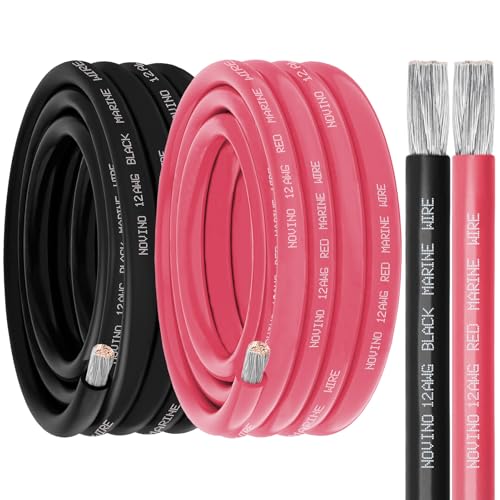
The NOVINO 12 AWG kit delivers 50 feet each of red and black tinned oxygen-free copper — 100 feet total — making it the most versatile length-to-gauge combination in this lineup. True 12 AWG stranding with thick PVC insulation rated to 600 volts and 105 degrees Celsius dry means this wire handles substantial current loads without derating concerns. The tinned coating on every strand prevents corrosion even when the jacket gets nicked or terminals are exposed to moisture, a common failure point in untreated copper wire.
Owner feedback consistently highlights the flexibility of the stranding and the toughness of the insulation during routing in tight engine compartments and boat helm consoles. Multiple verified buyers used this exact kit for amplifier power feeds, bilge pump rewiring, and trolling motor connections without experiencing voltage drop or insulation damage during installation. The UL 1426 and ABYC compliance provides independent verification that the wire meets recognized marine and automotive standards rather than relying on self-reported specifications.
For any project requiring a robust 12 AWG conductor with proven corrosion resistance and full-length color-coded polarity marking, this NOVINO kit offers the best balance of conductor quality and usable length. It suits both dedicated automotive rewiring jobs and dual-purpose marine/overland builds where exposure to the elements is constant.
What works
- True tinned OFC copper with verified stranding count
- 100 feet total provides ample length for dual circuits
- Insulation rated to 600V and 105°C dry for under-hood use
What doesn’t
- Some users note it runs slightly stiffer than fine-stranded audio wire
- Not available in individual spools beyond the 2-pack
2. NOVINO 10 Gauge Marine Wire
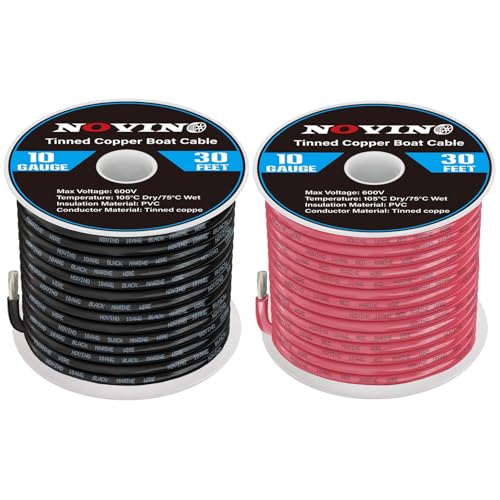
The NOVINO 10 AWG kit steps up to a heavier 10-gauge conductor while maintaining the same tinned OFC copper construction and insulation specifications found in the brand’s 12 AWG offering. At 30 feet per color (60 feet total), this kit targets high-amperage runs where voltage drop over distance must be minimized — think inverter feeds, main battery-to-distribution-block cables, or high-power amplifier supply lines. The 600-volt insulation rating provides generous safety margin for 12-volt and 24-volt automotive systems.
Buyer reports emphasize the consistent conductor diameter and the quality of the timing, which resists oxidation far better than bare copper when wires are run through engine bays or exposed to road salt and humidity. The thicker 10 AWG strands still offer enough flexibility for routing around obstacles thanks to the fine stranding construction, though the added gauge naturally reduces pliability compared to smaller wire sizes. Several users specifically cited using this for solar charge controller wiring and dual-battery isolator setups with no measurable voltage drop.
For installers who need the current-carrying capacity of 10 AWG without compromising on corrosion resistance or insulation toughness, this NOVINO kit represents a premium choice that matches or exceeds OEM-grade wire construction. It is especially well-suited for auxiliary battery systems, winch power leads, and any circuit drawing over 30 amps continuously.
What works
- Heavy 10 AWG tinned copper handles high sustained current loads
- Meets UL 1426, SAE, and ABYC construction standards
- Thick PVC jacket resists abrasion and heat deformation
What doesn’t
- 60-foot total length may require careful planning for long chassis runs
- Heavier gauge is noticeably stiffer than smaller wire sizes
3. NOVINO 14 Gauge Marine Wire
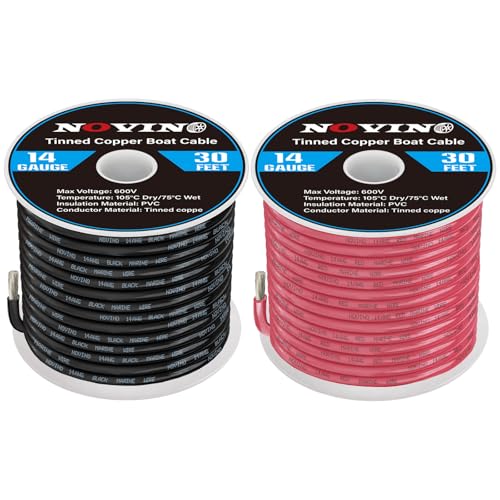
The NOVINO 14 AWG kit provides an economical entry point into tinned marine-grade copper without sacrificing the construction quality found in the brand’s heavier gauges. With 30 feet of red and 30 feet of black, the 60-foot total length covers most automotive accessory circuits — lighting, stereo power, electric fan wiring, and trailer harness repairs — where 14 AWG is the standard recommended gauge for circuits drawing up to 15 amps. The same UL 1426 and ABYC compliant insulation rated to 600 volts and 105 degrees Celsius dry ensures this wire performs reliably in engine bay environments.
Verified buyers consistently praise the corrosion resistance of the tinned stranding, with several reporting successful use in boat rewiring, fish finder installations, and motorcycle accessory circuits where exposure to moisture is unavoidable. The insulation thickness is noticeably greater than standard primary wire sold at auto parts stores, which translates to better abrasion resistance when pulled through metal grommets or alongside sharp body panels. Some users noted the wire is less flexible than fine-stranded audio cable, but the trade-off yields a tougher jacket that resists cuts and chafing.
For anyone building or repairing automotive circuits on a budget who refuses to compromise on conductor quality, this 14 AWG NOVINO kit delivers genuine tinned OFC copper at a very accessible price point. It fills the gap between cheap CCA wire and overpriced boutique audio cable, offering honest construction that holds up in real-world conditions.
What works
- Genuine tinned OFC copper at a budget-friendly price point
- Thick insulation resists cuts and abrasion during routing
- Color-coded red and black sheaths simplify polarity identification
What doesn’t
- Stiffer than expected for 14 AWG, limiting tight-radius bends
- 60-foot length may not suffice for full vehicle rewiring projects
4. NOVINO 16 Gauge Marine Wire
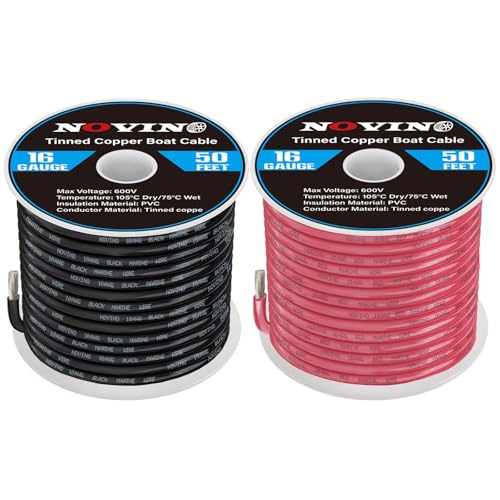
The NOVINO 16 AWG kit offers the longest total length in the brand’s marine wire lineup — 50 feet each of red and black for 100 feet combined — making it the ideal choice for projects requiring multiple low-current circuits or long signal runs. While 16 gauge is limited to approximately 10 amps maximum for power delivery, it excels in applications like switch panel wiring, LED lighting circuits, sensor signal cables, and speaker wire where flexibility and corrosion resistance matter more than raw current capacity.
Owner reviews note the fine stranding of this 16 AWG wire makes it noticeably more pliable than the thicker gauges in the NOVINO range, easing installation in tight dashboards and cramped conduit runs. The same tinned OFC construction and 600-volt insulation rating apply here, so this wire does not sacrifice durability for flexibility. Several buyers specifically purchased this for trailer lighting rewiring and found the 100-foot spool enough to complete both the running light and brake light circuits with ample leftover material.
For installers tackling comprehensive accessory wiring where multiple 16 AWG circuits are required — such as adding interior LED strips, auxiliary fuse panels, or marine helm stations — this kit provides the best per-foot value in the brand’s lineup while maintaining full marine-grade construction. It pairs naturally with the 14 AWG or 12 AWG NOVINO kits for a complete vehicle wiring solution using consistent materials throughout.
What works
- 100-foot total length covers extensive multi-circuit projects
- Fine stranding offers good flexibility for tight routing paths
- Marine-grade timing on every strand prevents corrosion
What doesn’t
- 16 AWG current capacity is limited to low-draw circuits only
- Not suitable for amplifier power or high-amperage battery feeds
5. GEARit 10 Gauge CCA Wire
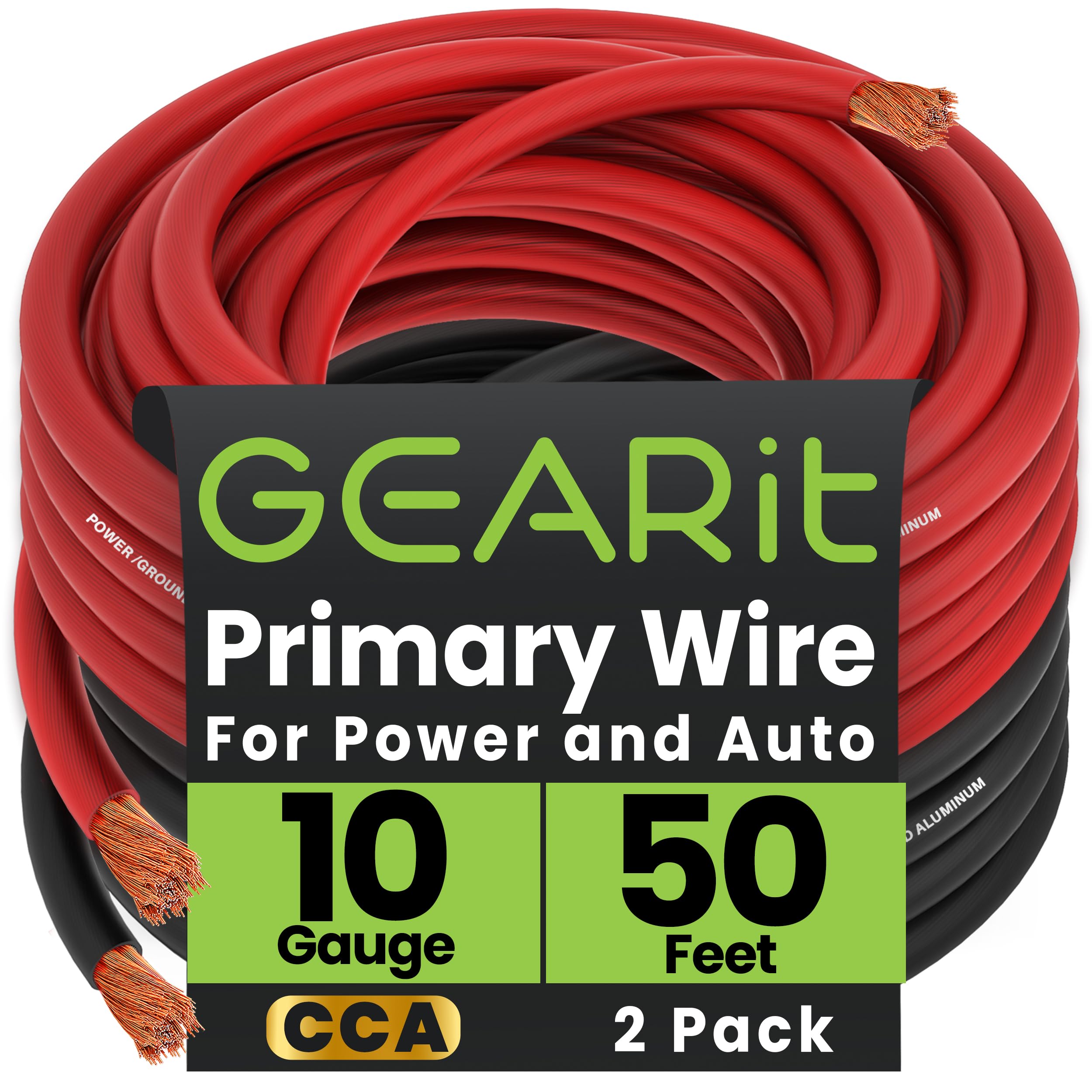
The GEARit 10 AWG CCA kit takes a different approach than the NOVINO offerings by using Copper Clad Aluminum conductors rather than pure OFC copper. At 50 feet per color (100 feet total), this wire provides generous length in a heavy gauge that is well-suited for applications where weight matters or where the budget does not justify the premium for full copper. CCA construction offers approximately 60 percent of the conductivity of pure copper but at a significant weight reduction and lower material cost.
Buyer feedback shows this wire being used primarily for car audio amplifier power feeds, solar panel array wiring, and electric fan conversions where the medium current draw does not push CCA to its limits. The flexible PVC jacket earns consistent praise for ease of routing, and the color-coded insulation simplifies polarity matching during installation. Some verified users noted that the wire performed adequately for 12-volt automotive audio applications but cautioned against using it for critical high-amp circuits like starter motor cables or inverter feeds where voltage drop must be minimized.
For budget-conscious builders who need 10 AWG capacity for moderate-current projects and are comfortable working with CCA’s higher resistance per foot, the GEARit kit offers the best value in heavy gauge wire. It is particularly well-suited for temporary installations, workshop wiring, or automotive audio systems where the total circuit length is short enough that the additional resistance remains inconsequential.
What works
- 100-foot total length at a heavy 10 AWG gauge is generous for the price
- Flexible PVC jacket is easy to route through tight spaces
- Color-coded sheaths simplify correct polarity hookup
What doesn’t
- CCA material has higher resistance than pure OFC copper
- Not recommended for high-amp circuits or critical safety systems
Hardware & Specs Guide
Conductor Material
The conductor metal directly determines current capacity and long-term reliability. Oxygen-Free Copper (OFC) provides the lowest resistance and best corrosion resistance, making it the standard for automotive and marine wiring. Tinned OFC adds a protective coating that prevents oxidation even when the jacket is compromised. Copper Clad Aluminum (CCA) uses an aluminum core with a thin copper layer — it is lighter and cheaper but carries roughly 40 percent more resistance than the same gauge in pure copper, limiting its use to lower-current applications.
Insulation Ratings
Jacket quality determines how wire handles heat, moisture, and abrasion. Look for insulation rated to at least 105 degrees Celsius (221 Fahrenheit) dry and 75 degrees Celsius (167 Fahrenheit) wet for under-hood use. A 600-volt rating is standard for marine-grade wire and provides generous safety margin for 12-volt and 24-volt systems. Thicker wall insulation resists cuts and chafing during installation and throughout the service life of the vehicle.
Wire Gauge Selection
Choosing the correct American Wire Gauge (AWG) prevents voltage drop and overheating. For a 10-foot circuit length, 16 AWG handles up to 10 amps, 14 AWG handles up to 15 amps, 12 AWG handles up to 20 amps, and 10 AWG handles up to 30 amps. Longer runs require stepping up one gauge size for every additional 10 feet to maintain acceptable voltage drop below 3 percent. Always consult a wire gauge chart for the specific amperage and circuit length of your project.
Stranding and Flexibility
Marine-grade wire uses finer stranding than standard primary wire, which improves flexibility and resistance to vibration fatigue. A higher strand count (more individual wires per conductor) allows tighter bending radii without work-hardening the copper. For chassis grounding, engine bay routing, or any installation with frequent movement, fine-stranded wire significantly outlasts solid-core or coarse-stranded alternatives. The trade-off is slightly higher cost per foot, which is justified by the reliability gain.
FAQ
Can I use marine wire for automotive applications?
What is the difference between OFC and CCA wire?
What gauge wire should I use for car audio amplifiers?
How do I properly strip automotive wire without damaging the conductor?
Can I mix CCA and OFC wire in the same circuit?
Final Thoughts: The Verdict
For most buyers, the best wire for automotive use winner is the NOVINO 12 Gauge Marine Wire because it delivers genuine tinned OFC copper in a versatile gauge with 100 feet of total length, meeting the demands of the widest range of automotive electrical projects. If you need heavy current capacity for inverters or battery feeds, grab the NOVINO 10 Gauge Marine Wire for its premium 10 AWG construction. And for budget-friendly multi-circuit accessory wiring where 16 AWG suffices, nothing beats the length and value of the NOVINO 16 Gauge Marine Wire.

Certification: BSc in Mechanical Engineering
Education: Mechanical engineer
Lives In: 539 W Commerce St, Dallas, TX 75208, USA
Md Amir is an auto mechanic student and writer with over half a decade of experience in the automotive field. He has worked with top automotive brands such as Lexus, Quantum, and also owns two automotive blogs autocarneed.com and taxiwiz.com.