Dual-sport and adventure riding demand a tire that doesn’t force you to choose between highway stability and trail traction. The 80/20 split prioritizes pavement manners while retaining enough bite for gravel roads, fire trails, and light off-road exploration — a balance that separates well-engineered rubber from compromised all-rounders.
I’m Amir — the founder and writer behind Four Wheel Ask. I’ve spent years analyzing tread compound data, studying owner-reported failure rates, and comparing ply construction across dozens of dual-sport and adventure tire models to understand what actually holds up under mixed use.
After combing through thousands of verified owner reviews and cross-referencing technical specifications from multiple manufacturers, this guide narrows the field to the models that deliver real-world durability and traction. Here are the best 80/20 adventure tires for riders who truly need both on-road comfort and off-road capability.
How To Choose The Best 80/20 Adventure Tires
Selecting the right 80/20 tire means understanding how your riding habits align with tread design, compound hardness, and carcass construction. A tire that excels on long highway stretches may feel vague on loose gravel, while an aggressive knobby will wear prematurely during daily pavement commutes. The key is identifying where your actual miles land and choosing a tire whose design matches that split.
Tread Pattern and Void Ratio
The 80/20 designation typically means the tread pattern has closely spaced blocks with a lower void ratio compared to a 50/50 or 90/10 tire. Less empty space between lugs means more rubber contacting the pavement, which translates to better braking and cornering grip on asphalt. Look for tread blocks with siping — small slits cut into the rubber — that help displace water and maintain traction in wet conditions without sacrificing dry-road stability.
Compound Hardness and Wear Characteristics
Manufacturers engineer dual-compound or single-compound formulations to balance mileage against grip. Harder compounds extend tread life on pavement but can feel slick on loose dirt or wet rocks. Softer compounds offer superior off-road bite but may wear noticeably faster during highway cruising. The best 80/20 tires use a compound that resists chunking at the knobs while maintaining enough pliability to conform to uneven trail surfaces.
Ply Rating and Carcass Construction
Ply rating indicates the tire’s resistance to punctures and its load-carrying capacity. A 4-ply rating is common for lighter dual-sport bikes, while 6-ply or higher constructions suit heavier adventure touring machines that carry luggage. Bias-ply construction offers a stiffer sidewall that resists flex during aggressive cornering on pavement, while radial construction provides a more compliant ride over washboard gravel and rocky trails. Your bike’s weight and typical load should guide this decision.
Fitment and Size Compatibility
Adventure and dual-sport bikes come in a wide range of rim diameters and widths. Before purchasing, verify the tire’s dimensions against your bike’s stock sizing using the sidewall markings. Running a wider tire than the rim is designed for can cause vague steering feel and increased risk of bead unseating during low-pressure off-road use. Stick to manufacturer-recommended sizes unless you are prepared to alter suspension geometry and ride height.
Quick Comparison
On smaller screens, swipe sideways to see the full table.
| Model | Category | Best For | Key Spec | Amazon |
|---|---|---|---|---|
| Dunlop Trailmax Mission | Front Tire | Premium on/off-road balance | 90/90-21, Bias-Ply, 4-Ply | Amazon |
| MICHELIN Anakee Adventure | Front Tire | Wet grip and highway stability | 110/80R-19, Radial, 59V | Amazon |
| Tusk Dsport Adventure Set | Tire Set | Dual-sport value with trail grip | 90/90-21 & 120/90-18, Tube Type | Amazon |
| OBOR Advent 4-Pack | ATV Set | XC racing and mixed terrain | 21×7-10 & 20×11-9, 6-Ply | Amazon |
| Shinko Dual Sport 705 | Rear Tire | Budget-friendly dual-sport longevity | 130/80-17, Bias Ply, Tube Type | Amazon |
| Yokohama GEOMT G003 | Truck/SUV Tire | Heavy-duty off-road with highway manners | 33 Inch, Radial, 121 Load Index | Amazon |
| Tusk EMEX T-35 Set | Dirt Bike Set | Soft/intermediate terrain traction | 80/100×21 & 120/80×19, Tube Type | Amazon |
| MaxAuto ATV Sport Quad | ATV Pair | Rear sport ATV performance | 20X10-9, 4-Ply, Tubeless | Amazon |
| SunF A021 TT Pair | ATV Pair | Entry-level paved trail duty | 20×7-8, 6-Ply, Tubeless | Amazon |
In-Depth Reviews
1. Dunlop Trailmax Mission Front Tire (90/90-21)

The Dunlop Trailmax Mission represents a genuine engineering effort to close the gap between pavement-focused adventure tires and off-road-capable knobbies. Its staggered step tread block design provides rigidity at the contact patch during straight-line highway riding while the wrap-around lugs on the tire’s edge protect against sharp rocks when the pavement ends. Owner reports consistently highlight low highway noise and minimal vibration, which is uncommon for a tire with this level of off-road intent.
Multiple long-term reviews on medium to large adventure bikes, including the Kawasaki KLR 650 and BMW R 1250 GS, indicate the Trailmax Mission delivers impressive tread wear well beyond the 8,000-mile mark without significant chunking or flat-spotting. Riders who have swapped from factory-fitment tires note a meaningful reduction in high-speed wobble, particularly when carrying luggage. The 4-ply bias construction keeps the casing stable under load without transmitting excessive road harshness through the handlebars.
Where the Trailmax Mission truly stands out is in wet traction. The staggered step design and deep sipes evacuate water effectively at highway speeds, and owners report no hydroplaning concerns during heavy rain. On gravel and hard-pack dirt, the tread blocks bite predictably without the vague skating sensation that plagues many 80/20 designs. This tire is a strong choice for riders who spend 80 percent of their miles on pavement but need genuine capability on the 20 percent of unpaved routes.
What works
- Excellent high-speed stability on pavement with minimal noise
- Wrap-around lugs provide real rock protection on the sidewall
- Tread wear is exceptional for a tire with off-road pretensions
What doesn’t
- Not suited for deep mud or soft sand due to tighter tread spacing
- Premium price point may push budget-conscious riders toward alternatives
2. MICHELIN Anakee Adventure Front Tire (110/80R-19)
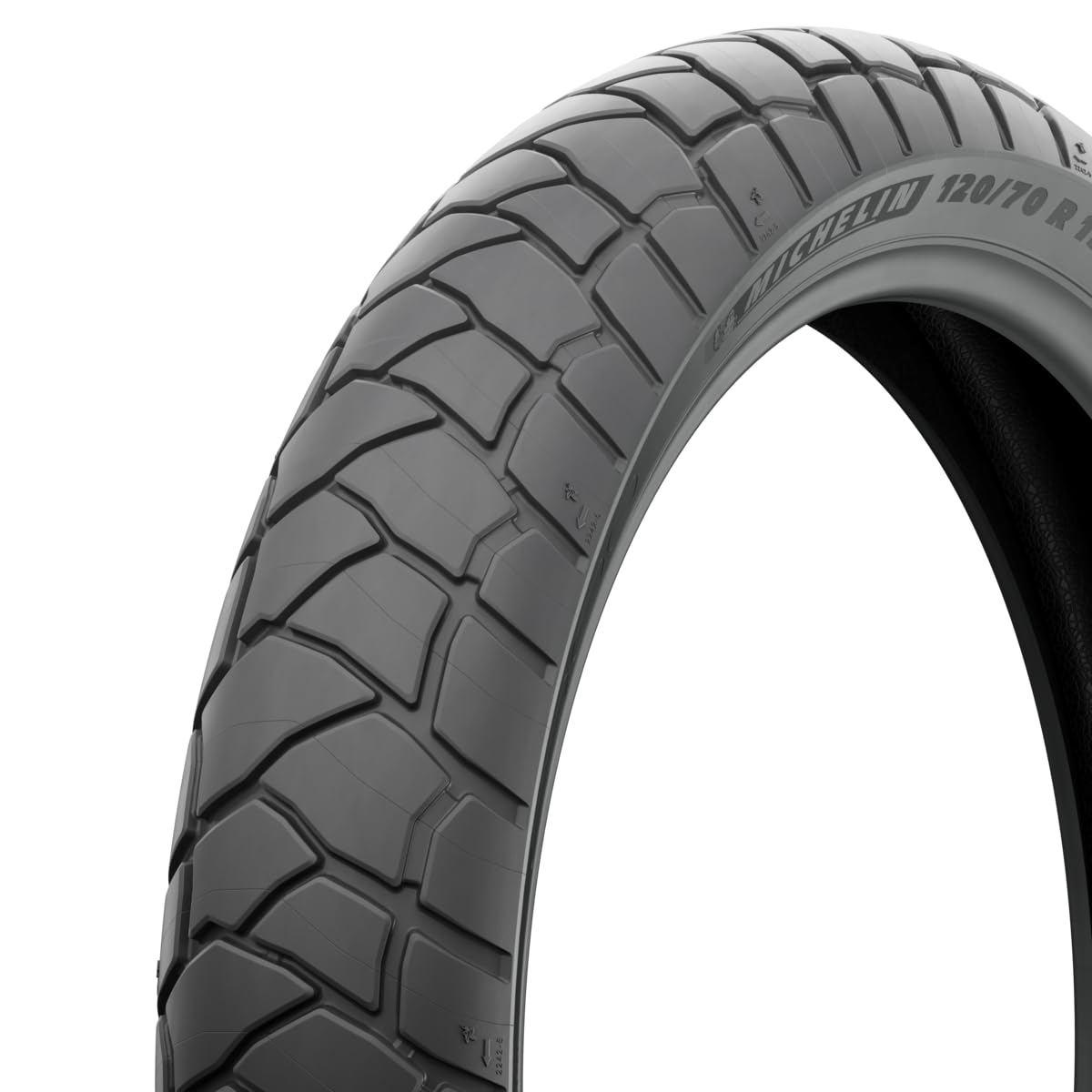
MICHELIN’s Anakee Adventure leverages silica-infused tread compounds and Bridge Block Technology borrowed from the Anakee Wild line to deliver wet-weather confidence that few competitors match. The radial construction provides a noticeably more compliant ride over corrugated gravel roads compared to bias-ply alternatives, and the 2CT compound in the rear version adds a harder shoulder layer for cornering durability. Owner feedback across bikes as varied as the Indian FTR and Yamaha Tracer 700 consistently praises the tire’s ability to grip on damp pavement without feeling greasy at higher lean angles.
The fully grooved geometric tread pattern clears mud and loose debris effectively during off-road sections, though the tread depth is shallower than a dedicated knobby. Riders who primarily use their bikes for multi-day adventure tours with mix of mountain passes and unpaved shortcuts report that the Anakee Adventure holds up well over 6,000 to 8,000 miles before the center tread begins to show noticeable wear. The tire requires minimal weight during balancing, which indicates consistent carcass manufacturing tolerances.
One detail that separates the Anakee Adventure from the rest of the premium segment is its predictable breakaway on loose surfaces. The transition from grip to slide is progressive enough that less experienced off-road riders can feel the limit approaching rather than being caught off guard by a sudden loss of traction. On cold mornings, the silica compound warms up faster than conventional carbon-black mixes, reducing the need for cautious riding during the first few miles.
What works
- Exceptional wet-grip performance due to advanced silica compound
- Radial construction smooths out washboard gravel and rough pavement
- Predictable, progressive breakaway on loose terrain inspires confidence
What doesn’t
- Some owners report howling noise in tight, low-speed corners
- Premium pricing places it above budget-friendly options
3. Tusk Dsport Adventure Motorcycle Tire Set (90/90-21 & 120/90-18)

The Tusk Dsport Adventure set punches well above its price segment by offering tall, aggressive knobbies in a DOT-legal package that wears surprisingly well on pavement. Owners riding KTM 690 Enduros and Honda CRF450Ls report that the rubber compound resists the rapid center-tread wear that plagues softer dirt bike tires during highway stretches. The set includes both front and rear tubes, simplifying the purchase for riders mounting them on conventional dual-sport wheels without tubeless spokes.
Stiff sidewalls make tire installation more labor-intensive than premium alternatives, but the flip side is that the carcass provides good feedback during aggressive cornering on pavement. Multiple long-term reviewers note that the tall knob pattern clears mud effectively and digs into loose rocky climbs with authority. The trade-off is that highway cruising above 65 mph generates noticeable tread growl, which is characteristic of any tire with this tread depth and spacing.
Where the Dsport Adventure truly delivers value is in its ability to handle technical single-track and rocky enduro sections without chunking. Riders who push their dual-sport bikes through steep, loose terrain report that the lugs remain intact after several thousand miles of mixed abuse. For owners who want a single set of tires that can handle a Saturday trail ride and a Monday commute, this kit offers one of the most favorable cost-per-mile ratios in the 80/20 category.
What works
- Impressive tread life for a knobby-pattern dual-sport tire
- DOT compliance combined with genuine off-road grip for technical terrain
- Complete set with tubes included at a budget-friendly price point
What doesn’t
- Requires significant balancing weight on some wheels; stiff sidewalls complicate mounting
- Noticeable highway noise compared to road-biased adventure tires
4. OBOR Advent ATV Tires 4-Pack (21×7-10 & 20×11-9)

The OBOR Advent tire set was developed with input from GNCC racers and reflects a design philosophy that prioritizes predictable cornering and slide control across XC terrain, hard-pack, loose loam, and sand. The tread block layout is engineered to deliver consistent traction when transitioning between different surface types within a single lap or trail loop. Owner reports from Baja race teams and weekend trail riders both confirm that the 6-ply casing resists punctures effectively, even when crossing sharp rocky sections at speed.
Riders who have tested the Advent on sport ATVs like the Yamaha Banshee and Honda TRX450R note that the tire tracks well during hard braking and maintains steering precision in rutted corners. The compound is formulated to avoid the greasy feel that some all-terrain ATV tires develop on wet roots or damp clay. Several long-term reviews indicate that the tread wears evenly across the carcass, with no cupping or scalloping even after extended use on both pavement and dirt.
While the Advent is marketed as a cross-country tire, it handles loose sand and mud better than the tightly spaced tread blocks might suggest. The paddle-like spacing on the rear tires clears mud efficiently, and the front tires provide enough bite to keep the steering wheel tracking true. For ATV owners who ride a mix of trail conditions and want a single set that doesn’t require a tire change between race weekends and recreational rides, the OBOR Advent delivers race-bred design at a competitive mid-range investment.
What works
- Proven race pedigree with consistent real-world performance across diverse terrain
- Puncture-resistant 6-ply casing holds up to sharp rocks and high-speed impacts
- Even tread wear pattern with no cupping reported in long-term owner reviews
What doesn’t
- Primarily designed for ATVs; not suitable for motorcycle fitment
- Four-tire pack is a significant upfront investment for casual riders
5. Shinko Dual Sport 705 Series Rear Tire (130/80-17)

The Shinko Dual Sport 705 has built a reputation among budget-minded dual-sport riders for delivering reliable on-road mileage without completely abandoning off-road capability. The aggressive tread pattern provides solid adhesion in both wet and dry pavement conditions, and the rubber compound resists tearing when the tire encounters gravel or hard-pack during light off-road excursions. Owners riding Kawasaki KLR 650s and Suzuki DR650s report that a rear set can last upward of 9,000 miles with proper inflation and regular rotation.
Ride quality feedback is mixed among owners, with some noting that the tire transmits more road vibration through the chassis compared to premium alternatives. This is likely a consequence of the bias-ply construction and the stiffer compound formulation required to achieve the reported mileage figures. However, riders who prioritize tread life over plushness find the 705 to be a cost-effective workhorse that handles potholes and rough pavement without structural issues or bead leaks.
On unpaved surfaces, the 705 performs best on packed gravel and dry fire trails where the tread blocks can find purchase. Loose sand, deep mud, or wet clay push the tire beyond its intended design envelope, causing the tread to pack up and lose traction. The 705 is a clear choice for riders whose 20 percent off-road consists of well-maintained dirt roads and who want a tire that won’t break the bank when it’s time to replace a worn rear.
What works
- Excellent highway tread life, with owners reporting 9,000+ miles on rear fitments
- Strong wet and dry pavement grip for a dual-sport tire at this price point
- Puncture resistance holds up well against potholes and road debris
What doesn’t
- Noticeable road vibration compared to softer-compound tires
- Limited off-road capability beyond packed gravel and dry fire roads
6. Yokohama GEOMT G003 (33 Inch)

The Yokohama GEOMT G003 is a full-on off-road mud-terrain tire that incorporates GEO-SHIELD technology for improved cut and chip resistance in severe terrain. While its void ratio places it closer to a 60/40 or 50/50 split in practice, the tire’s wide flat profile and optimized sipe pattern deliver surprisingly composed highway behavior. Owner reviews on full-size trucks like the Chevrolet Silverado 1500 report minimal hydroplaning at highway speeds during heavy rain, a testament to the tread design’s water evacuation capabilities.
The sidewall armor is a standout feature for anyone who ventures into rocky trails or construction sites. The reinforced shoulder resists abrasion and impact damage that would compromise lesser tires. Multiple owners who use their trucks for logging, hunting, and off-road recovery note that the G003 climbs steep loose inclines without excessive wheel spin and self-cleans in muddy conditions better than many all-terrain tires. The trade-off in tread noise is present but consistently described as surprisingly quiet for a mud-terrain pattern.
Tread wear is a strong point for the G003, with owners reporting even wear across the contact patch even after thousands of miles of mixed highway and trail use. The wide flat profile distributes the vehicle’s weight evenly, reducing the tendency for center-tread wear that plagues some aggressive off-road tires during pavement commuting. For truck and SUV owners who need genuine off-road capability but refuse to tolerate the noise and vibration of traditional mud-terrain tires, the G003 offers a refined compromise.
What works
- Surprisingly quiet highway ride for a mud-terrain tread pattern
- Reinforced sidewall armor protects against impacts in rocky terrain
- Excellent self-cleaning in mud and even tread wear over thousands of miles
What doesn’t
- Deep mud and soft sand still push the tire beyond its optimal design window
- Premium pricing places it above budget off-road tire options
7. Tusk EMEX T-35 Dirt Bike Tire Set (80/100×21 & 120/80×19)

The Tusk EMEX T-35 is designed specifically for soft to intermediate terrain, making it a focused choice for dirt bike riders who spend most of their time on loose dirt, sand, loam, and hard-packed trails. The deep tread pattern digs in aggressively during acceleration and cornering on loose surfaces, and the bias construction maintains carcass stability at higher speeds across whooped-out sections. Owners riding 250F and 450F motocross bikes report that the front tire tracks accurately through rutted corners without deflecting off rocks.
Despite its soft-terrain focus, the EMEX T-35 holds up reasonably well on harder surfaces compared to gummy enduro tires. The rubber compound resists the rapid knob wear that plagues softer compounds when they encounter pavement or hard-pack for extended stretches. Multiple owners note that the rear tire’s meaty tread pattern provides strong hookup when climbing loose hills, and the side knobs offer predictable bite when the bike is laid over in bermed corners.
Installation is straightforward thanks to the tube-type design and reasonably flexible sidewalls. Riders mounting these tires with standard tire spoons report no unusual difficulty. The main drawback, consistent with any dedicated off-road tire, is that extended pavement use accelerates wear and generates noticeable tread noise. The EMEX T-35 is best reserved for riders whose off-road ratio skews heavily toward trail riding and motocross rather than dual-sport commuting.
What works
- Aggressive tread depth delivers reliable traction in soft loam and loose dirt
- Front tire tracks precisely through ruts without deflection on hard-pack
- Tube-type design simplifies field repairs and tire changes
What doesn’t
- Pavement riding accelerates tread wear and produces noticeable noise
- Not designed for mud or wet clay conditions where tread packs up quickly
8. MaxAuto ATV Sport Quad Tires Set of 2 (20X10-9 Rear)

The MaxAuto ATV Sport Quad tires are built with a hard racing compound formulated to withstand the abuse of competitive sport ATV riding and high-speed trail use. The 20X10-9 rear size is a common fitment for Honda TRX450R, Yamaha Raptor 660, and Suzuki LT-R450 models, and owners consistently report that the tread pattern provides strong acceleration bite out of corners. The 4-ply tubeless construction keeps weight manageable while offering sufficient puncture resistance for trail riding and dune use.
Owner reviews highlight the tire’s surprising durability during burnouts and aggressive riding. Multiple users report that the small tread lugs remain attached even after repeated high-rpm spin testing on pavement, which indicates good rubber-to-carcass bonding. In sand, the tire’s tread spacing clears efficiently, allowing the knobs to dig in for forward traction rather than floating on top of loose material. Riders who frequent dune areas note that the MaxAuto tires perform comparably to more expensive sand-specific alternatives.
The main limitation is the hard compound’s reduced grip on wet pavement or damp rocks. Riders transitioning from softer tires to the MaxAuto should adjust their cornering expectations during wet conditions. The tire also requires proper inflation pressure to avoid cupping; owners who run pressures above the recommended 7 psi maximum report center-tread wear acceleration. For sport ATV owners who want a cost-effective rear tire that withstands hard use across mixed terrain, the MaxAuto pair offers strong value.
What works
- Hard racing compound resists chunking during aggressive throttle application
- Strong sand performance with efficient tread self-cleaning
- Durable lugs that stay intact even after repeated high-rpm abuse
What doesn’t
- Reduced wet-pavement grip due to hard compound formulation
- Cupping can develop if tire pressures are not maintained within spec
9. SunF A021 TT Sport ATV Tires Pair (20×7-8)

The SunF A021 is engineered as an all-purpose ATV tire for paved trails and compacted surfaces, making it an entry-level option for riders who need consistent performance on maintained roads and hard-pack. The 6-ply construction provides a robust carcass that resists punctures and abrasion, which is beneficial for utility ATVs that carry moderate loads. Owners who mount these tires on Coleman minibikes and smaller ATVs report that the tread runs smoothly on pavement with minimal vibration at moderate speeds.
Rider feedback indicates that the A021 shines on street surfaces where the tightly spaced tread blocks offer predictable braking and cornering grip. However, transitioning from pavement to loose gravel or dirt trails reveals the tire’s limitations. Multiple owners note that rear-wheel braking on dirt roads can cause the tire to slide rather than bite, which creates a hazardous situation for riders expecting off-road traction. The tire is best suited for riders who understand that its design prioritizes street manners over dirt capability.
Mounting the A021 can be challenging due to the stiff sidewalls caused by the shipping compression. Owners report that the tire beads are difficult to seat initially and may require blocking the sidewalls to restore their shape before inflation. Once properly mounted and broken in, the tires provide a stable ride with consistent air retention. The SunF A021 is a functional budget option for ATV and mini-bike owners whose off-road needs are limited to well-packed trails and who prioritize pavement ride quality.
What works
- Smooth and stable on pavement with predictable braking characteristics
- Robust 6-ply construction resists punctures on improved surfaces
- Affordable entry point for mini-bike and small ATV owners
What doesn’t
- Poor off-road traction on loose gravel and dirt; rear wheel slides during braking
- Stiff sidewalls from shipping compression make bead seating difficult
Hardware & Specs Guide
Ply Rating and Load Capacity
Ply rating directly affects a tire’s ability to resist punctures and support weight without excessive flex. A 4-ply rating suits lighter dual-sport bikes and ATVs used primarily on maintained trails, while 6-ply construction adds a layer of puncture resistance for rocky terrain and heavier loads. Higher ply counts increase sidewall stiffness, which can improve cornering stability on pavement but may reduce ride compliance on rough surfaces. Owners carrying gear for multi-day trips should prioritize 6-ply or higher ratings to avoid sidewall damage from sharp rocks and logs.
Bias vs. Radial Construction
Bias-ply tires use overlapping cord layers that create a stiffer carcass, providing predictable handling on pavement and better resistance to sidewall cuts in rocky terrain. Radial construction uses cord layers oriented perpendicular to the direction of travel, allowing the sidewall to flex more independently from the tread. This results in a more comfortable ride over corrugated gravel roads and improved tread contact patch consistency during cornering. Adventure riders covering long mixed-terrain miles often prefer radials, while dual-sport riders focused on budget and durability lean toward bias-ply options.
Tread Void Ratio and Pattern Design
The void ratio is the percentage of open space between tread blocks relative to total tread area. An 80/20 tire typically has a void ratio around 20 to 25 percent, meaning more rubber contacts the pavement for highway stability. Tread blocks with sipes and stepped edges improve grip on wet pavement and hard-pack without requiring a softer compound that would wear quickly. Tires with wrap-around lugs on the shoulder provide additional sidewall protection and off-road bite when leaning the bike into loose turns.
Speed Rating and Load Index Markings
Speed ratings indicate the maximum sustained speed a tire can handle safely. For adventure and dual-sport tires, common ratings include R (106 mph), S (112 mph), and V (149 mph). Load index numbers correspond to the maximum weight each tire can carry at full inflation pressure. Matching the load index to your bike’s weight, including rider and luggage, is critical for safe high-speed operation. Overloading a tire beyond its rated capacity generates excessive heat buildup and increases the risk of tread separation or carcass failure.
FAQ
What does 80/20 actually mean in adventure tires?
Can I use 80/20 tires for long-distance touring?
How many miles do 80/20 adventure tires typically last?
Are 80/20 tires safe for highway speeds?
Final Thoughts: The Verdict
For most riders seeking the best 80/20 adventure tires, the top recommendation is the Dunlop Trailmax Mission because it delivers the most balanced combination of highway stability, off-road bite, and long tread life across a wide range of adventure bikes. If you prioritize wet-weather confidence and a plush highway ride, the MICHELIN Anakee Adventure justifies its premium position with advanced silica compound technology. For dual-sport riders who want genuine trail capability without breaking the bank, the Tusk Dsport Adventure set offers the best cost-per-mile value in the category.

Certification: BSc in Mechanical Engineering
Education: Mechanical engineer
Lives In: 539 W Commerce St, Dallas, TX 75208, USA
Md Amir is an auto mechanic student and writer with over half a decade of experience in the automotive field. He has worked with top automotive brands such as Lexus, Quantum, and also owns two automotive blogs autocarneed.com and taxiwiz.com.