Most car chargers claim fast charging but deliver slow trickles when you actually plug in a laptop or a modern flagship phone. The difference between a charger that works and one that frustrates comes down to real wattage output, protocol support, and how the ports share power under load.
I’m Amir — the founder and writer behind Four Wheel Ask. My approach to automotive accessories focuses on cross-referencing manufacturer specifications against verified owner feedback to identify which models actually deliver consistent power without overheating or voltage drop over months of daily use.
After sorting through the latest USB-C offerings for 2025, the best usb c car charger needs to handle multiple devices at full speed, stay compact enough to avoid blocking controls, and hold up to the heat and vibration inside a parked car in summer.
How To Choose The Best USB C Car Charger
Selecting the right USB-C car charger comes down to matching the power delivery profile with the devices you actually carry. A charger that works well for an iPhone alone will struggle with a MacBook or a Galaxy S25 Ultra running navigation and wireless Android Auto simultaneously.
Real Wattage and Port Sharing
Many chargers advertise a high total wattage but split power in ways that leave every port running at half speed. Look for models that publish per-port maximums clearly, especially the USB-C port that handles your primary device. A 100W USB-C port retains full speed even when the secondary ports are active, which prevents the situation where plugging in a passenger’s phone cuts your own charging rate in half.
Protocol Support — PD 3.0, PPS, and QC 4.0
USB-C alone does not guarantee fast charging. Power Delivery 3.0 with Programmable Power Supply (PPS) allows the charger to adjust voltage in small increments, which is essential for Samsung Super Fast Charging and Google’s adaptive charging. Devices that lack PPS support fall back to slower standard rates, so matching the charger’s protocol set to your phone’s requirements makes a noticeable difference in real-world charge times.
Build Quality and Thermal Management
A car charger lives in one of the harshest environments inside a vehicle — direct sunlight through the windshield can push interior temperatures past 60°C. Chargers with active thermal monitoring, metal or reinforced polycarbonate housings, and strain-relief reinforced cable ends tend to last longer without voltage sag or connector looseness. Retractable cable models add convenience but introduce a moving mechanical part that needs durable internal springs and latch mechanisms.
Quick Comparison
On smaller screens, swipe sideways to see the full table.
| Model | Category | Best For | Key Spec | Amazon |
|---|---|---|---|---|
| UGREEN 145W 4-Port Retractable | Retractable | Laptop + phone daily carry | 100W USB-C + 60W retractable cable | Amazon |
| NXPGKEA 200W Car Charger | High-Power | Charging laptops at full speed | 2 x 100W USB-C + 1 USB-A | Amazon |
| SUPERONE 6-in-1 Retractable | Multi-Device | Families with many gadgets | 99W total, 6 ports, 2 retractable cables | Amazon |
| Belkin BoostCharge 42W | Compact | Clean minimalist setup | 30W USB-C + 12W USB-A | Amazon |
| Anker 323 52.5W | Value | Reliable two-port fast charging | 30W PowerIQ 3.0 USB-C + 22.5W USB-A | Amazon |
In‑Depth Reviews
1. UGREEN 145W 4-Port Retractable Car Charger

The UGREEN 145W stands apart from the crowded car charger market by delivering a genuine 100W from its main USB-C port alongside a 60W retractable cable that extends up to 70cm. Owner reports confirm that a 16-inch MacBook Pro charges from zero to full in roughly 90 minutes while a connected iPhone 16 and iPad Pro maintain their own fast-charge rates without any port dropping out — something few multi-port chargers manage in real-world use.
The retractable cable mechanism uses a spring-latch system that stops at any length and retracts cleanly with a gentle pull, which eliminates the loose-cable mess that typically accumulates around the center console. Build quality leans toward the dense, solid feel of reinforced polycarbonate, and the Space Gray finish matches most modern interior trims without looking like an aftermarket add-on.
Thermal management is handled through passive heat dissipation rather than active throttling, and owner feedback spanning several months of daily commutes reports no significant overheating even when all four ports are loaded. The main caveat is physical size — this unit extends further from the socket than a standard stubby charger, so it may not fit flush in vehicles where the 12V port is recessed or surrounded by protruding trim.
What works
- Full 100W laptop charging from the main USB-C port without sharing power degradation
- Retractable 60W cable keeps the cabin organized and extends to a useful 70cm
- Simultaneous fast charging for MacBook, iPhone, and iPad without thermal throttling
What doesn’t
- Larger physical footprint may block access in tight or recessed 12V sockets
- Feels slightly less premium in hand than the price suggests despite solid performance
2. NXPGKEA 200W Car Charger

This 200W charger focuses on raw power capacity with two USB-C ports that each support up to 100W output, plus a USB-A port for legacy devices. Owner feedback from laptop users confirms that a Dell XPS 15 or MacBook Pro 16 pulls full speed from either USB-C port without negotiation delays, and the bundled 100W-rated USB-C to USB-C cables include an E-Marker chip that maintains proper power delivery handshake with the vehicle’s electrical system.
The three-port layout covers the most common real-world scenario — driver charging a laptop on the main USB-C, passenger running a phone on the second USB-C, and a third device like a tablet or Switch on the USB-A. The total 200W ceiling means no single port gets starved even when all three are active, which is rare in this category where most chargers split a shared pool under 100W.
Build quality uses TPE cable sleeving with reinforced strain relief at both ends, and owner reports note the charger feels dense and robust in hand. The main drawback is the lack of a retractable cable or any cable management feature, so you are managing two separate USB-C cords in the cabin. Some owners also mention the charger runs warm under sustained 200W load, though no performance degradation has been reported during normal driving cycles.
What works
- Dual 100W USB-C ports maintain full speed simultaneously for true laptop-class charging
- Included 100W-rated cables with E-Marker eliminate guesswork and negotiation failures
- Universal protocol support covers PD 3.0, QC 4.0, PPS, and SCP for broad device compatibility
What doesn’t
- No retractable or integrated cable management leads to loose cords in the cabin
- Runs noticeably warm under sustained high-load charging sessions
3. SUPERONE 6-in-1 Retractable Car Charger
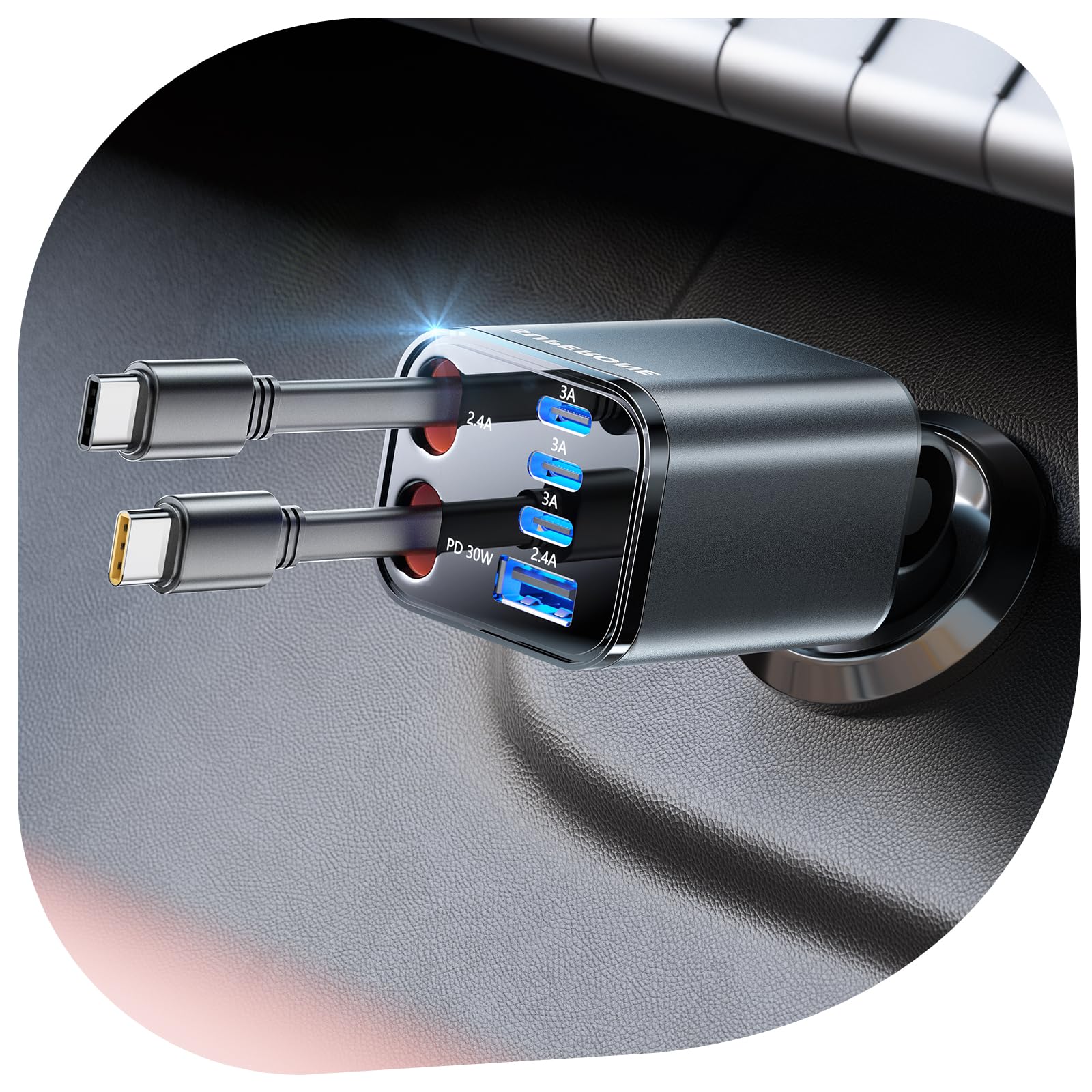
The SUPERONE 6-in-1 solves the cable clutter problem with two built-in retractable USB-C cables — one rated at 30W for fast charging and a second 12W cable for secondary devices — plus four additional USB ports for passengers. The 180-degree adjustable plug base swivels to sit flush against angled or vertical 12V sockets, and the anti-slip buckle design keeps it firmly seated even on rough roads according to multiple owner reports from truck and SUV drivers.
Total output reaches 99W, which is enough to charge a iPhone 16 from zero to 80% in about 30 minutes while simultaneously powering a second phone and a tablet through the open USB ports. The retractable cables extend up to 31.5 inches and lock at any intermediate length, then retract fully with a light pull — a mechanism that owners confirm remains reliable after months of daily use without the spring tension weakening or the latch failing.
Despite the six-port layout, the charger body is noticeably more compact than traditional multi-port models, though it is still larger than a basic single-cable unit. Some owners noted that the retracted cable coils can create a slight curl memory over time, but this does not affect charging performance. The all-plastic enclosure feels less dense than metal-bodied competitors, but the trade-off keeps weight low and prevents the charger from sagging in the socket under its own mass.
What works
- Two retractable cables eliminate loose cords and keep the center console organized
- 180-degree swivel plug fits angled or recessed 12V sockets without blocking adjacent controls
- Six total ports provide enough capacity for family trips with multiple devices
What doesn’t
- Plastic housing feels less premium than metal or reinforced polycarbonate alternatives
- Retracted cables develop a slight curl pattern that does not fully straighten over time
4. Belkin BoostCharge 42W Dual Port Car Charger

The Belkin BoostCharge 42W takes a focused approach — a single USB-C port delivering 30W with PD 3.0 and PPS support, paired with a 12W USB-A port for a passenger device. Owner reports confirm that the USB-C port charges an iPhone 16 from zero to 50% in roughly 21 minutes and supports Samsung Super Fast Charging for the Galaxy S25 series thanks to the PPS protocol, which dynamically adjusts voltage down to 5mV increments for optimal charge curves.
The housing is made from post-consumer recycled plastic, and the packaging is entirely plastic-free, which matters if sustainability is part of your purchase criteria. The form factor is compact and sits nearly flush in most 12V sockets, leaving the surrounding space clear for gear shifters, climate controls, or storage cubbies. Belkin backs the unit with a 2-year warranty and a Connected Equipment Warranty that covers damage to connected devices if the charger malfunctions.
The 42W total is a hard ceiling — the USB-C and USB-A ports share that budget, so plugging a high-draw device into both ports simultaneously splits the available power rather than doubling it. Owners note this is clearly stated in the specs but can be misleading if you see the 42W number and assume each port delivers that individually. No cable is included in the box, which is consistent with Belkin’s approach but adds a small inconvenience if you do not already have a high-quality USB-C cable in the car.
What works
- PPS support enables full Samsung Super Fast Charging and Google adaptive charging
- Compact form factor sits nearly flush and does not block surrounding controls
- 2-year warranty plus Connected Equipment Warranty provides strong device protection
What doesn’t
- 42W total is shared between ports, not per-port — misleading at first glance
- No charging cable included in the package despite the premium positioning
5. Anker 323 USB-C Car Charger 52.5W
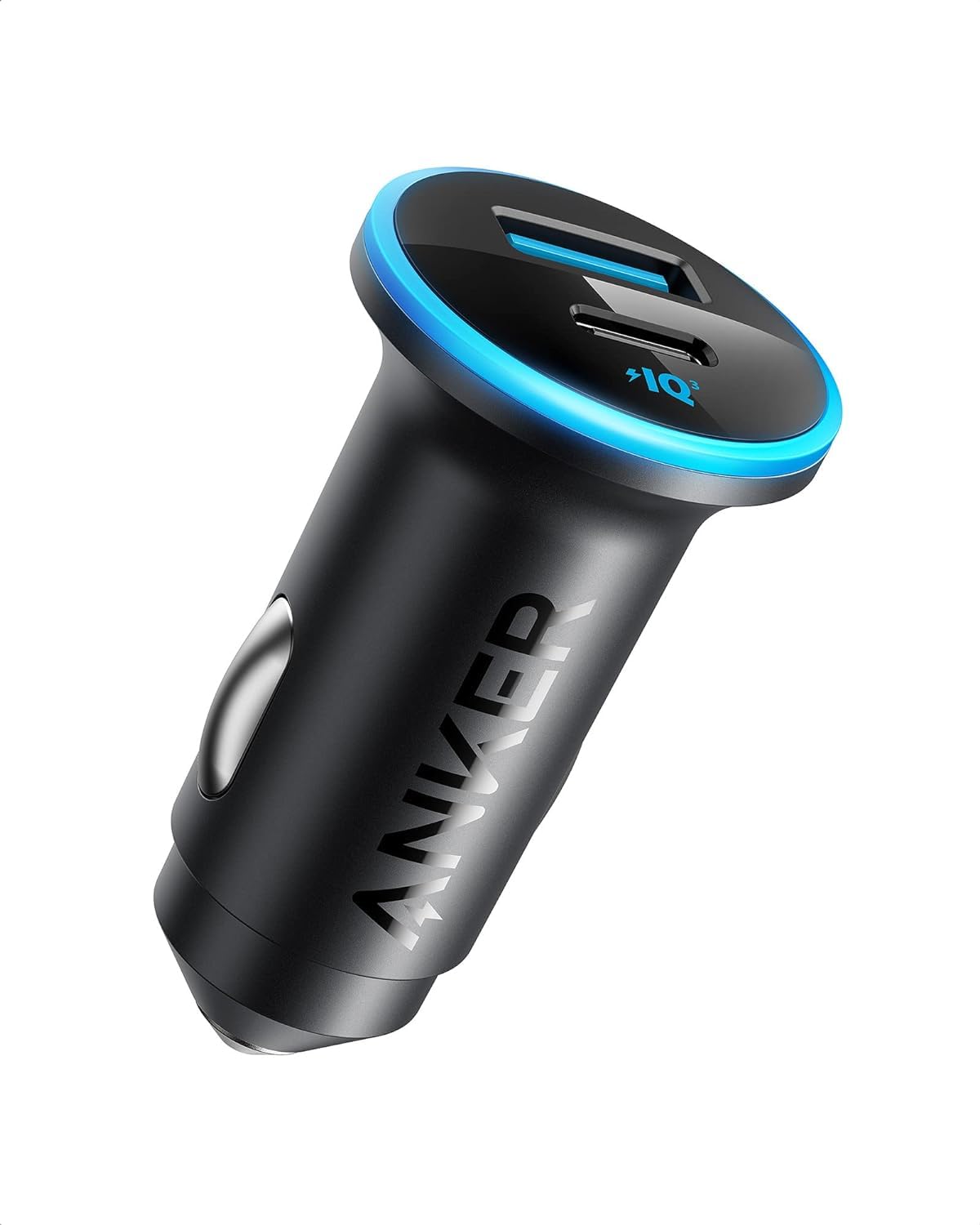
The Anker 323 delivers a practical 30W USB-C port alongside a 22.5W USB-A port in a compact form factor that has become a benchmark for reliable daily charging. Owner reports spanning more than six months of use confirm that the USB-C port charges an iPhone 14 Pro to 50% in about 25 minutes and maintains consistent power delivery without the intermittent disconnections that plague cheaper dual-port chargers. The included welcome guide and 18-month warranty reflect Anker’s standard after-sales support structure.
ActiveShield 2.0 monitors internal temperature and adjusts power output dynamically to prevent overheating, which is particularly relevant for summer driving where cabin temperatures can spike. The soft blue LED indicator provides visual confirmation that the charger is active without being bright enough to cause glare at night — a detail multiple owners specifically praised in their feedback. The charger body is compact enough to leave adjacent sockets accessible in vehicles with multiple 12V ports.
The main limitation is the 30W ceiling on the USB-C port, which is sufficient for phones and tablets but will not charge a modern laptop at full speed. The USB-A port tops out at 22.5W, which is adequate for most phones but below what some competing USB-A implementations offer. Anker’s PowerIQ 3.0 technology handles broad device compatibility well, but the lack of PPS support means Samsung users may not reach the fastest charge rates available on their devices.
What works
- ActiveShield 2.0 thermal management prevents overheating during summer driving conditions
- Compact footprint leaves adjacent 12V sockets and surrounding controls unobstructed
- Proven long-term reliability with consistent owner feedback over six-plus months of daily use
What doesn’t
- 30W USB-C port cannot charge laptops at full speed
- No PPS protocol support limits fast-charge speeds on Samsung Galaxy devices
Hardware & Specs Guide
Power Delivery 3.0 and PPS
PD 3.0 is the baseline for fast USB-C charging on modern phones and laptops, supporting up to 240W over the standard. PPS (Programmable Power Supply) adds fine-grained voltage control in 5mV increments, which allows the charger to match the optimal charge curve for devices like Samsung Galaxy S25 and Google Pixel 9 series. Without PPS, those devices fall back to slower standard PD rates, adding 15-25 minutes to a full charge cycle compared to a PPS-enabled charger.
Retractable Cable Mechanisms
Retractable cable chargers use a spring-loaded spool and a locking latch that engages when the cable stops. The best implementations use a ratchet system that allows the user to lock the cable at any intermediate length rather than at fixed stops. Durability depends on the spring material — stainless steel music wire springs maintain tension longer than basic carbon steel, and reinforced cable exit points reduce fraying where the cable bends at the housing edge.
Thermal Management Strategies
Car chargers dissipate heat through passive conduction into the metal 12V socket body and active temperature monitoring. ActiveShield and similar systems use onboard thermistors to detect rising temperature and reduce current before the charger hits critical thresholds. Chargers without active monitoring rely entirely on the socket acting as a heat sink, which works well for sub-50W loads but becomes insufficient at sustained 100W+ output where internal component temperatures can exceed 80°C within 15 minutes under load.
Total Output vs. Per-Port Allocation
Advertised total wattage is the sum of all ports under ideal conditions, but the real-world behavior depends on the power management IC. Fixed-allocation chargers reserve a set wattage per port regardless of what is connected, while dynamic-sharing chargers redistribute power from idle or low-draw ports to active ones. Dynamic allocation is preferable for multi-device use because it prevents a partially charged phone from wasting wattage that a laptop could use for faster charging.
FAQ
Can a USB C car charger damage my phone battery?
How many watts do I need to charge a laptop in my car?
What does PPS mean on a car charger?
Final Thoughts: The Verdict
For most buyers, the best usb c car charger winner is the UGREEN 145W 4-Port Retractable Car Charger because it combines genuine laptop-class 100W output with a retractable cable that keeps the cabin organized — a balance of power and practicality that few competitors achieve. If you need maximum raw wattage for charging two laptops simultaneously on long road trips, grab the NXPGKEA 200W Car Charger with its dual 100W ports. And for a budget-friendly daily driver that prioritizes compact size and proven reliability over peak power, the Anker 323 52.5W remains a solid pick that has earned its reputation through consistent owner satisfaction over years of real-world use.

Certification: BSc in Mechanical Engineering
Education: Mechanical engineer
Lives In: 539 W Commerce St, Dallas, TX 75208, USA
Md Amir is an auto mechanic student and writer with over half a decade of experience in the automotive field. He has worked with top automotive brands such as Lexus, Quantum, and also owns two automotive blogs autocarneed.com and taxiwiz.com.