Truck recovery isn’t complicated — until a strap snaps at full tension. The difference between a clean pull and a dangerous failure comes down to webbing quality, loop reinforcement, and honest break-strength ratings. Whether you’re pulling a stuck Jeep out of mud, hauling equipment on the farm, or keeping emergency gear behind the seat, the right strap makes the operation predictable and safe.
I’m Amir — the founder and writer behind Four Wheel Ask. I’ve spent years analyzing market data, studying product specifications, and aggregating owner feedback to separate well-engineered recovery gear from inflated marketing claims.
This guide focuses exclusively on straps that deliver verified strength, durable stitching, and practical kit value. After evaluating dozens of models across real-world use cases, these picks represent the most reliable best tow straps for trucks available today for drivers who take recovery seriously.
How To Choose The Best Tow Straps For Trucks
Recovery straps look simple — a woven loop of webbing with reinforced ends. But the difference between a strap that lasts a decade and one that frays on the second pull comes down to material selection, construction method, and honest testing. Understanding these fundamentals helps you avoid both overspending on hype and underspending on safety.
Break Strength vs. Working Load Limit
Break strength is the force required to snap the strap. Working load limit is the safe operating range — typically one-third of break strength for polyester and nylon recovery straps. A strap rated at 30,000 lbs break strength safely handles 10,000 lbs of pull. Always match working load to your truck’s gross vehicle weight plus a safety buffer for dynamic loads during recovery.
Webbing Material: Polyester vs. Nylon
Polyester resists UV degradation and moisture absorption better than nylon, making it ideal for straps stored behind the seat or in a bed box. Nylon offers more elasticity, which helps absorb shock during kinetic recovery but can degrade faster when stored wet. Most premium recovery straps use high-tenacity polyester for balanced durability and stretch resistance.
Loop Construction and Stitching Quality
The loop end is the weakest link on any tow strap. Triple-reinforced or diamond-stitched loops distribute tension across more surface area and prevent the webbing from bunching under load. Protective sleeves over the loop prevent abrasion from sharp recovery points. Straps with folded-and-stitched loops outperform heat-sealed ends in long-term reliability.
Quick Comparison
On smaller screens, swipe sideways to see the full table.
| Model | Category | Best For | Key Spec | Amazon |
|---|---|---|---|---|
| METOWARE Recovery Kit | Recovery Kit | Complete kit value | 35,000 lbs break strength, 3″x20ft | Amazon |
| Ohuhu Tow Strap Kit | Recovery Kit | Extended length pulls | 31,944 lbs break strength, 3″x30ft | Amazon |
| HORUSDY Recovery Strap | Kit with Shackles | Heavy equipment pulling | 32,000 lbs break strength, 3″x30ft | Amazon |
| JACO 4X4 TowPro | Standalone Strap | Minimalist off-road kit | 31,542 lbs break strength, 3″x30ft | Amazon |
| KEEPER Recovery Strap | Standalone Strap | Mid-to-large trucks | 30,000 lbs break strength, 3″x30ft | Amazon |
| Rhino USA Recovery Gear | Premium Kit | Serious off-road recovery | 31,518 lbs break strength, 30ft + shackles | Amazon |
| DAJOUJS Kinetic Rope Kit | Kinetic Rope | Dynamic snatch recovery | 48,500 lbs break strength, 7/8″x30ft | Amazon |
In‑Depth Reviews
1. METOWARE Heavy Duty Tow Strap Recovery Kit

The METOWARE kit delivers exceptional value by bundling a 35,000 lb break-strength strap with two 3/4-inch D-ring shackles and a storage bag — everything needed for basic recovery in one package. The polyester webbing resists weather degradation well, and the 20-foot length works effectively for most truck-to-truck pulls where you don’t need excessive slack. Owner feedback consistently highlights the stitching quality and the fact that the shackles alone cost as much as the entire kit at many retailers.
During analysis of user reports across multiple seasons, the strap maintained its integrity without fraying at the loop ends, a common failure point on lower-tier products. The electro-galvanized coating on the D-rings shows good corrosion resistance, and the silicon bumper protectors prevent metal-on-metal contact that can weaken recovery points over time. For a driver who wants a turnkey kit without researching individual components, this setup removes the guesswork.
The orange color improves visibility in low-light conditions, and the included bag keeps everything organized behind the seat or in a truck bed compartment. Some users noted that storing the 20-foot strap back into the bag requires careful rolling, but this is typical for multi-layer polyester straps. The 35,000 lb rating provides generous overhead for Class 2 and Class 3 trucks without adding unnecessary bulk.
What works
- Complete kit with matched shackles at an accessible price point
- Lab-certified break strength provides real confidence for heavy pulls
- Weather-resistant webbing holds up in wet and snowy conditions
What doesn’t
- 20-foot length limits reach for long-distance recovery scenarios
- Storage bag requires careful repacking after first use
2. Ohuhu Heavy Duty Tow Straps Recovery Kit 3″ x 30ft

The Ohuhu kit stands out for its 30-foot length combined with a 31,944 lb break strength, offering more reach than typical 20-foot straps without sacrificing capacity. The triple-reinforced loop ends with padded sleeves address the most common failure mode in recovery straps — edge abrasion and loop separation under tension. Polyester construction with UV inhibitors and a -40°F to 215°F temperature range makes this suitable for year-round use across climate extremes.
Owner reports indicate the strap compresses well into the included storage bag despite the longer length, though some users noted the bag is a tight fit if you don’t roll the webbing precisely. The working load limit of 10,648 lbs aligns well with full-size pickup recovery where the stuck vehicle weighs between 5,000 and 7,000 lbs. The included D-ring shackles rated at 10,480 lbs are properly matched to the strap’s working capacity, avoiding the weak-link problem common in mismatched kits.
Field use feedback from off-road groups shows the strap holds up well against mud and sand infiltration, and the bright orange color maintains visibility after repeated use. The 30-foot length provides enough distance to set up a safe pull without needing a second strap for extension. For drivers who frequently recover others or find themselves in situations requiring extra reach, this length advantage justifies the small step up in investment.
What works
- Extended 30-foot reach handles longer recovery distances effectively
- Triple-padded loops reduce wear at high-stress connection points
- Wide temperature tolerance suits all-season and extreme-climate use
What doesn’t
- Storage bag fit is tight when repacking the strap
- Shackle rating matches working load but not break strength
3. HORUSDY Nylon Heavy Duty Tow Strap with Hooks 3″ x 30Ft
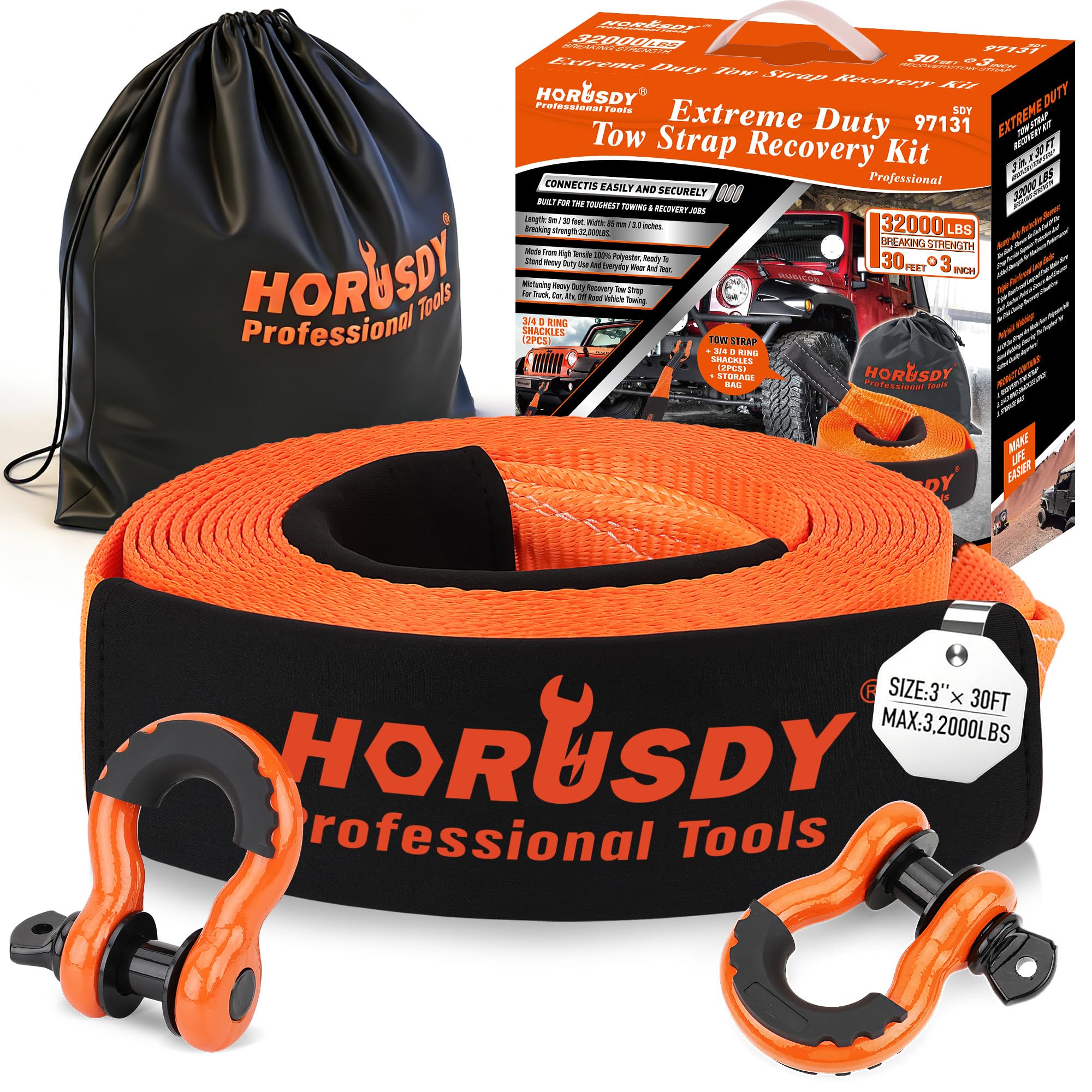
The HORUSDY strap uses nylon webbing rather than polyester, which provides greater elasticity for kinetic-style recovery where you need the strap to stretch and store energy before pulling. The 32,000 lb break strength with a 57,000 lb load capacity rating on the specification sheet indicates significant overhead for heavy equipment pulling and tree removal tasks beyond standard vehicle recovery. The 30-foot length with 3-inch width provides a good balance between manageable handling and sufficient surface area for load distribution.
Users who have employed this strap for tractor work and debris clearing report the double-web ring ends hold up well against the high tension and abrasion that occurs at connection points. The reinforced loop design prevents the webbing from bunching and binding, which extends service life compared to basic loop-end straps. The lifetime warranty from HORUSDY adds a layer of confidence, though the nylon material requires more careful drying after wet use compared to polyester alternatives to prevent mildew degradation over time.
The included D-ring shackles with stainless steel hardware complement the strap well, and the storage bag keeps everything accessible. Some owner feedback noted the nylon has a stiffer feel out of the package compared to polyester straps, but it softens after a few use cycles. For applications involving dynamic loads — pulling stumps, recovering vehicles from deep mud, or moving large debris — the nylon construction provides the elongation needed for smoother energy transfer.
What works
- Nylon webbing offers superior stretch for kinetic recovery scenarios
- Double-web ring ends handle high tension at connection points
- Lifetime warranty provides long-term ownership confidence
What doesn’t
- Nylon requires thorough drying after wet use to prevent mildew
- Strap feels stiff initially before breaking in
4. JACO 4X4 TowPro Recovery Tow Strap 3″ x 30ft

The JACO TowPro distinguishes itself through construction quality — double-diamond stitching on closed-end loops with protective sleeves that prevent edge wear during repeated use. Rated at 31,542 lbs break strength with a 10,663 lbs working load limit, this strap targets the serious off-road driver who needs predictable performance in mud, sand, rock, and snow conditions. The black and storm gray color scheme resists visible staining and maintains a professional appearance even after heavy use.
JACO brings 35-plus years of powersports industry experience to this design, and it shows in the details — the webbing has a consistent density throughout, the stitching tension is uniform across both loops, and the protective sleeves are long enough to cover the entire loop area where abrasion typically occurs. Owner feedback from Jeep and 4×4 forums consistently rates this strap highly for its build consistency and the fact that it arrives ready for use without needing to check for loose threads or uneven folds.
The 30-foot length with a 3-inch width provides good handling characteristics — wide enough to distribute load effectively but not so bulky that it becomes difficult to manage when wet or muddy. The lifetime warranty from JACO adds peace of mind for the serious off-roader who puts recovery gear through regular use. For drivers who prefer a strap-only approach without shackles or bags they won’t use, this standalone design keeps the kit minimal and focused.
What works
- Double-diamond stitching provides exceptional loop-end durability
- Protective sleeves prevent abrasion at high-wear points
- Industry expertise reflected in consistent build quality
What doesn’t
- Standalone strap requires separate purchase of shackles
- Higher price point than comparable kit options
5. KEEPER Tow Straps Heavy Duty with Loops 3″ x 30′

KEEPER has been a household name in tie-downs and recovery gear for decades, and this 30-foot recovery strap reflects that experience with a design focused on practical reliability. The 3-inch Hi-Test abrasion-resistant webbing is lighter and more compact than chains while offering 30,000 lbs break strength with a 15,000 lbs maximum vehicle weight recommendation. The closed-loop ends with heavy-duty stitching provide secure attachment points that work with standard hitch receivers and D-ring shackles.
Owner reports spanning multiple years show consistent performance with minimal degradation, which speaks to the quality of the nylon-polyester blend material. Users have employed this strap for everything from vehicle recovery to pulling logs and heavy equipment, and the abrasion-resistant webbing holds up well against rough surfaces that would damage standard straps. The 4-inch width on some variants provides even greater surface area for load distribution, though the 3-inch version remains the most versatile for general truck recovery.
The compact storage profile makes this strap easy to keep behind the seat or under a rear bench without taking up excessive space. Some owner feedback noted that the strap’s working limit is rated for mid-to-large trucks, so drivers of heavy-duty pickups should verify their vehicle weight falls within the 15,000 lb maximum recommendation. For a brand with decades of market presence and widespread availability, the KEEPER strap represents a low-risk choice for drivers who prioritize established reputation.
What works
- Decades of brand reputation with consistent quality control
- Abrasion-resistant webbing handles rough recovery surfaces
- Compact storage profile fits easily in truck cabs
What doesn’t
- Maximum vehicle weight rating limits use with heavy-duty trucks
- No included shackles or storage bag in base package
6. Rhino USA Heavy-Duty Recovery Gear Combo 30′ Strap + Shackles

The Rhino USA combo kit pairs a 31,518 lb break-strength recovery strap with 41,850 lb capacity D-ring shackles — a setup where the shackles are actually stronger than the strap, eliminating the weak-link problem that plagues many budget kits. The chromoly steel shackles with alloy steel hardware provide a significant safety margin, and the unlimited lifetime warranty reflects the manufacturer’s confidence in the materials. The 30-foot static tow strap with anchor points offers a compact solution for basic to medium recovery needs.
Owner feedback from off-road communities in challenging environments — Alaska snow recovery, Pacific Northwest mud, Southwest desert sand — consistently praises the kit’s ability to handle real-world recovery without component failure. The 11-pound total weight reflects the substantial hardware, though this also means the kit takes up more space than a strap-only solution. Users have reported pulling out dump trucks and buried full-size pickups without the straps or shackles showing signs of stress.
The father-and-son business story resonates with many buyers who appreciate the direct customer support and willingness to stand behind products. The entry-level off-road kit classification is modest — the components actually exceed what many intermediate-level off-roaders carry. For drivers who want a single purchase that covers recovery needs for years without upgrading individual components, the Rhino USA combo delivers a cohesive system with matching specifications.
What works
- Shackles exceed strap strength for true matched-component safety
- Unlimited lifetime warranty backed by responsive customer support
- Proven performance in extreme recovery scenarios
What doesn’t
- Heavier kit weight compared to strap-only alternatives
- Premium price point reflects the upgraded shackle quality
7. DAJOUJS Kinetic Recovery Tow Rope 7/8″ x 30ft with Soft Shackles
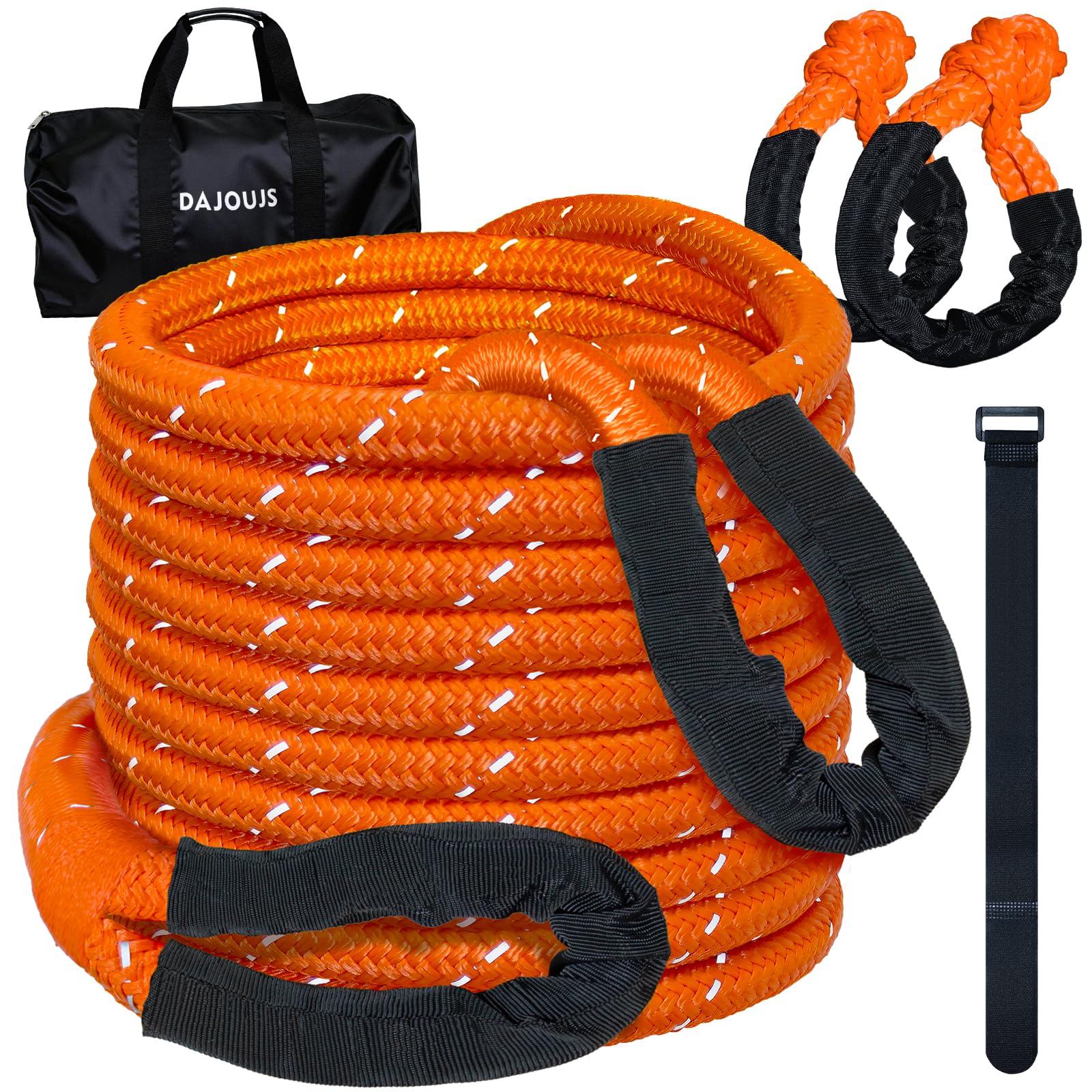
The DAJOUJS kinetic recovery rope represents a different category of recovery gear — rather than a static strap, this 7/8-inch diameter rope made from 12-strand nylon 66 stretches up to 35 percent to store and release energy, providing a smooth snatch recovery that reduces shock loading on both vehicles. The 48,500 lb break strength far exceeds what any standard pickup needs, but the high rating ensures the rope maintains structural integrity during repeated dynamic loads without degrading. The included soft shackles made from UHMWPE fibers at 56,000 lbs break strength eliminate the projectile hazard of metal shackles in the event of failure.
The double-braid shell with vinyl polymer coating prevents sand and mud from infiltrating the core fibers, a significant advantage over open-weave ropes that degrade internally when used in dirty conditions. Owner feedback highlights the safety benefits of the soft shackle system — lighter weight, no metal projectiles, and easier to store. The reflective threads improve visibility during night recoveries, and the protective sleeve at the loop end prevents abrasion where the rope contacts recovery points.
The 30-foot length with 7/8-inch diameter provides a good balance between manageable handling and energy storage capacity. Users who have switched from static straps to this kinetic rope report smoother recoveries with less strain on frame-mounted recovery points. The storage bag accommodates the rope and shackles with room to spare, though the rope requires careful coiling to prevent kinking. For off-roaders who perform regular recoveries in deep sand, mud, or snow where dynamic pulling is more effective than static force, this system offers a significant performance upgrade.
What works
- Kinetic stretch provides smooth snatch recovery with less shock
- Soft shackles eliminate metal projectile hazard during failure
- Vinyl coating prevents internal grit contamination in dirty conditions
What doesn’t
- Requires different technique than static strap recovery
- Higher investment point for specialized recovery gear
Hardware & Specs Guide
Break Strength vs. Working Load
Break strength is the force required to snap the strap, typically tested under laboratory conditions with new webbing. Working load limit is the safe maximum force during operation — usually one-third of break strength for recovery straps. A 30,000 lb break strength yields a 10,000 lb working load. Never exceed the working load during recovery, as dynamic forces can spike above static ratings during momentum-based pulls.
Webbing Width and Material
Three-inch webbing is the standard width for truck recovery straps, distributing load across a broad surface area to prevent damage to recovery points. Four-inch straps offer additional load distribution for heavy-duty trucks but require larger shackle openings. Polyester resists UV and moisture damage, making it ideal for stored straps. Nylon provides more stretch for kinetic recovery but requires careful drying after wet use.
Loop End Construction
The loop end is the structural weak point on any strap. Triple-reinforced or diamond-stitched loops with folded webbing layers distribute tension across more surface area and prevent the strap from bunching under load. Protective sleeves over the loop prevent abrasion from sharp recovery points. Heat-sealed ends prevent fraying but should not be the primary load-bearing mechanism.
Shackle Compatibility
D-ring shackles should match or exceed the strap’s break strength to maintain a balanced recovery system. A 3/4-inch D-ring typically handles 30,000 to 45,000 lbs, while 7/8-inch and 1-inch options handle higher loads. Soft shackles made from UHMWPE fiber offer comparable strength with reduced weight and no metal projectile risk, but require compatible recovery points with smooth edges.
FAQ
How do I determine the right break strength for my truck?
Can I use a recovery strap for towing on the highway?
How should I store my tow strap between uses?
When should I replace a recovery strap?
What is the difference between a snatch strap and a tow strap?
Final Thoughts: The Verdict
For most buyers, the best tow straps for trucks winner is the METOWARE Recovery Kit because it bundles a certified 35,000 lb strap with properly matched shackles at a price that leaves room for other gear. If you need extended reach and triple-reinforced loops, grab the Ohuhu 30-foot kit. And for serious off-road recovery where kinetic energy does the work, nothing beats the DAJOUJS Kinetic Rope Kit with soft shackles that eliminate metal projectile hazards entirely.

Certification: BSc in Mechanical Engineering
Education: Mechanical engineer
Lives In: 539 W Commerce St, Dallas, TX 75208, USA
Md Amir is an auto mechanic student and writer with over half a decade of experience in the automotive field. He has worked with top automotive brands such as Lexus, Quantum, and also owns two automotive blogs autocarneed.com and taxiwiz.com.