A torque belt that snaps mid-ride turns a trail day into a tow bill. Whether you wheel a built go-kart or a 1000cc UTV, the belt is the weakest link in your drivetrain — unless you choose one engineered for the load. Material compounds, cord construction, and dimensional precision separate a belt that lasts seasons from one that frays in a single afternoon.
I’m Amir — the founder and writer behind Four Wheel Ask. I track market trends, analyze material composition data, and synthesize owner feedback to identify the most reliable drivetrain components available today.
This guide evaluates five distinct options for different applications and budgets. For owners seeking reliable power transfer without premature wear, identifying the best torque belts starts with understanding material composition and fitment requirements.
How To Choose The Best Torque Belts
Selecting the right torque belt means matching three variables: vehicle application, belt material, and dimensional accuracy. A belt that fits loosely slips under load and generates heat that accelerates wear. One that fits too tightly strains the clutch sheaves and robs power. The goal is a belt that seats precisely, engages smoothly, and sheds heat efficiently across the RPM range you actually use.
Material and Cord Construction
Standard rubber belts use polyester or nylon cords that stretch over time. Premium options incorporate aramid fibers — often marketed as Kevlar — that resist fraying and maintain tension under high heat. For high-horsepower UTVs or modified small engines, aramid cord construction is the difference between a belt that lasts a season and one that fails mid-ride.
Fitment and Dimensional Specs
Width, length, and angle must match the clutch system exactly. A belt that is one millimeter too wide can cause high idle creep; one that is too narrow slips under torque. Asymmetrical belts (like the 669 series used on TAV2 converters) have a specific profile that reduces engine load and improves power delivery. Always verify the manufacturer part number against your vehicle’s clutch system before purchasing.
Application-Specific Design
Go-kart torque converters and side-by-side CVT systems place very different demands on a belt. Go-kart belts see frequent starts and stops at lower speeds, while UTV belts endure sustained high speeds, mud, sand, and hill climbs. A belt engineered for extreme heat dissipation and shock load resistance is non-negotiable for UTV work. For recreational go-karts, a durable asymmetrical belt with proper elasticity offers the best balance of cost and performance.
Quick Comparison
On smaller screens, swipe sideways to see the full table.
| Model | Category | Best For | Key Spec | Amazon |
|---|---|---|---|---|
| SuperATV RZR XP 1000 Belt | UTV | High-abuse trail riding | Aramid fiber cord | Amazon |
| QYMOTO CFMOTO Belt | UTV | OEM replacement value | Mitsubishi rubber | Amazon |
| SuperATV General Belt | UTV | High-horsepower UTVs | 400 hp shock load | Amazon |
| VEVOR 30 Series Kit | Go-Kart | Complete converter swap | Asymmetrical 669 belt | Amazon |
| Mophorn 30 Series Kit | Go-Kart | Budget mini bike build | 2-7 hp range | Amazon |
In-Depth Reviews
1. SuperATV Heavy Duty CVT Drive Belt for Polaris RZR XP 1000

The SuperATV Heavy Duty belt is purpose-built for the 2014-2020 Polaris RZR XP 1000, a machine known for demanding high torque loads in rough terrain. Construction uses an aramid fiber cord that reduces fraying and improves power transfer through the clutch compared to standard polyester cords. The belt also features XC Technology and a knife-cut aramid cord profile designed to handle extreme heat without delamination.
Owner reports consistently highlight smooth engagement and excellent heat dissipation during aggressive dune riding and hill climbs. Multiple riders noted that this belt survived heavy abuse — sustained 70 mph runs in Oregon dunes — where previous belts failed within miles. The belt is not compatible with the Trails and Rocks Edition, so verify your sub-model before ordering.
SuperATV backs this belt with a 3-month warranty against manufacturing defects. For RZR XP 1000 owners who ride hard and want a belt that won’t leave them stranded, this is the most consistently praised option in the aftermarket space.
What works
- Aramid cord resists fraying under extreme heat
- Smooth engagement with reduced slippage
- Proven durability in sand and dune conditions
What doesn’t
- Not compatible with RZR XP 1000 Trails and Rocks Edition
- Premium pricing versus standard replacement belts
2. SuperATV World’s-Best CVT Drive Belt for Polaris General

The World’s-Best Racing Series belt from SuperATV targets 2016+ Polaris General models, including the XP 1000 and XP 4 1000 variants. The standout feature is a custom Kevlar braid integrated into the cord structure that provides a shock load rating of 400 horsepower — well beyond what even a modified General can produce. This headroom translates to exceptional durability under real-world conditions.
An advanced rubber compound is used to prevent delamination at high clutch temperatures, and precision-ground sidewalls ensure smooth engagement during heavy-throttle maneuvers. Owners who switched to this belt after experiencing failures with other aftermarket options report dramatically improved lifespan. One comparison noted the SuperATV belt outlasted a competitor belt by over ten miles of abuse before showing any signs of wear.
The belt fits both 2-seat and 4-seat General models and includes the same 3-month warranty as the RZR version. For General owners who ride aggressively or run larger tires that increase drivetrain load, this belt delivers the highest safety margin available.
What works
- Kevlar braid provides massive shock load headroom
- Precision sidewalls for smooth engagement
- Outperforms other aftermarket belts in direct comparisons
What doesn’t
- Limited to Polaris General platform only
- Higher cost than OEM replacement belts
3. QYMOTO OEM CFMOTO CVT Drive Belt Mitsuboshi
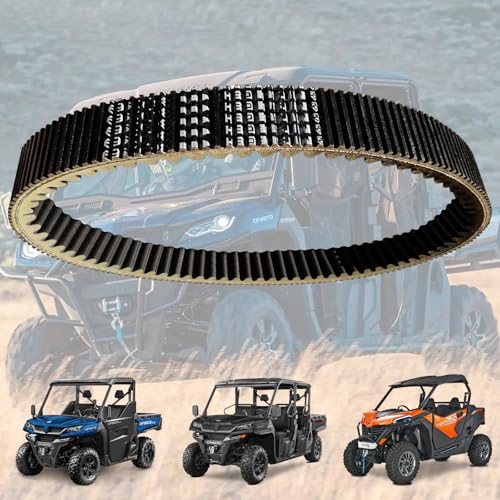
The QYMOTO belt is an OEM-grade replacement for CFMOTO UTVs including the UFORCE 1000, CFORCE 1000, ZFORCE 950, ZFORCE 800 Trail, and CFORCE 800 models. The belt is manufactured by Mitsuboshi, a Japanese supplier that produces original equipment belts for many major UTV brands. The replacement part number is 0JWA-055000-10000, matching the factory CFMOTO specification.
Precision engineering ensures the tooth profile engages smoothly with the clutch pulleys without the adjustment hassle often required by generic aftermarket belts. Owners of CFMOTO 1000 XL and ZForce 950 models confirm perfect fitment and restored performance immediately after installation. The belt includes break-in instructions to maximize longevity.
For CFMOTO owners looking for a factory-quality replacement at a lower price than the dealer alternative, this belt delivers genuine OEM material and dimensional accuracy. The Mitsuboshi construction provides confidence in durability for riders who log regular trail miles.
What works
- OEM-grade Mitsuboshi construction
- Perfect fitment with no modifications needed
- Lower cost than dealer OEM belts
What doesn’t
- Limited to specific CFMOTO models only
- Break-in period required for optimal performance
4. VEVOR Torque Converter 30 Series for Go-Kart
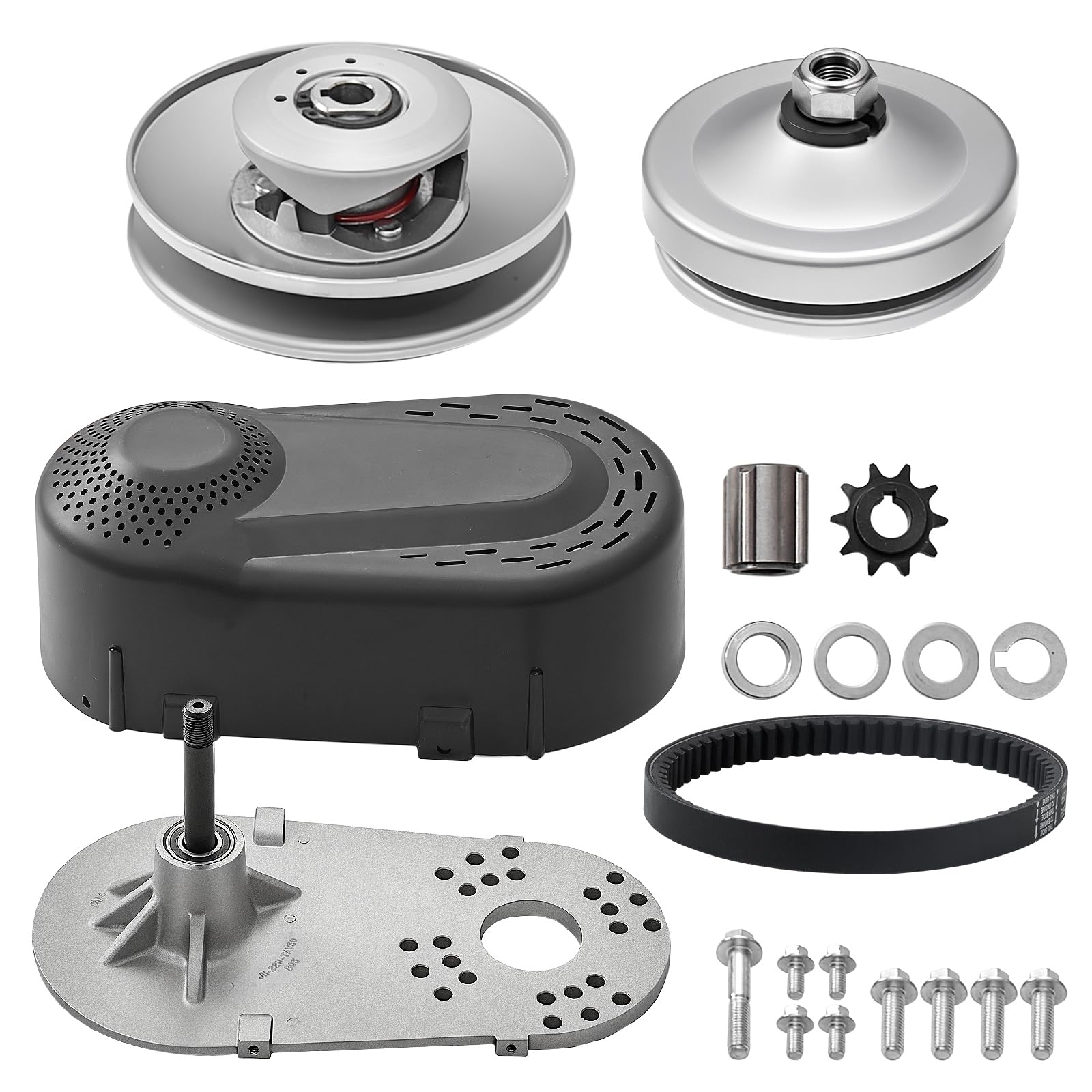
The VEVOR 30 Series torque converter kit is a complete replacement for TAV2-style systems on go-karts and mini bikes with 4-8 hp engines. The kit uses an asymmetrical belt design — the 669 series — that reduces engine load and improves power delivery compared to symmetrical belts. The driver pulley accepts a 3/4-inch straight crankshaft, while the driven pulley has a 5/8-inch bore.
Owner feedback highlights buttery-smooth engagement with no jerking at idle, making it ideal for youth karts and recreational riders. The kit includes the belt, both pulleys, a plastic cover, aluminum mounting plate, and all hardware. One owner compared this kit directly to another popular Amazon brand and rated the VEVOR higher for packaging quality and instruction clarity.
The belt lifespan is noted as decent for recreational use, though experienced riders recommend carrying a spare for longer excursions. For go-kart builders who want a complete torque converter swap with reliable components, this kit provides strong value and solid real-world performance.
What works
- Complete kit with all mounting hardware included
- Asymmetrical belt reduces engine load
- Smooth engagement with no jerking at idle
What doesn’t
- Plastic cover may not fit all installations
- Belt lifespan moderate for heavy use
5. Mophorn Torque Converter CVT 2-7 HP for Mini Bike

The Mophorn 30 Series torque converter is designed for small engines in the 2-7 hp range, making it a natural fit for Predator 212 builds, Coleman mini bikes, and older Murray go-karts. The kit includes the same TAV2/30 asymmetrical system architecture as the VEVOR, with a 3/4-inch driver pulley, 5/8-inch driven pulley, 669 asymmetrical belt, mounting plate, and cover.
Owners report straightforward installation on popular platforms. A Coleman BT200X owner noted that the converter doubled low-end torque and achieved a 30.5 mph top speed after adding a riser plate and crankshaft adapter. Another rider running a built Predator 212 at 15 hp and 7000 rpm confirmed the belt held up well, though some modifications were needed for the plastic cover.
The kit has been on the market since late 2015 and maintains a strong track record for reliability at a competitive price point. The instructions are functional but not detailed, and some owners note that the plastic cover lacks a chain cutout that must be added with tin snips. For budget-conscious builders, this is a proven entry point into CVT performance.
What works
- Proven compatibility with Predator 212 and Coleman bikes
- Significant low-end torque improvement over clutch
- Long-standing market presence with consistent reviews
What doesn’t
- Plastic cover needs modification for chain clearance
- Instructions lack detail for first-time installers
Hardware & Specs Guide
Asymmetrical Belt Profile
TAV2/30 series torque converters use an asymmetrical belt design where the belt profile is not symmetrical across its width. This shape reduces engine load at idle and provides progressive engagement as RPM rises. The 669 belt designation refers to the specific length and profile used in these systems. Asymmetrical belts must be installed with the correct orientation — the belt direction matters for proper heat distribution and wear patterns.
Aramid Fiber Cord Construction
Aramid fibers — commonly known by the brand name Kevlar — offer five times the tensile strength of steel by weight. In torque belts, aramid cords resist stretching under heat and maintain consistent engagement pressure against the clutch sheaves. Belts with aramid construction typically cost more but deliver significantly longer service life in high-torque or high-heat applications such as dune riding, hill climbs, or modified engines.
Shock Load Rating
Shock load rating measures the instantaneous force a belt can withstand without snapping. Standard CVT belts typically handle 150-200 hp shock loads, while premium racing belts can exceed 400 hp. This rating matters most for riders who drop the clutch at high RPM or run oversized tires that multiply drivetrain stress. A higher shock load rating provides a safety margin that prevents catastrophic belt failure during aggressive maneuvers.
Belt Width and Angle Tolerance
CVT belts must match the clutch sheave angle exactly — typically 26 to 30 degrees depending on the manufacturer. Width tolerance is equally critical: a belt that is 0.5 mm too wide can cause belt creep at idle, while one that is too narrow slips under load. OEM-spec belts like the Mitsuboshi CFMOTO unit are ground to precise tolerances, while generic belts may vary by 1-2 mm and require adjustment.
FAQ
What is the difference between a torque converter belt and a standard drive belt?
How do I know which torque belt size fits my vehicle?
How often should I replace a CVT torque belt?
Final Thoughts: The Verdict
For most buyers, the best torque belts winner is the SuperATV Heavy Duty CVT Belt for Polaris RZR XP 1000 because it combines aramid cord durability, proven heat management, and consistent owner praise for surviving extreme abuse on the trail. If you want OEM-grade precision at a lower dealer price, grab the QYMOTO Mitsuboshi belt for CFMOTO models. And for a complete go-kart torque converter swap that delivers smooth engagement out of the box, nothing beats the VEVOR 30 Series kit.

Certification: BSc in Mechanical Engineering
Education: Mechanical engineer
Lives In: 539 W Commerce St, Dallas, TX 75208, USA
Md Amir is an auto mechanic student and writer with over half a decade of experience in the automotive field. He has worked with top automotive brands such as Lexus, Quantum, and also owns two automotive blogs autocarneed.com and taxiwiz.com.