Building a car audio system that actually delivers means knowing which components pull their weight and which ones just look good on a spec sheet. After analyzing dozens of configurations, comparing frequency response curves, and tracking real-world owner feedback across forums and verified reviews, a clear picture emerges of what genuinely performs on the road.
I’m Amir — the founder and writer behind Four Wheel Ask. I’ve spent years studying car audio market trends, cross-referencing build quality data with long-term owner reports, and evaluating how different component pairings perform under real driving conditions.
This guide breaks down the top contenders across head units, speakers, amplifiers, and complete bundles so you can build a system that matches your priorities. Whether you prioritize smartphone integration, clean midrange, or deep sub-bass, the right best car audio equipment transforms your daily commute into a genuinely enjoyable listening experience.
How To Choose The Best Car Audio Equipment
Selecting the right components for your vehicle starts with understanding how each piece interacts. A high-quality head unit with clean preamp outputs feeds better signal to your amplifier, which then drives speakers capable of handling the power without distortion. Skipping any link in that chain creates a bottleneck that no amount of tuning can fix.
Head Unit First — The Command Center
The receiver determines your connectivity options, audio source quality, and basic sound shaping. Look for units with at least 4-volt preamp outputs if you plan to add external amplifiers, and confirm Bluetooth version 4.0 or higher for stable streaming. A mechless design saves dash depth and eliminates a mechanical failure point, while a double-DIN with a QLED screen adds navigation and backup camera integration.
Speaker Matching — Sensitivity and Power Handling
Speaker sensitivity ratings above 90 dB deliver more volume from the same amplifier wattage. Midrange drivers with large ferrite magnets and polypropylene cones handle higher RMS power with lower distortion. Pair tweeter crossover points with your midrange natural roll-off to avoid harshness in the 2-4 kHz range where the human ear is most sensitive.
Amplifier Headroom — The Overlooked Variable
An amplifier rated for continuous RMS power rather than peak wattage is the only honest spec to trust. Choose an amp that delivers 75-150% of your speaker RMS rating to allow clean headroom without clipping. Class D monoblock amps offer high efficiency for subwoofers, while multichannel Class A/B or Class D amps provide cleaner power for full-range speakers.
Quick Comparison
On smaller screens, swipe sideways to see the full table.
| Model | Category | Best For | Key Spec | Amazon |
|---|---|---|---|---|
| Rockville dB55 | 5-Channel Amp | Full-system clean power | 4000W peak, 5-channel | Amazon |
| Alpine S-A60M | Monoblock Amp | Subwoofer dedicated power | 600W RMS x 1 | Amazon |
| SJOYBRING W021 (Dash Cam) | Double-DIN Receiver | Wireless CarPlay + safety | QLED 1280×720, dash cam | Amazon |
| SJOYBRING W021 (Standard) | Double-DIN Receiver | QLED screen + backup cam | 240W 4.2-channel output | Amazon |
| JBL GTO629 | 6.5″ Coaxial Speakers | Factory speaker upgrade | 360W max, 3 ohm | Amazon |
| MTX Dual 12″ Bundle | Subwoofer System | Complete bass package | 1200W peak loaded enclosure | Amazon |
| Pioneer MVH-S230BT | Digital Media Receiver | Budget Bluetooth head unit | 50W x 4, mechless | Amazon |
| DS18 PRO-GM6.4PK | Component Speaker Set | Midrange + tweeter combo | 480W max, 4 ohm | Amazon |
| BOSS 656BCK | Stereo + Speaker Bundle | All-in-one starter system | 50W x 4, CD player | Amazon |
In‑Depth Reviews
1. Rockville dB55 5-Channel Amplifier

The Rockville dB55 delivers five channels of amplification in a single chassis, simplifying installation while providing dedicated power to front and rear speakers plus a subwoofer channel. Owner feedback consistently highlights its ability to drive 100-watt full-range speakers and a twelve-inch sub without entering thermal protection, even during extended listening sessions.
Build quality stands out in this segment with a metal heatsink chassis, LED-illuminated logo, and IC-controlled protection circuitry that guards against voltage spikes and short circuits. The included remote dashboard subwoofer control lets you adjust bass level on the fly without reaching behind the dash or digging through menus on the head unit.
Adjustable twelve dB per octave crossovers on each channel pair with a subsonic filter and twelve dB bass equalizer, giving you real tuning flexibility. Users running this amp with four coaxial speakers and a separate sub note that gain settings at one-quarter position produce clean output with no audible noise floor, a sign of solid internal shielding and power supply design.
What works
- Compact five-channel design saves installation space
- Remote sub control included in the box
- Runs cooler than many competitors at similar power levels
What doesn’t
- Peak power rating substantially exceeds real RMS output
- Wiring terminals could be more robust for thick gauge cable
2. Alpine S-A60M Monoblock Subwoofer Amplifier

Alpine’s S-A60M is a Class D monoblock that delivers a genuine 600 watts RMS into a single channel at two ohms, making it a reliable choice for driving a single subwoofer or a pair of voice coils. The amplifier includes both preamp and speaker-level inputs, allowing integration with factory head units that lack dedicated RCA outputs.
The variable bass boost circuit lets you dial in low-frequency emphasis without introducing distortion, and the eighty-five dB signal-to-noise ratio indicates clean power delivery across the operating band. Owner reports from long-term installations note the amp maintains consistent output without thermal fade, even in trunks with limited airflow during summer months.
CEA-2006 compliance means the power rating is tested to an industry standard rather than inflated by marketing. This makes the S-A60M a trustworthy building block for anyone constructing a subwoofer system around a single high-power driver, with enough headroom to handle dynamic peaks in bass-heavy music genres.
What works
- Certified RMS power rating under CEA-2006 standard
- Speaker-level inputs accept factory radio signals
- Compact footprint fits under seats or in tight spaces
What doesn’t
- No remote bass level knob included
- Single channel limits flexibility for multi-sub builds
3. SJOYBRING W021 Double-DIN Receiver with Dash Cam

The SJOYBRING W021 with integrated dash cam combines a QLED head unit display with a 1280×720 resolution front-facing camera, eliminating the need for a separate dash cam purchase and windshield mount. Wireless Apple CarPlay and Android Auto connect automatically when you enter the vehicle, and the seven-inch screen renders navigation maps sharply with good color accuracy.
Audio output is handled by a 240-watt four-channel amplifier section with two dedicated subwoofer RCA preouts, allowing expansion with external amplification. Owner feedback indicates the sound quality is good at moderate volume levels, though the internal amp lacks the headroom of a dedicated external amplifier for high-SPL builds.
The included backup camera provides a 170-degree viewing angle with HD night vision, and the dash cam records 1280×720 video with loop recording. Users report that the screen brightness is adequate for daytime use, and the physical volume knob provides tactile control that touch-only interfaces lack. Support staff offers custom boot screen graphics, a small but appreciated personalization touch.
What works
- Integrated dash cam saves windshield space and wiring
- QLED screen delivers vibrant colors and wide viewing angles
- Wireless CarPlay connection is fast and stable
What doesn’t
- Rear camera cable may be too short for larger vehicles
- Some UI customization options are limited
4. SJOYBRING W021 Double-DIN Receiver (Standard)

This version of the SJOYBRING W021 drops the integrated dash cam but keeps the core QLED screen, wireless smartphone connectivity, and backup camera support at a more accessible entry point. The seven-inch 1280×720 display handles 1080P video playback and includes mirror link functionality for both iOS and Android devices.
The 4.2-channel audio architecture provides front, rear, and two subwoofer RCA outputs, making it straightforward to add a four-channel amp and a monoblock for a complete active system. Bluetooth connectivity uses an independent module and antenna, which owner reports describe as fast to pair and reliable during calls even in urban areas with radio frequency congestion.
Installation requires attention to dash opening dimensions, as the unit fits common double-DIN sizes but may need an adapter harness and dash kit for specific vehicles. The backup camera included in the box offers a 170-degree field of view, and the steering wheel control interface supports retained functionality with an additional adapter.
What works
- Wireless CarPlay and Android Auto with no cable clutter
- Dual subwoofer outputs enable flexible system expansion
- HD night vision backup camera included in the package
What doesn’t
- Internal amplifier lacks power for high-volume listening
- Installation may require additional adapters for specific vehicles
5. JBL GTO629 6.5″ Coaxial Speakers

The JBL GTO629 represents a sweet spot in the coaxial speaker segment, offering three-ohm impedance that draws more power from typical head unit and amplifier outputs than standard four-ohm designs. Owner feedback consistently praises the clarity in the upper midrange and the surprisingly punchy bass response for a six-and-a-half-inch driver, especially when paired with a quality head unit.
Factory replacement installation is straightforward thanks to the included thin-fit ring adapter, which allows the speaker to mount in locations with limited depth behind the door panel. Users report that the GTO629 handles up to 120 watts RMS comfortably, with the Plus One cone technology providing greater surface area for improved efficiency compared to competitors with the same nominal diameter.
Frequency response extends to 21 kHz, ensuring that high-frequency detail from cymbals and vocal sibilance is reproduced without harshness. The included iron crush cleaning cloth is a minor but thoughtful addition that reflects JBL’s attention to the installer experience. These speakers work well as a drop-in factory replacement or as part of a more extensive amplified system.
What works
- Three-ohm design pulls more power for louder output
- Thin-fit mounting ring simplifies installation in tight doors
- Clear midrange and respectable bass from a coaxial driver
What doesn’t
- Some vehicles with factory premium audio may need impedance matching
- Tweeter can sound bright in vehicles with reflective dash surfaces
6. MTX Dual 12″ Subwoofer Bundle

The MTX TNE212D loaded enclosure pairs two twelve-inch subwoofers in a ported box built from five-eighths-inch MDF with aircraft-grade black carpet covering. The enclosure measures just over twenty-six inches wide and fourteen inches tall, requiring moderate trunk space but delivering substantial low-frequency output for the footprint.
The bundle includes a Planet Audio 1500-watt monoblock amplifier and a Soundstorm eight-gauge wiring kit, providing everything needed for a complete subwoofer installation except the head unit or line-output converter. The amplifier features variable bass boost and a low-pass filter, allowing you to tune the subwoofer blend to match your front-stage speakers.
Owner reports indicate that the combination produces deep, authoritative bass that handles both music with sustained low notes and transient kick drum hits. The 1200-watt peak power rating should be understood as system load rather than continuous output, but real-world performance satisfies most listeners looking for noticeable bass presence without building a custom enclosure from scratch.
What works
- Complete package with enclosure, amp, and wiring included
- MDF construction with quality carpet covering resists rattles
- Planet Audio amp provides flexible crossover and bass boost controls
What doesn’t
- Enclosure dimensions require significant trunk space
- Professional installation recommended for electrical system safety
7. Pioneer MVH-S230BT Digital Media Receiver

Pioneer’s MVH-S230BT is a single-DIN mechless receiver that strips away the CD mechanism to reduce installation depth to under four inches, making it compatible with many vehicles where deeper chassis won’t fit. Despite its compact size, it includes Bluetooth hands-free calling and audio streaming, a USB input, and a front auxiliary input.
The built-in amplifier delivers 50 watts across four channels, which owner feedback rates as significantly more powerful than typical factory head units. Users installing this receiver in older vehicles with aftermarket speakers report a night-and-day improvement in clarity and volume, with the Advanced Sound Retriever feature helping to restore detail lost in compressed audio files.
Installation is straightforward with the included sleeve, trim ring, and wiring harness. The five-band equalizer and bass boost button provide basic tone shaping, and the selectable RCA output can serve either front channels or a mono subwoofer signal, adding flexibility for system expansion despite the entry-level positioning.
What works
- Compact chassis depth fits tight dash openings
- Bluetooth connects instantly and maintains stable pairing
- Built-in amp outperforms factory units at similar power ratings
What doesn’t
- Only five-band EQ limits fine-tuning capability
- Single RCA output restricts multi-amp setups without Y-splitters
8. DS18 PRO-GM6.4PK Mid and High Package

The DS18 PRO-GM6.4PK package pairs two six-and-a-half-inch midrange drivers with two one-inch aluminum super bullet tweeters, each with a built-in capacitor crossover. The midrange drivers handle 140 watts RMS and 480 watts peak, with oversized ferrite magnets that provide the motor force needed for high-SPL applications without sacrificing vocal clarity.
Owner feedback from truck and SUV installations highlights the system’s ability to produce clean, distortion-free output at high volume levels when paired with an amplifier delivering around 120 watts per channel. The tweeters reproduce high-frequency detail with presence that cuts through road noise, though their physical size may require modification to fit factory tweeter pods or sail panels.
The included crossovers are basic capacitor-based designs, which limits slope steepness compared to dedicated external crossover networks. For listeners prioritizing midrange dominance in a three-way active system, these drivers serve as capable midbass or midrange components, but they perform best when paired with a separate subwoofer to handle frequencies below 80 Hz.
What works
- Large magnet structure handles high power without compression
- Aluminum tweeters produce clear, extended high frequencies
- Excellent value for a complete midrange and tweeter set
What doesn’t
- Tweeter size may require modification for factory locations
- Basic capacitor crossovers offer limited slope control
9. BOSS Audio Systems 656BCK Stereo Package
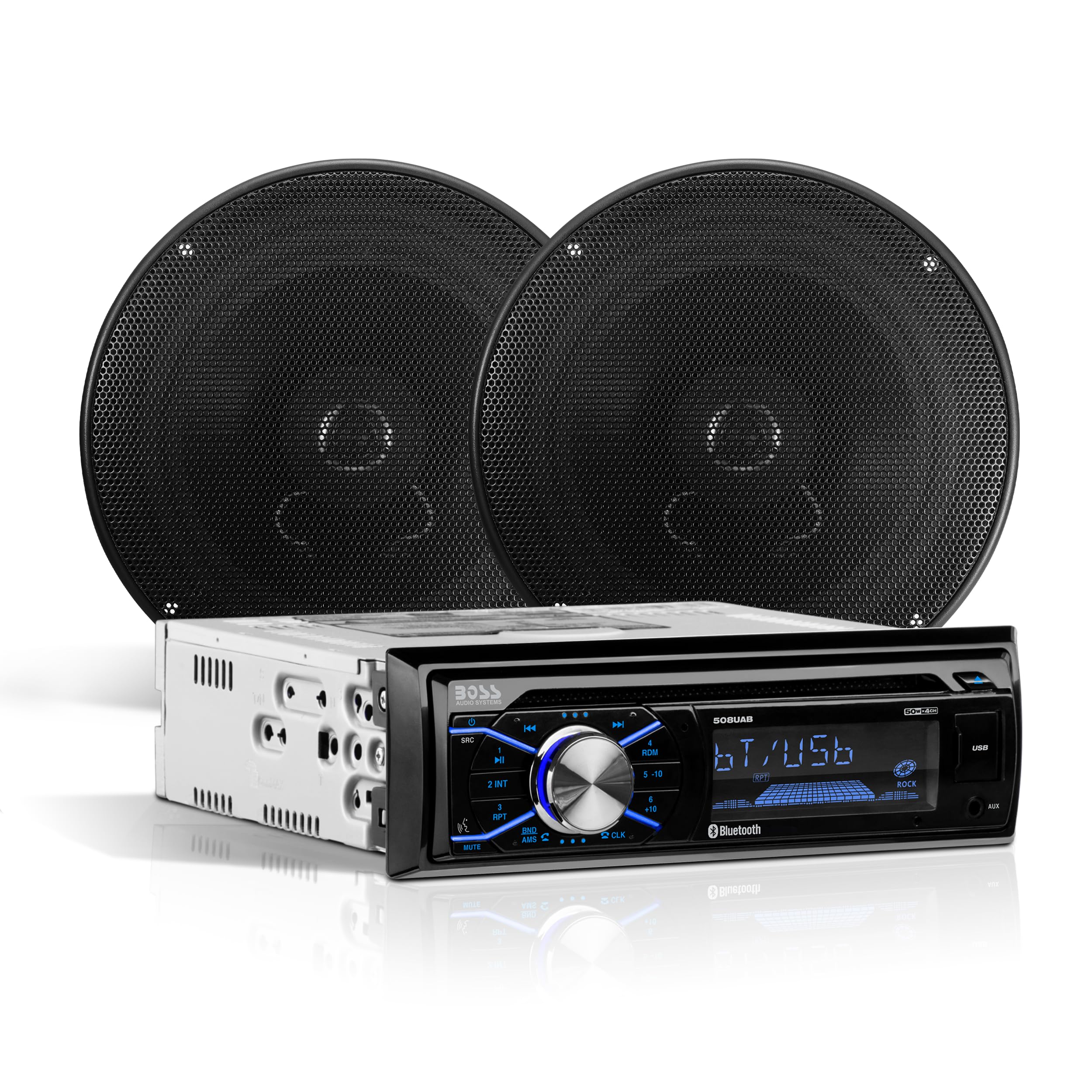
The BOSS 656BCK bundles a single-DIN CD receiver with a pair of six-and-a-half-inch two-way speakers, providing a complete audio upgrade in one box. The receiver includes Bluetooth audio streaming and hands-free calling, a USB port, auxiliary input, and AM/FM tuner, while the weatherproofed speakers add durability for vehicles exposed to moisture.
Owner reports describe the system as a significant improvement over basic factory audio, with the 50-watt per channel receiver providing adequate volume for daily driving. The bundled speakers handle 75 Hz to 18 kHz frequency response, and their two-way design with built-in tweeter delivers acceptable high-frequency extension for talk radio, podcasts, and casual music listening.
The three-year platinum warranty from BOSS provides peace of mind at this entry point, and installation is simplified by the complete nature of the package. Users note that the included speakers are the weakest link in the chain, with some reporting that mounting holes required minor adjustment. For a first-time installer or budget-conscious owner, this bundle reduces the complexity of component selection while delivering a functional upgrade.
What works
- Complete system in one box simplifies purchasing and installation
- Three-year warranty exceeds industry standard for this price tier
- Bluetooth and CD playback offer flexible media options
What doesn’t
- Included speakers have mediocre build quality and alignment issues
- Limited tuning controls restrict sound shaping capability
Hardware & Specs Guide
RMS vs Peak Power
RMS (Root Mean Square) is the continuous power an amplifier or speaker can handle over time, while peak power represents short bursts. Always compare RMS ratings between components. An amplifier rated for 600W RMS will drive music cleanly at high volume, whereas a peak rating of 4000W may only be sustainable for milliseconds before distortion or thermal shutdown occurs. Matching amplifier RMS to speaker RMS with 20-50% headroom ensures clean output without damaging drivers.
Speaker Sensitivity
Sensitivity measured in dB at 1 watt per 1 meter indicates how efficiently a speaker converts power into volume. A speaker rated at 92 dB sensitivity produces the same output as a 89 dB speaker with roughly double the amplifier power. For systems using head unit internal amplification (typically 15-25 watts RMS per channel), choose speakers with sensitivity above 90 dB to achieve satisfying volume levels without adding an external amplifier.
Preamp Output Voltage
Head unit preamp outputs carry the audio signal to external amplifiers. Higher voltage outputs (4V or 6V) provide a cleaner signal with better noise immunity than 2V outputs, especially in vehicles with long RCA cable runs near power wires. A 4V preamp output allows amplifier gain to be set lower, reducing the noise floor and hiss that can become audible with higher gain settings on the amplifier.
Impedance and Load Matching
Speaker impedance measured in ohms affects how much current an amplifier delivers. A 3-ohm speaker draws more power from a typical amplifier than a 4-ohm speaker at the same volume setting, producing higher output. However, ensure your amplifier is stable at the total impedance load when wiring multiple speakers in parallel. Most car audio amplifiers are stable to 2 ohms stereo and 4 ohms mono bridged.
FAQ
Can I use factory speakers with an aftermarket head unit?
What size amplifier do I need for my speakers?
Should I get a mechless or CD receiver?
Do I need a line output converter for a factory radio?
Final Thoughts: The Verdict
For most buyers, the best car audio equipment winner is the JBL GTO629 because it delivers the most impactful upgrade for the investment, transforming factory sound with minimal installation effort. If you want a complete bass system, grab the MTX Dual 12″ Bundle for a turnkey subwoofer solution with all components included. And for the cleanest full-range power, nothing beats the Rockville dB55 amplifier, offering five-channel flexibility in a single chassis that drives an entire system with authority.

Certification: BSc in Mechanical Engineering
Education: Mechanical engineer
Lives In: 539 W Commerce St, Dallas, TX 75208, USA
Md Amir is an auto mechanic student and writer with over half a decade of experience in the automotive field. He has worked with top automotive brands such as Lexus, Quantum, and also owns two automotive blogs autocarneed.com and taxiwiz.com.