Nothing ages a car’s appearance faster than swirl marks etched into the clear coat, water spots baked on by the sun, or the chalky haze of oxidized paint. A quality rubbing compound is the first line of defense, using precisely graded abrasives to level the clear coat and remove these defects before polishing and waxing lock in the final gloss. Choosing the wrong grit, however, can leave holograms, marring, or unnecessary paint loss.
I’m Amir — the founder and writer behind Four Wheel Ask. I’ve spent years breaking down automotive detailing chemistry, analyzing abrasive particle size, lubricity, and wipe-off behavior from market data and aggregated owner feedback to separate the products that truly cut from those that just smear.
Whether you’re planning a full single-stage correction or just tackling sun-faded patches, the right rubbing compound for cars will determine how much clear coat you remove and how level the surface ends up before your final polish step.
How To Choose The Best Rubbing Compound For Cars
Rubbing compounds are classified by abrasive type and particle size rather than brand labels. Understanding these specs helps you match the product to the defect depth and application method.
Abrasive Grit and Cut Level
Look for the grit rating if listed — a lower number (120 grit) indicates a coarser, heavier cut that handles 1200-grit sanding scratches or heavy oxidation. Higher numbers (1500–2400 grit) produce a finer finish and are safer for light swirl removal on modern clear coats. Compounds with aluminum oxide or silicon carbide abrasives offer consistent particle fracture for predictable cut.
Work Time and Dust Control
Machine buffing requires a compound that stays wet and lubricated for a full work cycle. Fast-drying formulas create airborne dust and require more product to rewet the surface. High-lubricity creams with extended work time allow you to work the abrasives until they break down fully, producing a cleaner finish that wipes off without residue.
Quick Comparison
On smaller screens, swipe sideways to see the full table.
| Model | Category | Best For | Key Spec | Amazon |
|---|---|---|---|---|
| Griot’s Garage BOSS Correcting Cream | Premium Cream | Moderate defects via DA polisher | 120 grit aluminum oxide | Amazon |
| Meguiar’s D30016 DA Microfiber Correction Compound | Machine Compound | DA polisher with microfiber cutting discs | 240 grit; no-sling formula | Amazon |
| Chemical Guys V32 Optical Grade Extreme Compound | Ceramic Clear Coat | Scratch-resistant and ceramic clear coats | 1500 grit ceramic abrasive | Amazon |
| Mothers 08612 Professional Rubbing Compound | All-Purpose | Heavy oxidation and water spots | Mild abrasive; 12 oz | Amazon |
| ABRO Rubbing Compound 10 oz | Budget Pick | Sun-faded and oxidized paint | Fine aluminum oxide; 10 oz | Amazon |
In‑Depth Reviews
1. Griot’s Garage BOSS Correcting Cream 16 oz

The BOSS Correcting Cream is engineered for the dual-action polisher user who wants a single product capable of removing moderate defects — light scratches, swirls, and water etching — without premature drying. Its 120 grit aluminum oxide abrasive is aggressive enough to cut through 1200-grit sanding marks yet refined enough to finish down nicely when worked with a softer pad. The high-lubricity formula stays wet through a full buff cycle, meaning less dust and easier wipe-off compared to ordinary compounds that turn to powder mid-pass.
Owner feedback on 12-year-old black paint is particularly telling — users report restoring depth and clarity to paint they had written off as irreparable. The cream works well with the BOSS Fast Correcting Foam Pad, but it also pairs effectively with orange or white hex logic pads for those dialing in aggressiveness on their own. The 16-ounce bottle provides multiple correction sessions before needing a refill.
What moves this to the top spot is the balance of cut and finish. It doesn’t leave haze that requires a secondary polishing step, saving time on single-stage corrections. The lack of silicone also means it’s body shop safe and won’t interfere with subsequent coatings or wax applications.
What works
- Extended lubricity prevents dusting during machine buffing
- Removes moderate defects while finishing clear for single-stage jobs
- Body shop safe and silicone-free for paint prep workflows
What doesn’t
- Requires a DA polisher for best results — manual application is less effective
- More expensive per ounce than budget alternatives
2. Meguiar’s D30016 DA Microfiber Correction Compound 16 oz
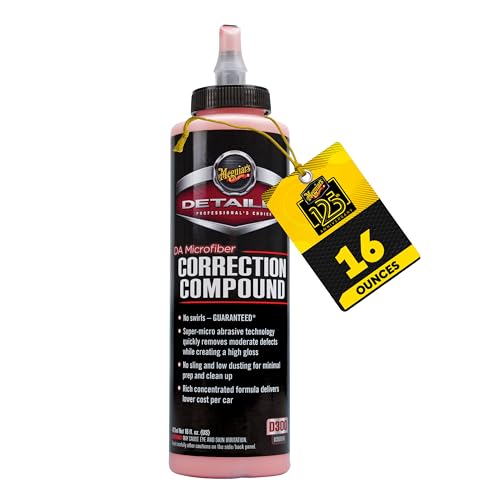
Meguiar’s D30016 is formulated specifically for use with a dual-action polisher paired with a microfiber cutting disc — the microfiber fibers grab the abrasive particles and create a rapid cutting action that shortens correction time. At a 240 grit rating, it strikes a middle-ground cut level that removes moderate swirls, oxidation, and water spots faster than traditional foam-pad compounds while leaving a surprisingly refined finish. The super micro abrasive technology prevents the compound from slinging off the pad, keeping your work area cleaner.
User reviews highlight its effectiveness on OEM clear coats that have accumulated years of surface defects. Many DIY enthusiasts report that this was the product that allowed them to transition from hand polishing to machine correction without fear of burning through the clear coat. The concentrated formula means a little product goes a long way — a single bottle can handle a full-size sedan with careful application.
One consideration is that the compound is paired best with microfiber discs, which are more aggressive on the paint than foam pads. This limits its versatility if you only have foam pads available, but the results with the recommended setup are hard to beat.
What works
- Rapid cut rate when used with microfiber cutting discs saves time
- No-sling formula reduces clean-up and wasted product
- Highly concentrated — a 16 oz bottle lasts multiple full corrections
What doesn’t
- Requires a DA polisher and microfiber pads for optimal performance
- Less effective on heavy 1000-grit sanding scratches compared to coarser creams
3. Chemical Guys V32 Optical Grade Extreme Compound 16 oz

Chemical Guys V32 uses ceramic-grade abrasives rather than traditional aluminum oxide, which gives it a unique edge when correcting modern scratch-resistant and ceramic-infused clear coats. The 1500 grit rating puts it in the fine-to-medium cut category — it removes 1500-grit wet sanding marks and light oxidation while leaving a surface that often requires only a finishing polish afterward. The formula is completely free of silicone fillers, making it body shop safe and ideal for paint prep before ceramic coatings.
Reviews from owners of black and dark-colored vehicles consistently mention that V32 does the heavy lifting of cutting out years of accumulated swirls without leaving micro marring. It pairs well with foam cutting pads on a dual-action polisher, and the extended work time allows you to pass over a panel multiple times before the compound dries up. Users also report impressive results cleaning hard water spots from automotive glass when applied with felt polishing pads.
The trade-off is that V32 is not aggressive enough for heavy oxidation or deep scratches that require a 1200-grit or coarser compound. It sits firmly in the cutting-but-refined category, which is perfect for ceramic clear coats but not for heavily neglected single-stage paint.
What works
- Ceramic abrasive safer for modern scratch-resistant clear coats
- No silicone fillers — body shop and coating-prep friendly
- Works on automotive glass for water spot removal
What doesn’t
- Won’t cut through heavy oxidation or deep scratches effectively
- Priced higher per ounce than generic compounds with similar cut levels
4. Mothers 08612 Professional Rubbing Compound 12 oz
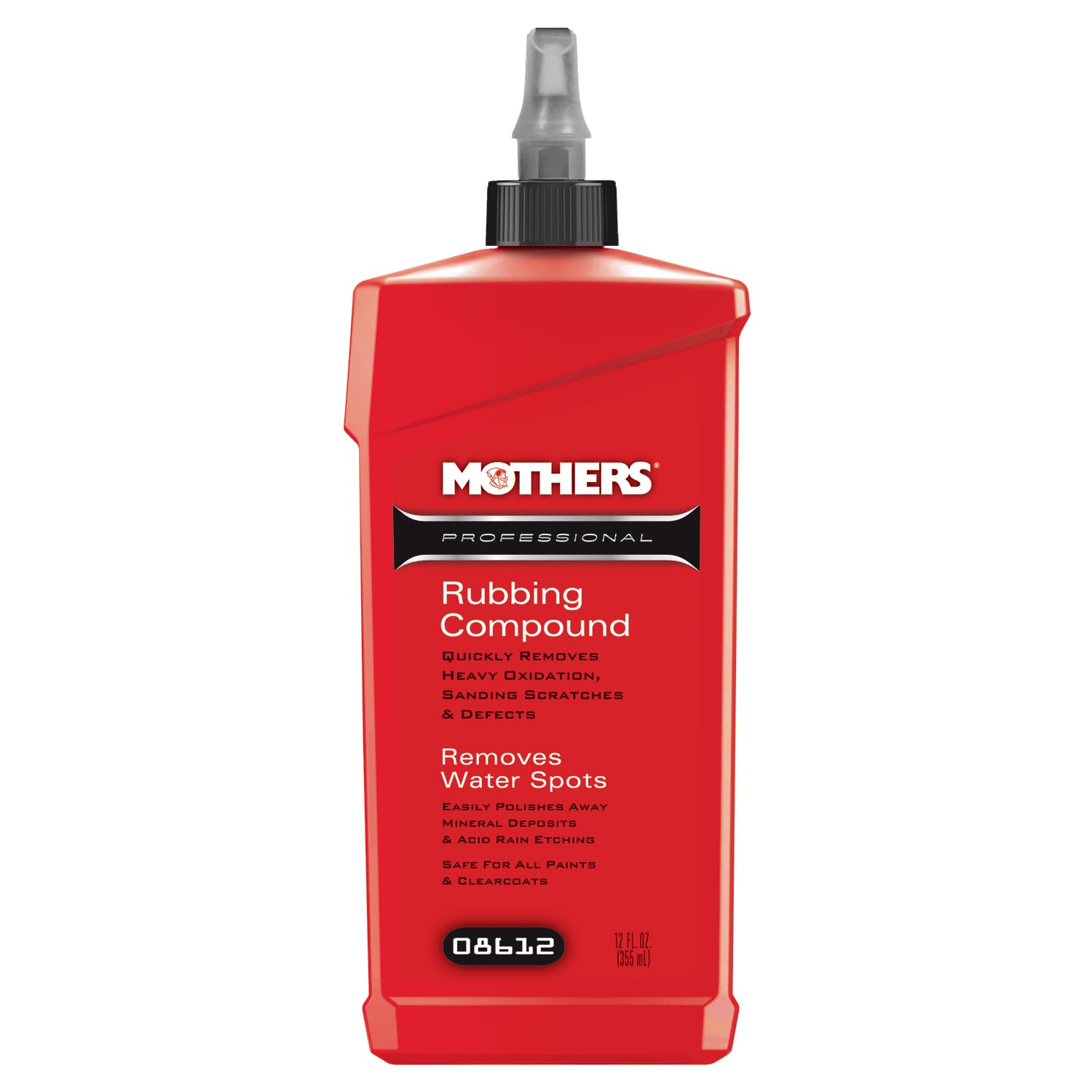
Mothers Professional Rubbing Compound brings a body-shop-proven formula to the consumer market in a convenient 12-ounce tube. The abrasive particle size is mild — reviewers note it has a lighter cut than many dedicated compounds, making it suitable for water spot removal, light oxidation, and bringing life back to faded single-stage paint without risking clear coat damage. It works with a buffer or by hand, though the abrasives break down quickly with manual effort, requiring less pressure than aggressive compounds.
Detailing enthusiasts have also repurposed it effectively for headlight restoration, noting that it cuts through the yellowed oxidation layer faster than dedicated headlight kits. The quick-clean wiping behavior means it leaves minimal residue behind — you can go straight to polish or wax without an intermediate panel wipe in many cases. Several users specifically mention how well it worked on 2000s-era Honda and Toyota paint formulations that are notoriously thin.
Because the cut is mild, it is not the best choice for removing deep scratches or sanding marks from 1500-grit or below. Users expecting heavy correction will need to make multiple passes, which consumes more product per panel.
What works
- Mild abrasive safe for thin or aged clear coats
- Effective on headlights and single-stage paint oxidation
- Wipes off clean with minimal residue
What doesn’t
- Multiple passes required for moderate-to-heavy defects
- Smaller 12-ounce container compared to competitors’ 16-ounce bottles
5. ABRO Rubbing Compound 10 oz

ABRO Rubbing Compound is an entry-level product designed specifically for sun-faded, oxidized paint that has turned chalky. The fine aluminum oxide abrasive is less aggressive than premium compounds, making it a safe starting point for first-time users who want to test the waters of paint correction without investing in an expensive bottle. It can be applied by hand or with a buffer, and reviews consistently highlight its effectiveness on neglected truck hoods and roofs where the clear coat has failed and left a white, powdery surface.
Owner experiences on heavily oxidized clear coat are positive — before-and-after photos show a dramatic transformation using nothing but the compound and manual elbow grease. The formula cleans up with minimal residue, leaving a shine that looks polished even before applying a finishing wax. Several users note that it worked better than more expensive brands on the specific problem of parked-outside oxidation, likely because the fine abrasives are well-matched to the soft, degraded surface.
The main limitations are a tendency to dry out faster than premium creams, especially in hot weather, and a petroleum-solvent smell that some users find strong. It also lacks the lubricity for extended machine buffing sessions without frequent reapplication.
What works
- Excellent value — very low cost per ounce for basic correction needs
- Effective on chalky oxidized paint when applied by hand
- Works on various surfaces including metal, glass, and plastic
What doesn’t
- Dries out quickly during machine buffing — requires frequent reapplication
- Strong solvent odor that lingers during application
Hardware & Specs Guide
Abrasive Material Type
Most rubbing compounds use aluminum oxide, which fractures into sharper edges as it breaks down, maintaining cut consistency. Ceramic abrasives (used in Chemical Guys V32) are harder and stay sharper longer, making them ideal for modern scratch-resistant clear coats. Silicon carbide is occasionally used for heavy-cut compounds but can be too aggressive for thin clear coats.
Grit Rating and Cut Level
A lower grit number means a coarser, more aggressive cut. Compounds rated around 120-240 grit (Griot’s, Meguiar’s) are designed to remove 1200-1500 grit sanding scratches and heavy oxidation. Finer grit compounds rated 1500+ (Chemical Guys V32) are better for light swirl removal and finishing. Always match the compound grit to the defect depth.
FAQ
Can I use a rubbing compound on clear coat without damaging it?
Should I apply rubbing compound by hand or with a machine?
How do I know when the rubbing compound has done its job?
Final Thoughts: The Verdict
For most buyers, the rubbing compound for cars winner is the Griot’s Garage BOSS Correcting Cream because it delivers the best balance of cut, lubricity, and finish for moderate defects. If you need a compound designed specifically for a dual-action polisher with microfiber discs, grab the Meguiar’s D30016. And for tackling heavy sun-faded oxidation on a budget, nothing beats the ABRO Rubbing Compound as a starting point.

Certification: BSc in Mechanical Engineering
Education: Mechanical engineer
Lives In: 539 W Commerce St, Dallas, TX 75208, USA
Md Amir is an auto mechanic student and writer with over half a decade of experience in the automotive field. He has worked with top automotive brands such as Lexus, Quantum, and also owns two automotive blogs autocarneed.com and taxiwiz.com.