Walking into a freezing garage on a winter morning kills productivity before the first tool touches a workbench. A dependable heat source changes that equation entirely, transforming an unworkable space into a comfortable workshop regardless of outside temperatures. Kerosene heaters have earned their reputation in this role through raw simplicity — no electrical grid dependency, robust heat output, and fuel flexibility that keeps them running when other systems fail.
I’m Amir — the founder and writer behind Four Wheel Ask. My approach to recommending garage heating equipment is rooted in deep market research, poring over technical specifications, analyzing build quality data across dozens of models, and aggregating real owner experiences to separate marketing claims from actual performance.
Select the best kerosene heater for garage by comparing BTU output, burn duration, safety certifications, and fuel type suitability across leading models.
How To Choose The Best Kerosene Heater For Garage
Selecting the right kerosene heater for your garage requires matching the unit’s output, fuel efficiency, and safety systems to your specific workspace conditions. Here is a breakdown of the critical decision points that separate a satisfying purchase from a regretful one.
BTU Output and Garage Size Matching
A common mistake is underestimating the heat output needed for a garage, especially uninsulated spaces. A general rule is 20 to 30 BTUs per square foot for an insulated garage and 40 to 60 BTUs for uninsulated structures. Small 8,000 to 10,000 BTU units warm compact single-car garages or workshops up to 350 square feet, while 23,000 BTU models handle up to 1,000 square feet. For large multi-car garages or open shops, forced-air units delivering 75,000 to 125,000 BTUs are the practical choice.
Convection vs. Forced Air Heating
Convection kerosene heaters radiate heat outward from a glowing catalytic dome or burner grid, warming objects and air gradually without a fan. They operate silently, require no electricity, and produce a gentle, even heat ideal for occupied spaces where noise matters. Forced-air heaters use a motor-driven fan to blow air across a combustion chamber, pushing massive volumes of hot air into the space rapidly. The trade-off is noise and electrical dependency, but the speed of temperature rise is unmatched for large, drafty garages.
Safety Systems and Certifications
Every kerosene heater intended for indoor or enclosed use should include a tip-over automatic shutoff switch and a low-oxygen safety sensor (ODS) that cuts fuel flow if oxygen levels drop. Look for models with guarded heating elements, stable base designs, and fuel gauges that prevent overfilling. Certification from CSA or UL provides independent verification that the heater meets established safety standards for the claimed use environment.
Fuel Type, Burn Time, and Maintenance
Grade K-1 kerosene is the cleanest-burning option, producing minimal odor and soot when burned in a well-maintained heater. Some forced-air models accept diesel fuel as an alternative, though this increases maintenance frequency due to higher sulfur content. Burn time depends on tank capacity and wick or nozzle adjustment — smaller 1.2-gallon tanks provide 12 to 15 hours on low, while larger 1.9-gallon tanks extend to 18 to 21 hours. Wick replacement every one to two seasons and periodic combustion chamber cleaning keep performance consistent.
Quick Comparison
On smaller screens, swipe sideways to see the full table.
| Model | Category | Best For | Key Spec | Amazon |
|---|---|---|---|---|
| Dura Heat DH2304BB | Convection | Mid-size garages up to 1,000 sq ft | 23,800 BTU, 1.9 gal tank, 12-hr burn | Amazon |
| Sengoku HeatMate HMC-23K | Convection | Premium silent heating | 23,500 BTU, 1.9 gal tank, push-button start | Amazon |
| Kero World KW-24G | Convection | Reliable brand with 2-year warranty | 23,800 BTU, 360-degree heating, 8-12 hr burn | Amazon |
| InoKraft Maxheat MH125 | Forced Air | Smart thermostat auto on-off control | 125,000 BTU, heats 3,200 sq ft, 25-95°F | Amazon |
| DEWALT DXH75KT | Forced Air | Trusted brand, diesel-compatible | 75,000 BTU, heats 1,875 sq ft, CSA certified | Amazon |
| Mr. Heater 75K | Forced Air | Industrial-grade reliability | 75,000 BTU, 11-hr run, LED diagnostics | Amazon |
| Baotree 12,500 | Forced Air | Propane alternative with 10-ft hose | 95,000-125,000 BTU, heats 2,497 sq ft | Amazon |
| AHUAWA 10,000 BTU | Convection | Budget-friendly 2-in-1 stove & heater | 8,000-10,000 BTU, 1.35 gal, 15-21 hr burn | Amazon |
| LINWIN 9,000 BTU | Convection | Compact camping and small shop | 9,000 BTU, 1.2 gal, 16-20 hr, 360-degree heat | Amazon |
| vnekjse 10,000 BTU | Convection | Entry-level 2-in-1 cooking and heating | 10,000 BTU, 4.5L tank, heats 215-323 sq ft | Amazon |
| VEVOR 215K BTU | Forced Air | Industrial-scale workshop heating | 215,000 BTU, 13.2 gal, 7.5-hr, thermostat | Amazon |
In-Depth Reviews
1. Dura Heat Convection Kerosene Heater DH2304BB
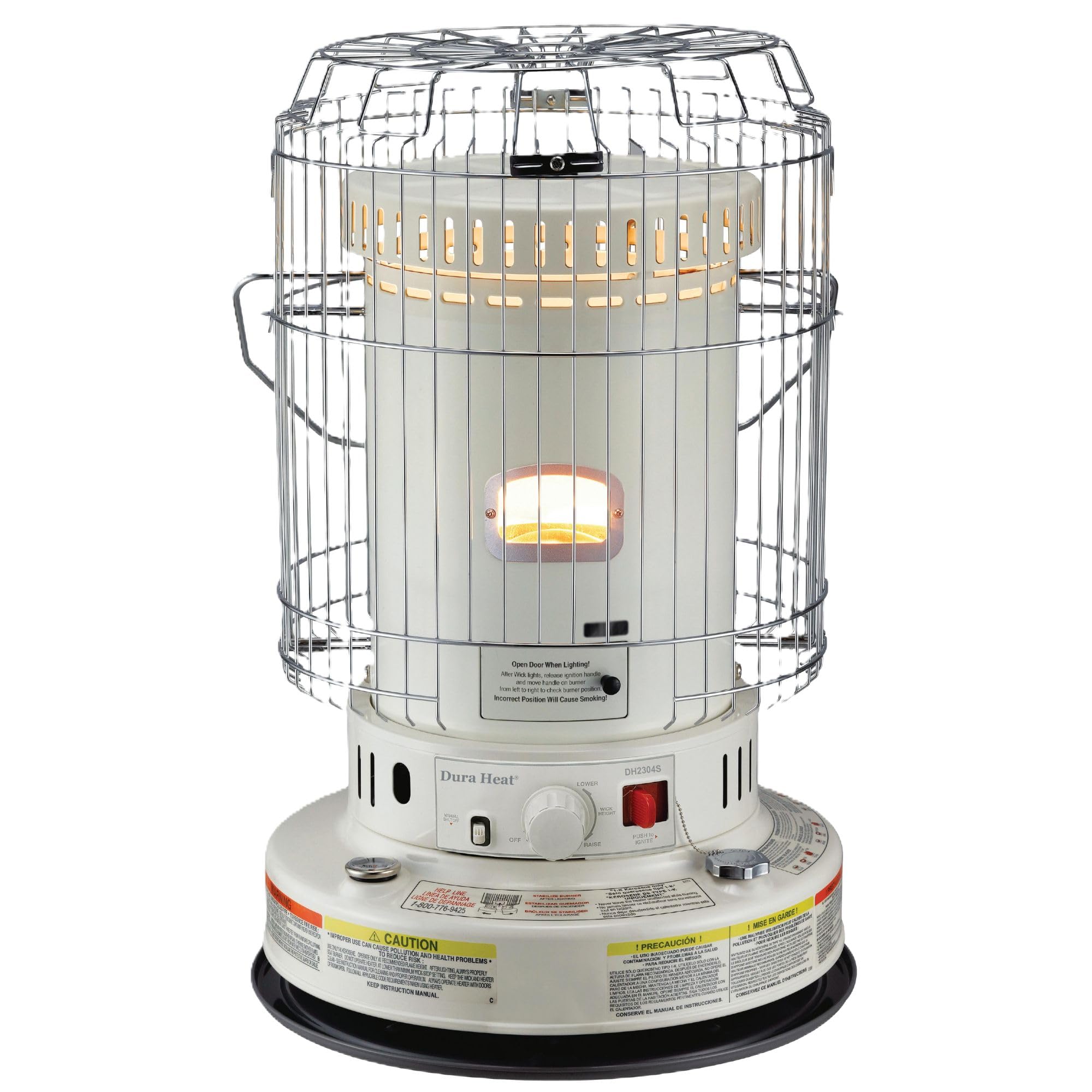
The Dura Heat DH2304BB delivers a substantial 23,800 BTU output through a convection heating design that warms spaces up to 1,000 square feet without relying on electricity. Its 1.9-gallon fuel tank supports up to 12 hours of continuous operation on a single fill, making it a practical choice for all-day garage sessions or overnight emergency heating. The beige cabinet-style housing integrates a battery-powered ignition and a pinned wick system that simplifies both startup and routine maintenance compared to simpler wick-adjustment designs.
Safety engineering includes a tip-over emergency shutoff and a no-lift burner system that minimizes odor during operation and shutdown, addressing a frequent complaint among kerosene heater users. Owner feedback consistently highlights the unit’s ability to raise a 24-by-24-foot garage to comfortable working temperatures even when outdoor conditions drop to around 20 degrees Fahrenheit. The assembly process receives positive marks for clarity, and the overall build quality feels substantial for its competitive price tier.
The heater provides both heat and light during power outages, adding a layer of utility for emergency preparedness scenarios. The combustion process produces a visible glow through the protective grille that doubles as ambient lighting, which reviewers note as a welcome feature during winter storms when grid power is unavailable. For garage owners seeking a balance of heating capacity, runtime, and straightforward operation, this model represents a well-rounded package that avoids the common pitfalls of budget-tier kerosene heaters.
What works
- Substantial 23,800 BTU output heats mid-size garages effectively
- No-lift burner system reduces odor during shutdown
- Battery-powered ignition works without grid power
- Tip-over shutoff and stable cabinet design enhance safety
What doesn’t
- Unit weight makes moving between locations less convenient
- Some users report initial wick adjustment requires patience
2. Sengoku HeatMate HMC-23K Portable Kerosene Heater

Sengoku brings over 65 years of alternative heating experience to the HeatMate HMC-23K, a convection kerosene heater that produces 23,500 BTU and covers up to 1,000 square feet. The unit features a push-button automatic ignition system, an EZ flame adjuster, and a 1.9-gallon fuel tank that delivers up to 12 hours of heating per fill. The white pedestal design includes a siphon pump and batteries in the box, reducing the hassle of sourcing additional components before first use.
Safety systems on the HMC-23K include an automatic shutoff, a tip-over switch, and protective safety guard grills around the heating element. Reviewers consistently note the clean burn characteristics of this model, reporting minimal odor during steady-state operation when using K-1 kerosene. Several owners use this unit in greenhouses to protect plants during cold snaps, citing the even, convection-based heat distribution as a key advantage over forced-air alternatives that can create hot and cold spots.
The build quality reflects Sengoku’s manufacturing standards, with well-fitted components and a finish that holds up to regular use. Assembly requires no tools, and the intuitive control layout reduces the learning curve for those new to kerosene heaters. Owners report that the unit maintains comfortable temperatures in unheated garages and sheds during winter months, with the 23,500 BTU output proving sufficient for spaces that fall within the rated coverage area. The combination of brand reputation, included accessories, and reliable ignition makes this a strong contender for buyers prioritizing convenience and build integrity.
What works
- Push-button auto ignition simplifies startup
- Includes siphon pump and batteries for immediate use
- Over 65 years of brand history in alternative heating
- Clean burn with minimal odor on K-1 kerosene
What doesn’t
- Fuel cost of K-1 kerosene adds to operating expense
- Not suitable for poorly insulated spaces above 1,000 sq ft
3. Kero World KW-24G 23,800 BTU Portable Kerosene Heater

The Kero World KW-24G is a 23,800 BTU convection kerosene heater designed with a 360-degree heating radius that distributes warmth evenly throughout the surrounding space. The pedestal-style unit features a push-to-start ignition and operates for 8 to 12 hours on a single tank of fuel, making it suitable for extended garage sessions or overnight use in auxiliary buildings. The gray finish and rounded cabinet give it a utilitarian aesthetic that blends into workshop environments without looking out of place.
Safety provisions include an accidental tip-over shutoff that immediately extinguishes the flame if the unit is knocked over, a critical feature for garages with foot traffic or pets. Owners report that the heater can effectively raise the temperature of an entire house within a few hours, highlighting its capability beyond single-room applications. The 2-year warranty provided by Kero World adds a layer of confidence that shorter warranty periods do not offer, signaling the manufacturer’s confidence in the product’s longevity.
Some users note that the auto igniter can be temperamental, with a minority reporting the need to light the unit with a match as a fallback. The unit weighs approximately 34 pounds when filled with fuel, which may present mobility challenges for older users or those with limited strength. Customer support from Kero World receives positive mentions for responsiveness, particularly in handling shipping damage or replacement requests. For buyers who value long warranty coverage and a proven track record, the KW-24G represents a thoughtful investment in garage heating reliability.
What works
- 360-degree heat distribution eliminates cold spots
- 2-year warranty exceeds industry standard coverage
- Tip-over shutoff enhances garage safety
- Proven build quality with positive long-term owner reports
What doesn’t
- Auto igniter can be unreliable on some units
- Heavy when filled, difficult for some users to move
4. InoKraft Maxheat MH125 Forced Air Propane Heater
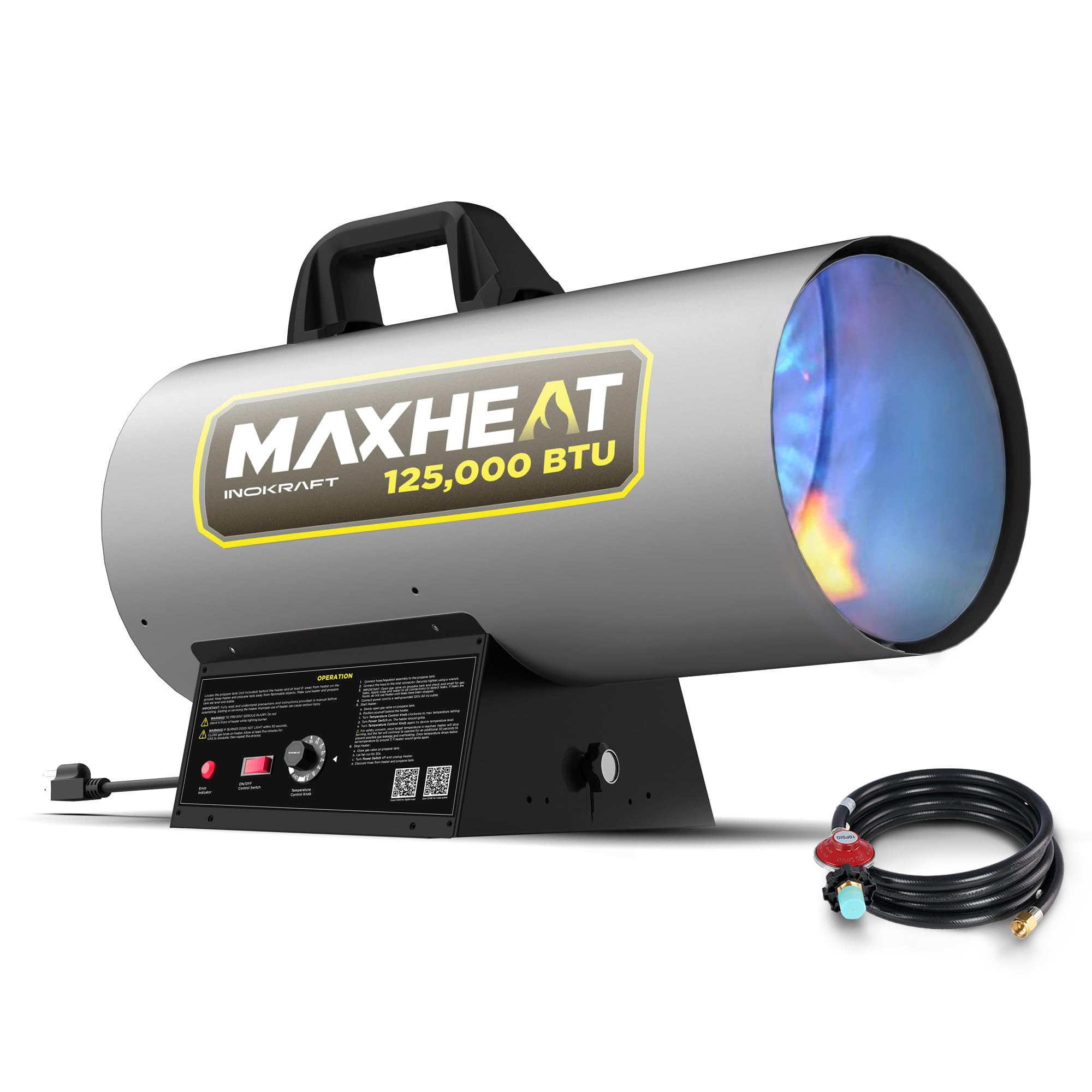
The InoKraft Maxheat MH125 is a forced-air propane heater that delivers 125,000 BTUs of heating power with a unique auto on-off thermostat that maintains temperatures between 25 and 95 degrees Fahrenheit. This smart temperature control distinguishes it from simpler forced-air units that run continuously until manually adjusted, reducing fuel consumption by cycling the burner based on actual workspace temperature. The unit heats areas up to 3,200 square feet, covering everything from small home garages to large workshop spaces and construction sites.
The heavy-duty forced-air fan raises temperatures significantly within five minutes, a performance benchmark that owners consistently confirm in their feedback. A 32-by-32-foot uninsulated garage reaches comfortable working temperatures in short order, with the thermostat maintaining the set level without constant manual intervention. The 10-foot hose connects to a standard 20-pound propane tank or larger, and the 115-volt electrical requirement is standard for most garage outlets. Multi-protection safety features include overheat auto-shutoff and gas leak prevention systems with CSA certification.
Noise level is a consideration with any forced-air unit, but owners report that the MH125 operates more quietly than older salamander-style heaters they have used previously. The adjustable heat angle allows directing warmth where it is needed most, and the portable handle makes relocation straightforward. Propane consumption is notable at higher settings — a 20-pound tank may last approximately six hours at maximum output — but the thermostat reduces average usage during steady-state operation. For garage owners who want set-and-forget temperature control without constant wick adjustments, this forced-air solution delivers a modern alternative to traditional kerosene convection heaters.
What works
- Auto thermostat maintains set temperature without manual intervention
- 125,000 BTU heats large garages and shops rapidly
- CSA certified with overheat and gas leak protection
- Quieter operation than many forced-air competitors
What doesn’t
- High propane consumption at maximum output
- Requires 115-volt electrical outlet for fan operation
5. DEWALT DXH75KT Kerosene Heater, 75K BTU
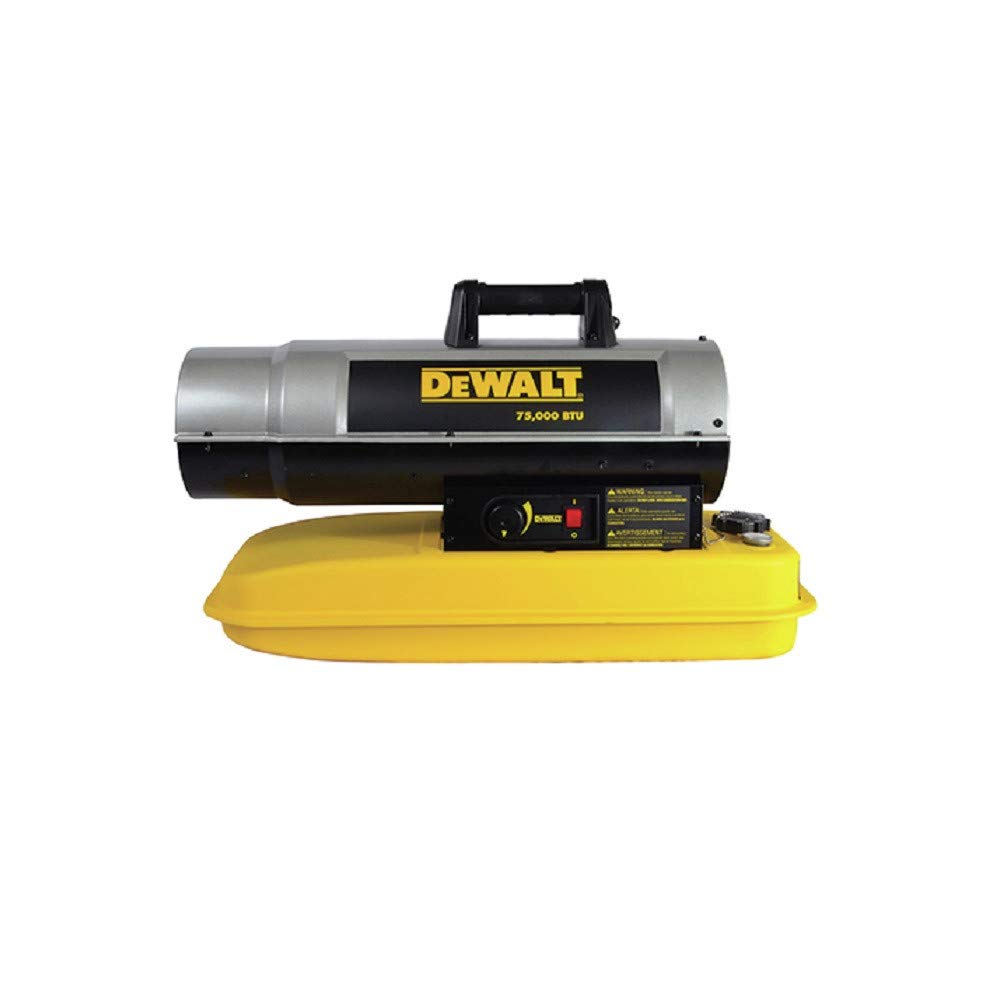
The DEWALT DXH75KT is a forced-air kerosene heater rated at 75,000 BTU, designed for well-ventilated workspaces including construction sites, barns, warehouses, and home workshops. The yellow pedestal housing is immediately recognizable as part of the DEWALT ecosystem, and the recessed controls protect the thermostat and switch from accidental damage during transport or use. CSA certification confirms the unit meets established safety standards for its intended application category.
One of the standout features of this model is its ability to burn both kerosene and diesel fuel, providing flexibility when kerosene supply is limited or when cost considerations favor diesel. Owners report that the heater starts instantly with no puff of smoke or lingering fumes when using quality fuel. The 75,000 BTU output heats a 28-by-30-foot garage effectively even during Northeast winter conditions, with the thermostat maintaining consistent temperatures without constant adjustment. The unit’s build quality receives praise for surviving multiple seasons of regular use without performance degradation.
Recessed controls and a heavy-duty high-output fan are paired with a fuel gauge that allows easy monitoring of remaining run time. Some owners have noted that the yellow fuel tank finish scratches relatively easily, though this is a cosmetic rather than functional concern. A small number of users report motor issues after extended use, though these experiences appear to be outliers based on the broader feedback pool. For buyers who value brand recognition, diesel fuel flexibility, and the proven performance of a 75,000 BTU forced-air design, the DEWALT DXH75KT offers a compelling package that aligns with professional-grade expectations.
What works
- Dual-fuel capability accepts kerosene or diesel
- Instant startup with no smoke or fumes
- Recessed controls protected during transport
- CSA certified for workshop and jobsite use
What doesn’t
- Fuel tank finish scratches easily
- Some reports of motor inconsistency across long-term use
6. Mr. Heater 75,000 BTU Forced Air Kerosene Heater

Mr. Heater has built a strong reputation in the portable heating market, and the 75,000 BTU forced-air kerosene model exemplifies the engineering standards that drive that reputation. The cabinet-style unit operates for approximately 11 hours on a full tank, delivering fixed 75,000 BTU output through a heavy-duty high-output fan that moves substantial air volume. The six-function LED diagnostics panel provides real-time feedback on operating status, which simplifies troubleshooting and maintenance compared to units with basic on-off switches.
The low-oxygen safety shutoff system adds a critical layer of protection for enclosed spaces, automatically cutting fuel flow if oxygen levels drop below safe thresholds. Owners report that the heater can raise a two-car garage from 15 degrees Fahrenheit to 65 degrees within ten minutes, with the thermostat maintaining that temperature for extended periods before cycling off for approximately 20 minutes. The unit runs on K-1 kerosene and starts instantly, with minimal carbon monoxide emissions when properly maintained. Build quality is described as robust, with easy-access components that simplify periodic maintenance.
Using K-1 kerosene is essential for clean operation and long service life, as lower-grade fuels accelerate carbon buildup on the combustion components. Owners who have used the heater for multiple seasons note that running it periodically during warmer months prevents fuel degradation that can clog the system. The unit works effectively with diesel fuel as an alternative, though maintenance frequency increases accordingly. For garage owners who prioritize build quality, diagnostic capabilities, and a brand with extensive field support, this Mr. Heater model justifies its position as a premium forced-air option that rewards proper care with years of reliable service.
What works
- Low-oxygen safety shutoff enhances enclosed space safety
- Six-function LED diagnostics simplify troubleshooting
- Rapid heating — 15°F to 65°F in under 10 minutes
- Robust build quality with easy-access maintenance points
What doesn’t
- Requires K-1 kerosene for optimal cleanliness
- Premium pricing reflects industrial-grade components
7. Baotree 12,500 BTU Forced Air Propane Heater
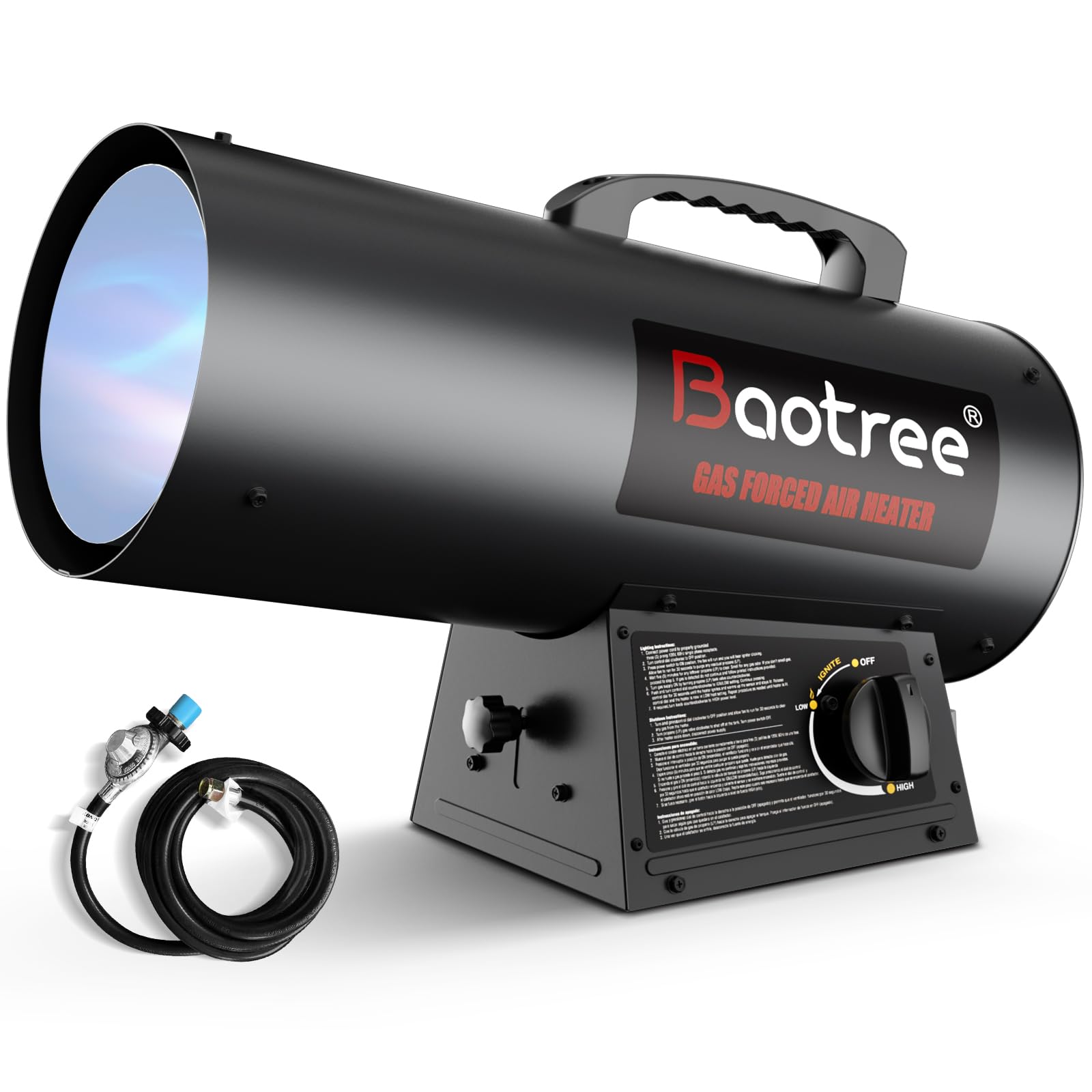
The Baotree forced-air propane heater delivers a variable output range of 95,000 to 125,000 BTU, covering spaces up to 2,497 square feet with rapid heating performance. The torpedo-style design includes a 10-foot hose with regulator, allowing connection to standard 20-pound propane tanks without additional purchases. Pulse ignition technology ensures reliable startup while preventing flameout and gas leaks, and the overheat protection system automatically shuts the unit off during power outages for added safety.
Owner feedback consistently highlights the speed at which this heater warms a two-car garage, with one reviewer noting that it achieves comfortable temperatures in minutes compared to over an hour with their previous heating solution. The adjustable heating angle of 30 to 45 degrees allows directing airflow precisely where needed, and the portable handle makes relocation between work areas straightforward. Noise level is comparable to other forced-air units in this class — described as similar to a small jet engine — but owners find it acceptable as background white noise during work.
The unit is lightweight and well-built for its price tier, with a double-walled tube that stays cooler to the touch than single-wall alternatives. Some owners report minor issues with included regulator components, though these appear to be isolated quality control variations rather than systemic problems. Proper ventilation is mandatory for safe operation, as with all forced-air propane heaters. For garage owners who want the speed of forced-air heating without the kerosene fuel logistics, this Baotree model delivers strong value with a fuel source that is widely available and easy to transport.
What works
- Variable 95,000-125,000 BTU output covers large garages
- 10-ft hose and regulator included for immediate setup
- Adjustable heat angle directs warmth precisely
- Pulse ignition prevents flameout and gas leaks
What doesn’t
- Forced-air noise level noticeable during operation
- Propane tank not included with purchase
8. AHUAWA 10,000 BTU Kerosene Heater, 2-in-1 Stove & Heater
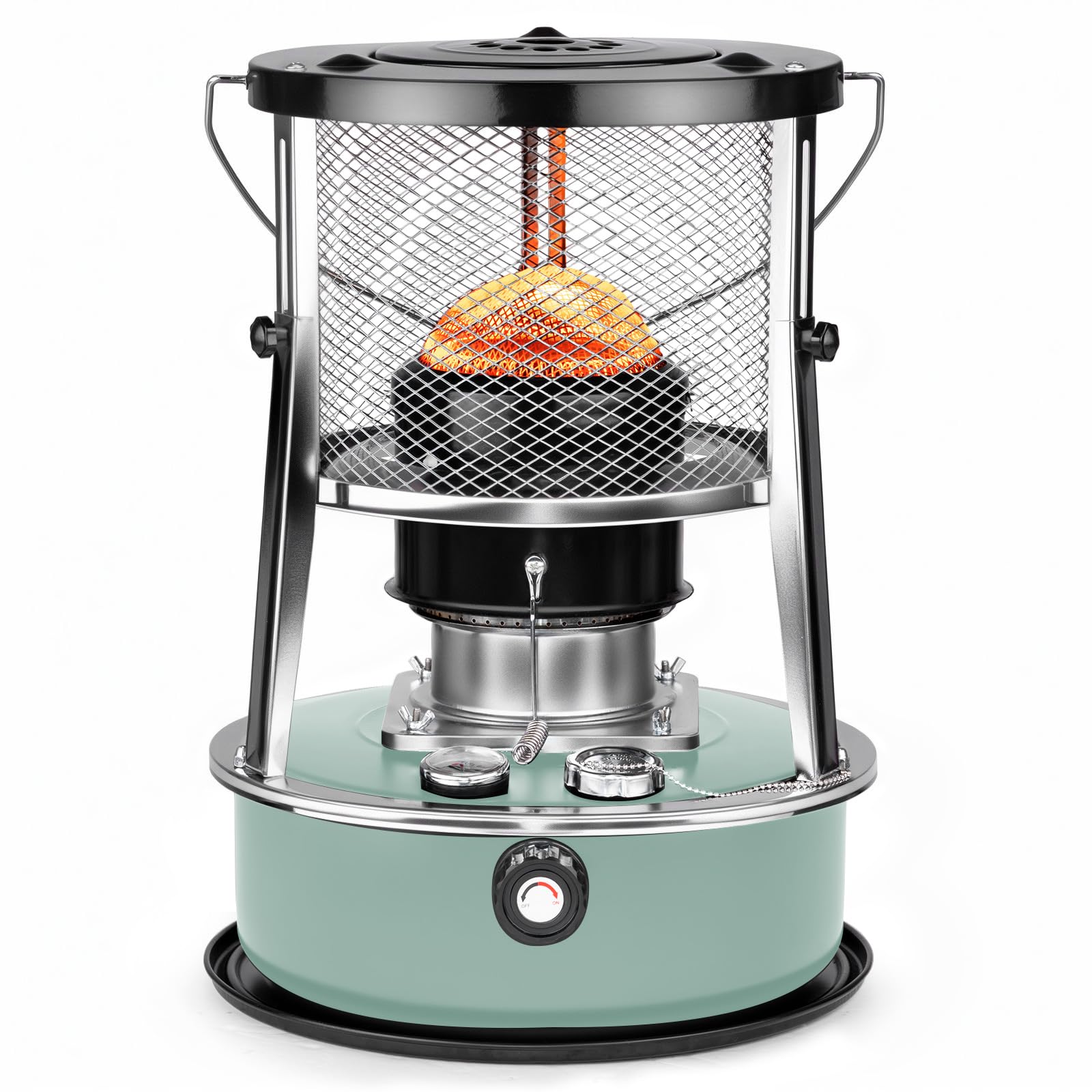
The AHUAWA 10,000 BTU kerosene heater is a compact 2-in-1 unit that functions as both a space heater and a cooking surface, making it a versatile addition to small garages, workshops, or emergency preparedness kits. The 1.35-gallon fuel tank provides 15 to 21 hours of continuous heat on a single fill, which is exceptional runtime for a heater in this output class. The blue pedestal design includes a protective safety net, a solid anti-tip base, and a real-time fuel gauge that eliminates guesswork about remaining run time.
Owners report that the heater produces exceptional heat output even on the low setting, with one user noting significant savings on their electric bill during 20-degree Fahrenheit weather after switching to this kerosene unit. The top cooking surface adds practical utility during power outages, allowing users to heat food or boil water without relying on a separate camp stove. The included accessory kit — storage bag, funnel, siphon pump, gloves, and extra wicks — provides everything needed for immediate operation and ongoing maintenance without additional purchases.
Some operational quirks require attention: the handle becomes hot during extended use, and extinguishing the flame requires manually turning the wick down and blowing out the flame rather than a simple shutoff switch. Proper flame adjustment during the first few minutes of operation is necessary to avoid initial smoke or odor. The unit’s cage arms feel less robust than premium alternatives, though no structural failures appear in the feedback data. For budget-conscious buyers seeking a reliable backup heat source with cooking capability and exceptional runtime, this AHUAWA model delivers impressive value despite requiring some user adaptation.
What works
- 15-21 hour runtime on a single 1.35-gallon fill
- 2-in-1 design functions as heater and cooking surface
- Complete accessory kit included with purchase
- Fuel gauge provides real-time level monitoring
What doesn’t
- Handle becomes hot during extended operation
- Requires manual flame extinguishing rather than shutoff switch
9. LINWIN 2-in-1 Portable Kerosene Heater & Stove, 9,000 BTU

The LINWIN 2-in-1 kerosene heater and stove produces 9,000 BTU of radiant heat with a 1.2-gallon fuel capacity that supports 16 to 20 hours of continuous operation. The aquamarine pedestal design includes a height-adjustable hood that allows the top cooking surface to be positioned closer to the heat source for faster meal preparation during camping or emergency use. The 360-degree radiant heating design warms immediately after ignition, with the catalytic dome glowing cherry red for efficient heat distribution without visible flame once properly adjusted.
Owner reports indicate that this heater performs well in spaces up to 800 square feet, with one reviewer noting it keeps their shop comfortably warm. The unit heats two gallons of water in approximately nine minutes, confirming the cooking capability as a functional feature rather than a marketing add-on. The included package contains a storage bag, two extra wicks, a funnel, a siphon pump, and gloves, providing everything needed for initial setup and routine wick replacement. The carry handle and adjustable height make it easy to position in different locations.
Wick adjustment sensitivity is a recurring theme in owner feedback, with the flame requiring attentive fine-tuning during the first 10 to 15 minutes of operation to achieve clean combustion with minimal smell. Some units ship with the wick installed slightly crooked, which causes gear binding and uneven dome glow until corrected through simple disassembly and realignment. The absence of an automatic igniter or shutoff button means the user must light the unit manually and extinguish by slowly turning down the wick until the coil loses red glow. For experienced users familiar with wick-type heaters, these characteristics are manageable, but newcomers should expect a learning curve during the first few uses.
What works
- 16-20 hour burn time suits all-day garage sessions
- Height-adjustable cooking surface for meal preparation
- Comprehensive accessory kit included
- 360-degree radiant heat distribution
What doesn’t
- Wick adjustment is sensitive and requires practice
- No automatic ignition or shutoff button
10. vnekjse Kerosene Heater, 10,000 BTU, 2-in-1 Design
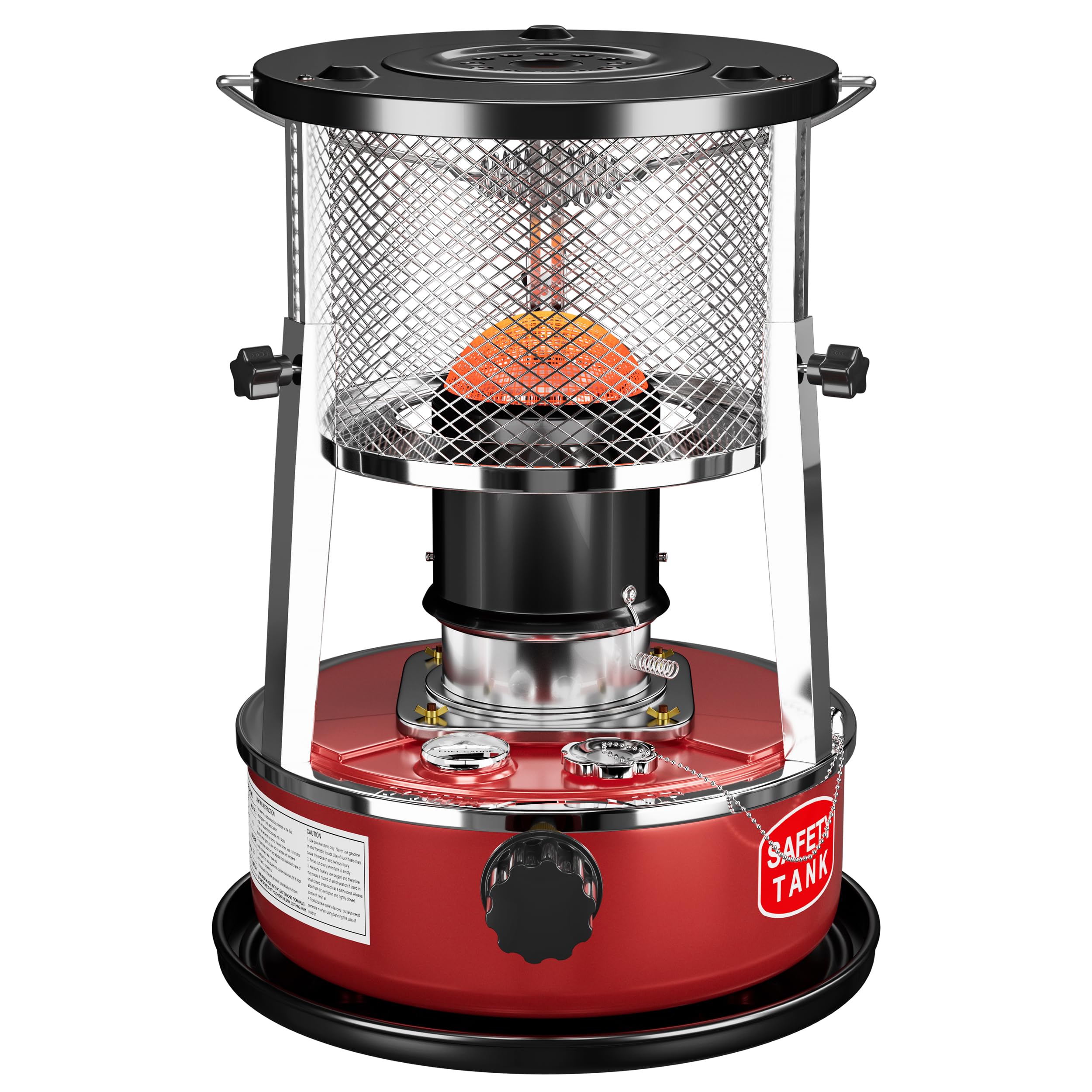
The vnekjse 10,000 BTU kerosene heater offers a 2-in-1 heating and cooking solution in a compact red pedestal package that covers 215 to 323 square feet. The maximum calorific value of 10,000 BTU per hour with a fuel consumption rate of approximately 0.2 liters per hour makes it an economical choice for small garages, workshops, or greenhouse applications. The 360-degree heat distribution design ensures warmth radiates in all directions without creating directional hot spots, and the removable enamel top allows for cooking, boiling, or barbecuing.
Owner feedback paints a mixed but informative picture of this model’s real-world performance. Positive reviews highlight the heater’s ability to warm an 1,100-square-foot space to comfortable temperatures even in sub-10-degree-Fahrenheit weather, with a 12-hour burn time on one gallon of fuel. Several users note that the build quality exceeds expectations for the price point, with some going so far as to compare its performance favorably to top-tier Japanese kerosene heater models. The no-electricity requirement and quiet operation make it suitable for locations where power is unreliable or unavailable.
However, quality control issues appear in a meaningful subset of units, with reports of wick adjustment knobs failing from the first use, preventing the flame from being extinguished safely. Some users report that the wick will not retract sufficiently to extinguish the flame after several uses, requiring disassembly to correct. These safety-concerning issues suggest that while the unit performs well when functioning correctly, buyers should carefully test all controls immediately upon receipt and be prepared to return defective units. The sparse instruction manual is a common complaint, though the basic operation is intuitive enough for those familiar with kerosene heater fundamentals.
What works
- Compact size fits small garages and workshops well
- 2-in-1 cooking and heating functionality
- 360-degree heat distribution for even warmth
- Excellent runtime on minimal fuel consumption
What doesn’t
- Quality control issues with wick adjustment mechanism
- Instructions lack detail for proper operation
11. VEVOR 215,000 BTU Forced Air Kerosene Diesel Heater

The VEVOR 215,000 BTU forced-air kerosene heater is a heavy-duty torpedo-style unit designed for industrial-scale heating applications, including large workshops, barns, construction sites, and warehouses up to 44,996 cubic feet. The massive 13.2-gallon fuel tank provides up to 7.5 hours of continuous operation at a consumption rate of 1.5 gallons per hour, reducing the need for frequent refueling during extended work sessions. The thermostatic control system includes a room temperature display adjustable from 40 to 110 degrees Fahrenheit, with automatic shutdown when the target temperature is reached for energy savings.
Owner reports from large shop environments confirm that this heater transforms uninsulated pole barns of 3,000 square feet from freezing to comfortable in minutes, even when outdoor temperatures are in the teens. The unit accepts both kerosene and diesel fuel, though owners strongly recommend kerosene for cleaner combustion, as diesel can clog jets within the first few minutes of operation. The dual fuel filters help reduce smoke and odor, and the low-fuel auto-shutoff prevents running the system dry. A pressure gauge provides continuous monitoring of operating conditions.
Portability is addressed through an integrated handle and relatively lightweight construction for the power class, though the unit is still substantial enough to require deliberate movement rather than casual carrying. The noise level is commensurate with forced-air heaters of this output — loud enough to require hearing protection during extended proximity but acceptable for intermittent use in large spaces. Initial burn-off of manufacturing residues is recommended before regular use. For garage owners operating in very large spaces or requiring rapid temperature recovery after door openings, the VEVOR 215K represents a cost-effective alternative to permanently installed heating systems, provided adequate ventilation is maintained.
What works
- 215,000 BTU output heats extremely large spaces rapidly
- 13.2-gallon tank provides 7.5 hours of continuous operation
- Thermostatic control with temperature display saves fuel
- Dual fuel filters reduce smoke and odor during operation
What doesn’t
- Diesel fuel causes jet clogging without kerosene mixing
- High noise level requires hearing protection nearby
Hardware & Specs Guide
BTU Output and Coverage
British Thermal Units measure the heat output of a kerosene heater. For garage applications, the required BTU depends on square footage, ceiling height, and insulation quality. A general guideline is 20 to 30 BTU per square foot for insulated garages and 40 to 60 BTU per square foot for uninsulated spaces. Small convection heaters in the 8,000 to 10,000 BTU range suit compact single-car garages up to 350 square feet. Mid-range convection units around 23,000 BTU cover up to 1,000 square feet. For large multi-car garages or open shop spaces, forced-air heaters from 75,000 to 215,000 BTU provide the rapid temperature rise needed to overcome heat loss from high ceilings and frequent door openings.
Convection vs. Forced Air Heating
Convection kerosene heaters radiate heat from a glowing catalytic dome or burner surface without a fan, warming objects and air gradually through natural air movement. They operate silently, require no electricity, and provide gentle, even heat suitable for occupied spaces. Forced-air heaters use an electric fan to blow air across a combustion chamber, pushing large volumes of hot air into the space rapidly. They heat faster and cover larger areas but produce noticeable noise and require a 115-volt electrical outlet. The choice between the two depends on garage size, tolerance for fan noise, and whether grid independence is a priority during power outages.
Fuel Types and Burn Times
Grade K-1 kerosene is the recommended fuel for all kerosene heaters due to its low sulfur content, which minimizes odor, soot, and maintenance requirements. Some forced-air models accept diesel fuel as an alternative, though diesel’s higher sulfur content accelerates carbon buildup on combustion components and may clog fuel jets. Burn time depends on tank capacity and power setting — smaller 1.2-gallon tanks at low output can run 16 to 21 hours, while larger 1.9-gallon tanks at higher output may last 8 to 12 hours. Forced-air heaters with large 13.2-gallon tanks run approximately 7.5 hours at maximum output. Proper fuel storage in sealed containers prevents water absorption and fuel degradation that affect combustion quality.
Safety Systems and Certifications
Tip-over automatic shutoff is a mandatory safety feature that cuts fuel flow if the heater is knocked over, preventing fires in busy garage environments. Low-oxygen safety sensors (ODS) monitor ambient oxygen levels and shut down the heater if concentrations drop below safe thresholds, protecting against asphyxiation in enclosed spaces. Guarded heating elements prevent accidental contact with hot surfaces, and stable base designs with wide footprints reduce tip-over risk. Certification from CSA or UL provides independent verification that the heater meets established safety standards. Proper ventilation is essential regardless of built-in safety features — convection heaters require a window or door cracked open, while forced-air units must never be used in fully enclosed spaces without adequate airflow.
FAQ
Is it safe to use a kerosene heater inside a garage?
How many BTUs do I need to heat my garage?
Can I use diesel fuel instead of kerosene in my heater?
How often do I need to replace the wick in a kerosene heater?
Why does my kerosene heater smell when I turn it off?
Final Thoughts: The Verdict
For most buyers, the best kerosene heater for garage winner is the Dura Heat DH2304BB because it combines substantial 23,800 BTU output with a generous 1.9-gallon tank, battery-powered ignition, and safety systems that cover the needs of mid-size garages without requiring electricity. If you prefer silent, maintenance-friendly operation with a trusted brand name, grab the Sengoku HeatMate HMC-23K. And for large workshops or uninsulated spaces where speed of temperature rise matters most, nothing beats the InoKraft Maxheat MH125 with its automatic thermostat that maintains precise temperatures without constant attention.

Certification: BSc in Mechanical Engineering
Education: Mechanical engineer
Lives In: 539 W Commerce St, Dallas, TX 75208, USA
Md Amir is an auto mechanic student and writer with over half a decade of experience in the automotive field. He has worked with top automotive brands such as Lexus, Quantum, and also owns two automotive blogs autocarneed.com and taxiwiz.com.