Nothing ends a morning faster than a battery that refuses to turn over. The Group 26R form factor fits a specific set of vehicles, and swapping in the wrong chemistry or an underrated CCA unit guarantees headaches before winter even peaks. The right choice here is about matching your car’s electrical demands with a battery that delivers consistent power across temperature extremes without leaking, corroding, or fading after a dozen deep cycles.
I’m Amir — the founder and writer behind Four Wheel Ask. I study battery chemistries, BCI group specifications, cold cranking amp curves, and owner-reported longevity data to separate marketing claims from real-world performance across dozens of automotive battery models.
AGM and lithium options now dominate the replacement market for good reason: they handle vibration, resist acid leaks, and hold voltage longer than conventional flooded designs. Choosing the right best group 26r battery means balancing cold cranking amps, reserve capacity, and AGM technology for reliable starts year-round.
How To Choose The Best Group 26R Battery
Selecting the right battery for your vehicle requires more than matching the terminal orientation. You need to evaluate chemistry type, cold cranking capacity, reserve power, and physical dimensions to ensure the unit fits both your tray and your driving habits. Here are the critical factors to weigh before you buy.
AGM vs. Lithium vs. Flooded: Which Chemistry Fits Your Drive?
Flooded lead-acid batteries are the cheapest upfront but require periodic water checks and vent tube routing, and they spill acid if tipped. AGM (Absorbent Glass Mat) units are sealed, vibration-resistant, and maintenance-free, making them the dominant choice for modern vehicles with start-stop systems. Lithium iron phosphate (LiFePO4) batteries weigh roughly one-third of an equivalent AGM, deliver higher usable capacity, and include a BMS that prevents over-discharge, but they require a compatible charging system and cost more initially. For most daily drivers, AGM offers the best balance of reliability, safety, and price.
Cold Cranking Amps and Reserve Capacity Explained
Cold Cranking Amps (CCA) measure the battery’s ability to start an engine at 0°F. A higher CCA number means stronger cranking in frigid conditions. Reserve Capacity (RC) tells you how many minutes the battery can run essential electronics if the alternator fails — important for vehicles with high accessory loads. For a Group 26R application targeting reliable winter performance, look for at least 600 CCA and 90 minutes of reserve capacity. Cars with larger engines or additional electrical draw benefit from 700+ CCA and 100+ RC.
Verifying Group Size, Terminal Layout, and Physical Fit
BCI group size dictates the battery’s length, width, height, and terminal position. Group 26R features reversed polarity compared to Group 26 — positive on the left, negative on the right for most applications. Always measure your existing battery tray and compare the dimensions listed on the product page. A battery that is too tall may short against the hood, while one that is too narrow may shift during cornering. Check that the terminal type (top-post, side-post, or dual-terminal) matches your cable connectors before finalizing your choice.
Warranty Coverage and Manufacturer Support
Battery warranties vary widely from pro-rata to full replacement terms. A 36-month full replacement warranty signals confidence from the manufacturer, while longer terms (up to 48 months) are common on premium AGM and lithium models. Pay attention to whether the warranty is handled by the brand directly or through the retailer — some buyers report frustration when the seller and manufacturer point responsibility elsewhere. A responsive customer service team can make a significant difference if a unit fails prematurely.
Quick Comparison
On smaller screens, swipe sideways to see the full table.
| Model | Category | Best For | Key Spec | Amazon |
|---|---|---|---|---|
| SDULIBITIY LiFePO4 Group 26 | Lithium | Lightweight starting | 600 CCA, 512 Wh | Amazon |
| ODYSSEY PC925 AGM28L | AGM | Long service life | 330 CCA, 52 RC | Amazon |
| Weize Platinum Group 24F | AGM | High reserve capacity | 710 CCA, 120 RC | Amazon |
| Goodyear 47-H5-AGM | AGM | Brand reliability | 680 CCA, 100 RC | Amazon |
| Weize Platinum Group 35 | AGM | Versatile fitment | 650 CCA, 100 RC | Amazon |
| Renogy Group 48 H6 | AGM | Deep cycle hybrid | 720 CCA, 120 RC | Amazon |
| Autocessking Group 47 | AGM | Entry-level AGM | 680 CCA, 100 RC | Amazon |
| Polaris Heavy Duty AGM | AGM | OEM replacement | AGM sealed, 36.6 lb | Amazon |
| ACDelco Gold AUX14-200 | AGM | Auxiliary battery | 200 CCA, 12 Ah | Amazon |
In‑Depth Reviews
1. SDULIBITIY LiFePO4 Group 26 Lithium Battery
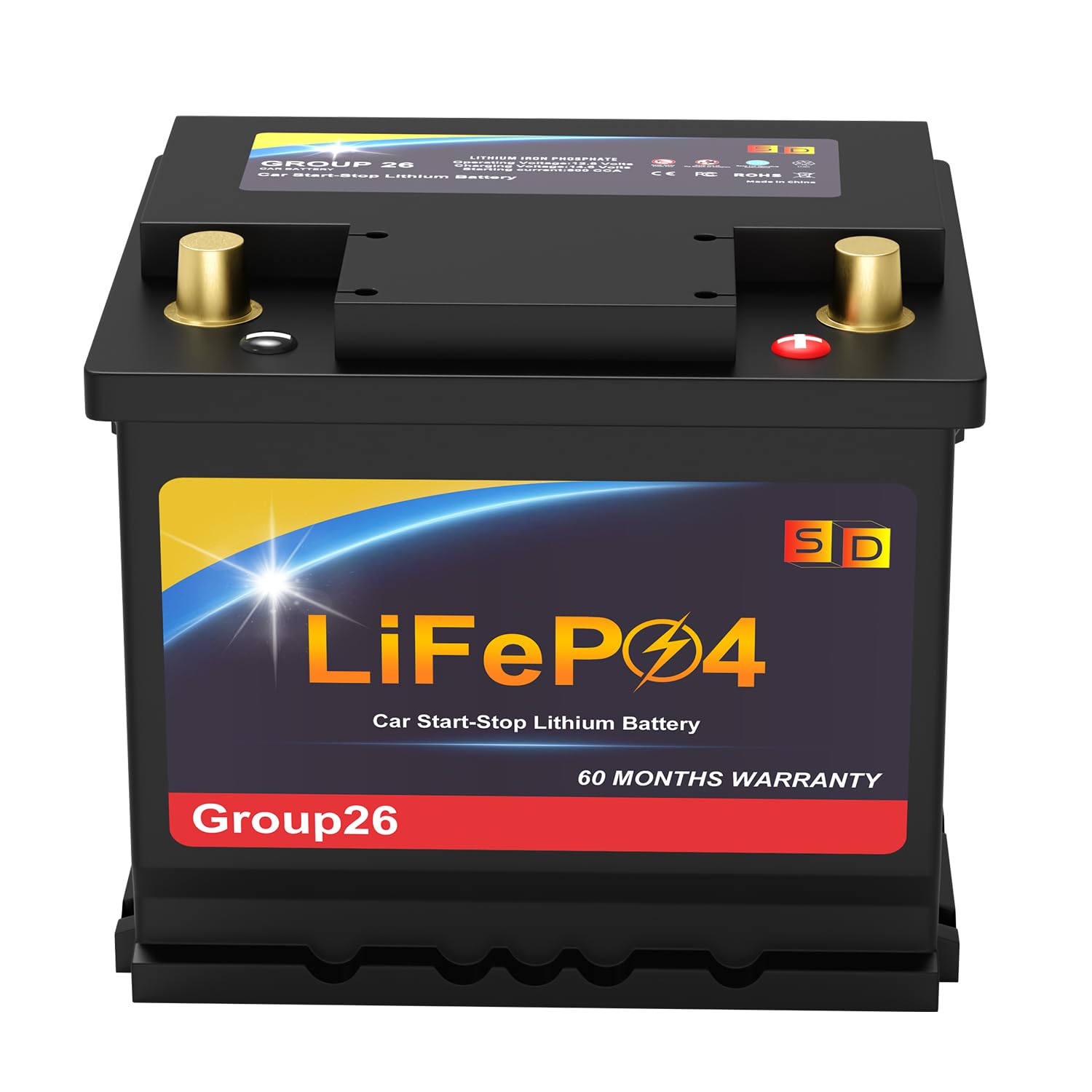
This lithium iron phosphate unit delivers 600 cold cranking amps from a BCI Group 26 footprint that weighs only 11 pounds — roughly one-third the mass of an equivalent AGM battery. The built-in BMS provides overcharge, over-discharge, over-voltage, and overcurrent protection, which extends service life and prevents the kind of parasitic drain failures common with conventional batteries during storage periods. The dimensions (8.14 x 6.88 x 7.08 inches) align closely with Group 26R trays, making this a direct-fit upgrade for many vehicles that originally specified a lead-acid unit.
Owner reports highlight the strong starting performance in both high-heat and sub-freezing conditions, with the lithium chemistry maintaining voltage under load better than AGM as temperatures drop. The inclusion of a display button and start button on the case adds a layer of usability that lead-acid batteries do not offer. For vehicles equipped with start-stop technology, the lithium chemistry cycles more efficiently than AGM without the voltage sag that can trigger reset codes in sensitive ECUs.
The five-year manufacturer warranty covers defects and premature failure, which is a longer protection window than most AGM competitors provide. The lightweight construction also reduces overall vehicle weight by roughly 25 to 30 pounds compared to a standard AGM swap, which has a small but measurable effect on fuel economy and handling balance. For drivers who plan to keep their vehicle for several years, the upfront investment pays back through reduced replacement frequency and superior cold-weather reliability.
What works
- Extremely lightweight at 11 lb reduces total vehicle mass
- BMS prevents over-discharge and parasitic drain damage
- Delivers full starting voltage even in sub-zero temperatures
What doesn’t
- Requires compatible charging system to avoid BMS interference
- Upfront cost is higher than mid-range AGM alternatives
2. ODYSSEY PC925 AGM28L Battery

The ODYSSEY PC925 uses a pure lead AGM construction that delivers 330 CCA from a compact 6.64 x 7.05 x 5.04-inch case, making it one of the most power-dense batteries in this category. The thin plate grid technology provides faster recharge efficiency than standard AGM designs — the manufacturer claims a full recharge in four to six hours under normal driving conditions. Reserve capacity is rated at 52 minutes, which is modest, but the battery is designed for starting duty rather than deep-cycle accessory power.
Owner reviews consistently mention service lives of six to nine years in daily-driven vehicles, which is roughly double the lifespan of typical flooded or entry-level AGM batteries. The 4-year full replacement warranty (non-pro-rata) is among the strongest terms available in the automotive battery market, reflecting the manufacturer’s confidence in the plate design and assembly quality. Multiple users report this battery outlasting their previous three battery changes combined, particularly in vehicles stored during winter months.
The non-spillable design allows flexible mounting orientations (except inverted), which is helpful for vehicles with tight or irregular battery trays. The 26-pound weight reflects the high lead content that contributes to its cycle life. For drivers who prefer a set-and-forget solution and are willing to pay a premium for longevity, the ODYSSEY PC925 sets the benchmark for AGM durability in the compact size segment.
What works
- Proven 6-9 year service life in daily driven vehicles
- Full 4-year replacement warranty with no pro-rata reduction
- Recharges to full capacity in 4-6 hours of driving
What doesn’t
- Reserve capacity of 52 minutes limits accessory run time
- Not suited for deep-cycle or solar applications
3. Weize Platinum AGM Group 24F Battery

The Weize Platinum Group 24F packs 710 CCA and 120 minutes of reserve capacity into a sealed AGM case that measures 10.75 x 6.81 x 8.98 inches. This combination makes it a strong candidate for vehicles with elevated electrical demands, such as those equipped with aftermarket audio systems, auxiliary lighting, or winches. The 70 Ah capacity provides sustained power delivery for stop-start systems and regenerative braking cycles without the voltage drop that triggers warning lights in modern cars.
Customer feedback highlights the battery’s ability to resolve electrical gremlins that appeared with aging OEM batteries — specifically slow crank issues, door lock hesitation, and battery saver mode activations after short trips. The AGM construction uses high-density negative paste and glass fiber mat separators that resist vibration and thermal cycling better than flooded equivalents. The operating temperature range spans -22°F to 158°F, covering both extreme winter and hot climates.
The 36-month warranty covers full replacement during the term, and buyer reports indicate that Weize’s customer support team responds to warranty claims with practical troubleshooting steps rather than redirecting to the retailer. The terminal layout (left negative, right positive) matches standard Group 24F orientation, but double-checking your specific vehicle’s polarity remains essential before purchase. For drivers who need both high cranking power and generous reserve capacity, this unit delivers strong all-round performance.
What works
- High 710 CCA ensures reliable cold-weather starting
- 120-minute reserve capacity supports accessory loads
- Resolves start-stop and battery saver mode issues
What doesn’t
- Group 24F size requires careful tray measurement
- Casing is heavier than lithium alternatives
4. Goodyear 47-H5-AGM Platinum Battery
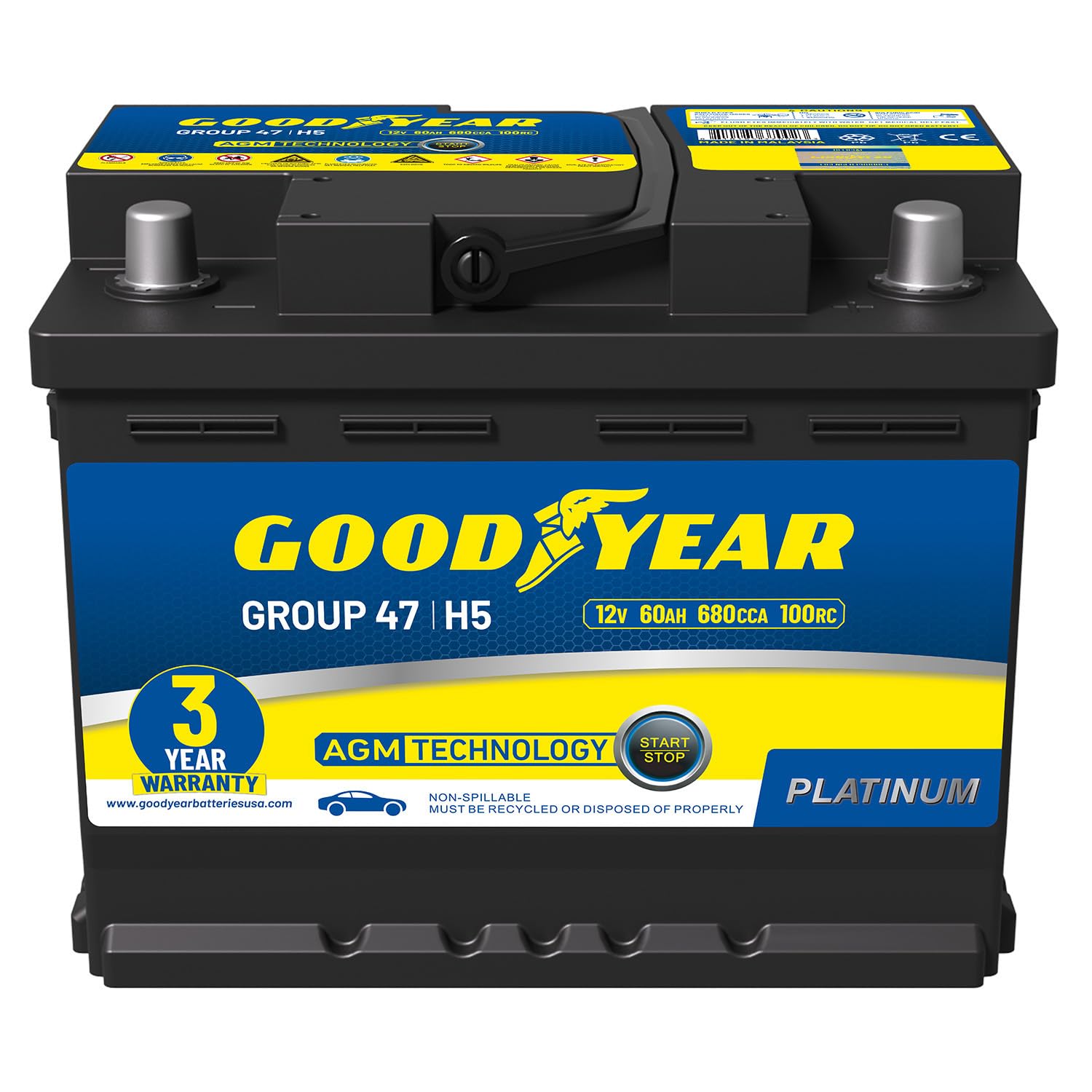
Goodyear’s entry into the AGM battery space brings 680 CCA and 100 minutes of reserve capacity in a Group 47 (H5) case that fits many European and Asian sedans requiring a compact, high-output battery. The platinum series uses spill-proof AGM technology with shock and vibration resistance suitable for both on-road and light off-road use. The dimensions (9.37 x 6.75 x 7.50 inches) match the H5 form factor, and the terminal layout places positive on the right and negative on the left.
Owners report successful replacement of auxiliary batteries in Chrysler Pacifica and Jeep Wrangler models, noting that the AGM chemistry eliminated the auto start-stop errors that plague those vehicles when the OEM auxiliary battery begins to fail. The CE certification and ISO factory audit provide a baseline quality assurance that not all aftermarket battery brands disclose. The 36-month manufacturer warranty covers defects and premature failure, which aligns with the industry standard for AGM products at this level.
The plate grid design provides up to twice the cycle life of conventional flooded batteries, and the wide temperature operating range ensures consistent performance from -22°F to 140°F. The inclusion of mounting screws in the package simplifies installation, although the wire harness and mounting accessories are sold separately. For buyers who value a recognizable brand name combined with AGM reliability at a mid-range price point, the Goodyear 47-H5-AGM represents a sensible choice.
What works
- Resolves stop-start error codes in Chrysler and Jeep models
- CE certified with ISO factory quality audit
- Includes mounting screws for straightforward install
What doesn’t
- Some buyers report compatibility issues with specific models
- Wire harness and brackets sold separately
5. Weize Platinum AGM Group 35 Battery

The Weize Platinum Group 35 provides 650 CCA and 55 Ah capacity within a compact case measuring 9.06 x 6.89 x 8.82 inches, making it a drop-in replacement for a wide range of Japanese and American vehicles that specify Group 35 fitment. The AGM construction delivers up to twice the cycle life of conventional flooded batteries, with tapered terminals positioned left negative and right positive. The acceptable charging current range of 0-17 amps allows compatibility with standard alternator outputs without risk of overcharging.
Customer reviews frequently mention that this battery solved persistent electrical issues — random stop-start deactivation, door lock cycling, and battery saver mode warnings — that occurred with aging OEM batteries. The low self-discharge rate means the battery holds voltage during storage periods better than flooded alternatives, which is useful for seasonal vehicles or those parked for extended stretches. The 36-month full replacement warranty provides a safety net that matches the terms of premium battery brands at a lower price point.
The vibration resistance is reinforced by the glass mat design, which prevents internal plate shorting common in flooded batteries subjected to rough roads. The operating temperature range spans -22°F to 158°F, covering both northern winter starts and desert summer heat. Weize’s customer support team has a track record of processing warranty replacements with voltage test verification and photo documentation rather than forcing buyers through a lengthy retailer return process. For drivers seeking a reliable AGM upgrade without overspending, this is a well-rounded option.
What works
- Solves common start-stop and electrical system glitches
- Low self-discharge rate ideal for seasonal vehicle storage
- Responsive warranty support with practical claim process
What doesn’t
- Group 35 size limits compatibility with larger trays
- Does not include mounting hardware or brackets
6. Renogy 12V 70Ah AGM H6 Group 48 Battery
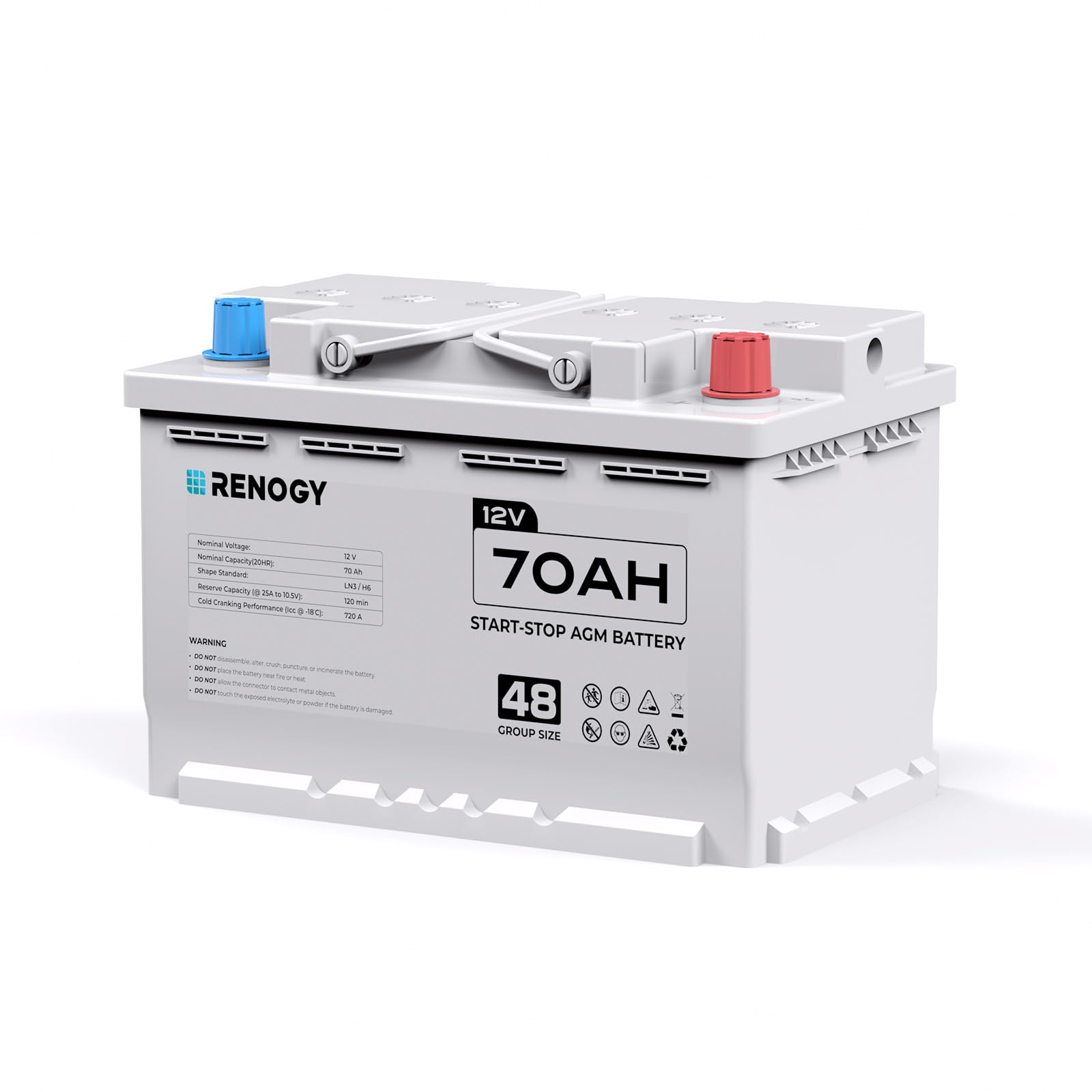
Renogy brings its solar-energy expertise to the automotive AGM segment with this Group 48 battery that delivers 720 CCA and 120 minutes of reserve capacity from a 70 Ah design. The sealed lead-acid construction uses glass fiber mat separators to minimize acid leaks and corrosion, making it suitable for engine bay installations where vibration and temperature swings are constant. The operating range of -22°F to 158°F covers the full spectrum of driving climates, and the start-stop optimization ensures reliable cycling for vehicles equipped with regenerative braking systems.
Owner feedback indicates a solid fitment for Jeep Grand Cherokee and other SUVs that require a Group 48 battery, with users noting that the battery arrived fully charged and held voltage well during storage. The 48.6-pound weight reflects the higher lead content compared to standard flooded units, which contributes to the 720 CCA output. The warranty period is 2 years on material and workmanship, which is shorter than some competitors but aligns with Renogy’s focus on value-priced AGM products.
The battery’s deep-cycle heritage from Renogy’s solar line gives it better tolerance for repeated discharge cycles than typical starting batteries, though the manufacturer explicitly states it is not designed for deep-cycle solar applications. The built-in handles on both sides simplify carrying and positioning during installation. For drivers who want a high-CCA AGM from a brand with renewable energy credentials at a mid-range price, the Renogy H6 offers competitive specs with proven reliability in temperature-extreme environments.
What works
- 720 CCA provides strong cranking in extreme cold
- 120-minute reserve capacity supports high electrical loads
- Sealed design resists acid leaks and corrosion
What doesn’t
- 2-year warranty is shorter than the AGM average
- Heavier than some Group 48 AGM competitors
7. Autocessking H5 Group 47 AGM Battery
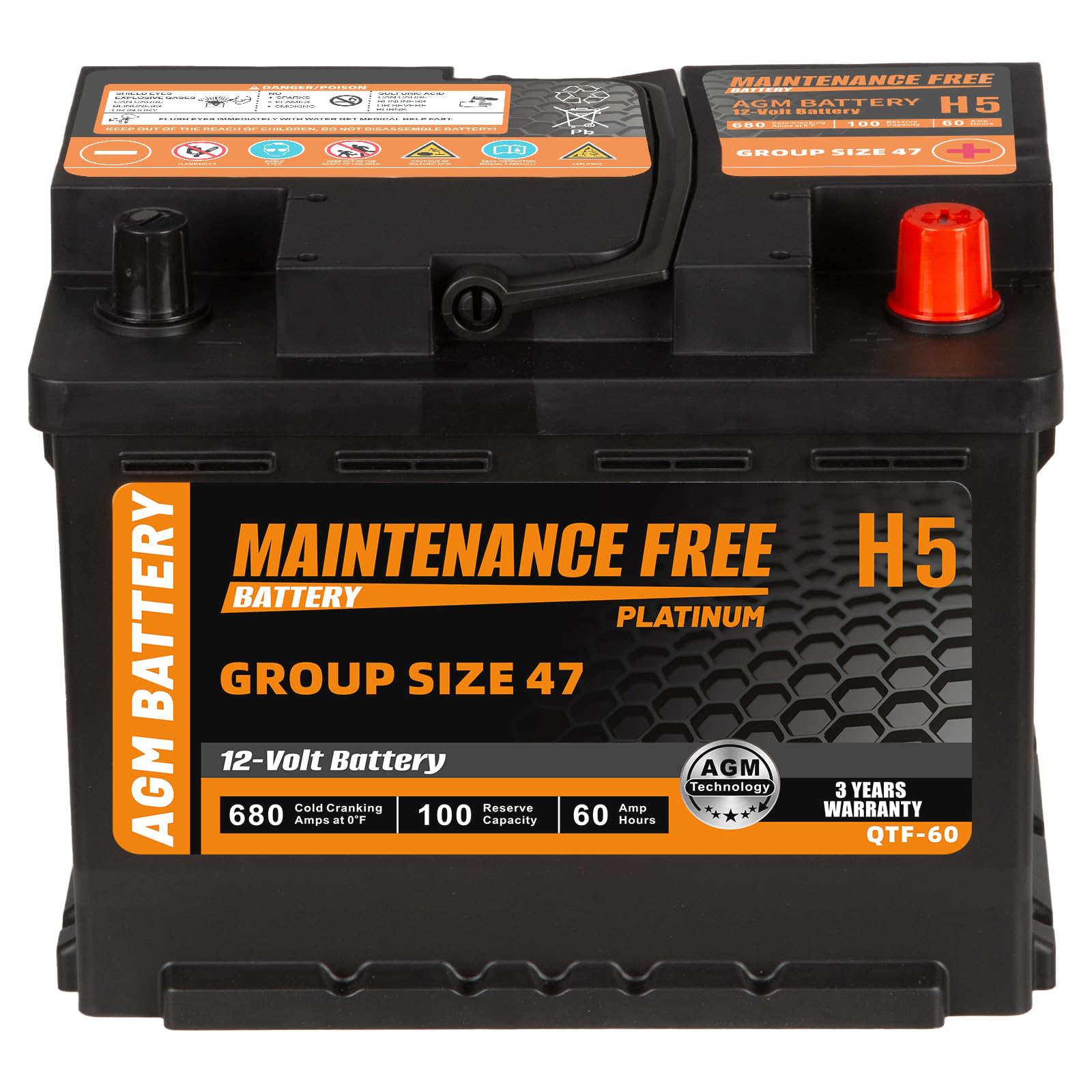
The Autocessking H5 Group 47 AGM battery delivers 680 CCA and 60 Ah capacity from a case that matches the standard H5 dimensions (9.57 x 6.89 x 7.48 inches) with left negative and right positive terminal layout. The AGM technology uses high-density negative paste to improve conductivity and claims four times the cycle life of conventional flooded batteries. The operating temperature range spans -40°F to 75°C, with continuous reliable performance from -18°C to 60°C, covering the extremes most drivers encounter.
Buyers report successful fitment in Honda Accord and Civic models from the 2019-2022 generations, noting that the battery started immediately and solved the original slow-crank problem without any terminal modification. The 3-year warranty provides coverage consistent with mid-tier AGM offerings, and the 39-pound weight keeps the unit manageable for DIY installation. The included carrying handle simplifies positioning, and the leak-proof vent cap prevents acid escape during installation or vibration.
The vibration resistance is rated at 18 times that of standard batteries, which is beneficial for vehicles driven on rough pavement or light off-road trails. The manufacturer notes that this is a starting battery and should not be used for deep-cycle applications such as solar projects. For budget-conscious buyers who want genuine AGM construction with competitive CCA and a 3-year warranty, the Autocessking delivers essential performance at an accessible price.
What works
- 680 CCA at a budget-friendly price point
- 18x vibration resistance for rough-road durability
- Includes carrying handle for easier installation
What doesn’t
- Long-term durability not yet proven in owner reviews
- Not suitable for deep-cycle or solar applications
8. Polaris Heavy Duty AGM Battery
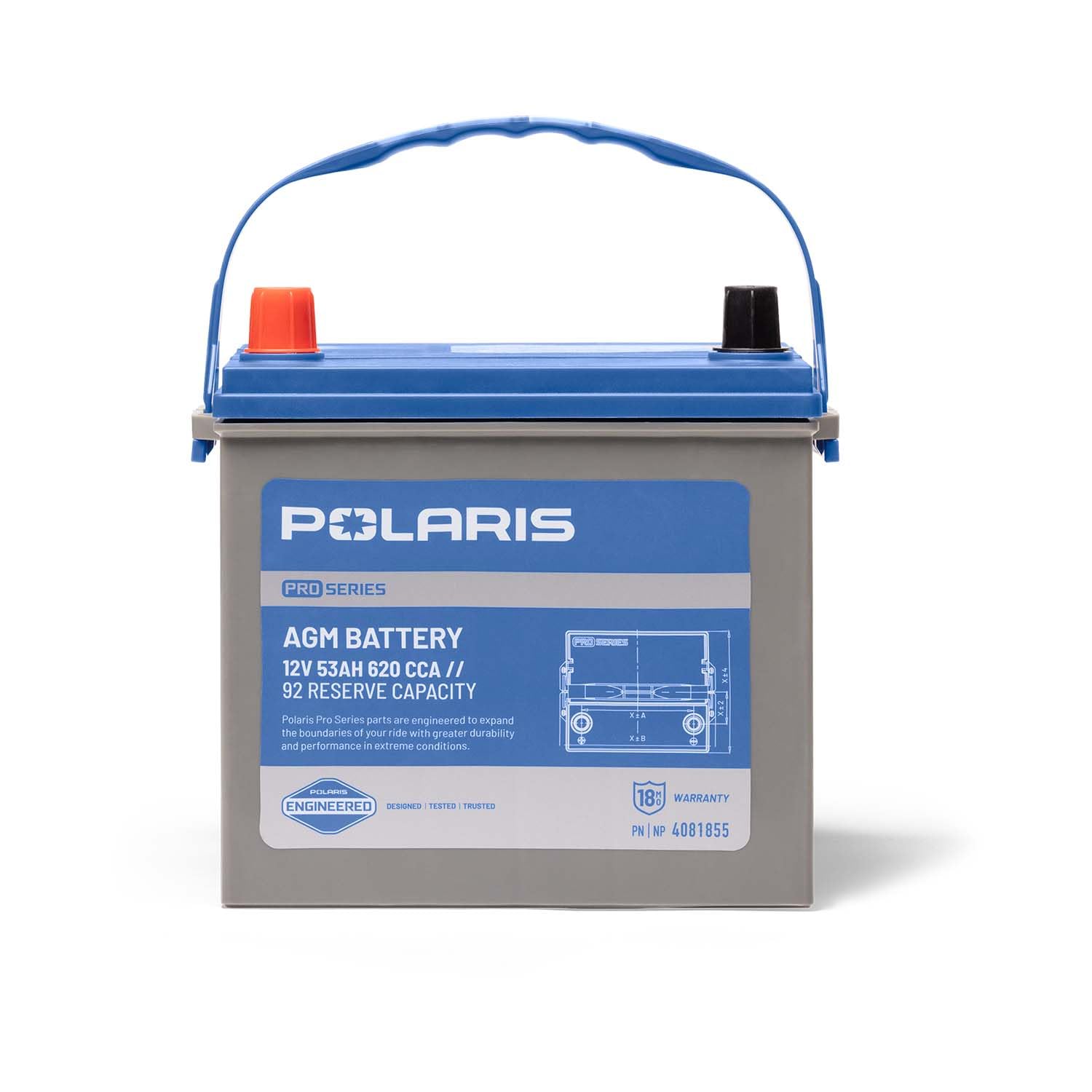
This Polaris AGM battery is designed as a direct OEM replacement for Polaris RZR and other powersports vehicles, but it also fits certain passenger cars such as the Hyundai Ioniq PHEV where the sealed gel construction eliminates the need for a vent tube. The fully sealed, leak-proof case resists vibration and impacts better than flooded batteries, which is critical for off-road use where terrain shocks can damage internal plates. The 36.6-pound weight reflects the heavy-duty construction aimed at highly accessorized vehicles with additional electrical loads.
Owners report successful installations in 2019 Hyundai Ioniq PHEV and 2016-2018 Polaris RZR models, noting that the battery provides stronger cranking than the OEM unit and fits the existing tray without modification. The sealed design allows flexible mounting positions as long as the battery is not inverted, which is useful for vehicles with non-standard battery compartments. The price point undercuts dealer pricing significantly, with some buyers reporting savings compared to OEM replacement quotes from dealerships.
The warranty term is shorter than some competitors at 6 months, which reflects the specific OEM-replacement nature of this product. Some customers received units that appeared to be old stock and failed to hold a charge after several days on an AGM charger, though the majority report successful long-term performance. For owners of Polaris vehicles or Hyundai Ioniq models seeking a direct-fit, no-modification AGM upgrade, this battery eliminates the guesswork of cross-referencing group sizes.
What works
- Direct OEM fit for Polaris RZR and Hyundai Ioniq PHEV
- Sealed gel construction needs no vent tube
- Significant savings vs dealer OEM replacement pricing
What doesn’t
- 6-month warranty is shorter than industry standard
- Some units arrive as old stock with reduced capacity
9. ACDelco Gold AUX14-200 Auxiliary AGM Battery
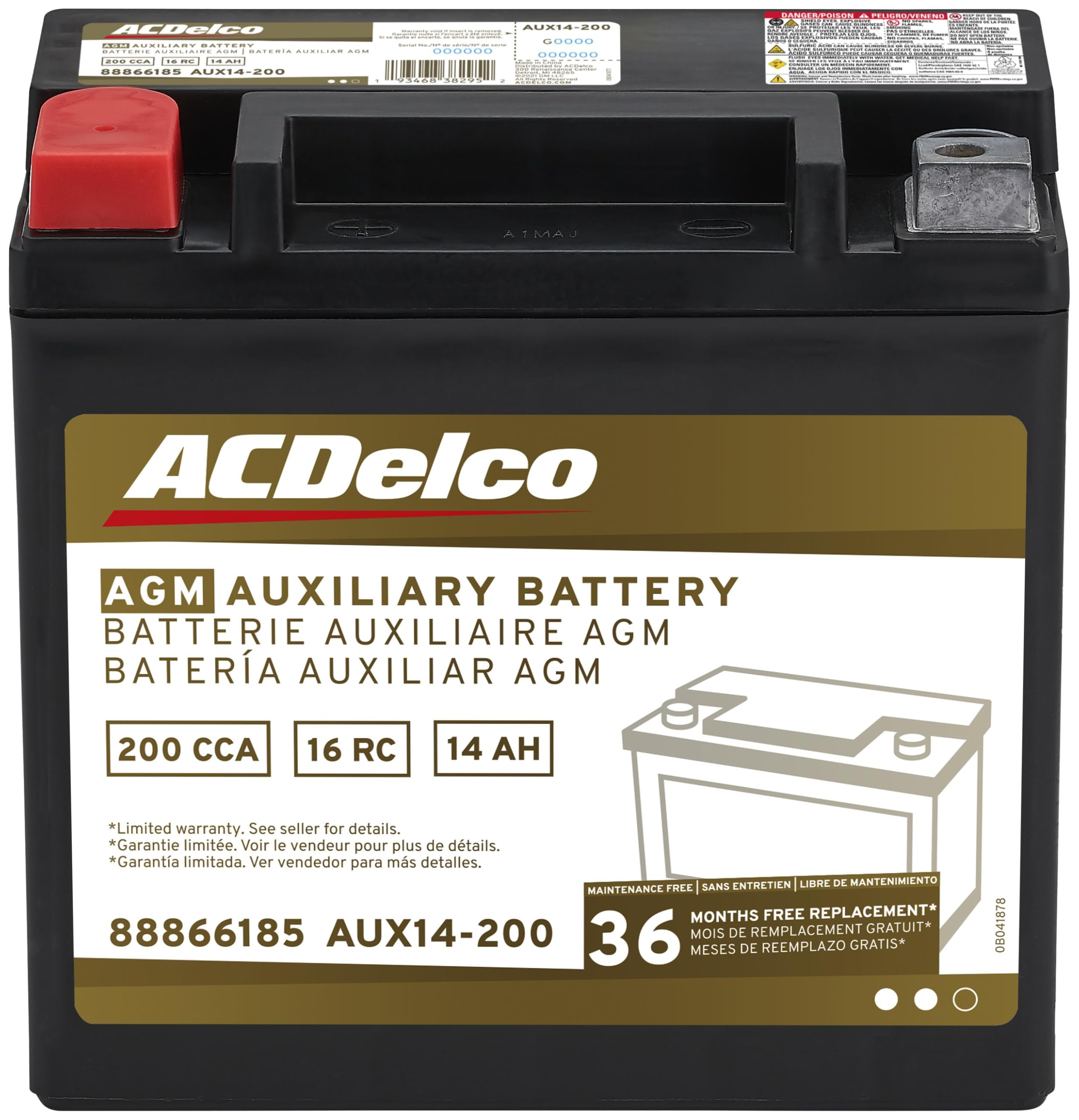
The ACDelco Gold AUX14-200 is a dedicated auxiliary AGM battery designed for vehicles that use a secondary battery to power start-stop systems, infotainment, and accessory loads without taxing the main starting battery. With 200 CCA and 12 Ah capacity in a compact 3.4 x 5.9 x 5.7-inch case, this unit serves as the secondary power source in vehicles like the Chrysler Pacifica, Mercedes SL-Class, and Dodge Durango that have a separate auxiliary battery tray. The AGM construction is maintenance-free with a leak-proof pressurized valve system that prevents dry-out and acid damage to terminals.
Owner reports confirm this battery fits as a direct replacement for the factory auxiliary battery in a range of General Motors and European vehicles, with users noting that it resolved start-stop system errors and accessory power interruptions. The high-density plate oxide design maximizes power-per-pound for the compact form factor, and the heavy top lead with through-partition connections optimizes power delivery. The 36-month warranty provides coverage comparable to main-battery standards in the auxiliary category.
Some buyers experienced difficulty with the warranty claim process when the battery stopped holding a charge, with ACDelco directing them back to Amazon rather than handling the replacement directly. The terminal layout may require minor modification for certain Mercedes applications, though most installations are straightforward. For owners needing a reliable auxiliary battery replacement without paying dealer markup on an OEM part, the AUX14-200 offers GM-backed quality at a reasonable investment.
What works
- OEM-level quality backed by General Motors engineering
- Compact AGM design fits standard auxiliary battery trays
- Resolves start-stop and accessory power errors
What doesn’t
- Warranty process may require retailer instead of direct support
- Limited to auxiliary/start-stop duty, not main starting
Hardware & Specs Guide
AGM Battery Construction
Absorbent Glass Mat (AGM) batteries use fiberglass separators sandwiched between lead plates to hold the electrolyte in suspension. This design eliminates free liquid acid, making the battery spill-proof and resistant to vibration damage. AGM units handle deep discharge cycles better than flooded batteries, recharge faster, and operate reliably across a wider temperature range. They are the recommended replacement for any vehicle originally equipped with AGM, as downgrading to flooded chemistry can cause charging system conflicts and reduced service life.
Cold Cranking Amps vs. Reserve Capacity
Cold Cranking Amps (CCA) measure the current a battery can deliver at 0°F for 30 seconds while maintaining at least 7.2 volts. Higher CCA matters most for cold-climate starting. Reserve Capacity (RC) measures how many minutes the battery can supply 25 amps at 80°F before voltage drops below 10.5 volts — essentially the battery’s stamina if the alternator stops working. For Group 26R applications, aim for a minimum of 600 CCA and 90 RC for reliable daily performance, and consider 700+ CCA and 100+ RC for vehicles with winches, audio systems, or heavy accessory loads.
Lithium Iron Phosphate (LiFePO4) Starting Batteries
LiFePO4 chemistry offers a weight reduction of 60-70% compared to AGM, faster recharge acceptance, and a built-in Battery Management System (BMS) that protects against overcharge, over-discharge, and short circuits. These batteries maintain higher voltage under load during cold starts and can deliver more usable capacity from a smaller physical footprint. However, they require a charging system compatible with lithium voltage profiles — some older alternators or ECUs may not charge them correctly without a DC-DC converter or BMS interface.
BCI Group Size and Terminal Orientation
The Battery Council International (BCI) group size standard ensures physical and electrical compatibility across manufacturers. Group 26R specifies dimensions of roughly 8.19 x 6.81 x 7.75 inches with reversed terminal polarity (positive on the left, negative on the right for most vehicle applications). Always measure your battery tray length, width, and height, and verify the terminal position relative to the cable routing before purchasing. A battery that is too tall can short-circuit against the hood insulation, while incorrect terminal orientation may require cable extension or rerouting.
FAQ
What does Group 26R mean on a battery?
Can I replace a flooded battery with an AGM battery?
How long do AGM batteries typically last?
Is a lithium battery worth the higher price for starting duty?
Final Thoughts: The Verdict
For most buyers, the best group 26r battery winner is the SDULIBITIY LiFePO4 Group 26 because it delivers high cranking power, cuts weight by over 60% compared to AGM, and includes a comprehensive BMS for long-term protection. If you want proven longevity with a track record of 8-plus years of service, grab the ODYSSEY PC925 AGM28L. And for a value-driven AGM that balances performance and price, nothing beats the Weize Platinum Group 24F with its 710 CCA and 120-minute reserve capacity.

Certification: BSc in Mechanical Engineering
Education: Mechanical engineer
Lives In: 539 W Commerce St, Dallas, TX 75208, USA
Md Amir is an auto mechanic student and writer with over half a decade of experience in the automotive field. He has worked with top automotive brands such as Lexus, Quantum, and also owns two automotive blogs autocarneed.com and taxiwiz.com.