Dumping a 40-pound gas can into a lawn mower or truck bed is a recipe for drips, fumes, and a strained lower back. A dedicated fuel pump transforms that chore into a clean, hands-free operation that takes seconds instead of minutes. The right unit eliminates the tilt-and-pour struggle entirely.
I’m Amir — the founder and writer behind Four Wheel Ask. I’ve spent years analyzing fuel transfer hardware, poring over build materials, pump motors, adapter compatibility, and owner-reported reliability across dozens of models to separate the real performers from the leaky duds.
Whether you’re topping off a tractor, an ATV, or a generator, the right gas can with pump saves time and spares your spine — just be sure the auto-stop sensor and adapter set match your specific container thread size.
How To Choose The Best Gas Can With Pump
Not every battery-powered pump handles gasoline vapors well, and adapter compatibility varies more than most buyers expect. Focus on these three factors to avoid a drip-prone misfit.
Flow Rate and Motor Efficiency
Flow is measured in gallons per minute (GPM). Entry-level pumps hover around 2.5 GPM, while mid-range units push 3.2 to 3.8 GPM. A faster motor empties a five-gallon can in roughly 80 seconds rather than two minutes, which matters when you are fueling multiple machines in one session. Check that the pump is rated for gasoline specifically — some budget models lack the vapor-sealed motor required for flammable liquids.
Adapter Thread Pattern and Can Compatibility
Most North American plastic gas cans use a 2-inch inner diameter opening, but Scepter SmartControl cans and older metal jerry cans use different thread patterns. A good kit includes at least four adapters spanning 2.0 to 3.75 inches. If the adapter does not seat firmly, the pump wobbles and leaks fuel down the side of the can during use.
Auto-Stop Sensor Reliability
An auto-stop sensor is the difference between a clean fill and a puddle of gasoline on your garage floor. The sensor sits near the nozzle tip and cuts power the instant liquid reaches it. Look for units with a beeper or LED indicator that confirms the shut-off — this gives you confidence to walk away while the pump runs. Avoid pumps that rely solely on a mechanical float; electronic sensors respond faster and more consistently.
Quick Comparison
On smaller screens, swipe sideways to see the full table.
| Model | Category | Best For | Key Spec | Amazon |
|---|---|---|---|---|
| MISFANS 3.8 GPM | Electric Pump | High-speed daily fueling | 3.8 GPM flow rate | Amazon |
| VEECAP 2nd Gen | Electric Pump | Quiet, leak-free operation | 3.8 GPM, 1.4 lbs | Amazon |
| FEEDRON FDR-FT | Electric Pump | Dual-power versatility | 3.8 GPM, USB-C ready | Amazon |
| Keimi Portable | Electric Pump | Compact travel storage | 3.2 GPM, 51″ hose | Amazon |
| SKYJDM Red | Electric Pump | Back-friendly ergonomics | 3.2 GPM, 4 adapters | Amazon |
| anngrowy | Electric Pump | CSA-certified safety | 3.2 GPM, auto-stop | Amazon |
| koulate Portable | Electric Pump | Budget entry-level buy | 3.2 GPM, 3 adapters | Amazon |
In‑Depth Reviews
1. MISFANS 3.8 GPM Fuel Transfer Pump
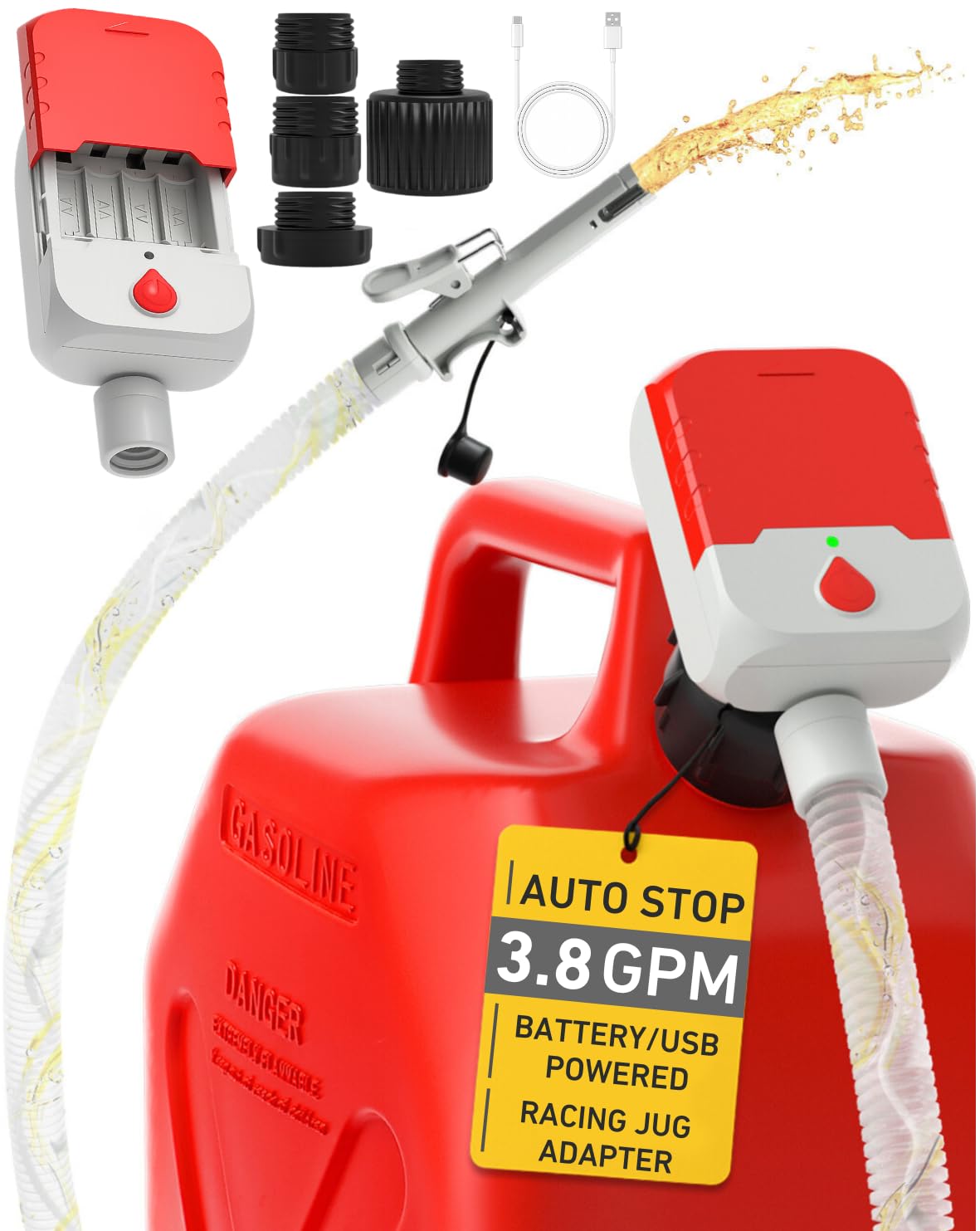
The MISFANS pump delivers a genuine 3.8 GPM flow rate — roughly 20 percent faster than the standard 3.2 GPM units in this class — which cuts the time needed to empty a five-gallon can by nearly 25 seconds. The housing is high-impact ABS, and the transparent PE hose lets you spot air bubbles or sediment mid-transfer. Real owner reports confirm the auto-stop sensor triggers every time the nozzle tip touches liquid, with audible cutoff feedback that eliminates guesswork.
Four adapters (2.0, 2.1, 2.75, and 3.75 inches) cover the vast majority of North American plastic cans, including the wide-mouth racing jugs that often reject smaller kits. The pump runs on 4 AA batteries or a USB-C cable connected to any power bank, giving you flexibility when the batteries run flat mid-job. Owners specifically praise the dedicated on/off button — earlier models used a cycling switch that was easy to mis-press.
The 19-inch intake hose is flexible enough to reach the bottom of a deep can, though a few users note the intake tube can curl upward when the can is nearly empty, leaving about an inch of fuel un-pumped. That is a minor trade-off for the speed and build quality at this price tier. The included storage bag keeps the hose and adapters together in the garage or truck toolbox.
What works
- Fastest flow rate in this comparison at 3.8 GPM
- Dual power option (AA or USB-C) for uninterrupted use
- Reliable auto-stop sensor with audible beeper confirmation
What doesn’t
- Flexible intake tube may not drain the last inch of fuel
- Batteries not included in the package
2. VEECAP 2nd Gen Automatic Fuel Transfer Pump
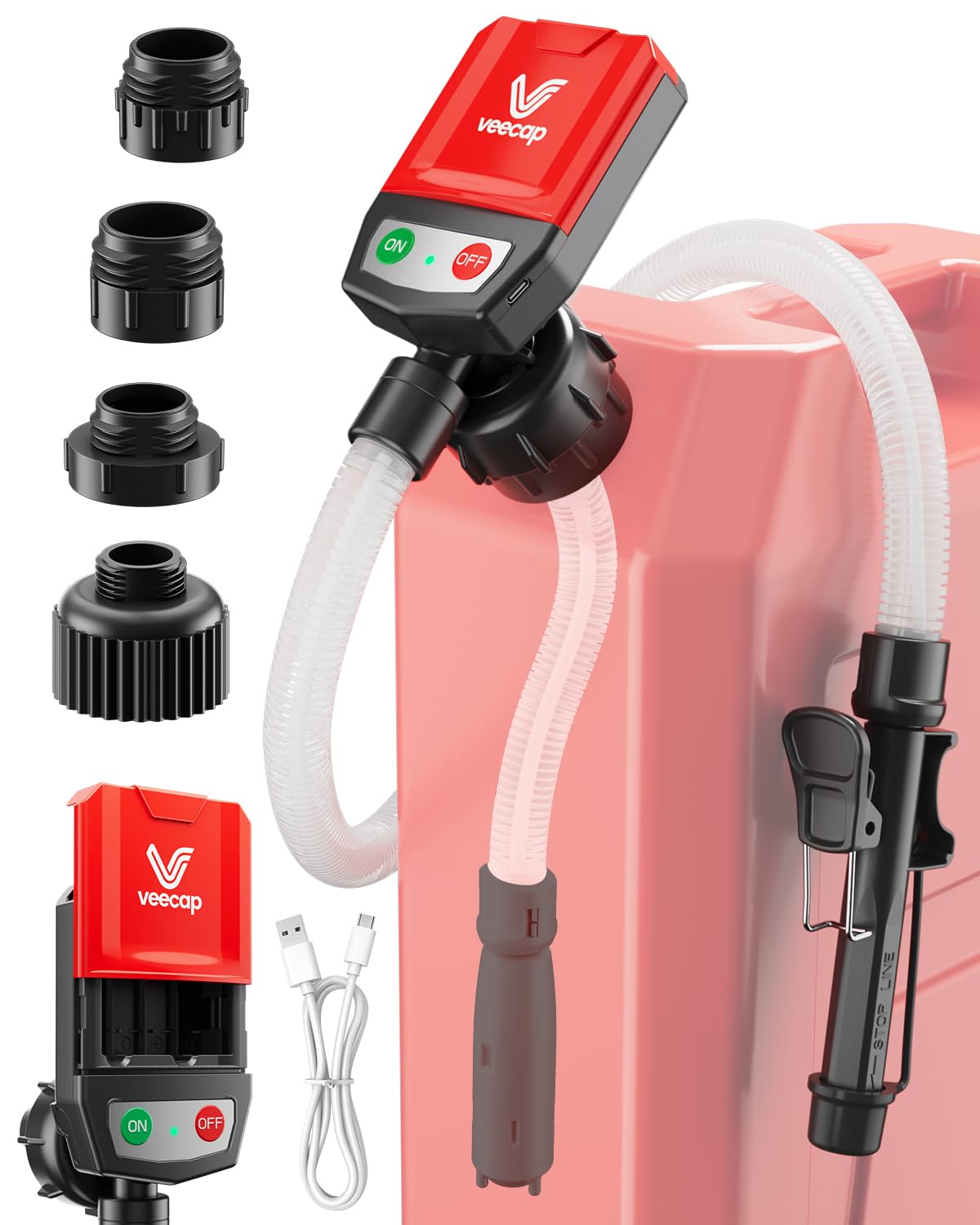
The VEECAP second-generation pump weighs just 1.4 pounds, making it the lightest unit in the premium tier without sacrificing the 3.8 GPM flow rate. The motor runs noticeably quieter than the competition — owners report the hum is about half as loud as the MISFANS unit — which matters during early-morning fueling before work. The reinforced leak-proof pipeline uses a thicker wall than most budget pumps, and the seal around the adapter collar stays dry even when the can is tilted slightly.
Four adapters range from 2.0 to 3.75 inches, but the manual explicitly warns against Scepter SmartControl cans — the internal filter basket blocks the intake tube. That is a clear limitation if you own those cans, but for standard No-Spill or VP Racing jugs the fit is tight and secure. The auto-stop sensor uses the same electronic cutoff found on the MISFANS pump, with an LED that glows red when the pump stops.
The included drawstring storage bag is larger than most competitors’ bags, accommodating the hose without excessive coiling that could kink the polyethylene tube. USB-C power input is available for continuous use, but the pump ships without a cable — you will need your own. Overall this unit is ideal for anyone who prioritizes quiet operation and low weight over raw speed.
What works
- Extremely quiet motor for discreet early-morning use
- Ultra-light 1.4 lb build reduces hand fatigue
- Thick-walled hose resists kinking during storage
What doesn’t
- Not compatible with Scepter SmartControl cans
- USB-C cable sold separately
3. FEEDRON FDR-FT Fuel Transfer Pump

The FEEDRON FDR-FT matches the 3.8 GPM flow of the top-tier units but lands at a slightly lower mid-range price point, making it the strongest value in this roundup. The ABS shell feels dense and the metal clip that secures the nozzle to the can rim is reinforced — a weak point on several budget pumps that snap within the first few uses. Owners consistently note that the auto-stop sensor is highly sensitive, cutting flow within a second of the liquid contacting the nozzle tip.
Four adapters cover the standard North American thread sizes, and the pump includes a USB-C cable in the box — not an afterthought add-on. The beeper emits a short chirp when the auto-stop engages, which is loud enough to hear across a garage but not annoying. The 51-inch discharge hose handles awkward fill angles on trucks and tractors without binding.
A small minority of buyers report that the plastic nozzle holder on the body snapped off during the first use. This part holds the nozzle between uses and breaking it does not affect pump function, but it is an annoyance. For the flow speed, dual-power flexibility, and included USB cable, the FEEDRON offers the best feature-per-dollar ratio in this comparison.
What works
- 3.8 GPM flow at a mid-range price point
- Included USB-C cable saves an extra purchase
- Reinforced metal clip resists snapping
What doesn’t
- Plastic nozzle holder breaks easily
- Adapters may not fit older metal jerry cans
4. Keimi Portable Fuel Transfer Pump
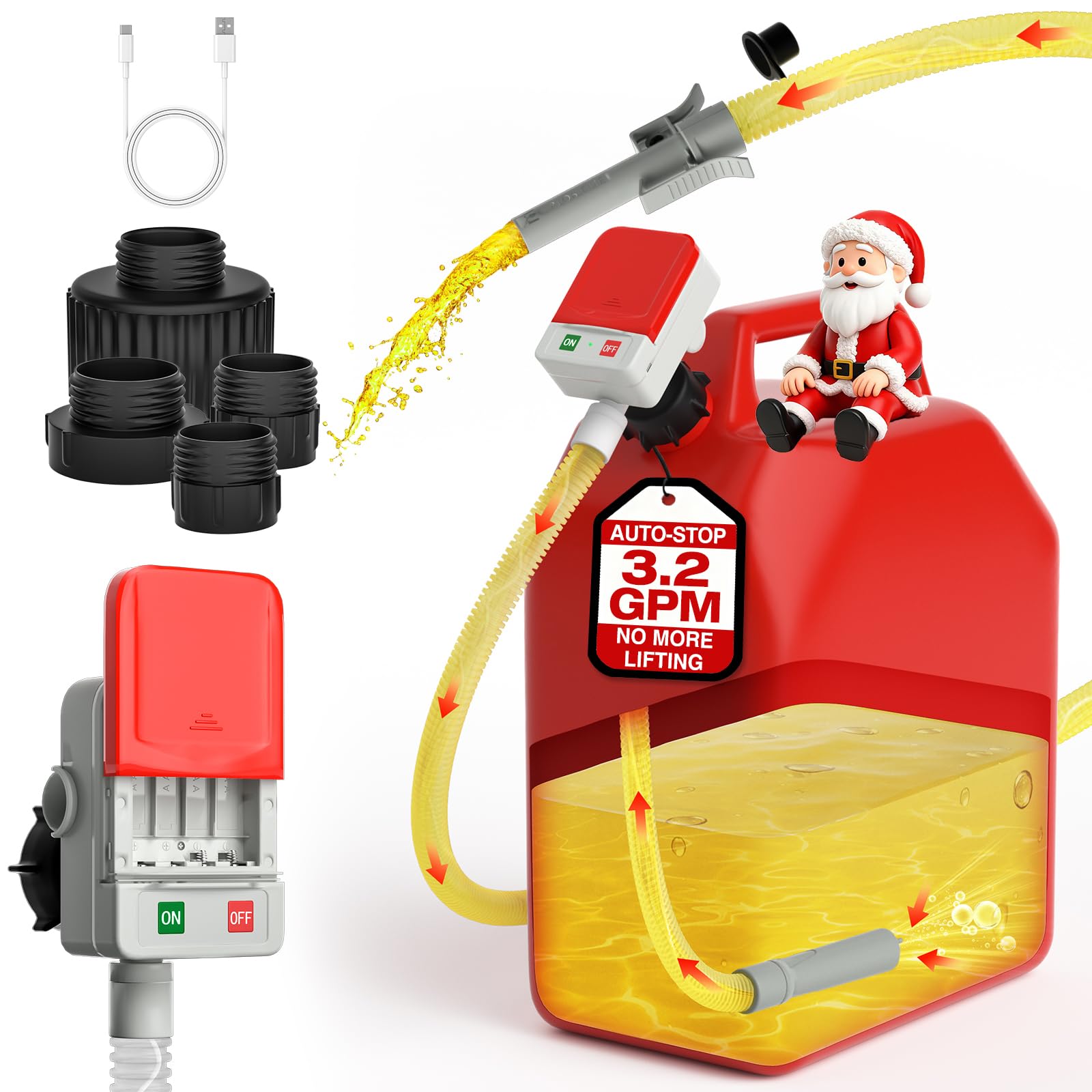
The Keimi pump is built around portability — the entire kit, including four adapters and the hose, fits into a bag that takes up less space than a lunchbox. The 3.2 GPM flow rate is standard for this class, slightly slower than the 3.8 GPM leaders, but the motor draws less current from the batteries, extending runtime per set of AAs. Owners report getting through about eight full five-gallon transfers on a single set of 4 AA batteries.
The auto-stop sensor works reliably across gasoline, diesel, and kerosene. The nozzle tip has a slightly wider diameter than the competitors, which improves shut-off speed with thicker fluids like diesel. Four adapters (2.0, 2.1, 2.75, and 3.75 inches) are included, and the hose barb connectors screw on without tools. The intake hose is 19 inches, adequate for standard five-gallon cans but too short for deep drums taller than 23 inches.
The unit can operate on 2 AA batteries in a pinch, though the flow rate drops noticeably — about 1.8 GPM. That emergency mode is useful when you only have two cells left and need to finish a transfer. The lack of USB-C power input means you are fully dependent on batteries, which is the main drawback versus the dual-power competitors.
What works
- Compact bag fits in tight trunk or garage spaces
- Long battery life — up to 8 cans per AA set
- Wide nozzle tip handles diesel well
What doesn’t
- No USB-C power input for backup operation
- Intake hose too short for deep drums
5. SKYJDM Red Fuel Transfer Pump
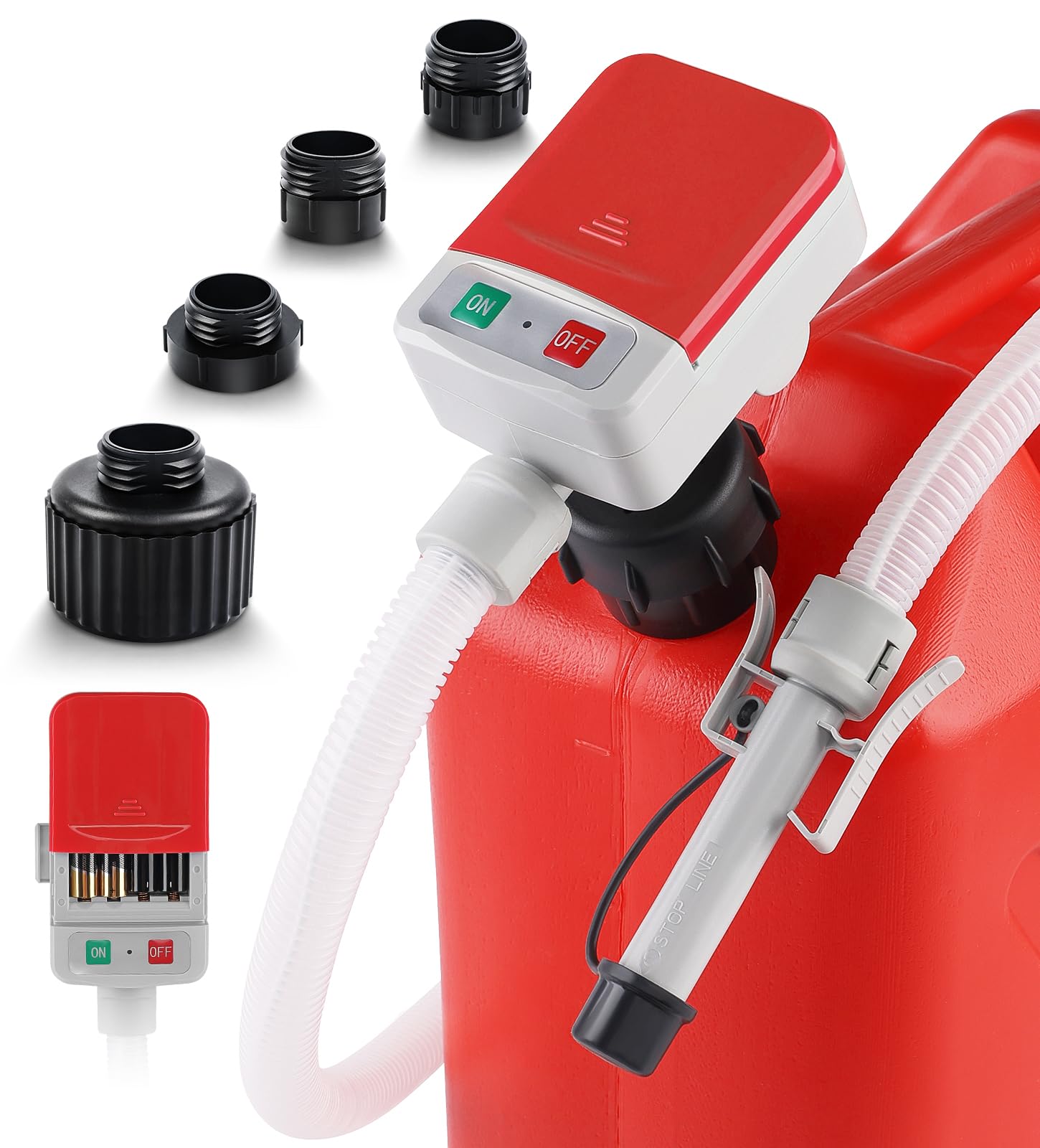
The SKYJDM red pump focuses on user comfort — the body shape features a contoured grip that fits the hand better than the cylindrical housings used by most competitors. This makes a real difference when you are holding the pump steady against a fuel neck for several minutes. The 3.2 GPM flow rate is adequate for cars, lawn mowers, and motorcycles, though it trails the 3.8 GPM units for heavy-duty farm use.
Four adapters (2.0, 2.1, 2.75, and 3.75 inches) are included, and the pump is clearly labeled as incompatible with Scepter SmartControl cans — the same limitation as the VEECAP. The auto-stop sensor uses an internal electronic switch rather than a mechanical float, and testing by owners confirms zero false triggers when the hose is jostled during transfer. The 51-inch hose gives plenty of reach to the side of a truck bed or tractor fuel neck.
The pump runs exclusively on 4 AA batteries — no USB-C port — which simplifies the wiring but eliminates the option of continuous power. The motor is rated for gasoline and diesel only; the manual advises against kerosene or water. A few owners note the intake hose is slightly stiffer than the transparent hoses on rival models, making it harder to maneuver into the bottom corner of a rectangular can.
What works
- Ergonomic grip reduces hand strain during long fills
- Reliable electronic auto-stop with no false triggers
- Low vibration motor is comfortable to hold
What doesn’t
- No USB power option limits flexibility
- Intake hose stiffness makes tight maneuvering harder
6. anngrowy Fuel Transfer Pump
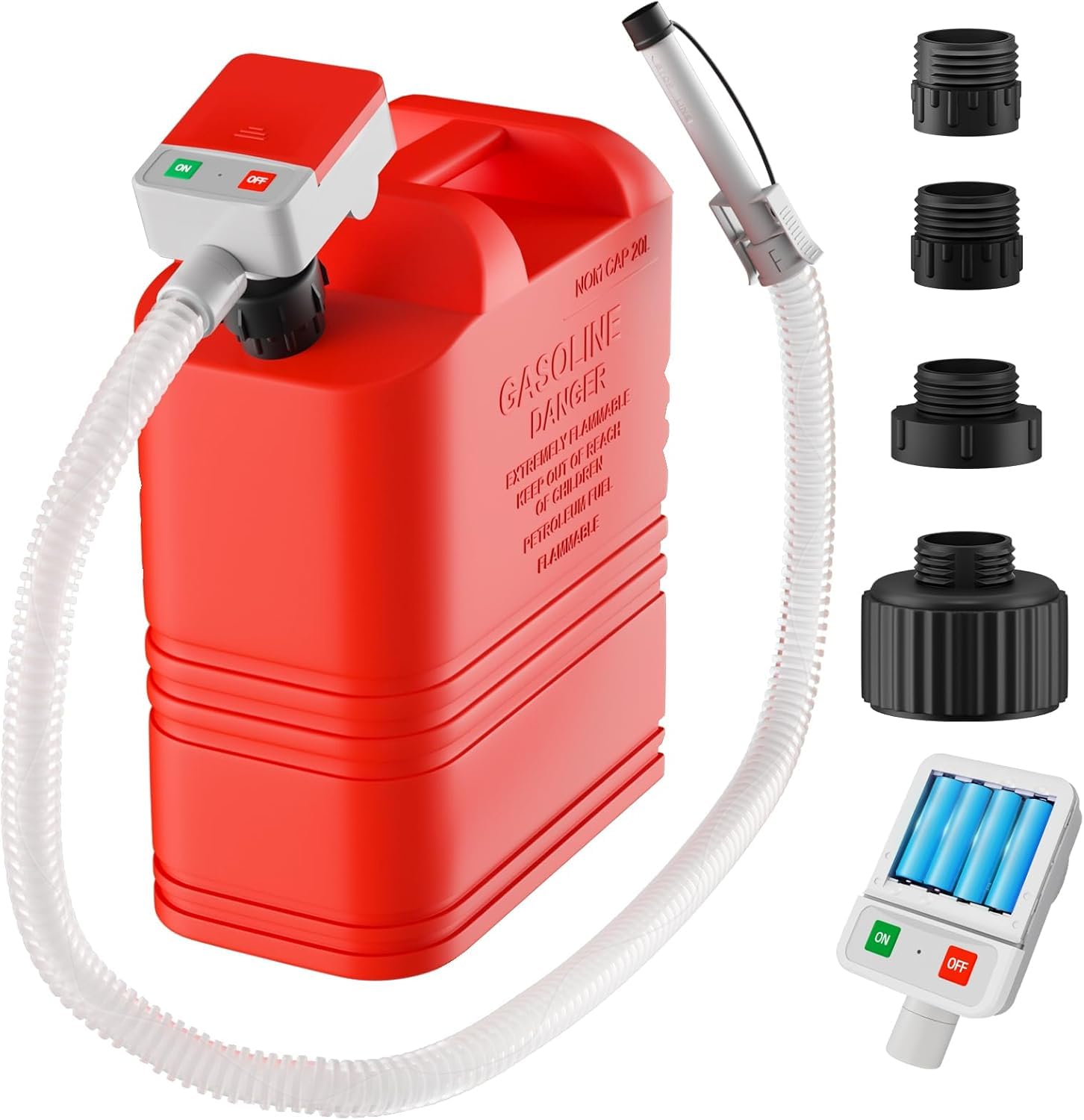
The anngrowy pump is the only unit in this lineup with CSA certification, meaning it has been independently tested to meet Canadian and U.S. safety standards for fuel handling equipment. That certification matters for insurance compliance in commercial garages and for buyers who want documented third-party verification of vapor-safe construction. The flow rate is a steady 3.2 GPM, comparable to the SKYJDM and Keimi pumps.
Four adapters (2.0, 2.1, 2.75, and 3.75 inches) are included, and the pump body features a threaded inlet connection rather than a friction-fit barb. The threaded connection creates a more positive seal, reducing the chance of the adapter vibrating loose during transfer. The auto-stop sensor works well with gasoline and diesel, but some owners report slightly slower reaction with thicker fluids like used motor oil.
The pump runs on 4 AA batteries with the option to use just 2 in an emergency. There is no USB-C input, so you cannot run it from a power bank. The storage bag is a basic drawstring without internal pockets, so the adapters can rattle loose during transport. For buyers who prioritize certified safety over speed, the anngrowy delivers peace of mind that few competitors match.
What works
- CSA certified for verified safety compliance
- Threaded inlet seal stays tight under vibration
- Steady 3.2 GPM flow with low motor noise
What doesn’t
- No USB power input for backup operation
- Storage bag lacks internal adapter organization
7. koulate Portable Electric Fuel Tank Pump
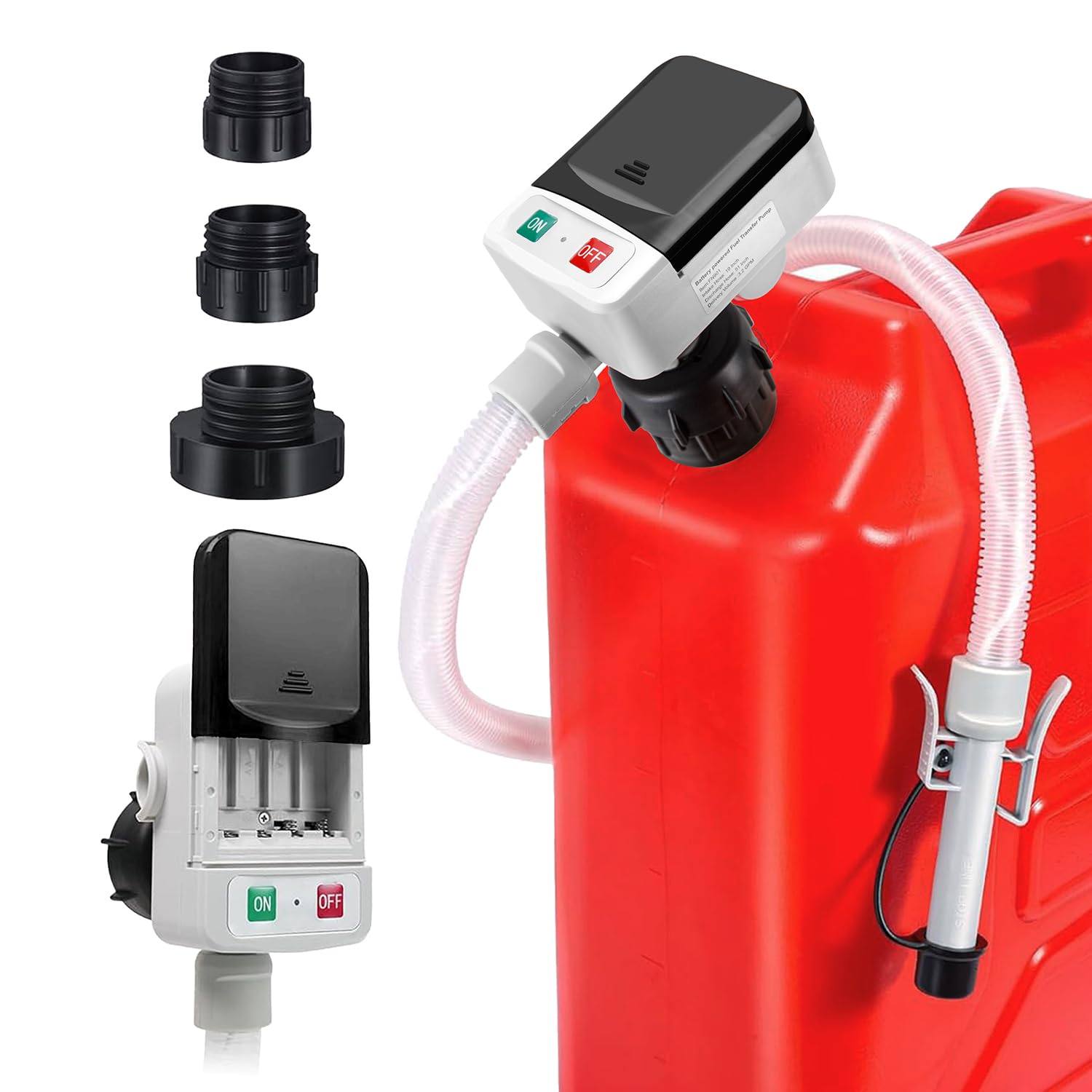
The koulate pump is the entry-level option in this guide, offering a 3.2 GPM flow rate and a 51-inch hose at a price that undercuts the rest of the field by a significant margin. The ABS plastic body feels slightly thinner than the mid-range units, but the pump includes an auto-stop sensor with an LED display and alarm — features usually reserved for pumps at a higher price tier. The LED shows battery level and pump status, which is genuinely useful for monitoring runtime.
Three adapters are included (the smallest count in this comparison), covering 2.0, 2.75, and 3.75 inches. The 2.1-inch size common on some Canadian cans is missing, which could be a dealbreaker for certain buyers. The threaded NPT connector screws onto standard cans securely, but the plastic threads on the adapter are finer than the competition and can cross-thread if over-tightened. Owners advise finger-tight only.
The pump operates on 4 AA batteries with no USB backup, and the auto-stop alarm emits a loud beep that some users find startling in a quiet garage. For occasional use — a few fills per season — the koulate works fine. For weekly heavy use, the thinner plastic housing and limited adapter selection make the mid-range options a better long-term investment.
What works
- Lowest entry price for a pump with auto-stop sensor
- LED display shows battery level and pump status
- Loud alarm provides clear overflow warning
What doesn’t
- Only three adapters — misses the 2.1-inch size
- Fine plastic threads prone to cross-threading
Hardware & Specs Guide
Flow Rate (GPM)
Flow rate determines how fast you can empty a gas can. Pumps in this guide range from 3.2 to 3.8 GPM. A 3.8 GPM pump empties a standard five-gallon can in about 79 seconds versus 94 seconds for a 3.2 GPM unit. The difference compounds when you are fueling multiple machines. Faster pumps draw more current, so battery life is shorter at higher flow rates — expect roughly six full cans from a 3.8 GPM pump versus eight from a 3.2 GPM model on the same 4 AA batteries.
Auto-Stop Sensor Technology
Every pump in this guide uses an electronic conductivity sensor near the nozzle tip. When the liquid contacts the sensor, the circuit closes and cuts power to the motor within half a second. Mechanical float-based auto-stop valves are slower and prone to sticking with cold fuel. The electronic sensor has no moving parts, so reliability is high as long as the sensor tip stays clean. A beeper or LED confirmation lets you know the pump has stopped without staring at the nozzle.
Adapter Thread Patterns
North American plastic gas cans use four common opening diameters: 2.0 inches (standard round jugs), 2.1 inches (some Canadian and No-Spill cans), 2.75 inches (wide-mouth racing jugs), and 3.75 inches (heavy-duty contractor cans). Most pump kits include adapters for three or four of these sizes. Scepter SmartControl cans use a proprietary thread pattern with an internal filter basket that blocks the pump intake tube — no standard adapter fits these cans.
Battery vs. USB Power
AA battery power gives you total portability with no cord to manage. A set of 4 AA alkaline cells typically provides 30 to 40 minutes of continuous run time. USB-C power input lets you connect a power bank for extended use without replacing batteries. Some pumps offer both options; others rely solely on batteries. If you plan long fueling sessions or forget to stock batteries, a pump with USB-C backup is worth the small premium.
FAQ
Can I use a battery-powered pump with diesel fuel?
Why does my pump not fit Scepter SmartControl cans?
How do I clean the auto-stop sensor after use?
What does the 2.1-inch adapter fit that the 2.0-inch does not?
Final Thoughts: The Verdict
For most buyers, the gas can with pump winner is the MISFANS 3.8 GPM because it combines the fastest flow rate with dual USB-C and battery power and a proven auto-stop sensor that owners consistently praise. If you want the lightest, quietest unit for early-morning garage work, grab the VEECAP 2nd Gen. And for the best balance of speed and price with a USB cable included, nothing beats the FEEDRON FDR-FT.

Certification: BSc in Mechanical Engineering
Education: Mechanical engineer
Lives In: 539 W Commerce St, Dallas, TX 75208, USA
Md Amir is an auto mechanic student and writer with over half a decade of experience in the automotive field. He has worked with top automotive brands such as Lexus, Quantum, and also owns two automotive blogs autocarneed.com and taxiwiz.com.