When the radio calls for a machine that dwarfs the rest of the fleet, 1:5 scale RC cars deliver physics‑defying mass, tire‑shredding torque, and a presence that makes 1/10th vehicles look like toys. The buyer stepping into this tier isn’t hunting for a parking‑lot racer; they want a full‑size driving experience packed into a package that can clear a 6‑foot gap and land flat.
I’m Amir — the founder and writer behind Four Wheel Ask. I’ve spent years digging through exploded differential cross‑sections, motor KV curves, and stripped‑screw horror stories across budgets from three figures to four, filtering real‑world durability from marketing hyperbole so you don’t waste a single dollar on a machine that folds on its first tumble.
This guide exists to separate the genuine land‑yachts from the overpriced shelf queens, helping you pinpoint the one true 1:5 scale rc cars that matches your bashing style and your tolerance for voltage.
How To Choose The Best 1:5 Scale RC Car
Stepping into 1:5 scale means committing to a rig that can span 30 inches and weigh over 25 pounds. Price alone doesn’t separate the contenders from the pretenders—you must evaluate drivetrain material, power system voltage, suspension geometry, and replacement‑part availability before clicking buy.
Power System: Brushed vs. Brushless and Voltage Tiers
The 1:5 class splits cleanly into two voltage camps. Budget‑tier units often use 4S brushed setups that barely motivate a 20‑pound chassis, producing anemic acceleration and overheating after five minutes of grass running. Premium and mid‑range options use sensored brushless motors (typically 750–1200Kv) on 6S to 8S LiPo packs, generating enough torque to wheelie on command. Always verify the ESC’s burst amp rating—a 120A speed controller on a 25‑pound truck is a fire waiting to happen. Look for 160A continuous or higher in 1:5 builds.
Chassis Metallurgy: 6061 vs. 7075 Aluminum
At this scale, the chassis takes every landing directly. Entry‑level models use 2.5mm 6061 aluminum—acceptable for gentle cruising but prone to bending during high‑speed cartwheels. Premium chassis plates are machined from 3mm or thicker 7075‑T6 aluminum, which offers roughly double the yield strength. Aftermarket EXB (Extreme Bash) reinforcement plates and steel skid plates are common upgrades for buyers who plan to send their car off ramps repeatedly.
Suspension Architecture: Oil‑Filled Shocks and Adjustability
Cheap 1:5 rigs skimp on shock internals with non‑adjustable, low‑viscosity oil dampers that bleed bypass quickly on hard landings. Mid‑range and premium vehicles use large‑bore (16mm+) aluminum oil‑filled shocks with threaded bodies for preload adjustment and multi‑piston valving. Independent suspension is standard for desert trucks and buggies, while solid‑axle setups dominate rock crawlers like the Axial SCX6. Before purchasing, confirm that replacement shock shafts and seals are available from the manufacturer or third‑party outlets—nothing sidelines a 1:5 car faster than a blown O‑ring.
Drivetrain Components: Differentials, Drive Shafts, and Servos
A 1:5 RC car’s drivetrain bears the highest torque loads in the hobby. Hardened steel ring and pinion gears (often 40Cr chromium‑molybdenum alloy) are mandatory for any bashing beyond flat pavement. Look for metal center drive shafts with telescoping splines rather than plastic slipper clutches that melt under extended 8S use. Steering servos must deliver at least 25 kg‑cm of torque at 6V for a 25‑pound vehicle—anything less will struggle to turn at low speeds on loose terrain.
Quick Comparison
On smaller screens, swipe sideways to see the full table.
| Model | Category | Best For | Key Spec | Amazon |
|---|---|---|---|---|
| ARRMA Outcast 8S | Stunt Truck | Extreme bashing at 30‑inch scale | 7075‑T6 EXB chassis, 8S capable | Amazon |
| ARRMA Mojave 6S V2 | Desert Truck | High‑speed desert running | 60+ mph, 6S BLX power system | Amazon |
| Losi Super Baja Rey 2.0 | Desert Truck | Licensed scale realism at 1/6 | 750Kv motor, 50+ mph, LED light bars | Amazon |
| Axial SCX6 JLU Wrangler | Rock Crawler | Slow‑speed technical crawling | 1200Kv sensored motor, 2‑speed trans | Amazon |
| Losi 8IGHT-XTE 4S | Race Truggy | Competition legal 1/8 truggy racing | Sensored brushless, TLR race chassis | Amazon |
| TEAM LOSI 8IGHT-X/E 2.0 Kit | Race Buggy | Build‑your‑own competition buggy | Nitro/electric combo, TLR suspension | Amazon |
| AMORIL RLAARLO AK-787 | Speed Car | 120 mph top‑speed runs | Carbon chassis, electric spoiler, 3300mAh | Amazon |
| Hosim MAZEK M23 | Short Course Truck | Budget 62+ mph speed runs | 3670 2850Kv motor, 100A ESC | Amazon |
| Hosim VEXARO MAX | Monster Truck | Budget all‑terrain bashing | 3660 3100Kv motor, 3 diffs, 50 mph | Amazon |
| RocHobby 1941 MB Scaler | Scale Crawler | Detailed military trail runner | 550 35T brushed motor, 4‑link suspension | Amazon |
| RIAARIO S10 Rally | Rally Car | Budget‑conscious 40 mph rally | 3300Kv brushless, carbon chassis, 4WD | Amazon |
In‑Depth Reviews
1. ARRMA Outcast 4X4 8S BLX 1/5 Stunt Truck

The ARRMA Outcast 8S is the definitive answer to “what does a 25‑pound stunt truck feel like?” and the answer is terrifyingly addictive. Built on the EXtreme Bash 7075‑T6 chassis, this 1/5 behemoth accepts a full 8S LiPo stack, shoving a Spektrum Firma 1200Kv sensored brushless motor that produces enough wheel speed to backflip a truck that spans 30 inches. The drivetrain uses hardened steel ring and pinion gears housed in beefy metal differentials—every gear mesh feels bank‑vault tight out of the box.
ARRMA paired the motor with a Firma 160A Smart ESC that logs telemetry through Spektrum transmitters, letting you monitor motor temperature, battery voltage, and esc current draw in real time. The suspension uses massive aluminum oil‑filled shocks with threaded collars for preload tuning, and the turnbuckles are all heavy‑duty steel. On grass, the Outcast accelerates hard enough to make the front wheels float at 30 mph, and a full‑throttle pull on 8S asphalt pushes past 60 mph without breaking a sweat.
Downsides center on the sheer scale—this truck requires two 4S 5000mAh LiPo packs for 8S operation, and the battery compartment is not a universal fit for all pack shapes. The foam‑filled tires balloon aggressively above 50 mph, so speed‑run fans will need belted alternatives. But for pure, planet‑stomping bashing where every landing shakes the ground, the Outcast 8S is the apex predator of its class.
What works
- EXB 7075‑T6 chassis laughs off high‑speed cartwheels
- 8S sensored power system delivers violent acceleration
- Spektrum telemetry integration monitors ESC temps live
What doesn’t
- Requires two 4S LiPo packs for full 8S operation
- Stock tires balloon excessively at top speed
- Battery tray doesn’t accommodate all aftermarket pack shapes
2. ARRMA Mojave 6S V2 4WD BLX Desert Truck

The Mojave 6S V2 redefines what a 1/7 desert truck can do on a 6S budget. It runs the Spektrum Firma 2050Kv brushless motor paired with a 150A ESC, producing 60+ mph on 6S with the optional pinion gear installed. The chassis uses a box‑section anodized aluminum frame with EXB‑compatible front brace reinforcement, meaning you can land short off a jump without cracking the bulkhead. The large‑volume waterproof receiver box keeps the electronics dry through puddle crossings and muddy washes.
ARRMA engineered the suspension with 16mm aluminum oil‑filled shocks that include threaded bodies for ride‑height tuning, and the independent front/rear arms use steel hinge pins for durability. The drivetrain features metal differentials with silicone fluid prefilled from the factory, so you can run multiple packs without tear‑down. The body is a licensed replica of a real Mojave trophy truck, with molded vents and a cage that looks the part at 60 mph.
The quibble is battery clearance—the tray is sized for two 2S or 2S/3S combos, and a single 4S pack won’t fill the compartment securely without foam padding. The stock tires are pre‑glued but the foam inserts degrade quickly under sustained high‑speed runs on hot asphalt. Still, for open‑desert style running where top speed and scale looks collide, the Mojave 6S V2 is the undeniable contender.
What works
- 60+ mph on 6S with included optional pinion
- EXB‑compatible front brace for crash protection
- 16mm oil‑filled shocks with threaded preload adjusters
What doesn’t
- Battery tray awkward for single large packs
- Stock foam tires wear fast at high speed
- Body mount pins can pop loose on hard landings
3. Losi Super Baja Rey 2.0 1/6 Desert Truck

The Losi Super Baja Rey 2.0 is a 1/6‑scale trophy truck that prioritizes scale authenticity without sacrificing real off‑road speed. It runs a Spektrum Firma 750Kv sensored brushless motor on 8S, cranking out 50+ mph with the realistic body roll you’d expect from a full‑size desert racer. Losi licensed actual Method Race Wheels and BFGoodrich KM3 tires, mounted on beadlock rims that look correct and hold their grip across gravel, sand, and medium‑grade rock gardens.
The Firma 160A ESC is paired with a Spektrum DX3 transmitter right out the box, and the truck comes with three separate LED light bars (two on the roof, one on the front bumper) that throw enough light for after‑dusk runs. The suspension uses large‑bore aluminum oil‑filled shocks with titanium‑nitride shafts, and the rear trailing‑arm setup mimics real trophy truck kinematics—the axle stays planted during acceleration even on loose surfaces.
Battery and charger are not included, and the 8S requirement means you’ll need two 4S packs with an EC5 connector. The stock servo is adequate but swaps out easily for a 40kg unit for tighter steering response. The plastic skid plate under the front diff is a weak point on rocky terrain—an optional aluminum skid is a smart add. If your priority is a scale trophy truck that actually runs hard, this Losi delivers the fullest package.
What works
- Licensed Method wheels and BFG KM3 tires look and grip authentically
- 750Kv sensored motor delivers smooth, controllable torque
- Three LED light bars enable low‑light running
What doesn’t
- Requires two 4S LiPo packs—no charger included
- Plastic front diff skid is too fragile for rocks
- Stock servo torque borderline for 1/6 weight
4. Axial SCX6 Jeep JLU Wrangler 1/6 Rock Crawler

The Axial SCX6 JLU Wrangler is the largest production rock crawler on the market at 1/6 scale, tipping the scale at 25 pounds with a 33‑inch wheelbase. It runs a Spektrum Firma 1200Kv sensored brushless motor paired with a 120A crawler‑specific ESC that prioritizes low‑speed modulation over top‑end RPM. The metal‑gear two‑speed transmission lets you shift on the fly between a granny gear for boulder climbs and a higher ratio for trail sections.
Axial used the proven SCX10 III architecture scaled up: AR90 axles with a heavy‑duty spool, three‑link front/four‑link rear suspension, and 7‑inch tall BFGoodrich KM3 tires mounted on licensed Black Rhino beadlock wheels. The chassis accepts standard 4S LiPo packs, and the sensored motor provides near‑silent crawling at walking pace. The Spektrum DX3 transmitter includes a fifth channel for shifting the two‑speed transmission, keeping your thumb free for steering.
The factory servo is a 40kg unit that handles the weight well, but the wheel hexes are an unusual 17mm size, limiting aftermarket wheel options. Some units have arrived with loose slipper clutch settings from the factory that need retightening before the first serious climb. It’s a slow, deliberate machine—if you want speed, the SCX6 is not the answer. But for technical 1:1‑scale rock trails recreated in your backyard, nothing else comes close.
What works
- Unmatched 1/6 crawling scale authenticity
- 2‑speed metal‑gear transmission for trail versatility
- 40kg steering servo handles the 25‑lb weight confidently
What doesn’t
- Unusual 17mm wheel hex limits aftermarket rim choices
- Slipper clutch often needs factory re‑adjustment
- Too slow for buyers wanting 30+ mph bashing
5. Losi 1/8 8IGHT-XTE 4S 4X4 Brushless Race Truggy

The Losi 8IGHT-XTE is a ROAR National Championship‑winning platform adapted into a ready‑to‑run truggy that gives competitive racers a real shot at the podium without building from a kit. It runs a sensored brushless motor on 4S, delivering a balance of acceleration and top speed that suits intermediate and advanced drivers on clay and dirt tracks. The TLR‑derived suspension geometry includes adjustable camber links, steel turnbuckles, and large‑bore shocks with threaded collars for quick spring rate changes.
The chassis is a 3mm 7075‑T6 aluminum plate with machined pockets, and the drivetrain uses metal differentials shimmed from the factory. The included Spektrum receiver includes SRXL2 telemetry, allowing you to monitor battery voltage and ESC temperature. The tires are pre‑glued racing rubber optimized for medium‑bite surfaces, and the truggy corners flat with predictable steering exit.
No battery or charger is included, and the 4S requirement means a single 14.8V pack or two 2S packs in series. The factory receiver is adequate for sport racing but developing racers should budget for a high‑end transmitter with adjustable expo. Some owners report the center diff driveshaft snapping without a crash—replacing it with a hardened steel shaft is a recommended first upgrade. For the price, you get genuine TLR race DNA in a turnkey package.
What works
- ROAR winning TLR suspension geometry out of the box
- 3mm 7075‑T6 chassis plate for rigidity
- Spektrum SRXL2 telemetry ready
What doesn’t
- Center driveshaft can snap without impact
- Requires separate 4S battery purchase
- Stock receiver lacks expo for new racers
6. TEAM LOSI RACING 8IGHT-X/E 2.0 Combo Race Kit

The TEAM LOSI 8IGHT-X/E 2.0 Combo Kit is the ultimate dual‑power platform for racers who want to build a competition buggy from the ground up and decide between nitro or electric later. The box includes all parts needed for both configurations—a single chassis that accepts either a .21 nitro engine or a sensored brushless motor mount, with included radio trays for both. The updated center diff mount is lighter and more rigid than the previous gen.
TLR revised the suspension arms for 2023 with a truss reinforcement insert that resists flex under high‑G cornering. The new geometry provides slightly more anti‑squat for better acceleration out of slow turns. The chassis layout has been balanced to allow the motor/battery weight to sit lower, improving the center of gravity. You get the same 3mm 7075 aluminum chassis plate and hardened steel drivetrain components that make the 8IGHT platform a winner at national events.
The tradeoff is assembly effort—this is a true kit with no electronics included, requiring glue, shock oil, diff fluid, and common hobby tools to complete. The instruction manual is clear but expects builder familiarity with TLR setups. If you enjoy building a race car to your exact specifications and want the flexibility to run both power types, this kit offers more value than buying two separate RTR vehicles.
What works
- Single chassis accepts nitro or electric conversion
- Truss‑reinforced suspension arms for cornering stiffness
- Updated center diff mount improves chassis twist resistance
What doesn’t
- No electronics, motor, or engine included
- Assembly requires experienced hobby tool knowledge
- Higher upfront investment after electronics purchase
7. AMORIL RLAARLO 1/10 AK-787 High Speed RC Car

The AMORIL RLAARLO AK-787 is a 1/10 scale speed‑run machine that targets 120 mph out of the box with its high‑KV brushless motor and lightweight carbon fiber chassis. The signature feature is an electrically actuated rear spoiler that adjusts through a 15‑degree range on the fly to manage aerodynamic downforce at different speeds—a first at this price point. The chassis uses a 2.5mm carbon fiber plate with a triangular support deck for torsional stiffness during high‑speed passes.
The drivetrain splits the center driveshaft into two steel shafts joined by an aluminum support bearing, which prevents harmonic whipping at extreme RPM. The suspended independent gearbox uses a 1/8 differential in a 1/10 chassis to handle the torque load. A 3300mAh 35C hardcase LiPo is included, and the adjustable battery tray can be moved to change the weight bias for long straights versus technical corners.
At these speeds, tire prep is critical—the stock rubber is pre‑glued but not belted, so ballooning becomes a stability issue above 90 mph. The 1/10 scale means it rides lower than a true 1/5 truck, making high‑speed handling twitchy on uneven pavement. It’s a specialist tool for speed‑run enthusiasts who enjoy tuning gearing and aero for GPS‑verified records, not for casual bashing.
What works
- Active electric spoiler improves high‑speed stability
- Carbon fiber chassis is lightweight and torsionally stiff
- 1/8 differential in 1/10 car handles torque without stripping
What doesn’t
- Unbelted tires balloon dangerously above 90 mph
- Twitchy handling on anything but glassy pavement
- Narrow 1/10 scale not suited for off‑road use
8. Hosim MAZEK M23 1/10 RC Truck 62+ mph
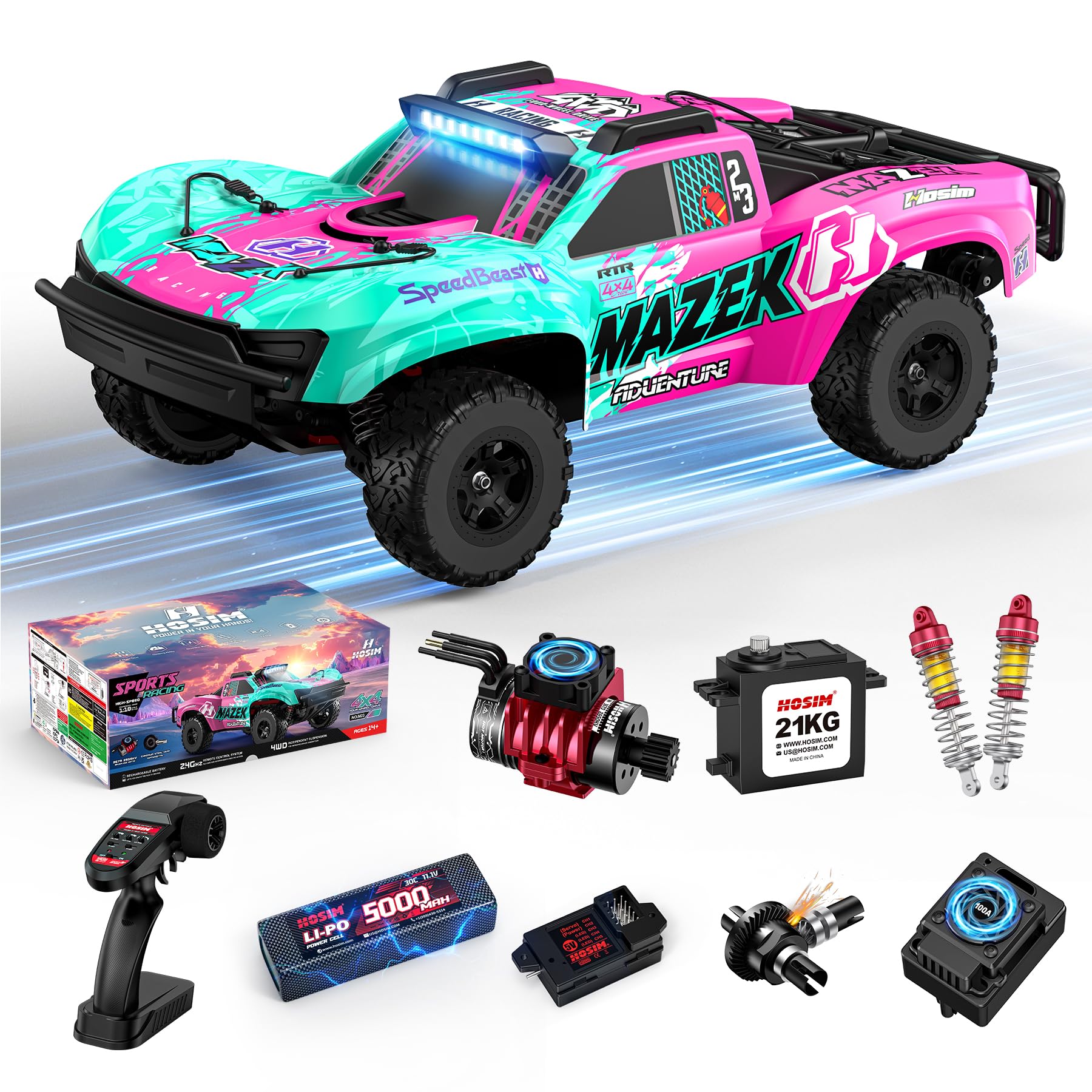
The Hosim MAZEK M23 is a 1/10 scale short course truck that punches well above its asking price with a 3670 2850Kv brushless motor and 100A ESC capable of 62+ mph on 3S and 100+ mph on 4S (battery sold separately). The drivetrain uses a chromium steel spiral differential and CNC‑milled metal links, and the upgraded nylon chassis absorbs abuse better than typical plastic tubs at this tier. The oil‑filled aluminum shocks allow camber and damping tweaks, so you can tune the truck for stability at 50+ mph.
A 5000mAh 11.1V 3S LiPo is included, delivering 25 minutes of run time at full speed. The 21kg metal‑gear steering servo provides responsive turns even on loose surfaces. The 2.4GHz radio system offers adjustable steering and throttle endpoints, a feature rarely found at this price. The MAZEK handles grass, gravel, and packed dirt with composure, though extreme jumps can bottom out the suspension on hard landings.
The ESC cooling fan is adequate but can struggle during sustained 4S speed runs in summer heat; adding an external fan is a common first mod. The stock tires are pre‑glued but the rubber compound is medium‑hard, offering good longevity at the expense of outright grip on wet surfaces. For a budget‑conscious buyer wanting genuine 60+ mph performance without sacrificing durability, the MAZEK M23 is the strongest value proposition in the 1/10 speed world.
What works
- 62 mph out of the box on 3S, 100+ mph potential on 4S
- Chromium steel spiral differential resists wear at high RPM
- Adjustable steering/throttle endpoints on included radio
What doesn’t
- ESC cooling fan struggles in sustained summer runs
- Stock tires lack wet‑surface bite
- Suspension bottoms harshly on big jumps
9. Hosim VEXARO MAX 1/8 Brushless RC Monster Truck
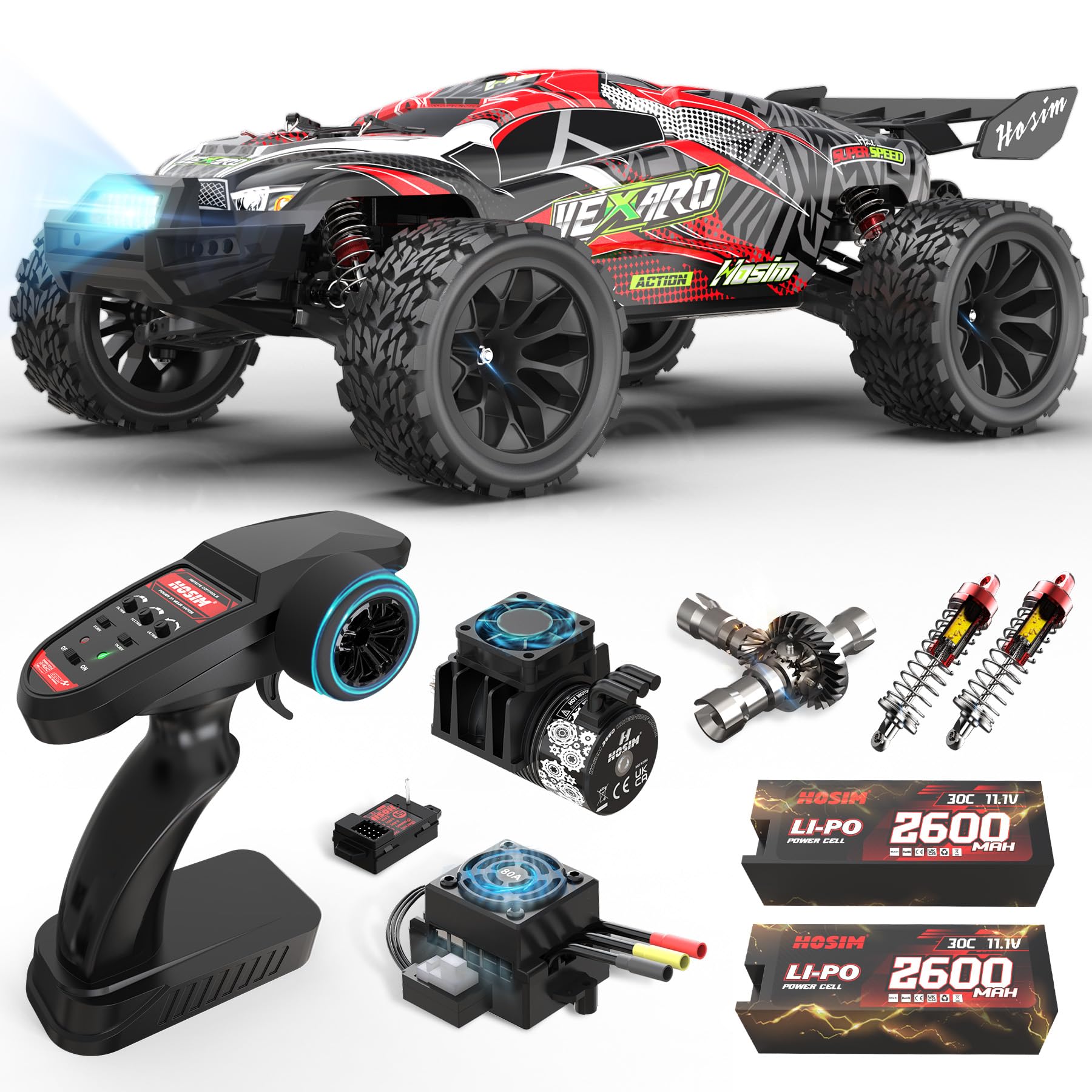
The Hosim VEXARO MAX is a 1/8 scale monster truck built around a 3660 3100Kv brushless motor and 80A ESC that deliver 50+ mph on 3S. The standout feature is three differentials—front, center, and rear—all upgraded to 40Cr chromium steel for wear resistance. The all‑metal chassis uses metal suspension arms and adjustable linkages, and the hydraulic oil‑filled shocks give the VEXARO a planted feel over uneven terrain that typical budget monster trucks lack.
Hosim includes two 3S 2600mAh LiPo batteries and a dual charger in the box, allowing up to 60 minutes of total run time if you swap packs. The 2.4GHz radio has a claimed 320‑foot range with a 9kg steering servo that provides adequate turn authority on loose surfaces. The foam‑filled tires mount on metal hex hubs, and the truck can clear obstacles up to 6 inches with a proper run‑up.
The 80A ESC is the bottleneck—it runs warm on 3S and is not designed for 4S operation, limiting upgradability. The included batteries are low‑C (30C continuous), which means voltage sag under hard acceleration. Upgrading to higher‑C 3S packs and a 120A ESC would unlock the VEXARO’s true potential but adds cost. For a package that includes everything needed to run and bash out of the box at a friendly price, the VEXARO MAX is a solid entry into the 1/8 monster truck segment.
What works
- Three 40Cr steel differentials for drivetrain longevity
- Two 3S batteries + charger included—instant run kit
- All‑metal suspension arms improve crash survival
What doesn’t
- 80A ESC is 3S only, limits upgrade path
- Included batteries low‑C rating causes voltage sag
- Steering servo torque marginal for aggressive terrain
10. RocHobby 1/6 1941 MB Scaler RC Crawler

The RocHobby 1941 MB Scaler is a 1/6 scale military replica of the classic Willys MB Jeep, built for scale crawling with a brushed 550 35T motor that prioritizes torque over speed. The four‑link suspension system with adjustable shock mounts lets you fine‑tune articulation for rocky trails, and the full‑time 4WD with limited‑slip diff ensures both axles stay motivated. The body is polycarbonate with pad‑printed military markings, a folding windshield, fuel tank, shovel, and ax—every removable detail rewards the scale enthusiast.
RocHobby designed the chassis to be compatible with standard 1/10 and 1/8 aftermarket parts, so upgrading to a brushless system or metal‑gear axles is straightforward. The 2.4GHz radio includes EPA (end‑point adjustment) and a digital neutral trim, giving you precise control over throttle and steering endpoints. The large battery compartment fits standard 2S LiPo packs, and the drivetrain is quiet and smooth at low speeds.
Battery and charger are not included, which is a notable omission at this price point. The 35T brushed motor is adequate for mild crawling but overheats quickly on steep inclines in high gear. The plastic steering links are the weakest structural point—swapping to aluminum links is a common reliability upgrade. For dedicated scale fans who appreciate historically accurate details and are willing to invest in electronics, the MB Scaler is a rewarding platform.
What works
- Museum‑quality military scale details with functional accessories
- Four‑link suspension adjustable for maximum articulation
- Compatible with standard 1/10 and 1/8 aftermarket parts
What doesn’t
- Battery and charger not included
- 35T brushed motor struggles on steep climbs
- Plastic steering links are a failure point
11. RIAARIO S10 1/10 Brushless Rally Car
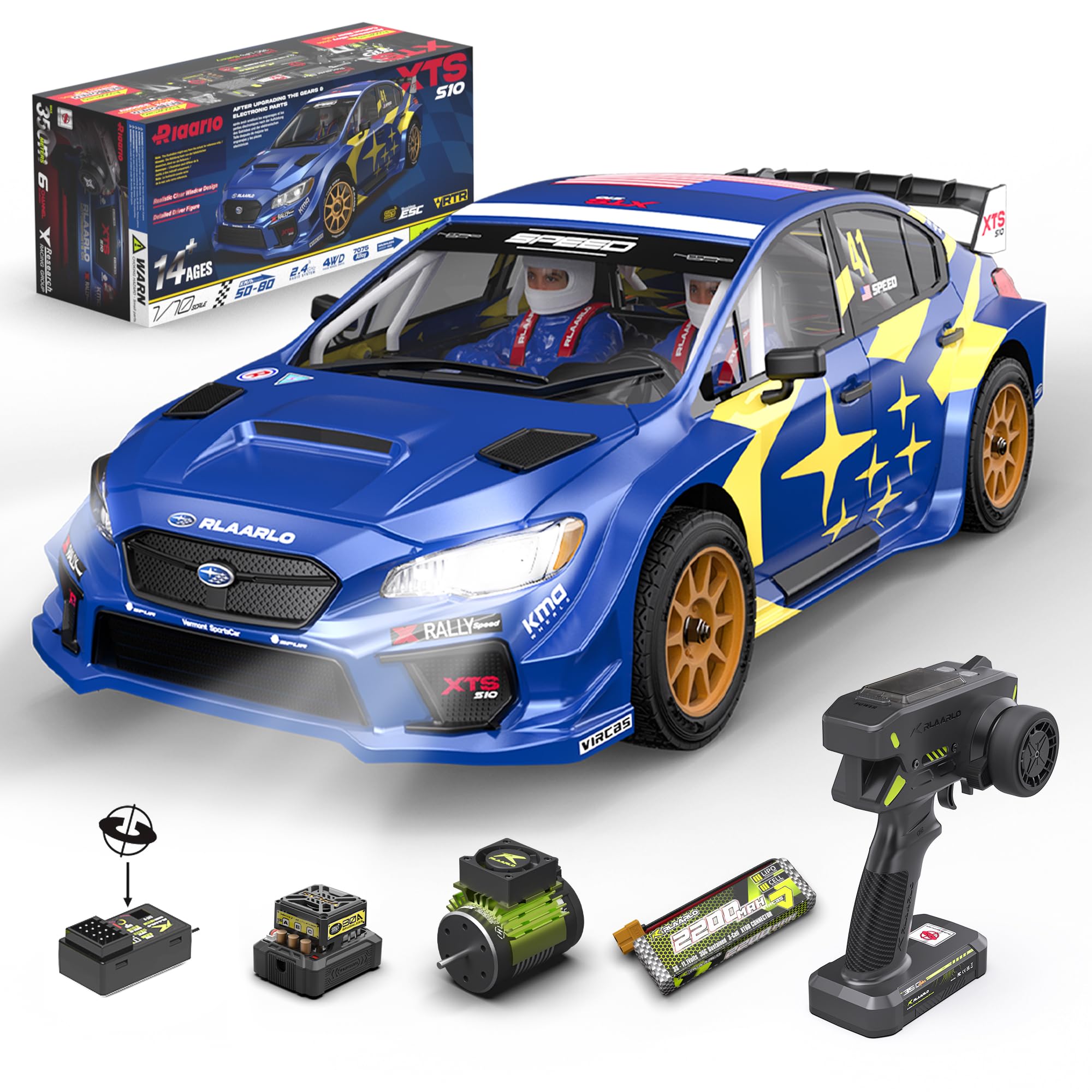
The RIAARIO S10 is a 1/10 scale rally car that packs a 3652‑3300KV brushless motor and 80A ESC into a compact package that tops 40+ mph on 3S. The chassis is a 2.5mm 6061 aluminum plate with 4mm 7075 aluminum shock towers and metal hydraulic shocks—a spec that outclasses many budget rally cars by a wide margin. The center differential uses a fully enclosed frame‑style bracket that creates a dual‑triangle reinforcement structure, significantly boosting chassis rigidity during cornering.
The all‑metal drivetrain uses hardened chrome steel motor and reduction gears, plus 1144 carbon steel CVD shafts. The 11kg steering servo is fast and keeps the car tracking through loose corners. RIAARIO includes a 3S 2200mAh LiPo battery and a 350‑meter range 2.4GHz radio system, so the S10 runs straight out of the box. The 1.2mm polycarbonate body is spray‑painted with a glossy finish that resists scratching on gravel stages.
Some owners have reported wiring issues with the integrated light system, and the stock body shell is not as impact‑resistant as thicker bodies on dedicated bashers. The 80A ESC is adequate for 3S but not 4S, capping upgrade potential. For beginners and intermediate drivers who want a nimble, 4WD rally car that drifts on dirt and corners on pavement without breaking the bank, the S10 is a strong entry point into the rally segment.
What works
- 2.5mm 6061 chassis with 7075 shock towers is rare at this price
- Center diff dual‑triangle bracket reduces chassis flex
- All metal drivetrain with hardened steel gears
What doesn’t
- Wiring quality for lights can be inconsistent
- 1.2mm polycarbonate body is vulnerable to crash splits
- 80A ESC limits future 4S upgrades
Hardware & Specs Guide
Chassis Material & Thickness
The chassis is the skeleton that decides whether a 25‑pound landing ends in a bent frame or a walk‑away. 6061 aluminum (2.0–2.5mm) is adequate for casual driving but fatigues quickly under repeated high‑speed impacts. Premium builds use 7075‑T6 aluminum (3mm+) which offers nearly double the yield strength, or carbon fiber plates for mass‑critical speed‑run cars. Heat‑treated 7075 resists permanent deformation better than any other option at this scale.
Motor KV Rating & Voltage
Motor KV multiplied by battery voltage gives you approximate unloaded RPM—higher KV means more top speed, lower KV means more torque. A 1200Kv motor on 8S spins at roughly 35,520 RPM, while a 2850Kv motor on 3S spins near 31,350 RPM. For 1/5 trucks over 20 pounds, low‑KV sensored motors (750–1200Kv) on 6S to 8S provide the torque needed to accelerate the mass without overheating. Speed‑run cars use higher KV (3300Kv+) on smaller chassis for raw RPM.
ESC Rating & Telemetry
The ESC’s continuous amp rating must exceed the motor’s maximum draw by at least 20% to prevent thermal shutdown. A 160A ESC paired with an 8S motor system is typical for 1/5 bashing, while 100–120A ESCs handle 1/10 and 1/8 chassis well. Spektrum Smart ESCs offer real‑time battery voltage, motor temperature, and current draw via telemetry—useful for tuning gear ratios without overheating the system mid‑session.
Differential Metallurgy & Fluid Weight
Differential gears in 1/5 and 1/8 cars face the highest torque loads in the drivetrain. Hardened steel (40Cr chromium‑molybdenum) ring and pinion gears resist wear far better than sintered metal or plastic options. The weight of silicone fluid in each diff changes handling: lighter fluid (10,000–30,000 cSt) allows the inside wheel to spin faster, improving cornering on high‑traction surfaces, while heavier fluid (100,000 cSt+) locks the diff for maximum traction on loose terrain.
FAQ
Do I need special batteries for a 1:5 scale RC car?
How fast do 1:5 scale RC cars actually go?
Can I run a 1:5 scale RC car on grass?
Are 1:5 scale RC cars waterproof?
What size servo do I need for a 1:5 RC car?
Final Thoughts: The Verdict
For most buyers, the 1:5 scale rc cars winner is the ARRMA Outcast 8S because its EXB 7075‑T6 chassis, 8S sensored power system, and Spektrum telemetry integration deliver unbeatable durability and performance for the scale. If you want old‑school scale realism with genuine licensed wheels and trailing‑arm suspension, grab the Losi Super Baja Rey 2.0. And for technical rock crawling where 25‑pound mass and 2‑speed transmission make boulders feel like pebbles, nothing beats the Axial SCX6 JLU Wrangler.

Certification: BSc in Mechanical Engineering
Education: Mechanical engineer
Lives In: 539 W Commerce St, Dallas, TX 75208, USA
Md Amir is an auto mechanic student and writer with over half a decade of experience in the automotive field. He has worked with top automotive brands such as Lexus, Quantum, and also owns two automotive blogs autocarneed.com and taxiwiz.com.