A fuel system that can’t maintain proper pressure turns any drive into a headache — rough idles, hard starts, hesitation under load, and that sinking feeling when the engine cuts out at the worst moment. Without the right diagnostic tool, you’re stuck swapping parts and hoping for the best.
I’m Amir — the founder and writer behind Four Wheel Ask. I’ve analyzed the build specs, adapter compatibility, and real owner feedback across dozens of fuel pressure tester kits to separate the tools that give you fast, repeatable readings from those that leak or strip out on the first use.
Whether you’re a professional mechanic or a weekend DIYer, choosing a reliable fuel pressure gauge tester means understanding hose ratings, adapter thread quality, and gauge accuracy — variables that directly determine whether your diagnosis takes ten minutes or leads to a costly misdiagnosis.
How To Choose The Best Fuel Pressure Gauge Tester
Selecting the right fuel pressure gauge tester goes beyond simply picking the cheapest option. You need a kit that matches your vehicle’s fuel system type, provides adapters for common test ports, and offers a gauge with a readable scale and sufficient accuracy for diagnosing pressure drops as small as a couple of PSI.
Gauge Range and Resolution
Most gasoline fuel systems operate between 30 and 85 PSI, but some returnless and direct-injection designs push higher. A 0–140 PSI gauge covers the vast majority of gasoline engines and provides clear resolution in the critical 0–100 PSI zone. Avoid gauges with a max range far above 140 PSI for gasoline work — the needle deflection becomes too small to read accurately at normal operating pressures.
Adapter Compatibility and Thread Quality
Your tester must include adapters for Schrader valves (1/4-inch SAE standard), M6, M8, M10, M12, and M14 test ports to cover most Asian, European, and domestic vehicles. Look for adapters machined from brass or aluminum — these materials resist thread galling and corrosion when exposed to gasoline. Steel adapters can seize in aluminum fuel rails over time, creating a nightmare removal situation.
Hose Working Pressure and Material
The hose assembly must handle at least 300 PSI working pressure to provide a safe margin above the gauge’s maximum reading. Nylon-reinforced rubber resin hoses offer superior resistance to gasoline permeation and heat compared to standard rubber hoses. A built-in pressure relief valve and a long discharge hose let you safely bleed system pressure without spraying fuel everywhere.
Quick Comparison
On smaller screens, swipe sideways to see the full table.
| Model | Category | Best For | Key Spec | Amazon |
|---|---|---|---|---|
| BETOOLL Pro | Premium | Ford vehicles and broad coverage | Includes 6.30mm, 7.89mm, 9.49mm Ford adapters | Amazon |
| ZJERYL GULL Pro | Premium | High gauge accuracy and 18 components | Dual scale 0-140 psi / 0-10 bar | Amazon |
| Orion Motor Tech | Mid-Range | Heavy-duty professional use | Dual movement gauge with shockproof casing | Amazon |
| JIFETOR TU-114 | Mid-Range | Comprehensive kit with aluminum tee | Aluminum tee for in-line splicing | Amazon |
| YSTOOL | Entry-Level | Beginner DIY and basic diagnostics | 3-1/2″ color-coded dial with rubber cover | Amazon |
| XiTuanYuan | Entry-Level | Budget-friendly universal coverage | 15″ Schrader hose + M6/M8/M10/M12/M14 adapters | Amazon |
| Lisle 20300 | Specialty | Vacuum and pressure fuel pump testing | 0-25 inHg vacuum + 0-14 PSI pressure | Amazon |
In‑Depth Reviews
1. BETOOLL Pro Fuel Injection Pressure Tester Kit

The BETOOLL Pro stands out because it includes three specialized Ford adapters — 6.30mm (SAE 1/4), 7.89mm (SAE 5/16), and 9.49mm (SAE 3/8) — that are often missing from universal kits. This makes it the most complete solution for owners of Ford, Lincoln, and Mercury vehicles who need to tap into the Schrader valve without jury-rigging connections. The double-scale gauge reads 0-140 PSI and 0-10 bar, providing the resolution needed to catch pressure variances down to a couple of PSI that indicate a failing pump or restricted filter.
All adapters and fittings are machined from corrosion-resistant materials, which matters when they’re threading into aluminum fuel rails that have been exposed to years of thermal cycling. The 17 x 13 x 4-inch blow-molded case keeps every component organized, and the three included hose sizes (6.30mm, 7.89mm, 9.49mm) match the most common Ford fuel line diameters. The gauge itself features a rubber boot for impact protection and a clearly marked dial with white numerals against a black background for quick reading in low-light engine bays.
For a premium kit, the build quality justifies the investment — the hoses feel thick and resistant to kinking, and the brass threads engage smoothly without cross-threading. The only limitation is the 0-140 PSI range, which excludes modern high-pressure direct-injection gasoline systems that operate well above 2,000 PSI, so verify your vehicle’s fuel rail pressure before purchasing. For standard port-injected and returnless systems, this kit provides the broadest vehicle coverage of any tester in this comparison.
What works
- Includes three Ford-specific adapters that are rarely found in universal kits
- Hoses match common Ford fuel line diameters for leak-free connections
- Sturdy blow-molded case keeps 17 components organized and protected
What doesn’t
- 0-140 PSI range is too low for high-pressure direct-injection gasoline systems
- Premium price point may exceed the budget of casual DIYers
2. ZJERYL GULL Pro Fuel Injection Pressure Tester Kit

The ZJERYL GULL Pro delivers an 18-piece set that covers nearly every connection scenario a professional mechanic encounters, including the 15-inch Schrader hose, the 8-inch M6 port hose, and the full range of M8 through M14 adapters. The measurement accuracy is explicitly stated as “High” in the specifications, and the analog gauge’s dual scale (0-140 PSI and 0-10 bar) provides clear tick marks every 2 PSI in the critical 0-60 PSI range where most port-injected systems operate.
The kit includes a quick-release valve button that allows single-handed operation — a practical feature when you’re holding a flashlight and trying to read the gauge simultaneously. The hoses use rubber nylon resin construction with a working pressure rating that comfortably exceeds the gauge’s maximum, providing a safety margin during testing. The gauge body is overmolded with a rubber protective layer that absorbs shock if the kit is dropped, and the clear plastic face resists fogging from fuel vapors.
At 3.48 kilograms, this is one of the heavier kits in its class, a consequence of the dense blow-molded case and the substantial number of brass fittings included. The weight signals quality — thinner components would weigh less but also wear out faster. The kit explicitly lists exclusion for Bosch, CIS Jetronic, and GM throttle body systems, so double-check your fuel injector type before purchasing. For shops that see a wide mix of Asian and European vehicles, the sheer component count makes this a strong daily driver.
What works
- 18-piece set provides the most comprehensive adapter selection in this comparison
- Quick-release valve enables one-handed pressure bleed and fuel recovery
- High measurement accuracy with clear 2 PSI tick marks on the gauge face
What doesn’t
- Heavy case at 3.48 kilograms can be cumbersome to carry between service bays
- Incompatible with Bosch, CIS Jetronic, and GM throttle body systems
3. Orion Motor Tech Fuel Pressure Test Kit
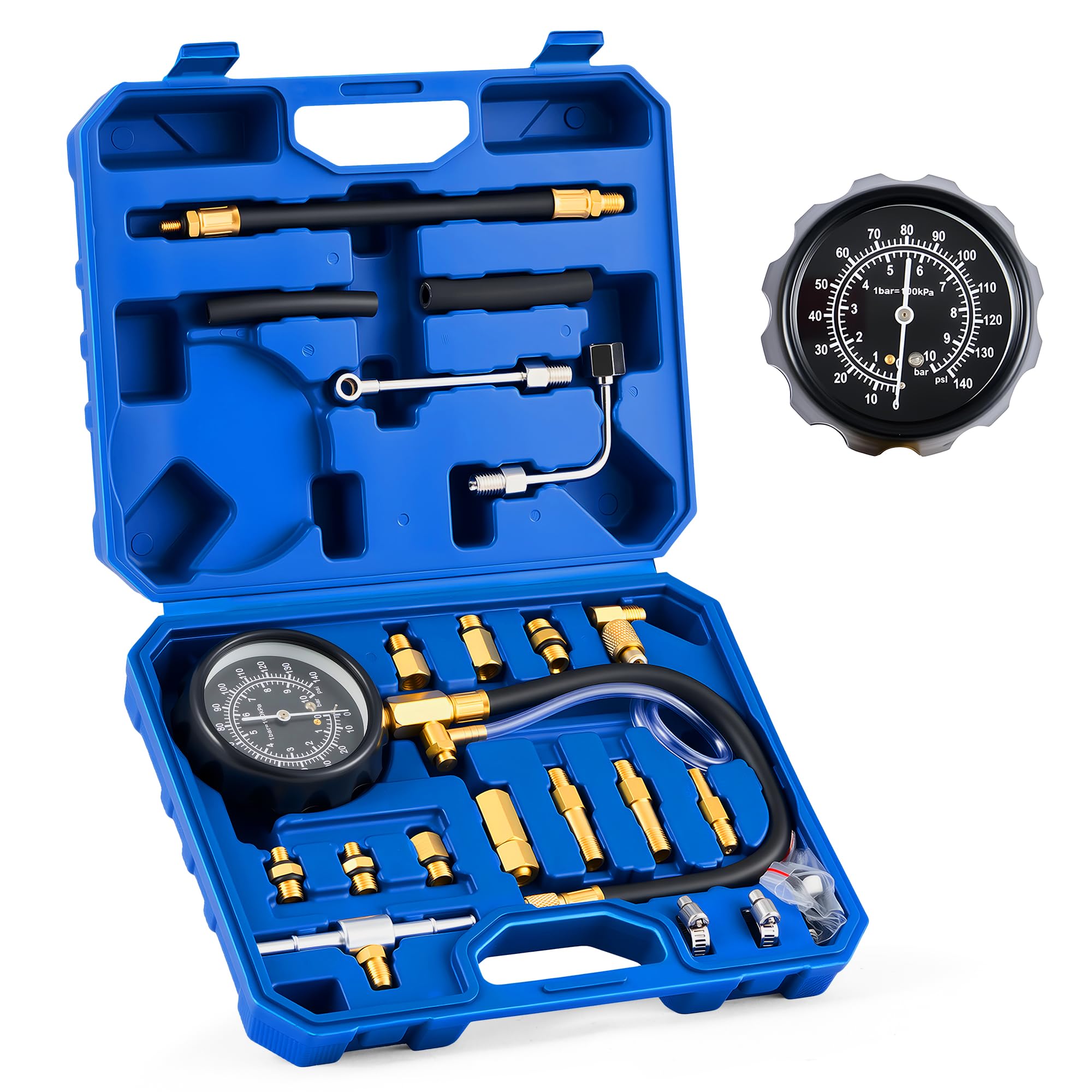
Orion Motor Tech built this kit around a dual-movement pressure gauge that provides double-calibrated readings and a shockproof rubber casing — a design that maintains accuracy even when the gauge is subjected to engine vibration during a running test. The 0-140 PSI dial is adjustable for calibration, letting you zero the needle before each diagnostic session. The kit includes 15 adapters, 3 hoses, 2 hose clamps, and a storage case, covering nearly every Schrader valve and M6 through M14 test port configuration found on Asian and domestic vehicles.
The reinforced rubber hoses are rated to 300 PSI working pressure, more than double the gauge’s maximum range, providing a genuine safety margin when testing systems that may spike temporarily during fuel pump priming. Push-in connectors and precision-threaded adapters install quickly without requiring a wrench on every fitting, which saves time in cramped engine compartments where finger access is limited. The brass and aluminum construction resists the corrosion that forms when adapters are left in contact with residual gasoline between uses.
Where this kit truly differentiates itself is in the connector quality — the threads engage smoothly without binding, and the O-rings seat properly to create a leak-free seal on the first try. The kit is listed as a universal fit for cars and trucks, and the included hose clamps add an extra layer of security when using the T-fitting to splice into the fuel line. The main drawback is that no Ford-specific adapters are included, so owners of late-model Ford vehicles may need to source those separately. For general shop use, this is the most thoughtfully engineered mid-range kit available.
What works
- Dual-movement adjustable gauge maintains accuracy under engine vibration
- 300 PSI-rated hoses provide a generous safety margin above gauge range
- Push-in connectors and precision threads install quickly without extra tools
What doesn’t
- No dedicated Ford adapters included in the standard kit
- Blow-molded case lacks designated cutouts for every adapter, causing some to rattle
4. JIFETOR TU-114 Fuel Pressure Gauge Kit

The JIFETOR TU-114 packs a 3-1/2-inch large dial gauge with a dual color-coded scale (red for critical pressure zones, green for normal operating range), making it easy to spot abnormal readings at a glance. The included aluminum T-fitting lets you splice the gauge inline between the fuel pump and the engine — a configuration that’s essential when your vehicle lacks a dedicated Schrader test port. The kit includes the standard 15-inch Schrader hose, an 8-inch M6 hose, and M8, M10, M12, and M14 adapters, covering the same range as kits costing significantly more.
The hoses use rubber nylon resin construction with increased stress resistance, and the built-in pressure relief valve works with a 16-inch fuel drain hose to release pressure safely into a gas can. The gauge’s rubber cover protects against drops, and the blow-molded case keeps every component sorted in dedicated cavities. The instructions clearly explain what low and high pressure readings typically indicate: low pressure often points to a clogged fuel filter, weak pump, or restricted line, while high pressure usually means a faulty regulator or a kinked return line.
Where the JIFETOR earns its value reputation is in the fit and finish of the brass adapters — they thread into the test ports smoothly without galling, and the O-rings maintain a seal without overtightening. The kit excludes Bosch, CIS Jetronic, and GM throttle body systems, but for the vast majority of modern Asian and domestic port-injected vehicles, this is a well-rounded and affordable package. The only real compromise is the absence of Ford-specific adapters, which limits its out-of-the-box utility for Ford owners.
What works
- Color-coded gauge scale instantly highlights abnormal pressure readings
- Aluminum T-fitting enables testing on vehicles without dedicated test ports
- Brass adapters thread smoothly with leak-free O-ring seals
What doesn’t
- No Ford-specific adapters included in the kit
- Incompatible with Bosch, CIS Jetronic, and GM throttle body systems
5. YSTOOL Fuel Pressure Tester Gauge Kit

The YSTOOL kit centers around a 3-1/2-inch color-coded dial gauge with a shockproof rubber cover that protects the movement during transport and use. The gauge reads 0-140 PSI and includes both a Schrader valve hose (15 inches) and an M6 port hose (8 inches), plus M8, M10, M12, and M14 adapters to cover most test port configurations. The kit supports two assembly forms — direct connection to the Schrader valve or inline measurement using the included T-type joint between the fuel pump and engine.
What separates the YSTOOL from bare-bones entry kits is the built-in translucent fuel discharge hose and pressure release valve, which allow you to safely bleed system pressure into a container without spraying gasoline across the engine bay. The connectors are made from brass and aluminum, providing good airtightness and corrosion resistance. The reinforced rubber resin nylon hoses are rated to 300 PSI working pressure and resist torsion and high temperature better than standard rubber hoses found on cheaper kits.
The kit explicitly notes it does not include a small Schrader connector to service some Ford models, and it’s incompatible with Bosch, CIS-Jetronic, and GM throttle body systems. The gauge’s color-coded scale makes it accessible for DIYers who aren’t yet comfortable interpreting PSI numbers alone — green indicates the normal operating zone, while red signals problem territory. For a first-time fuel system diagnostician, the YSTOOL provides the core functionality needed to identify low-pressure issues like a weak fuel pump or a clogged filter without overwhelming complexity.
What works
- Color-coded dial makes pressure interpretation intuitive for beginners
- Built-in pressure relief valve and translucent discharge hose enable clean fuel recovery
- Brass and aluminum connectors resist corrosion from fuel exposure
What doesn’t
- Missing small Schrader connector needed for some Ford models
- No adapter coverage for Bosch, CIS-Jetronic, or GM throttle body systems
6. XiTuanYuan Fuel Pressure Tester Gauge Kit

The XiTuanYuan kit is the lightest and most affordable option in this comparison at 2.83 pounds, reflecting a simplified component set that still covers the essentials. The 0-140 PSI gauge connects to Schrader valves through a 15-inch hose and to M6 test ports through an 8-inch hose, with M8, M10, M12, and M14 adapters completing the coverage for most Asian and domestic gasoline vehicles. The quick-release valve button allows single-handed operation for inflation and deflation of the fuel system during testing.
The kit’s universal design claims compatibility with cars, trucks, SUVs, motorcycles, ATVs, and RVs, but excludes Bosch, CIS Jetronic, and GM throttle body systems as well as diesel high-pressure injection pumps and direct-injection engines. The gauge face is clear and the markings are easy to read, though the overall build quality of the hoses feels less robust than the premium kits — the hose material is standard rubber rather than nylon-reinforced resin, which may degrade faster with repeated exposure to fuel.
For a DIYer who only needs to test a pressure reading once or twice a year on a single vehicle, the XiTuanYuan kit provides the necessary functionality at a budget-friendly entry point. The manufacturer offers a one-year replacement guarantee for defective fittings, which provides some peace of mind despite the lower initial investment. The downsides are the lack of a T-fitting for inline testing and the omission of any Ford-specific adapters, which means some vehicles will require additional parts to complete the connection.
What works
- Lightweight kit at 2.83 pounds is easy to carry and store
- Quick-release valve enables single-handed pressure control
- One-year replacement guarantee covers defective fittings
What doesn’t
- Standard rubber hoses lack the fuel resistance of nylon-reinforced alternatives
- No T-fitting for inline testing on vehicles without Schrader ports
7. Lisle 20300 Vacuum Gauge and Fuel Pump Tester

The Lisle 20300 occupies a unique niche — it’s not a full pressure test kit but rather a compact, purpose-built gauge that reads both vacuum (0-25 inches Hg and 0-800 mm Hg) and pressure (0-14 PSI and 0-1000 g/cm²). At only 0.35 pounds and measuring 10.1 x 2 x 4 inches, this is a tool you can toss in a backpack or glove compartment. The dual-range capability lets you test both the suction side of a mechanical fuel pump and the output side, making it particularly useful for diagnosing older carbureted engines and small engines on lawn equipment, generators, and motorcycles.
The gauge uses a standard NPT thread interface and comes in a simple skin-pack without a blow-molded case. The plastic body is lightweight but feels less durable than the all-metal construction of dedicated fuel pressure testers. The pressure range maxes out at 14 PSI, which means it cannot test modern fuel-injected systems — those typically operate at 30 PSI or higher. However, for vintage vehicle restorers and small-engine mechanics, the combination of vacuum and low-pressure measurement in a single lightweight tool is genuinely useful.
The Lisle 20300 is best understood as a complement to a full fuel pressure tester kit rather than a replacement. If you work exclusively on modern fuel-injected cars, this tool will be of limited use. But if you maintain a mix of older engines, small engines, and fuel-injected vehicles, having both a high-pressure tester and the Lisle vacuum/pressure gauge gives you complete diagnostic coverage for both the delivery and suction sides of any fuel system.
What works
- Dual vacuum and pressure measurement in a single compact gauge
- Extremely lightweight at 0.35 pounds for easy portability
- Ideal for diagnosing carbureted engines and small-engine fuel pumps
What doesn’t
- 14 PSI max pressure cannot test modern fuel-injected systems
- Plastic body and skin-pack packaging feel less robust than dedicated test kits
Hardware & Specs Guide
Gauge Movement Type
The dual-movement gauge design found in the Orion Motor Tech kit uses two independent bourdon tubes to average out pressure reading errors caused by vibration and temperature changes. Entry-level gauges typically use a single bourdon tube movement, which can drift over time and with thermal cycling. For professional use where consistent readings matter, a dual-movement or adjustable gauge provides greater long-term accuracy.
Hose Working Pressure and Material
Nylon-reinforced rubber resin hoses (rated at 300 PSI in premium kits) resist fuel permeation and high-temperature degradation much better than standard rubber hoses. The working pressure rating should always exceed the gauge’s maximum scale to provide a safety margin. Kits that list a hose working pressure of 300 PSI with a 140 PSI gauge maintain a plus-100% safety factor, which is the industry standard for professional diagnostic tools.
FAQ
Why does my fuel pressure gauge kit exclude Bosch, CIS Jetronic, and GM throttle body systems?
How do I interpret a fuel pressure reading that’s lower than the manufacturer specification?
Can I use a 0-140 PSI fuel pressure tester on a modern direct-injection gasoline engine?
Final Thoughts: The Verdict
For most buyers, the fuel pressure gauge tester winner is the BETOOLL Pro because it includes the Ford-specific adapters that universal kits lack, making it the most complete solution for diagnosing fuel pressure issues across a broad range of vehicles right out of the box. If you want a heavy-duty kit with a dual-movement adjustable gauge for professional shop use, grab the Orion Motor Tech. And for a budget-friendly entry point that still covers the essential test ports, nothing beats the XiTuanYuan.

Certification: BSc in Mechanical Engineering
Education: Mechanical engineer
Lives In: 539 W Commerce St, Dallas, TX 75208, USA
Md Amir is an auto mechanic student and writer with over half a decade of experience in the automotive field. He has worked with top automotive brands such as Lexus, Quantum, and also owns two automotive blogs autocarneed.com and taxiwiz.com.