Over-tightening a single bolt on your carbon handlebars or suspension linkage can ruin a component in an instant. Bike torque wrenches eliminate the guesswork, delivering precise clamping force measured in Newton-meters to protect expensive frames, stems, and seatposts from stress fractures or slippage. A proper wrench is not a luxury; it is the single most important tool for any serious road or mountain bike mechanic.
I’m Amir — the founder and writer behind Four Wheel Ask. I have spent years analyzing fastener specifications, evaluating measurement accuracy across hundreds of samples, and studying real owner reports to separate tools that hold calibration from those that drift within weeks.
Whether you are building a new build or performing routine maintenance, knowing exactly how much force each bolt sees keeps your bike safe and your ride quiet. In this guide, I have broken down the strengths and trade-offs of five top-rated models to help you find the best bike torque wrench for your specific workshop needs.
How To Choose The Best Bike Torque Wrench
Bicycle fasteners are small, often made from aluminum or titanium, and require very low torque values compared to automotive bolts. A proper wrench must operate smoothly in the 2-to-25 Nm range and provide a clear indication when the target is hit. Understanding a few key specs will steer you toward the right tool for your workbench or trail-side kit.
Click Action and Low-Torque Sensitivity
Click-type wrenches produce an audible and tactile snap when the preset torque is reached. At very low settings — below 5 Nm — the click can be subtle, so look for models that use a finely calibrated spring mechanism. Many budget-friendly click wrenches feel vague under 3 Nm; premium or mid-range units maintain a crisp signal even at the low end of their range.
Drive Size and Bit Compatibility
A 1/4-inch drive is the standard for bicycle work because it accepts the small hex, Torx, and Phillips bits common on modern road and mountain bikes. A 3/8-inch drive or larger is generally overkill for handlebar, stem, and seatpost bolts, though it may be handy for cassette lockrings or bottom bracket cups. Check whether the wrench includes a full set of bits or if you need to supply your own.
Calibration and Accuracy Rating
Accuracy is usually stated as a percentage of the wrench’s full-scale reading. A ±4% tolerance is adequate for most home mechanics, while ±2% or ±1% is preferred for precision work on carbon frames or sensitive suspension components. Digital wrenches often claim tighter accuracy than beam or click types, but they require batteries and are more vulnerable to drops.
Quick Comparison
On smaller screens, swipe sideways to see the full table.
| Model | Category | Best For | Key Spec | Amazon |
|---|---|---|---|---|
| SUERCUP Digital Torque Wrench | Digital | Precision work & data logging | ±1% accuracy / 0.45–30 Nm | Amazon |
| Matework 50-Piece Torque Wrench Set | Kit | Complete workshop coverage | ±3% accuracy / 1.1–26 Nm | Amazon |
| LEXIVON Inch Pound Torque Wrench | Click | Bare-bones reliability | ±4% accuracy / 2.26–22.6 Nm | Amazon |
| MARQUE Adjustable Bike Torque Wrench | Preset | On-bike carry & simple use | Fixed settings at 4, 5, 6 Nm | Amazon |
| ARUCMIN 1/2-Inch Click Torque Wrench | High-Torque | Cassette & high-torque bolts | ±3% accuracy / 13.6–203.3 Nm | Amazon |
In‑Depth Reviews
1. SUERCUP 1/4-inch Digital Torque Wrench
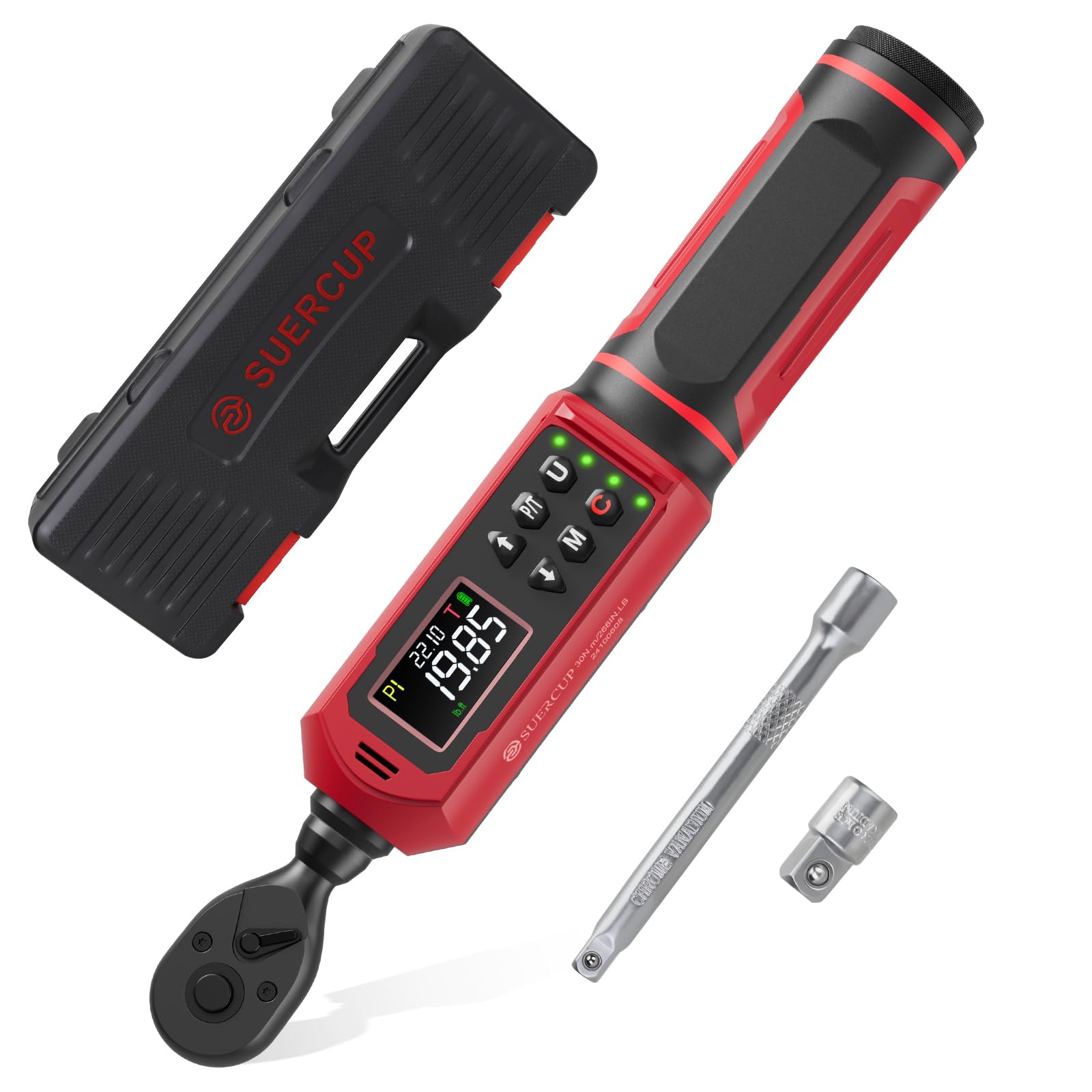
The SUERCUP digital wrench brings ±1% accuracy — double the precision of typical click-type tools — across a 0.45-to-30 Nm range that covers almost every fastener on a modern bicycle. The large color display shows torque in real-time with a backlight for low-light shop conditions, and the handle vibrates, beeps, and flashes an LED when the target is reached. That triple alert system eliminates any doubt, especially valuable when working on carbon components where overtightening by a single Newton-meter can cause cracks.
Beyond basic use, the SUERCUP stores up to 500 torque readings in Peak Mode, letting you log each bolt’s final value for quality control or simply to double-check your work later. It comes with a 100mm extension bar and a 1/4-to-3/8 adapter, so it can handle a wider range of tasks than its compact size suggests. The quick-release ratchet head makes swapping sockets effortless, saving time during multi-bolt jobs like stem swaps or derailleur adjustments.
The trade-off is reliance on three AAA batteries; if the battery dies mid-job, the wrench becomes a decoration. The construction feels solid, though digital internals are inherently less tolerant of hard drops compared to a mechanical click tool. For mechanics who want logged precision and a clear visual readout, this is the most capable option in the group.
What works
- Industry-leading ±1% accuracy across a wide bicycle-friendly torque range
- Triple alert (vibration, beep, LED) prevents accidental overtightening
- Stores up to 500 peak torque values for record-keeping
What doesn’t
- Requires batteries and is less durable than a fully mechanical wrench
- Digital display can be hard to read in direct sunlight despite backlight
2. Matework 50-Piece Bike Torque Wrench Set
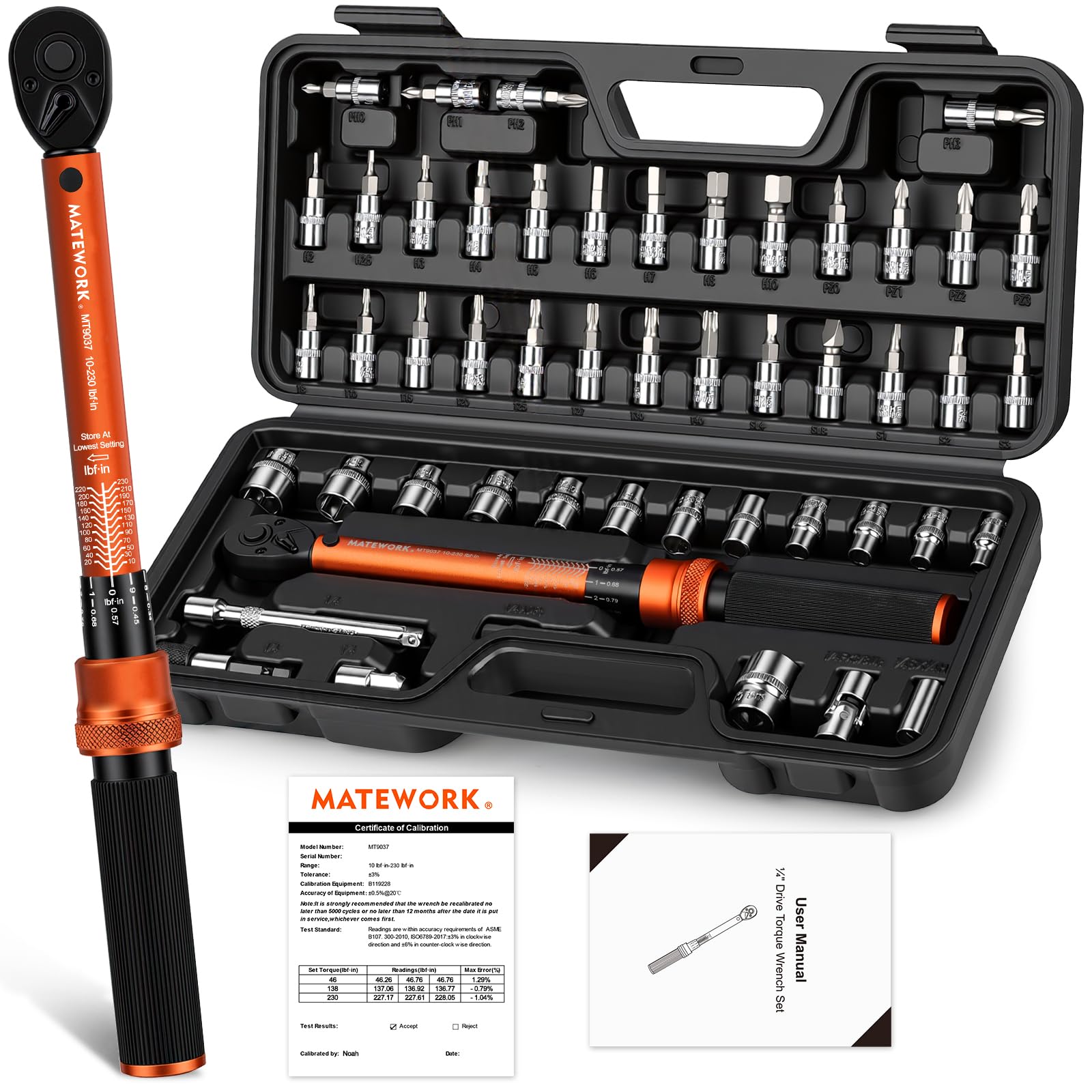
This kit combines a 1/4-inch drive click wrench rated at ±3% accuracy with a comprehensive 50-piece assortment of bits, sockets, and adapters — everything you need to service a full bike without buying extra tools. The wrench covers 1.1 to 26 Nm, which spans handlebar clamps, seatpost bolts, brake calipers, and derailleur hangers. The dual-range scale reads in both in-lb and Nm, and each increment is marked in 0.1 Nm steps for truly fine adjustments.
The 72-tooth reversible ratchet head delivers a tight 5-degree swing arc, making it easy to work in cramped spaces like the back of a stem or inside a frame’s cable routing port. The selection of bit sockets includes Hex from H2 to H10, Torx T8 to T40, Phillips, Pozi, Robertson, and standard 6-point sockets, plus several adapters and a 4-inch extension bar. The molded plastic case keeps everything organized and makes it easy to grab for a shop session or a race-day toolbox.
At low settings under 5 Nm the audible click is noticeably subtle, so you need to pay close attention — this is common among click-type wrenches in this price tier. The included storage case, while functional, is not impact-resistant. Overall, this set delivers unmatched versatility for the home mechanic who wants a single solution rather than piecing together bits and a separate wrench.
What works
- Comprehensive 50-piece kit covers nearly every bicycle fastener type and size
- 0.1 Nm micro-adjustments allow precise settings for delicate carbon parts
- 72-tooth ratchet with 5-degree arc works well in confined spaces
What doesn’t
- Click feel is weak below 5 Nm, requiring careful attention at low torque
- Storage case is basic plastic without reinforcement for workshop abuse
3. LEXIVON Inch Pound Torque Wrench LX-181

The LEXIVON LX-181 is a straightforward 1/4-inch drive click wrench with a dual-scale range of 20-200 in-lb (2.26-22.6 Nm), covering the sweet spot for stem bolts, handlebar clamps, and seatpost collars. It comes with a pre-calibration certificate traced to a serial number, so you know exactly what accuracy (±4%) you are working with out of the box. The reinforced ratchet gear is made from heat-treated chrome vanadium steel, giving it a toughness that many plastic-handled budget wrenches lack.
The patent-pending dual-range scale uses high-contrast yellow markings on a black gloss background, which remain readable in low garage light without squinting. The reversible ratchet head operates in both directions, though torque measurement only registers in the clockwise direction — standard for this class of tool. The non-slip knurled handle provides a secure grip even with oily or gloved hands, and the 10.75-inch length gives enough leverage without being cumbersome for bike-sized bolts.
Owners note that the click is clear and positive even toward the lower end around 20 in-lb, which is where many cheaper wrenches go vague. The trade-off is the lack of a full bit set — you need to supply your own sockets or hex bits. For a mechanic who already owns a set of 1/4-inch drive bits and wants a no-nonsense click wrench that holds calibration, this is a rock-solid choice.
What works
- Clear, positive click action at low torque values down to 20 in-lb
- Heat-treated chrome vanadium steel construction for long-term durability
- Includes individual calibration certificate with traceable serial number
What doesn’t
- No bit or socket set included — requires separate purchase of drive accessories
- ±4% accuracy is adequate but less precise than digital or higher-end click tools
4. MARQUE Adjustable Bike Torque Wrench

The MARQUE wrench strips away complexity with a fixed dial offering three preset torque values — 4, 5, and 6 Nm — which happen to cover the vast majority of handlebar, stem, seatpost, and derailleur bolts on modern road and mountain bikes. Instead of an adjustable handle, you rotate the tip to one of the three detents, and the tool clicks out at that exact value. This design practically eliminates the possibility of setting the wrong torque and damaging a part.
The tool itself is small enough to slide into a jersey pocket or saddle bag, making it an excellent choice for on-the-road adjustments or trailside repairs. It comes with four permanently attached bit ends: 3, 4, and 5 mm hex, plus a T25 Torx. Each tool is individually tested and recorded with a serial number, giving you a clear paper trail for quality assurance. The ergonomic handle uses durable steel internals to withstand the bumps of being tossed into a pack.
The obvious limitation is that you cannot use it for anything outside the 4-6 Nm window — brake rotor bolts, bottom bracket cups, and cassette lockrings are off the table. For those tasks you will need a separate, wider-range wrench. For the home mechanic who only works on standard bolt groups and wants dead-simple operation without scrolling through scales, the MARQUE is a purpose-built gem.
What works
- Simplest possible operation — turn the dial to one of three pre-set torque values
- Ultra-compact and light enough for trail-side or jersey pocket carry
- Includes the four most common bicycle bit sizes (3, 4, 5 hex + T25)
What doesn’t
- Limited to 4, 5, and 6 Nm — no coverage for higher-torque or sub-4 Nm bolts
- Fixed bits cannot be swapped for other sizes; not usable outside its preset range
5. ARUCMIN 1/2-Inch Drive Click Torque Wrench

The ARUCMIN wrench operates in a totally different torque league — 13.6 to 203.3 Nm — which is far above what most bicycle fasteners require but perfect for drivetrain components like cassette lockrings, bottom bracket cups, and crank arm bolts. The 1/2-inch drive head is built for high leverage and uses a 72-tooth ratchet mechanism with ±3% accuracy and an included calibration certificate. The head is made from hardened chromium-molybdenum alloy, chosen for its ability to withstand repetitive high-torque cycles without slipping.
The handle is aluminum-titanium alloy, which keeps the 17.2-inch tool surprisingly light for its torque capacity, and the dual-range laser-etched scale is easy to read without fear of wearing off. The auto-lock knob holds your setting securely once you release it, so you do not accidentally bump the adjustment during use. It includes two sockets (3/4 and 13/16 inch) and a 5-inch extension bar, making it ready out of the box for automotive or motorcycle applications alongside bike work.
For standard bicycle use — 4-8 Nm stem bolts, 5-6 Nm seatpost clamps — this wrench is completely inappropriate because its minimum torque of 13.6 Nm is already too high. You can easily overtighten sensitive aluminum or carbon parts. This tool belongs in a shop that also services e-bike crank bolts, motorcycle chassis fasteners, or automotive components. It earns its place here only as the heavy-duty specialist for specific high-torque bike tasks.
What works
- Massive torque range suitable for cassette lockrings, bottom brackets, and crank bolts
- Durable chromium-molybdenum head and aluminum-titanium handle resist corrosion
- Includes two sockets and an extension bar for immediate use
What doesn’t
- Minimum torque of 13.6 Nm is too high for most standard bicycle fasteners
- Large 1/2-inch drive and 17-inch length are overkill for delicate stem and handlebar work
Hardware & Specs Guide
Torque Range for Bicycle Fasteners
Most bicycle bolts fall between 2 Nm (small derailleur clamp bolts) and 15 Nm (cassette lockrings). Handlebar stems, seatpost collars, and brake calipers typically sit in the 4-8 Nm range. A dedicated bike torque wrench should offer a low end no higher than 2 Nm and a high end of at least 20 Nm to cover the vast majority of components. A wrench that starts at 13.6 Nm cannot safely torque the small bolts on carbon handlebars or stems.
Click vs Digital vs Preset Mechanisms
Click-type wrenches use a spring-loaded cam that releases with an audible snap at the preset value. They are mechanical, battery-free, and reliable but can feel subtle at very low torque settings. Digital wrenches add visual readouts, data storage, and multi-unit switching but depend on batteries and are more fragile. Preset wrenches lock you into specific torque values — great for simplicity, but limiting if your bike uses non-standard bolt groups. Choose based on how many different torque values you need to hit regularly.
FAQ
Can I use an automotive torque wrench on my bicycle?
What torque setting should I use for carbon handlebars?
How often should I calibrate my bike torque wrench?
Final Thoughts: The Verdict
For most buyers, the bike torque wrench winner is the SUERCUP digital torque wrench because its ±1% accuracy, triple-alert system, and data logging eliminate all guesswork across the full bicycle torque range. If you want a complete one-stop kit with bits and sockets included, grab the Matework 50-piece set. And for trail-side simplicity where weight and size matter most, nothing beats the MARQUE preset tool that covers the 4-6 Nm sweet spot with zero setup.

Certification: BSc in Mechanical Engineering
Education: Mechanical engineer
Lives In: 539 W Commerce St, Dallas, TX 75208, USA
Md Amir is an auto mechanic student and writer with over half a decade of experience in the automotive field. He has worked with top automotive brands such as Lexus, Quantum, and also owns two automotive blogs autocarneed.com and taxiwiz.com.