Measuring and transferring engine oil cleanly is one of those garage tasks that separates a smooth job from a sticky mess. The right container eliminates guesswork, prevents drips, and protects your engine from overfills or contamination — but the market is crowded with flimsy jugs, poorly marked pitchers, and spouts that dribble. Finding a unit that seals properly, pours predictably, and survives repeated use in a real workshop takes more than a quick glance at the shelf.
I’m Amir — the founder and writer behind Four Wheel Ask. I spend my time dissecting automotive fluid-handling products, comparing material grades, seal designs, and measurement accuracy across hundreds of owner reports to separate durable tools from disposable plastic.
Whether you need a measuring container for oil changes or a drum pump for bulk transfer, these models define the best engine oil dispenser standard.
How To Choose The Best Engine Oil Dispenser
Selecting the right oil dispenser depends on the volume of fluid you move, the space you work in, and how picky you are about accuracy. A unit that excels for a DIY oil change may frustrate a tech handling multiple vehicles with different sump capacities. Focus on three core factors before you buy.
Capacity and Measurement Accuracy
Match the dispenser volume to your largest typical oil change. A 5- to 6-quart container handles most passenger cars, while trucks and SUVs with 8-quart sumps demand larger vessels. Look for molded graduations rather than printed labels — raised markings survive solvent exposure and never wear off. Check owner reports for accuracy complaints; some containers have markings that drift by a quarter-inch or more, throwing off critical measurements for engines without dipsticks.
Spout Design and Pour Control
The spout is the interface between the container and your engine. Flexible corrugated spouts reach around obstructions in tight engine bays, while rigid or swivel spouts offer better control for straight-shot fill ports. A threaded cap on the spout keeps dust and debris out during storage — an overlooked feature that prevents contamination on the next use. For bulk operations, a lever-action pump eliminates tipping and provides metered flow directly into the fill hole.
Material Composition and Chemical Resistance
High-density polyethylene (HDPE) is the standard for oil dispensers because it resists cracking, holds up to petroleum-based fluids, and remains translucent enough to see fluid levels. Polypropylene (PP) offers similar chemical resistance with slightly better impact strength. Avoid containers made from recycled or thin-gauge plastics — they may degrade with prolonged exposure to hot oil or develop stress cracks around the handle and spout threads after repeated thermal cycling.
Quick Comparison
On smaller screens, swipe sideways to see the full table.
| Model | Category | Best For | Key Spec | Amazon |
|---|---|---|---|---|
| Groz 41882 | Measuring Container | Precise Oil Changes | 8-Quart Capacity | Amazon |
| WirthCo 94046 | Measuring Container | Swivel Spout Use | 4.5-Quart Capacity | Amazon |
| Steelman 99472 | Dispensing Jug | Mess-Free Pouring | 6-Quart Capacity | Amazon |
| WirthCo 94367 | Measuring Container | Accurate Fluid Tracking | 5-Liter Capacity | Amazon |
| K Tool 73993 | Bucket Pump | Bulk Fluid Transfer | 2.14 oz per Stroke | Amazon |
In-Depth Reviews
1. Groz 8-Quart Oil Measuring Container with Flexible Spout (41882)
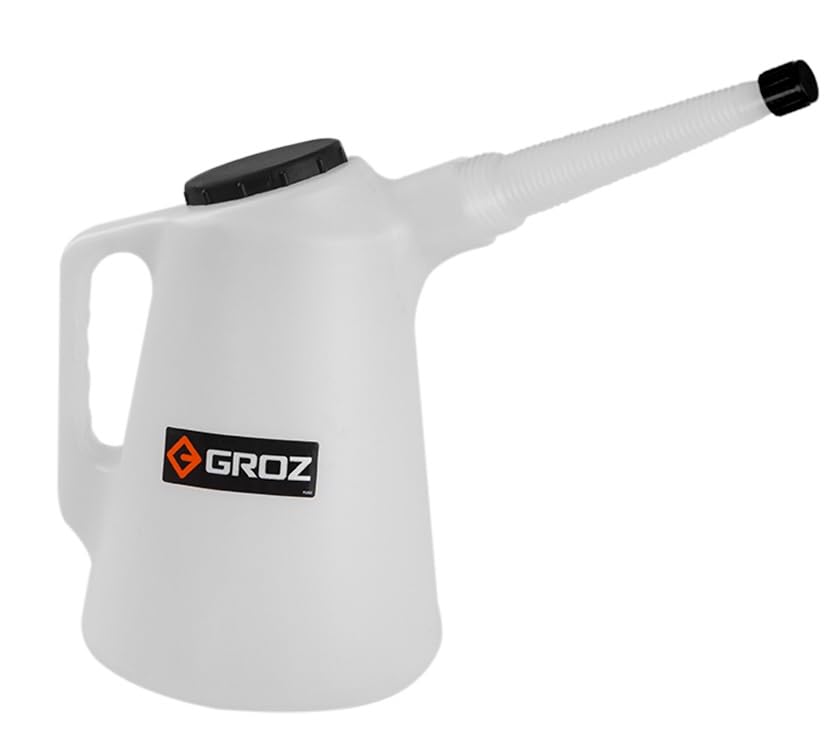
This Groz container strikes the ideal balance between capacity, build quality, and thoughtful engineering. The 8-quart volume handles full oil changes on trucks and large SUVs without requiring a refill mid-job, while the translucent HDPE body lets you monitor fluid level throughout the pour. The heavy-duty corrugated spout bends into tight engine compartments and maintains its shape during flow — a critical detail when you are aiming at a recessed fill port on a modern transverse-mounted engine.
Owner feedback consistently highlights the leak-proof threaded design and the dual-cap system that seals both the spout and the main opening. A secure screw-on cap with a lock ring prevents the spout from loosening during storage, and the separate lid keeps contaminants out between uses. The raised graduations in quarts and liters provide reliable reference points, though a handful of users note minor variation at fractional marks and recommend verifying with water on the first fill for precision-critical applications.
The ergonomic handle and relatively lightweight 1.1-pound construction make one-handed pouring manageable even when the container is full. Across the review pool, this unit outperforms pricier alternatives in sealing reliability and overall user satisfaction. It stands as the most well-rounded option for anyone who values accuracy, spill prevention, and long-term durability in a single package.
What works
- Flexible corrugated spout reaches past engine bay obstructions
- Threaded cap and lock ring maintain a secure, leak-proof seal
- 8-quart capacity covers full oil changes for most trucks and SUVs
- Lightweight HDPE body with clear graduations in quarts and liters
What doesn’t
- Some units require minor calibration for sub-quart markings
- Spout can be stiff to install initially before loosening
2. WirthCo Funnel King Heavy Duty Graduated Measuring Container (94046)

WirthCo brings decades of fluid-handling experience to this 4.5-quart container, and the engineering pedigree shows. The standout feature is the 360-degree swivel spout, which rotates to pour from any orientation — a genuine advantage when working around strut towers, intake tubing, or other underhood clutter. Molded raised-letter graduations in U.S., metric, and imperial units remain legible after years of exposure to hot oil, coolant, and shop solvents, unlike decals that peel or fade.
Customer reports emphasize the sturdy feel of the thick-wall polyethylene construction. Owners describe it as a “very sturdy pitcher” that resists deformation under load and shows no signs of cracking after repeated thermal cycles. The translucent body provides clear visual confirmation of fluid levels, and the integrated pour spout directs flow without the need for a separate funnel in most applications. Several users specifically cite its value for measuring oil changes on vehicles that require precise quantities, such as jet skis and outboard motors.
One area where feedback divides is the marking scheme. The container includes only whole-quart graduations, which disappointed a segment of buyers who expected half-quart or quarter-quart reference lines for fine measurement. At this capacity, the unit best suits users working in full-quart increments or those comfortable adding their own fractional marks. For its build quality, material thickness, and swivel-spout versatility, this container justifies a slight premium over basic alternatives.
What works
- 360-degree swivel spout allows flexible pour orientation
- Thick-wall HDPE construction withstands heat and chemical exposure
- Raised molded graduations never fade or peel
- Larger capacity than standard quart pitchers for multi-quart fills
What doesn’t
- Only whole-quart markings — no half or quarter graduations
- Premium build comes at a higher cost than entry-level jugs
3. Steelman 6-Quart Oil Measuring and Dispensing Jug (99472)

Steelman designs this 6-quart jug around convenience and visibility. The translucent polyethylene body provides a clear window into fluid levels, while the large hinged lid snaps open for easy filling from bulk containers and closes securely to keep shop dust out between uses. The 9.5-inch flexible spout extends deep into fill ports and bends around mild obstructions, making it a strong fit for DIYers working on everything from lawn equipment to passenger cars.
Reviewers consistently praise the clear, easy-to-read side markings that include both liter and quart graduations. The 6-quart capacity hits a sweet spot — large enough for a single oil change on most vehicles without being unwieldy. Owners have repurposed the jug for coolant, windshield washer fluid, and even household tasks like filling humidifiers, citing the spout design as a major reason for the versatility. The lightweight 10-ounce construction minimizes fatigue during extended use.
The most common criticism is the absence of a dust cap for the nozzle. Without a seal, the spout interior is exposed to airborne particles during storage, which can contaminate fluid on the next pour. Several users have improvised rubber caps or suggest adding a dedicated seal for cleanliness. A second point raised by a few owners is the desire for a fine mesh screen in the spout to filter debris from bulk containers. For the price and ease of use, this jug delivers strong daily performance with minor concessions on storage hygiene.
What works
- Hinged snap-lid makes filling quick and seals out debris
- 9.5-inch flexible spout reaches into tight fill ports
- Clear translucent body with dual liter and quart markings
- Lightweight and easy to maneuver even when full
What doesn’t
- No dust cap on nozzle leaves spout open to contamination
- Lid seal could be more positive for complete leak prevention
4. WirthCo Funnel King 5 Liter Measuring Container (94367)

This 5-liter / 5-quart container from WirthCo’s Funnel King line offers a compelling blend of measurement visibility and no-nonsense construction at a budget-conscious price point. The translucent heavy-duty polyethylene body gives you continuous visual confirmation of fluid levels, while the raised quart and liter graduations are bold enough to read in dim garage lighting without squinting. The extended screw-on flexible spout includes a cap that keeps debris out during storage — a feature often missing from jugs at this level.
User reviews consistently highlight the accurate markings and spill-free pouring performance. Owners specifically note the spout drains quickly and cleanly, reducing drip-back that can create puddles around the fill neck. The 5-liter capacity maps neatly to common oil change volumes for smaller cars, motorcycles, lawn mowers, and powersports equipment. Several verified buyers used it for transmission fluid drain-and-fill procedures and praised the clearly defined volume marks that eliminate guesswork when refilling by extracted volume.
One trade-off is the slightly smaller capacity compared to 6- or 8-quart options, which means multiple fills for larger vehicles or equipment with 10-plus-quart sumps. The container also lacks a pour spout on the main opening — you rely entirely on the flexible screw-on spout, which works well for directed pouring but adds an extra step during filling. For the value-oriented buyer who needs accurate measurement and solid build quality for standard oil changes and fluid transfers, this container punches above its weight class.
What works
- Accurate raised graduations in quarts and liters with high visibility
- Screw-on spout cap keeps the nozzle clean during storage
- Heavy-duty polyethylene resists cracking and chemical degradation
- Spout pours cleanly with minimal drip-back
What doesn’t
- 5-liter capacity requires multiple fills for larger engines
- No integrated pour spout on the main opening for filling convenience
5. K Tool International Lever Action Bucket Pump with 4-Foot Hose (73993)

When the job requires moving oil from a 5-gallon bulk drum into a fill port, a lever-action bucket pump changes the game. K Tool International delivers a purpose-built unit designed specifically for heavier fluids — transmission fluid, differential oil, hydraulic fluid, and gear lube — that would be impractical to pour from a bucket. The steel-bodied pump mounts directly onto a standard 5-gallon pail, and the 12-inch drum cover creates a stable platform that keeps the mechanism aligned during repeated strokes.
Owner feedback consistently validates the pump’s ability to handle viscous fluids without leaking or binding. The 2.14-ounce-per-stroke output means a typical transmission fluid change takes around a hundred pumps, but users report the ergonomic lever handle makes the process tolerable without excessive hand fatigue. The 4-foot PVC hose with a steel spout provides enough reach to access fill ports on tractors, trucks, and equipment where the bucket cannot sit directly beneath the opening. Multiple reviews confirm the pump fits 5-gallon buckets securely and is easy to install and remove.
The primary limitation is throughput speed — moving thick hydraulic oil through the system takes patience, especially when transferring several gallons. Some users have replaced the included hose with a longer tube and upgraded the clamp for better flow. The pump is also limited to fluids within the viscosity range of heavy automotive oils; it is not designed for water-thin solvents or food-grade liquids. For any shop that regularly services equipment using bulk oil drums, this pump eliminates the mess and risk of tipping that comes with manual pouring.
What works
- Lever action provides controlled dispensing without spills or tipping
- Handles heavy oils including transmission and hydraulic fluid
- Fits standard 5-gallon buckets with a secure drum cover
- Ergonomic handle reduces hand fatigue during repeated strokes
What doesn’t
- Flow rate is slow with thicker fluids; requires patience for large volumes
- Stock hose length and clamp may need upgrading for some applications
Hardware & Specs Guide
Material Science: HDPE vs. PP
High-density polyethylene (HDPE) dominates the oil dispenser category because it offers an optimal balance of chemical resistance, impact strength, and translucency. HDPE withstands continuous exposure to motor oil, transmission fluid, and hydraulic fluid without swelling or stress cracking, and its natural haze lets you see fluid levels without relying solely on graduations. Polypropylene (PP) delivers similar chemical resistance with slightly higher stiffness and thermal tolerance, making it a solid choice for hot-fluid applications, though it tends to be more opaque. Both materials resist degradation from petroleum-based solvents, but avoid containers made from recycled or thin-gauge variants, which can develop micro-cracks around threaded areas and handles after repeated thermal cycling.
Dispensing Mechanisms
Oil dispensers fall into three primary delivery categories. Gravity-fed containers rely on a flexible or rigid spout and are best for measured pours into accessible fill ports — look for threaded spout caps to prevent contamination during storage. Swivel-spout designs rotate 360 degrees for angled access in tight engine bays. Lever-action bucket pumps use a piston mechanism to draw fluid from a bulk drum and dispense it through a hose, ideal for high-volume shops or equipment servicing where repeated lifting of a heavy container is impractical. Push-button or siphon-style pumps exist for intermediate volumes but are less common in automotive use. Match the mechanism to your typical fluid volume and the accessibility of your fill ports.
FAQ
What is the best capacity for an engine oil dispenser?
Can I use an oil dispenser for other automotive fluids?
How do I clean and maintain my oil dispenser?
Final Thoughts: The Verdict
For most buyers, the best engine oil dispenser winner is the Groz 8-Quart Measuring Container because it combines flexible-spout reach, leak-proof sealing, and a generous 8-quart capacity at a reasonable price point. If you want the convenience of a rotating spout and the thickest wall construction available, grab the WirthCo 94046. And for bulk fluid transfer from 5-gallon drums in a professional shop environment, nothing beats the K Tool International Lever Action Bucket Pump.

Certification: BSc in Mechanical Engineering
Education: Mechanical engineer
Lives In: 539 W Commerce St, Dallas, TX 75208, USA
Md Amir is an auto mechanic student and writer with over half a decade of experience in the automotive field. He has worked with top automotive brands such as Lexus, Quantum, and also owns two automotive blogs autocarneed.com and taxiwiz.com.