The difference between a grainy traffic dispute and an insurance-winning high-definition cycling record often comes down to the camera strapped to your handlebars or helmet. Riders who invest in a dedicated cycling video camera don’t just want to document their Strava segment; they need reliable loop recording, durable weather sealing, and a lens that captures critical detail at 25 mph. Selecting the wrong one means shaking footage that’s useless as evidence and a battery that dies before your century ride ends.
I’m Amir — the founder and writer behind Four Wheel Ask. I’ve spent years analyzing action camera market data, reading deeply into sensor specifications, stabilization algorithms, and mount compatibility so that cyclists like you can skip the buyer’s remorse and lock in a camera that actually performs on the road.
Whether you need a radar-integrated rearview unit for group safety rides or a pocket-sized 4K system for mountain single-track, this guide breaks down the top options for the best cycling video camera to match your specific riding style and budget.
How To Choose The Best Cycling Video Camera
Selecting the right camera for your bike goes beyond simply picking the cheapest 4K option. You need to match the specific recording mission — evidence gathering, adventure vlogging, or group ride safety — with the right combination of sensor quality, stabilization, and battery endurance. Here are the three most critical factors to evaluate before you buy.
Sensor sensitivity and low-light capability
The sensor determines how well your camera captures detail in dusk, dawn, or tree-lined shade. Cameras using a Sony Starvis IMX335 or a larger 1/1.3-inch sensor will outperform budget sensors in preserving license plate details and road signs when the sun drops. For urban commuters who ride at twilight, prioritizing a larger pixel sensor such as 2.4 µm is a smarter move than chasing the highest frame rate.
Stabilization type for mount location
Handlebar-mounted cameras experience high-frequency vibration, while helmet-mounted units need to compensate for head movement. Electronic Image Stabilization (EIS) is standard, but look for advanced systems like DJI’s HorizonSteady or Insta360’s FlowState that lock the horizon even during 360-degree roll. If you mount the camera on a helmet, make sure the stabilization supports a 360° roll axis correction to avoid disorienting sideways footage when you glance over your shoulder.
Battery life and loop recording logic
A cycling camera with a 4-hour battery at 1080p is the baseline for long group rides. Models that offer hot-swappable batteries or power bank charging allow you to extend recording without downtime. Equally important is loop recording with G-sensor event locking: the camera should automatically overwrite the oldest unprotected file but lock footage when it detects a collision. Without this logic, you risk losing the exact moment of impact when the memory card fills up mid-ride.
Quick Comparison
On smaller screens, swipe sideways to see the full table.
| Model | Category | Best For | Key Spec | Amazon |
|---|---|---|---|---|
| Garmin Varia RCT715 | Rear Radar Camera | Group safety & incident evidence | 1080p 30fps / 153-yard radar | Amazon |
| DJI Osmo Action 5 Pro | Premium Action Cam | Low-light & high-speed 4K recording | 4K/120fps / 1/1.3″ sensor | Amazon |
| DJI Osmo Nano MTB Kit | Compact POV Cam | Mountain biking & helmet POV | 4K/60fps / 143° FOV / 128GB | Amazon |
| Insta360 X3 128GB Kit | 360 Action Cam | Creative reframing & invisible selfie stick | 5.7K 360 / FlowState stabilization | Amazon |
| AKASO 360 | 360 Value Cam | Budget 360 capture with high MP photos | 5.7K 360 / Dual 48MP sensors | Amazon |
| Xtra Edge Pro | All-Around Action Cam | Diving, skiing, cycling versatility | 4K/60fps / 65ft waterproof | Amazon |
| Vantrue F1 | Motorcycle Dash Cam | Hardwired dual cam & GPS evidence | 4K+1080P / 160° / IP67 | Amazon |
| AKEEYO AKY-710S | Bike Dash Cam | All-in-one bike cam with parking monitor | 2K/55fps / 142° / 64GB included | Amazon |
| EKUZO Smart Helmet | Integrated Helmet Cam | All-in-one head protection & recording | 2K front + 1080P rear / CPSC cert | Amazon |
In‑Depth Reviews
1. Garmin Varia™ RCT715

The Garmin Varia RCT715 is the only unit on this list that combines a rear-facing radar with a 1080p camera and a tail light into a single seatpost-mounted device. The radar detects vehicles up to 153 yards away and sends audible alerts directly to a Garmin Edge computer or the Varia app, giving you that vital heads-up before a car passes close. The camera automatically saves footage before, during, and after an incident, making it the most self-contained safety and evidence system for any road cyclist who rides in traffic.
Its three power modes let you choose between always-on recording, radar-only, or a radar-activated mode that starts the camera only when a vehicle approaches. This flexibility extends battery life to 6 hours in day-flash mode at 1080p, which covers most weekend group rides without needing a recharge. The 16 GB SD card is included out of the box, so you can start recording immediately after mounting.
The drawback is that this is a rear-only solution — if you want front-facing footage, you will need a separate handlebar camera. Additionally, the 1080p resolution at 30fps is perfectly adequate for evidence but not for cinematic slow-motion or creative vlogging. If your priority is pure road safety with automatic incident documentation, the RCT715 is the most category-specific tool available.
What works
- Integrated radar gives audible rear-approaching alerts
- Auto-incident recording preserves critical evidence
- Flexible power modes effectively extend ride time
What doesn’t
- Rear-only recording requires a second camera for front view
- 1080p maximum resolution limits creative reframing
- Proprietary mount system limits alternative positions
2. DJI Osmo Action 5 Pro

The DJI Osmo Action 5 Pro brings a pro-grade 1/1.3-inch sensor with 2.4 µm pixels and a 13.5-stop dynamic range, which means it handles the transition from a shaded forest path into bright sunlight without blowing out the sky or losing shadow detail. Action Camera 4K at 120fps gives you silky slow-motion playback that can reveal exactly what happened during a near-miss or a technical descent. Its 360° HorizonSteady stabilization locks the horizon regardless of how much your handlebar twists over rough terrain.
The built-in 1950mAh Extreme Battery Plus delivers up to 4 hours of recording, and the IP68 rating lets you ride through heavy rain without worrying about the housing. Dual OLED touchscreens make it easy to frame a shot from any mounting angle, and subject tracking works well for keeping yourself centered in a vlog-style 16:9 frame during a solo ride. The 47 GB of internal storage is a generous buffer for quick sessions without an SD card, but you should still add a high-endurance card for long rides.
The catch is that the base kit includes only one battery, so multi-day tourers will need to buy the Adventure Combo or carry a power bank. Also, while the image quality is superb, the Action 5 Pro lacks the 360-degree capture of some rivals, so you cannot reframe the angle after recording. It remains the best all-around action camera for cyclists who want top-tier low-light performance and buttery stabilization.
What works
- Exceptional low-light clarity with high dynamic range
- Industry-leading HorizonSteady stabilization
- Fast subject tracking works well for solo vlogging
What doesn’t
- Single battery in base kit limits all-day recording
- No 360-degree capture for post-ride angle selection
- Premium pricing reflects the high-end feature set
3. DJI Osmo Nano Mountain Off-Road Kit (128GB)
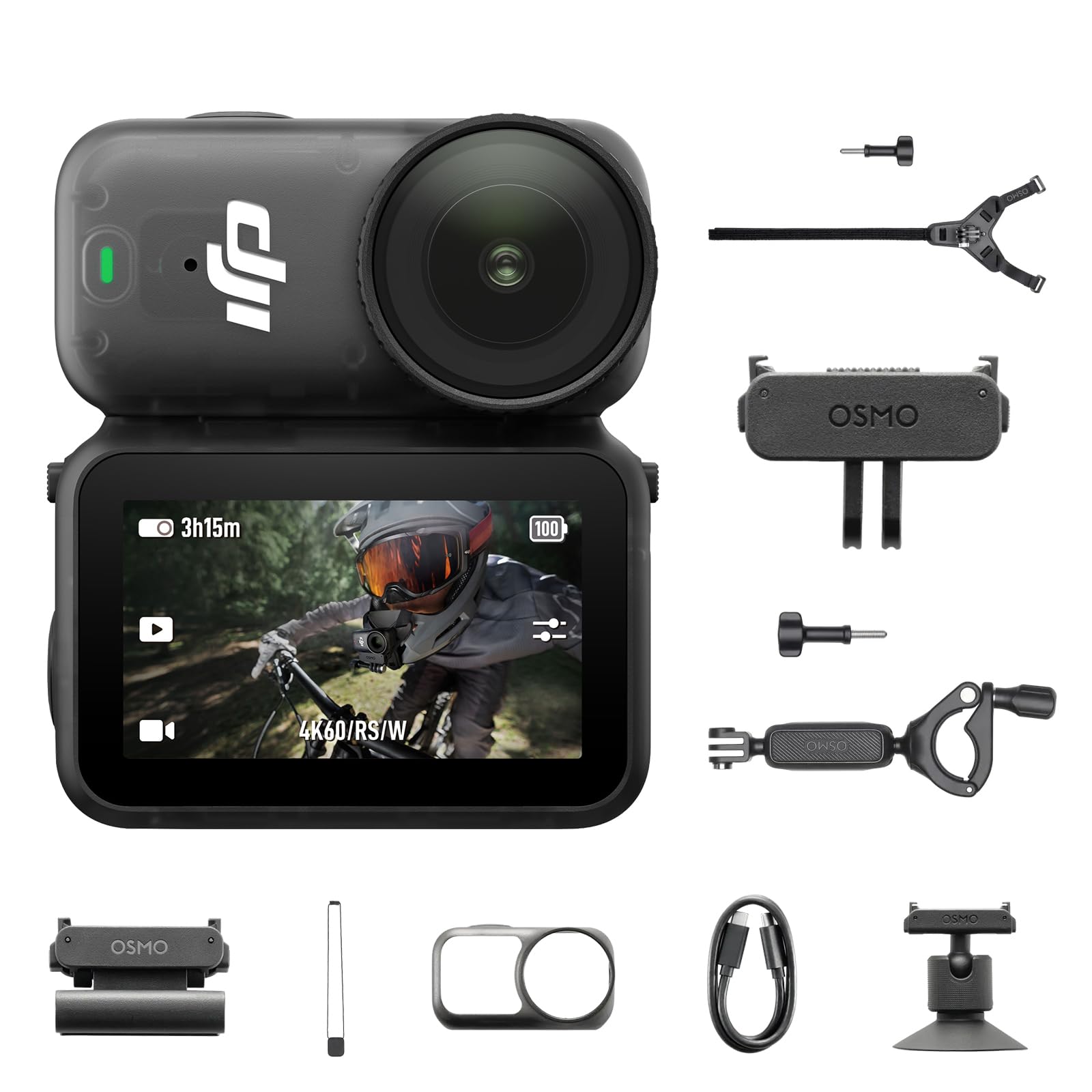
The DJI Osmo Nano Mountain Off-Road Kit is purpose-built for riders who want a minuscule, magnetic body camera that mounts to a helmet chin or handlebar without feeling like a brick strapped to their head. It records 4K at 60fps with a 143-degree ultra-wide field of view, ensuring you capture the trail ahead and your hands on the bars in a single frame. The 128 GB of built-in storage means you never need to buy an SD card, and the 200-minute battery life covers extended backcountry loops.
What sets the Nano apart is its magnetic wearable design — you can clip it to a backpack strap, helmet vent, or bike frame with the included dual-direction quick-release folding adapter. The 1/1.3-inch sensor and 10-bit D-Log M color profile produce flat, gradeable footage that retains highlight and shadow detail even under dense canopy cover. Direct microphone support lets you connect a DJI Mic 2 for clear wind-filtered audio commentary during descents.
The main limitation is the fixed-lens non-swappable nature of the unit: unlike the Action 5 Pro, you cannot change the battery mid-ride, and the 128 GB storage cannot be expanded with a microSD card. Riders who need modularity for multi-day bikepacking trips may find the sealed design restrictive. For daily trail shredders who want mountain-bike-specific mounting and effortless magnetic capture, the Nano kit delivers a tailored solution.
What works
- Ultra-compact magnetic design for flexible POV mounting
- Built-in 128 GB eliminates SD card hassle
- 10-bit D-Log M color profile for professional grading
What doesn’t
- Non-swappable battery limits continuous ride duration
- Storage cannot be expanded via external memory
- High price point for a single-purpose action cam
4. Insta360 X3 128GB Vlog Kit

The Insta360 X3 is the definitive 360-degree cycling camera, capturing everything around you in 5.7K Active HDR video so you never have to decide which direction to point the lens. Its FlowState Stabilization and Horizon Lock algorithms keep the footage smooth even when you’re bouncing down a gravel washboard, and you can reframe the shot after the ride to show the trail ahead, the rider behind, or a sweeping scenery pan. The included 114 cm Invisible Selfie Stick disappears from the 360 footage, making it look like a drone is following you.
For cyclists who also shoot straight-ahead wide-angle footage, the X3 offers a 4K single-lens mode at 30fps and a super-wide 170-degree MaxView at 2.7K 60fps. The 2.29-inch touchscreen is bright enough for outdoor use, and the AI-powered Insta360 app handles automatic reframing and editing. The kit comes with a 128 GB microSD card, which is an adequate start, but heavy shooters will want to upgrade to a high-endurance V90 card for 360 footage.
The main trade-off for a 360 camera is the editing workflow: you must reframe the footage in the app or desktop software to get a usable traditional video, and that takes time and practice. Battery life hovers around 80 minutes of continuous 360 recording, so longer rides require spare batteries or a power bank. If you love creative storytelling and want to capture every angle of your ride, the X3 is unmatched in its price bracket.
What works
- Shoot first, reframe later eliminates missed angles
- FlowState stabilization is incredibly smooth
- Invisible selfie stick creates natural third-person shots
What doesn’t
- 360 editing workflow adds post-ride processing time
- Battery life is shorter than standard action cams
- Single-lens 4K mode lacks high frame rate for slow-mo
5. AKASO 360 Action Camera Cycling Combo
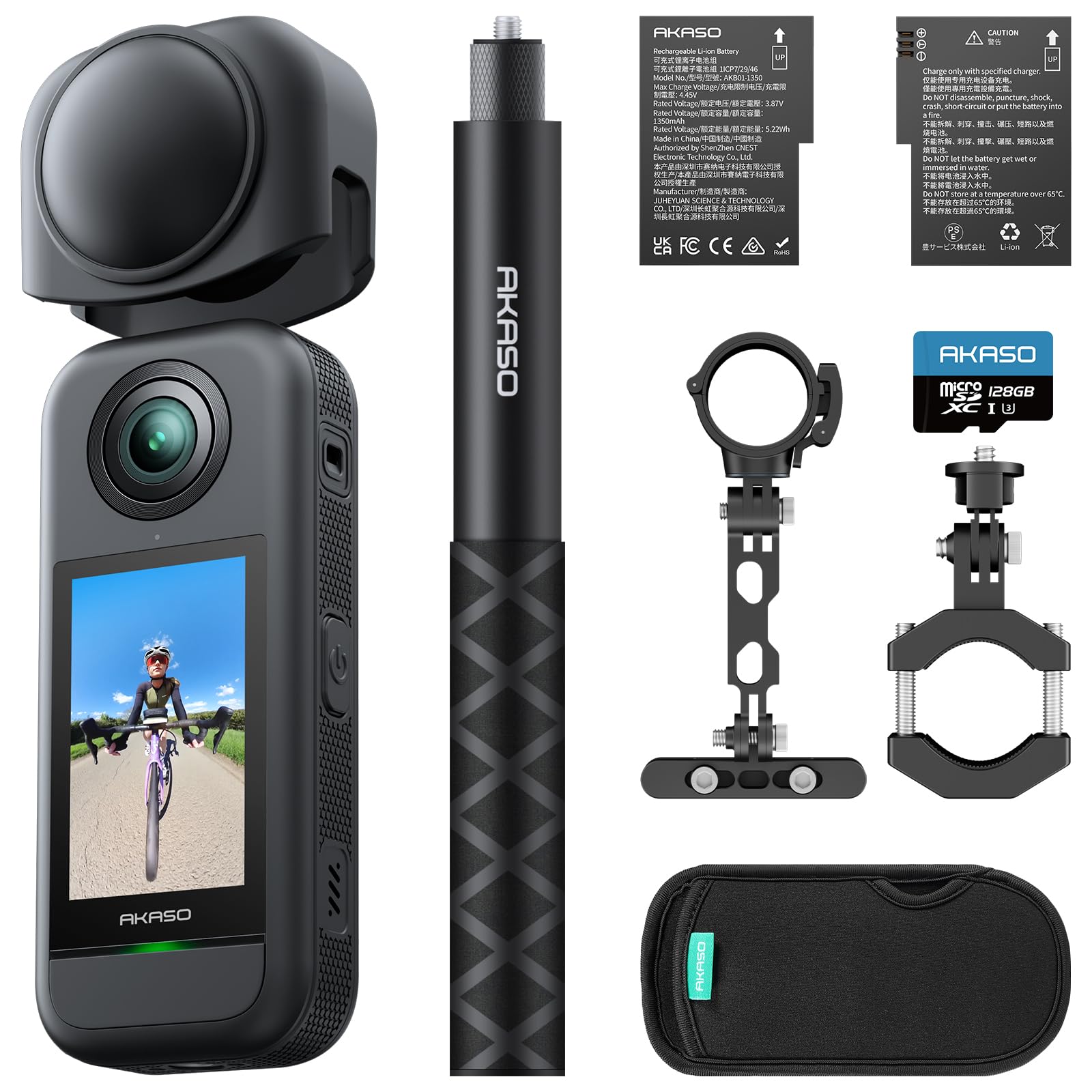
The AKASO 360 delivers 5.7K 360-degree video with dual 1/2-inch 48MP sensors, capturing both immersive spherical footage and 72MP 360 stills for high-resolution landscape shots. Its 360° Supersmooth stabilization smooths out handlebar vibrations without requiring a gimbal, and the 360° Horizon Lock keeps your footage level through full spins. The 256 GB microSD card included in the cycling combo means you can start recording heavy 360 data right away without an extra purchase.
AI Subject Tracking automatically keeps a chosen rider or object centered in the frame, which is particularly useful for solo cyclists who want a self-following POV effect without a camera operator. The DNG8 RAW photo mode captures more dynamic range in low light, and the AKASO 360 Studio app provides free tools to reframe and export your 360 clips. Compared to the Insta360 X3, the AKASO 360 offers a larger included storage card and higher still resolution at a noticeable discount.
The downside is that AKASO’s app and desktop software ecosystem is less polished than Insta360’s, with fewer automatic editing templates and slower export speeds. The build quality is solid but lacks the premium anodized feel of the DJI or Insta360 units. For budget-conscious riders who want 360 capture with high-resolution photo capability, the AKASO 360 represents the strongest value proposition on the list.
What works
- High still resolution (72MP) for landscape photos
- Included 256 GB microSD card is generous and ready
- AI tracking works well for solo cycling vlogs
What doesn’t
- App and editing software are slower and less refined
- Build finish feels less premium than top-tier rivals
- Battery life is average for 360 video recording
6. Xtra Edge Pro Action Camera
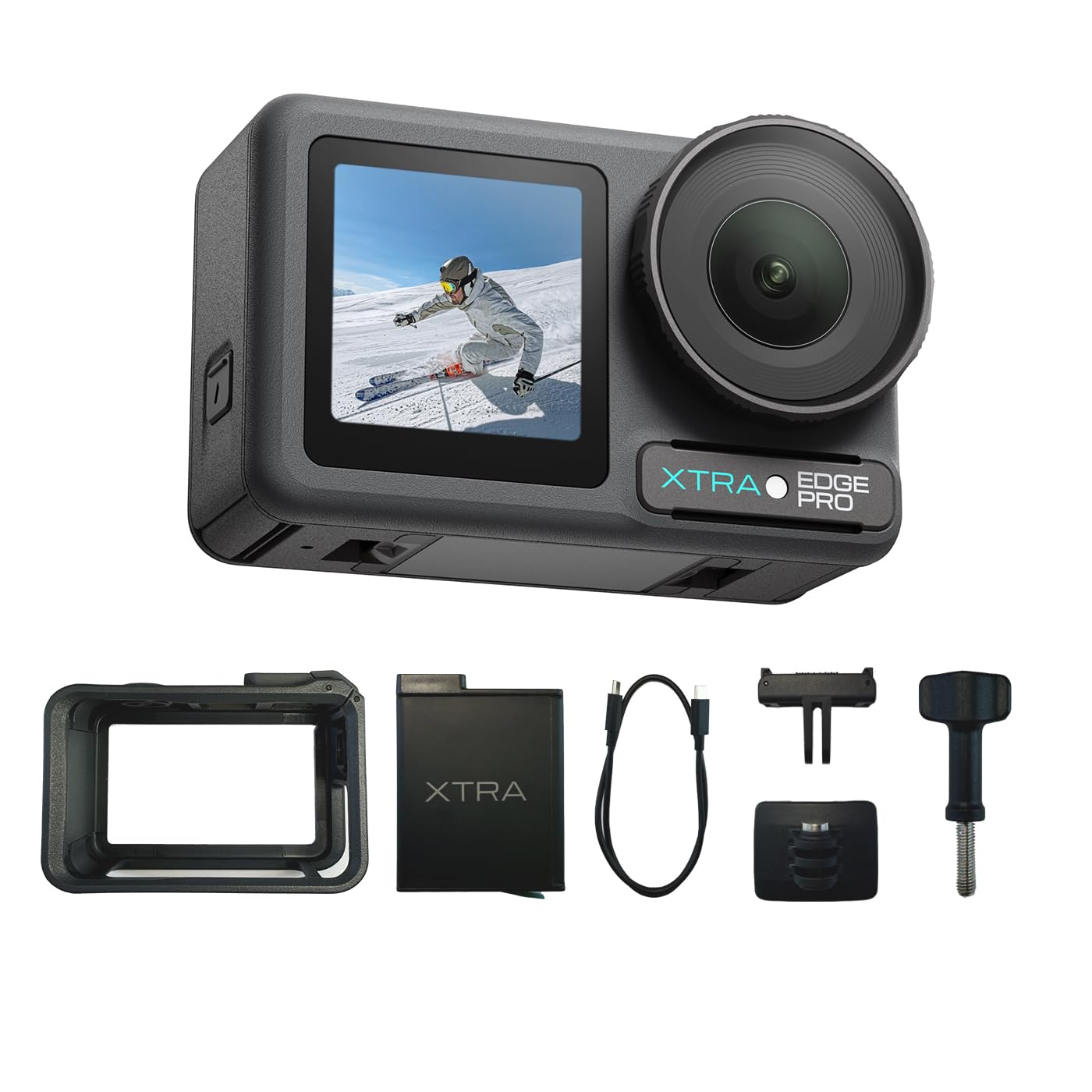
The Xtra Edge Pro packs a 1/1.3-inch sensor that rivals the sensor size found in the DJI Action 5 Pro, but at a lower entry point. It records smooth 4K video at 60fps and includes a dedicated Night View Mode that boosts gain in low-light scenes without introducing excessive noise. The 65-foot waterproof rating is achieved without an external housing, making it a strong choice for cyclists who also swim, snorkel, or ride through deep puddles.
Its stabilization suite — called 360 Lock, TiltGuard, and MotionMaster — works together to eliminate shake from gravel climbs and off-camber descents. The included Cold-Resistant Battery minimizes power drop in winter temperatures, so fat-tire riders and commuters in northern climates get consistent recording time. The Dual-Orientation Protective Frame allows quick switching between horizontal and vertical mounting without unscrewing the camera body.
The main complaint among users is that the companion app lacks the polish of DJI’s Mimo or Insta360’s app, and firmware update frequency has been inconsistent. The standard bundle includes only one battery, so all-day riders should order spares. For the budget-minded adventurer who wants a large sensor in a rugged body without paying flagship prices, the Xtra Edge Pro delivers impressive specs per dollar.
What works
- Large 1/1.3 sensor captures great detail in all light
- 65ft waterproof without a housing
- Cold-resistant battery performs in winter conditions
What doesn’t
- App experience and firmware updates lag behind DJI
- Only one battery included in standard bundle
- Not a 360 camera, so angle is fixed at recording time
7. Vantrue F1 Motorcycle 4K Dash Cam

The Vantrue F1 is an IP67-rated dual-camera system that records 4K from the front and 1080p from the rear simultaneously, with 160-degree lenses on both channels to cover three lanes of traffic. It uses the STARVIS sensor for the front camera, which excels at capturing license plates and street signs in low ambient light. The included wired remote control lets you lock a file, snap a photo, or start voice recording without taking your hands off the handlebar.
Its GPS module embeds speed, route, and elevation data directly into the video, and the Vantrue PC player overlays this information on a map for export as a PDF — a powerful piece of evidence in disputes. The F1 supports OTA firmware updates and a 5 GHz Wi-Fi connection for fast file downloads to your phone. It accepts up to a 512 GB SD card, giving you weeks of loop-recorded footage before the oldest files are overwritten.
The F1 lacks a built-in display, so you rely entirely on the app or a computer for configuration and viewing. It is also designed as a hardwired dash cam rather than a portable action cam, so there is no battery for standalone use when off the bike. For the commuting cyclist or motorcyclist who wants a permanent, weather-sealed dual-camera system with GPS evidence logging, the Vantrue F1 is the most capable dedicated dash cam on the list.
What works
- Full-body IP67 rated for rain and dust protection
- GPS route and speed overlay create strong evidence
- Wired remote control enables one-handed file locking
What doesn’t
- No on-camera display, must use app or PC
- Hardwire design lacks portability for off-bike use
- Front and rear wiring adds installation complexity
8. AKEEYO AKY-710S Bike Camera with Mount

The AKEEYO AKY-710S is a dedicated bicycle dash cam built around a Starvis IMX335 sensor that records 2K video at 55fps or 4K at 28fps through a 142-degree wide-angle lens. Its specialized quick-release bike mount attaches and detaches in seconds, and the accompanying app allows you to flip the display orientation if you mount the camera upside down on the handlebars. The IP66 weather rating and 1800mAh battery give you over 4.5 hours of 1080P recording on a single charge, covering most club rides.
Parking monitoring mode uses the G-sensor to automatically begin recording if your bike is bumped while parked, adding a layer of security when you stop for coffee. The package includes a 64 GB high-performance storage card, so there is no immediate need to buy extra memory. Wireless connectivity via 2.4 GHz Wi-Fi enables OTA firmware updates and real-time preview on your smartphone without removing the SD card.
The main limitation is the lower maximum 4K frame rate of 28fps, which can appear slightly choppy for fast-paced downhill action compared to 60fps cameras. The app interface is functional but not as polished as those from Garmin or DJI. For the cyclist who wants a purpose-built handlebar dash cam with parking security and a generous included memory card, the AKY-710S offers strong value at an affordable entry point.
What works
- Purpose-built quick-release bike mount simplifies use
- Parking monitoring adds theft deterrent recording
- 64 GB card included for immediate out-of-box use
What doesn’t
- 28fps at 4K is too slow for high-speed action
- App interface is clunky compared to premium brands
- No 360-degree or dual-lens recording capability
9. EKUZO DC Smart Bike Helmet with Cameras
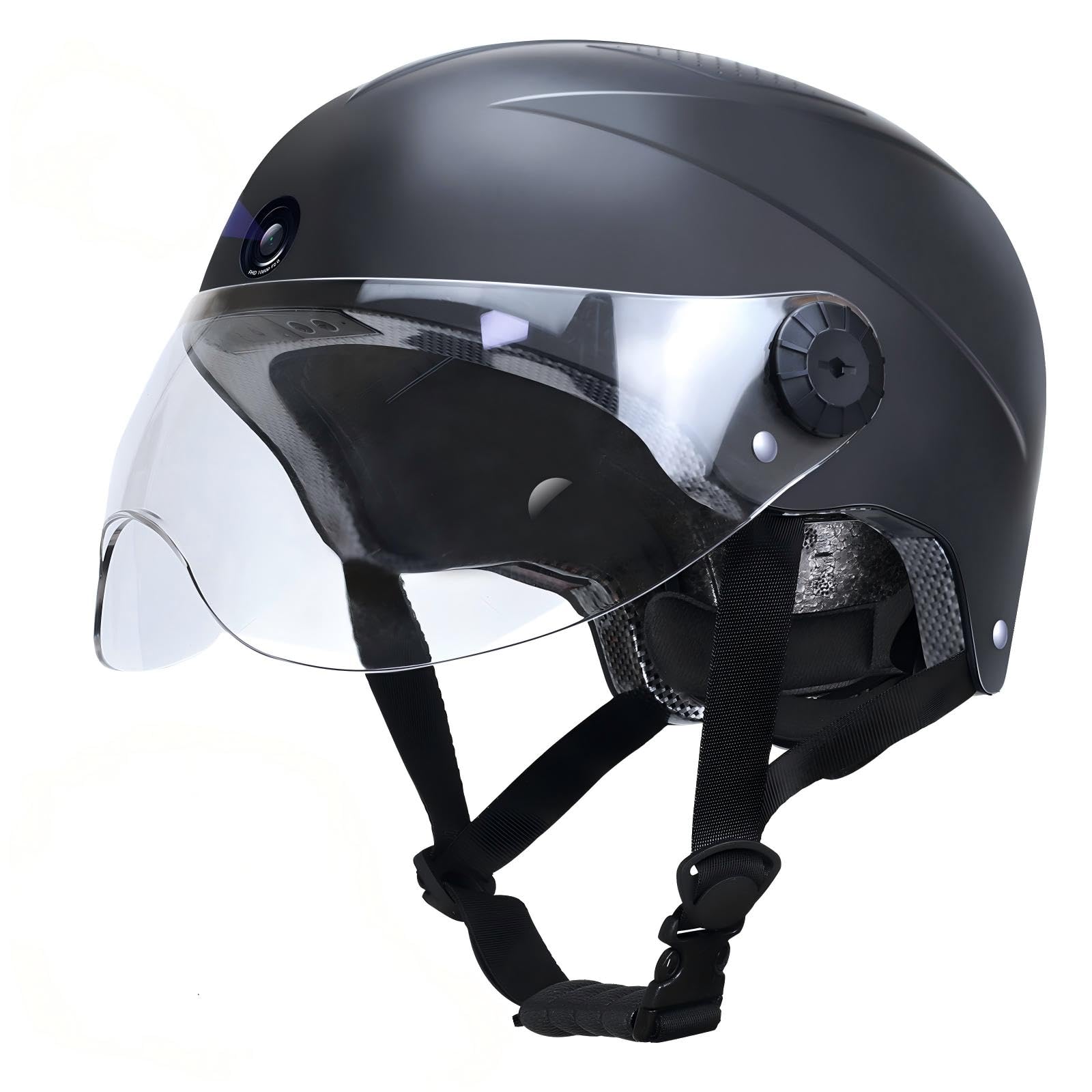
The EKUZO Smart Helmet integrates dual cameras — a 2K front-facing camera and a 1080P rear-facing camera — directly into a CPSC-certified helmet shell, eliminating the need to mount separate cameras. It records automatically when powered on, and the Smart Helmet Pro app lets you adjust resolution settings, view live feeds, and download clips wirelessly. The fit system accommodates head circumferences from 21 to 24.8 inches with an EPS protective shell and an ABS outer layer.
Bluetooth connectivity enables hands-free calls, voice navigation prompts, and music playback during your ride, though activating the app will disconnect Bluetooth for calls while recording continues. The IP65 water resistance handles light rain, and the battery lasts about 4 hours of continuous recording. For commuters who dislike the look and hassle of strapping a separate camera to their helmet, this integrated design offers a streamlined all-in-one solution.
The trade-off is that you cannot upgrade or replace the cameras independently, and the 2K maximum front resolution is lower than what a standalone 4K action cam delivers. The helmet’s aesthetic is distinctly sporty and may not match sleek road bike setups. For the urban commuter or e-bike rider who wants a single device for head protection and incident recording without extra mounting hardware, the EKUZO helmet provides a clean, functional package.
What works
- Integrated design eliminates separate camera mounting
- Automatic recording on power-up needs no app
- Bluetooth music and calls add convenience for commuting
What doesn’t
- Cameras are non-replaceable if damaged or outdated
- 2K front resolution is lower than 4K alternatives
- Helmet ventilation may be less than dedicated cycling lids
Hardware & Specs Guide
Sensor Size and Pixel Pitch
Sensor size directly impacts low-light performance and dynamic range. A 1/1.3-inch sensor (found on the DJI Osmo Action 5 Pro and Xtra Edge Pro) collects more light per pixel than a smaller 1/2.3-inch sensor, resulting in cleaner detail at dusk or under tree canopy. Pixel pitch — the physical size of each pixel — determines how well the sensor handles high-contrast scenes. 2.4 µm pixels are ideal for cycling video because you often ride through patchy light (forest shadows to open sky), and larger pixels prevent highlight clipping.
Frame Rate vs. Resolution Trade-off
For high-speed cycling footage, 60fps is the minimum for capturing smooth detail during a fast descent. Cameras that offer 4K at 60fps (DJI Osmo Action 5 Pro, Xtra Edge Pro) freeze motion better than 4K at 28fps (AKEEYO AKY-710S). However, some dash cams like the Vantrue F1 prioritize continuous evidence recording at 30fps to maintain longer loop recording times. The best approach is to match the frame rate to your primary use: 60fps for action and slow-motion review, 30fps for maximum battery life and loop duration.
Stabilization Systems Explained
Electronic Image Stabilization (EIS) is standard, but the best cycling cameras use gyro data and crop-based compensation to eliminate handlebar vibration. DJI’s HorizonSteady and Insta360’s FlowState correct for 360° roll-axis shake, meaning your footage stays horizon-level even when you lean the bike into a corner. For 360 cameras like the Insta360 X3 and AKASO 360, stabilization is processed in the reframing software, allowing you to lock the horizon in post-production. Without strong stabilization, fast gravel or bumpy pavement produces unwatchable shakycam footage.
Waterproof Rating and Mounting Options
An IP65 rating handles rain and road spray, while IP67 or better allows submersion for cleaning or riding through standing water. The Vantrue F1 and AKEEYO AKY-710S are fully weather-sealed, making them suitable for year-round commuting without a separate housing. Mounting adapters matter: the DJI Osmo Nano MTB Kit includes a helmet chin mount and handlebar clamp, while the Garmin Varia RCT715 mounts exclusively to the seatpost. Ensure the mount system supports your preferred camera position — handlebar, helmet chin, top of helmet, or seatpost — before purchasing.
FAQ
What is the best frame rate for recording cycling as evidence?
Do I need a 360 camera for cycling or is a standard action cam enough?
Can I use a motorcycle dash cam on my bicycle?
How important is GPS speed and route embedding in a cycling camera?
Final Thoughts: The Verdict
For most buyers, the best cycling video camera winner is the Garmin Varia RCT715 because it combines rear-facing radar safety with automatic incident recording and a tail light in one compact seatpost unit, making it the most practical tool for road cyclists who ride in traffic. If you want premium 4K image quality with industry-leading stabilization for mountain biking and low-light conditions, grab the DJI Osmo Action 5 Pro. And for creative cyclists who want to capture every angle and reframe later, the Insta360 X3 offers unmatched 360-degree versatility with a generous 128 GB storage kit included.

Certification: BSc in Mechanical Engineering
Education: Mechanical engineer
Lives In: 539 W Commerce St, Dallas, TX 75208, USA
Md Amir is an auto mechanic student and writer with over half a decade of experience in the automotive field. He has worked with top automotive brands such as Lexus, Quantum, and also owns two automotive blogs autocarneed.com and taxiwiz.com.