Adding a subwoofer to a car audio system isn’t just about getting louder—it’s about recovering the low-frequency foundation that factory speakers physically cannot reproduce below 50 Hz. Without a dedicated driver for the bottom octave, kick drums lose their weight, bass lines turn into a muddy hum, and the entire soundstage collapses into the midrange. A properly matched subwoofer restores the tactile punch that separates a convincing system from a tinny one.
I’m Amir — the founder and writer behind Four Wheel Ask. I’ve spent years analyzing car audio hardware specifications, enclosure design principles, and amplifier matching to help buyers separate genuine low-end extension from inflated peak power marketing claims.
Whether you’re working with a compact coupe or a full-size SUV, finding the right car audio subwoofer comes down to understanding power handling, enclosure compatibility, and voice coil configuration for your specific vehicle layout.
How To Choose The Best Car Audio Subwoofer
Selecting a subwoofer for a vehicle demands more than picking the largest cone diameter you can fit. You need to match the driver’s RMS power handling to your amplifier’s continuous output, choose a voice coil configuration that presents a safe impedance load, and confirm the enclosure type suits your listening preference. Beginners often overvalue peak power numbers while ignoring the enclosure’s role in controlling cone motion at the resonant frequency.
RMS Power vs. Peak Power — Ignore the Big Number
Peak power ratings represent a brief thermal limit before the voice coil fails. RMS (root mean square) power is the continuous rating the subwoofer can handle without distortion or overheating. Your amplifier should deliver RMS power within 75-125% of the subwoofer’s RMS rating. Overpowering with clean signal is safer than underpowering with a clipped signal, which burns voice coils faster.
Voice Coil Configuration — Single vs. Dual
A single voice coil (SVC) subwoofer presents one impedance value, typically 2 or 4 ohms. A dual voice coil (DVC) subwoofer offers two coils that can be wired in series, parallel, or individually to match amplifier requirements. DVC drivers give you flexibility to present a 1-ohm or 4-ohm load depending on your amp’s stable rating, which is critical for maximizing amplifier output without exceeding its limits.
Enclosure Type — Sealed vs. Ported vs. Bandpass
Sealed enclosures deliver tight, accurate bass with a gradual roll-off below the tuning frequency, making them ideal for sound quality builds. Ported enclosures boost output around the tuning frequency, adding loudness and low-end extension at the cost of transient accuracy. Bandpass enclosures isolate the subwoofer inside a chamber, producing high output over a narrow bandwidth but are difficult to design without introducing phase cancellation.
Mounting Depth and Space Constraints
Measure the available airspace in your chosen location before buying. Shallow-mount subwoofers with mounting depths under 3.5 inches fit behind seats or under truck benches but require smaller enclosure volumes. Full-depth drivers with 5-6 inch mounting depths need dedicated trunk boxes or custom fiberglass enclosures but typically offer higher excursion and thermal capacity.
Quick Comparison
On smaller screens, swipe sideways to see the full table.
| Model | Category | Best For | Key Spec | Amazon |
|---|---|---|---|---|
| Rockford Fosgate Prime R2D2-10 | Component | Sound quality in sealed enclosures | 250W RMS / 2″ DVC | Amazon |
| Audiopipe TXX-BDC2-12 | Component | High SPL in ported enclosures | 750W RMS / 2.5″ BASV coil | Amazon |
| Pioneer TS-A2000LD2 | Shallow Mount | Limited-depth installations | 250W RMS / 8″ driver | Amazon |
| Rockville RVB10.1A | Powered | Simplified all-in-one install | 300W RMS / built-in AB amp | Amazon |
| Pioneer TS-A3000LS4 | Shallow Mount | Deep bass in tight truck spaces | 400W RMS / 12″ driver | Amazon |
| Rockville SK512 Package | Complete System | First-time buyers wanting a full setup | 350W RMS system / 12″ K5 | Amazon |
| MTX TNE212D Bundle | Complete System | Dual-subwoofer trunk builds | 600W RMS system / dual 12″ | Amazon |
| JBL SUBBP12AM | Powered | Factory-integration clean bass | 150W RMS / Slipstream port | Amazon |
| SVS SB-1000 Pro | Powered | Reference-level low-frequency extension | 325W RMS / 12″ high-excursion | Amazon |
In‑Depth Reviews
1. SVS SB-1000 Pro

The SVS SB-1000 Pro is a sealed powered subwoofer that redefines what a compact 12-inch driver can achieve. Its Sledge STA-325D amplifier delivers 325 watts RMS continuous power with discrete MOSFET output stages, driving a high-excursion long-throw driver that maintains linearity even near Xmax limits. The 50MHz Analog Devices DSP allows precise in-room tuning through the smartphone app, letting you adjust crossover frequency, parametric EQ, and room gain compensation without touching the cabinet.
This subwoofer’s sealed cabinet with extra-thick MDF front baffle and internal bracing eliminates cabinet resonance that masks low-frequency detail. The 12-inch driver features a dual ferrite magnet motor and a long-throw parabolic surround that supports extreme cone excursion while keeping distortion below 1% at reference levels. Frequency response extends to 20 Hz in-room with minimal roll-off, making it suitable for both demanding car audio builds and home theater integration.
The smartphone app sets the SB-1000 Pro apart from every other subwoofer in this comparison. You can store multiple presets for different music genres, adjust volume in 0.5 dB steps, and engage a 12 dB/octave low-pass filter between 30 Hz and 200 Hz. The wired and wireless connectivity options simplify placement, while the compact sealed enclosure fits in spaces where ported boxes cannot.
What works
- DSP app provides precise room EQ and crossover control unmatched in this class.
- Sealed cabinet design delivers tight, articulate bass with no port noise.
What doesn’t
- Premium price point may exceed budget for entry-level builders.
- Requires external amplifier wiring for integration into existing car audio systems.
2. Pioneer TS-A3000LS4

The Pioneer TS-A3000LS4 is a 12-inch shallow-mount subwoofer engineered for vehicles where trunk or under-seat space is at a premium. With a mounting depth of just 3.5 inches and a recommended sealed enclosure volume of 0.8 cubic feet, it fits behind truck seats and under rear benches where full-depth drivers cannot. The glass-fiber and mica reinforced IMPP cone provides the rigidity needed to handle 400 watts RMS without audible cone breakup at high excursion.
The 4-ohm single voice coil design simplifies wiring with most monoblock amplifiers, presenting a straightforward 4-ohm load that any stable amp can drive. Sensitivity is rated at 88 dB, which is above average for shallow-mount drivers and translates to good output efficiency even with lower-powered amplifiers in the 300-500 watt RMS range. The frequency response extends low enough to reproduce 30 Hz bass with authority when paired with an appropriate sealed enclosure.
Pioneer designed the TS-A3000LS4 to integrate seamlessly with their A-series full-range speakers, but it works equally well with any aftermarket component set. The trim ring and mounting gasket included in the box simplify installation, and the shallow profile means you can tuck this subwoofer into spaces that would normally force you to use an 8-inch or 10-inch driver instead.
What works
- Shallow 3.5-inch mounting depth fits under seats and behind truck consoles.
- 4-ohm SVC simplifies wiring and works with nearly any monoblock amplifier.
What doesn’t
- Sealed enclosure required for optimal performance; ported designs may exceed space limits.
- 88 dB sensitivity is good for shallow mount but lower than full-depth competitors.
3. JBL SUBBP12AM

The JBL SUBBP12AM is a powered subwoofer enclosure that combines a 12-inch polypropylene woofer with a built-in 150-watt RMS amplifier in a single sealed box. This all-in-one design eliminates the need to match an external amplifier’s power rating and impedance, making it a straightforward upgrade for factory systems. The Slipstream port design reduces turbulent airflow noise that plagues conventional ported enclosures at high output levels.
The frequency response spans 35 Hz to 120 Hz, with the built-in amplifier’s low-pass crossover allowing you to blend the subwoofer with your main speakers. The included remote sub level control lets you adjust bass output from the driver’s seat without reaching into the trunk. The polypropylene cone resists moisture and temperature changes better than paper cones, making it suitable for vehicles in humid climates.
Owners with Honda CR-Vs and Ford F-150s report that the compact enclosure fits easily in hatchback trunks and behind rear seats. The integrated amplifier uses line-level inputs, so you can connect directly to a factory head unit using an adapter without needing a separate line output converter. The 450-watt peak rating is a thermal limit, but the real-world clean output at 150 watts RMS is enough to add noticeable low-end presence to any factory system.
What works
- Built-in amplifier simplifies installation and eliminates external amp wiring.
- Slipstream port design delivers distortion-free bass even at high volumes.
What doesn’t
- 150W RMS is modest; won’t satisfy ground-shaking SPL enthusiasts.
- Sealed enclosure limits low-end extension compared to larger ported designs.
4. MTX TNE212D Bundle

The MTX TNE212D bundle pairs a dual 12-inch loaded enclosure with a Planet Audio 1500-watt monoblock amplifier and Soundstorm 8-gauge wiring kit. The loaded enclosure uses 5/8-inch MDF construction wrapped in aircraft-grade black carpet, measuring 13.5 inches deep by 26.63 inches wide by 14 inches tall. This is a system designed for buyers who want significant cone area without having to research individual component matching.
The Planet Audio monoblock amplifier features high and low-level inputs, variable bass boost, and a low-pass filter for tuning. The 1500-watt peak rating corresponds to approximately 500 watts RMS at 2 ohms, which pairs reasonably with the dual 4-ohm voice coil configuration of the MTX subwoofers when wired for a 2-ohm final load. The bundled wiring kit includes 100% copper RCA cables, power cable, ground wire, and fuse holder.
This bundle requires a compatible head unit or line-output converter, and the electrical system must support the amplifier’s current draw during sustained bass passages. The dual subwoofer configuration produces significant output in the 30-50 Hz range, and the ported enclosure design adds around 6 dB of efficiency at the tuning frequency compared to sealed alternatives.
What works
- Complete bundle includes subwoofers, amplifier, and wiring kit for one-box purchase.
- Dual 12-inch cone area moves substantial air for SPL-oriented builds.
What doesn’t
- Amplifier RMS power is lower than peak rating suggests; real output is around 500W RMS.
- Enclosure dimensions require significant trunk space; not suitable for compact cars.
5. Rockville SK512 Package

The Rockville SK512 package bundles a vented 12-inch K5 subwoofer enclosure with a DB11 monoblock amplifier and an 8-gauge wiring kit. The K5 subwoofer uses a 2-inch 4-layer aluminum voice coil wound with Japanese OFC copper wire, paired with a fiber-reinforced non-pressed paper cone that resists warping under high power. The vented enclosure is built from 3/4-inch MDF with computer-designed ports angled at 15 degrees for optimized airflow.
The DB11 amplifier delivers 350 watts RMS at 2 ohms, which matches the K5 subwoofer’s single 4-ohm voice coil wired to present a 4-ohm load to the amplifier. The amplifier includes a variable low-pass filter, subsonic filter, and bass boost with remote level control. The 8-gauge wiring kit includes 100% copper RCA cables, power cable rated for 60 amps, and installation accessories like wire ties and ring terminals.
This package is designed for first-time buyers who want a complete system without compatibility guesswork. The vented enclosure’s 1.52 cubic feet of internal airspace tuned around 35 Hz provides a noticeable low-end bump that enhances rock and hip-hop playback. The angled port design reduces chuffing noise at moderate output levels compared to straight ports of equivalent cross-sectional area.
What works
- Vented enclosure boosts output around tuning frequency for louder bass per watt.
- All components are matched for impedance and power handling out of the box.
What doesn’t
- Non-pressed paper cone may be less durable than polypropylene or composite alternatives.
- Amplifier power is limited to 350W RMS; upgrading later requires replacing the whole system.
6. Rockville RVB10.1A

The Rockville RVB10.1A is a powered 10-inch subwoofer enclosure with a built-in Class AB amplifier rated at 300 watts RMS and 500 watts peak. The anti-vibration MDF enclosure has a tapered design measuring 15.75 inches long by 12.99 inches high, with a width that narrows from 14.17 inches to 10.63 inches. This wedge shape fits behind truck seats and in compact hatchbacks where rectangular boxes cannot.
Owner reports from Honda CR-V and Ford F-150 installations confirm the subwoofer adds clean low-end presence without requiring major modification. The adjustable bass boost and low-pass crossover let you fine-tune the output to match your main speakers. RCA and high-level inputs allow connection to both aftermarket and factory head units without an additional line output converter.
The Class AB amplifier runs warmer than Class D designs but produces cleaner sine waves at moderate power levels. The 10-inch driver has enough cone area to pressurize a small cabin effectively, and the ported enclosure design adds around 3 dB of efficiency compared to a sealed box of the same volume. Owners note that a break-in period of about two weeks improves bass extension as the suspension loosens.
What works
- Tapered enclosure fits in tight spaces where standard rectangular boxes won’t.
- Built-in Class AB amplifier delivers clean power without external amp wiring.
What doesn’t
- Class AB amp is less efficient than Class D; may generate noticeable heat in small enclosures.
- 300W RMS is adequate for cabin-filling bass but won’t rattle windows in larger vehicles.
7. Audiopipe TXX-BDC2-12
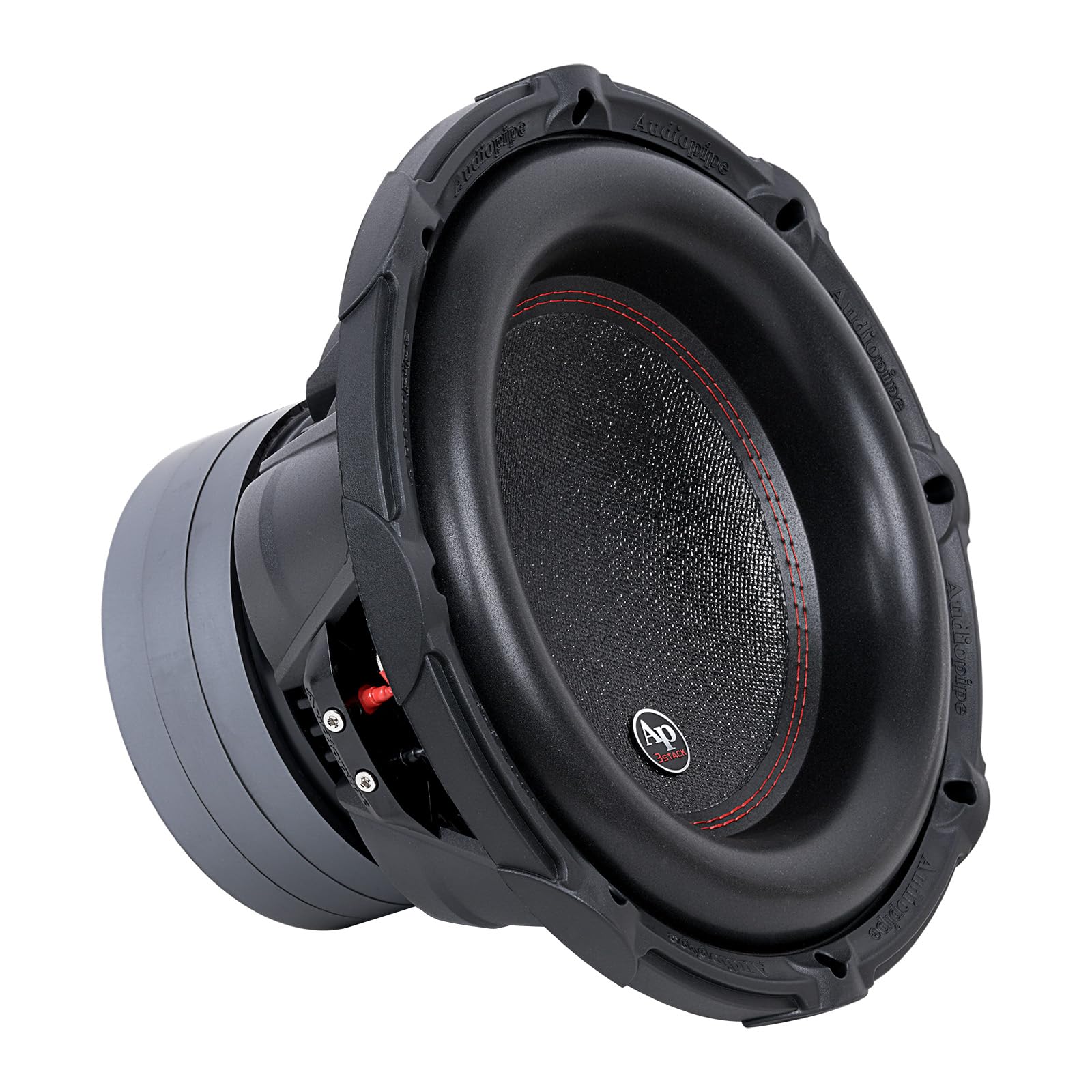
The Audiopipe TXX-BDC2-12 is a high-power 12-inch subwoofer with a double stack magnet structure that increases magnetic flux density in the voice coil gap, improving motor force and cone control. The dual 4-ohm voice coils can be wired to present a 2-ohm or 8-ohm load, giving you flexibility to match amplifiers rated for either impedance. RMS power handling is rated at 750 watts, with a peak capacity of 1500 watts for brief dynamic peaks.
The 2.5-inch black aluminum BASV voice coil features a 4-layer winding that improves heat dissipation compared to standard copper coils of the same diameter. The aluminum basket provides structural rigidity while allowing ventilation through the spider area to cool the voice coil during extended high-power playback. The composite cone construction uses layered materials that resist deformation while maintaining low moving mass for transient response.
The frequency response extends from 20 Hz to 900 Hz, giving this subwoofer unusual midbass extension capability. Sensitivity is rated at 88 dB, which is reasonable for a 750-watt driver. The patent pipe multi-connect terminals accept up to 8-gauge wire and support parallel or series wiring without adapters. This subwoofer is best paired with an amplifier capable of delivering 600-900 watts RMS into a 2-ohm load.
What works
- Double stack magnet motor provides strong cone control for high-SPL applications.
- 2.5-inch BASV voice coil handles high thermal load without power compression.
What doesn’t
- Requires a powerful amplifier (600W+ RMS) to reach full potential.
- Large mounting depth may not fit in shallow enclosures or under-seat boxes.
8. Rockford Fosgate Prime R2D2-10

The Rockford Fosgate Prime R2D2-10 is a 10-inch dual 2-ohm voice coil subwoofer rated at 250 watts RMS with 500 watts peak power handling. The mica-injected polypropylene cone provides the stiffness needed for accurate cone motion without adding significant mass, while the stamp-cast basket with integrated spider venting improves voice coil cooling. The 4.319-inch mounting depth and 9.125-inch cutout diameter fit standard 10-inch sealed enclosures.
The dual 2-ohm voice coils can be wired in series for a 4-ohm load or parallel for a 1-ohm load, giving you flexibility when matching amplifiers that are stable at either impedance. The 28 Hz frequency response extends low enough to reproduce sub-bass content in well-tuned enclosures. This subwoofer is optimized for both sealed and vented enclosures, making it versatile for different sound preferences.
Rockford Fosgate backs this subwoofer with a full 1-year warranty, reflecting confidence in the build quality. The 10-inch driver size strikes a balance between cone area and installation flexibility, fitting in smaller enclosures that 12-inch drivers cannot. Owners consistently report that the R2D2-10 delivers clean bass output that integrates well with factory speaker systems when paired with a suitable amplifier.
What works
- Dual 2-ohm voice coils offer flexible wiring configurations for 1-ohm or 4-ohm loads.
- Spider venting design keeps the voice coil cooler during extended playback.
What doesn’t
- 250W RMS limits maximum output compared to higher-powered competitors.
- 10-inch cone area produces less deep bass extension than 12-inch drivers.
9. Pioneer TS-A2000LD2

The Pioneer TS-A2000LD2 is an 8-inch shallow-mount subwoofer with a 2.625-inch mounting depth, making it the most space-efficient driver in this comparison. The 2-ohm single voice coil design allows a 2-ohm load from a single subwoofer, maximizing amplifier output without requiring dual subs. RMS power handling is 250 watts, with a peak capacity of 700 watts for dynamic transients.
The glass-fiber and mica reinforced IMPP cone provides the rigidity needed for an 8-inch driver to produce meaningful low-frequency output. The recommended 0.5 cubic foot sealed enclosure creates a subwoofer system that fits under front seats, behind rear seats, or in shallow trunks where space is measured in inches rather than feet. The 83 dB sensitivity is typical for shallow-mount designs and reflects the trade-off between shallow profile and efficiency.
Pioneer designed this subwoofer to integrate with their A-series full-range speaker lineup, creating a cohesive sound signature when paired together. The included trim ring and mounting screws simplify installation, and the compact form factor means you can add a subwoofer to vehicles where traditional 10-inch or 12-inch enclosures simply cannot go. This driver is best suited for adding low-end presence to small sedans, coupes, and compact trucks.
What works
- 2.6-inch mounting depth fits in the tightest installation spaces available.
- 2-ohm SVC simplifies wiring and extracts full power from 2-ohm stable amplifiers.
What doesn’t
- 8-inch driver has limited cone area; deep sub-30 Hz extension is compromised.
- 83 dB sensitivity requires more amplifier power to match output of larger drivers.
Hardware & Specs Guide
RMS Power Handling
RMS (root mean square) power represents the continuous thermal limit of the voice coil. A subwoofer rated at 400W RMS can sustain that power level without overheating or distorting over long listening sessions. Always match your amplifier’s RMS output to within 75-125% of this rating.
Voice Coil Configuration
Dual voice coil (DVC) subwoofers have two separate coils that can be wired in series for double the impedance, parallel for half the impedance, or individually to run each channel of a stereo amp. This flexibility allows you to present a 1-ohm, 2-ohm, or 4-ohm load matching your amplifier’s stable rating.
Frequency Response
This spec indicates the range of low frequencies the subwoofer can reproduce. A rating of 20 Hz to 200 Hz means the driver can produce the lowest audible bass notes. In practice, enclosure tuning often determines the practical low-frequency limit more than the driver’s free-air response.
Enclosure Volume Requirements
Each subwoofer needs a specific internal air volume for proper operation. Sealed enclosures require smaller volumes (0.5-1.5 cu ft) and produce tighter bass. Ported enclosures need larger volumes (1.5-3.0 cu ft) and boost output around the tuning frequency. Always follow the manufacturer’s recommended enclosure volume.
FAQ
Can I connect a car audio subwoofer to a factory head unit without an aftermarket stereo?
What happens if I wire a dual voice coil subwoofer incorrectly?
Does a larger subwoofer always produce more bass than a smaller one?
How do I know if my car’s electrical system can handle an aftermarket subwoofer amplifier?
Final Thoughts: The Verdict
For most buyers, the car audio subwoofer winner is the SVS SB-1000 Pro because its DSP-controlled amplifier and sealed cabinet deliver reference-level low-frequency accuracy that outperforms everything else in this comparison. If you need shallow-mount installation under a seat, grab the Pioneer TS-A3000LS4. And for a hassle-free powered system, nothing beats the JBL SUBBP12AM.

Certification: BSc in Mechanical Engineering
Education: Mechanical engineer
Lives In: 539 W Commerce St, Dallas, TX 75208, USA
Md Amir is an auto mechanic student and writer with over half a decade of experience in the automotive field. He has worked with top automotive brands such as Lexus, Quantum, and also owns two automotive blogs autocarneed.com and taxiwiz.com.