Installing a new chain shouldn’t require a bench vise, a hammer, and a prayer. Whether you’re swapping gearing for track days or just replacing a worn-out 530 on your commuter, the tool you choose determines whether the master link seats flush and the rivet head flares cleanly — or you’re ordering a second link after crushing an O-ring. A purpose-built press and rivet tool turns a fiddly, high-stakes operation into a straightforward garage job.
I’m Amir — the founder and writer behind Four Wheel Ask. I’ve combed through the market, analyzing hardened steel construction, pin geometry, and chain-size compatibility from 420 to 632, backed by thousands of owner reports across ride and track conditions.
From entry-level press tools to professional-grade forged steel kits, this guide breaks down the options for the chain tool for motorcycle that match your mechanical skill level and the demands of your specific chain pitch.
How To Choose The Best Chain Tool For Motorcycle
A chain tool does three things: breaks old chain links by pressing out the rivet pins, press-fits the side plate onto the new master link, and flares the rivet heads so the link can’t walk off. Picking the wrong one means failed flares, bent pins, or crushed O-rings. Focus on these points first.
Tool Steel Grade and Pin Hardness
The cutting pin and press pins are the most stressed components. Tools like the RK UCT2100 use SKH9 tool steel for the cutting pin — a high-speed steel grade that resists deformation against hardened chain rivets. Softer steel pins mushroom after a few uses, making them impossible to remove from the tool body. Check that the breaking pin is replaceable; many budget tools don’t allow swaps, turning the whole unit into a single-use item.
Chain Pitch and Sprocket Clearance
Chain pitch (520, 525, 530, 532, 630) determines the width of the side plates and the distance between the pins. A tool designed for 520-530 chains typically works for most street and off-road bikes. However, as the Motion Pro Master Link Press Tool shows, some tools don’t accommodate the wider link plates of a 530 chain without forcing the plate into the anvil — which can bend the link. Measure the width of your chain’s side plate before buying if you run a 530 or larger.
Press Mechanism — Screw vs. Lever Action
Screw-driven tools (like the Pit Posse PP309) offer more controlled, incremental force, reducing the risk of O-ring damage. Lever-action tools can snap or slip if the pin isn’t perfectly aligned. For riveting, the screw mechanism allows you to feel the flare engagement — you stop when resistance spikes, not when the tool jams. The D.I.D KM500R uses a mechanical stop that prevents over-riveting, a feature that justifies its premium placement in the market.
Quick Comparison
On smaller screens, swipe sideways to see the full table.
| Model | Category | Best For | Key Spec | Amazon |
|---|---|---|---|---|
| D.I.D KM500R | Rivet & Cut | Professional-grade flaring | Forged steel, 520-532 chain | Amazon |
| RK Racing UCT2100 | Universal Kit | Multi-brand chain compatibility | SKH9 steel cutting pin | Amazon |
| Motion Pro 08-0470 PBR | Breaker Tool | Hardened breaker precision | 520, 525, 530 chains | Amazon |
| Tru-Tension Link Monkey | All-in-One | 420 to 530 coverage | Hardened steel body | Amazon |
| Pit Posse PP309 | 16-Piece Kit | Cam and drive chains | #25 to #630 range | Amazon |
| Tusk Heavy Duty Set | Breaker/Riveter | 520-530 heavy use | 2.55 lb steel construction | Amazon |
| Motion Pro Master Link Press | Press Tool | Master link installation only | 5.6 oz, compact design | Amazon |
In‑Depth Reviews
1. D.I.D KM500R Chain Cut and Rivet Tool

The D.I.D KM500R is the benchmark that other chain tools measure themselves against. Its forged steel body with black oxide finish resists corrosion, and the integrated mechanical stop prevents over-riveting — a feature that spares you from crushing the link’s O-rings. The tool handles 520, 525, 530, and 532 chains, making it compatible with nearly every modern street and dirt bike from 250cc to liter-class machines.
Experienced mechanics report that the KM500R eliminates the guesswork from the riveting step. The tool stops automatically when the rivet head reaches the correct flare diameter, which means no more measuring with calipers. At 8 ounces, it’s compact enough to toss into a tool roll for track-side use, but the plastic storage case keeps everything organized in the garage.
The one practical note is that D.I.D recommends grinding the old rivet heads flat before using the breaker pin — this is standard practice, but some first-time users skip this step and complain about pin breakage. Follow the procedure, and this tool delivers clean breaks and perfect flares chain after chain.
What works
- Mechanical stop prevents over-riveting
- Forged steel resists bending under high torque
- Compact enough for track tool bags
- Works with 520 through 532 pitch chains
What doesn’t
- Requires grinding rivet heads before breaking
- Plastic case feels less durable than the tool itself
2. RK Racing Chain UCT2100 Universal Chain Tool Kit

The RK UCT2100 is designed for riders who switch between chain brands and need a tool that accommodates varied pin hardness. Its standout feature is the SKH9 tool steel cutting pin — a high-speed steel formulation that resists wear when punching through hardened rivets from DID, Regina, and RK chains alike. The ergonomic handle provides a secure grip even with greasy gloves, reducing hand fatigue during the press operation.
Laser-etched part numbers on each anvil and pin simplify identification when you need to swap between 40-type and 50-type chains. One practical advantage is that the tool can break links without pre-grinding the rivet head, though owners report smoother results when they do take that extra 30 seconds. The universal design also handles 60-type O-ring chains, covering larger dirt and ATV applications.
The included instructions have drawn criticism for being unclear, particularly around the rivet-flaring step and which anvil to pair with specific chain models. First-time users should watch a video walkthrough before starting. Once the learning curve is overcome, the UCT2100 produces consistently centered rivet flares with no side-plate distortion.
What works
- SKH9 steel pin punches harder chains
- Laser-etched parts prevent mixing up anvils
- Ergonomic handle improves torque control
- Works on 40, 50, and 60 type chains
What doesn’t
- Instructions are vague for first-time users
- Bulky compared to dedicated breaker tools
3. Motion Pro 08-0470 PBR Chain Breaker

The Motion Pro PBR (Pro-Breaker) is a dedicated breaker tool that prioritizes one job: pushing rivet pins out cleanly without bending the tool frame. Its silver block snaps into position and holds the chain plate perfectly aligned with the breaker pin, eliminating the wobble that causes pins to drift sideways. The tool is purpose-built for 520, 525, and 530 chains — the three most common street and sport-bike sizes.
Construction quality is immediately apparent: the steel body has no play in the threads, and the breaker pin engages smoothly without the gritty resistance found on budget alternatives. Owners who downsized from a 530 to a 520 chain for track use report the tool handled the pin removal effortlessly, even on chains with hardened rivets from OEM manufacturers. The compact form factor stores easily under a seat or in a tail bag.
The limitation is that this tool does not include a rivet-flaring function — it’s purely a breaker. Riders who need a full install tool will need to pair it with a separate press and rivet set. Additionally, the price point places it in the premium range for a single-function tool, making it a specialized choice for those who already own a press tool.
What works
- Zero-play alignment for clean pin punches
- Smooth thread engagement with no binding
- Ultra-compact for portable storage
- Handles sport-bike chain downsizing well
What doesn’t
- No riveting function — breaker only
- Premium price for a single-purpose tool
4. Tru-Tension Link Monkey Chain Tool

The Tru-Tension Link Monkey covers the widest chain-size range in this segment — from 420 up to 530 — making it suitable for scooters, dirt bikes, mid-displacement nakeds, and larger cruisers. The hardened steel body is built to withstand repeated use, and the all-in-one design lets you break the chain, press the side plate, and rivet the pins without swapping tool bodies. It simplifies the workflow for riders doing their first chain replacement.
Owner feedback highlights that the tool works reliably on DID 525 chains, a common OEM size on adventure bikes. The simplicity of the design reduces the number of loose components to lose in the garage. The press mechanism applies even force across the side plate, minimizing the risk of pressing one side deeper than the other — a common cause of tight links.
The main downsides involve the spring and the included instructions. The spring that holds the alignment pin in place reportedly weakens after several uses, requiring manual positioning. The one-page manual relies heavily on photos that are too small to read clearly, so first-timers should search for a tutorial video beforehand. Despite these minor issues, the Link Monkey delivers solid results for its position in the market.
What works
- Covers 420 through 530 chain sizes
- All-in-one design reduces part swapping
- Even press force prevents crooked side plates
- Works on X and O-ring chains
What doesn’t
- Spring weakens after repeated use
- Instruction manual is unhelpful
5. Pit Posse PP309 16-Piece Chain Tool Kit
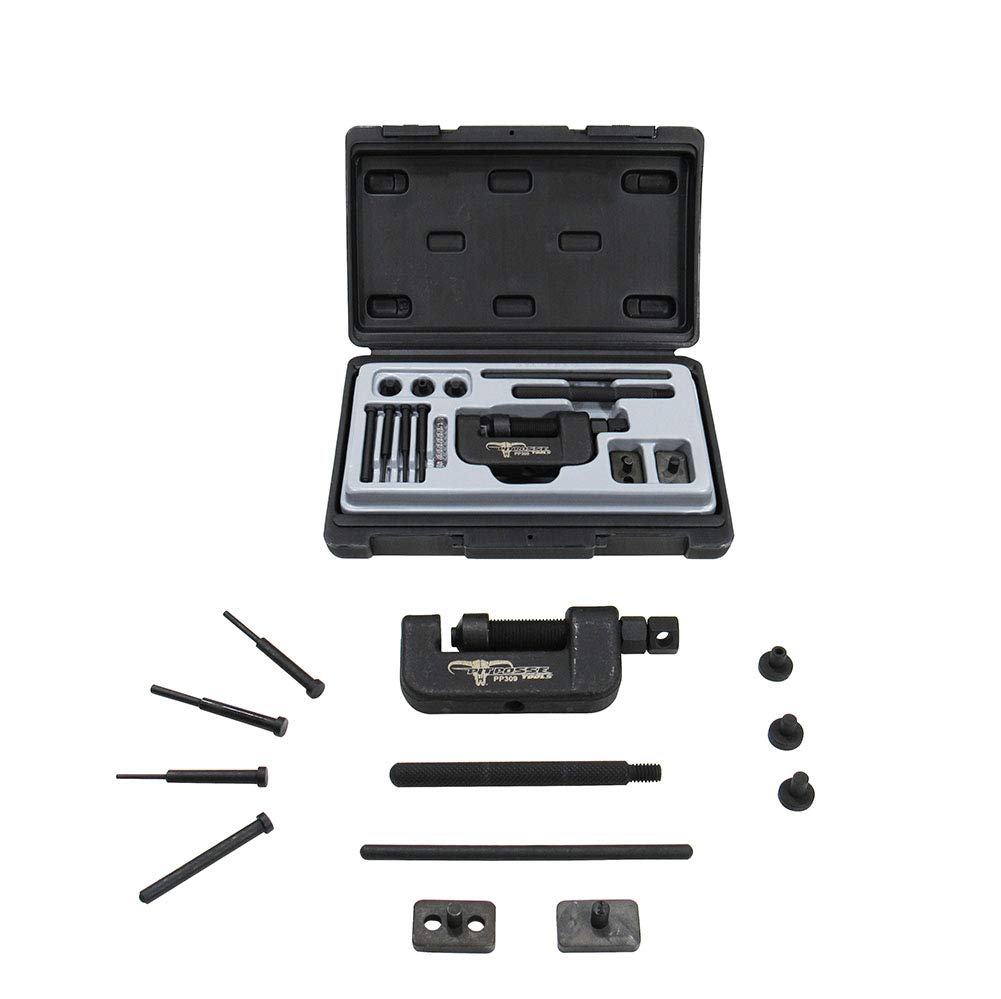
The Pit Posse PP309 brings 16 components in a zippered carrying case — three breaking tips, two anvils, a rivet tip, upper and lower guides, a spring, lever, handle, alignment bolt, push bolt, two press plates, and a manual. This kit is designed for a two-step process: use the breaking tips to punch out old rivets, then swap to the press plates and anvil to install the new master link. It covers chains from #25 through #630, including cam chains.
Durability is a mixed bag. Several owners report that the tool body functions well for light to medium use — breaking a chain and installing a new one without issues. The zinc-plated finish, however, has shown surface rust on some units within days of opening the box, particularly in humid climates. The breaking tips are replaceable, but the anvils may need slight filing to fit into the body if the thread tolerances are tight.
For the price-conscious mechanic who only does one chain every couple of seasons, this kit provides every bit you need. The trade-off is that consistency varies between units. Inspect all pieces before the first use and check that the handle threads fully into the body. If it doesn’t, return it immediately — a correctly functioning unit works well for the price point.
What works
- 16 pieces cover cam and drive chains
- Replaceable breaking tips extend tool life
- Included case keeps everything organized
- Works on #25 through #630 sizes
What doesn’t
- Surface rust reported on some units out of box
- Anvil fitment varies between units
6. Tusk Heavy Duty Chain Breaker Rivet Tool
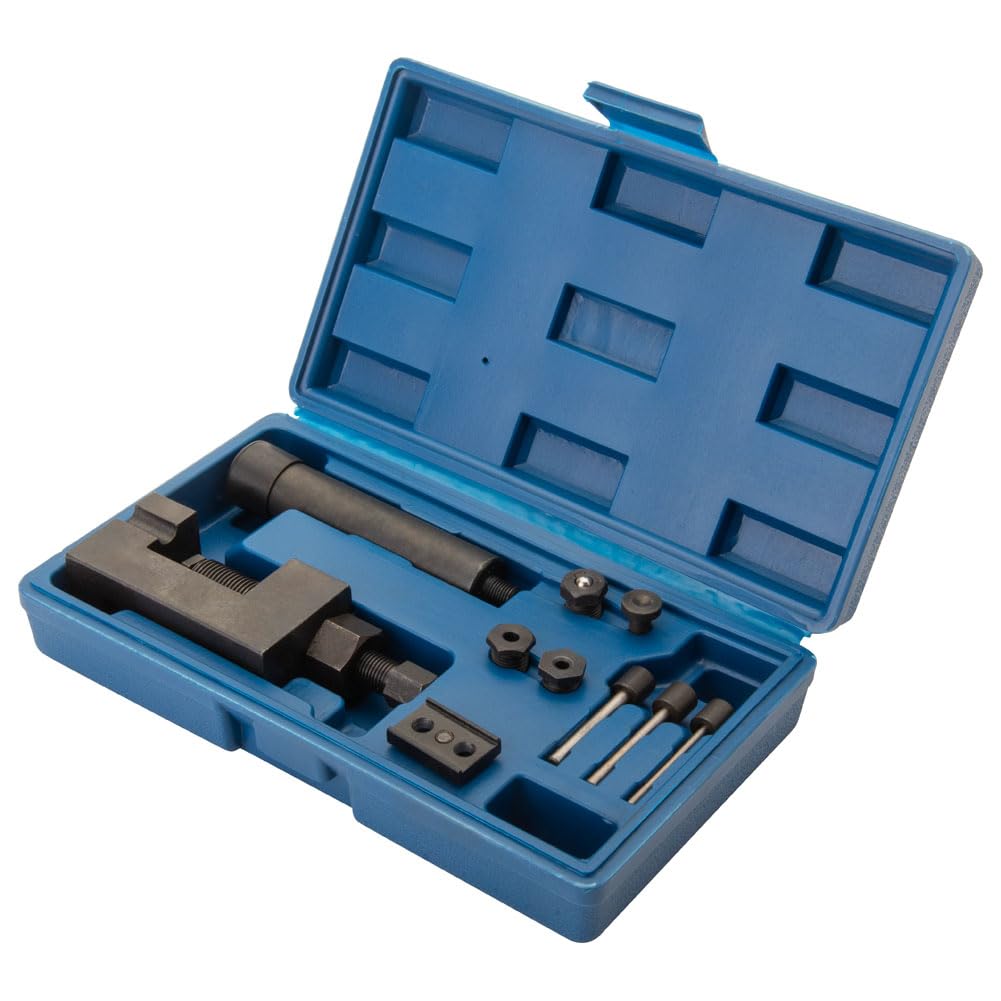
The Tusk Heavy Duty tool packs 2.55 pounds of steel into a compact brick-like form factor intended for 520, 525, and 530 chains. It combines a breaker function and a rivet function in a single body design, and the heavy construction provides the leverage needed to push out stubborn rivets without flexing the tool frame. This is particularly valuable on older chains where rust has fused the pin to the bushing.
User reports from Africa Twin owners running 525VX3 chains confirm the tool breaks and rivets effectively when used slowly with controlled turns. The key warning is to never rush the screw mechanism — one user crushed an O-ring by advancing the press too quickly. The tool works best when you back off half a turn between each full turn of the handle, giving the metal time to move without binding.
The biggest frustration is quality control on the packaging and condition of the item upon arrival. Multiple buyers have received units with white residue on the case, surface rust, or signs of previous use. The tool itself functions well when undamaged, but you should inspect it immediately upon delivery and return any unit that shows wear consistent with prior handling.
What works
- Heavy steel frame prevents flex under load
- Single-body design for breaker and rivet
- Works on hardened 525 chains without issue
- Generous leverage for stuck pins
What doesn’t
- Units sometimes arrive used or rusted
- Easy to over-tighten and crush O-rings
7. Motion Pro Master Link Press Tool

This Motion Pro tool focuses exclusively on pressing master links — no breaker function, no riveting anvil. At 5.6 ounces, it’s the lightest option in this guide and was designed specifically for riders who use clip-style master links and need a controlled way to seat the side plate without a bench vise. The small footprint makes it ideal for stashing in a trail-side repair kit or under the seat for emergency roadside use.
The tool works by sandwiching the master link between two press plates and advancing a screw to push the plate into place. Owners who upgraded from decades of using a screwdriver and vice grips report that this tool makes the job trivial — the side plate seats evenly without galling the pin surface. It’s designed for modern press-fit master links where the plate doesn’t slide on by hand.
The limitation is clear: this tool cannot flare rivet heads or break old chains. If your bike uses a rivet-style master link (common on higher-horsepower bikes), you’ll need to pair this press with a separate breaker and rivet tool. Also, some 530 chain side plates are too wide to fit between the anvil blocks without tapping the link into place with a mallet — verify your chain pitch before relying on this for a planned job.
What works
- Ultra-light and portable for tool rolls
- Even plate pressure prevents crooked installation
- Simplifies press-fit master link seating
- Motion Pro build quality with durable paint finish
What doesn’t
- No breaker or rivet function
- 530 chain links may require forcing into anvil
Hardware & Specs Guide
Pin Diameter and Chain Pitch
Chain pitch determines the distance between pin centers, and tool compatibility hinges on whether the anvil gap matches the side-plate width. A 520 chain has a 5/8-inch pitch with a roller width of 1/4 inch; 530 chains use the same pitch but with a 3/8-inch roller width. Tools that only specify “520-530” may still struggle with the wider side plates of a 530 rivet-link setup. Measure your current chain’s side-plate width at the master link. If the tool’s anvil opening is narrower than the side plate, you will have to force the link in — which can deform it permanently. The D.I.D KM500R and RK UCT2100 avoid this issue by providing adjustable or wide-mouth anvil designs.
Tool Steel Composition
The breaker pin takes the most abuse. Low-carbon steel pins mushroom after a few uses, locking themselves into the tool body. Premium tools like the RK UCT2100 use SKH9 high-speed steel, which maintains hardness up to 600°F during the friction of punching through a rivet. Forgers treat the D.I.D KM500R body with a black oxide coating that reduces galling on the threads. The Motion Pro PBR uses a through-hardened alloy steel that resists bending even when the breaker pin is slightly off-center. A replaceable pin design — like the Pit Posse PP309 offers — lets you swap a worn pin instead of discarding the entire tool, but only if the tool body threads remain undamaged.
FAQ
Can I use a chain breaker tool on a clip-style master link?
How do I know if my chain tool is damaging the O-rings?
Do I need to grind the old rivet head before using the breaker pin?
Final Thoughts: The Verdict
For most buyers, the chain tool for motorcycle winner is the D.I.D KM500R because it combines forged steel durability, a mechanical over-riveting stop, and compatibility with the most common chain sizes. If you need a tool that handles multiple chain brands without pre-grinding, grab the RK Racing Chain UCT2100 for its SKH9 steel pin and ergonomic handle. And for a dedicated breaker that gives you zero-play pin alignment, nothing beats the Motion Pro 08-0470 PBR. Each of these tools eliminates the frustration of a bad chain installation and ensures your master link is safe for the road.

Certification: BSc in Mechanical Engineering
Education: Mechanical engineer
Lives In: 539 W Commerce St, Dallas, TX 75208, USA
Md Amir is an auto mechanic student and writer with over half a decade of experience in the automotive field. He has worked with top automotive brands such as Lexus, Quantum, and also owns two automotive blogs autocarneed.com and taxiwiz.com.