Electric vehicle owners face a unique tire dilemma: the instant torque from an electric motor shreds conventional rubber in record time, while the added weight of a battery pack demands a compound that can handle a heavier load without sacrificing rolling efficiency. An all-season tire designed without EV-specific needs in mind can drain your range by 10–15% and wear out twice as fast as expected. Choosing the right set means balancing low rolling resistance for maximum miles per kilowatt-hour against the grip needed to handle heavy, instant acceleration in rain, dry heat, and light snow.
I’m Amir — the founder and writer behind Four Wheel Ask. I’ve spent years analyzing tire compounds, tread patterns, load indexes, and UTQG ratings across hundreds of models to identify which all-season tires genuinely deliver for the unique demands of electric vehicles.
This guide breaks down the top options for keeping your EV planted, quiet, and efficient through every season. Whether you drive a Tesla, Hyundai Ioniq, Ford Mustang Mach-E, or Kia EV6, you’ll find the all season tires for electric vehicles that match your driving style and budget.
How To Choose The Best All Season Tires For Electric Vehicles
Electric vehicles impose forces on tires that gas-powered cars simply do not. The curb weight of a typical EV is 500–1,000 pounds heavier than its combustion counterpart, and the electric motor delivers peak torque from zero RPM — meaning your tires experience maximum force the instant you press the pedal. Without the right load range, compound, and tread design, you’ll lose range, wear out tires in 20,000 miles, and fight road noise that ruins the EV’s natural silence.
Load Index and XL Construction
The single most overlooked spec on an EV tire is the load index. Standard load (SL) tires often cannot safely carry the weight of a modern EV battery pack — especially in the rear where many packs sit. Look for XL (Extra Load) construction, which typically adds 10–15% more load capacity than a standard SL tire at the same inflation pressure. A load index of 94 (1,477 pounds per tire) is a good starting point, but many larger EVs require 103 (1,929 pounds) or higher. Run your vehicle’s gross axle weight rating against the tire’s load capacity before buying anything.
Rolling Resistance and Range Impact
Every pound of rolling resistance directly subtracts from your EV’s kilowatt-hour budget. A tire formulated with a low-rolling-resistance tread compound — typically silica-based rather than carbon-black-heavy — can reduce energy loss by 10–20% compared to an aggressive summer-performance tire. Look for tire manufacturers that advertise eco-friendly tread compounds or fuel-saving technology; those same attributes translate directly to longer EV range. Avoid any tire with deep, aggressive tread blocks unless you genuinely need snow traction daily, as they increase friction and drain the battery faster.
Noise Control: Siping and Pitch Sequencing
An EV has no engine noise to mask tire hum, so every decibel of road noise enters the cabin directly. The best all-season tires for EVs use variable-pitch tread sequencing — where the size and spacing of tread elements vary randomly — to break up harmonic noise frequencies. Lateral siping on outer blocks also helps by allowing the rubber to deform slightly over road imperfections rather than transmitting vibration. If a tire review mentions “quiet ride” or “low road noise” from owners of gas sedans, expect that noise to be even more apparent inside an EV. Prioritize tires with documented noise-reduction engineering.
Quick Comparison
On smaller screens, swipe sideways to see the full table.
| Model | Category | Best For | Key Spec | Amazon |
|---|---|---|---|---|
| Michelin Pilot Sport AS 4 | UHP All-Season | Performance EV handling | XL Load Range | Amazon |
| Goodyear Assurance Finesse | Eco All-Season | Range-focused EV driving | Low rolling resistance | Amazon |
| MICHELIN Defender2 | Long-Life All-Season | High-mileage EV longevity | 80,000-mile warranty | Amazon |
| Pirelli P Zero All Season | Grand Touring All-Season | Quiet EV highway cruising | Variable pitch sequencing | Amazon |
| Continental ProContact TX | Touring All-Season | Wet-weather confidence | 65,000-mile treadwear | Amazon |
| Mastertrack M-TRAC GT | UHP All-Season | Aggressive driving, EV torque | 460 AA UTQG | Amazon |
| Goodyear Eagle Touring | Touring All-Season | Budget EV daily driving | 99 load index | Amazon |
| Forceum Octa | Performance All-Season | Entry-level EV performance | 400 AA UTQG | Amazon |
| Fullway HP108 | Truck/SUV All-Season | Budget EV truck/SUV grip | XL, 4-ply rated | Amazon |
In‑Depth Reviews
1. Michelin Pilot Sport AS 4
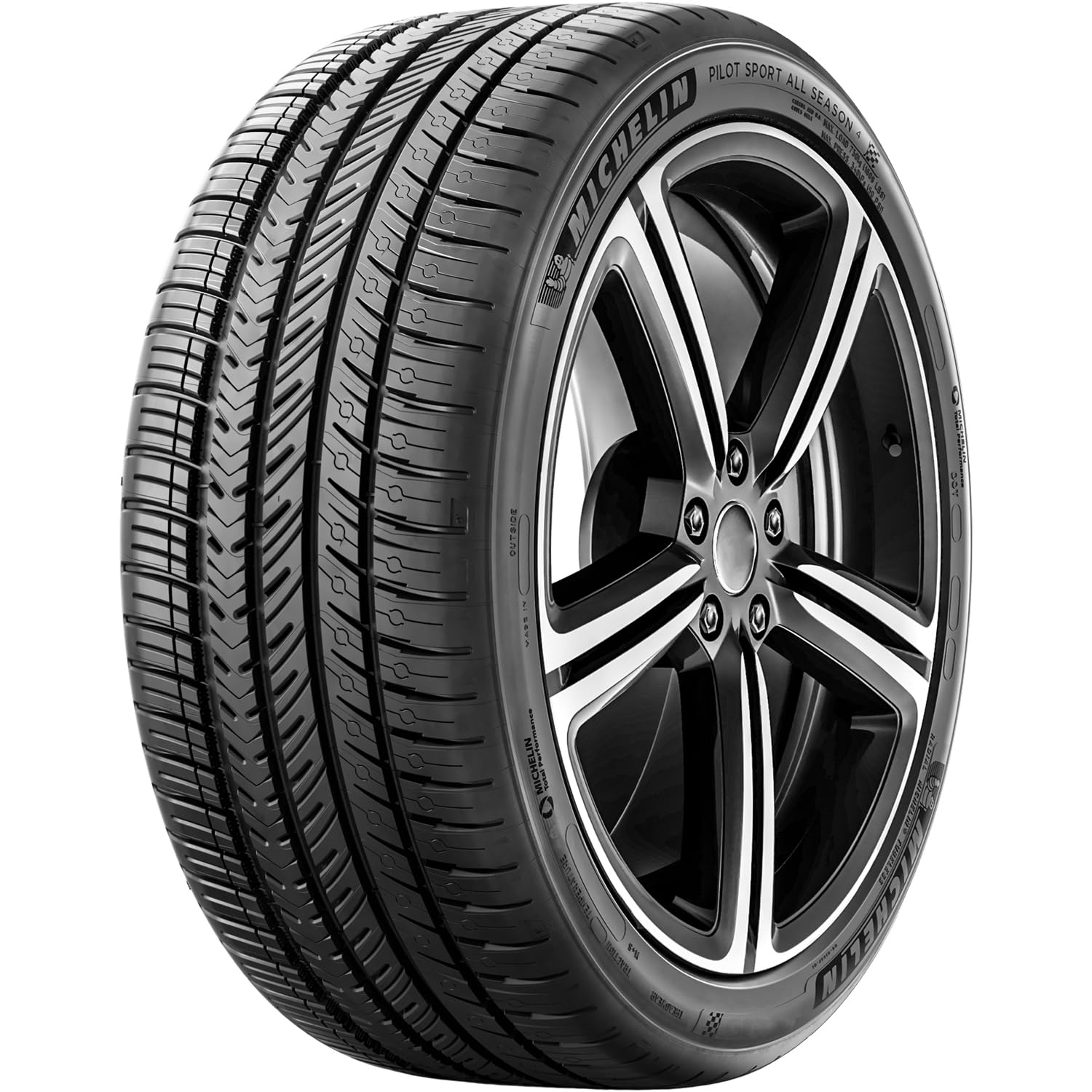
The Michelin Pilot Sport AS 4 is the benchmark ultra-high-performance all-season tire that EV owners with a heavy right foot should consider first. Its Dynamic Response Technology distributes forces and temperature evenly across the tread face, which matters enormously when an electric motor dumps instant torque through the contact patch. The asymmetric tread pattern combines a stiff outer shoulder for dry cornering with silica-infused inner compound for wet braking — a dual approach that keeps an EV planted during aggressive acceleration from a stop.
The XL load range rating means it can safely carry the 4,500–5,000-pound curb weight of a typical mid-size EV without sidewall deformation that would kill steering precision. Owners of sporty EVs like the Tesla Model 3 Performance or Hyundai Ioniq 6 report that the Pilot Sport AS 4 maintains steering feel and lateral grip well beyond what standard touring tires can deliver at comparable pressures. The trade-off is that this tire prioritizes performance over absolute low rolling resistance — expect a modest range reduction compared to dedicated eco-focused rubber.
Winter confidence on this tire is real for light snow, though it is not a substitute for a dedicated winter set if you live in an area with heavy snowfall. The variable-pitch tread sequencing does an excellent job minimizing harmonic drone at highway speeds, which is critical in a cabin with no engine noise to mask tire hum. For an EV driver who values responsive handling and wet grip above maximum range, this is the benchmark.
What works
- Exceptional dry and wet grip for an all-season tire
- XL construction safely handles EV weight loads
- Low noise at highway speeds for a UHP tire
What doesn’t
- Higher rolling resistance than eco-focused tires
- Premium pricing makes it a significant investment
2. Goodyear Assurance Finesse

The Goodyear Assurance Finesse is engineered specifically for drivers who care about energy efficiency first and foremost. Its patented low rolling resistance tread compound is formulated with a silica-heavy blend that reduces internal friction within the rubber, which directly translates to less energy wasted as heat and more kilowatt-hours pushing the car forward. Owners of hybrids and EVs — including documented feedback from a 2024 CR-V Sport-L Hybrid owner in Western NY — consistently report excellent wet and winter grip without the range penalty that aggressive tread designs impose.
The load index of 103 (1,929 pounds per tire) provides a comfortable safety margin for heavier EVs that exceed standard SL tire limits. The optimized road contact patch is designed to wear evenly across the tread face, which matters because EV torque tends to accelerate center-tread wear on tires not designed for it. Goodyear also incorporated a specially formulated rubber compound that maintains flexibility in colder temperatures without hardening, which improves snow traction without resorting to deep, energy-sapping tread blocks.
One concern reported by an owner was that two of the four tires arrived with manufacturing dates from 2022 — roughly three years old. While five to six years of rubber life is generally considered acceptable, it is worth checking the DOT date code upon delivery to ensure optimal compound freshness for an EV that will be driven year-round. The ride quality is genuinely comfortable and quiet, making it a strong choice for daily commuting where range preservation matters more than cornering thrills.
What works
- Low rolling resistance extends EV driving range
- High load index safely supports heavy EV battery packs
- Competent snow traction in moderate winter conditions
What doesn’t
- Possible older manufacturing date stock
- Not designed for aggressive cornering or high-speed driving
3. MICHELIN Defender2

The MICHELIN Defender2 is the tire you buy when your EV racks up 20,000 miles per year and you want to forget about replacements for the next four years. Michelin’s engineering claims that this tire outlasts three leading competitive tires by up to 25,000 miles in treadwear testing — a bold statement that aligns with its 80,000-mile manufacturer’s treadwear limited warranty. For an EV owner, that warranty coverage matters because the instant torque profile tends to accelerate treadwear versus a comparable gas vehicle, and having that protection is a tangible advantage.
Locking 3-D sipes create hundreds of biting edges that maintain grip as the tread wears, which is exactly what you need when an EV’s weight and torque combine to scrub rubber faster at low tread depths. The Defender2 supports load capacities up to 2,271 pounds per tire with its 109 load index in XL construction — enough for large crossover EVs like the Ford Mustang Mach-E or Tesla Model Y. Owners report immediate improvements in road-holding stability after switching from the factory tires, especially when the roads are slick.
The 60-day satisfaction guarantee gives you room to evaluate the tires on your specific EV before committing fully. The main trade-off is that the Defender2 is a grand-touring tire, not a performance tire — it prioritizes tread life and wet-braking confidence over ultimate dry cornering grip. If your daily drive involves enthusiastic corners rather than straight-line highway miles, a UHP tire like the Michelin Pilot Sport AS 4 may be a better fit despite its shorter lifespan.
What works
- Exceptional treadwear warranty for high-mileage EV owners
- Very high load capacity for heavy electric crossovers
- Reliable wet and dry stopping performance
What doesn’t
- Less sporty handling feel than UHP alternatives
- Premium price point may exceed budget constraints
4. Pirelli P Zero All Season

The Pirelli P Zero All Season brings motorsport-derived tread engineering to the EV segment without the typical noise penalty. Lateral siping on the outer blocks is optimized to maintain cornering control during hydroplaning situations, while winter siping technology on the inner blocks improves snow traction — a dual-zone approach that suits an EV’s variable weight distribution. Select sizes are available with Pirelli Noise Cancelling System (PNCS), which uses a foam insert inside the tire cavity to dampen cavity resonance noise, making this one of the quietest tire options for an EV cabin.
The variable sized tread elements with a specific pitch sequence are engineered to minimize noise inside the vehicle, and owners of sedans like the Honda Accord Sport and Toyota Camry LE confirm that these tires are noticeably quieter than comparable performance all-seasons. For an EV, where wind noise and tire noise dominate the acoustic environment at highway speeds, this matters enormously. The circumferential grooves within the tread quickly evacuate water to reduce hydroplaning risk, providing confidence in heavy rain conditions that often expose cheap tires.
Load capacity sits at 1,477 pounds per tire (load index 94) in SL construction, which is adequate for lighter EVs like the Nissan Leaf or Chevy Bolt but may fall short for heavier crossovers. If your EV exceeds 4,500 pounds curb weight, you should verify that your specific size is available in XL or check the P Zero’s optional XL variants. The Pirelli is a solid mid-range option that balances noise comfort, all-season capability, and reasonable cost without compromising the EV’s natural quietness.
What works
- Very low cabin noise with PNCS technology
- Excellent hydroplaning resistance for wet climates
- Variable siping provides both dry and snow grip
What doesn’t
- SL load rating may not suit heavier EVs
- Warranty coverage not as extensive as Michelin offerings
5. Continental ProContact TX

The Continental ProContact TX is a touring all-season tire that delivers strong wet braking and handling metrics backed by a 65,000-mile limited treadwear coverage. For an EV owner who encounters frequent rain — or who lives in an area with unpredictable weather — the tire’s silica-infused compound provides reliable grip on slick pavement without the stiffness that often accompanies high-wear compounds. Multiple owners of sedans and coupes confirm that the ride is smooth and the road noise is low, which aligns well with the EV’s quiet cabin requirements.
The load index of 94 (1,477 pounds per tire) in SL construction is standard for passenger cars, but larger EVs with heavier curb weights should verify fitment before buying. The tire’s construction includes nylon reinforcement for high-speed stability, which helps maintain composure when an EV’s instant torque pushes the tire hard during highway merging. Continental’s reputation for consistent quality across production batches means you can rotate tires without worrying about significant differences in diameter or balance from one tire to the next.
The ProContact TX handles light snow with competence, but it is not designed for deep winter conditions — treat it as a three-season tire with light snow capability rather than a true winter tire. Some owners have noted that the traction is good but not outstanding in the first few hundred miles before the mold-release compound wears off. For an EV driver who values a comfortable, quiet ride with reliable wet-weather performance and a solid mileage warranty, the Continental delivers a balanced package without stretching the budget.
What works
- Very good wet braking and hydroplaning resistance
- Comfortable, low-noise ride for EV cabins
- Reassuring mileage warranty for long-term ownership
What doesn’t
- SL load rating may not support heavier EV models
- Not suitable for moderate or heavy snow conditions
6. Mastertrack M-TRAC GT
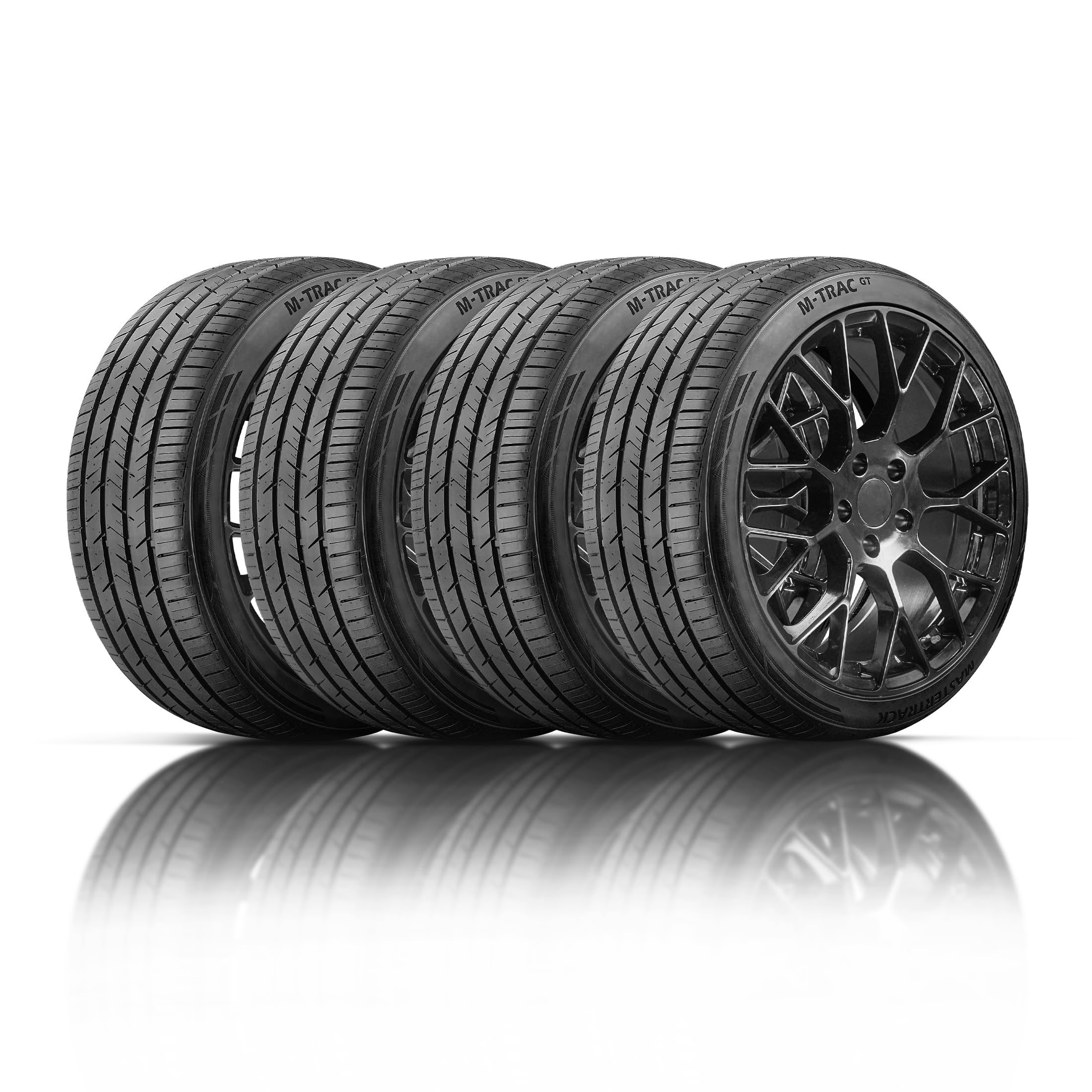
The Mastertrack M-TRAC GT is a set of four ultra-high-performance all-season tires that come loaded with a five-year manufacturer warranty and free three-year road hazard protection. With a UTQG rating of 460 AA, this tire is built for aggressive driving scenarios — its dual tread technology uses a 4-groove and 5-groove configuration depending on wheel width, and the manufacturer claims a 22% reduction in hydroplaning risk compared to standard designs. For an EV owner who regularly uses the instant torque for spirited driving, the rigid outer blocks and silica inner compound offer a genuine dual-compound approach that supports 1.5G lateral acceleration claims.
The load index of 105 (2,039 pounds per tire) in XL construction makes this tire suitable for heavier EVs, including performance crossovers like the Tesla Model Y Performance or the Ford Mustang Mach-E GT. The 2P+2S+1N compound layering is designed to warm up 30% faster than standard ZR tires, which matters on cold mornings when an EV’s full torque is available immediately but the tread rubber needs temperature before it can deliver maximum grip. Owners report increased mileage per tank — by 30 to 40 miles — which suggests that the rolling resistance is not excessively high despite the aggressive tread pattern.
One owner noted that the tires are “somewhat loud,” which is a common trade-off with UHP rubber that offers high dry grip. In a gas car, engine noise would partially mask this; in an EV, the tire hum will be more noticeable, especially on coarse asphalt. If absolute cabin silence is your priority, a touring tire like the Continental ProContact TX or Pirelli P Zero All Season would be a better fit. For EV drivers who prioritize handling response, warranty protection, and load capacity above whisper-quiet operation, the M-TRAC GT is a compelling package.
What works
- High UTQG rating for strong wear and temperature resistance
- XL load rating supports heavy performance EVs
- Comprehensive warranty and road hazard protection included
What doesn’t
- Higher road noise compared to touring tires
- May be overbuilt for EV drivers who drive conservatively
7. Goodyear Eagle Touring All Season
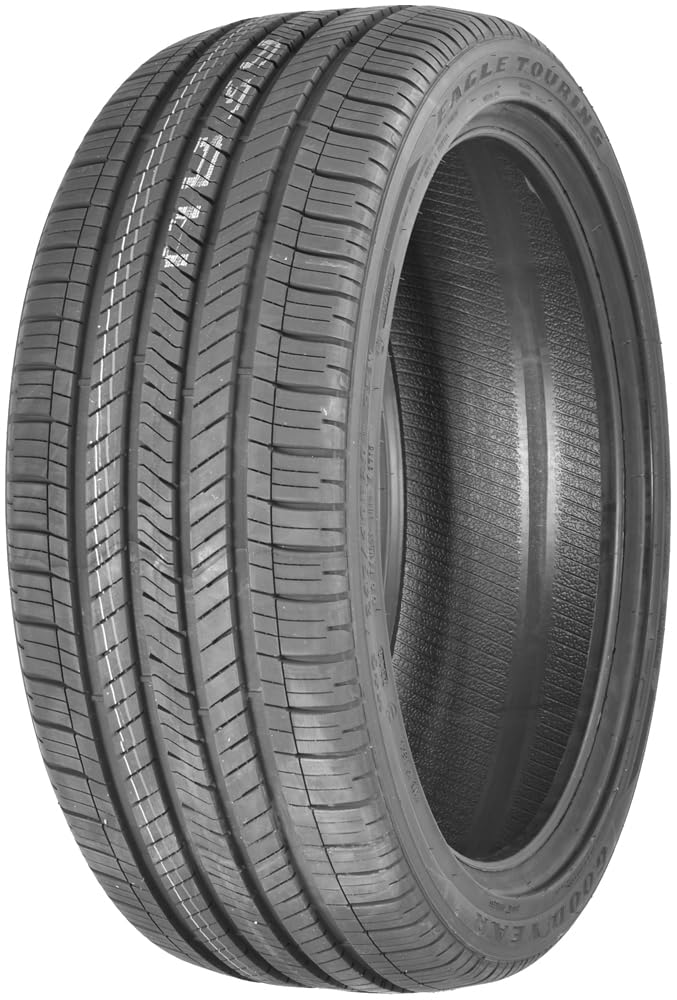
The Goodyear Eagle Touring All Season proves that you do not need to spend premium money to get solid grip and a quiet ride for your EV. The tire’s optimized tread pattern is specifically designed to quiet noise from on-road driving, which owners of Dodge Charger R/T and Challenger R/T vehicles have confirmed in real-world use. For an EV, where every decibel is audible, the fact that multiple reviewers describe these tires as “quiet” and “smooth” is a meaningful signal that they will not ruin your driving experience through cabin roar.
The biting edges integrated into the tread design provide confident all-season traction in wet, dry, and snowy conditions — one owner reported driving through a Michigan first big snow without a single slip. The load index of 99 is appropriate for lighter to mid-weight EVs, though heavier crossovers should verify the specific load capacity against their vehicle’s axle weights. The construction is radial SL, so if your EV is on the heavier side — say, over 4,500 pounds — you should look for an XL-rated tire instead.
The main limitation of this tire is that it is a touring design, not a high-performance one. It delivers predictable cornering and solid braking but will not match the steering response of a dedicated UHP tire. For the EV commuter who drives sensibly and values cost efficiency over lap-time performance, the Eagle Touring offers a compelling balance of price, noise comfort, and all-season traction. Just make sure to check the manufacturing date upon delivery to avoid aged stock.
What works
- Very affordable entry point for EV tire replacement
- Quiet ride that suits an EV’s silent cabin
- Surprisingly capable snow traction for a touring tire
What doesn’t
- SL load range not ideal for heavy EV models
- Moderate performance limits under hard acceleration
8. Forceum Octa
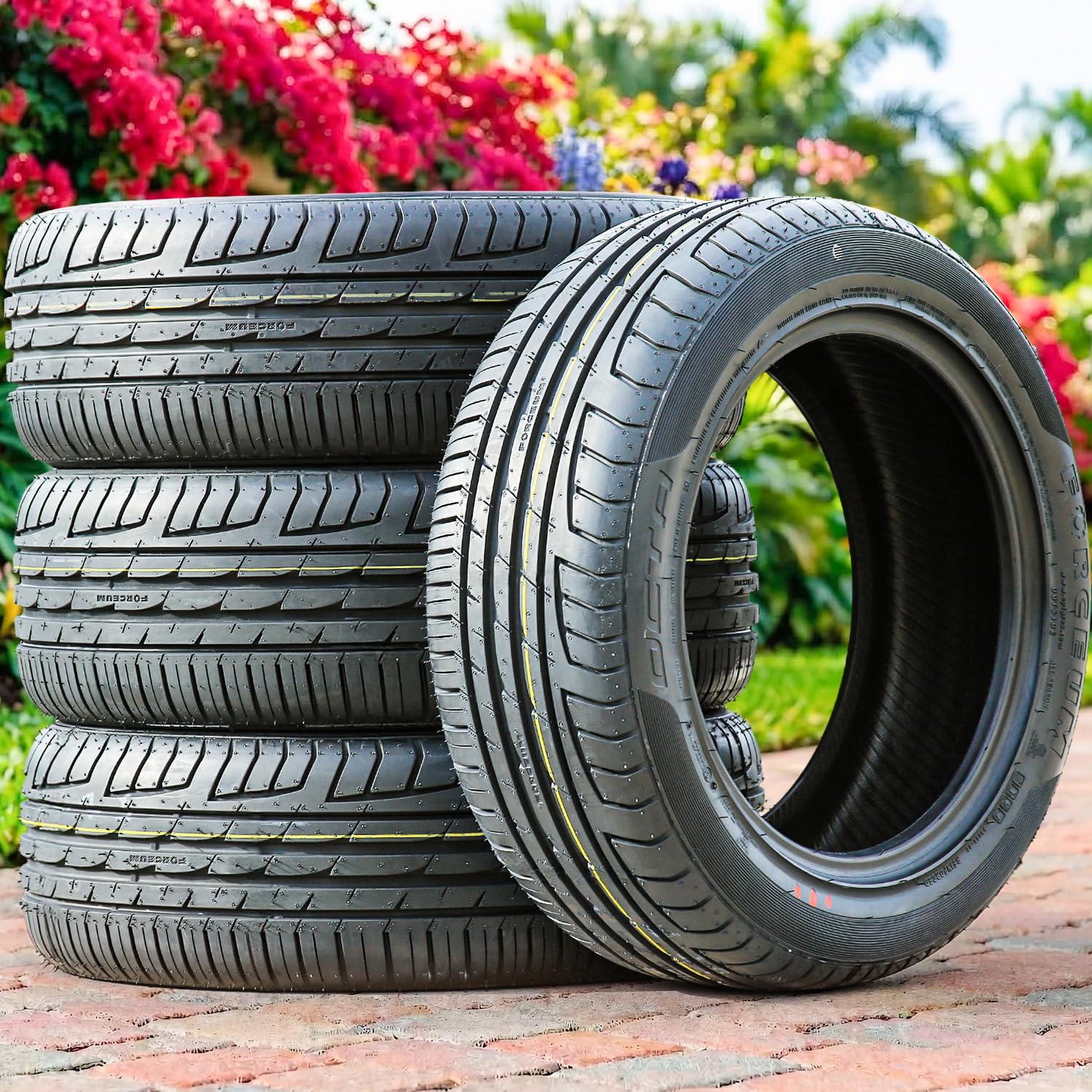
The Forceum Octa is a budget-oriented high-performance all-season tire that sets of four coming in at a very accessible price point. The 400 AA UTQG rating indicates respectable treadwear and temperature resistance for the cost, while XL load range construction means it can handle heavier vehicles — including mid-weight EVs — without sidewall concerns. Owners driving 80 miles daily in upstate NY report that the tires perform well in snow and rain, which is impressive for a tire at this price tier.
The 4-ply construction and XL load capacity support the weight of many EVs that fall into the 3,500–4,500-pound range, though the 94 load index (1,477 pounds per tire) means you should not use these on the heaviest crossover EVs. The tire’s symmetric tread pattern wears evenly when properly rotated, and one owner noted that the tires required very little balancing weight during installation — a good indicator of consistent manufacturing quality. For an EV that is used primarily for commuting or errands, the Forceum Octa delivers functional grip without draining the budget.
The biggest caveat is that this is a budget tire, and the compound will not last as long or perform at the same level as a premium tire from Michelin or Continental. Expect shorter tread life under EV torque loads, and anticipate less refined wet braking and snow traction than premium competitors. However, for an EV owner who needs a set of four tires delivered and installed for a fraction of the cost of premium rubber, the Forceum Octa is a legitimate option that punches above its weight class.
What works
- Very attractive price for a set of four XL tires
- Competent snow and rain traction for the cost
- XL load rating supports many mid-weight EVs
What doesn’t
- Shorter tread life under EV torque compared to premium tires
- Less refined wet braking and overall performance
9. Fullway HP108
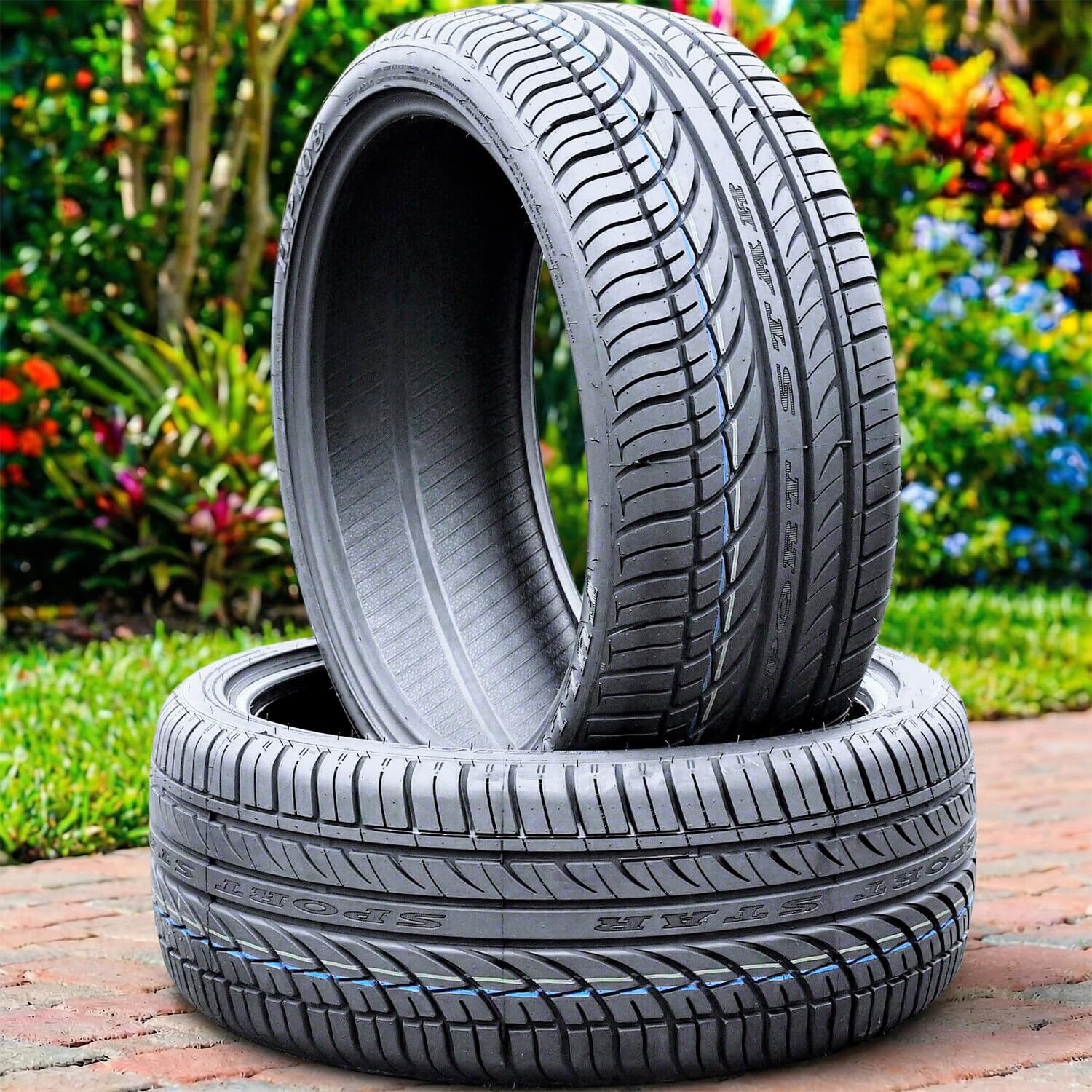
The Fullway HP108 is a budget truck/SUV high-performance radial that comes in a set of two tires at an entry-level price. For an EV owner with a crossover or truck — such as a Rivian R1T or Ford F-150 Lightning that can fit this tire’s 245/45R20 sizing — the XL load range and 4-ply construction provide the strength needed to handle heavy battery weight. Owners of vehicles like the Dodge Charger and Chrysler 300 report that these tires last 15,000 miles and still have life left, which is a strong sign for a budget tire under sustained torque loads.
The 103 load index (1,929 pounds per tire) gives it a wide safety margin for heavier EVs, and the 4-ply sidewall construction resists the sidewall flex that degrades handling on heavy vehicles. Owners note that the tires are “thick and nice looking” and that the ride quality after installation is smooth, with minimal balance weight required. Rain traction is rated as “surprisingly good” by multiple owners, which matters for EV drivers who need confidence in wet conditions without spending premium money.
The main trade-off is longevity. At this price point, the tread compound is designed to be cost-effective, not long-lasting. Under the constant torque load of an electric motor, you can expect faster wear than you would get from a premium tire like the Michelin Defender2. The HP108 is also a budget performance tire, so it will be somewhat louder than a dedicated touring tire inside the cabin. For an EV owner on a tight budget who needs XL-rated rubber for a heavier vehicle, this tire delivers where it counts without pretending to be a premium product.
What works
- Very low cost for XL-rated truck/SUV tires
- High load index suitable for heavy EVs
- Acceptable rain traction for the price
What doesn’t
- Shorter tread life under EV torque loads
- Higher road noise compared to touring tires
Hardware & Specs Guide
Load Index and Load Range (SL vs XL)
Every tire carries a numeric load index that indicates its maximum safe carrying capacity at full inflation pressure. For EVs, XL (Extra Load) tires are strongly recommended because the weight of the battery pack pushes the vehicle’s gross weight beyond what standard SL tires can handle. A typical mid-size EV may require a load index of 98 or higher, while large crossovers often need 103–109. Always verify your vehicle’s recommended load index from the doorjamb sticker — do not guess based on the gas version of the same model.
UTQG Ratings: Treadwear, Traction, Temperature
The Uniform Tire Quality Grading system provides a standardized comparison across brands. The treadwear grade (e.g., 400, 460, 500) indicates expected wear rate — higher numbers mean longer life, but EV torque can reduce the effective mileage. The traction grade (AA, A, B, C) measures wet stopping distance, and the temperature grade (A, B, C) indicates the tire’s ability to dissipate heat at high speeds. For an EV, look for a traction grade of AA and a temperature grade of A to ensure the tire can handle the instant heat buildup from aggressive acceleration.
Rolling Resistance and Range Optimization
Tires account for roughly 15–20% of an EV’s total energy consumption at highway speeds. A low rolling resistance tire uses a silica-based tread compound that reduces internal friction, while an aggressive performance tire with deep tread blocks increases friction and reduces your driving range. If range is your top priority, choose a touring tire with a smooth rolling compound. If you need more cornering grip, accept that you will lose some miles per kilowatt-hour — typically 5–10% compared to an eco-focused tire.
Noise Attenuation: Siping and Tread Pitch
Without an internal combustion engine masking tire noise, every irregularity in the tread pattern becomes audible inside an EV. Variable pitch sequencing — where tread blocks are spaced at different, aperiodic intervals — prevents the buildup of resonant frequencies that cause droning. Lateral siping (small slits incised into the tread blocks) allows the rubber to deform over pavement imperfections rather than transmitting vibration into the suspension. Tires with quieter tread patterns will always feel more premium in an EV than those optimized purely for grip.
FAQ
Can I use standard all-season tires on my EV?
How do I know if a tire has low rolling resistance for my EV?
Will EV torque wear out my tires faster than a gas car?
What load index do I need for a Tesla Model Y or Ford Mustang Mach-E?
Do I need a specific “EV certified” tire or can any all-season work?
Final Thoughts: The Verdict
For most buyers, the best all season tires for electric vehicles winner is the Michelin Pilot Sport AS 4 because it combines XL load capacity, exceptional wet and dry grip, and surprisingly quiet operation in a package that handles instant torque without compromise. If you want maximum driving range and tread life, grab the MICHELIN Defender2 with its 80,000-mile warranty and low rolling resistance compound. And for a budget-friendly option that still offers XL construction and solid all-season traction, nothing beats the Forceum Octa for price-conscious EV owners.

Certification: BSc in Mechanical Engineering
Education: Mechanical engineer
Lives In: 539 W Commerce St, Dallas, TX 75208, USA
Md Amir is an auto mechanic student and writer with over half a decade of experience in the automotive field. He has worked with top automotive brands such as Lexus, Quantum, and also owns two automotive blogs autocarneed.com and taxiwiz.com.