Dead zones don’t announce themselves. You crest a hill, drop into a canyon, or cross a stretch of open highway and suddenly your call drops, your map freezes, and your music buffers into silence. A signal booster is the only piece of hardware that turns that frustration into a non-issue — and the difference between a good booster and a mediocre one comes down to band support, gain, and antenna design.
I’m Amir — the founder and writer behind Four Wheel Ask. I’ve spent years analyzing frequency-band compatibility charts, comparing amplifier gain curves, and studying owner-reported real-world performance across dozens of vehicle signal booster models to understand what actually works when you’re off the grid.
Anyone who frequently travels through remote regions knows the best cell booster for car keeps you connected and safe when you absolutely need it most.
How To Choose The Best Cell Booster For Car
Every signal booster on the market does the same basic job — capture a weak cellular signal, amplify it, and rebroadcast it inside your vehicle. But real-world performance varies dramatically based on three factors: frequency band support, amplifier gain, and antenna design. Understanding these specs before you buy saves you from buying a box that does nothing in your specific dead zone.
Frequency Bands and Carrier Compatibility
The most critical spec on any booster is the list of frequency bands it supports. Verizon, AT&T, T-Mobile, and U.S. Cellular each operate on different combinations of bands. A booster that covers Band 12/17 (700 MHz) works well for Verizon and AT&T in many areas, but misses T-Mobile’s main Band 71. If your carrier uses a band the booster doesn’t support, the device simply cannot amplify that signal. Always confirm your carrier’s primary bands in your region before buying.
Amplifier Gain and Real-World Coverage
Gain is measured in decibels (dB) and represents how much the booster amplifies the incoming signal. Most vehicle boosters fall between 50 dB and 65 dB of gain. In theory, higher gain means stronger amplification, but in practice the limiting factor is the quality of the signal the outside antenna can capture. A 65 dB booster with a poorly placed antenna often underperforms a 50 dB unit with an optimized antenna mount. Look for gain specs alongside real-world owner feedback rather than buying on numbers alone.
Antenna Type and Installation Requirements
Vehicle boosters use either omni-directional or directional outside antennas. Omni antennas receive signals from all directions — ideal for moving vehicles where the cell tower position changes constantly. Directional antennas must be pointed at a specific tower and work best for stationary setups like RVs parked at a campsite. Inside the vehicle, most kits use a patch antenna that sticks to a window or panel. The installation complexity ranges from simple magnetic-mount setups to permanent bracket installations requiring cable routing through tight spaces.
Single-User vs. Multi-User Performance
Basic boosters amplify signal for one device at a time, while premium units support multiple users and devices simultaneously. If you travel alone or only need navigation and calls, a single-user booster suffices. For families or work crews where everyone needs data, a multi-user model with higher total gain prevents the signal from splitting too thin across devices.
Quick Comparison
On smaller screens, swipe sideways to see the full table.
| Model | Category | Best For | Key Spec | Amazon |
|---|---|---|---|---|
| weBoost Drive 4G-X OTR | Premium | Truck & fleet use | 50 dB gain, multi-user | Amazon |
| APlusBoost SF-S1 | Premium | SUVs with roof racks | HD smart display, 5 bands | Amazon |
| HiBoost Travel 3.0 RV | Premium | RVs & campers | 50 dB gain, IP66 antenna | Amazon |
| GAGBK 6-Band Booster | Mid-Range | Overall value | 65 dB gain, 8 bands | Amazon |
| HiBoost Travel 3.0 Truck | Premium | Heavy-duty truck use | 50 dB gain, weatherproof | Amazon |
| SignalBrick Car Booster | Mid-Range | Easy DIY install | Omni antenna, AGC | Amazon |
| GAGBK Band 12/17 Booster | Budget | Entry-level price | 65 dB gain, compact | Amazon |
In-Depth Reviews
1. weBoost Drive 4G-X OTR

The weBoost Drive 4G-X OTR sits at the top of the vehicle booster segment for a reason — it delivers proven, repeatable signal improvement across all major U.S. carriers in a package built specifically for trucks and large vehicles. The 50 dB of gain won’t win a numbers race against some 65 dB competitors, but owner reports consistently show better real-world results because the antenna design and amplifier circuitry prioritize stable connections over raw amplification.
This kit ships with a 17-inch omni-directional antenna designed for mirror or CB-style mounting, a 3-way mount, mast extension, and side exit adapter. The booster supports multiple users simultaneously, so everyone in the cab gets stronger signal for calls, data, and hotspot use. Carriers covered include Verizon, AT&T, T-Mobile, Sprint, and U.S. Cellular across bands 12/17, 13, 5, 4, and 25/2. FCC approval confirms the unit meets safety and interference standards.
The biggest consideration is the price — this is a premium investment aimed at drivers who need reliable signal daily, not occasional weekend travelers. The trucker-specific mounting hardware also means it works best on vehicles with existing CB antenna mounts or mirror brackets. For over-the-road truckers or serious overlanders who treat connectivity as a safety requirement, the weBoost Drive 4G-X OTR justifies every component of its build.
What works
- Best-in-class real-world signal stability from a trusted brand
- Multi-user support with no noticeable signal splitting
- Complete truck-specific mounting kit included
What doesn’t
- Premium price point limits accessibility for casual users
- Installation requires existing mount points or professional help
2. APlusBoost SF-S1

The APlusBoost SF-S1 stands out in a market of black boxes by integrating a full HD smart display directly into the booster unit. This screen shows real-time indoor and outdoor signal strength, provides an installation guide, allows frequency band switching, and includes backlight adjustment and troubleshooting — all without requiring a smartphone app. For anyone who wants visibility into what their booster is actually doing, this display changes the ownership experience completely.
Under the hood, the SF-S1 is a five-band booster supporting 3G, 4G LTE, and 5G on bands 12/17, 13, 5, 4/66, and 2/25. It works with all major U.S. carriers including Verizon, AT&T, T-Mobile, Sprint, Straight Talk, and U.S. Cellular. The kit includes an omni-directional outside antenna with a foldable design for easy storage when not in use, plus an inside antenna and all necessary cabling. FCC approval is on file with ID 2A34B-SFZN007.
There is a specific installation requirement — the SF-S1 is designed for vehicles with a roof rack or similar mounting rack. The outside antenna needs that structure for proper placement. The 3-year warranty and dedicated support team add peace of mind. If your SUV or off-road vehicle already has a roof rack, this booster delivers premium signal intelligence that no other model matches.
What works
- HD display provides unparalleled real-time signal visibility
- Five-band coverage with 5G support across major carriers
- Foldable antenna design simplifies storage when not in use
What doesn’t
- Requires roof rack for antenna installation — not universal
- Higher price reflects the display premium over function
3. HiBoost Travel 3.0 RV

The HiBoost Travel 3.0 RV is engineered specifically for recreational vehicles, campers, vans, and trailers — vehicles that face unique signal challenges due to their metal construction and longer interior spaces. The kit delivers up to 50 dB of gain across bands 12/17, 13, 5, 4, 25/2, and 66, supporting 5G and 4G LTE for all major U.S. carriers. The outside antenna carries an IP66 weatherproof rating, is UV-resistant, and is heat-rated to 149°F, with a spring base that maintains stability even while driving on uneven surfaces.
Installation is designed for DIY owners with no professional help required. The kit includes a mounting bracket, two extension poles, a 26-foot exterior cable, an omni-directional indoor antenna with magnetic base, and both AC and DC power supplies. HiBoost provides an app with a video guide to walk through the setup step by step. The 3-year warranty and lifetime U.S.-based support — via app chat, phone, or email — add a layer of confidence that matters for RV owners who depend on their booster for extended trips.
The 50 dB gain figure is conservative compared to some 65 dB competitors, but HiBoost’s amplifier design prioritizes signal quality over raw numbers. Owner feedback indicates the Travel 3.0 RV reliably adds bars in moderate-to-weak signal zones rather than chasing marginal gains in fringe areas. For RV owners who want a weatherproof, easy-install solution with solid carrier support, this kit hits the sweet spot between capability and user-friendliness.
What works
- Weatherproof IP66 antenna built for RV road exposure
- Both AC and DC power options for campground or driving use
- U.S.-based lifetime support with 3-year warranty
What doesn’t
- 50 dB gain is lower than some competing models at similar price
- Antenna extension poles add complexity to installation
4. GAGBK 6-Band Booster
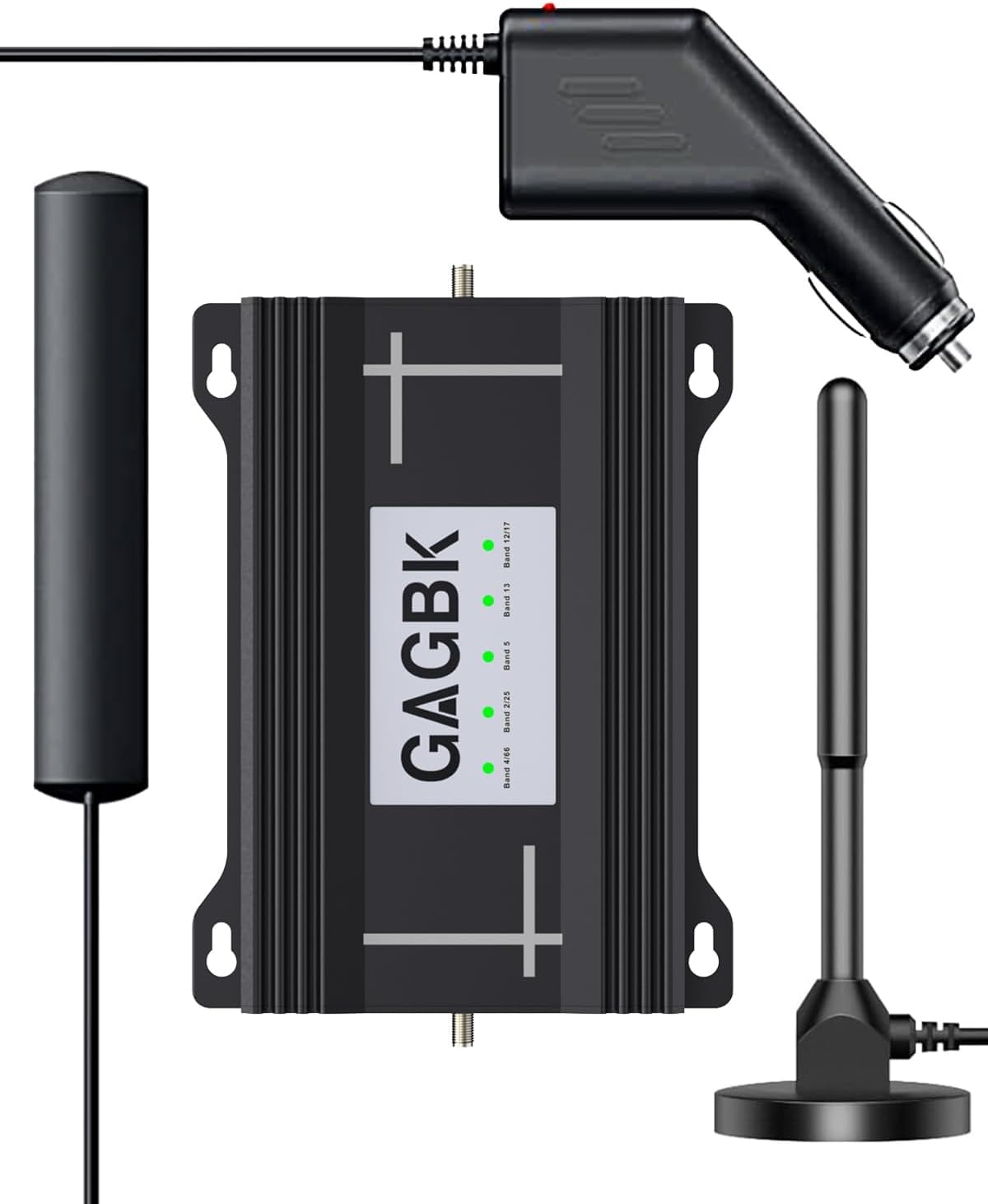
The GAGBK 6-Band Booster delivers one of the highest gain figures in its segment at 65 dB while supporting an unusually wide range of frequency bands for a mid-range product. Coverage includes bands 2, 4, 5, 12, 13, 17, 25, and 66 — which means it works with every major U.S. carrier including Verizon, AT&T, T-Mobile, Straight Talk, Cricket, and U.S. Cellular. The unit also supports 5G on n2, n5, n7, n12, n25, n41, n66, and n71.
The claimed communication range of 5-8 miles is ambitious, and real-world results depend heavily on terrain and tower distance. But the combination of high gain and broad band support gives this booster better odds of locking onto a usable signal in challenging fringe areas. Features include automatic gain control that adjusts in real time, inactivity mode to reduce power when not in use, and oscillation elimination to prevent feedback loops. Installation requires no drilling and takes about 10-20 minutes with the included magnetic whip antenna and indoor patch antenna.
GAGBK backs the unit with a 30-day money-back guarantee, 90-day replacement for defects, and a 3-year manufacturer warranty. The main trade-off is that the 65 dB gain can sometimes amplify noise alongside signal in very weak areas, and the aluminum alloy housing, while good for heat dissipation, feels less robust than the industrial-grade enclosures on premium competitors. For drivers who want maximum band coverage and high gain without stepping into premium pricing, this is the strongest value proposition available.
What works
- 65 dB gain is among the highest in this price category
- Broad 8-band support with 5G compatibility
- Simple no-drill installation in under 20 minutes
What doesn’t
- High gain can amplify background noise in weak signal zones
- Build quality trails industrial-grade premium competitors
5. HiBoost Travel 3.0 Truck

The HiBoost Travel 3.0 Truck is the heavy-duty sibling in HiBoost’s mobile booster lineup, purpose-built for trucks and SUVs that face vibration, weather extremes, and constant movement. The booster unit itself is encased in industrial-grade materials with a protective rubber cover, and the cables are thicker than standard to resist wear from road vibration. The high-gain outside antenna features a spring base that is shockproof and rustproof, designed to withstand harsh conditions without losing alignment.
Frequency support covers bands 12/17, 13, 5, 4, and 25/2 — the core bands used by Verizon, AT&T, T-Mobile, and U.S. Cellular. The 50 dB maximum gain is paired with an intelligent amplifier circuit that prioritizes signal stability over raw amplification, reducing the chance of oscillation or noise amplification in marginal conditions. The kit includes a 12V/3A DC power supply, indoor antenna with 9.84 feet of cable, outdoor antenna kit with 15 feet of cable, and two 15.74-inch extension poles. FCC approval is on file with ID OWWC230505S.
This booster shares the same 3-year warranty and U.S.-based support structure as the HiBoost RV model. The key difference is the ruggedization — the Travel 3.0 Truck is built to handle daily abuse that would damage lesser boosters. The trade-off is that the narrower band support compared to the GAGBK 6-Band means it may not perform as well on carriers using less common frequencies. For truck owners who prioritize durability above all else, this is the most physically resilient option available.
What works
- Industrial-grade construction with rubber cover and thick cables
- Shockproof spring antenna base resists road vibration
- U.S.-based support with 3-year warranty coverage
What doesn’t
- Narrower band support than some competitors at lower price
- 50 dB gain is adequate but not class-leading
6. SignalBrick Car Booster
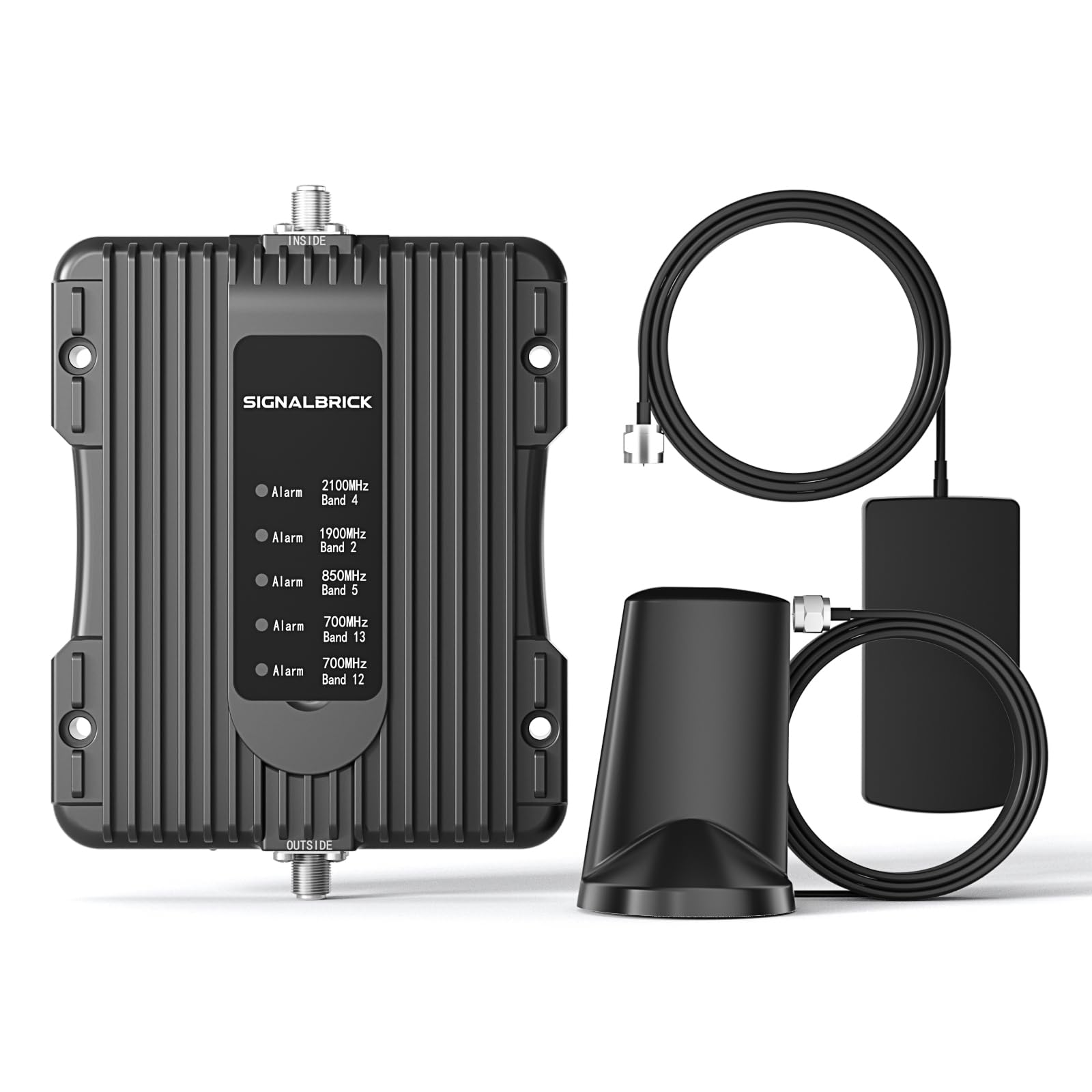
The SignalBrick Car Booster focuses on simplicity and broad carrier support at a mid-range price point. It covers bands 12/17, 13, 5, 2/25, and 4 — the five most commonly used bands across Verizon, AT&T, T-Mobile, Sprint, Straight Talk, and other U.S. carriers. The omni-directional outside antenna captures signal from all directions, eliminating the need to orient it toward a specific tower, which is ideal for moving vehicles where tower position changes constantly.
Intelligent automatic gain control adjusts signal strength and power levels in real time, reducing energy consumption while maintaining a stable connection. The LED indicator on the booster gives immediate visual feedback on signal reception status. Installation is genuinely straightforward — the magnetic outdoor antenna and indoor patch antenna require no drilling, and the entire process takes less than 30 minutes for one person. The 3-year warranty and FCC certification provide standard protection.
The main limitation is that SignalBrick does not specify a maximum gain figure in the same transparent way as competitors, and the real-world performance in very weak signal areas may be more conservative than the 65 dB units. This booster is best suited for daily commuters and moderate-use drivers who want reliable signal improvement in suburban and rural fringe zones without the complexity of premium kits. It delivers consistent, hassle-free performance that matches its mid-range positioning.
What works
- Simple installation with magnetic antennas — no drilling required
- Broad five-band coverage for all major carriers
- Automatic gain control optimizes signal in real time
What doesn’t
- No published gain spec makes comparison difficult
- Performance may underwhelm in very remote dead zones
7. GAGBK Band 12/17 Booster

The GAGBK Band 12/17 Booster is the entry-level option in this lineup, but it packs a surprising 65 dB of gain into a compact aluminum housing. The trade-off for the lower price is band support — this unit focuses specifically on bands 12, 13, and 17, which are the primary 700 MHz bands used by Verizon, AT&T, and compatible carriers. If your carrier operates mainly on these frequencies, this booster delivers high amplification where it matters most.
The kit includes an outside magnetic whip antenna with 16 feet of cable, an inside patch antenna with 10 feet of cable, and a 12V/2A power adapter with 3 feet of cable. Automatic gain control adjusts the amplification level in real time to prevent oscillation, an LED indicator shows connection status, and a sleep mode reduces power draw when the booster is not actively in use. FCC approval confirms compliance with safety standards. GAGBK supports the unit with a 30-day money-back guarantee, 90-day replacement, and 3-year manufacturer warranty.
The narrow band support is the limiting factor — if your carrier uses Band 4, 5, or 25 as a primary frequency, this booster will not amplify those signals. It also requires manual power-off when not in use for extended periods to avoid draining the car battery. For drivers on Verizon or AT&T who need a budget-friendly solution for basic call quality and data in moderate dead zones, the GAGBK Band 12/17 Booster offers remarkable value per dollar spent.
What works
- 65 dB gain at an entry-level price point
- Compact aluminum housing with good heat dissipation
- Sleep mode reduces power draw when not in use
What doesn’t
- Limited to bands 12/13/17 — not universal coverage
- Requires manual power-off to prevent battery drain
Hardware & Specs Guide
Gain and Coverage Explained
Amplifier gain, measured in decibels (dB), determines how much the booster increases the captured signal strength. A 50 dB booster amplifies a weak signal by a factor of 100,000, while a 65 dB booster pushes that to over 3 million times. In real-world driving, the higher gain helps in deeper fringe areas, but only if the outside antenna captures a usable signal in the first place. The coverage range inside the vehicle depends on the indoor antenna placement and the vehicle’s construction — metal roofs and window tinting can reduce rebroadcast effectiveness regardless of gain.
Frequency Bands and Carrier Support
Cellular carriers in the U.S. operate on specific frequency bands. Band 12/17 (700 MHz) and Band 13 (700 MHz) are the primary long-range bands for Verizon and AT&T. Band 4 (1700/2100 MHz) and Band 25/2 (1900 MHz) serve T-Mobile and additional capacity. Band 5 (850 MHz) is used across multiple carriers for backup coverage. A booster must support the exact bands your carrier uses in your region. Check your phone’s field test mode or carrier coverage map to identify the bands before choosing a booster, because buying one that misses your primary band means zero signal improvement.
Antenna Types and Placement
Omni-directional antennas receive signals equally from all directions and are the standard choice for moving vehicles where the nearest tower changes direction constantly. Directional antennas (Yagi style) offer higher gain toward a single tower but require manual aiming and are best for stationary RV or campsite use. The outside antenna must be placed on the vehicle roof or hood for best line-of-sight to the tower, with at least 12 inches of separation from the inside rebroadcast antenna to prevent oscillation feedback. Proper placement is the single most common installation mistake that reduces booster effectiveness.
Installation and Power Considerations
Most vehicle boosters draw power from the 12V accessory outlet (cigarette lighter) and require routing cables from the outside antenna through a door seal, window gap, or pre-existing grommet. Magnetic mount antennas simplify the process by requiring no drilling, but the cable must still enter the vehicle interior. Permanent bracket installations with roof racks or mirror mounts provide better stability for long-term use. Always remember to disconnect or power off the booster when not in use for extended periods to avoid parasitic battery drain, especially on older vehicle electrical systems.
FAQ
How do I know if a cell booster is compatible with my carrier?
Will a cell booster work in areas with zero signal?
Can I install a vehicle cell booster myself or do I need a professional?
Do I need a different booster for 5G versus 4G LTE?
Final Thoughts: The Verdict
For most buyers, the best cell booster for car winner is the weBoost Drive 4G-X OTR because it delivers the most consistent real-world signal improvement across carriers and vehicle types, backed by a brand with decades of RF engineering experience. If you want HD signal visibility and a modern display, grab the APlusBoost SF-S1. And for maximum value with broad band coverage, nothing beats the GAGBK 6-Band Booster for drivers who need high gain without the premium price.

Certification: BSc in Mechanical Engineering
Education: Mechanical engineer
Lives In: 539 W Commerce St, Dallas, TX 75208, USA
Md Amir is an auto mechanic student and writer with over half a decade of experience in the automotive field. He has worked with top automotive brands such as Lexus, Quantum, and also owns two automotive blogs autocarneed.com and taxiwiz.com.