A parking lot dent, a highway hit-and-run, or a false insurance claim — without clear footage you are left with he-said-she-said and a deductible. A proper security dash cam does not just record the road; it watches your parked car, logs GPS coordinates, and captures license plates in challenging light so you have irrefutable evidence when it matters most.
I’m Amir — the founder and writer behind Four Wheel Ask. My recommendations come from months of cross-referencing technical spec sheets, studying sensor performance data, and aggregating thousands of owner experiences across forums and verified purchase reviews.
The right choice depends on your specific needs: channel count for full coverage, sensor quality for night clarity, and parking mode sophistication for true 24/7 protection. This guide breaks down the top contenders to help you find the best car security dash cam for your vehicle and budget.
How To Choose The Best Car Security Dash Cam
Dash cams have evolved from simple recording devices into sophisticated security systems. Choosing the right one means understanding sensor technology, channel configurations, parking mode capabilities, and how these factors translate to real-world evidence capture. Here is what to prioritize.
Channel Count: Two vs Three Cameras
A 2-channel system covers front and rear — sufficient for most drivers and the most common accident scenarios. A 3-channel system adds an interior cabin camera, which is essential for rideshare drivers, taxi operators, or anyone who wants coverage of break-ins or passenger incidents. The extra channel adds complexity and cost, so match the count to your actual risk profile.
Sensor Quality: Why STARVIS 2 Matters
Night performance is the single biggest differentiator between budget and premium dash cams. Sony STARVIS 2 sensors offer roughly 2.5x the dynamic range and light sensitivity of first-generation STARVIS, dramatically reducing motion blur and noise in low-light conditions. This directly translates to readable license plates at night, which is the primary reason most people invest in a dash cam for security.
Parking Mode: Real 24/7 Protection
Not all parking modes are created equal. Basic motion detection can miss slow-moving threats or generate endless false alerts. Look for buffered recording that captures footage before the trigger event, time-lapse compression for efficient storage, and collision detection with emergency lock. A hardwire kit is required for true 24-hour operation, so factor that into your installation plan and overall cost consideration.
Quick Comparison
On smaller screens, swipe sideways to see the full table.
| Model | Category | Best For | Key Spec | Amazon |
|---|---|---|---|---|
| VIOFO A329S | Premium 2CH | Ultimate clarity & SSD storage | 4K 60fps front + 2K rear | Amazon |
| Vantrue N4S | Premium 3CH | Rideshare & full cabin coverage | 2.7K front + 1440P interior + 1440P rear | Amazon |
| ROVE R2-4K Dual PRO | Premium 2CH | Dual STARVIS 2 & included extras | 4K front + 2K rear, 128GB card + CPL | Amazon |
| VIOFO A229 Plus 3CH | Mid-Premium 3CH | 3-channel HDR with dual STARVIS 2 | 1440P+1440P+1080P, 3-channel HDR | Amazon |
| 70mai T800E | Mid-Range 3CH | Value 3-channel with Wi-Fi 6 | 4K front + 1080P interior + 1080P rear | Amazon |
| FAIMEE 3CH | Value 3CH | Budget triple-camera with 128GB included | 4K front + 2K interior + 2K rear | Amazon |
| Pelsee P1 Pro | Entry-Level 2CH | Budget-friendly with STARVIS 2 front | 4K front + 1080P rear, 64GB included | Amazon |
In‑Depth Reviews
1. VIOFO A329S 4K 60FPS Dash Cam Front and Rear
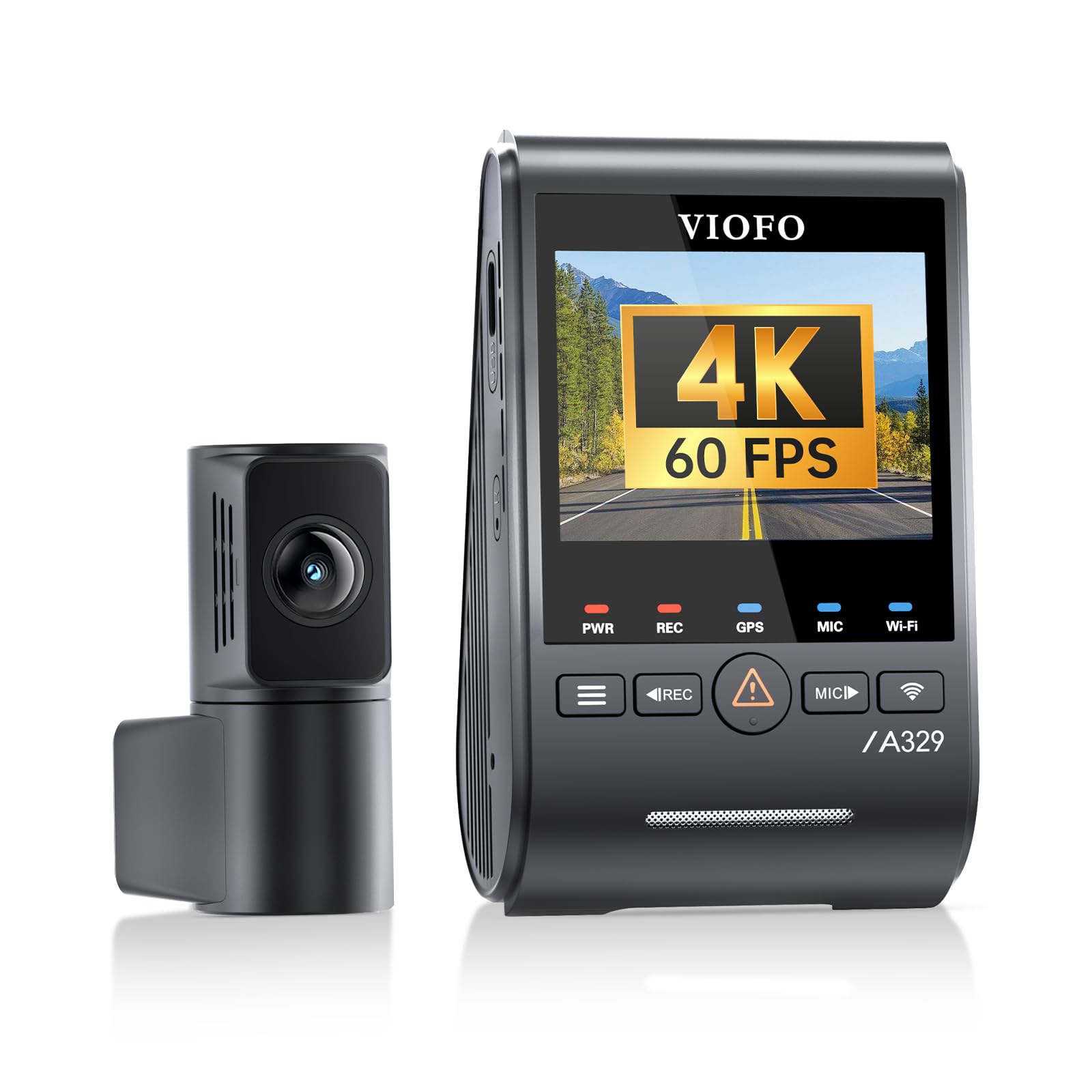
The VIOFO A329S represents the current pinnacle of consumer dash cam engineering, pairing a front-facing 4K 60fps sensor with a rear 2K STARVIS 2 IMX675 for exceptionally smooth and detailed capture. The front IMX678 sensor delivers noticeably less motion blur and superior low-light performance compared to any 30fps unit, making it the strongest choice for those who prioritize forensic-grade footage. The 60fps advantage becomes apparent when reading fast-moving license plates in urban traffic or on highways.
Beyond raw video quality, the A329S offers next-generation Wi-Fi 6 connectivity that reduces a 1-minute 4K download to under 10 seconds, and an ultra-low-power parking mode that triggers recording only upon collision impact — preserving battery life while maintaining surveillance. The unit supports external SSDs up to 4TB via Type-C, effectively eliminating storage concerns for long trips or fleet use. The included CPL filter reduces windshield glare significantly, a small addition that makes a real difference in harsh sunlight.
Owner feedback consistently praises the build quality and the responsiveness of VIOFO’s technical support. The coaxial rear cable design minimizes radio-frequency interference, a thoughtful detail for clean installations. The trade-off is a premium investment and the absence of an interior cabin camera in the base 2-channel configuration. For drivers who want the sharpest possible front and rear evidence capture with future-proof connectivity, the A329S sets the benchmark.
What works
- Front 4K 60fps delivers unmatched smoothness and plate clarity
- Dual STARVIS 2 sensors provide excellent night performance
- Wi-Fi 6 enables extremely fast app transfers
- Supports up to 4TB external SSD for massive storage
What doesn’t
- No interior cabin camera in 2CH configuration
- Parking mode hardwire kit sold separately
- Premium investment reflects the advanced feature set
2. Vantrue N4S 3 Channel Front Inside Rear Dash Cam
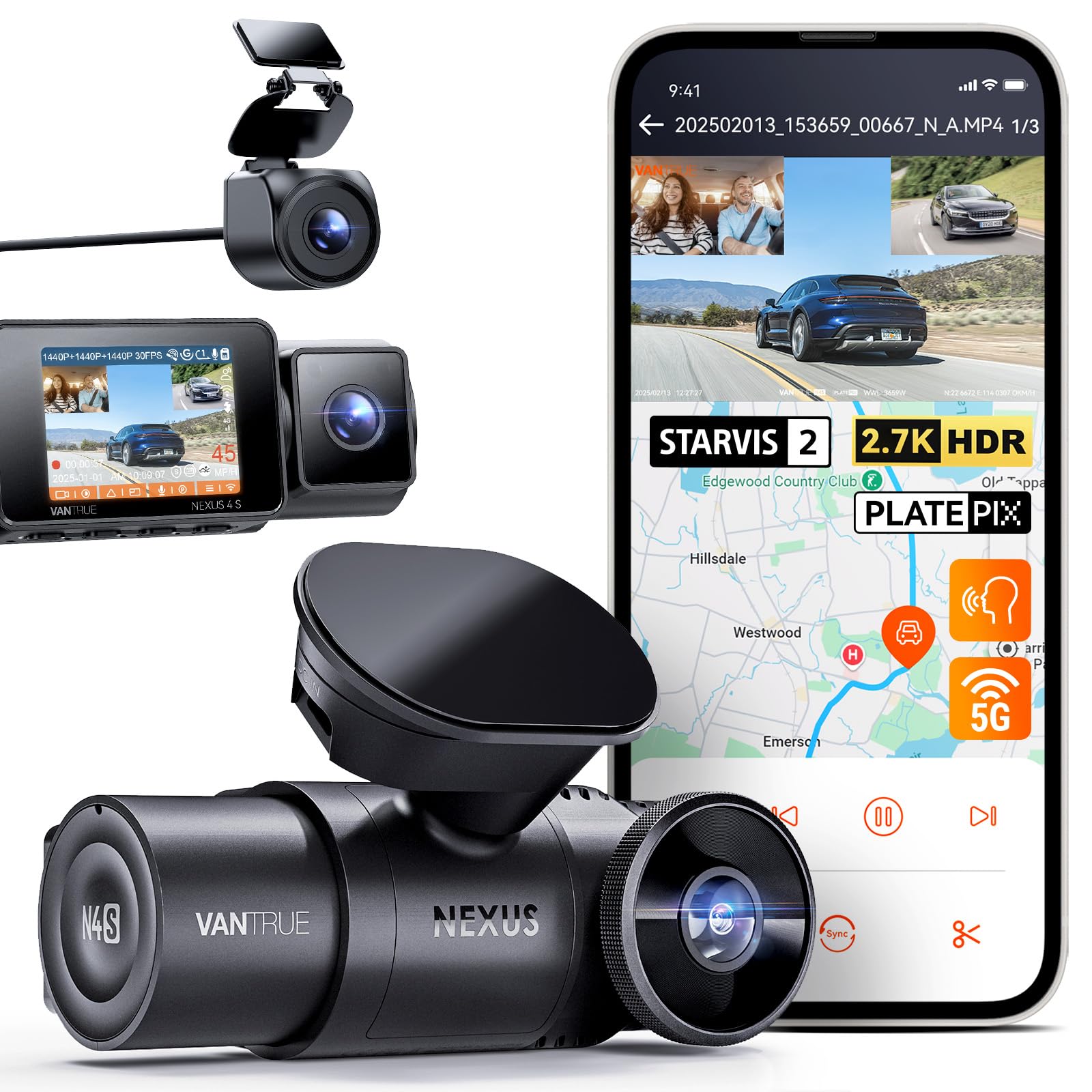
The Vantrue N4S is purpose-built for drivers who need full three-channel coverage without compromise. Its 2.7K front camera uses a STARVIS 2 IMX675 sensor with Vantrue’s exclusive PlatePix algorithm, which owner reports indicate improves license plate readability by about 1.5x in challenging light. The interior camera includes four infrared LEDs for clear cabin footage in complete darkness, while the rear camera offers a unique 2.5K resolution and IP67 weather resistance — allowing exterior mounting on trucks, SUVs, or vehicles with obstructed rear glass.
The N4S introduces a 5GHz Wi-Fi connection for app-based video review, and a dual-mode GPS module that logs coordinates and speed data usable for mileage reports and insurance claims. The 10-second pre-recording buffer in parking mode captures the moments leading up to an impact, addressing a common shortfall in lesser systems. Voice control supports multiple languages, and the interface is notably intuitive for a 3-channel unit.
Long-term Vantrue users report strong reliability across temperature extremes, with the N4S representing a meaningful generational leap over earlier models. The primary consideration is that the 2.7K front resolution, while excellent, trails the 4K offerings from VIOFO and ROVE in pure detail. For rideshare drivers, taxi operators, or anyone wanting comprehensive interior and exterior coverage, the N4S delivers a balanced, well-executed package.
What works
- IP67 waterproof rear camera enables flexible exterior mounting
- PlatePix technology enhances night-time plate capture
- IR interior camera works in pitch-black cabin conditions
- Buffered parking mode records before impact event
What doesn’t
- Front camera resolution is 2.7K, not 4K
- Hardwire kit required for parking mode and sold separately
- Some users report occasional recording gaps
3. ROVE R2-4K Dual PRO Dash Cam Front and Rear
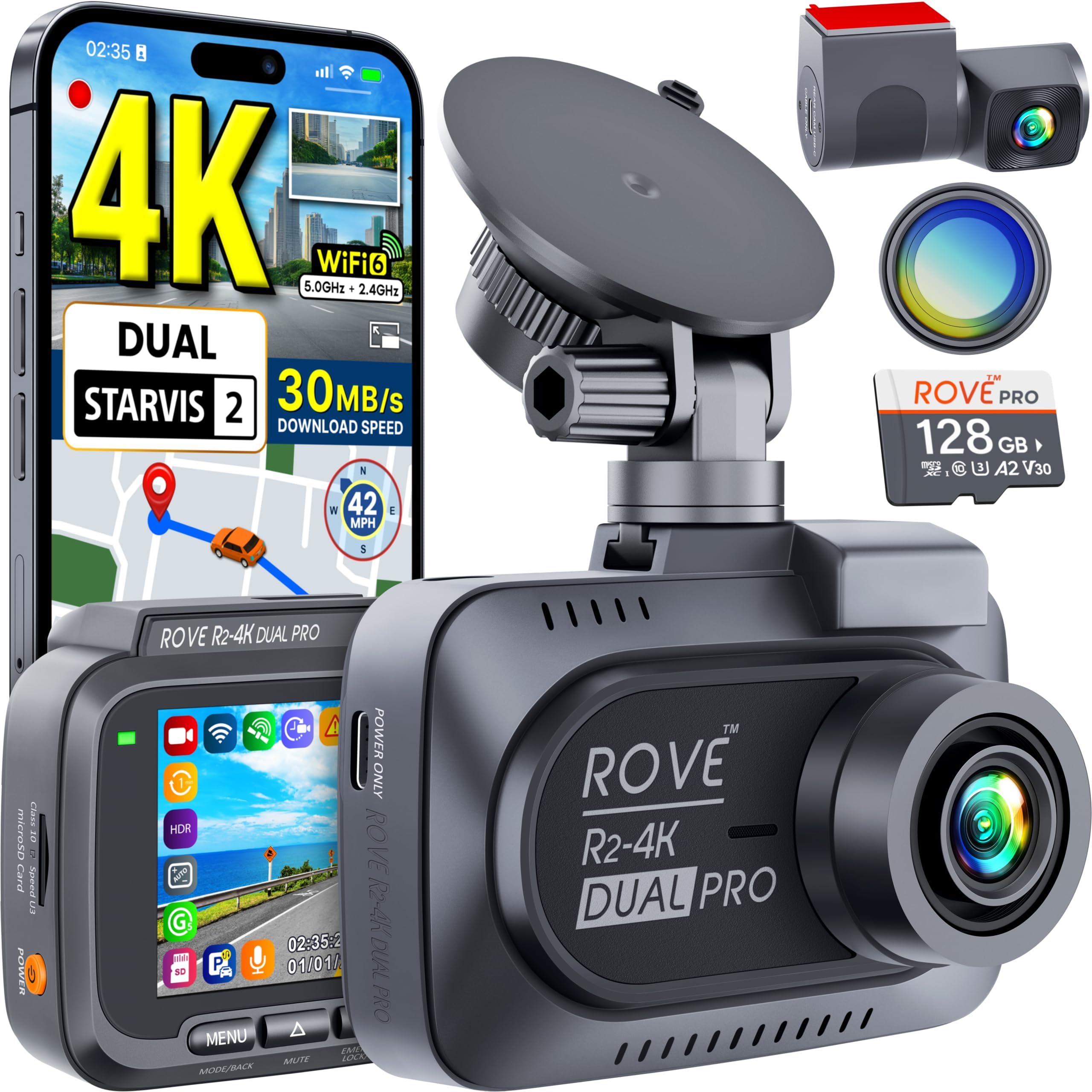
The ROVE R2-4K Dual PRO distinguishes itself by pairing Sony’s most advanced STARVIS 2 sensors — IMX678 on the front and IMX675 on the rear — with an unusually generous bundle that includes a 128GB ROVE PRO microSD card and a CPL filter right in the box. This combination means you get 4K front and 2K rear recording with HDR imaging from the moment you open the package, with no additional purchases needed to start capturing high-quality footage. The F1.7 front aperture and F1.55 rear aperture maximize light intake in low-light scenarios.
Wi-Fi 6 support enables wireless transfer speeds up to 30MB/s, and the quad-mode GPS logs accurate route and speed data viewable through the ROVE Dash Cam GPS Player software. The 24-hour parking mode offers three intelligent options — time-lapse, motion detection, and collision detection — with the latter saving a full 1-minute event video to a locked folder and issuing a voice alert upon your return. The suction mount design is robust and well-reviewed for staying secure in hot climates.
Long-time ROVE customers frequently cite the brand’s customer service as a differentiator, with support teams responsive to compatibility questions and accessory needs. The 150-degree front and 140-degree rear field of view is slightly narrower than some competitors, but this often results in less fisheye distortion and better plate readability at distance. For drivers who value a complete out-of-box experience with premium sensor hardware, the R2-4K Dual PRO is a compelling mid-premium choice.
What works
- Dual STARVIS 2 IMX678 + IMX675 sensor pair
- Included 128GB card and CPL filter add value
- Wi-Fi 6 reaches 30MB/s download speeds
- Voice alert notifies you of parking mode events
What doesn’t
- No interior cabin camera option
- Field of view slightly narrower than some rivals
- Parking mode requires separate hardwire kit
4. VIOFO A229 Plus 3 Channel Dash Cam
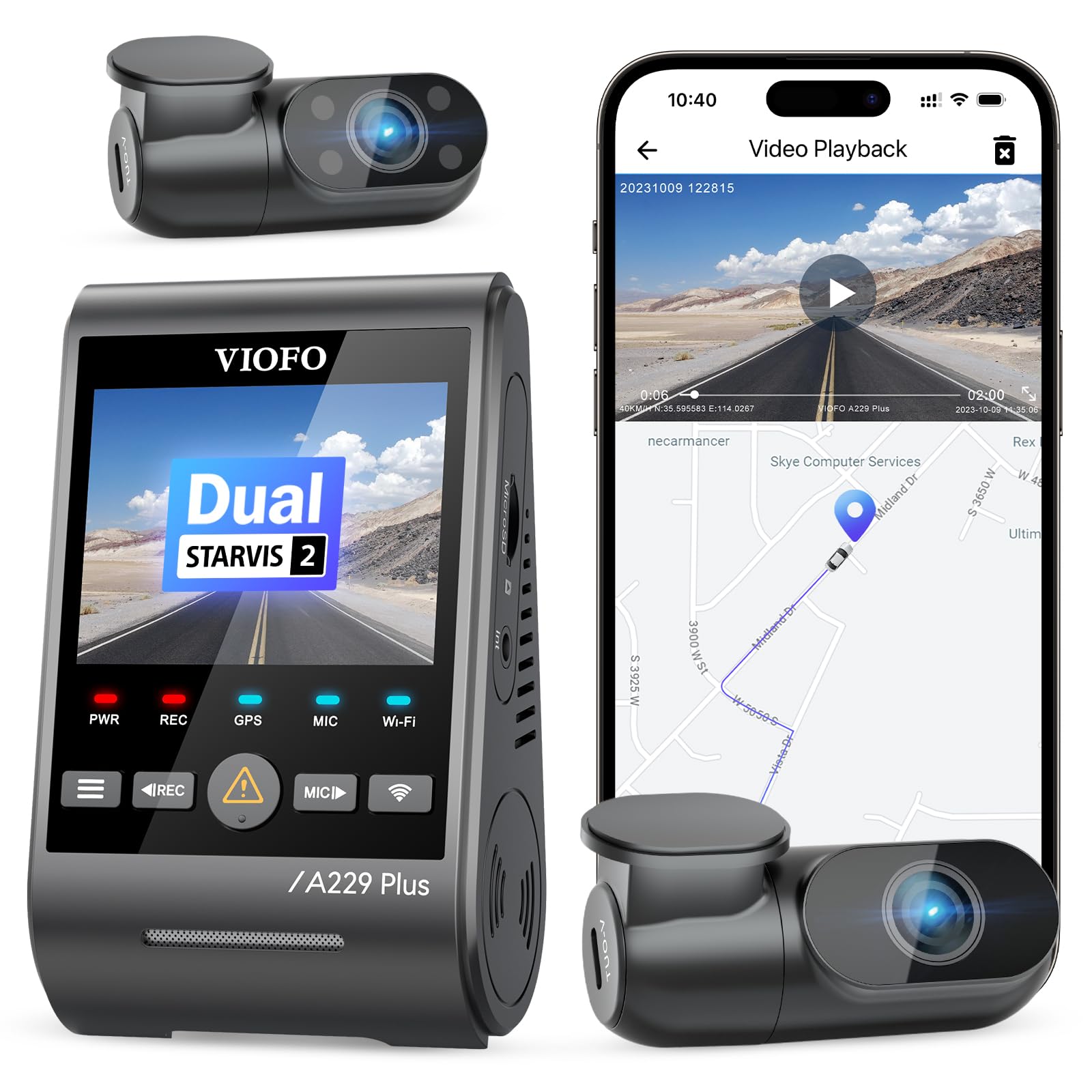
The VIOFO A229 Plus 3CH brings the brand’s engineering rigor to a three-channel format, featuring Sony STARVIS 2 IMX675 sensors on both the front and rear channels plus a STARVIS-based interior camera with HDR on all three feeds. This is a significant technical achievement — most 3-channel systems reserve HDR for the front lens or omit it entirely on secondary cameras. The result is balanced exposure across every corner of the vehicle, which matters when you need to identify a face in the cabin or a plate behind you at night.
The interior camera includes four infrared LED lights that activate automatically in low cabin light, capturing black-and-white footage in total darkness. The voice control system recognizes 12 distinct commands, and the quad-mode GPS module locks onto GPS, BeiDou, Galileo, and GLONASS simultaneously for precise location logging. The 5GHz Wi-Fi connection enables faster transfers than the previous generation, and the improved menu interface simplifies configuration.
Owner reviews frequently highlight the compact size of the interior and rear cameras, which simplifies mounting and cable routing. The 1440P front and rear resolution strikes a practical balance between detail and file size, allowing the included 64GB card to hold more footage than a 4K-only system. The trade-off is that the A229 Plus does not match the 4K resolution of premium competitors, and the hardwire kit is an additional expense. For three-channel coverage with genuine HDR on every camera, the A229 Plus is a well-calibrated choice.
What works
- HDR enabled on all three channels simultaneously
- Dual STARVIS 2 sensors on front and rear
- IR interior camera captures clear footage in darkness
- Compact camera housings simplify installation
What doesn’t
- Front and rear resolution is 1440P, not 4K
- Hardwire kit for parking mode sold separately
- Interior camera uses STARVIS 1, not STARVIS 2
5. 70mai 4K Dash Cam Front and Rear Inside T800E

The 70mai T800E enters the market as a 3-channel system that captures 4K front footage plus 1080P interior and 1080P rear recording, making it one of the most affordable ways to get 4K resolution alongside a cabin camera. The front sensor uses an F1.55 aperture with HDR and 3D noise reduction, delivering solid low-light performance that competing owners in this mid-range bracket find impressive for the investment. The interior camera includes switchable infrared recording, allowing you to toggle IR on or off based on cabin conditions.
Wi-Fi 6 connectivity is a standout feature at this level, enabling app transfers up to 5x faster than standard Wi-Fi 4. The built-in 5-mode GPS provides accurate speed and route tracking, and the voice control system handles essential commands without requiring menu navigation. A 64GB card is included, supporting loop recording out of the box with expansion up to 512GB. The super capacitor design ensures reliable operation in extreme temperatures from 14°F to 140°F, addressing a common weak point in battery-powered units.
User feedback consistently notes the straightforward installation process and the value proposition of getting three channels with 4K front coverage at this price point. The trade-offs include 1080P resolution on the interior and rear cameras — lower than the 1440P or 2K options on pricier units — and the absence of 4G connectivity for remote viewing. For Uber and Lyft drivers or families who want total coverage without overspending, the T800E delivers strong performance per dollar spent.
What works
- Affordable 3-channel system with 4K front camera
- Wi-Fi 6 enables fast file transfers
- Super capacitor handles extreme temperature ranges
- Switchable IR for interior night recording
What doesn’t
- Interior and rear cameras limited to 1080P
- No 4G connectivity for remote monitoring
- Parking mode hardwire kit purchased separately
6. FAIMEE 4K+2K+2K 3 Channel Dash Cam
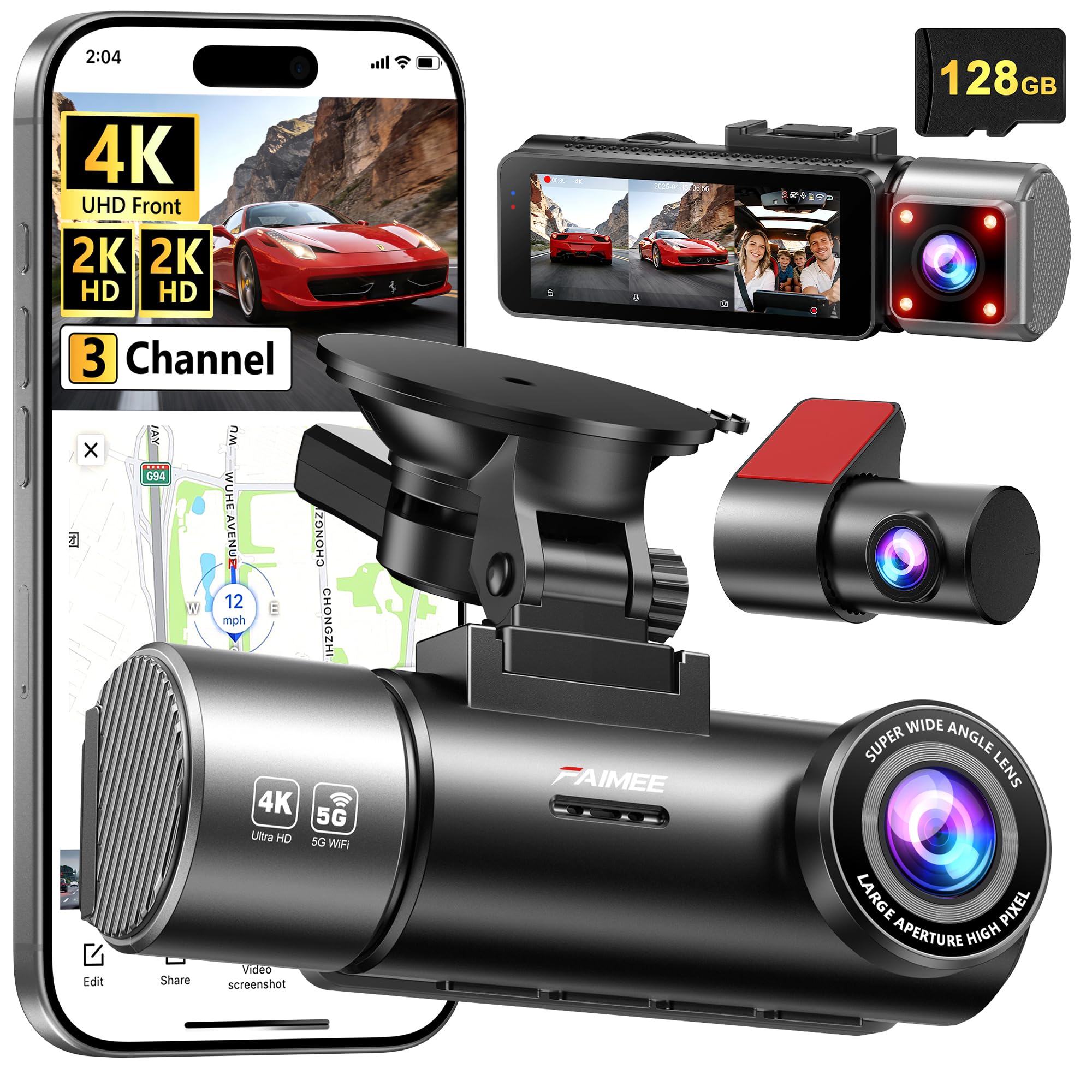
The FAIMEE 3-channel dash cam offers 4K front recording alongside 2K interior and 2K rear cameras — a resolution combination rarely seen at this price tier. The 170-degree front lens provides a wide field of view that minimizes blind spots, while the F1.8 aperture and WDR technology help maintain clarity in mixed lighting conditions. The inclusion of a 128GB high-endurance memory card in the box means the system is ready to record immediately, removing one of the most common post-purchase hassles.
Dual-band Wi-Fi (5.8GHz and 2.4GHz) connects to the FAIMEE app for live viewing, playback, and downloads without removing the SD card. The built-in GPS module logs speed, route history, and location coordinates viewable on Google Maps — a practical feature for fleet managers or rideshare drivers who need trip verification. The parking mode uses G-sensor collision detection and time-lapse recording, though the hardwire kit is not included and must be sourced separately.
Owner reviews frequently mention the straightforward setup process and the video quality exceeding expectations given the overall cost. The app is described as functional but not as polished as offerings from VIOFO or 70mai. The maximum supported SD card size is 256GB, which is lower than competitors that accept 512GB or 1TB cards. For budget-conscious buyers who want 2K resolution on all three channels and a large included memory card, the FAIMEE system represents a strong value proposition with minimal compromises on core recording quality.
What works
- 2K resolution on both interior and rear cameras
- 128GB memory card included for immediate use
- Dual-band Wi-Fi for flexible app connectivity
- Built-in GPS with Google Maps route tracking
What doesn’t
- Maximum SD card support limited to 256GB
- App interface less refined than premium brands
- Hardwire kit for parking mode purchased separately
7. Pelsee P1 Pro 4K Dash Cam Front and Rear
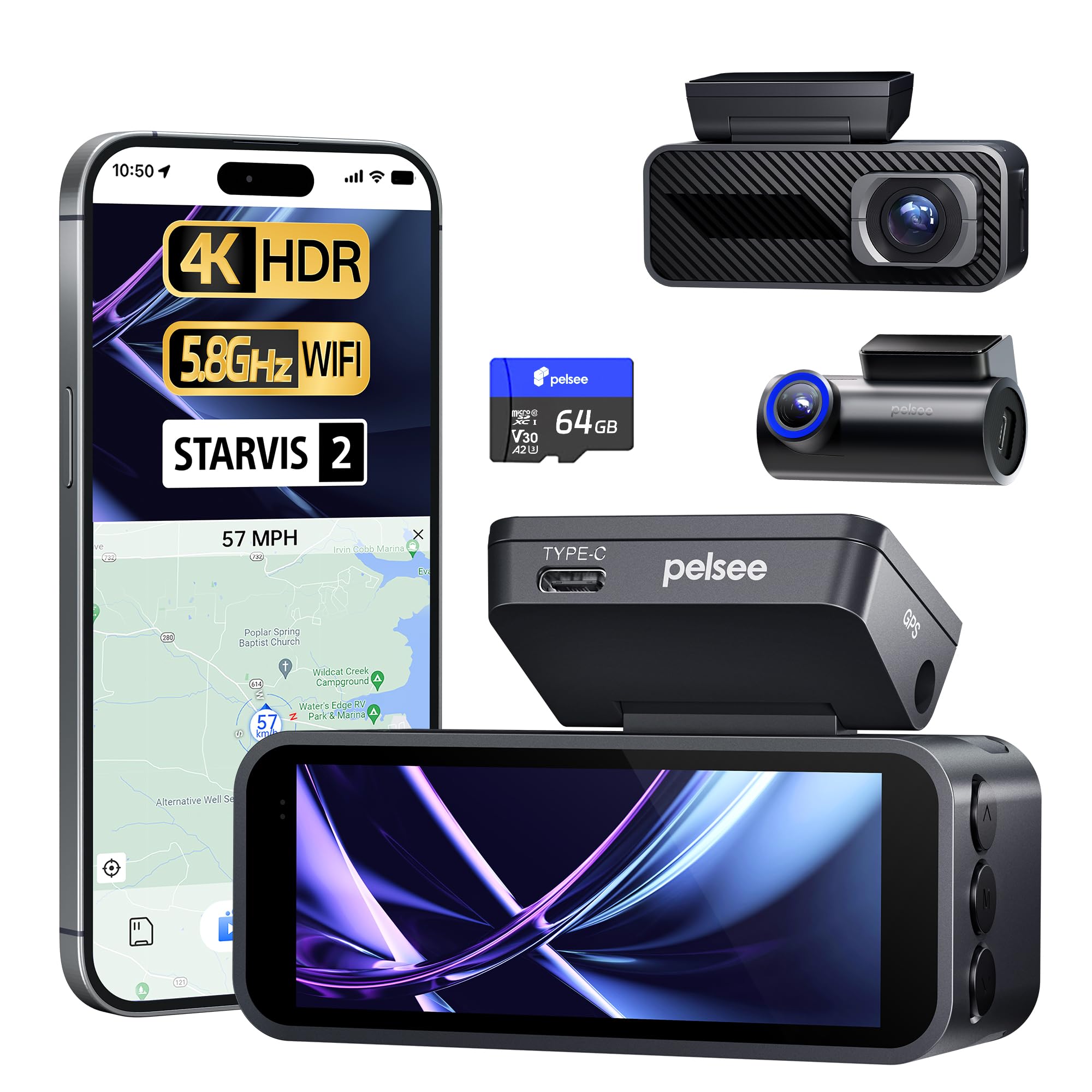
The Pelsee P1 Pro brings a Sony STARVIS 2 sensor to the front camera at a highly accessible price point, making it the most affordable entry into premium sensor technology in this guide. The front camera records 4K HDR at 25fps, while the rear camera operates at 1080P with WDR for balanced exposure. The 3.39-inch IPS screen is one of the largest in this category, providing clear live previews and easy menu navigation — a practical advantage for users who prefer on-camera controls over app-based operation.
The system includes ADAS features such as forward collision warning, lane departure alerts, and pedestrian detection — uncommon at this price level. Voice control recognizes eight commands for hands-free operation, and the 5.8GHz Wi-Fi enables real-time viewing and downloads via the Pelsee Cam app. A 64GB SD card is pre-installed, with expansion support up to 512GB. The 24-hour parking mode activates via G-sensor impact detection or time-lapse compression, though it requires a separately purchased hardwire kit.
Owner feedback is notably positive, with many 5-star reviews praising the straightforward installation, build quality, and responsive customer support. The 25fps frame rate on the front camera is lower than the 30fps standard found on most competitors, which can impact smoothness when capturing fast-moving vehicles. The rear camera is limited to 1080P rather than 2K. For drivers on a tighter budget who still want STARVIS 2 night performance and a large viewing screen, the Pelsee P1 Pro delivers exceptional foundational quality at a welcoming price.
What works
- STARVIS 2 front sensor at an accessible price
- Large 3.39-inch IPS screen for live preview
- ADAS safety alerts included out of the box
- 64GB card pre-installed, expandable to 512GB
What doesn’t
- Front records at 25fps instead of 30fps
- Rear camera resolution is 1080P, not 2K
- Hardwire kit for parking mode not included
Hardware & Specs Guide
STARVIS 2 Sensor Technology
Second-generation Sony STARVIS sensors offer roughly 2.5x dynamic range and low-light sensitivity compared to first-generation STARVIS. This translates to less noise, reduced motion blur, and better license plate readability at night. Models featuring dual STARVIS 2 sensors (front and rear) provide the most consistent image quality across all lighting conditions. The IMX678 sensor found in premium units captures more pixels at higher sensitivity than the IMX675 used in mid-range systems.
Frame Rate and Bitrate
Frame rate determines how smooth motion appears in playback. Standard dash cams record at 30fps, while premium models like the A329S offer 60fps for significantly smoother capture of fast-moving vehicles. Bitrate — measured in Mbps — affects image detail more than resolution alone. A high-bitrate 1440P feed can outperform a low-bitrate 4K feed in plate readability. Look for units that specify H.265 encoding for efficient storage without sacrificing quality.
Parking Mode Types
Three common parking modes exist: motion detection (starts recording when movement is detected), time-lapse (compresses hours into minutes at low frame rates), and collision detection (activates on G-sensor impact). Buffered recording, available on premium models, saves footage from 10-15 seconds before the trigger event. All parking modes require a hardwire kit connected to the vehicle’s fuse box to avoid draining the starter battery.
Channel Configurations
A 2-channel system covers front and rear, suitable for most accident scenarios. A 3-channel system adds an interior camera, essential for rideshare drivers or those wanting cabin surveillance. Some 3-channel units feature switchable IR for night interior capture. The trade-off is increased installation complexity and higher storage consumption. Waterproof rear cameras, like the IP67 unit on the Vantrue N4S, allow exterior mounting on vehicles without rear window access.
FAQ
Do I need a 3-channel dash cam or is 2-channel enough?
What does a hardwire kit do and do I need one?
How much storage do I need for a dash cam?
Can a dash cam drain my car battery overnight?
Final Thoughts: The Verdict
For most buyers, the best car security dash cam winner is the VIOFO A329S because it combines 4K 60fps front capture, dual STARVIS 2 sensors, and the most advanced parking mode available in a refined, well-supported package. If you need full cabin coverage for rideshare or family monitoring, the Vantrue N4S delivers the best 3-channel experience with its IP67 waterproof rear camera and PlatePix night technology. And for the strongest out-of-box value with premium sensors, the ROVE R2-4K Dual PRO includes everything you need to start recording in 4K immediately, including the memory card and CPL filter.

Certification: BSc in Mechanical Engineering
Education: Mechanical engineer
Lives In: 539 W Commerce St, Dallas, TX 75208, USA
Md Amir is an auto mechanic student and writer with over half a decade of experience in the automotive field. He has worked with top automotive brands such as Lexus, Quantum, and also owns two automotive blogs autocarneed.com and taxiwiz.com.