Nothing ruins a fresh wash faster than spotting a fresh swirl or a parking-lot door ding under the sunlight. A proper car scratch polish is the difference between living with that haze and restoring the deep, wet look your paint had the day you bought it. But not every polish cuts the same way—some are designed for final gloss, others for aggressive defect removal.
I’m Amir — the founder and writer behind Four Wheel Ask. I’ve spent years analyzing paint correction chemistry, abrasive technology, and the real-world feedback from thousands of DIY detailers and professional body shops to understand exactly what separates a great scratch polish from a waste of money.
Whether you are battling oxidized clear coat on an older daily driver or chasing micro-marring on a dark-colored show car, picking the right car scratch polish comes down to matching the abrasive cut to the defect depth and your application method.
How To Choose The Best Car Scratch Polish
Not all polishes are built the same. The wrong product can either fail to cut a scratch or cut so aggressively that you thin your clear coat more than needed. The key is understanding three things: the abrasive type, the defect depth, and your application tool.
Understand Abrasive Grit and Cut Level
Car scratch polishes use abrasive particles—most commonly aluminum oxide—suspended in a lubricating carrier. The grit size and the way the abrasive breaks down during buffing determines whether the product is a heavy cut compound or a fine finishing polish. A heavy cut compound uses larger, sharper particles that physically level the clear coat. A finishing polish uses smaller or diminishing abrasives that refine the surface to a high gloss without leaving micro-marring.
Match the Polish to the Scratch Depth
If you can catch your fingernail in the scratch, it has probably penetrated the clear coat and needs touch-up paint—polish alone will not fix it. For surface-level swirls and light scratches that you cannot feel with your nail, a mid-cut polish or a heavy cut compound followed by a finishing polish will restore clarity. Oxidized, chalky paint often needs a heavy cut compound as the first step to strip the dead clear coat before a polish can bring back the gloss.
Hand Application vs. Machine Buffing
Polishes designed for hand application need to stay wet longer and often include more lubricity so they do not dry out before you can work them. Machine-specific compounds are formulated for high-speed rotational or dual-action buffers and will dust or gum up if used improperly by hand. If you do not own a polisher, look for a “by hand” kit or a cream with a long work time and a non-dusting formula.
Quick Comparison
On smaller screens, swipe sideways to see the full table.
| Model | Category | Best For | Key Spec | Amazon |
|---|---|---|---|---|
| Griot’s Garage BOSS Correcting Cream | Professional Cream | Moderate defects, extended work time | 16 oz / Aluminum Oxide / 120 grit | Amazon |
| Menzerna Heavy Cut Compound 1000 | Heavy Cut Compound | Deep scratches, sanding marks | 8 oz / Aluminum Oxide / 1000 grit | Amazon |
| Menzerna Super Finish Plus 3800 | Finishing Polish | Mirror finish, dark paint perfection | 8 oz / Aluminum Oxide / Medium cut | Amazon |
| Adam’s Polishes Hand Correction Kit | 2 Step Hand Kit | DIY hand correction, paint transfer | Aluminum Oxide / 400 grit / 2 step | Amazon |
| ABRO Rubbing Compound | Aggressive Compound | Oxidized paint, heavy haze | 10 oz / Aluminum Oxide / Fine grit | Amazon |
In‑Depth Reviews
1. Griot’s Garage BOSS Correcting Cream

Griot’s BOSS Correcting Cream is a professional-grade paint correction cream engineered for dual-action and rotary buffers. The 120-grit aluminum oxide abrasive strikes a precise balance between cut and finish—it knocks down moderate swirls and light scratches while leaving the paint clear enough that you can skip a second finishing step on many colors. The 16-ounce bottle provides generous coverage for several full-car corrections.
What sets it apart is the high-lubricity formulation that resists drying out during extended buff cycles. Even on warm panels, this cream stays wet, reduces dusting, and wipes off cleanly without residue. Pairing it with a medium-cut foam pad like Griot’s BOSS Fast Correcting Pad delivers predictable cut without the risk of burning through edges or body lines.
On darker paint colors, the finish clarity after using this cream alone is exceptional—owners of black and dark blue vehicles report near-showroom gloss without the need for a separate finishing polish. It is not designed for heavy oxidation or deep fingernail-catching scratches, but for the vast majority of daily-driver swirls and light defects, this is the most reliable single-step correction cream available.
What works
- Exceptional lubricity prevents drying and dusting
- Wipes off cleanly with minimal residue
What doesn’t
- Not aggressive enough for deep scratches or heavy oxidation
- Best results require a machine buffer
2. Menzerna Heavy Cut Compound 1000
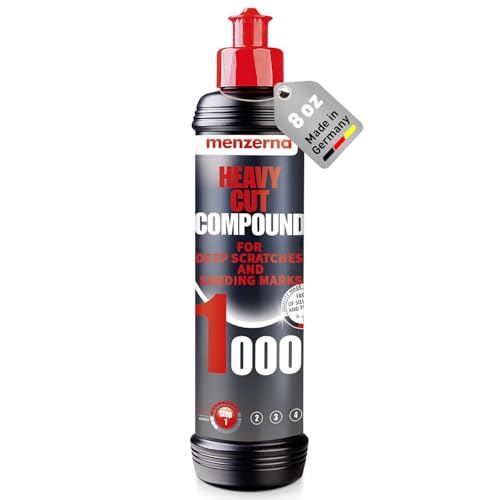
When the clear coat is deeply scratched or marred by sanding marks, the Menzerna Heavy Cut Compound 1000 delivers the aggressive cut needed to level the surface. The 1000-grit aluminum oxide abrasive is engineered to remove significant material quickly, making it the correct starting point for any multi-step paint correction on neglected or heavily swirled panels.
This compound works best with a rotary polisher or a long-throw dual-action machine paired with a heavy-cut foam pad. Applying it by hand is possible but requires significantly more effort and yields slower results. Used correctly, it levels deep scratches and orange peel efficiently, and it finishes down well enough that a subsequent finishing polish like the Menzerna Super Finish Plus 3800 can fully restore the gloss.
Be aware of the clear coat thickness before using this compound—several users have reported cutting through the clear coat on thin factory paint when using too much pressure or too many passes. Always start with a test spot and inspect the paint thickness if you have access to a paint depth gauge. On older single-stage paints, this compound is extremely effective for removing surface oxidation.
What works
- Excellent cut for deep scratches and sanding marks
- Finishes well for a heavy compound
What doesn’t
- Can cut through clear coat if overused
- Not beginner-friendly for hand application
3. Menzerna Super Finish Plus 3800
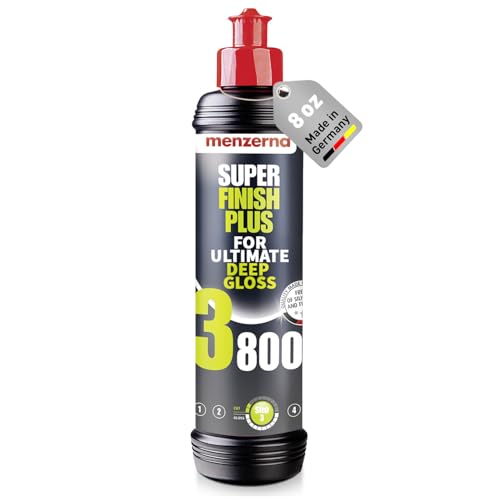
The Menzerna Super Finish Plus 3800 is the definitive finishing polish for achieving a deep, wet-looking mirror finish on any color, but it truly shines on dark paints. The diminishing abrasive technology means the particles break down as you work, starting with a light cut to remove holograms and micro-marring left by heavier compounds, then transitioning to a pure polish that leaves a defect-free surface.
This polish is designed for the final gloss step after a heavy cut compound like the Menzerna 1000. It creates zero additional haze and fills the microscopic scratches left by earlier correction steps, producing a clarity that is difficult to distinguish from showroom condition. It works with both rotary and dual-action polishers, and the long working time makes it very forgiving even for amateur detailers.
Because it has no abrasive capability of its own, the Super Finish Plus 3800 will not fix scratches—it only refines the finish after the heavy lifting is done. Some detailers also use it by hand for minor spot correction on edges and tight areas. For anyone doing a multi-step correction, this is the standard against which all other finishing polishes are measured.
What works
- Produces an unmatched deep gloss on dark paint
- Long working time with no dusting
What doesn’t
- Cannot remove scratches on its own
- Requires a compound step beforehand for correction
4. Adam’s Polishes Car Scratch & Swirl Remover Hand Correction Kit
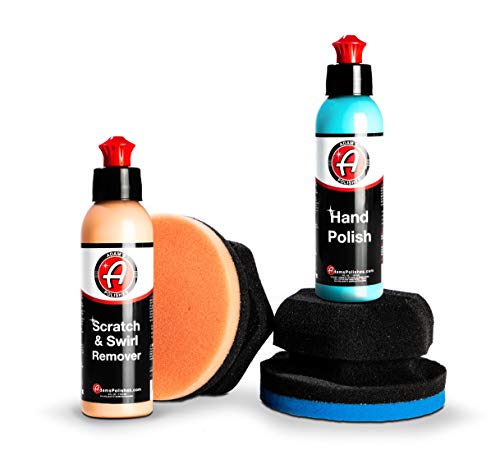
Adam’s Polishes Hand Correction Kit is purpose-built for the DIY owner who wants to correct paint defects without buying or learning how to use a machine buffer. The kit includes a scratch and swirl remover compound paired with an orange foam applicator pad and a separate hand polish for the finishing step, giving you a complete two-step correction system in one box.
The scratch and swirl remover uses diminishing micro-alumina abrasives that disintegrate as you work, preventing you from cutting deeper than necessary. This makes the kit relatively safe for beginners who are nervous about burning through clear coat. The dustless formula performs well even in direct sunlight, which is a real advantage for outdoor detailing without a controlled garage environment.
Realistic expectations are important here—this kit will remove light swirls, paint transfer, and surface-level clear coat scratches, but it cannot fix deep scratches that catch your fingernail. Some owners note that the applicator pad can feel rough on the paint if you use too much pressure, so light passes with moderate speed are recommended. The included hand polish acts as the final gloss step, leaving a smooth, reflective surface.
What works
- Complete two-step system for hand correction
- Dustless formula works in direct sunlight
What doesn’t
- Cannot fix deep scratches beyond the clear coat
- Foam pad can feel aggressive on sensitive paint
5. ABRO Rubbing Compound 10 oz

The ABRO Rubbing Compound is a no-nonsense, fast-cutting abrasive paste formulated for heavily oxidized, chalky, and weathered paint that needs aggressive correction. It uses aluminum oxide abrasives suspended in a pale paste that stays thick enough to work by hand without dripping, making it an excellent choice for restoring old trucks, boats, and motorcycles where the clear coat has faded completely.
This compound is not a polish—it is a rubbing compound meant to be the first step in a full restoration. After ABRO cuts through the dead oxidation and levels the surface, you need to follow up with a polish and wax to restore gloss and protect the exposed fresh clear coat. It works well with both hand application and a wool pad on a rotary buffer, and it cleans up with minimal residue when wiped off promptly.
Customers have reported dramatic before-and-after results on sun-damaged paint, especially on horizontal panels like hoods and roofs where oxidation is worst. The compound does have a strong solvent smell typical of aggressive automotive compounds, and it dries out quickly if you work too slowly. For the price, it delivers more cutting power than most polishes in its range, but it requires follow-up products to achieve a glossy final finish.
What works
- Very aggressive cut for heavy oxidation and haze
- Works well by hand or machine
What doesn’t
- Requires a polish step afterward for gloss
- Dries out quickly if not worked fast enough
Hardware & Specs Guide
Aluminum Oxide Abrasives
Almost all quality car scratch polishes use aluminum oxide as the cutting agent. The grit size (measured in mesh or grit number) determines how aggressive the product is—lower numbers like 120 cut faster but leave a coarser finish, while higher numbers like 1000 or 4000 are finer and leave a smoother surface. Diminishing abrasive technology breaks down the particles during buffing so that a single product can start as a heavy cut and end as a light polish.
Clear Coat Thickness
Factory clear coat is typically between 1.5 and 2.5 mils thick. Every time you use a heavy cut compound, you remove approximately 0.1 to 0.3 mils of clear coat. Using a paint depth gauge before corrections is the only reliable way to know how many passes your paint can safely handle. Over-thinning the clear coat leaves it vulnerable to UV damage and premature failure.
FAQ
Can car scratch polish remove scratches I can feel with my fingernail?
What is the difference between a rubbing compound and a polish?
Can I use a heavy cut compound by hand instead of a machine?
Final Thoughts: The Verdict
For most buyers, the best car scratch polish winner is the Griot’s Garage BOSS Correcting Cream because it delivers professional-grade cut and finish in a single step with excellent lubricity and minimal dusting. If you need to tackle deep scratches and heavy oxidation before polishing, grab the Menzerna Heavy Cut Compound 1000. And for a complete hand-applied correction kit that removes light to moderate defects without a machine, nothing beats the Adam’s Polishes Hand Correction System.

Certification: BSc in Mechanical Engineering
Education: Mechanical engineer
Lives In: 539 W Commerce St, Dallas, TX 75208, USA
Md Amir is an auto mechanic student and writer with over half a decade of experience in the automotive field. He has worked with top automotive brands such as Lexus, Quantum, and also owns two automotive blogs autocarneed.com and taxiwiz.com.