Sanding automotive bodywork, paint, primer, and filler demands more than just pressure and elbow grease—it demands a block that maintains a true flat plane on large panels while also flexing into compound curves on fenders and hoods. A rigid block on a contoured surface will dig in and create low spots. A floppy sheet wrapped around a finger lacks the consistency to level filler. The solution is a kit that pairs the correct block profiles with the right grit progression, and the variety of material, profile, and attachment systems on the market makes choosing the right one the difference between a smooth final coat and hours of rework.
I’m Amir — the founder and writer behind Four Wheel Ask. My market research focuses on analyzing abrasive geometry, foam density ratings, and PSA versus hook-and-loop retention systems across dozens of automotive paint-preparation kits to identify which setups consistently deliver flat, defect-free surfaces.
This guide breaks down the five kits that solve the core tension between rigidity for flat repairs and flexibility for curves, helping you identify the exact profile shapes, attachment types, and grit ranges that match your specific bodywork project. The goal is to help you select the best car sanding block kit for your workflow, whether you are blocking a flat hood or shaping a complex quarter panel.
How To Choose The Best Car Sanding Block Kit
Automotive paint preparation is about controlling the interface between abrasive and substrate. The wrong block geometry or attachment method introduces waviness or chatter marks that sanding alone cannot fix. Focus on three variables: profile versatility, backing rigidity, and grit range.
Profile Versatility vs. Flat Panel Rigidity
A single rectangular block works for wide flat panels like a hood or roof, but it fails on concave curves like a fender lip or convex ridges on a door. A kit with multiple profiles—concave, convex, inside angle, round-over—lets you match the block’s contact patch to the panel’s shape. For high-spot removal on filler, a rigid longboard is non-negotiable. For final sanding on a curved surface, a flex-block is essential.
Attachment Systems: PSA vs. Hook and Loop
Pressure-sensitive adhesive (PSA) paper requires a clean block surface and careful alignment, but it offers a totally rigid backing. Hook-and-loop allows rapid grit changes and reusability, but the loop fabric adds a slight thickness and cushion that can reduce the block’s ability to cut a dead-flat plane. Auto-body professionals tend to favor PSA longboard paper for blocking filler, while hobbyists appreciate hook-and-loop convenience.
Grit Range and Progression
A typical urethane primer surfacer sands at 320 to 400 grit. Basecoat requires 600 to 1000 grit wet sanding before clear. Clear coat finishing goes 1500 to 3000 grit. A kit that tops out at 220 grit will not serve paint work. A kit that starts at 60 grit and goes to 5000 provides the range to shape filler, level primer, and wet-sand clear in one set.
Quick Comparison
On smaller screens, swipe sideways to see the full table.
| Model | Category | Best For | Key Spec | Amazon |
|---|---|---|---|---|
| VOLSIVE 7pcs Set | Hook & Loop | Flexible body contour sanding | Foam density: medium PU | Amazon |
| TCP Global Longboard | PSA Longboard | Dead-flat panel blocking | Working length: 16.5 inches | Amazon |
| Fulton 21 Profile Grips | Contour Rubber | Concave/convex detail sanding | Profiles: 21 (inside + outside) | Amazon |
| LotFancy 108pc Kit | Grit Variety | Multi-surface grit progression | Grit range: 60 to 5000 | Amazon |
| Dura-Block AF4402 | PSA Rigid | Professional flat filler blocking | Size: 11” x 2-5/8” x 1-1/2” | Amazon |
In‑Depth Reviews
1. VOLSIVE 7pcs Hand Sanding Block Set
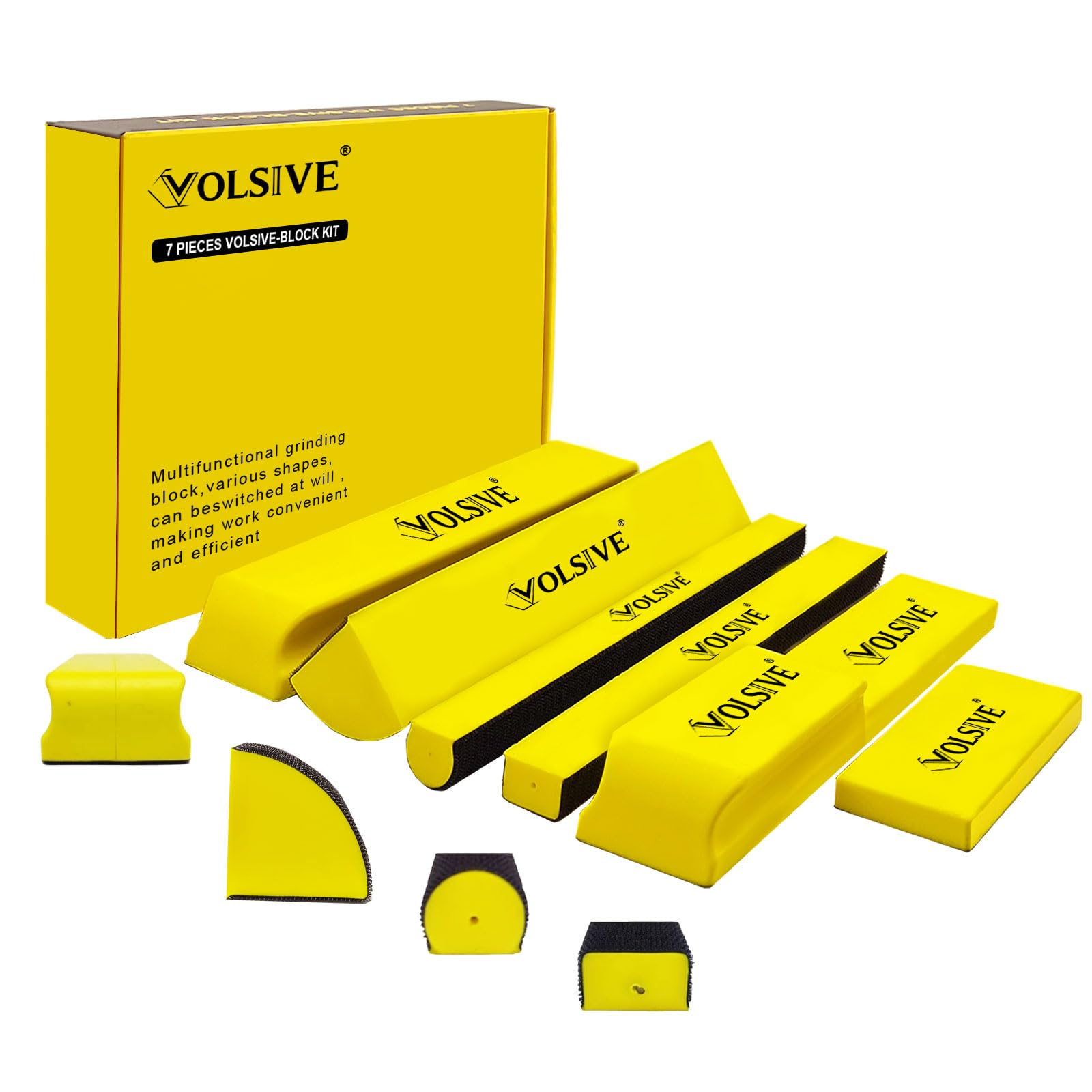
The VOLSIVE set includes seven polyurethane foam blocks in lengths from 5 to 9 inches, each using a hook-and-loop face for quick sandpaper changes. The medium-density foam is the sweet spot for automotive bodywork: it is stiff enough to block a flat repair panel without digging corners, yet soft enough to wrap into a fender’s curve. The 9-inch block offers near-longboard reach for long straight panels.
A key practical advantage is the foam’s ability to conform slightly to the panel as you apply pressure. Users sanding a 1993 Astro van reported that the blocks reduced the repetitive-motion fatigue of hard plastic blocks while still cutting true. The hook-and-loop backing holds 180-grit discs securely, and the pads trim easily with scissors for custom shapes.
This kit does not include sandpaper sheets. The blocks are bare foam, so you must supply your own hook-and-loop abrasive discs or sheets cut to length. For a bodywork specialist who already has a preferred abrasive brand, this is an advantage. For a beginner, it means an additional purchase.
What works
- Seven block lengths provide both small-detail and long-panel reach
- Medium-density PU foam balances flatness and conformity
- Hook-and-loop backing enables rapid grit changes without adhesive mess
What doesn’t
- No abrasive sheets included
- Foam will wear faster than hard plastic or rubber blocks with heavy use
2. TCP Global Wooden Handle Longboard Sander

The TCP Global longboard is built for one job: keeping a true, dead-flat plane over large panels. The 16.5-inch steel body supports a rubber pad that conforms to subtle contours while the wooden handle provides a secure grip. This design accepts both PSA sticky-paper in 2-3/4 inch rolls or standard dry longboard paper held by clips, giving the user flexibility between quick-peel adhesion and traditional wrap-and-clip methods.
The rubber pad is the critical element here. A hard plastic longboard will bridge a low spot but cannot follow a crown. A soft foam block will dip into a low spot and ruin flatness. The TCP pad sits between those extremes: dense enough to level filler, compliant enough to track a slight body line. The steel body resists flex, so the block cannot bend in the middle during heavy two-handed sanding.
The wooden handle is comfortable for long sessions, but the longboard’s bulk makes it less useful in tight spots like door jambs or around taillight openings. This is a panel-only tool. Beginners sometimes find the PSA alignment tricky—once the paper touches the rubber, there is no repositioning.
What works
- Steel body and rubber pad produce consistent flatness on large repairs
- Accepts both PSA and clip-held dry paper formats
- Comfortable wooden handle reduces fatigue during extended blocking
What doesn’t
- Too large for tight corners, jambs, and small contoured areas
- PSA paper requires perfect first-attempt alignment
3. Fulton 21 Profile Contour Sanding Grips

The Fulton Contour set is built around 11 rubber grips with 21 total profiles, including inside/outside radii from 1/4 inch to 7/8 inch, 90-degree inside angles, 60 and 75 degree grips, and 30 and 45 degree grips. Each grip is double-ended—convex on one side, concave on the other—with a flexible middle section for flat or sweeping surfaces. This design addresses the precise problem of sanding a crisp inside angle without rounding it over.
The set includes 50 pre-cut aluminum-oxide sheets in 80, 100, 120, 150, and 220 grits. The sheets are specifically sized for the grips, so there is no trimming or folding. The rubber material is heavy-duty and shows little wear after repeated use on cabinetry and auto interior trim. Users restoring furniture with beveled edges and carved details report that the 90-degree grip preserves sharp corners that a flat block would soften.
These grips have a limited application for large flat repairs. The largest profile pad is smaller than a standard block, so they cannot replace a longboard for leveling bondo across a full door skin. They excel at detail and trim work that a standard block cannot reach.
What works
- Double-ended concave/convex grips prevent rounding sharp inside profiles
- Fifty pre-cut sheets in five common grits eliminate cutting waste
- Durable rubber material resists deformation after repeated use
What doesn’t
- Grip size too small for large panel blocking
- Included grit range stops at 220, requiring separate purchase for paint finish work
4. LotFancy Sandpaper 60 to 5000 Grit, 108PCS

The LotFancy kit delivers 108 sheets of silicon carbide waterproof paper across 18 grits from 60 to 5000, plus a lightweight ABS sanding block with a cushioned foam pad and screw clamp. This is the most complete grit progression in the list. The 60 to 180 range handles heavy material removal on filler and rust. The 320 to 600 range levels primer. The 1000 to 5000 range wet-sands basecoat and clear coat to a polish-ready state.
The included block uses a screw-clamp system that holds the paper securely but requires loosening and tightening for each paper change. The ABS body is lightweight but rigid, which means it works fine on flat surfaces but does not conform to curves. The block’s foam pad provides a slight cushion that reduces chatter, but the block lacks the mass and profile variety for serious bodywork shaping.
Customers have used this kit to polish knife blades and refinish car trim, noting the block is the weakest link—flimsy compared to professional-grade blocks. The real value is the sheer number of grit steps. For a home user who needs one kit to cover everything from body repair to final buffing, this eliminates the cost of buying separate grit packs.
What works
- Eighteen grits from 60 to 5000 cover every phase of body and paint work
- Silicon carbide waterproof paper holds up to wet sanding without disintegrating
- Screw-clamp block is simple and holds sheets taut
What doesn’t
- Included block is lightweight and feels flimsy for heavy production work
- Block profile is limited to flat surfaces only
5. Dura-Block AF4402 Black 2/3-Sanding Block

The Dura-Block AF4402 is the block used in professional body shops worldwide—a simple, hard, black block measuring 11 inches long by 2-5/8 inches wide by 1-1/2 inches tall. It accepts 2-3/4 inch wide PSA paper in cut lengths or rolls. The rectangular geometry provides a true, unyielding flat surface for leveling filler on straight panels. There is no foam, no contour grip, no hook-and-loop—just a rigid substrate upon which the user controls flatness.
The 2/3 scale (two-thirds the length of a full longboard) makes it more maneuverable than a 16-inch block while still long enough to avoid bridging short waves. The block follows curves by rocking on its edge, but it does not conform. For a user sanding a flat roof or hood repair, this is an advantage. For a user sanding a complex body line like a BMW E30 fender, the rigid edge can create a sharp transition.
This block has no sandpaper included. The user must supply PSA paper separately. The lack of any included consumables and the single-profile shape means this is a supplement, not a standalone kit. For a professional who already owns a collection of blocks, this is a reliable workhorse. For a beginner assembling their first kit, it leaves gaps.
What works
- Rigid, non-flexing body produces industry-standard flatness on filler
- Lightweight design at 2.88 ounces reduces hand fatigue
- Long-established shop standard with proven durability
What doesn’t
- Single rectangular profile limits use on curved body panels
- No abrasive paper included, requiring immediate secondary purchase
Hardware & Specs Guide
PSA vs. Hook-and-Loop Backing
PSA (pressure-sensitive adhesive) paper has a peel-and-stick backing that bonds directly to the block’s surface. It offers zero slip and keeps the paper dead-flat, which is critical for leveling body filler. Hook-and-loop uses a fabric interface that holds paper via microscopic hooks. It allows paper reuse and rapid changes, but the fabric layer adds a small amount of cushion that can reduce the block’s ability to produce a perfectly flat plane on hard filler.
Foam Density and Block Rigidity
Automotive sanding blocks range from hard plastic (Dura-Block) to medium-density polyurethane (VOLSIVE) to cushioned foam (LotFancy). Hard blocks produce the flattest surface on large repairs but have zero curve conformity. Medium-density foam compresses slightly under load, allowing the block to follow a body line without bridging or digging. Low-density foam provides comfort but can dip into low spots, creating waves instead of leveling them.
FAQ
Can I use a hook-and-loop block with standard PSA sandpaper?
What block length do I need for leveling body filler on a door panel?
How do I prevent the block from rounding over sharp body lines?
Final Thoughts: The Verdict
For most buyers, the best car sanding block kit winner is the VOLSIVE 7pcs Set because its seven flex-block lengths cover both large panel blocking and small contoured spots using a single hook-and-loop system. If you need dead-flat filler leveling on large flat panels, grab the TCP Global Longboard. And for preserving crisp angles on trim, body lines, and molding, nothing beats the Fulton 21 Profile Grips.

Certification: BSc in Mechanical Engineering
Education: Mechanical engineer
Lives In: 539 W Commerce St, Dallas, TX 75208, USA
Md Amir is an auto mechanic student and writer with over half a decade of experience in the automotive field. He has worked with top automotive brands such as Lexus, Quantum, and also owns two automotive blogs autocarneed.com and taxiwiz.com.