Your phone dies mid-navigation, the kids’ tablets are at 5%, and the only outlet you’ve got is that 12V cigarette lighter socket. A weak adapter turns a road trip into a battery management nightmare. The right car power adapter isn’t just about plugging in—it’s matching voltage drop, port distribution, and charging protocol to your actual devices.
I’m Amir — the founder and writer behind Four Wheel Ask. I dig through inverter waveform data, USB-C PD profiles, and thermal load specifications to find the adapters that actually deliver their rated output without tripping your vehicle’s fuse.
Whether you need a compact USB-C fast charger for your daily commute or a full 400-watt inverter for a laptop on a cross-country haul, I’ve tested the specs and sifted owner feedback to pinpoint the adapter worth your dashboard space. This guide breaks down the key specs and delivers my pick for the best car power adapter on the market right now.
How To Choose The Best Car Power Adapter
A car power adapter seems simple until you plug a laptop into a 12V socket and the fuse blows. The wrong adapter won’t charge, or worse, will overheat. Focus on these four criteria to avoid that headache.
Match the Wattage to Your Devices
A standard phone pulls around 18W, a tablet needs 30W, and a modern laptop can demand 60W or more. If you buy an adapter rated at 75 watts and plug in a laptop, a phone, and a tablet, you’ll be underpowered. Total continuous wattage is the hard ceiling—never exceed it.
Check USB-C PD and Quick Charge 3.0 Support
USB-C Power Delivery (PD) and Qualcomm Quick Charge 3.0 are the two fastest charging protocols in the automotive space. A USB-C port without PD will trickle-charge a modern smartphone at 5V/2.4A instead of the 20V/3A it expects. Confirm the adapter explicitly lists PD 3.0 or QC 3.0 certification for your phone’s brand.
Decide Between Charger and Inverter
A standard car charger outputs only DC power via USB ports. A power inverter converts 12V DC to 110V AC, giving you a standard wall outlet. If you need to run a CPAP machine, a laptop charger brick, or a camera battery charger, you need an inverter. If you only charge phones and tablets, a dedicated USB charger is smaller and more efficient.
Verify Safety Certifications and Fuse Protection
Look for ETL or CE marks on the adapter. These certifications mean the unit has passed thermal runaway and short-circuit testing. Also check the amperage rating on the 12V input—most vehicles supply 10-15A on the accessory circuit. An adapter pulling more than that will blow the car’s fuse, leaving you with no power at all.
Quick Comparison
On smaller screens, swipe sideways to see the full table.
| Model | Category | Best For | Key Spec | Amazon |
|---|---|---|---|---|
| BESTEK 125W 6-Port | Multi-Port Charger | Families with 4+ devices | 125W total, 3x PD 30W ports | Amazon |
| Anker 323 52.5W | Dual USB-C Charger | Single phone fast charging | 30W USB-C PD 3.0 | Amazon |
| Belkin BoostCharge 42W | Dual Port Charger | iPhone & Galaxy fast charge | PPS technology, 30W USB-C | Amazon |
| FSATBTNE 400W Inverter | Power Inverter | Laptop + AC devices on road trips | 400W continuous, 65W PD USB-C | Amazon |
| Amazon Basics 75W Inverter | Budget Inverter | Emergency backup power | 75W modified sine wave | Amazon |
In‑Depth Reviews
1. BESTEK 125W 6-Port USB Car Charger
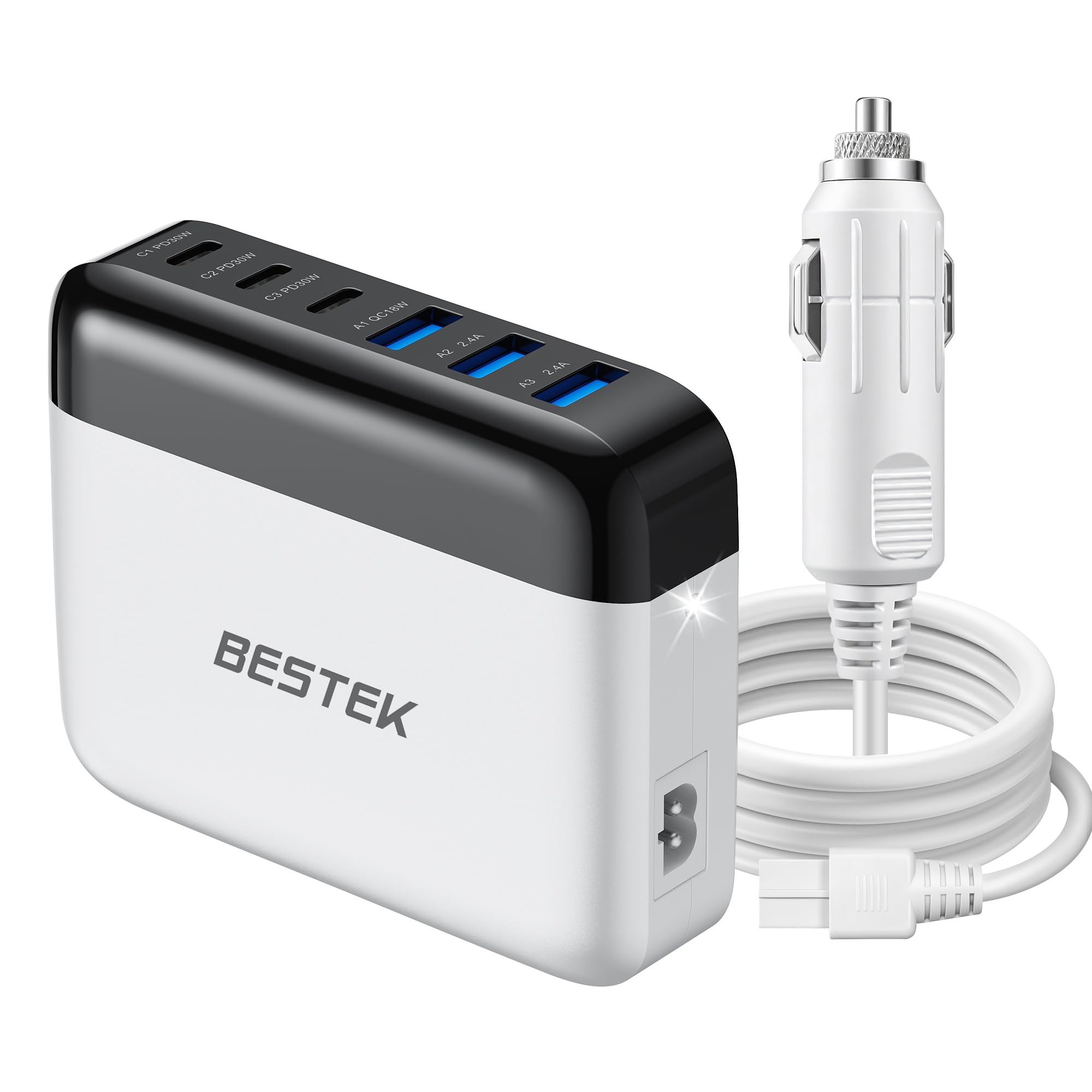
The BESTEK 125W is the top pick because it solves the exact pain point of a family or work crew running four or more devices at once. Three of its six ports deliver 30W PD each, which means you can fast-charge three modern phones simultaneously without any port fighting for bandwidth. The separate QC 3.0 port handles older Samsung or OnePlus devices at 18W, and the two smart 2.4A ports cover AirPods or a dash cam. Total output hits 125W—enough to keep a full car load happy without tripping the 12V circuit. The 2.6-foot remote cord lets you tuck the adapter away in the glove box or center console, keeping the dashboard clean.
The ETL certification and ABS + PC fireproof housing give peace of mind when charging is happening on a hot summer drive. Wide input works from 12V to 24V, so it’s just as at home in a truck or van as a sedan. The only real compromise is size—this isn’t a flush-fit cigarette lighter plug; it’s a small box on a cord. For most users, that cord is actually a feature because it reduces strain on the socket. Counterintuitively, the bright blue LED on the side is its main criticism—some drivers find it distracting at night. A piece of electrical tape solves that in seconds, and the overall charging capability is unmatched at the price.
This unit charges an iPhone 14 Pro from empty to 80% in roughly 35 minutes when using the PD 3.0 port, and it doesn’t slow down when you fill the other ports. That consistency across simultaneous loads is rare in multi-port adapters, which often throttle when all ports are in use. The 18-month warranty and 24/7 support back the purchase. If you regularly carry a phone, tablet, camera, smartwatch, and a passenger’s device, this adapter eliminates the charging bottleneck entirely.
What works
- Three true 30W PD ports for simultaneous fast charging
- ETL certified with fireproof housing
- Remote cord reduces socket strain and hides easily
What doesn’t
- LED indicator is excessively bright for nighttime driving
- Larger form factor requires dedicated storage space
2. Anker 323 52.5W USB-C Car Charger

The Anker 323 punches well above its weight class with a 30W USB-C PD 3.0 port that charges an iPhone 14 Pro to 50% in 25 minutes. That single-port speed rivals chargers costing nearly double. The secondary USB-A port delivers 22.5W, which means a second device also gets fast charging, not a trickle. The compact housing is noticeably shorter than previous Anker car chargers, sitting nearly flush with the cigarette lighter socket. That low profile matters if your vehicle’s 12V port is in a tight center console area.
Anker’s ActiveShield 2.0 temperature monitoring is a meaningful safety layer for an adapter this small—heat dissipation is the biggest challenge with 52.5W in a tiny package. The 3.3-foot included USB-C cable is a bonus that removes the immediate need to buy a separate cord. Compatibility covers the full Apple and Samsung lineup, including iPhone 16, Galaxy S25, and Pixel devices. The 18-month warranty reflects Anker’s confidence in the internal voltage regulation, which holds steady even when the car’s alternator output fluctuates during accessory draw.
Where this adapter falls short is device count: you only get two ports. If you need to charge a phone, a tablet, and an AirPod case simultaneously, you’re one port short. The included cable is also fairly short, which limits placement options if your 12V socket is in the trunk or under the dash. However, for the solo driver or a couple who each need fast charging, the Anker 323 delivers the highest per-port power density in its class. The combination of PD speed, build quality, and thermal safety makes it a no-brainer for daily commutes.
What works
- 30W PD port charges flagship phones incredibly fast
- ActiveShield 2.0 temperature protection
- Compact flush-fit design stays out of the way
What doesn’t
- Only two ports limit multi-device households
- Included cable is short at 3.3 feet
3. Belkin BoostCharge 42W Dual Port Car Charger

The Belkin BoostCharge 42W distinguishes itself with PPS (Programmable Power Supply) technology, which dynamically adjusts voltage and current to match the exact requirements of Samsung Galaxy and Google Pixel devices. That PPS support means a Galaxy S25 charges at its maximum negotiated speed rather than falling back to a generic PD profile. The 30W USB-C port can push an iPhone from 0-50% in 21 minutes, making it one of the fastest single-port solutions tested. The 12W USB-A port is slower but sufficient for a second phone or a pair of wireless earbuds.
Belkin builds the housing from post-consumer recycled content, and the packaging is completely plastic-free—a meaningful sustainability angle for environmentally conscious buyers. The 2-year warranty and connected equipment warranty add a layer of protection that budget adapters don’t offer. Extensive internal testing includes thousands of plug/unplug cycles and temperature stress tests, which explains the premium feel in hand. The build is rock solid with no wobble when inserted.
The main limitation is the 42W total power cap. With both ports active, the USB-A side is limited to 12W, which means a power-hungry tablet won’t charge quickly on the A port. The charger also doesn’t include a cable, so you must supply your own USB-C cord. For a single primary device plus a secondary low-power gadget, the Belkin is superb. But if you need to charge two high-power phones simultaneously, the total output ceiling means each gets less than half its potential speed. It’s a purpose-built charger for flagship-device owners who prioritize protocol compliance and safety coverage over raw port count.
What works
- PPS technology optimizes charge for Samsung and Pixel phones
- 2-year warranty with equipment coverage
- Sustainably built with recycled materials
What doesn’t
- Total 42W shared across ports limits simultaneous high-speed charging
- No cable included in the box
4. FSATBTNE 400W Power Inverter

The FSATBTNE 400W is the right choice when your needs extend beyond phone charging to actual AC-powered devices. Two standard 110V AC outlets handle a laptop charger brick, a CPAP machine, or a camera battery charger up to 400 continuous watts, with an 800-watt peak for startup surges. The 65W USB-C PD port is a standout—it’s strong enough to fast-charge a MacBook Pro 14-inch to 50% in 37 minutes, something most adapters in this price range can’t manage. The 18W USB-A port covers a second device for good measure.
The aluminum alloy housing acts as a heat sink, paired with an intelligent fan that adjusts speed based on thermal load. This keeps the unit cool during extended use without running the fan at full noise 24/7. The 24-inch cigarette lighter cord lets you position the inverter under a seat or in a center cubby. Safety protections include automatic shutdown for under-voltage, over-voltage, overload, and short circuit. The CE certification confirms it meets European safety standards.
The trade-off is the modified sine wave output. Sensitive electronics like medical equipment or variable-speed power tools may buzz or run inefficiently on modified sine wave power—pure sine wave inverters cost significantly more. The inverter is also bigger than a simple USB charger (roughly the size of two stacked iPhones), so it takes up storage space. But for its price bracket, the 400W continuous output and 65W PD port make it the most versatile single-power solution for campers, road trippers, and mobile workers who need real AC power on the go.
What works
- 65W USB-C PD charges laptops at full speed
- 400W continuous and 800W peak for AC devices
- Aluminum housing with intelligent cooling fan
What doesn’t
- Modified sine wave output not ideal for sensitive electronics
- Bulkier form factor requires dedicated storage
5. Amazon Basics 75W Portable Car Power Inverter

The Amazon Basics 75W inverter is the no-frills entry point for users who need emergency power for a phone and a small laptop or tablet. The single 110V AC outlet delivers a modified sine wave, enough for phone chargers and LED lights but not for inductive motor loads or precision electronics. The USB port pushes 2.1A, which is standard but not fast-charge—your phone will charge slowly compared to a dedicated USB-C PD adapter. At 7.2 ounces and roughly the size of a candy bar, it tucks into a glove box without noticeable bulk.
ETL certification covers the basic safety protections: high/low voltage cutoffs, low battery alarm, short circuit, and overheat shutdown. For the price, the protection suite is reasonable. It works for occasional camping trips where you need to top off a device or power a small fan, but it’s not built for heavy daily use. Multiple owners report using it weekly for months without failure, suggesting consistent build quality for a budget inverter.
The limiting factor is the 75-watt ceiling. A standard 60W laptop brick uses nearly all the available power, leaving nothing for the USB port. The AC outlet also has a fixed position—there’s no articulation or angled plug, so heavy cables can pull the inverter sideways in the socket over time. For the driver who just needs a safety net for emergencies or a very light camping setup, the Amazon Basics inverter does the job without wasted investment. Anyone needing reliable daily power for multiple devices should step up to a higher-wattage unit.
What works
- Compact and lightweight for glove box storage
- ETL certified with multiple safety protections
- Low enough cost to keep as a backup only
What doesn’t
- 75W total severely limits device options
- USB port is only 2.1A, no fast charging
Hardware & Specs Guide
USB-C Power Delivery (PD) and Quick Charge 3.0
PD 3.0 and QC 3.0 are the two dominant fast-charging protocols in automotive adapters. PD 3.0 negotiates higher voltage (up to 20V) for faster laptop charging, while QC 3.0 adjusts voltage in 200mV increments for efficient Qualcomm-device charging. An adapter supporting both protocols offers the widest compatibility across iPhone, Samsung, and Google Pixel devices.
Modified Sine Wave vs. Pure Sine Wave
Most budget inverters output a modified sine wave, which creates a stepped approximation of household AC power. This is fine for simple chargers, lights, and resistive loads. Pure sine wave inverters produce smooth power identical to a wall outlet, necessary for medical equipment, variable-speed tools, and high-end audio gear. Pure sine wave inverters cost roughly twice as much for the same wattage.
Continuous vs. Peak Wattage Rating
Continuous wattage is what the adapter can sustain for hours. Peak (or surge) wattage is a short burst, typically a few seconds, needed to start a motor or power up a device with a large internal capacitor. Never rely on peak rating for your total load calculation—always use continuous wattage. A 400W continuous inverter can briefly hit 800W but won’t survive sustained loads above 400W.
EMI and Thermal Protection
Electromagnetic interference (EMI) can interfere with your car’s radio or GPS signal if the adapter lacks proper shielding. Quality adapters include ferrite cores on the input cable. Thermal protection is equally vital: the adapter should automatically cut power if the internal temperature exceeds a safe threshold, preventing melted plastic or fire in a hot vehicle cabin.
FAQ
Can a car power adapter drain my vehicle battery if left plugged in?
What is the difference between a 75W and a 400W car power adapter?
Why does my phone charge slowly even with a 30W adapter?
Is it safe to use a car power inverter while driving?
Final Thoughts: The Verdict
For most buyers, the best car power adapter winner is the BESTEK 125W 6-Port because it covers every device in a modern household with three dedicated 30W PD ports and ETL-certified safety. If you want ultra-compact single-device USB-C PD speed, grab the Anker 323 52.5W. And for true AC power on road trips where you need to run a laptop and a CPAP machine, nothing beats the FSATBTNE 400W Inverter for its combination of 400W continuous output and 65W laptop-speed USB-C charging.

Certification: BSc in Mechanical Engineering
Education: Mechanical engineer
Lives In: 539 W Commerce St, Dallas, TX 75208, USA
Md Amir is an auto mechanic student and writer with over half a decade of experience in the automotive field. He has worked with top automotive brands such as Lexus, Quantum, and also owns two automotive blogs autocarneed.com and taxiwiz.com.