A paint finish that feels smooth but looks hazy, marred by swirl marks under the garage lights, is every detailer’s quiet frustration. The difference between a dull, scratched surface and a deep, liquid gloss often comes down to the contact point between the machine and the clear coat. Choosing the wrong foam density or fiber type compounds the problem, turning a polish session into a lesson in paint correction physics.
I’m Amir — the founder and writer behind Four Wheel Ask. I’ve spent years analyzing the construction, material science, and owner-reported longevity of detailing consumables to help buyers cut through the marketing fluff.
After researching foam cell structure, wool fiber behavior, and hook-and-loop retention systems across dozens of kits, I’ve built a clear ranking of the best car polishing buffing pads available right now for real-world paint correction and wax application.
How To Choose The Best Car Polishing Buffing Pads
Not every foam block or wool disc is designed for the same job. Understanding the material, the cut rate, and the backing system is critical to avoid burning through your clear coat or leaving holograms.
Foam Density and Cell Structure
Open-cell foam allows compound to flow through the pad, reducing heat buildup and preventing product sling. Denser, closed-cell foam amplifies cutting pressure but generates more friction, which can burn paint if you linger in one spot. Green and yellow pads typically use high-density foam for compound cutting, while red and blue pads use softer, open-cell foam for final finishing.
Wool vs. Foam vs. Microfiber
100% natural wool pads cut the fastest, ideal for removing 1200-grit sanding marks or heavy oxidation, but they shed fibers and require a spur tool to clean. Foam pads offer predictable cut progression from heavy to ultra-fine and are easier to clean. Microfiber pads fall between them, offering aggressive cutting with less shedding, but they lack the leveling ability of wool on uneven paint.
Backing Plate Compatibility and Pad Diameter
Using a 6-inch pad on a 6-inch backing plate creates a flush contact surface, but a pad that extends significantly past the backing plate edges can cause the pad to deform and create buffer trails. A 5-inch backing plate paired with a 6-inch pad offers a margin of safety and smoother rotation.
Quick Comparison
On smaller screens, swipe sideways to see the full table.
| Model | Category | Best For | Key Spec | Amazon |
|---|---|---|---|---|
| Griot’s Garage Red Waxing Pads | Finishing Foam | Streak-free wax & sealant application | 6.5″ flat beveled face | Amazon |
| SPTA Wool Polishing Pads (4-Pc) | Cutting Wool | Heavy oxidation & sanding mark removal | 100% natural wool fiber | Amazon |
| SPTA 6″ Mix Color Foam Set | Multi-Grit Foam | Full 5-stage correction from cut to finish | 168/150mm two-side diameter | Amazon |
| SPTA 5+1 Pad Buffing Kit | Orbital Foam Set | Entry-level 6″ compounding through waxing | Germany foam cell construction | Amazon |
| SIQUK 48-Piece 3″ Pad Kit | Drill Mini Pads | Tight areas, headlights, touch-up work | 48 count mix of foam & wool | Amazon |
In‑Depth Reviews
1. Griot’s Garage 6.5″ Red Foam Waxing Pads

Griot’s Garage engineered these red finishing pads with a flat beveled face that minimizes compound pooling edges, which directly reduces the risk of high spots when applying ceramic sealants or carnauba waxes. The thermoset bonding process between the foam and the hook-and-loop backing prevents delamination even after machine washing — a failure point common in cheaper pads after three or four cycles.
The open-cell foam structure runs at a fine 150-grit equivalent finish, meaning you won’t reintroduce micro-marring onto a freshly polished panel. Users report consistent results across several vehicles, with the pad maintaining its shape without collapsing at the center under the heat of a random orbital at speed setting 4 or 5.
Two pads per set feels sparse compared to multi-pack kits, but the build quality and material stability justify the investment for detailers who prioritize finish perfection over sheer quantity. These are not designed for cutting; keep them dedicated to wax, sealant, and ultra-fine polish application.
What works
- Flat beveled face spreads product evenly without streaking
- Thermoset foam survives hot garage storage and repeated machine washing
- Secure micro hook-and-loop system prevents pad walk at high oscillation
What doesn’t
- Set includes only two pads — low quantity for multi-stage correction
- Not suitable for cutting or compounding of deeper scratches
- Higher per-pad cost relative to generic finishing pads
2. SPTA 6″ 100% Natural Wool Buffing Pad Set
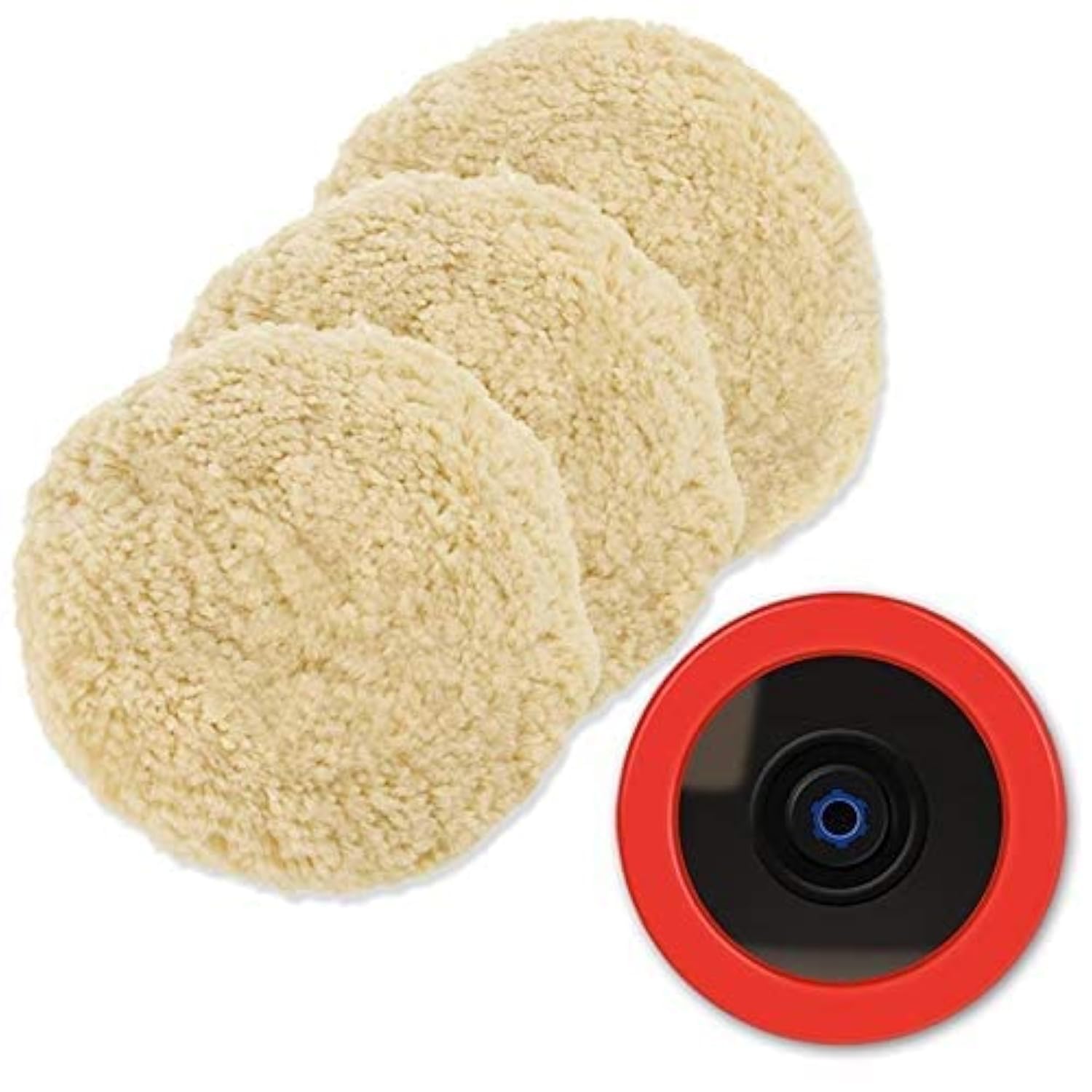
When wet-sanding residue or deep oxidation requires aggressive material removal, natural wool cuts faster than any foam or microfiber alternative. SPTA’s set delivers three 6-inch 100% natural wool pads along with a 5/8-11 threaded backing plate, giving you a ready-to-cut system for rotary or high-torque dual-action polishers.
The wool fibers have enough loft to hold heavy-cut compound against the panel without drying out prematurely, and the hook-and-loop backing — often a weak point on budget wool pads — stays firmly attached during high-speed operation. Users report that these pads match 3M wool disc performance at a fraction of the cost, with the caveat that all wool pads shed fibers initially.
A critical design note: the 5/8-11 backing plate fits standard rotary polishers, but you will want to pair these pads with a foam finishing pad for the final stage, because wool alone will leave a haze that needs refinement. Clean with a spur tool after each panel to prevent compound loading.
What works
- 100% natural wool cuts oxidation and sanding marks faster than blended alternatives
- Includes threaded backing plate — ready to mount on a rotary polisher
- Velcro grip remains secure under high shear without pad shifting
What doesn’t
- Initial shedding of loose fibers requires break-in on a scrap panel
- Requires a spur tool to clean between passes
- Not intended for final finishing — must follow with a foam pad
3. SPTA 6″ Mix Color Buffing Polishing Pads (5-Grit)
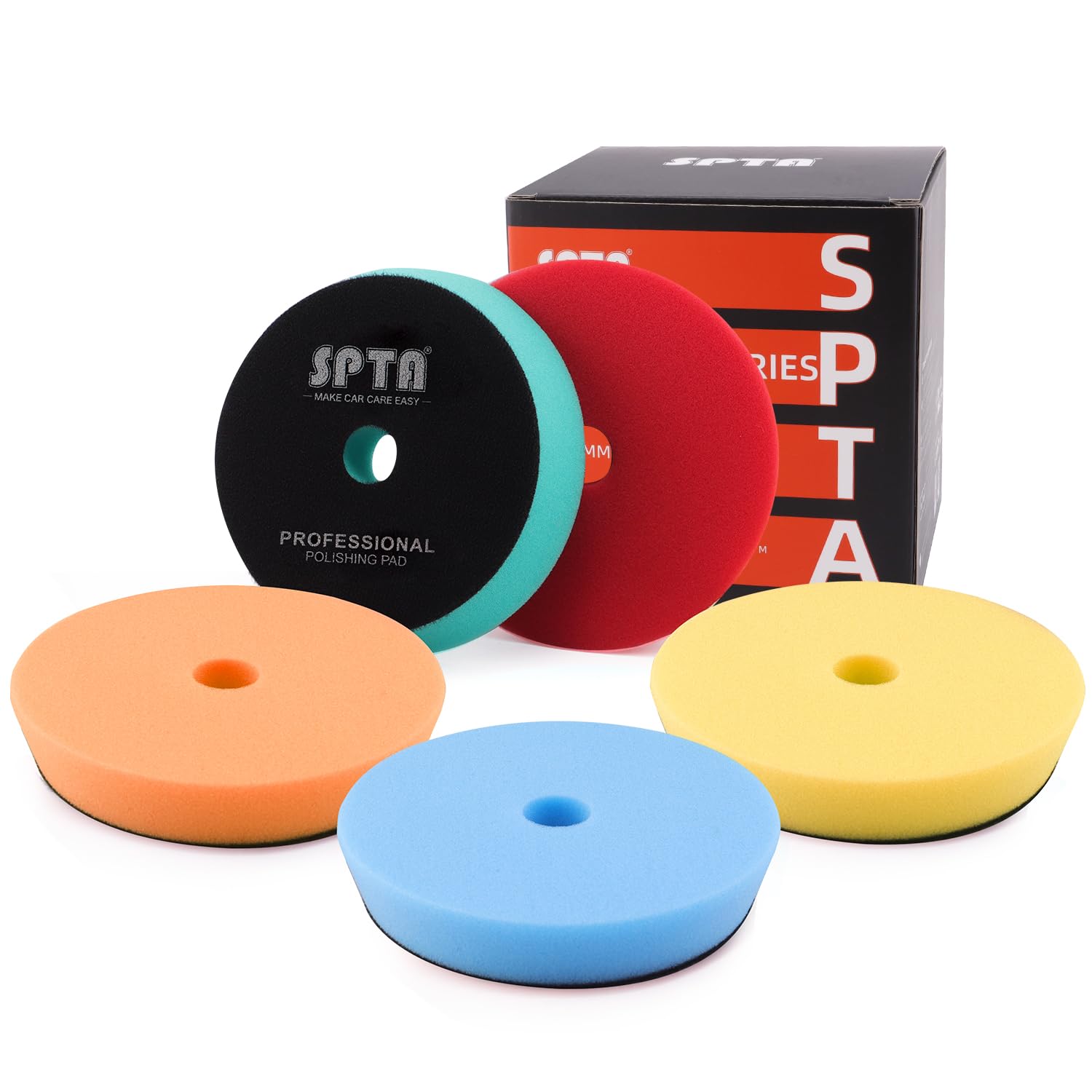
This five-pad set from SPTA uses a T-series grading system — T120 green for heavy cut, T80 yellow for high cut, T60 blue for moderate cut, T40 orange for light cut, and T10 red for ultra-fine finishing — covering the entire correction workflow from 1200-grit sanding mark removal to final gloss. Each foam formulation uses open-cell polyurethane that retains compound without slinging at high RPM.
A standout engineering detail is the stepped diameter: the front face measures 6.6 inches while the backing ring is 6 inches, creating a tapered overhang that prevents the pad edge from digging into adjacent body panels during angled passes. That overhang also reduces heat buildup at the foam-backing interface, extending pad life to an observed 4-5 cars before replacement.
Beginner users appreciate the visual color progression, which makes it hard to accidentally use a cutting pad for finishing work. The hook-and-loop grip holds firm on both 5-inch and 6-inch backing plates, though the T120 green pad demands a high-torque polisher to maintain rotation under cutting pressure.
What works
- Five distinct T-series foam formulations from heavy cut to ultra-fine finish
- Stepped front-to-back diameter protects adjacent surfaces during edge work
- Open-cell foam retains compound effectively at high oscillation speeds
What doesn’t
- Green heavy-cut pad requires a high-speed rotary or DA to maintain rotation
- Foam breakdown accelerates if used with aggressive compound on a rotary
- Not labeled with grit numbers on the pad surface — color coding must be memorized
4. SPTA 5+1 Piece 6″ Foam Polishing Pad Kit (TPPMIX)
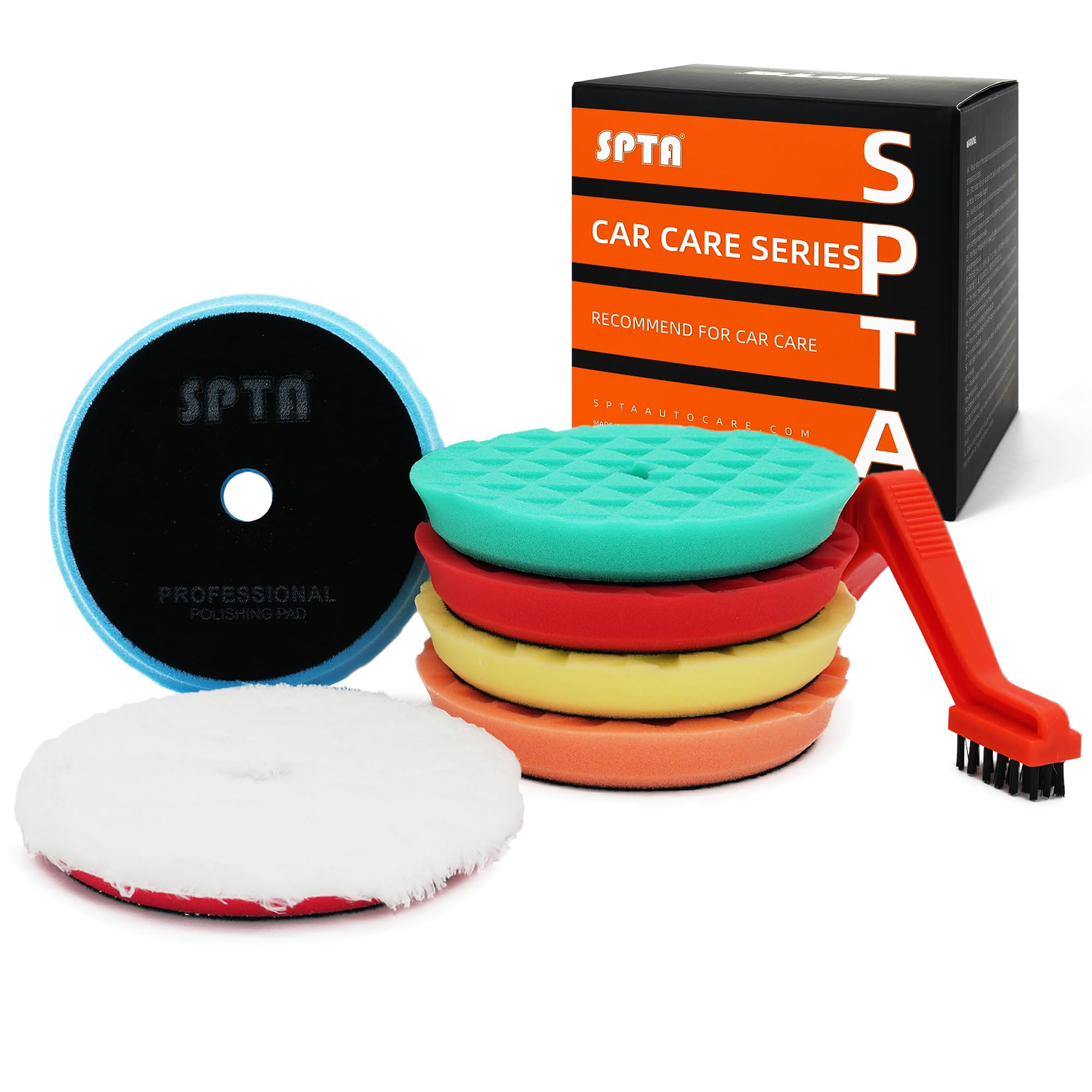
Five foam pads covering green (heavy cut), yellow (cut), orange (light cut), blue (polish), and red (finish), plus one microfiber finishing disc — this SPTA kit gives you a full 6-inch correction arsenal at an accessible price point. The foam is sourced from Germany with consistent cell density, and the green/yellow pads hold up to multiple sessions of heavy compounding without tearing or glazing over.
Hardness progression is clearly defined from hardest (green) to softest (red), making it straightforward to select the right pad for each stage of paint correction. Owners report using these pads on a full-size pickup truck for compounding, polishing, and waxing without any pad disintegrating under prolonged rotary use. The microfiber disc works best as a final buff to remove dried wax residue.
Compared to premium pads from Lake Country or Rupes, these SPTA pads have a shorter usable lifespan — expect 4-5 full vehicle corrections before the foam loses its structural integrity. For hobbyist detailers or small mobile detailing setups, that lifespan delivers excellent per-job value without sacrificing finish quality.
What works
- Germany-sourced open-cell foam with consistent density across all five grades
- Included microfiber finishing disc removes wax residue without marring
- Color-coded hardness progression makes pad selection foolproof for beginners
What doesn’t
- Foam begins to break down after 4-5 vehicles under continuous heavy use
- Hook-and-loop grip loosens slightly after repeated washing
- Lacks dedicated backing plate — must be purchased separately
5. SIQUK 48-Piece 3″ Car Polishing Pad Kit

When you need to polish tight engine bay areas, headlight lenses, door jambs, or small panel touch-ups, a full-size 6-inch pad cannot physically fit. SIQUK’s massive 48-piece kit solves that with 40 foam pads, two wool fiber polish pads, two wool buffing pads, two drill adapters, and two hook-and-loop backing discs — all at a 3-inch diameter designed for pneumatic or electric drill use.
The foam pads come in multiple colors with varying softness, allowing rough cutting on oxidized trim and fine finishing on clear coat within the same kit. Owners report using these for headlight restoration with impressive results, as the 3-inch size allows precise pressure control without overshooting onto surrounding paint. The included wool pads are notably more aggressive than the foam, useful for removing heavy oxidation before switching to finer foam pads.
Durability is the trade-off at this scale: foam tearing after 2-3 uses is common when working with fresh paint under heavy pressure. These pads are best treated as disposable consumables for spot correction rather than long-term shop tools. The drill adapters are plastic and can slip under high torque, so upgrading to a metal-chuck adapter improves consistency.
What works
- 48-piece inventory covers every small-area polishing need in one purchase
- Includes drill adapters and wool pads for immediate use without additional purchases
- 3-inch diameter enables precise work on headlights, jambs, and tight body lines
What doesn’t
- Foam pads tear after 2-3 uses under high pressure on fresh paint
- Pads lack grit or hardness labeling — selection requires trial and error
- Plastic drill adapters may slip under high torque; metal upgrade recommended
Hardware & Specs Guide
Foam Density and Cell Structure
Open-cell foam pads (common in finishing pads like the Griot’s Garage Red and SPTA T10) allow air and compound to flow through the material, reducing heat buildup and preventing the pad from glazing over. Closed-cell or high-density foam (green and yellow pads) applies more concentrated pressure to the paint surface for aggressive cutting but runs hotter. A good rule: the softer the pad feels, the finer the finish it will produce.
Wool Fiber Aggression and Backing Systems
100% natural wool pads cut faster than any foam grade because the individual fibers act as cutting edges. They require a 5/8-11 threaded backing plate for rotary polishers. Microfiber pads land between wool and foam in cut rate. Hook-and-loop backing density is measured in loops per inch; higher density loops (like the SPTA wool set) prevent the pad from detaching at high RPM.
FAQ
What does the color of a foam polishing pad mean?
Can I use a wool pad on a dual action polisher?
How do I know when to replace a buffing pad?
Final Thoughts: The Verdict
For most buyers, the best car polishing buffing pads winner is the SPTA 6″ Mix Color 5-Pad Set because it covers the entire correction workflow from heavy cut to ultra-fine finish with T-series foam that retains compound and resists tearing longer than the two entry-level kits. If you want the ultimate finishing pad for waxes and sealants, grab the Griot’s Garage Red Waxing Pads. And for heavy oxidation removal where raw cutting speed matters, nothing beats the SPTA 6″ Natural Wool Pad Set with its included backing plate and 100% wool fibers.

Certification: BSc in Mechanical Engineering
Education: Mechanical engineer
Lives In: 539 W Commerce St, Dallas, TX 75208, USA
Md Amir is an auto mechanic student and writer with over half a decade of experience in the automotive field. He has worked with top automotive brands such as Lexus, Quantum, and also owns two automotive blogs autocarneed.com and taxiwiz.com.