A sloppy fuse panel is the number one cause of electrical gremlins, melted wires, and dead batteries in modified cars and trucks. Choosing the right distribution block means the difference between a reliable accessory setup and a fire hazard waiting to happen.
I’m Amir — the founder and writer behind Four Wheel Ask. I spend my days studying wiring schematics, comparing terminal metallurgy, and aggregating thousands of owner install reports to separate genuine quality from marketing hype.
Whether you are wiring auxiliary lights on a work truck, building a campervan power center, or cleaning up a project car’s engine bay, the right distribution hub saves time and prevents future headaches. By analyzing terminal materials, current ratings, weather sealing, and hundreds of owner install reports, we pinpoint the best car fuse panel for reliable DC power distribution.
How To Choose The Best Car Fuse Panel
Selecting a fuse panel for your vehicle is not just about counting circuits. You must consider the environment, the total current draw, and whether you need integrated relay sockets. Below are the three most critical factors to evaluate before you buy.
Circuit Count and Amperage Planning
Count every accessory you plan to power now and in the near future. Each circuit should handle the expected load with headroom. A 30A-per-circuit rating is common for lighting and small pumps, while a 100A main bus rating supports several moderate loads simultaneously. Undersizing leads to nuisance blown fuses or voltage drop.
Build Quality and Terminal Materials
Tin-plated copper bus bars resist corrosion far better than bare steel or zinc alloys. Look for screw terminals that accept ring terminals without stripping. Molded nylon or PBT housings with strain relief on wire entries extend the lifespan of the unit in high-vibration environments like engine bays or off-road vehicles.
Environmental Sealing and Enclosure Design
For under-hood or marine use, an IP65 rating or a gasketed cover is essential to keep moisture and dust off the bus bars. Even a splash-resistant lid with a drip lip can be adequate inside a cabin or dry bay. Transparent covers let you inspect fuses without opening the box, while LED indicators simplify troubleshooting.
Quick Comparison
On smaller screens, swipe sideways to see the full table.
| Model | Category | Best For | Key Spec | Amazon |
|---|---|---|---|---|
| Snlazp 12V Fuse Block | Fuse Block | Clean Power Management | 12 Circuits w/ LED Indicators | Amazon |
| True Mods Waterproof Relay Box | Relay & Fuse Box | All-in-One Waterproof | IP65, 6 Relay + 6 Fuse | Amazon |
| DaierTek 12V Relay Box | Relay & Fuse Box | Budget Integration | 6 Relay + 6 Fuse, Pre-Wired | Amazon |
| Blue Sea Systems ST Blade Fuse Block | Fuse Block | Compact Marine Duty | 4 Circuit, 100A Rating | Amazon |
| RVBOATPAT Fuse Relay Box | Relay & Fuse Box | High-Capacity Setup | 6 Relay + 11 Fuse, 40A Relays | Amazon |
In‑Depth Reviews
1. Snlazp 12 Volt Fuse Block

The Snlazp fuse block delivers 12 independent circuits with a shared negative bus, making it a complete power distribution center in one compact housing. Each positive terminal has a corresponding negative screw right next to it, which simplifies wiring and reduces cable clutter. The housing is molded from flame-resistant PBT material, giving it mechanical strength and heat resistance that budget ABS blocks lack.
What sets this unit apart is the red LED warning indicator that illuminates when a fuse blows. In a crowded engine bay or trailer junction box, that visual cue saves hours of probe-and-guess troubleshooting. The clear cover locks in place securely, and owner reports confirm the lid stays put even on rough roads. The included assortment of fuses from 5A to 25A covers most common accessory loads right out of the box.
Several owners noted the battery-power input terminals feel smaller than ideal for heavy-gauge wire. For most 12V accessory builds the included screw terminals work fine, but if you are feeding the panel with 4 AWG or larger cable, you may want to upgrade the terminal hardware or add a separate distribution stud before the block.
What works
- LED indicators on every circuit for instant blown-fuse detection
- Locking clear cover stays secure in high-vibration environments
- PBT housing resists heat, flame, and mechanical stress
- Includes 25 assorted fuses and DIY identification stickers
What doesn’t
- Main power terminals are too small for 4 AWG or larger cable
- Lid hinge feels slightly fragile under repeated open-close cycles
2. True Mods Waterproof 12V Fuse Relay Box

The True Mods relay box is a complete under-hood power solution with six Bosch-style 5-pin relay sockets and six ATO/ATC fuse holders integrated into a single IP65-rated enclosure. The pre-wired pigtail harness uses 12 AWG wire for the main power feeds and 16 AWG for signal circuits, with color-coded labels on every lead that eliminate guesswork during installation. The “Z” shaped mounting brackets let you position the box in tight engine bay spaces where flat-bottom units cannot fit.
Nylon 66 construction gives this housing serious impact and chemical resistance, and the gasketed lid seals reliably against pressure-wash sprays and mud splash. Owner feedback from race car builds and off-road Jeep CJ5 restorations consistently praises the build quality and the flexibility of having independent power inputs for each relay. The kit includes fuses, terminals, silicon seals, and a 6-wire-to-1 terminal ring for consolidating ground returns.
A few owners experienced cracked lid tabs during initial installation, though the vendor responded quickly with replacement covers. The wires exit the box through a single bundled opening, which can make flush surface mounting awkward if you want the harness to sit flat against a panel. Plan your mounting location with enough clearance for the pigtail exit angle.
What works
- IP65 waterproof rating with gasketed lid for under-hood durability
- Pre-wired 12 AWG and 16 AWG color-coded pigtail harness
- Z-brackets allow flexible mounting in tight engine bay spaces
- Includes 5-pin relays rated 30A/40A for high-draw accessories
What doesn’t
- Lid tabs can crack if overtightened during first installation
- Wire bundle exit angle complicates flush surface mounting
3. DaierTek 12V Relay Box 6 Way

The DaierTek relay box brings 6 relay sockets and 6 fuse slots in a factory-prewired format that cuts installation time significantly. Color-coded wires — red for power, black for ground, blue for signals — follow standard automotive convention, and the 12 AWG heavy-duty leads on the relay side handle sustained 20A draws with minimal voltage drop. The base includes removable panels that let you reroute wires without cutting the housing.
Owners installing this in Ford F150 lighting builds and general automotive projects note that brass terminal connectors and genuine copper wire set this unit apart from cheaper zinc-alloy alternatives. The lid seals with a rubber gasket that blocks splashes and dust, though the unit is not rated for submersion. For interior or under-seat mounting it offers excellent protection, but under-hood exposure to direct pressure-wash spray may allow moisture past the gasket over time.
The supplied pigtail wires are on the short side, which limits mounting placement unless you are comfortable extending them with splices. Several reviewers also noted the included fuses are basic-quality units that may be worth upgrading with name-brand replacements for critical circuits. The relays themselves have held up well in extended use.
What works
- Factory pre-wired with color-coded 12 AWG power leads
- Brass connectors and copper wire for reliable conductivity
- Removable panels in the base simplify wire routing changes
- Gasketed lid provides splash and dust resistance
What doesn’t
- Pigtail wires are short and may require extension for some mounts
- Included fuses are basic quality; consider upgrading for critical circuits
4. Blue Sea Systems ST Blade Fuse Block 4 Circuit
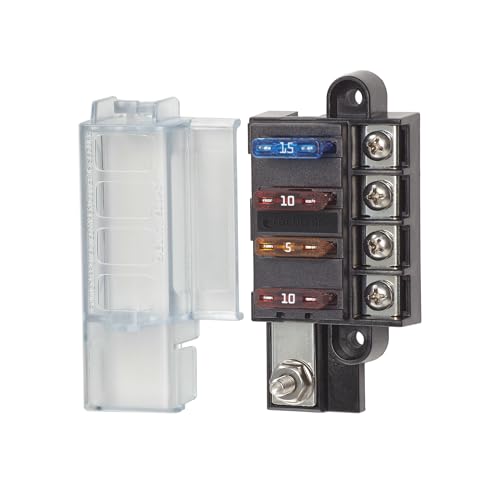
The Blue Sea Systems ST Blade fuse block is a 4-circuit distribution block built to marine-grade standards, and that pedigree translates directly to automotive reliability. The tin-plated copper bus bars and fuse clips resist corrosion far longer than unplated alternatives, which matters in any environment with humidity or salt spray. All terminals are arranged on one side of the compact housing, allowing installation in gaps as narrow as a tractor fender or boat helm console.
Owner reports from golf cart conversions, compact tractor accessory adds, and Sanger ski boat rewires all highlight the same strengths: the blade fuse sockets grip firmly, the screw terminals accept ring terminals cleanly, and the overall build quality justifies the slightly higher cost per circuit. The clear insulating cover provides space for write-on circuit labels, which makes future troubleshooting straightforward. The 100A bus rating with 30A per circuit gives ample headroom for lighting, horns, pumps, and small electronics.
The cover snaps on securely but several owners report it does not stay latched in high-vibration environments without additional tape or a zip tie. The single-sided terminal layout, while space-efficient, means all wires exit the same direction, which can create a tight bend radius in very shallow compartments. Plan your cable entry path before committing the mounting screws.
What works
- Tin-plated copper bus bars resist corrosion in wet environments
- Compact one-sided terminal layout fits extremely tight spaces
- Clear cover with circuit identification labels aids troubleshooting
- 100A main bus rating provides headroom for multiple accessories
What doesn’t
- Cover does not stay latched in high-vibration installations
- All wires exit one side, creating tight bend radius in shallow compartments
5. RVBOATPAT 12V Fuse Relay Box

The RVBOATPAT relay box offers the highest fuse capacity in this roundup with 11 ATC/ATO blade fuse slots paired with 6 pre-installed 4-pin 40A relays. This configuration lets you run multiple high-draw accessories — light bars, air compressors, winch solenoids, fuel pumps — each on its own fused and relayed circuit. The pre-wired design reduces the connection work to attaching your accessory leads and the main power feed.
Owner feedback from Honda Talon builds and project car wiring overhauls praises the value proposition: you get relays, fuses in five common ratings, and the housing all in one box. The unit accepts independent relay and fuse control, meaning each relay can trigger a separate circuit without sharing power across the bus. This is a genuine advantage when you need switched power for some accessories and constant power for others.
Build quality observations are mixed. The wiring crimp ends are not always consistently applied, and the lid snap tabs feel fragile compared to premium options. The cover is not waterproof — it has a moisture-redirecting lip but no gasket — so this unit belongs inside a cabin, under a seat, or in a dry bay rather than exposed to direct rain or pressure washing. Plan your mounting location accordingly.
What works
- High capacity with 11 fuse slots and 6 pre-installed 40A relays
- Includes assortment of 11 fuses from 5A to 30A for immediate use
- Independent relay and fuse control per circuit for flexible switching
- Pre-wired design minimizes installation complexity
What doesn’t
- Crimped wire ends have inconsistent quality from the factory
- Cover lacks waterproof gasket; interior or dry-bay mounting required
Hardware & Specs Guide
Bus Bar Materials
Tin-plated copper is the gold standard for fuse panel bus bars. It offers low electrical resistance, resists oxidation from humidity and salt, and maintains a stable connection over years of thermal cycling. Bare copper requires periodic cleaning. Zinc or steel buses are cheaper but corrode quickly in automotive environments, leading to voltage drop and intermittent faults.
Environmental Protection Ratings
IP65-rated enclosures are sealed against dust ingress and low-pressure water jets from any direction, making them suitable for engine bay and marine installations. Less expensive units with a simple drip lip or snap cover are adequate inside the passenger compartment, under a dash, or in a dry utility bay. Never rely on an unsealed cover in a location exposed to direct rain or pressure washing.
Wire Gauge and Current Capacity
Each circuit should be wired with a gauge appropriate for its fuse rating. A 30A circuit requires 10 AWG wire minimum; a 20A circuit needs 12 AWG. The main feed cable to the panel must handle the sum of all circuit loads. A 100A bus demands at least 4 AWG from the battery terminal, with proper ring terminals and strain relief at the connection.
Relay Integration vs. Standalone Fuse Block
A combined relay and fuse box reduces wiring complexity by housing both switching and overcurrent protection in one unit. This is ideal for high-draw accessories that need a trigger signal from a switch or ECU. A standalone fuse block is simpler and more compact for always-on circuits like USB chargers, dash cams, or interior lighting that do not require switched control.
FAQ
Can I mount a fuse panel directly to the battery?
How do I know how many circuits I need?
What is the difference between ATO and ATC blade fuses?
Can I use a car fuse panel for a solar or RV system?
Final Thoughts: The Verdict
For most buyers, the best car fuse panel winner is the Snlazp 12 Volt Fuse Block because it combines 12 circuits with LED troubleshooting indicators and a lockable cover at a mid-range investment that fits nearly any build. If you need IP65 waterproof protection with integrated relay control for under-hood use, grab the True Mods Waterproof Relay Box. And for a compact, corrosion-resistant block in tight marine or tractor spaces, nothing beats the Blue Sea Systems 4 Circuit Fuse Block.

Certification: BSc in Mechanical Engineering
Education: Mechanical engineer
Lives In: 539 W Commerce St, Dallas, TX 75208, USA
Md Amir is an auto mechanic student and writer with over half a decade of experience in the automotive field. He has worked with top automotive brands such as Lexus, Quantum, and also owns two automotive blogs autocarneed.com and taxiwiz.com.