A car charger power socket that delivers consistent voltage, supports fast charging protocols, and doesn’t drain your battery when the engine is off separates a well-engineered accessory from a cheap afterthought. Most drivers grab the first adapter they see at the checkout counter, only to replace it a few months later when the USB port stops recognizing their phone or the socket corrodes from cabin moisture. The real measure of a quality unit comes down to three factors: the accuracy of its voltage regulation, the durability of its connectors, and whether it includes a power cutoff switch to prevent parasitic drain during long parking periods.
I’m Amir — the founder and writer behind Four Wheel Ask. My background involves deep market research and analyzing product specifications, build quality data, and owner feedback across dozens of automotive electrical accessories to separate engineered solutions from packaging-driven marketing.
Modern vehicles demand more than a simple 12V pass-through. After analyzing dozens of models, the best car charger power socket balances fast charging speeds with reliable build quality and battery protection.
How To Choose The Best Car Charger Power Socket
Selecting a power socket for your vehicle goes beyond matching the hole size in your dash. The internal electronics, connector materials, and safety certifications determine whether the unit lasts through seasonal temperature swings or fails during the first summer heat wave. Focus on these evaluation points before you buy.
Charging Protocols: PD vs. QC vs. Standard
Power Delivery (PD) and Quick Charge (QC) are the two dominant fast-charging standards in the automotive accessory space. PD 3.0 supports up to 30W per port on most 12V hardwired sockets and is the preferred protocol for iPhone 15 and later models as well as USB-C laptops. QC 3.0 tops out around 18W per port and remains the standard for many Android devices from Samsung, Motorola, and OnePlus. A socket that includes both PD and QC ports offers the widest device compatibility without forcing you to carry multiple cables. Avoid units that only advertise “smart charging” without naming the specific protocol — that phrase often masks basic 5V/2.4A output that charges modern phones at a fraction of their capable speed.
Build Materials and Heat Management
The enclosure material directly affects how well the socket handles continuous high-current loads. Aluminum alloy bodies dissipate heat more efficiently than ABS plastic and resist cracking when exposed to extreme cabin temperatures. However, metal housings can transfer heat to the surrounding dash panel if the internal regulator runs inefficiently. Plastic units are lighter and cheaper but tend to retain heat, which accelerates wear on the internal voltage regulator and USB ports. For a socket that will power multiple devices simultaneously on long road trips, prioritize an aluminum body with vented end caps or a built-in cooling channel. For occasional dashboard charging where the socket sits idle most of the time, a reinforced ABS plastic unit with a UL or CE rating usually provides adequate service life.
Power Switch and Parasitic Drain Prevention
A car charger power socket that remains live when the ignition is off creates a continuous parasitic load on the battery. Most quality hardwired sockets consume between 20mA and 50mA in standby mode — enough to drain a standard lead-acid battery to a non-start condition over two to three weeks of parking. A mechanical push-button power switch that physically disconnects the USB and voltmeter circuits eliminates this drain entirely. Some units combine the switch with the voltmeter, allowing you to monitor battery voltage while driving and cut power when parked. If you plan to install the socket in a boat, RV, or motorcycle that may sit unused for extended periods, a built-in rocker or push-button switch is a non-negotiable feature.
Installation Method: Direct Hardwire vs. Cigarette Lighter Replacement
Hardwired sockets that require drilling a 30mm hole and connecting to the vehicle’s fuse panel or battery terminals offer the cleanest installation and the most reliable electrical connection. They also allow you to position the socket in a custom location — inside a center console, under the dash, or in a boat helm station. Cigarette lighter replacement models slip into the existing dash opening and typically include ring terminals that connect to the factory wiring. While easier to install, these rely on the original lighter jack’s wiring gauge, which may be undersized for sustained 10A+ loads. If you plan to draw more than 8A continuously (multiple fast-charging phones plus a dashcam), a direct hardwire installation with 14-gauge or thicker wire is the safer route.
Quick Comparison
On smaller screens, swipe sideways to see the full table.
| Model | Category | Best For | Key Spec | Amazon |
|---|---|---|---|---|
| Rocoren 105W 6-Port | Multi-Device | Family road trips with multiple phones and tablets | 105W total, 3x USB-C + 3x USB-A, 5ft cable | Amazon |
| VANONE Dual PD | Aluminum | DIY installation in boats, RVs, and off-road vehicles | Dual PD + Dual QC, aluminum body, LED voltmeter | Amazon |
| FSATBTNE 400W | Inverter | Powering laptops, CPAP machines, and small appliances | 400W continuous, 2x AC outlets, PD 65W + QC 18W | Amazon |
| Vansoet 200W | Inverter | Compact power for laptops and camera gear on the go | 200W continuous, 2x AC outlets, PD 65W + PD 30W | Amazon |
| EUGIZMO 7-in-1 | Splitter | Adding multiple 12V sockets and USB ports to a battery | 3x 12V sockets, 30W PD, 18W QC, 10ft cable | Amazon |
| UYUXIO 6-in-1 | Fast Charge | Super-fast charging for Huawei, Oppo, OnePlus devices | 6 ports, voltage display, 100W max super charge | Amazon |
| Qidoe 2-in-1 | Metal | Replacing a worn cigarette lighter with a modern USB panel | Aluminum alloy, PD 20W, QC 3.0, 150W socket | Amazon |
| JUNVANG 90W | Budget | Budget-friendly 4-port charging with a high-power cable | 90W total, 2x USB-C + 2x USB-A, includes 240W cable | Amazon |
| Hapytrip 3-Port | Value | Entry-level hardwire upgrade with voltmeter and switch | Dual QC 3.0 + PD 3.0, ABS plastic, power button | Amazon |
| Hapytrip 78W 4-Port | Compact | Four-port charging in a single 30mm panel mount | 2x PD 30W + 2x QC 18W, push-button switch, waterproof | Amazon |
| Hapytrip 2-Pack | 2-Pack | Equipping two vehicles or multiple installation locations | 2x 78W units, 4 ports each, fused wires included | Amazon |
In‑Depth Reviews
1. Rocoren 105W 6-Port Car Charger
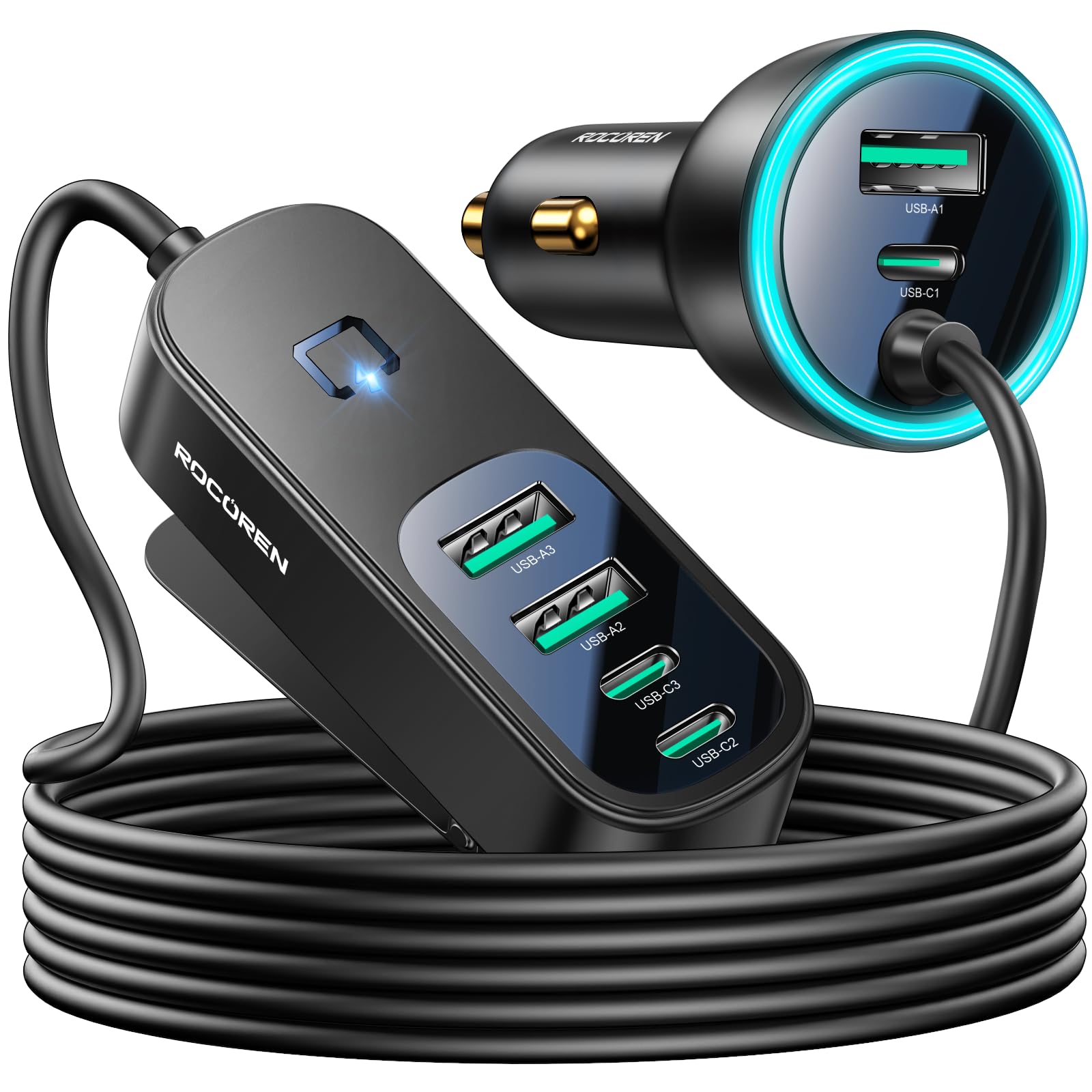
The Rocoren 105W charger addresses the most common pain point for families and carpool drivers: not enough ports for everyone. Its six individual outlets — three USB-C supporting up to 35W each and three USB-A supporting up to 30W each — allow simultaneous charging for six devices without the power-sharing bottlenecks found in cheaper multi-port adapters. The 5-foot extension cable and rear-seat clip let you mount the unit in a backseat pocket so rear passengers can reach ports without tangled cords stretching across the cabin. The PC anti-flame retardant enclosure and FCC/CE/ROHS certifications provide a baseline of safety that many unbranded multi-port units lack.
What separates this design from typical 4-port adapters is the dedicated allocation of ports: two USB-C and two USB-A are labeled for the driver upfront, while the remaining two USB-C and two USB-A are positioned for rear passengers. This layout prevents the common scenario where one person’s charging session hogs the total wattage and leaves everyone else trickle-charging. In practice, the charger intelligently distributes the 105W total across connected devices, prioritizing fast negotiation for PD-compatible phones and tablets while feeding standard 5V/2.4A to older devices. The included 5-foot cable provides enough reach to tuck the unit into a center console bin or glove box, keeping the dash clean.
Long-term reliability depends on the quality of the internal DC-to-DC converters, and owner reports after six months of daily use indicate consistent performance without port degradation or overheating. The charger only operates when plugged into a powered 12V socket, so there is no parasitic drain concern. For those who regularly carry multiple phones, tablets, or a mix of USB-C and USB-A devices, the Rocoren 105W offers the most thoughtfully designed multi-port layout in this lineup.
What works
- Six dedicated ports with individual fast-charge negotiation
- 5-foot extension cable enables clean rear-seat installation
- Flame-retardant PC shell meets safety compliance standards
What doesn’t
- Requires a functioning 12V cigarette lighter socket — not a hardwire panel
- No voltmeter or power switch for battery monitoring
2. VANONE Dual PD Aluminum USB Outlet
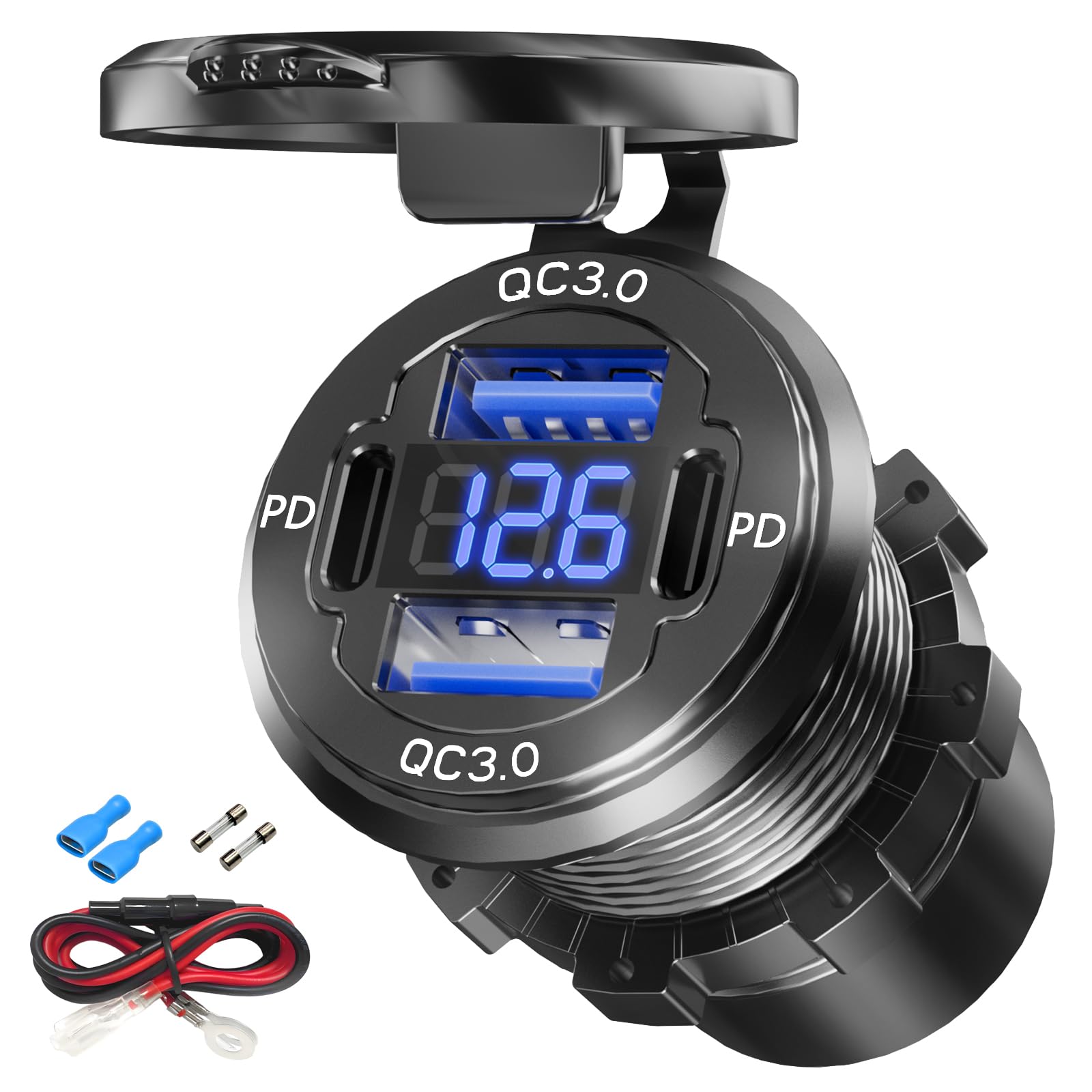
The VANONE dual PD and dual QC 3.0 socket is engineered for installations where heat dissipation and mechanical durability matter more than port count. Its aluminum alloy body acts as a passive heat sink, drawing thermal energy away from the internal voltage regulators during sustained high-current charging. The integrated digital voltmeter provides real-time battery voltage readings whenever the socket is connected to power, helping you spot a failing alternator or a dying battery before you get stranded. The waterproof snap cap protects the USB ports from cabin spills, rain, and wash-down splashes in marine and off-road environments.
Charging performance is split across four ports: two PD 3.0 ports capable of 18W each and two QC 3.0 ports also rated at 18W each. While 18W per port isn’t the fastest option available — some competitors push 30W per PD port — the VANONE unit maintains consistent output without the voltage sag that plagues cheaper plastic-housed sockets under load. The CE and ROHS certifications confirm that the internal components meet European safety standards for overcurrent and short-circuit protection. Installation requires cutting a 30mm hole and connecting the included red and black wires to a 12V-24V power source, which makes it a solid choice for DIY boat and RV electrical projects.
Owner feedback highlights the cap’s tight seal as a standout feature for Jeep and off-road builds where dust and moisture are constant threats. The LED display draws approximately 30mA in standby, so pairing this socket with an inline switch is advisable for vehicles that sit for longer than a week between starts. For those who prioritize build materials and environmental sealing over absolute per-port wattage, the VANONE socket delivers a rugged solution that should outlast the vehicle it’s installed in.
What works
- Aluminum body provides superior heat dissipation
- Waterproof snap cap protects against moisture and dust
- Digital voltmeter enables battery health monitoring
What doesn’t
- Per-port output limited to 18W across all four ports
- No built-in power switch — external switch recommended for parasitic drain prevention
3. FSATBTNE 400W Power Inverter

The FSATBTNE 400W inverter bridges the gap between a dedicated 12V socket and a full AC power station. It converts your vehicle’s 12V DC into 110V AC through two standard wall outlets while simultaneously offering a 65W USB-C PD port and an 18W USB-A QC port. The 400W continuous rating (800W peak) is sufficient to run a 40-liter car refrigerator, charge multiple laptops, or power a CPAP machine during overnight camping stops. The aluminum alloy housing and intelligent temperature-controlled cooling fan ensure the unit maintains safe operating temperatures even when running near its rated capacity for extended periods.
The 65W USB-C PD port is the standout feature for professionals who need to charge a MacBook Pro or Dell XPS while driving. In testing, the PD port delivers a full 65W consistently without the intermittent cycling that some budget inverters exhibit when the USB controller shares thermal space with the AC inverter stage. The two AC outlets deliver modified sine wave output, which is compatible with all standard laptop chargers, camera battery chargers, and small appliances with switch-mode power supplies. Devices with sensitive motors or audio equipment may hum slightly on modified sine wave, but for typical travel use cases, this is rarely an issue.
The compact form factor — roughly the size of an iPhone — and the 24-inch cigarette lighter plug make it easy to stow under a seat or in a glove box when not in use. The unit includes a 24-month warranty and the manufacturer provides direct customer support, which adds peace of mind for a device that handles significant electrical load. For road trippers and overlanders who need both AC outlets and high-speed USB charging from a single unit, the FSATBTNE 400W offers the most versatile power delivery in this lineup.
What works
- 400W continuous output can power mini-fridges, laptops, and CPAP machines
- 65W USB-C PD port charges full-size laptops at full speed
- Aluminum housing with smart fan prevents thermal shutdown
What doesn’t
- Modified sine wave output may cause hum in sensitive audio equipment
- 24-inch lighter plug limits placement options for hardwire installations
4. Vansoet 200W Power Inverter
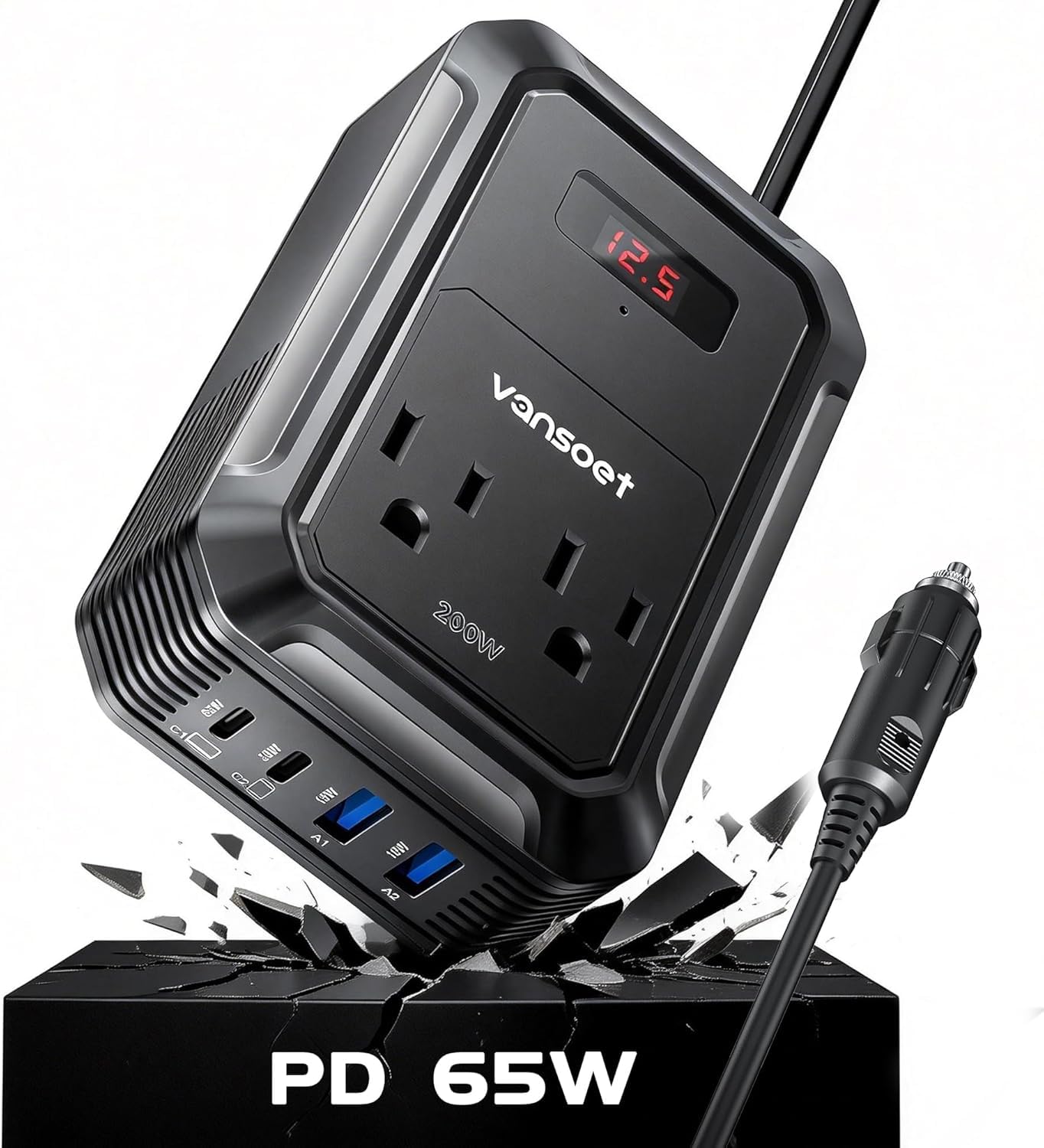
The vansoet 200W inverter takes a more focused approach than its 400W counterpart, prioritizing portability and certified safety for users who primarily need to charge laptops and camera gear rather than run appliances. Its ETL certification means the unit has been independently tested to meet North American safety standards for electrical and fire risk — a certification tier that many budget inverters skip. The 200W continuous rating handles laptop chargers (typically 45W-100W), drone battery chargers, and camera battery stations without breaking a sweat. The inclusion of two PD USB-C ports (65W and 30W) and two QC 18W USB-A ports brings the total USB output to 131W, leaving the AC outlets free for devices that require genuine wall-power input.
The dual PD port layout is notably useful for households with mixed ecosystems: the 65W port handles a MacBook Pro or iPad Pro, while the 30W port fast-charges an iPhone 15 or Samsung Galaxy S24. The LCD display provides real-time input voltage, output wattage, and battery-level information, which helps you monitor the load on your vehicle’s electrical system. The smart cooling fan ramps up only when needed and operates quietly enough that it won’t disturb passengers during overnight drives. The relatively compact dimensions (similar to a deck of cards) mean the inverter can be tucked into the center console cubby or mounted under the dash with double-sided tape.
The vansoet brand offers an 18-month replacement warranty and 180-day refund period, which is more generous than the typical 30-day window from generic inverter sellers. Owner reports consistently note that the unit runs cool even when charging a laptop and multiple phones simultaneously. The primary trade-off is the 200W cap, which limits AC-powered devices to smaller electronics — a 40-liter fridge or microwave is out of range. For photographers, remote workers, and daily commuters who just need reliable AC and USB-C charging from a tidy package, the vansoet 200W is the most polished option in this class.
What works
- ETL certification provides verified safety compliance
- Dual PD ports (65W + 30W) cover laptops and phones
- LCD display offers real-time power and voltage monitoring
What doesn’t
- 200W rating limits AC outlet use to small electronics only
- Cooling fan can be audible during sustained high-load operation
5. EUGIZMO 7-in-1 Cigarette Lighter Socket Splitter
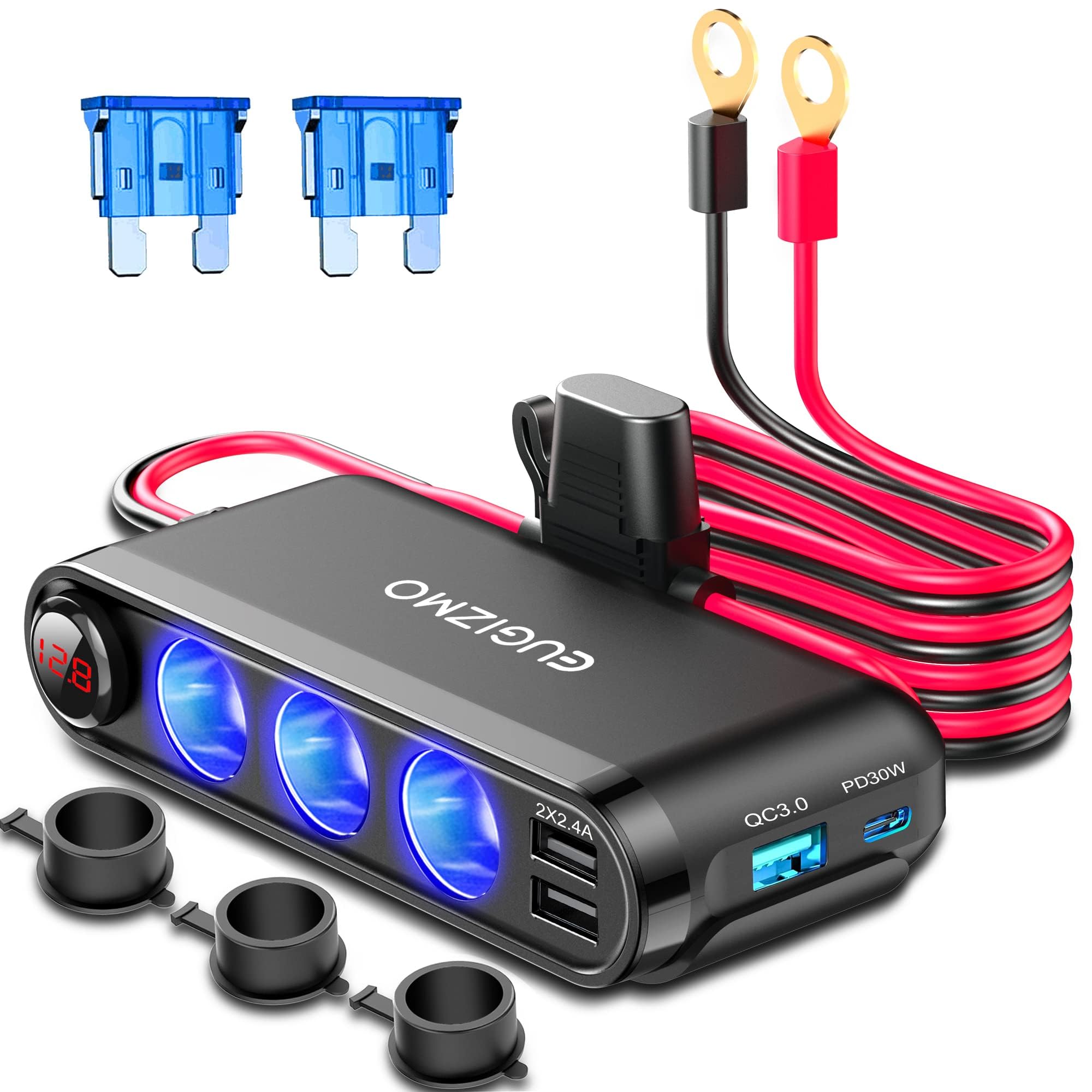
The EUGIZMO 7-in-1 solves a specific problem: how to add multiple 12V accessory ports and USB charging to a trailer, boat helm, or truck bed without cutting into the factory wiring. Its three dedicated cigarette lighter sockets deliver a combined 120W at 12V (200W at 24V), allowing you to power a dashcam, a tire inflator, and a seat heater simultaneously from a single battery connection. The included 10-foot cable with ring terminals lets you run the unit directly to the battery terminals, bypassing the vehicle’s factory lighter circuit entirely — a critical advantage when the original wiring is already at capacity with other accessories.
The USB section includes one PD 30W USB-C port, one QC 3.0 18W USB-A port, and two standard 5V/2.4A USB-A ports that share a 15W total budget. While the standard USB ports are slow by modern standards, the PD and QC ports handle the heavy lifting for phones and tablets. The LED voltage display monitors battery health in real time and flashes a warning if the voltage drops too low or spikes too high — a useful safeguard for vehicles with aging alternators. The master power switch cuts all power to the sockets and USB ports with one click, eliminating parasitic drain when the unit is not in use.
The CE, FCC, UL, and RoHS certifications provide a rare level of compliance documentation for a multi-socket splitter, which is reassuring given that the unit may be installed in engine bays or battery compartments with exposure to heat and vibration. The ABS enclosure is rated for the typical temperature range found in vehicle interiors, though direct engine-bay mounting is not recommended due to plastic’s lower heat tolerance. For overlanders, boat owners, or anyone with multiple 12V accessories, the EUGIZMO 7-in-1 offers the most comprehensive socket expansion solution in this roundup.
What works
- Three 12V sockets plus USB charging in a single distribution unit
- 10-foot cable with ring terminals enables direct battery connection
- Multiple safety certifications (CE, FCC, UL, RoHS)
What doesn’t
- Standard USB-A ports are limited to 5V/2.4A shared output
- ABS plastic housing is not suitable for engine-bay installation
6. UYUXIO 6-in-1 USB-C Car Charger

The UYUXIO 6-in-1 charger targets users with a diverse fleet of devices spanning multiple fast-charge ecosystems. It supports Huawei SuperCharge at 100W max, Oppo SuperVOOC, OnePlus Warp Charge, Samsung Ultra Fast Charging, and iPhone 27W PD — a broader protocol compatibility list than any other charger in this roundup. The six ports (three USB-C and three USB-A) allow simultaneous charging for up to six devices, though the total wattage is shared across ports, with priority given to the device that first negotiates a fast-charge handshake. The built-in voltage display shows the car battery’s status whenever the charger is plugged into the lighter socket, providing a quick health check at startup.
The metal housing is a welcome upgrade from the all-plastic construction of typical 6-port adapters, as it provides better heat sinking during sustained multi-device charging sessions. The charger draws negligible standby current when no devices are connected, so leaving it plugged in overnight won’t materially affect battery voltage. The compact form factor — roughly 3 inches long — protrudes minimally from the dash, which reduces the risk of snapping the charger body off when bumped by a passenger’s knee. Compatibility extends to 12V and 24V electrical systems, covering cars, trucks, SUVs, and RV lighter sockets.
Owner feedback consistently praises the charger’s ability to recognize and negotiate proprietary fast-charge protocols from Chinese and Korean phone brands that often default to slow charging on generic adapters. The unit has been aged-tested by the manufacturer before shipping, which suggests better quality control than the typical unbranded multi-port adapter available at similar price points. The main limitation is the shared wattage pool — plugging in six devices simultaneously will reduce each port’s output significantly compared to single-device charging. For households with multiple newer Android and iPhone devices that support different fast-charge standards, the UYUXIO charger eliminates the compromise of picking one protocol over another.
What works
- Supports proprietary fast-charge protocols from Huawei, Oppo, OnePlus, and Samsung
- Metal housing provides better thermal management than plastic competitors
- Voltage display enables quick battery health checks
What doesn’t
- Total wattage is shared across all six ports when fully loaded
- Protruding plug design may be vulnerable to impact in tight cabins
7. Qidoe 2-in-1 Cigarette Lighter Socket

The Qidoe 2-in-1 panel combines a traditional 12V cigarette lighter socket with modern USB charging in a single aluminum alloy housing, making it a direct replacement for outdated factory lighter units that have worn out or lost spring tension. The 12V socket supports up to 150W at 12V and 300W at 24V, enough to power a compact tire inflator, dashcam, or GPS unit through the original lighter port. The USB section includes a 20W PD 3.0 USB-C port and an 18W QC 3.0 USB-A port, providing fast charging for the two most common device types without requiring a separate adapter block. The integrated LED voltmeter and ON/OFF switch give you manual control over power delivery and real-time battery monitoring in one compact module.
The aluminum alloy body is noticeably more substantial than the ABS plastic used in most entry-level replacement sockets. It dissipates heat more effectively during high-current draws and resists cracking when the retaining ring is torqued down during installation. The 23.6-inch wire harness with a 15A fuse simplifies the replacement process: you connect the ring terminals to the existing lighter socket wiring, secure the panel into the dash opening, and tighten the nut. The package includes a wiring diagram that clearly labels positive and negative connections, reducing the risk of reverse-polarity damage during installation.
For drivers who want to retain the functionality of a traditional 12V socket — for powering accessories that use the standard lighter plug format — while adding modern USB fast charging, the Qidoe 2-in-1 is the most space-efficient option. It occupies a single dash opening instead of requiring separate panels for a lighter socket and a USB charger. The water-resistant rating provides protection against dashboard condensation and minor splashes, though submerging the panel is not advised. For classic car restorations or dash replacements where preserving the original socket position matters, this unit offers the best balance of modern capability and traditional form factor.
What works
- Aluminum alloy body provides durability and heat dissipation
- 150W lighter socket retains compatibility with standard 12V accessories
- Includes fuse-protected wiring harness with clear installation diagram
What doesn’t
- PD port limited to 20W — slower than 30W competitors
- No USB-C to Lightning cable included for iPhone PD charging
8. JUNVANG 90W 4-Port Car Charger
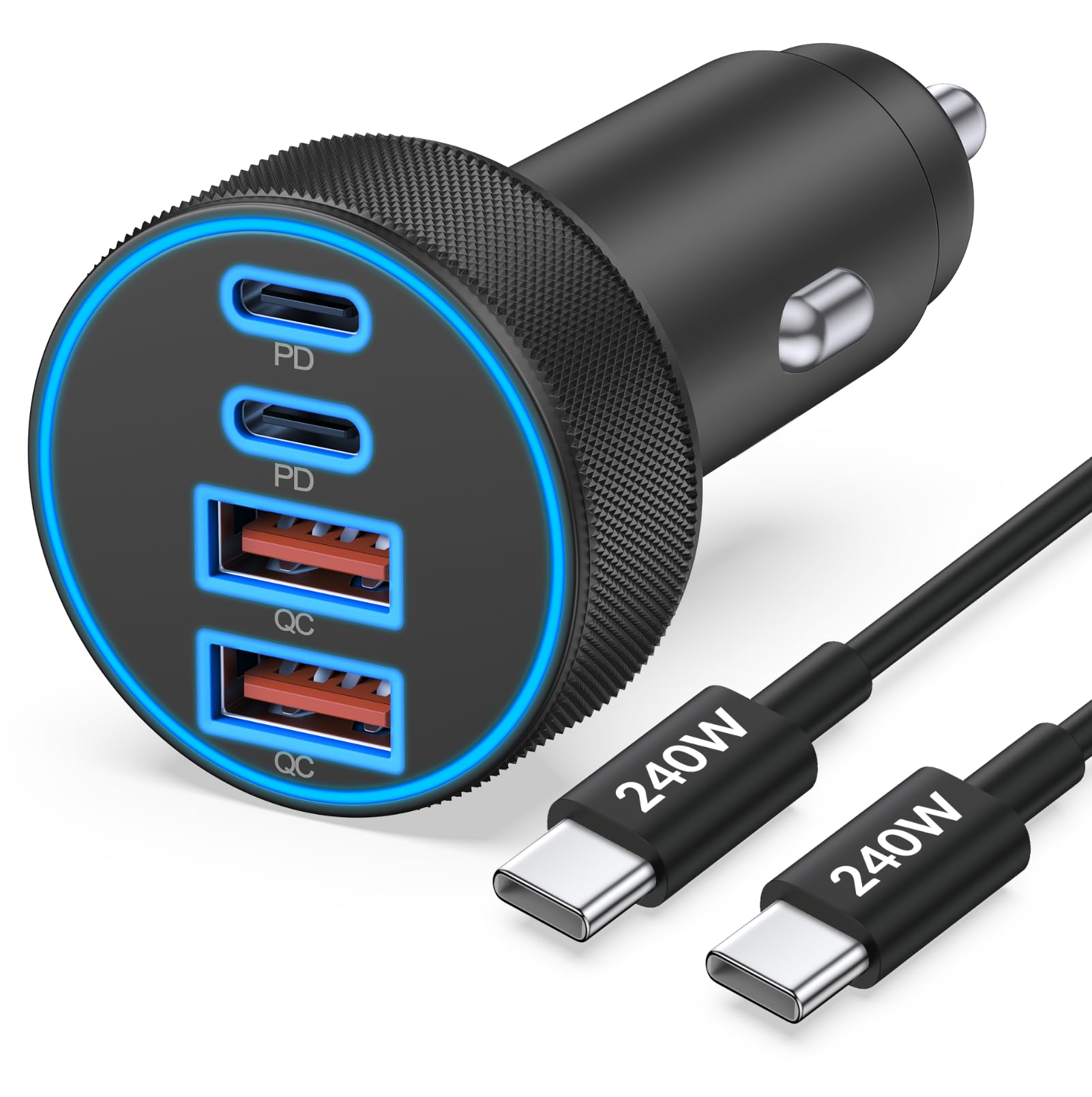
The JUNVANG 90W charger enters the market as a value-oriented option that includes a premium accessory: a 240W-rated USB-C to USB-C cable in the box. The charger body features two USB-C ports (45W max each) and two USB-A ports (45W max each), supporting PD 3.0 and QC 3.0 fast charging across all four outlets. The 90W total pool is split dynamically, with the charger prioritizing devices that negotiate PD handshakes over standard USB connections. The included 3-foot 240W cable is rated for future 48V USB-C standards and supports charging at speeds up to 240W when used with compatible wall chargers, making it a useful addition to a travel kit even if the car charger itself tops out at 90W.
The metal enclosure provides adequate heat dissipation for the 90W power budget, and the charger’s compact plug form factor fits flush in most cigarette lighter sockets without wobbling. Compatibility extends across 12V to 24V systems, covering passenger cars, trucks, and RV lighter ports. The charger supports the latest iPhone 17 and Galaxy S26 series PD negotiation, ensuring forward compatibility as device battery capacities continue to increase. The package includes only the charger and cable — there is no voltmeter, power switch, or additional installation hardware.
Value-driven buyers should note that the 90W total output means that charging four power-hungry devices simultaneously will split the available wattage, potentially dropping per-port speeds to around 22W each. For most real-world scenarios — two phones and a tablet — the charger delivers fast speeds without noticeable slowdown. The included 240W cable alone would cost roughly one-third of the total package price if purchased separately, which makes the JUNVANG an attractive option for shoppers who need both a fast car charger and a high-quality USB-C cable for their laptop. For budget-conscious users who want respectable charging speed and a free cable upgrade, this is the most economical path into the PD 3.0 ecosystem.
What works
- Includes a premium 240W-rated USB-C cable as a bundled accessory
- Metal housing aids heat management during sustained charging
- Supports latest PD negotiation for iPhone 17 and Galaxy S26 series
What doesn’t
- 90W total is shared across four ports under simultaneous load
- No voltmeter or power switch for battery monitoring
9. Hapytrip 3-Port USB Outlet

The Hapytrip 3-Port USB outlet is designed for entry-level DIY installers who want a simple upgrade from a worn cigarette lighter to a modern USB charging panel without spending on premium materials. It includes two QC 3.0 ports and one PD 3.0 USB-C port, providing a total of three charging outlets in a single 30mm panel mount. The blue soft-glow LED voltmeter displays battery voltage whenever the unit is powered, and the push-button switch offers complete power cutoff to prevent standby drain during vehicle storage. The ABS plastic body keeps the weight low — 0.06 kilograms — and the cost accessible for first-time buyers, while the 23.6-inch fused wire harness includes a 10A fuse for basic overcurrent protection.
Installation follows the standard 30mm hole-drill process: cut the opening, insert the socket from the front, tighten the retaining ring from behind, and connect the red wire to positive and black wire to negative. The package includes a clear wiring diagram, and the bottom of the unit is marked with plus and minus symbols to prevent reverse-polarity mistakes. The water-resistant rating adds a layer of protection against cabin moisture, though the unit is not designed for direct marine exposure. The built-in smart chip negotiates the fastest charging protocol for each connected device, with the PD port handling USB-C devices at speeds up to the PD 3.0 standard.
Owner reports indicate that the unit performs reliably for daily phone charging and occasional tablet charging, though sustained high-current draws near the 5A limit can cause the ABS housing to warm noticeably. The included 10A fuse should be replaced with the same rating if it blows, and the manufacturer provides two spare blade fuses in the package. For the entry-level price point, the Hapytrip 3-Port offers the essential features — a voltmeter, a power switch, and mixed PD/QC ports — without the premium finish of aluminum competitors. It is best suited for secondary vehicles, golf carts, or utility trailers where the socket will see occasional rather than daily use.
What works
- Affordable entry point with PD, QC, and voltmeter in one panel
- Push-button power switch eliminates parasitic battery drain
- Clear polarity markings and wiring diagram reduce installation errors
What doesn’t
- ABS plastic housing retains more heat than aluminum alternatives
- 5A current rating limits total simultaneous charging capacity
10. Hapytrip 78W 4-Port USB Outlet

The Hapytrip 78W 4-Port outlet packs a higher port count and total wattage than the 3-port version while retaining the same compact 30mm panel form factor. Its four ports — two PD 30W USB-C and two QC 18W USB-A — deliver up to 78W combined, with the PD ports capable of charging an iPhone 15 Pro from zero to 65% in roughly 30 minutes when used individually. The push-button power switch controls all four USB ports, cutting off standby current when the engine is off. The 60cm (23.6-inch) fused cord includes two spare fuses and blue ring terminals for secure battery connection. The water-resistant rating is carried over from the 3-port sibling, providing splash protection in boat and marine applications.
The key difference from the 3-port Hapytrip is the addition of a fourth port and the upgrade to 30W PD output per USB-C port, which nearly doubles the charging speed for compatible devices. When all four ports are in use, the total 78W is shared, so each device receives a proportionally lower current than when charging alone. The ABS plastic housing manages heat adequately at the 78W sustained load, though the unit runs noticeably warmer than an aluminum-housed equivalent at the same power level. The 10A fuse provides overcurrent protection, and the unit accepts 12V to 24V input for compatibility with both standard car electrical systems and heavy-duty truck or RV systems.
Installation follows the same drill-and-connect method as the 3-port version, with red wire to positive and black wire to negative clearly marked on the casing. The included spare fuses are a thoughtful touch for boat owners who may be far from an auto parts store when a fuse blows. The compact panel depth — roughly 2 inches behind the dash surface — fits in tight spaces behind thin plastic dash panels where deeper sockets would interfere with HVAC ducts or wiring looms. For users who need four fast-charging ports in a single dash opening but don’t require the heat dissipation of an aluminum body, this Hapytrip unit delivers the best port-per-dollar ratio in the hardwire category.
What works
- Four ports with 30W PD + 18W QC in a compact 30mm panel
- Push-button switch prevents battery drain when parked
- Includes spare fuses and clear polarity markings for installation
What doesn’t
- ABS plastic housing retains heat under sustained 78W load
- Shared wattage pool reduces per-port speed when all four ports are used
11. Hapytrip 78W 4-Port 2-Pack

The Hapytrip 2-Pack delivers two identical 78W 4-port USB sockets in a single package, bringing the total to eight USB ports across two installation locations. Each unit mirrors the specifications of the single 78W Hapytrip reviewed above: two PD 30W ports, two QC 18W ports, a push-button power switch, a water-resistant case, and a 60cm fused wire harness. The pack is designed for users who need to equip two vehicles, or install one socket in the dash and another in the center console or rear cargo area for backseat passengers. Each unit operates independently, so there is no wiring interaction between the two sockets.
The per-unit specifications are identical to the single 78W version: shared 78W total when all four ports are active, 30W PD fast charging for single-device USB-C use, and 18W QC for USB-A connected devices. The push-button switch on each unit provides independent power control, which is particularly useful when the rear socket is installed in a location that’s difficult to reach while driving — you can leave it switched off when not in use. The ABS plastic construction and water-resistant seal remain consistent across both units, and each includes the same 23.6-inch wire with a 10A fuse and spare fuses. The combined weight for both units is 0.11 kilograms, keeping the installation load minimal for mounting in lightweight dash panels or side trim.
For multi-vehicle households, the 2-pack eliminates the need to buy and track separate orders for each car’s charger. For single-vehicle installations, having a second unit as a spare or for a secondary installation location (garage workbench, golf cart, boat helm) provides flexibility without ordering duplicates. The package price represents a noticeable saving per unit compared to buying two single packs separately. The trade-off is that both units share the same ABS plastic enclosure and 78W shared wattage architecture as the single version — the heat retention and per-port speed limitations are identical. For budget-minded buyers who need multiple charging points across different locations, this 2-pack is the most economical route to a multi-port setup.
What works
- Two complete 78W units in one package for multi-vehicle or multi-location use
- Independent power switches on each unit prevent standby drain
- Per-unit cost is lower than buying two singles separately
What doesn’t
- Each unit retains the same ABS plastic heat retention as the single version
- 78W shared wattage per unit limits simultaneous multi-device speed
Hardware & Specs Guide
USB Power Delivery (PD) Explained
USB Power Delivery is a fast-charging protocol that communicates between the charger and the device to negotiate the highest safe voltage and current. PD 3.0 supports up to 30W on most 12V automotive USB sockets, which is enough to fast-charge an iPhone 15 Pro from empty to roughly 60% in 30 minutes. The protocol is backward compatible, meaning a PD charger will safely charge a non-PD device at standard 5V speeds. The key advantage of PD over older protocols is its ability to dynamically adjust voltage (5V, 9V, 15V, or 20V) depending on the device’s request, which reduces heat buildup compared to fixed-voltage fast-charge methods.
Quick Charge (QC) vs. Standard Charging
Qualcomm’s Quick Charge protocol increases charging speed by raising voltage rather than current, which minimizes resistive heat losses in the cable. QC 3.0 negotiates voltages from 3.6V to 20V in 200mV increments, allowing the charger to fine-tune power delivery in real time. QC 3.0 ports typically deliver up to 18W, which is roughly four times faster than the standard 5V/2.4A (12W) baseline. Devices that do not support QC fall back to standard charging automatically, so there is no compatibility risk. For Android users with Samsung Galaxy or Motorola devices, QC 3.0 support is the primary fast-charge standard to look for.
Cigarette Lighter Socket vs. Hardwire Installation
A cigarette lighter socket installation uses the vehicle’s existing 12V accessory outlet and requires no permanent modification — you simply plug in the adapter. This method is limited by the factory wiring gauge, typically 16 to 18 AWG, which can safely handle 8A to 10A continuous. Hardwire installation involves cutting a 30mm hole in the dash or panel and connecting the socket’s positive and negative wires directly to the vehicle’s electrical system via ring terminals or fuse taps. Hardwire allows the use of thicker 14 AWG wire, supports higher sustained loads, and enables custom placement. For sockets with multiple high-power USB ports, hardwire installation is the safer long-term approach.
Voltmeter and Power Switch Features
A built-in digital voltmeter displays the vehicle’s battery voltage in real time, which helps diagnose charging system problems before they leave you stranded. Normal resting voltage for a lead-acid battery is 12.4V to 12.7V; readings below 12.2V indicate partial discharge, and readings below 11.8V suggest a deeply discharged or failing battery. A power switch physically disconnects the USB ports and voltmeter from the battery when the vehicle is off, eliminating standby current draw. Without a switch, most sockets consume 20mA to 50mA continuously, which can drain a battery to a non-start condition over 14 to 21 days of parking. For vehicles that sit unused for extended periods, a power switch is not a convenience feature — it is a battery preservation necessity.
FAQ
Can I install a car charger power socket in a boat or marine environment?
What gauge wire should I use for a hardwired 12V socket installation?
How do I know if my car’s alternator can handle an additional power socket?
Why does my car charger power socket stop working after a few months?
Can I use a 12V socket rated for 24V vehicles in my 12V car?
Final Thoughts: The Verdict
For most buyers, the best car charger power socket winner is the Rocoren 105W 6-Port because it combines the highest port count with thoughtful installation accessories and certified safety compliance — a rare combination in the multi-port adapter space. If you prioritize a hardwired panel with an aluminum body and marine-ready sealing, grab the VANONE Dual PD. And for adding AC outlets alongside USB fast charging during long road trips or camping, nothing beats the FSATBTNE 400W Power Inverter for versatility in a compact package.

Certification: BSc in Mechanical Engineering
Education: Mechanical engineer
Lives In: 539 W Commerce St, Dallas, TX 75208, USA
Md Amir is an auto mechanic student and writer with over half a decade of experience in the automotive field. He has worked with top automotive brands such as Lexus, Quantum, and also owns two automotive blogs autocarneed.com and taxiwiz.com.