A turn signal that dims, flickers, or blends into brake light glare isn’t just an inconvenience — it’s a safety liability that other drivers will notice before you do. The shift from halogen to LED blinker technology has reshaped expectations for response time, color saturation, and long-term reliability, but the sheer volume of socket types, chip counts, and lumen ratings makes a blind purchase a gamble on fitment and performance.
I’m Amir — the founder and writer behind Four Wheel Ask. My approach to evaluating automotive lighting focuses on cross-referencing technical specifications, owner-reported longevity, and real-world fitment data across multiple vehicle platforms to separate genuine upgrades from marketing claims.
Whether you drive a sedan, SUV, or heavy-duty truck, selecting the right replacement requires matching base style, wattage draw, and thermal design to your vehicle’s specific socket and electrical system. After analyzing dozens of owner reports and spec sheets, the best car blinker bulb balances brightness, durability, and fitment across popular vehicle platforms.
How To Choose The Best Car Blinker Bulb
Selecting a blinker bulb that delivers reliable performance, correct fitment, and the brightness level your vehicle needs starts with understanding a few foundational details about your car’s lighting system and the available upgrade options. The following guide breaks down the core considerations before you make a purchase.
Socket Type and Base Compatibility
The most common mistake in blinker bulb replacement is ordering the wrong base configuration. Sockets such as 1156 (BA15S), 7440 (WY21W), and 3157 (P27/7W) look similar in listings but differ in locking tab alignment, pin offset, and overall length. Always verify your owner’s manual or remove the existing bulb to confirm the exact model number printed on its base before selecting a replacement.
LED Brightness and Beam Pattern
Not all LED chips produce the same usable light output. A bulb with 36 SMD chips arranged in a 360-degree pattern generally performs better in reflector-style housings than a design with chips clustered on one side. Lumen ratings between 800 and 1600 are common for blinker applications, but the housing’s reflective bowl and lens optics determine how much of that light reaches the road or other drivers.
Thermal Management and Build Materials
LED bulbs generate heat at the driver chip, and without adequate heat sinking, output drops and lifespan shortens. Bulbs with aviation aluminum bodies, hollow-core designs, or built-in constant current IC drivers dissipate heat more effectively than those relying on plastic housings or minimal thermal mass. This directly affects whether the bulb maintains consistent brightness over extended blinker use.
Hyper Flash, Load Resistors, and CAN-Bus Systems
Many modern vehicles detect bulb failure by measuring current draw. LED bulbs draw significantly less power than incandescent, which tricks the system into thinking a bulb is out, causing rapid flashing or dashboard error messages. Adding a 50W 6-ohm load resistor per side or swapping the factory flasher relay for an LED-compatible unit resolves this issue on most vehicles without triggering electrical faults.
Quick Comparison
On smaller screens, swipe sideways to see the full table.
| Model | Category | Best For | Key Spec | Amazon |
|---|---|---|---|---|
| AUXITO 7440/7443 Projector | 7440 LED | Unified beam pattern | 66 SMD chips, optical lens, 700% brighter | Amazon |
| iBrightstar 7443 | 7443 LED | Plug-and-play reliability | 54SMD 3014 + 3SMD 3030, projection lens | Amazon |
| AUXLIGHT 1156 | 1156 LED | 360-degree output | 60SMD-4014 chips, projector lens, 320% brighter | Amazon |
| Tomhasa 1156 | 1156 LED | Affordable brightness | 36SMD-2835 chips, 1600 lm, 12V/24V | Amazon |
| Torchbeam T20 7443/7440 | 7440 LED | Durable build quality | 54SMD 3014 + 3SMD 3030, 1300 lm, 30K hr life | Amazon |
| LEDYOTRY 7440/7443 | 7440 LED | Low power draw | 24SMD-2835 chips, 1200 lm, 3W, 50K hr life | Amazon |
| PHINLION 1156 | 1156 LED | High chip density | 72SMD-3014 chips, 4W, 360-degree output | Amazon |
| Antline 7443 | 7443 LED | Multi-bulb value pack | 33SMD-2835 chips, 1000 lm, 3.7W, 30K hr life | Amazon |
| Yorkim 7440 Projector | 7440 LED | High lumen output | 58SMD 3014 + 4SMD 3030, 1625 lm, 50K hr life | Amazon |
| LEDYOTRY 3157 | 3157 LED | Wide socket compatibility | 24SMD-2835 chips, 1200 lm, 3W, 50K hr life | Amazon |
| Philips 2357NA LongLife | Incandescent | OEM-style replacement | Twice the life of standard incandescent, OE quality | Amazon |
In‑Depth Reviews
1. AUXITO Latest 7440 7443 LED Bulb Amber Yellow Turn Signal Lights
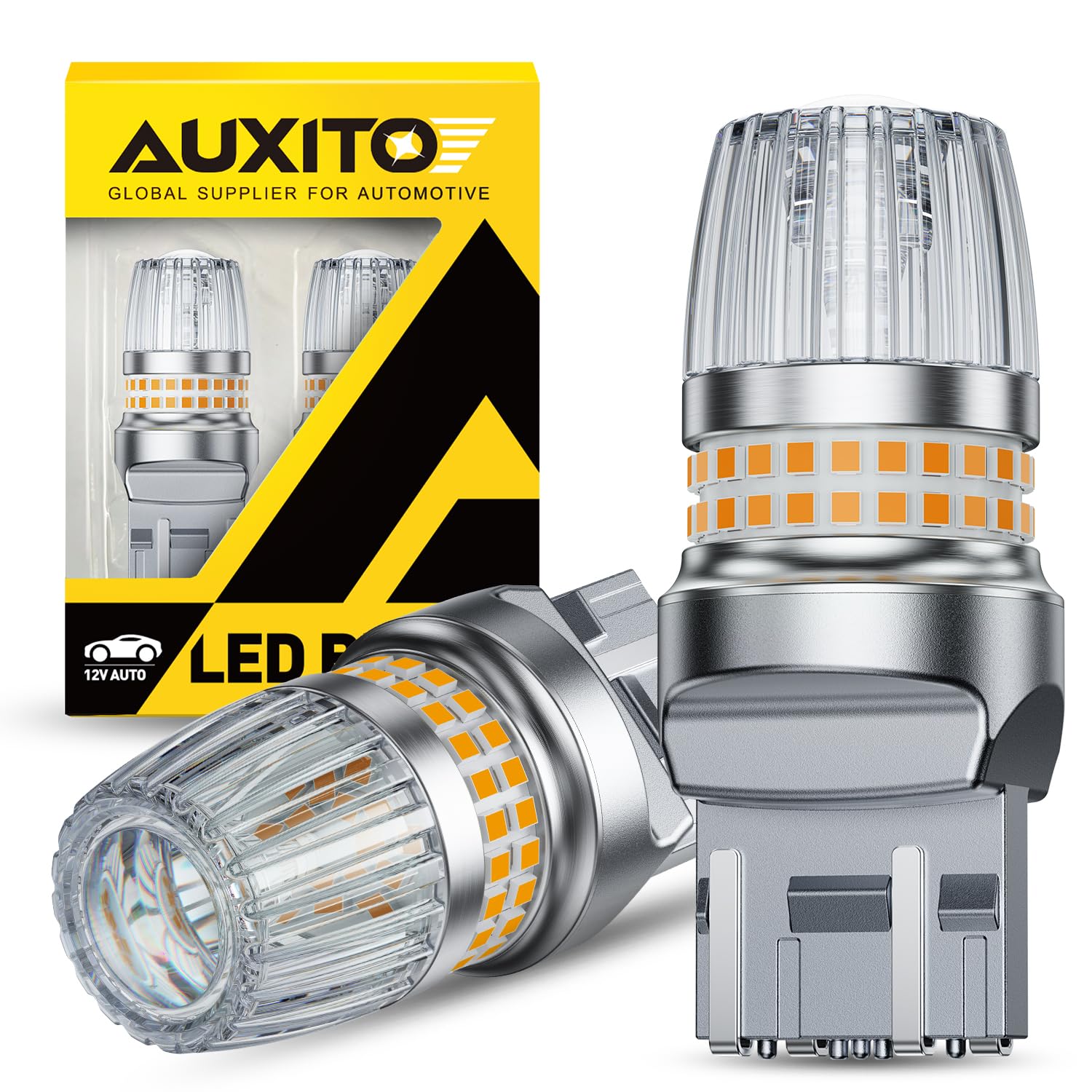
AUXITO’s 7440/7443 LED blinker bulb stands apart from the crowded field by integrating a custom optical lens that delivers 95 percent light transmittance, transforming harsh LED points into a diffused, even glow that won’t dazzle oncoming traffic. With 66 high-precision SMD chips arranged radially around the bulb, the 360-degree full-angle output eliminates dark spots and works effectively in both reflector and projector housings. The built-in EMC module has passed strict electromagnetic radiation tests, which means no interference with navigation, radio, or backup camera signals during operation.
Owner reports from Honda Accord, Audi, and various truck platforms confirm the plug-and-play installation takes roughly five minutes, though sensitive CAN-Bus vehicles may require load resistors to prevent hyper flash or dashboard warnings. The aviation-grade aluminum body paired with a scratch-resistant optical lens accelerates heat conduction, pushing the service life to an estimated 30,000 hours. The amber yellow color temperature remains consistent across voltage fluctuations between 12V and 24V, making it a versatile choice for passenger cars and light trucks alike.
Fitment covers 7440, 7440A, 7440NA, 7441, 7443, 7443NA, 7443A, 7444, 7444NA, 7444NAK, 992, WY21W, W21W, and W21/5W sockets. The non-polarity design eliminates guesswork during installation, though owners of Jeep, Chrysler, Chevrolet, GMC, Dodge, RAM, Volkswagen, Mercedes-Benz, Audi, and BMW models should budget for load resistors if the vehicle’s electrical system flags the lower current draw.
What works
- Optical lens creates a clean, uniform beam with no harsh hotspots
- EMC module prevents radio and backup camera interference
- Aviation aluminum body provides excellent long-term heat dissipation
What doesn’t
- Higher price point compared to basic SMD-only bulbs
- CAN-Bus vehicles often require additional load resistors for error-free operation
2. iBrightstar 7443 LED Bulb Amber
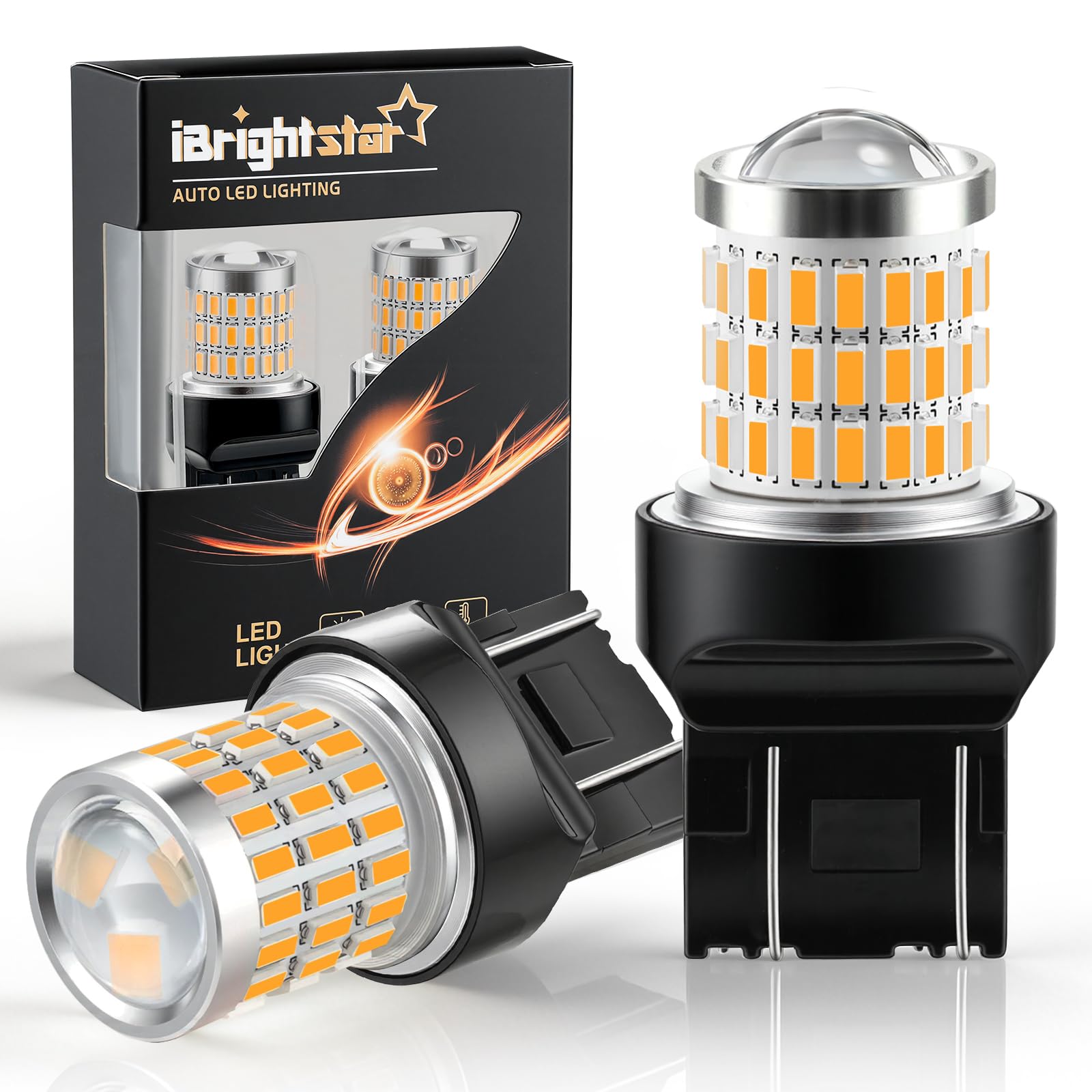
The iBrightstar 7443 LED bulb combines 54 SMD 3014 chips with 3 SMD 3030 chips per bulb, creating a hybrid chipset that balances wide-angle coverage with a focused forward beam. The projection lens built into the housing concentrates light output into a defined pattern that works well in socket designs where the bulb sits deep inside the reflector housing. The full aluminum housing with built-in constant current IC driver manages heat distribution effectively, supporting the rated 300 percent brightness increase over factory halogen bulbs.
Owners of Nissan Rogue Sport, Chevy Impala, and Toyota Tundra report that the non-polarity design simplifies installation, though access to the socket can be tight depending on the vehicle’s taillight assembly design. A 2017 Nissan Rogue Sport owner confirmed zero hyper flash after installation, while a 2010 Chevy owner noted the bulbs maintained clean white light output without flickering after nearly a year of use. The 450-lumen output per bulb is modest compared to some competitors, but the focused beam pattern makes those lumens count in reflector housings.
Socket compatibility includes 7440A, 7440NA, 7440, 7443NA, and 7443 variants. The 12V-24V wide operating voltage range adds flexibility for commercial or heavy-duty applications. Some owners noted a dim glow when the vehicle was off, which points to BCM ghosting issues rather than a bulb defect; swapping one LED for an incandescent or adding a resistor kit resolved this on affected models.
What works
- Hybrid chipset provides both wide coverage and focused forward throw
- True plug-and-play on many vehicles without hyper flash
- Compact design fits tight socket spaces
What doesn’t
- 450-lumen output is lower than many competing LED bulbs
- Ghosting or dim-on issues reported on some CAN-Bus vehicles
3. AUXLIGHT 1156 7506 LED Bulb Amber
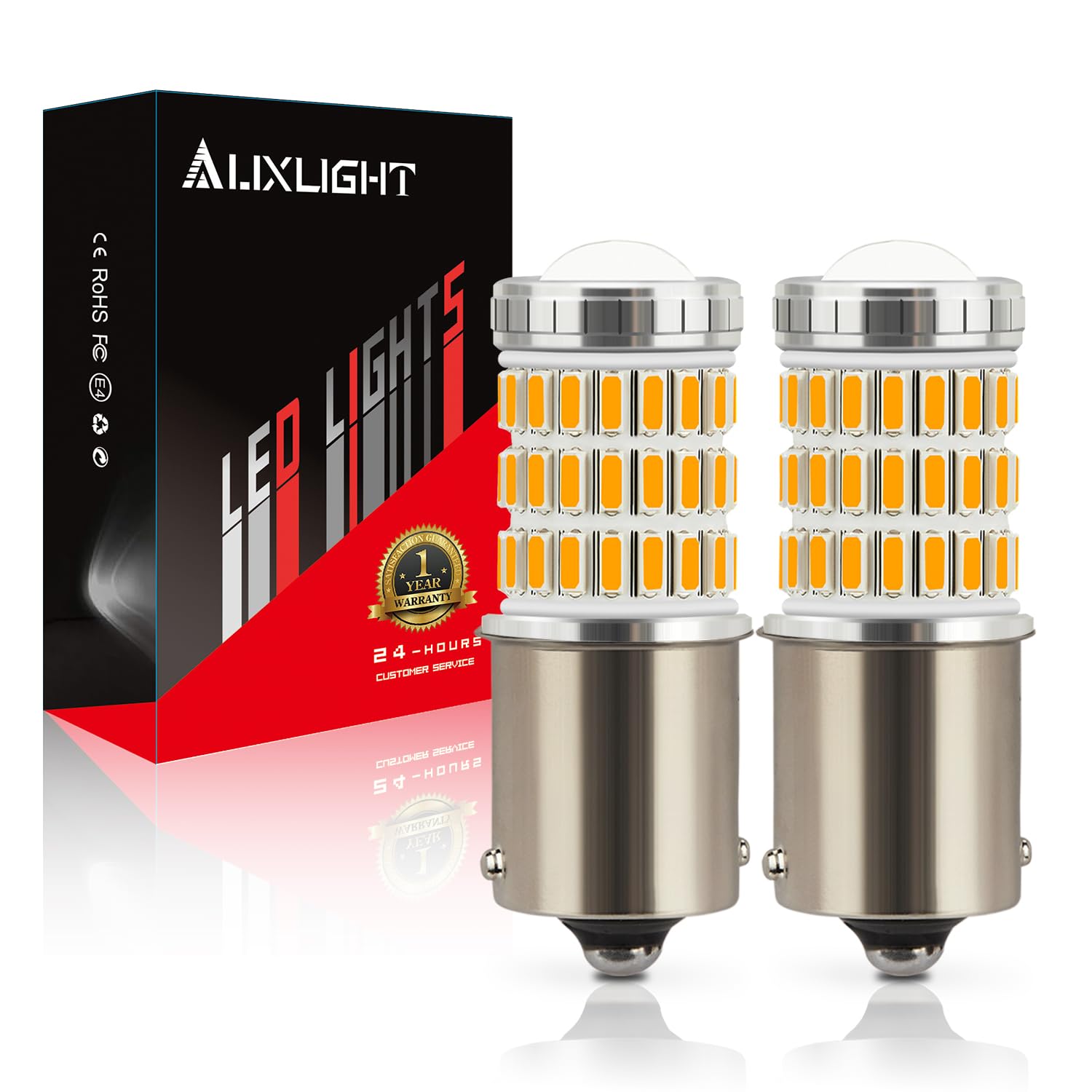
AUXLIGHT’s 1156 LED bulb employs 60 SMD 4014 chipsets paired with a clear projection lens, creating a uniform amber beam pattern that improves nighttime visibility for oncoming and following traffic. The 320 percent brightness increase over factory bulbs is supported by a full aluminum housing that distributes heat away from the LED driver, contributing to the 50,000-hour operating life estimate. The standard 1156/7506 base mirrors the dimensions of OEM halogen bulbs, so fitment modifications are rarely necessary in compatible sockets.
Users who installed these in 1998 4Runner turn signals and 2003 Nissan Pathfinder rear blinkers report massively brighter output with a crisp, clean amber shade. The bulb provides 360-degree illumination with noticeable forward light projection, which is particularly useful in reflective bucket housings that need light directed outward. Owners of Honda motorcycles have confirmed the exact fit for 1156-based turn signal replacements, noting the bulb is substantially brighter than the original incandescent units.
The compatibility list spans 1156, 7506, 1003, 1141, 1073, 1095, 1195, 1295, 2396, 3497, 631, 7533, and BA15S sockets among others. As with most LED turn signal upgrades, a 50W 6-ohm load resistor is required on many vehicles to prevent hyper flash, though the bulb itself functions as a direct replacement for backup, parking, brake, and DRL applications in addition to blinker duty.
What works
- Clear projection lens creates a defined, uniform beam pattern
- Full aluminum housing supports long 50,000-hour lifespan
- Mirrors OEM halogen dimensions for straightforward fitment
What doesn’t
- Requires load resistors for hyper flash prevention on most vehicles
- Some mixed feedback on the old vs. new bulb design being shipped randomly
4. Tomhasa 1156 LED Bulb Amber

The Tomhasa 1156 LED bulb delivers a competitive 1600-lumen output from 36 SMD 2835 chips arranged across multiple sides of the bulb for 360-degree illumination. The aviation aluminum body paired with a quality constant current IC driver keeps operating temperatures low, which directly contributes to a longer service life compared to bulbs using basic resistor-based current limiting. At 4.2 watts per bulb, the power draw is roughly 90 percent lower than an equivalent halogen 1156 bulb while producing 300 percent more usable light.
Long-term owner feedback is encouraging — one user reported the bulbs have lasted over three years without failure, while another noted they are an excellent upgrade for brake lights on a 2006 BMW X3 after discovering a connection mismatch for reverse lights. A 2003 Tundra owner confirmed the amber and red versions provide richer color saturation and brighter output for brake, parking, and turn signal applications, though an aftermarket relay was needed to resolve hyper flash.
The BA15S 180-degree symmetrical bayonet single contact base fits 1156, 1141, 1003, 7506, and P21W sockets. One reviewer pointed out that the two-mode brake/tail bulb design has a dim mode that makes the blinker function harder to distinguish at a glance, so careful consideration of your vehicle’s dual-filament requirements is warranted.
What works
- 1600-lumen output at 4.2W offers strong efficiency per watt
- Aviation aluminum body with constant current IC for thermal management
- Proven long-term durability with multiple reports exceeding three years
What doesn’t
- Two-mode design can make blinker function less distinct in brake applications
- Requires load resistor or relay replacement for hyper flash correction
5. Torchbeam T20 7443 7440 LED Turn Signal Light Bulbs

Torchbeam’s T20 7443/7440 LED bulb pairs 54 SMD 3014 chips with 3 SMD 3030 chips mounted radially around the bulb to achieve 1300 lumens of amber output across a full 360-degree pattern. The hollow-core design facilitates airflow through the bulb body, which lowers operating temperature and supports the 30,000-hour rated lifespan. The non-polarity plug-and-play design simplifies installation, though the bulb’s overall length is notably longer than a standard incandescent, which can create fitment challenges in compact housing assemblies.
Owners installing these in a 2007 Chevy Tahoe reverse lights and a 2018 Jeep Wrangler JL reported that the brightness significantly exceeds stock halogen output, though the Wrangler owner experienced both bulbs failing after two years of minimal use as backup lights. A reviewer with a small Japanese car noted the installation was difficult due to length constraints but confirmed the non-polarity feature helped simplify the wiring orientation once the bulb was seated.
Socket compatibility includes 7440, 7441, 7443, 7444, W21W, W21/5W, and T20 patterns. A 50W 6-ohm load resistor or compatible flash relay is necessary for turn signal applications on most vehicles to prevent hyper flash. The build quality feels sturdy in hand, though the mixed longevity feedback suggests that fitment and environmental conditions play a significant role in real-world lifespan.
What works
- Hybrid 54+3 SMD chipset delivers strong 1300-lumen output
- Hollow-core design improves airflow cooling for longer LED life
- Non-polarity base simplifies electrical connection regardless of vehicle wiring
What doesn’t
- Longer than stock bulbs, causing fitment issues in compact housings
- Mixed long-term durability reports, with some failures around the two-year mark
6. LEDYOTRY 7440 7443 LED Bulb Amber Turn Signal Light
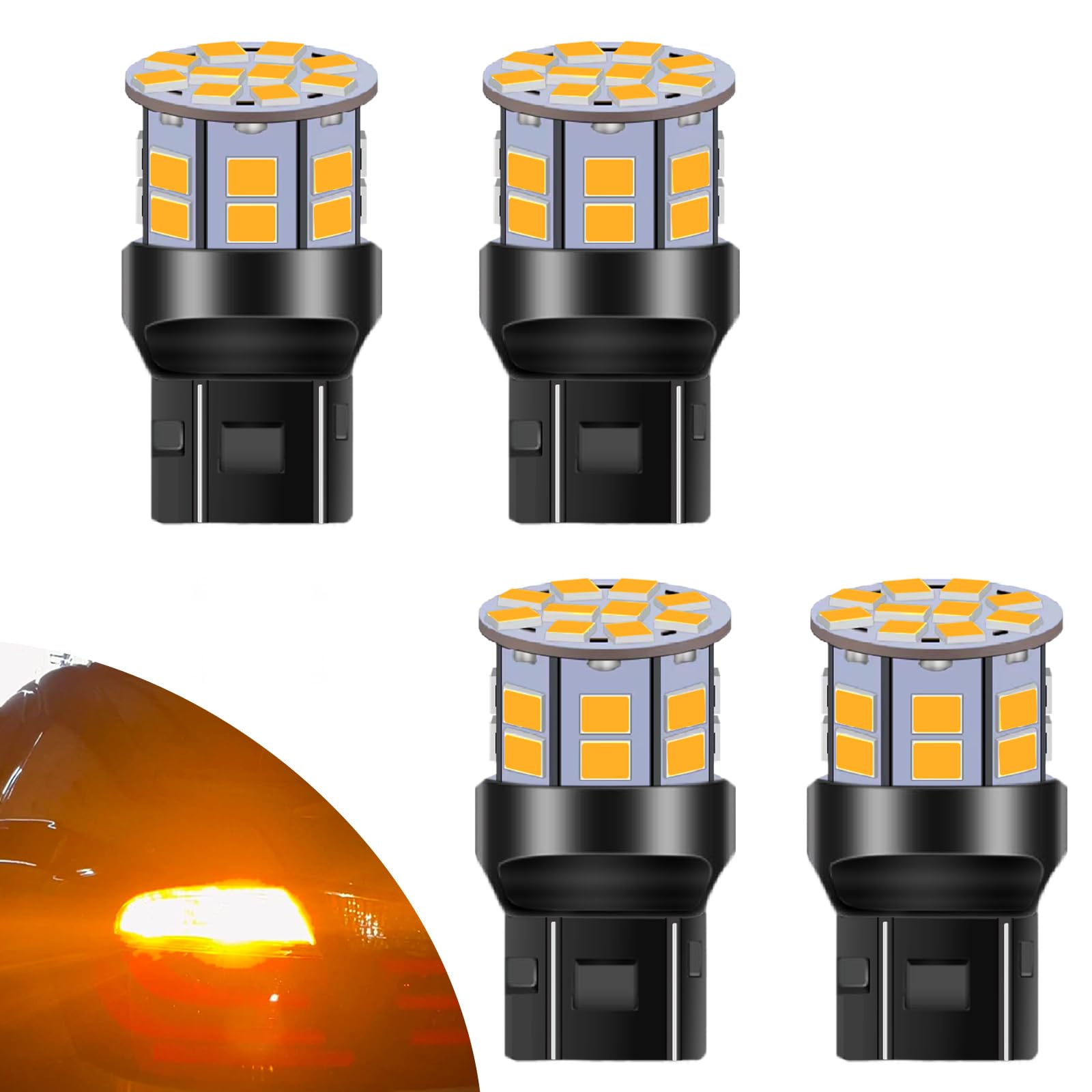
The LEDYOTRY 7440/7443 LED bulb achieves a remarkable 1200 lumens of amber output while drawing just 3 watts per bulb, making it one of the most electrically efficient options in the 7440 socket category. The 24 high-quality 2835 chips are arranged in a 360-degree lighting design that eliminates blind spots, producing a 400 percent brightness increase over standard halogen bulbs. The built-in intelligent IC driver stabilizes input current to protect circuit safety and maintain consistent brightness over the bulb’s 50,000-hour rated service life.
Users have successfully installed these in an 1157 socket swap on an ambulance, noting the bulbs are very bright with crisp on/off response and a 95 percent cost savings over proprietary bulbs. A Honda Motorcycle owner confirmed the exact fit for 1156-based turn signal replacements, appreciating the substantially brighter output. Several reviewers noted that while the bulb itself works perfectly, load resistors are mandatory for turn signal applications to prevent hyper flash or dashboard error codes.
This 4-pack covers 7440, 7441, 7443, 7444, 992, W21W, WY21W, T20, and related socket variants. The amber yellow color temperature sits around 3000 Kelvin, providing the warm amber hue that many vehicles require for legal turn signal compliance. The low 3W draw makes this a strong candidate for vehicles with sensitive electrical systems or for applications where minimizing total circuit load is a priority.
What works
- Exceptional 1200 lumen output at only 3 watts per bulb
- Intelligent IC driver stabilizes current for consistent long-term performance
- 4-pack value provides bulbs for multiple vehicle positions
What doesn’t
- Load resistors are almost always required for blinker use
- Amazon fitment filter may show incorrect compatibility for some models
7. PHINLION 1156 LED Bulb Amber Yellow Super Bright 72-SMD

PHINLION’s 1156 LED bulb packs 72 SMD 3014 chips into a single bulb, creating an extremely dense light array that produces 400 percent brighter output than a standard halogen 1156 while consuming only one-fifth the energy. The 6063 aluminum body provides excellent heat dissipation, and the built-in constant current IC driver eliminates radio interference while supporting a 12V-24V wide operating voltage range. The non-polarity design means the bulb functions correctly regardless of how it is inserted into the socket, which simplifies installation in hard-to-reach locations.
Owners have applied these bulbs as reverse lights, third brake lights, and turn signals across multiple platforms. One user reported the reverse light output was brighter than the vehicle’s headlights, while another used them successfully in a third brake light application and praised the excellent brightness level. A reviewer who purchased these as a replacement for a faulty brand noted the build quality appeared robust and the fit was accurate, though long-term durability remains unconfirmed.
The compatibility list spans 1156, BA15S, P21W, 1003, 1073, 1095, 1141, 2396, 3497, 631, 7506, and numerous other BA15S-based sockets. A 50W 6-ohm load resistor is recommended for turn signal upgrades to avoid hyper flash, but the bulb works as a direct fit for backup, parking, DRL, and brake light applications without additional components.
What works
- 72-SMD chip density delivers very high light output for the form factor
- 6063 aluminum body with constant current IC for effective thermal management
- Wide 12V-24V voltage range suits both passenger and commercial vehicles
What doesn’t
- Some units may not seat fully in certain socket depths due to chip density
- Hyper flash is common without additional load resistor or relay upgrade
8. Antline 7443 7440 T20 LED Bulbs Amber Yellow
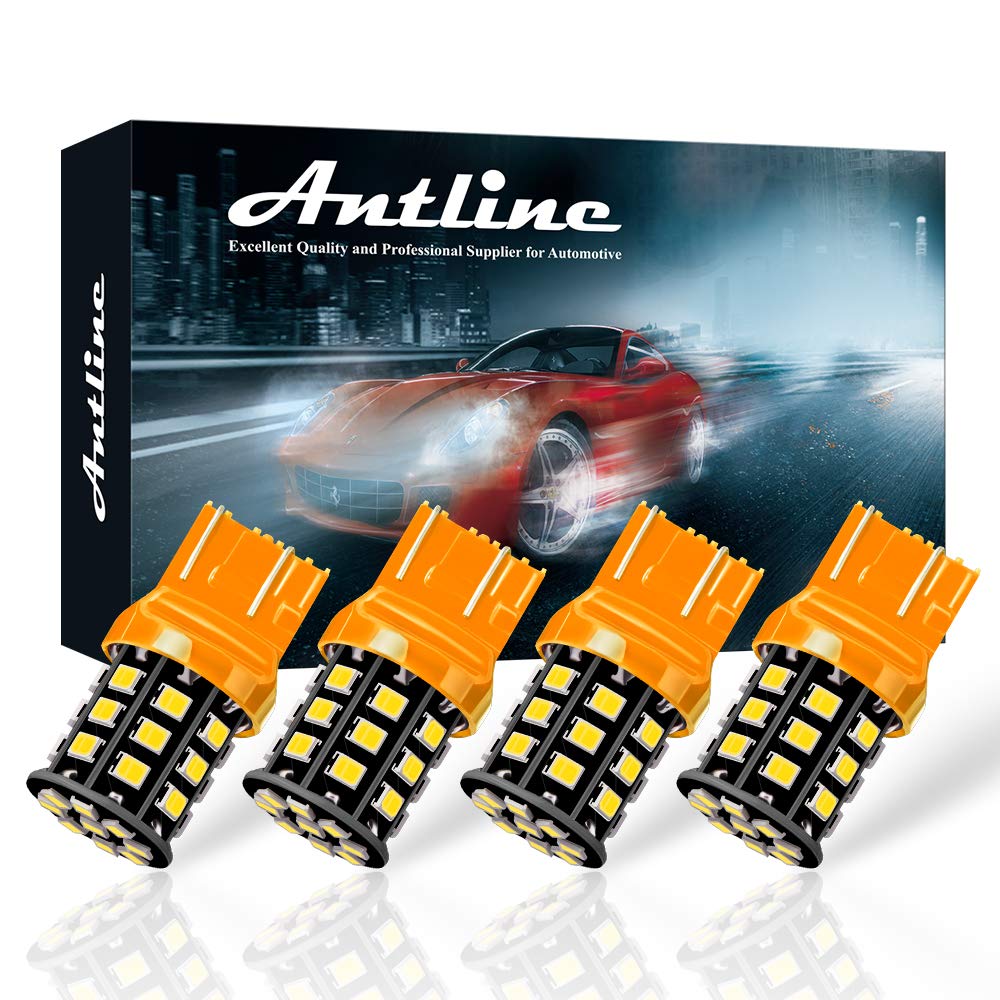
The Antline 7443 LED bulb uses 33 SMD 2835 chips per bulb to produce 1000 lumens of amber output with a 360-degree lighting design that enhances visibility from all angles. The wide 12V-24V operating voltage range and 3.7W power draw make it suitable for both standard automotive and commercial vehicle applications. The non-polarity design supports straightforward plug-and-play installation, though some sockets with tighter tolerances may require minor adjustments to the bulb base alignment.
Owners report that the solid amber color does not wash out when viewed alongside HID or LED headlamps, maintaining a distinct appearance that other drivers can clearly identify as a turn signal. One reviewer noted that the low-beam mode draws approximately 1W while the high-beam mode reaches 3.7W, generating noticeable heat during extended use. A negative review highlighted that the raised lip on the base prevented the bayonet pins from engaging fully in a 1996 Oldsmobile socket, requiring a Dremel modification to achieve fitment.
This 4-pack covers 7440, 7440A, 7440NA, 7441, 7443, 7443R, 7443LL, 7444, 7444NA, 992, T20, W21W, WY21W, and W21/5W sockets. The one-year warranty against manufacturer defects provides some peace of mind, but the mixed fitment feedback suggests owners of older domestic vehicles should verify socket depth and locking tab geometry before purchasing.
What works
- Solid amber color remains distinct even next to bright LED headlamps
- Wide voltage range supports 12V and 24V systems
- 4-pack provides good value for multi-position upgrades
What doesn’t
- Raised base lip can prevent bayonet pin engagement in some sockets
- Some units failed to blink correctly and stayed on as steady lights
9. Yorkim 7440 Led Bulb Amber 7443 Led Turn Signal Lights Bulb with Projector

Yorkim’s 7440 LED bulb pairs 58 SMD 3014 chips with 4 SMD 3030 chips and an HD projector lens to achieve 1625 lumens of amber output, making it one of the highest lumen-rated options in the 7440/7443 category. The intelligent IC driver regulates input current to maintain circuit safety while the full aluminum housing distributes heat away from the LED array, supporting the 50,000-hour rated lifespan. At 7.4 watts per bulb, the power draw is higher than many competing LED bulbs, but the lumen-per-watt ratio remains favorable compared to halogen.
Owner feedback from Chevy Silverado, Toyota Tacoma, and Colorado platforms confirms the bulbs deliver a clean white amber light that is significantly brighter than stock halogen. A 2022 Silverado Z71 owner used them for license plate lights with no error codes, while a Tacoma owner rated them as more than twice as bright as the original backup bulbs. The built-in projector lens helps create a defined beam cutoff that reduces glare for following drivers, though some owners of tinted taillight housings noted that the bulbs still shine through clearly without flickering.
The compatibility list covers 7440, 7440A, 7440NA, 7440SV, 7441, 7443, 7443NA, 7443R, 7444, 992, WY21W, and W21W sockets. Yorkim includes a specific warning that Jeep Chrysler, Chevrolet, GMC, Dodge, RAM, Volkswagen, Mercedes-Benz, Audi, and BMW models may experience flickering or error messages without load resistors, so owners of these brands should factor that into their installation plan.
What works
- 1625-lumen output is among the highest in the 7440 socket category
- HD projector lens creates a defined beam pattern that reduces glare
- Intelligent IC driver supports stable performance over 50,000-hour lifespan
What doesn’t
- 7.4W power draw is higher than many competing LED bulbs
- Known compatibility issues with multiple domestic and European brands requiring load resistors
10. LEDYOTRY 3157 LED Bulb Amber Yellow for Turn Signal Light
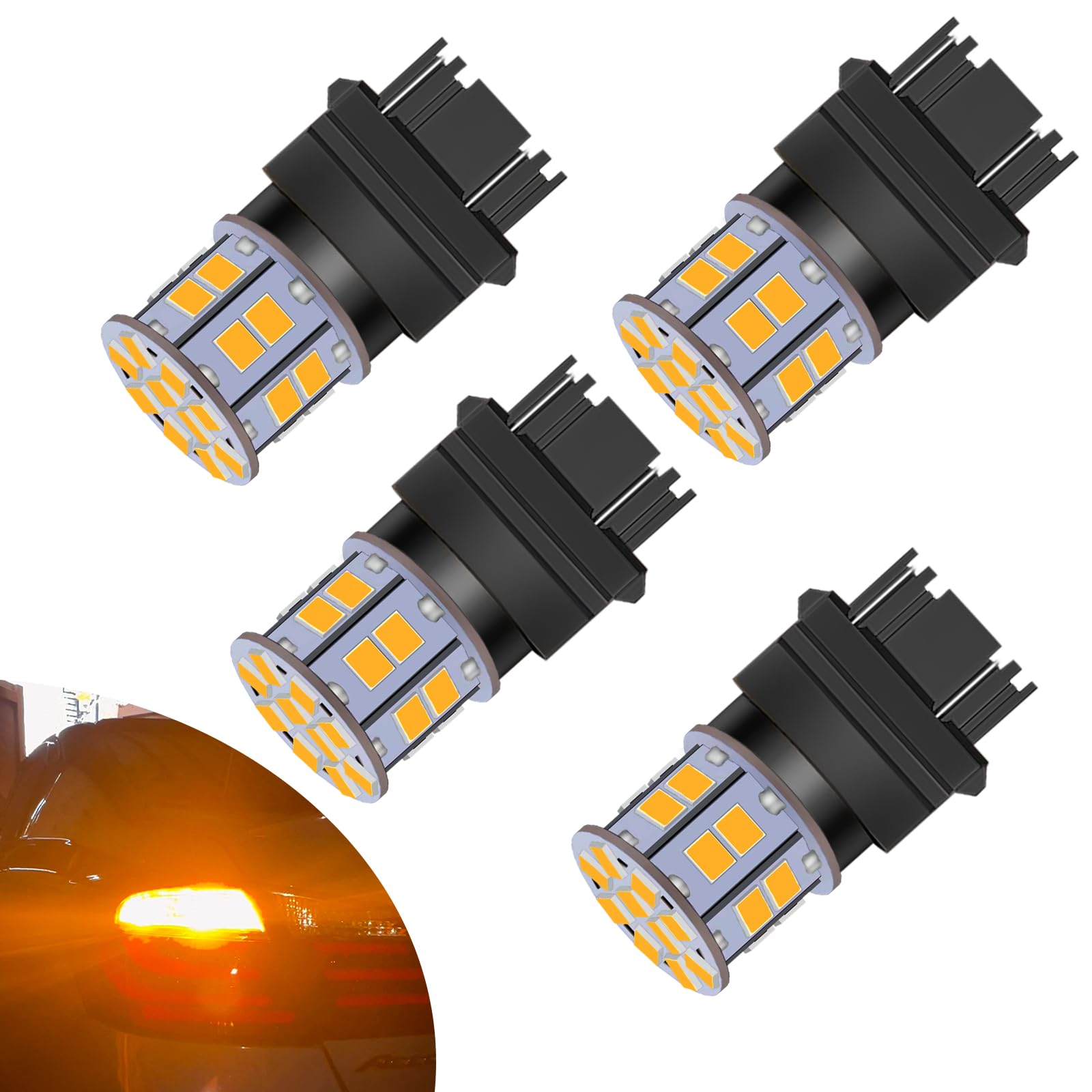
The LEDYOTRY 3157 LED bulb uses 24 high-quality 2835 chips arranged in a 360-degree lighting design to produce 1200 lumens of amber output while drawing just 3 watts of power. The 300 percent brightness increase over halogen bulbs is supported by an intelligent IC driver that stabilizes input current and protects the circuit from voltage fluctuations. The non-polarity design works with both US standard and CK sockets, which simplifies installation across a wide range of vehicle makes and models.
Users have successfully fit these bulbs into 1157 sockets after a socket swap on an ambulance, citing very bright crisp on/off performance and a 95 percent cost savings per bulb compared to proprietary alternatives. Multiple owners noted that the bulbs may trigger a vehicle’s light-out sensor due to the resistance difference from incandescent bulbs, though workarounds exist and some users simply perform manual walkaround checks instead. The 50,000-hour rated lifespan provides confidence for long-term use in turn signal, brake, tail, side marker, and parking light positions.
Socket compatibility includes 3157, 3156, 3057, 3357, 3457, 3757, 4057, 4114, 4157, and T25 P27/7W variants, among others. A 50W 6-ohm load resistor or compatible flash relay is recommended for turn signal applications to prevent hyper flash or dashboard error codes, though the bulb functions as a direct fit for non-blinker applications without additional components.
What works
- 1200-lumen output at only 3W offers excellent electrical efficiency
- Wide socket compatibility covers 3157, 3156, 3057, 4157, and many others
- Non-polarity design simplifies installation across different vehicle wiring configurations
What doesn’t
- Light-out sensor triggering is common on vehicles with resistance-based monitoring
- Load resistors required for error-free turn signal operation on most platforms
11. Philips 2357NA LongerLife Miniature Bulb

The Philips 2357NA LongerLife bulb represents the incandescent end of the spectrum, offering twice the service life of standard miniature bulbs while maintaining original equipment quality and fitment. This is not an LED upgrade — it is a direct OEM-style replacement for drivers who want a bulb that matches the factory electrical specifications without requiring load resistors, relay swaps, or CAN-Bus compatibility checks. The 2357NA base is designed for vehicles that use the 2357 or 3057 form factor, with staggered collar nubs that require proper alignment in the socket.
Owners of Hyundai Tucson, Genesis, and various other models confirm that the bulb is an exact fit and resolves check-turn-signal codes on vehicles that monitor bulb resistance. A 2019 Tucson owner replaced a left turn signal bulb and confirmed the car stopped sending a check-turn-signal error immediately after installation. One downside reported by a buyer is that the cardboard packaging provided minimal protection during shipping, with one of the two bulbs arriving cracked, though the non-smashed bulb functioned perfectly.
This two-pack provides bulbs for replacing both turn signals on the same axle, which Philips recommends to ensure symmetric light output since bulbs dim over time. The incandescent technology produces warm amber light that is fully compatible with all vehicle electrical systems without any additional hardware, making it a straightforward choice for owners who prefer to keep their vehicle’s lighting system stock and avoid the complexities of LED conversion.
What works
- True plug-and-play without load resistors, relays, or electrical modifications
- Twice the lifespan of standard incandescent bulbs at a reasonable cost
- OE-quality fitment eliminates compatibility concerns across all vehicle makes
What doesn’t
- Incandescent technology produces significantly less light than LED alternatives
- Shipping packaging is minimal and may not prevent damage during transit
Hardware & Specs Guide
BA15S (1156) Base
The BA15S base features a 180-degree symmetrical bayonet design with a single contact at the bottom. This is one of the most common single-filament bases used in turn signal, backup, and brake light applications across American, Japanese, and European vehicles. Bulbs using this base include 1156, 1141, 1003, 7506, and P21W. The symmetrical pin layout means orientation does not matter during installation, but the single contact limits functionality to one brightness level.
W21W (7440) and W21/5W (7443) Bases
The 7440 (W21W) base is a wedge-style single-filament socket commonly found in modern Japanese and Korean vehicles for turn signals and DRLs. The 7443 (W21/5W) variant adds a second filament or LED circuit for dual-brightness operation in brake/tail light applications. These bases use a locking tab system rather than bayonet pins, and the bulb must be oriented correctly to seat flush. Compatibility across 7440, 7440A, 7440NA, 7441, 7443, 7443NA, and 7444 is common.
P27/7W (3157) Base
The 3157 base uses a larger wedge-style design with two locking tabs and supports dual-filament operation for brake/turn signal applications. Cross-compatible with 3156, 3057, 3357, 3457, 3757, 4057, 4114, and 4157 sockets, this base is common in American trucks, SUVs, and older sedans. The dual-contact design allows separate circuits for running light (lower brightness) and brake/blinker (higher brightness) functions.
Load Resistors and Flash Relays
LED bulbs draw roughly 10 percent of the current that incandescent bulbs require. Most vehicle flasher modules interpret this reduced current draw as a burned-out bulb and respond by flashing at double speed (hyper flash) or displaying a dashboard error. A 50W 6-ohm load resistor wired in parallel with each LED bulb restores the current draw to approximately the same level as an incandescent, resolving the issue. Alternatively, swapping the factory flasher relay for an LED-compatible electronic relay solves the problem without generating heat.
FAQ
Why do my LED turn signal bulbs flash fast after installation?
How do I know which bulb base my vehicle uses?
Can I use LED bulbs for both turn signals and brake lights in the same socket?
Do I need load resistors for every vehicle when switching to LED blinkers?
How long should LED blinker bulbs last compared to incandescent bulbs?
Final Thoughts: The Verdict
For most buyers, the best car blinker bulb winner is the AUXITO 7440/7443 with Projector Lens because it combines the highest light output with a custom optical lens that produces a clean, uniform beam pattern while suppressing radio interference through its built-in EMC module. If you want a true plug-and-play experience without load resistors on many vehicles, grab the iBrightstar 7443. And for a budget-friendly LED upgrade with proven long-term durability, nothing beats the Tomhasa 1156 at its price point.

Certification: BSc in Mechanical Engineering
Education: Mechanical engineer
Lives In: 539 W Commerce St, Dallas, TX 75208, USA
Md Amir is an auto mechanic student and writer with over half a decade of experience in the automotive field. He has worked with top automotive brands such as Lexus, Quantum, and also owns two automotive blogs autocarneed.com and taxiwiz.com.