A cam bearing failure in a 5.3 LS doesn’t just rob oil pressure — it writes off the entire short block if debris circulates through the mains. Choosing the right set means understanding bore geometry, material composition, and the difference between a bearing that slips in at spec and one that requires a trip back to the machine shop.
I’m Amir — the founder and writer behind Four Wheel Ask. I’ve spent years cross-referencing manufacturer tolerances, owner-reported installation outcomes, and long-term durability data across dozens of cam bearing part numbers for Gen III small-block engines.
After analyzing over a decade of owner reports and technical data, I’ve identified the most reliable options available for your best cam bearings 5.3.
How To Choose The Best Cam Bearings 5.3
Selecting cam bearings for a 5.3 LS engine comes down to material compatibility, dimensional accuracy out of the box, and whether you plan to install them yourself or hand the block to a machine shop. The wrong choice can lead to low oil pressure, accelerated cam lobe wear, or bearings that spin in their bores.
Bearing Material and Lining Composition
The lining layer is what contacts your cam journal. Lead-based babbitt is the traditional choice for Gen III engines because it embeds debris well and conforms to slight misalignments. Aluminum alloy bearings offer higher load capacity but require tighter bore geometry and cleaner assembly conditions. Alloy steel shells provide structural rigidity but demand precise installation to avoid galling.
Part Number Cross-Referencing and Bore Fit
Not all cam bearing sets labelled for LS engines use the same outside diameter or width. The 5.3 LM7 and L59 blocks use specific journal widths that differ from the 6.0 LQ4 or 4.8 LR4. Confirming the bearing number — CH-10, CH-25, SH-1814S, or CB3166 — against your block’s cam bore dimensions prevents having to press out a mis-sized set after installation.
Installation Tooling Requirements
Bearing crush and alignment depend almost entirely on the tool used to drive them in. Universal expanding collet tools can work across multiple engine families but may not center perfectly in an LS bore. Fixed-diameter mandrels machined specifically for LS cam journal sizes deliver repeatable alignment. Factor the tool cost into your total build budget — damaging a set of bearings during installation wastes both money and time.
Quality Control and Packaging
Sets that arrive with nicked edges, burrs on the inner diameter, or inconsistent wall thickness indicate poor manufacturing inspection. Run a deburring tool around every bearing ID before installation, and always test-fit each bearing in its intended bore before committing to the final press. A bearing that feels loose by hand will only get looser with thermal cycling.
Quick Comparison
On smaller screens, swipe sideways to see the full table.
| Model | Category | Best For | Key Spec | Amazon |
|---|---|---|---|---|
| Clevite SH-1814S | Plain Bearing | OEM+ Rebuilds | Steel / Babbitt alloy | Amazon |
| Dura-Bond CH-10 | Plain Bearing | LS Swaps | Alloy steel construction | Amazon |
| King CR807SI | Plain Bearing | Performance Builds | Aluminum alloy | Amazon |
| Clevite SH-290S | Ball Bearing | Small Block Chevy | Babbitt material | Amazon |
| Michigan Motorsports CH-10 | Plain Bearing | Stock Replacement | Bi-metal micro babbitt | Amazon |
| Dura-Bond CH-25 | Roller Bearing | LS2 / LQ4 Builds | Alloy steel | Amazon |
| maXpeedingrods LS Tool | Installation Tool | LS Bearing Installation | 45# steel, 33 inch | Amazon |
| BTSHUB Universal Kit | Installation Tool | Multi-Engine Compatibility | 1.125 to 2.69 inch range | Amazon |
| easchwork E230215 Kit | Installation Tool | Complete Kit Versatility | Carbon steel, 5 adapters | Amazon |
| easchwork E230205 Tool | Installation Tool | Precision LS Work | 45# steel, 38 inch length | Amazon |
| DNJ CB3166 | Roller Bearing | Late-Model V8 Fitment | Alloy steel / iron | Amazon |
In‑Depth Reviews
1. Clevite 77 SH-1814S Camshaft Bearing Set

The Clevite 77 SH-1814S set uses a seamless steel tube with a lead-based babbitt overlay — the same construction philosophy that has made Clevite the default spec for OEM LS engine assembly. Every bearing surface is 100-percent machined after forming, which eliminates the thickness variation found in stamped or less rigorously finished sets. The result is a consistently tight clearance window across all journals straight out of the box.
Owner reports from LS1 and 5.3 LM7 rebuilds confirm that the cam slides through with minimal resistance when installed with the correct tool. The packaging separates the larger end bearings from the center liners, reducing the chance of installing a bearing in the wrong bore during a hurry-up build. Multiple reviewers noted that oil pressure returned to factory-fresh levels immediately after startup.
One verified buyer received a set with visible edge damage and reported it as a shipping issue rather than a manufacturing defect. Given the overwhelming majority of flawless installations, this appears to be a rare logistics problem rather than a quality control gap. For a stock or mild performance 5.3 rebuild where predictable clearances matter most, this set is the benchmark.
What works
- Machined seamless construction delivers bore-to-bore consistency that reduces the need for selective fitting
- Lead-based babbitt overlay provides excellent debris embedment and conformability for street-driven LS blocks
- Smart packaging with separated journal sizes speeds up installation and lowers the risk of bore mix-ups
What doesn’t
- Individual sets occasionally arrive with minor edge damage depending on shipping handling and packaging density
2. Dura-Bond CH-10 Camshaft Bearing Set

Dura-Bond’s CH-10 set is one of the most frequently referenced part numbers for 1997-2003 LS engines, covering the 4.8 LR4, 5.3 LM7/L59, and 5.7 LS1. The alloy steel shell is paired with a babbitt overlay that matches the hardness profile of factory GM cam journals. Each bearing is laser-etched with its journal position, which eliminates guesswork during installation — a small detail that saves significant time when working with the block on an engine stand.
User feedback from 5.3 cam swap builds consistently mentions that the bearings pressed in securely and that cam rotation felt smooth immediately after installation. One detailed account described a truck that had 2 PSI of oil pressure at idle before the swap and 60 PSI after replacing the bearings alongside a new cam. The dimensional consistency across all five journals was noted as excellent, with no need to file or hone individual bores.
A small number of builders recommend running a deburring tool around the inner diameter before pressing to prevent any microscopic burrs from shaving material off the cam lobes during the first few revolutions. This is standard practice for most bearing installations regardless of brand. For a direct-fit LS bearing that balances cost and reliability, the CH-10 remains a strong contender.
What works
- Laser-etched journal markings eliminate bore confusion and speed up multi-bearing installations significantly
- Consistent alloy steel shell dimensions produce reliable crush and oil clearance across all five journals
- Proven track record in 5.3 cam swap builds with documented oil pressure improvements of 30-40 PSI
What doesn’t
- Inner diameter should be deburred before installation to avoid microscopic metal transfer during initial cam rotation
3. King CR807SI Rod and Main Bearing Set

King’s CR807SI set represents the aluminum alloy direction in LS engine bearings, offering higher load capacity and improved fatigue resistance compared to traditional babbitt linings. The aluminum composition requires cleaner assembly conditions and more precise bore geometry, but the payoff is a bearing that holds its clearance window longer under sustained high-RPM operation. This set is standard-size and intended for 4.8, 5.3, and 6.0L Gen III engines.
Builders who have used these on 5.3 LM7 and 6.0 LQ4 platforms report consistently tight tolerances straight out of the box, with measurements landing at 0.017 to 0.019 inch clearance without needing selective swapping. Multiple verified buyers mentioned that King’s quality control matches or exceeds Clevite’s A-series line, which is notable given the price positioning. The packaging includes protective foam inserts that prevent the bearings from rattling against each other during transit.
One potential consideration is that King requires standard-size orders by default; oversize bearings must be requested directly before shipping. If your crank has been ground undersized, you will need to communicate that immediately after purchase. For a high-mileage 5.3 that is getting a performance cam and springs, this set provides the durability margin that aggressive lobe profiles demand.
What works
- Aluminum alloy construction delivers superior fatigue resistance for high-lift cam applications and sustained high RPM
- Exceptional dimensional consistency with documented clearances falling within 0.017-0.019 inch without selective fitting
- Protective foam packaging minimizes transit damage and keeps bearing surfaces free of nicks and debris
What doesn’t
- Oversize variants must be explicitly requested at time of purchase or the standard set will be shipped by default
4. Clevite 77 SH-290S Engine Camshaft Bearing Set

The SH-290S from Clevite 77 is designed around the small block Chevy journal geometry but sees frequent use in LS-family applications where the bore dimensions overlap. The babbitt lining follows the same seamless tube manufacturing process as the SH-1814S, with 100-percent machined surfaces that eliminate high spots. This set is particularly useful for builders who are working with mixed-generation parts or need a proven fallback when the primary LS-specific part number is backordered.
Multiple owners who installed these on 5.3 and 350 SBC engines noted that the bearings installed easily with the correct driver and that cam rotation was free of binding immediately after pressing. The value proposition is strong — the set delivers Clevite’s quality control at a price point that undercuts many dedicated LS sets. One experienced builder mentioned going through two sets because of an incorrect universal tool, emphasizing the importance of using the proper mandrel diameter regardless of bearing quality.
The main limitation is that this set was originally catalogued for small block Chevy dimensions, so cross-referencing against your specific 5.3 block’s cam bore width is essential before purchase. When the dimensions match, the performance is indistinguishable from the LS-specific Clevite sets. For budget-conscious builds where the block accepts SBC-spec bearings, this is a smart downgrade that does not compromise on material quality.
What works
- Seamless babbitt-lined construction with fully machined surfaces ensures consistent oil clearance and reduces break-in friction
- Cross-compatible with both SBC and certain LS bore geometries, offering flexibility for mixed-generation engine builds
- Clevite’s established quality control chain provides reliable dimensional accuracy at a competitive price point
What doesn’t
- Originally catalogued for small block Chevy — requires careful width cross-reference against 5.3 LS cam bore dimensions before ordering
5. Michigan Motorsports Dura-Bond CH-10 Cam Bearing Set

This Michigan Motorsports set is essentially a Dura-Bond CH-10 kit repackaged with a focused application range covering 1997-2003 LS1, LS6, 4.8, 5.3, 5.7, and 6.0L engines. The bi-metal construction uses a lead-based micro babbitt overlay on a steel backing, which is the same material specification that GM used in factory 5.3 blocks. The bearing set is sold as a complete kit for a single engine, so there is no need to piece together individual journals from different suppliers.
Verified buyers who installed these on LM7 and LQ4 blocks reported that the bearings drove in with a perfect fit and that the cam could be spun by hand with minimal effort afterward. One detailed account from an 85 K20 LS swap build mentioned that cam-to-bearing clearance came in at spec with a new GM camshaft. The packaging was noted as adequate, with bearings arriving free of visible edge damage or shipping debris.
A few reviewers recommended inspecting each bearing for manufacturing residue before installation, which is standard procedure for any bearing set at this price tier. The 30-day warranty is shorter than what some premium manufacturers offer, but the underlying Dura-Bond quality has a long track record in the LS community. For a straightforward stock replacement or mild street build, this set delivers the essential performance without upcharging for branding.
What works
- Bi-metal micro babbitt construction matches OEM LS material specification for reliable oil clearance and debris embedment
- Complete one-engine kit eliminates the need to source individual journals from multiple suppliers or part numbers
- Positive cam rotation reported immediately after installation with documented spec clearance on new GM camshafts
What doesn’t
- 30-day warranty period is shorter than industry average and does not cover installation errors or bore condition issues
6. Dura-Bond CH-25 Cam Bearing

The CH-25 from Dura-Bond is a less commonly specified part number that fits a narrower range of LS applications, primarily those requiring a roller bearing profile rather than the plain bearing design used in most 5.3 blocks. The alloy steel construction meets ABEC 7 precision standards, which indicates tighter dimensional control than the standard CH-10 set. This bearing is a better match for LS2 and LQ4 builds where the cam journal dimensions differ slightly from the earlier 5.3 LM7 specification.
Users who installed the CH-25 on 6.0L LQ4 and 5.3 swap engines reported seamless fitment and significant oil pressure improvements. One verified account described a 6.0L that had virtually no oil pressure at idle before the swap and registered 60 PSI after installation with bearing retainer compound used as extra insurance. The set was also confirmed to work on an LS2 application when installed by a machine shop.
The main consideration is that the CH-25 is not a direct substitute for the CH-10 in every 5.3 block. Bore diameter and journal width must be confirmed against your specific engine’s specifications before purchasing. For builders who have already identified that their 5.3 variant requires the CH-25 geometry, this set offers the same reliable Dura-Bond quality with an additional precision rating that suits performance-oriented clearances.
What works
- ABEC 7 precision rating provides tighter dimensional control than standard LS bearing sets for performance-oriented builds
- Alloy steel construction with proper lubrication delivers reliable oil pressure restoration in high-mileage LQ4 and LS2 blocks
- Compatible with bearing retainer compounds for added insurance in high-RPM or boosted applications
What doesn’t
- Not a drop-in replacement for CH-10 applications — requires verification of bore diameter and journal width before ordering
7. maXpeedingrods LS Cam Bearing Installation Removing Tool
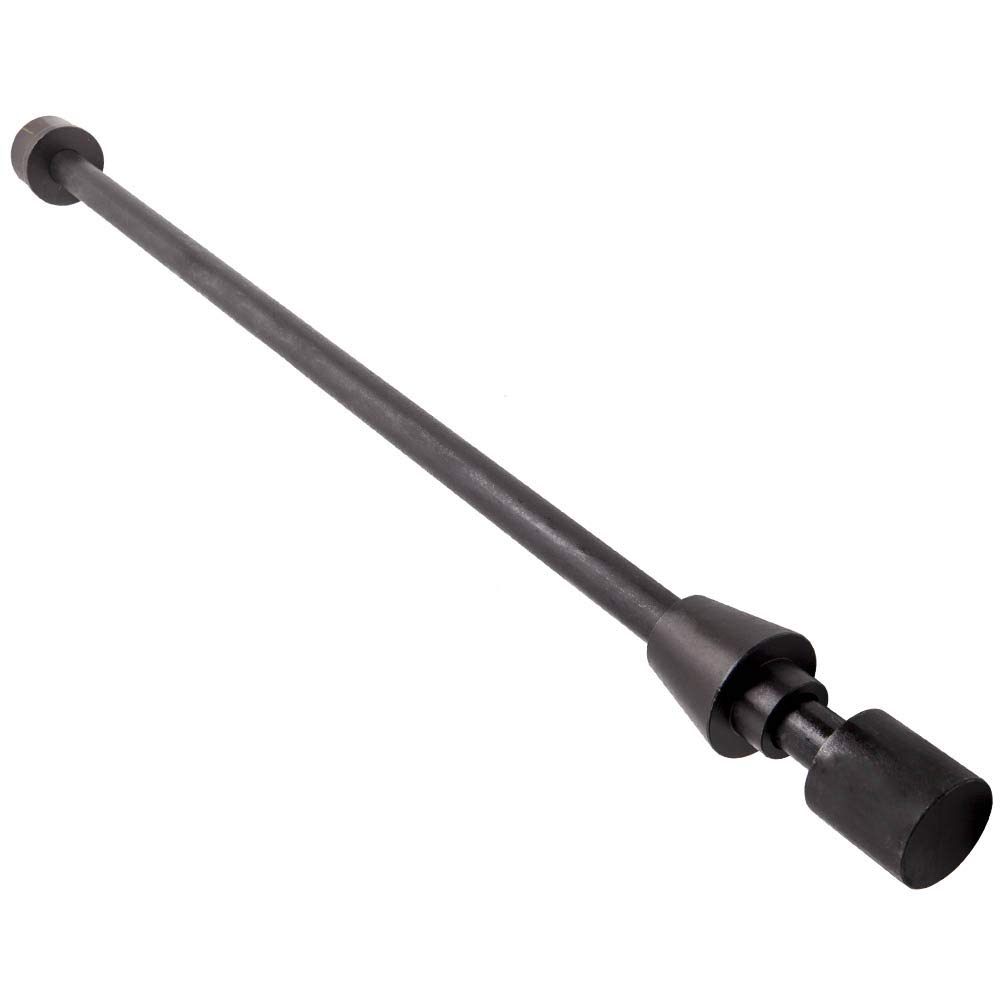
The maXpeedingrods tool is a fixed-diameter mandrel machined from 45# carbon steel specifically for LS cam bearing installation and removal. The 33-inch overall length provides enough reach to drive bearings through the full length of a 5.3 block without needing an extension. The detachable end is threaded directly into the shaft rather than held by a set screw, which eliminates the risk of the driving face separating during a heavy press stroke.
Multiple verified users reported that this tool outperformed universal expanding collet designs because the fixed diameter centers perfectly in the LS bore every time. One reviewer noted that the driving end had a slight burr from machining that marked the first bearing, but a quick pass with a file resolved the issue permanently. The tool has been used successfully on six different LS engines in one shop, indicating good durability for the price point.
At just over 12 pounds, this is a heavy tool that feels substantial in hand, which translates to predictable force transfer during bearing installation. The one-year warranty against manufacturing defects is a solid safety net for DIY builders who may not use the tool frequently. For anyone planning to install cam bearings on more than one LS engine, this dedicated mandrel eliminates the frustration of universal tools that fail to center consistently.
What works
- Fixed-diameter mandrel provides perfect centering in LS cam bores, eliminating the alignment issues common with universal collet tools
- Threaded shaft connection is more reliable than set-screw designs and prevents driving face separation under load
- Durable 45# steel construction with documented multi-engine service life from professional engine builders
What doesn’t
- Machining burr on the driving end may require light filing before first use to prevent marking bearing surfaces during installation
8. BTSHUB Universal Cam Bearing Removal and Installation Tool Set

The BTSHUB universal kit uses an expanding collet design with five neoprene-clad adapters that cover a bearing range from 1.125 to 2.690 inches. This span covers virtually all domestic and import cam bearing sizes, including the LS family, small block Chevy, Ford 460, and even Hemi applications. The neoprene sleeves protect the bearing surface during installation and reduce the risk of galling that can occur with bare metal collets.
Users have confirmed successful cam bearing removal and installation on LS engines, small block Chevys, and Ford 460 builds using this kit. The expanding collet mechanism provides good grip on the bearing inner diameter without distorting the shell, which is critical for maintaining proper crush. The kit includes a storage case, extension rod, and replacement rubber sleeves, making it a complete package for builders who work on multiple engine families.
A few users noted that the universal design requires more careful centering than a fixed-diameter mandrel, and the nylon centering cone helps but does not completely eliminate the need for visual alignment. The three-month warranty is shorter than dedicated LS tool offerings, but the versatility of covering a 1.5-inch bearing range justifies the trade-off for shops that see a variety of engines. For the DIY builder with one LS engine, a dedicated tool may be simpler, but for multi-engine flexibility, this kit is hard to beat.
What works
- Broad 1.125-2.690 inch range covers LS, SBC, Ford, and Hemi cam bearings in a single kit without needing multiple mandrels
- Neoprene-clad adapters protect bearing inner diameters from galling and reduce surface damage during installation and removal
- Complete package with case, extensions, and replacement sleeves provides immediate readiness for multi-engine shop use
What doesn’t
- Universal expanding collet design requires more careful centering than a fixed-diameter LS-specific mandrel for consistent alignment
9. easchwork Cam Bearing Install Tool & Engine Cam Bearing Remove Kit (E230215)
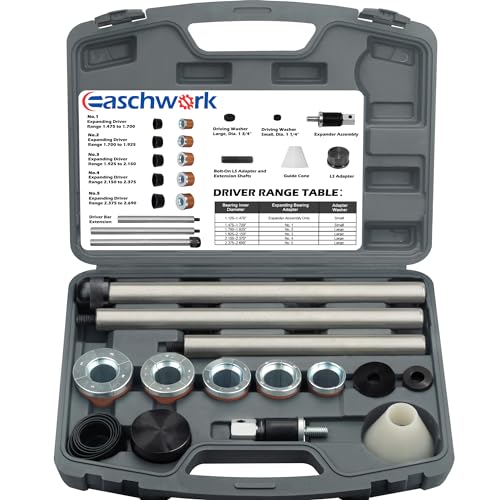
The easchwork E230215 kit combines an LS-specific bearing driver with a five-adapter universal set, effectively bridging the gap between a dedicated mandrel and a full universal kit. The carbon steel construction includes three extension rods that bring the total reach to well over 30 inches, which is sufficient for full-length V8 blocks including the 5.3 LS. The expander assembly uses a threaded cone design that locks the adapter firmly against the bearing inner diameter without slipping during the press stroke.
Verified buyers have used this kit successfully on LS 5.3 engines, Mark IV Chevy big blocks, and third-generation Hemi 5.7 and 6.1 engines. One detailed report described using frozen bearings for installation on a big block 489, noting that the tool drove them in cleanly without any damage to the new shells. The neoprene-clad adapters were praised for their grip and surface protection, especially on the smaller bearing sizes where metal collets tend to leave witness marks.
The comprehensive nature of this kit means there are many small pieces to keep track of, and the included storage case is essential for preventing lost adapters between jobs. At over 11 pounds, the kit is not lightweight, but the mass contributes to stable force transfer during bearing installation. For a shop or serious DIY builder who works on both LS engines and other V8 families, this dual-purpose kit eliminates the need to own separate dedicated and universal tools.
What works
- Combines LS-specific driver with universal five-adapter set, covering dedicated and multi-engine use cases in one purchase
- Threaded cone expander design provides secure bearing grip without slipping during high-force press strokes
- Proven compatibility across LS, big block Chevy, and Gen III Hemi engines from verified owner installation reports
What doesn’t
- Large number of small components requires organized storage to prevent loss of adapters and extension rods between jobs
10. easchwork Steel Cam Bearing Installation Removing Tool (E230205)
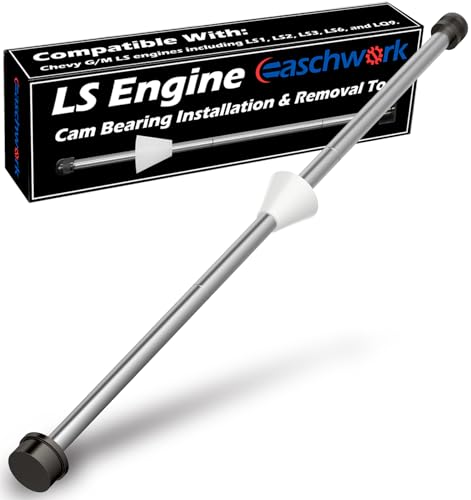
The easchwork E230205 is a dedicated LS cam bearing tool with a 38-inch length and a detachable driving end that separates for compact toolbox storage. The 45# carbon steel mandrel is threaded directly to the shaft, eliminating the set-screw failure point found on cheaper universal tools. The fixed diameter is machined specifically for LS cam journal sizes, which means the driver centers itself in the bore without requiring manual alignment or centering cones.
Multiple verified users reported that this tool outperformed both universal expanding collet designs and other LS-specific tools they had previously owned. One reviewer mentioned that it handled stubborn bearings without damaging the journals or the block, which is the primary failure mode of poorly aligned drivers. The tool has been used on six different LS engines in a single shop, indicating that the 45# steel construction holds up well under repeated use without deformation.
A few users noted that the detachable end does not have a retaining screw, which means it relies entirely on the thread engagement to stay connected during use. This design works well in practice but requires occasional checking to ensure the end has not loosened during heavy driving. For the DIY builder who is installing cam bearings on a single 5.3 engine, this tool provides professional-grade centering accuracy at a fraction of the cost of machine-shop-grade mandrel systems.
What works
- 38-inch overall length provides full-reach capability through any Gen III V8 block without requiring shaft extensions
- Fixed-diameter LS-specific mandrel self-centers in the bore, eliminating the alignment guesswork of universal collet tools
- Detachable driving end enables compact storage in a standard toolbox drawer when not in active use
What doesn’t
- Driving end relies on thread engagement only without a retaining screw, requiring periodic tightness checks during heavy use
11. DNJ CB3166 Cam Bearings for 2003-2016 GM V8 Engines
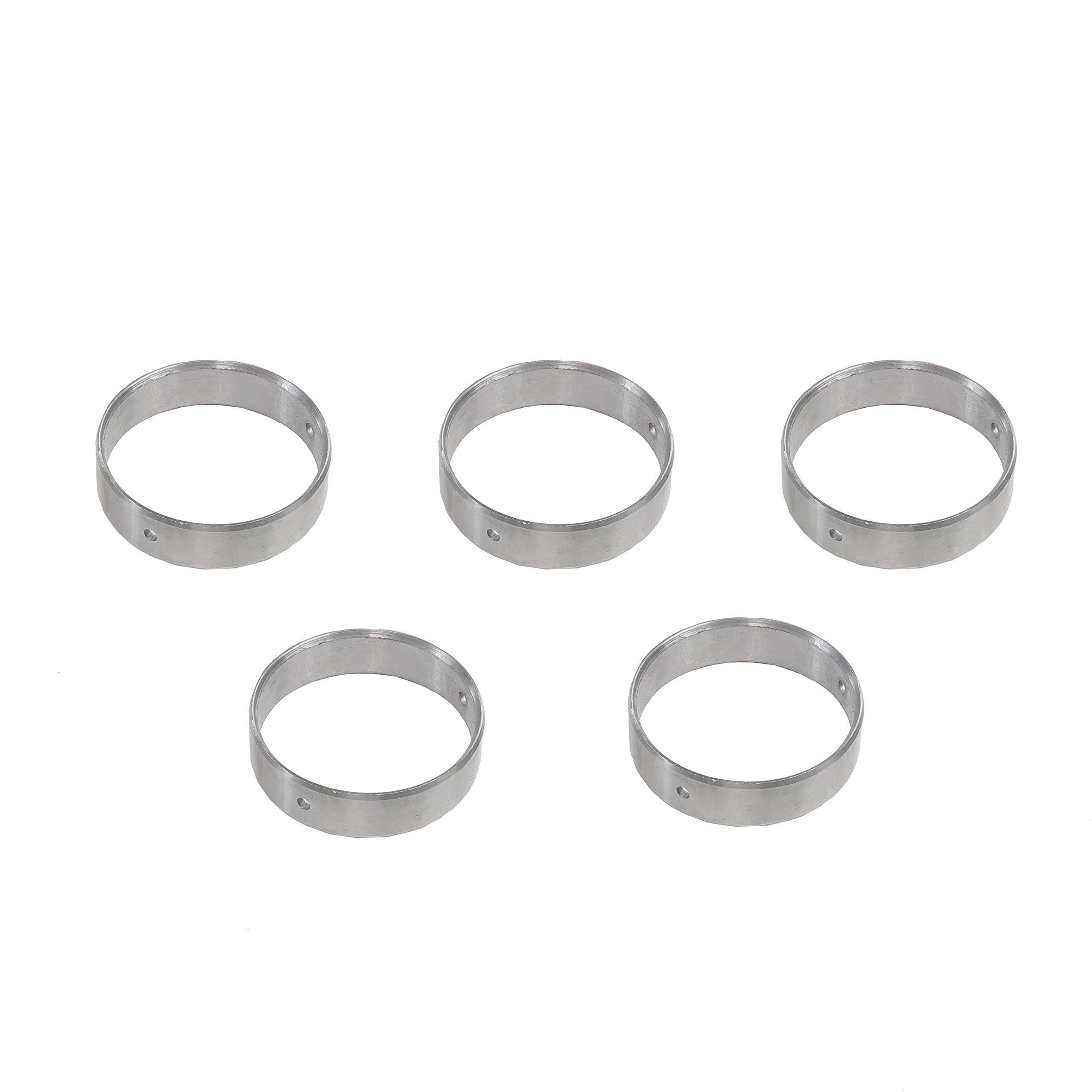
The DNJ CB3166 set covers a broad application range spanning 2003-2016 GM vehicles with 4.8L to 7.0L V8 engines, including the L96, LH8, LS4, LFA, L76, LY5, LH6, L92, LC9, L59, L33, LMG, and LM4. The alloy steel and iron construction with a 0.635-inch width is designed to match the cam bore dimensions found in these later Gen III and Gen IV blocks. DNJ has been supplying engine components for over 30 years, and this bearing set is one of their core catalog offerings.
Owner feedback on the CB3166 is mixed. Several verified buyers reported that the bearings arrived with visible damage or dimensional inconsistencies that made installation problematic. One detailed account from an aluminum block 6.0L build noted that the inner and outer bores were correct but the bearing was too narrow for the journal, suggesting that the set may be optimized for iron block applications with narrower cam journals. A positive review mentioned fast delivery and satisfactory performance in an unspecified application.
The inconsistent quality reports make this set a higher-risk choice compared to the Clevite or Dura-Bond alternatives. DNJ’s long history in the engine components market suggests that quality control may vary by production batch, which introduces uncertainty for builders who cannot afford to discover dimensional issues after the block is already assembled. For a 5.3 build where reliability is the priority, the reviews suggest verifying every bearing dimension before installation and having a backup set ready.
What works
- Broad application coverage across 2003-2016 GM V8 engines from 4.8L to 7.0L, including many Gen IV variants
- DNJ’s 30-year history in engine components indicates established manufacturing processes and supply chain experience
What doesn’t
- Multiple verified reports of bearings arriving damaged or with dimensional inconsistencies that prevent proper installation
- Reported narrower bearing width may be incompatible with aluminum block 6.0L applications despite being listed as compatible
Hardware & Specs Guide
Bearing Material Types
The lining material determines how the bearing handles debris, misalignment, and thermal cycling. Lead-based babbitt is the OEM standard for 5.3 LS engines because it embeds particles without scoring the cam journal and conforms to slight bore irregularities. Aluminum alloy bearings, like those used in King CR807SI sets, offer higher fatigue strength but require cleaner assembly conditions and tighter bore geometry. Alloy steel shells provide structural rigidity but must be installed with precise alignment to prevent galling. For street-driven 5.3 builds, babbitt remains the safest choice unless the build includes a high-lift cam that justifies the switch to aluminum.
Journal Marking Systems
Premium bearing sets from Dura-Bond and Clevite laser-etch or stamp each bearing with its intended journal position. This eliminates the need to measure each bore and sort bearings by trial fitment. The 5.3 LS uses five cam journals with specific width and diameter profiles that vary between the front and rear positions. Installing a bearing in the wrong bore can restrict oil flow to the cam phaser or valley gallery. Journal-marked sets reduce installation time by roughly 30 percent compared to unmarked sets that require individual measurement and cross-referencing against a service manual.
Installation Tool Selection
The tool used to press cam bearings directly affects the final crush and bore alignment. Fixed-diameter mandrels machined specifically for LS journal sizes, such as the maXpeedingrods and easchwork E230205 tools, self-center in the bore and apply force evenly around the bearing circumference. Universal expanding collet tools cover multiple engine families but require careful centering to avoid cocking the bearing during installation. A misaligned bearing during pressing can wipe out the oil clearance on one side, leading to localized heating and premature bearing failure. For a single 5.3 build, a dedicated LS mandrel is the lower-risk option.
Oil Clearance Targets
Factory 5.3 LS cam bearing clearance typically falls between 0.0015 and 0.0030 inches per side, with total clearance measured as the difference between the cam journal diameter and the bearing inner diameter. Sets that deliver consistent clearance across all five journals reduce the risk of oil starvation at the rear bearings, which are the last in the oiling circuit. Bearing sets with documented clearance reports in the 0.017-0.019 inch range (total clearance with a standard cam) are considered optimal for street and mild performance applications. Tighter clearances improve oil pressure at idle but require perfect bore alignment, while looser clearances reduce pressure but tolerate more journal deflection.
FAQ
Do all 5.3 LS engines use the same cam bearing size?
Can I reuse cam bearings when swapping a cam in a 5.3?
What causes cam bearings to spin in a 5.3 block?
Do I need a special tool to install cam bearings in a 5.3?
How do I check cam bearing clearance after installation?
Final Thoughts: The Verdict
For most 5.3 LS builders, the best cam bearings 5.3 winner is the Clevite 77 SH-1814S because it combines seamless machined construction, consistent babbitt overlay quality, and the most predictable clearance window across all five journals. If you want a bearing set that handles higher lift profiles and sustained RPM without fatigue, grab the King CR807SI. And for a budget-conscious stock rebuild where every dollar counts, nothing beats the Dura-Bond CH-10 for proven reliability and straightforward installation.

Certification: BSc in Mechanical Engineering
Education: Mechanical engineer
Lives In: 539 W Commerce St, Dallas, TX 75208, USA
Md Amir is an auto mechanic student and writer with over half a decade of experience in the automotive field. He has worked with top automotive brands such as Lexus, Quantum, and also owns two automotive blogs autocarneed.com and taxiwiz.com.