Surface scratches and swirl marks make any paint job look tired, but the right compound erases them without a trip to the bodyshop. The difference between a hazy finish and a deep, reflective gloss comes down to abrasive technology, work time, and how well the formula matches your paint type.
I’m Amir — the founder and writer behind Four Wheel Ask. My approach relies on cross-referencing technical data sheets, analyzing abrasive grit compositions, and synthesizing owner-reported results across hundreds of real-world paint correction sessions.
Choosing a compound means understanding cut level, lubrication, and residue behavior — not just brand reputation. After analyzing dozens of formulas and owner feedback, I found the best buffing compound for scratches that delivers professional-grade results reliably.
How To Choose The Best Buffing Compound For Scratches
Not every compound cuts the same way. Some rely on aggressive abrasives that remove material fast, while others use diminishing grit technology that breaks down as you work for a finer finish. Understanding three core factors will help you pick the right formula for your paint condition and equipment.
Abrasive Level & Grit Rating
Compounds are graded by the grit size of their abrasive particles — lower numbers (1500 grit) indicate larger, more aggressive particles that cut deeper scratches; higher numbers (3000 grit) mean finer particles for polishing. Heavy-cut compounds remove P1500-P2000 sanding marks but leave haze that requires a follow-up polish. Mid-range compounds handle light scratches and swirls with less risk of burning through clear coat. Always match the grit to the defect depth, not the size of the bottle.
Work Time & Lubrication
A compound that dries out quickly forces you to work fast and increases the chance of hazing. Premium formulas use high-lubricity carriers that extend the buff cycle, allowing the abrasive to break down evenly before the residue hardens. Long work time also reduces dusting — the fine powder that flies off during buffing — which keeps your workspace cleaner and prevents abrasive particles from re-contaminating the paint.
Paint Type Compatibility
Factory clear coats, ceramic-infused clear coats, gel coat (marine/RV), and single-stage paint each react differently to abrasives. Silicone-based compounds can leave residues that interfere with ceramic coatings or repainting. VOC-compliant, silicone-free formulas are safer for bodyshop environments and modern clear coats. Gel coat surfaces benefit from compounds with higher lubricity to prevent burning, while ceramic clear coats require optical-grade abrasives that won’t leave micro-marring.
Quick Comparison
On smaller screens, swipe sideways to see the full table.
| Model | Category | Best For | Key Spec | Amazon |
|---|---|---|---|---|
| Griot’s Garage BOSS Correcting Cream | Mid-Range | Moderate defects & swirls | 16 oz, aluminum oxide | Amazon |
| Malco Super Duty Heavy Cut | Industrial | Heavy oxidation & sand scratches | 1 gal, wool compatible | Amazon |
| Meguiar’s M11032 Ultra Pro Speed | Professional | Pro paint correction | 32 oz, fine grit | Amazon |
| Chemical Guys V34 Optical Grade | Hybrid | Ceramic clear coats | 16 oz, 1500 grit | Amazon |
| Mothers 08612 Professional Rubbing | Entry-Level | Light scratches & water spots | 12 oz, quick formula | Amazon |
In‑Depth Reviews
1. Griot’s Garage BOSS Correcting Cream

Griot’s engineered the BOSS Correcting Cream around a high-lubricity carrier that stays wet through the entire buff cycle, which prevents the compound from drying out and dusting mid-stroke. The aluminum oxide abrasive is graded to tackle moderate scratches and swirl marks without the aggressive cut that thins clear coat unnecessarily. Owner feedback on 12-year-old black paint shows it restores depth and gloss that oxidation had completely masked.
The formula wipes off cleanly with no greasy residue, making it a strong single-step option for those who want correction and finish in one pass. It pairs best with the BOSS Fast Correcting Foam Pad, but users report solid results with standard orange hex-logic pads as well. The 16-ounce size is generous for several full-car corrections.
For a DIY detailer who wants professional-level results without the learning curve of multi-stage systems, this cream delivers consistent, repeatable performance. The trade-off is that it won’t erase deep scratches beyond the clear coat layer — those require wet sanding first.
What works
- Extended buff cycle with no dusting
- Easy wipe-off, no sticky residue
- Restores depth on faded single-stage and clear coat paints
What doesn’t
- Ideal pad pairing required for maximum cut
- Not designed for deep scratches that penetrate clear coat
2. Malco Super Duty Heavy Cut Compound
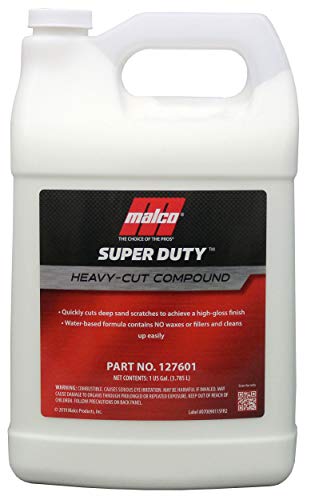
Malco’s Super Duty is a heavy-cut compound formulated to remove P1500 grit and finer sanding scratches from clear coat, single-stage paint, and gel coat surfaces. The abrasive package is designed for use with a wool cutting pad, which provides the mechanical aggression needed to level severe oxidation and deep swirls in a single pass. Professional detailers in the data consistently highlight how fast it cuts without generating excessive heat.
The compound finishes surprisingly well for its cut level — owners report a high-gloss surface straight off the wool pad, reducing the need for a separate polishing step on many jobs. It is VOC-compliant and bodyshop-safe, making it suitable for both collision repair and marine restoration. The gallon size is cost-effective for frequent users who go through compound quickly.
Where it loses points is residue management: overworking the product or using too much compound per section can leave a film that requires extra effort to remove. This is a tool for experienced users who understand panel temperature and buffing speed.
What works
- Aggressive cut removes heavy oxidation and sanding marks fast
- Leaves a high-gloss finish suitable for single-step work
- Large gallon volume delivers strong per-ounce value
What doesn’t
- Residue can be stubborn if overworked
- Best results require a wool cutting pad and experience
3. Meguiar’s M11032 Ultra Pro Speed Compound
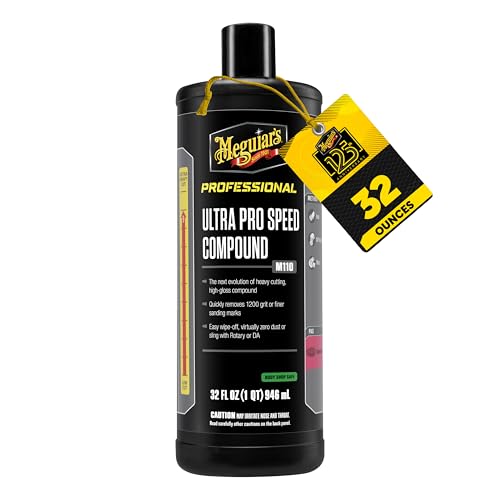
Meguiar’s M11032 is part of the Ultra Pro Speed system, designed specifically for dual-action polishers rather than rotary machines. The fine-grit aluminum oxide abrasive (200 grit classification) allows it to cut through heavy swirl marks and oxidation while still finishing down enough to minimize hazing. Owner reports from wet-sanding projects (1500 to 3000 grit) confirm it removes sanding scratches efficiently when worked properly.
The formula spreads smoothly and cleans up with minimal residue, which reduces the back-and-forth wipe-down time between sections. Its 32-ounce bottle is larger than most consumer compounds, reflecting its target audience of serious enthusiasts and professional detailers. The brand’s 125-year history in surface refinement shows in the consistency of the abrasive suspension — no separation or clumping straight out of the bottle.
The caveat is that achieving the advertised 1200-grit scratch removal requires careful technique, adequate product volume, and a machine with sufficient orbital throw. Novices may need multiple passes to reach full correction, but the compound is forgiving enough to avoid burning paint on the first attempt.
What works
- Cuts effectively with DA polishers, no rotary needed
- Large 32-ounce size for extended use
- Finishes well with minimal haze
What doesn’t
- Deep scratch removal requires technique and multiple passes
- Fine grit limits heavy-cut applications
4. Chemical Guys V34 Optical Grade Hybrid Compound

Chemical Guys formulated the V34 specifically for scratch-resistant and ceramic-infused clear coats, which require abrasives that won’t leave behind micro-marring. The optical-grade aluminum oxide removes 1500-2000 grit sanding scratches while remaining silicone-free and VOC-compliant — critical parameters for bodyshop environments and prep work before ceramic coating application. Multiple owner reviews confirm it erases light swirls and “ghost bug” etchings that clay bars and polishes couldn’t touch.
The compound has an extended work time that gives the user more control when working large panels, and it doesn’t load up the pad as quickly as some heavier-cut alternatives. It pairs well with medium-density foam pads on a DA polisher, though some experienced users note that a rotary buffer unlocks the full cutting potential. The 16-ounce bottle is compact but sufficient for several spot corrections or a full single-pass vehicle correction.
Where it falls short is deep scratch removal — this is not a heavy-cut compound. Owners consistently advise that V34 excels at fine swirls and light marring but will struggle with scratches that catch a fingernail. It is best viewed as a intermediate correction step rather than a standalone heavy compound.
What works
- Safe for ceramic clear coats and sensitive paint systems
- Silicone-free formulation prevents bonding issues with coatings
- Extended work time reduces dusting and pad loading
What doesn’t
- Limited cutting power for deep or fingernail-catching scratches
- Rotary buffer recommended for maximum performance
5. Mothers 08612 Professional Rubbing Compound
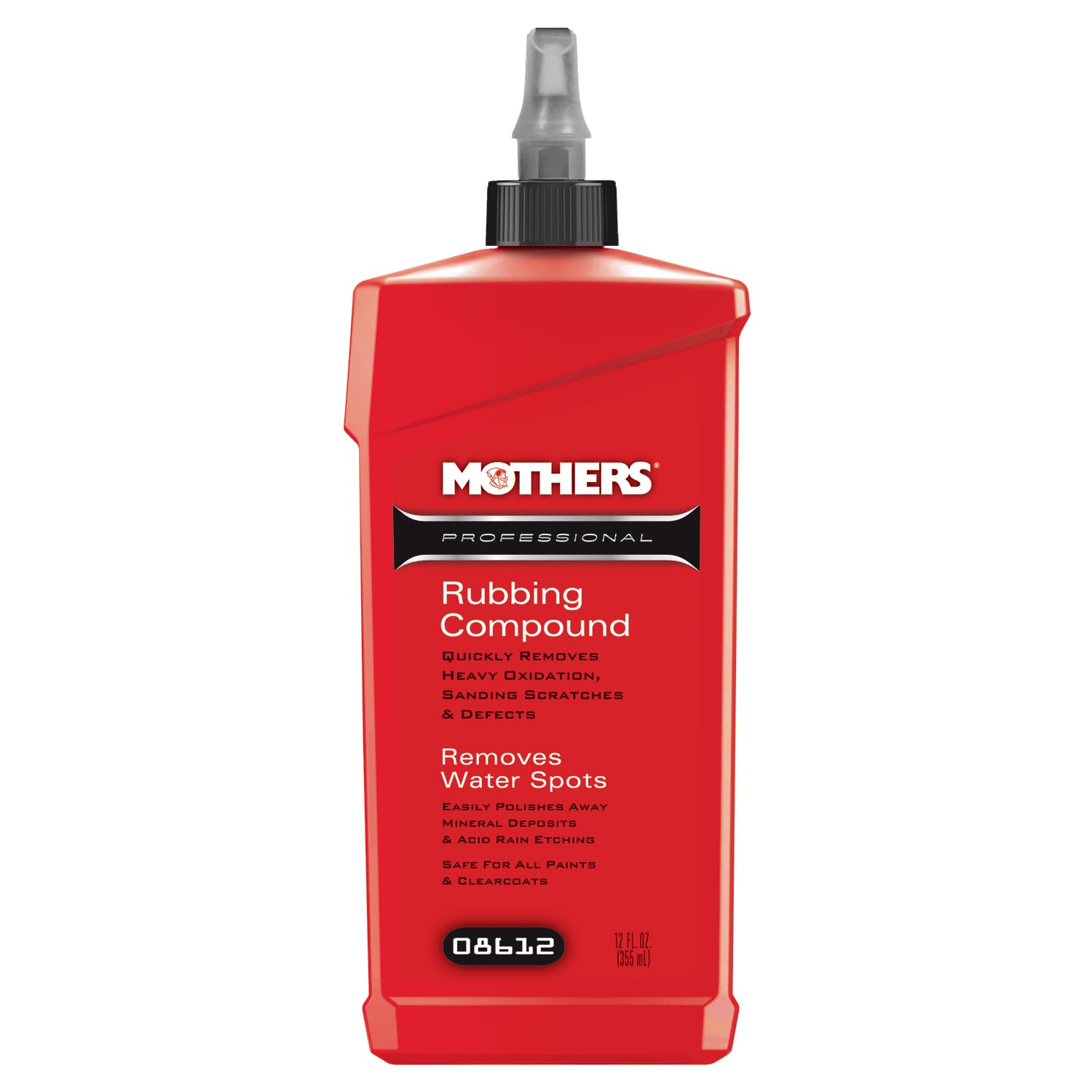
Mothers 08612 uses the same abrasive technology found in professional body shops, scaled to a 12-ounce consumer-friendly bottle. The rubbing compound is designed to cut through water spots, heavy oxidation, and light car-wash scratches without the aggressive material removal of a heavy-cut product. Owners consistently describe it as a “mild abrasive” that is more about refining the surface than grinding down deep defects — one reviewer noted it has less cut than a typical polishing compound.
It works with any buffer type and is simple enough for first-time users, yet the formulation holds up to professional use on clear coats, fresh paint after color sanding, and factory finishes. The 12-ounce bottle is compact for storage and spot repairs, though heavy users will go through it quickly on full-vehicle jobs. The lack of strong solvents means it cleans up easily with minimal residue.
The main drawbacks are the limited abrasive power and the fact that some users report skin sensitivity to the formula — gloves are recommended. This compound is best suited for maintaining an already decent finish rather than resurrecting severely neglected paint.
What works
- Professional-grade formula at an accessible price point
- Versatile for clear coats, fresh paint, and factory finishes
- Easy wipe-off with no harsh chemical smell
What doesn’t
- Mild abrasive won’t remove moderate to deep scratches
- May cause skin irritation — gloves strongly recommended
Hardware & Specs Guide
Abrasive Grit Ratings
A compound’s grit number indicates the size of its abrasive particles. Lower numbers (1500-2000) are heavier cuts that remove deeper scratches but leave a hazy finish that requires polishing. Higher numbers (3000+) are finer compounds that refine the surface and add gloss. Aluminum oxide is the most common abrasive in automotive compounds because it fractures during use, creating fresh cutting edges that maintain consistent performance throughout the buff cycle.
Work Time & Lubricity
Work time is the window between application and when the compound begins to dry out. High-lubricity carriers extend this window, allowing the abrasive to break down gradually rather than abruptly. Compounds with short work time force faster buffing speeds, which generates heat and increases the risk of burning through clear coat. Extended work time also reduces dusting — the fine abrasive powder that flies off during buffing — keeping the work area cleaner and preventing re-contamination of the paint surface.
Paint System Compatibility
Factory clear coats are relatively soft and respond well to mid-range compounds. Ceramic-infused clear coats require optical-grade abrasives that won’t leave micro-marring. Gel coat surfaces (marine/RV) need high-lubricity compounds to prevent heat buildup and burning. Single-stage paint (older vehicles) has no clear layer, so aggressive compounds can remove color pigment quickly — a gentler formula with careful technique is critical for preserving the paint film.
Application Method
Compounds designed for dual-action (DA) polishers typically finish finer than those formulated for rotary machines. DA polishers oscillate rather than spin in a fixed circle, reducing heat and the risk of holograms. Rotary buffers spin continuously and require more skill but deliver faster cut rates. Some compounds are optimized for one tool type, so check the manufacturer’s recommendation before purchasing — using a DA compound on a rotary can cause slinging, while using a rotary compound on a DA may not generate enough cut.
FAQ
Can I use buffing compound by hand or do I need a machine?
What is the difference between rubbing compound and polishing compound?
How do I know which grit level my compound should be?
Final Thoughts: The Verdict
For most buyers, the best buffing compound for scratches winner is the Griot’s Garage BOSS Correcting Cream because it balances cut and finish in one extended-work-time formula that suits both beginners and experienced detailers. If you need heavy cut for severe oxidation and sand scratches, grab the Malco Super Duty Heavy Cut Compound. And for a reliable entry-level option that won’t break the budget, nothing beats the Mothers 08612 Professional Rubbing Compound.

Certification: BSc in Mechanical Engineering
Education: Mechanical engineer
Lives In: 539 W Commerce St, Dallas, TX 75208, USA
Md Amir is an auto mechanic student and writer with over half a decade of experience in the automotive field. He has worked with top automotive brands such as Lexus, Quantum, and also owns two automotive blogs autocarneed.com and taxiwiz.com.