Brake fluid is the single most neglected hydraulic component in most cars, yet it directly determines whether your pedal feels firm or sinks under hard braking. Water absorption over time lowers the boiling point, vapor lock sets in, and stopping distance grows.
I’m Amir — the founder and writer behind Four Wheel Ask. I’ve spent years analyzing technical data sheets, cross-referencing owner feedback, and evaluating thermal performance across the top brake fluid formulations available today.
A wrong choice leads to brake fade at the worst moment, corrosion inside calipers, or premature seal failure. That’s why understanding wet and dry boiling points is the only reliable way to pinpoint the best auto brake fluid for your specific driving conditions and vehicle system.
How To Choose The Best Auto Brake Fluid
Selecting the right brake fluid goes beyond grabbing a familiar brand off the shelf. The fluid you pour into the reservoir must match your vehicle’s hydraulic system, driving style, and local climate. Three parameters dominate the decision.
Dry and Wet Boiling Points
The dry boiling point is measured from fresh, moisture-free fluid. The wet boiling point reflects performance after the fluid has absorbed around 3.7 percent water by volume — a realistic scenario after a year or two of service. A higher wet boiling point provides a larger safety margin against vapor lock during spirited driving or heavy braking on downhill stretches.
DOT Rating and Viscosity
DOT 3, DOT 4, and DOT 5.1 are the common glycol-based standards. Each has a minimum dry and wet boiling point requirement. Low-viscosity (LV) formulations are designed to flow faster through the small passages of modern ABS, ESC, and traction control modules, ensuring rapid pressure modulation without lag.
Compatibility With Your System
Never mix DOT 5 silicone fluid with glycol-based fluids. DOT 5 is purple, non-hygroscopic, and intended for show cars or military vehicles. All modern production cars use DOT 3, DOT 4, or DOT 5.1. Stick to what the reservoir cap or owner’s manual specifies to avoid seal swelling, brake failure, or system contamination.
Quick Comparison
On smaller screens, swipe sideways to see the full table.
| Model | Category | Best For | Key Spec | Amazon |
|---|---|---|---|---|
| Brembo L04210 | DOT 4 LV | High-performance street & track | 260 °C flash point, low viscosity | Amazon |
| Motorcraft PM20 | DOT 4 LV | Ford/Lincoln OEM spec | WSS-M6C65-A2, 16 oz | Amazon |
| Liqui Moly DOT 4 | DOT 4 | Value with premium protection | 1 liter, corrosion inhibitors | Amazon |
| Ford PM-1-C | DOT 3 | Daily-driven Ford/Mercury vehicles | 500 °F dry boiling point | Amazon |
| Wilwood 570 Hi-Temp | DOT 3 | Entry-level track & autocross | 570 °F dry boiling point | Amazon |
In‑Depth Reviews
1. Brembo L04210 Brake Fluid
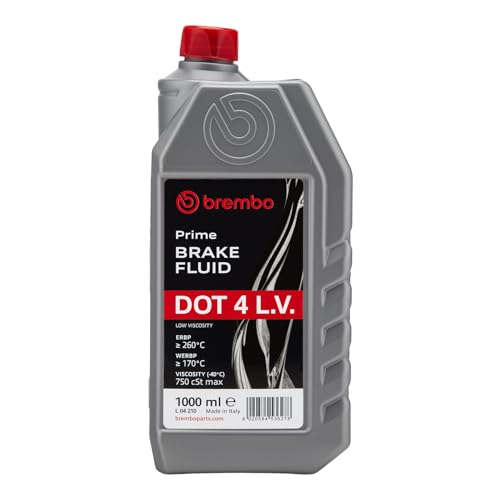
Brembo’s L04210 is engineered around the latest-generation electronic stability and braking systems. With a silicone-based formulation and a flash point rated at 260°C, this fluid maintains thermal integrity well beyond what most street-oriented DOT 4 products achieve. Owner feedback consistently notes a firm, consistent pedal feel even after repeated hard stops during canyon driving or lapping days.
The fluid’s very low viscosity at cold temperatures is a standout feature — it allows ABS and ESP modules to cycle rapidly without hesitation during low-traction conditions. Brembo includes corrosion inhibitors that protect internal caliper bores and master cylinder seals over extended service intervals. This is the bottle you choose when every fraction of a second matters and system reliability is non-negotiable.
Applications span passenger cars, crossovers, and sport sedans that demand fast hydraulic response. The 1-liter container provides enough volume for a full flush on most vehicles with a small surplus for bleeding. Enthusiasts who track their street cars will find the thermal margin sufficient for intermediate-level sessions without upgrading to a dedicated racing fluid.
What works
- Exceptional 260°C flash point for aggressive driving
- Low viscosity improves ABS and ESP response in cold weather
- Corrosion inhibitors extend caliper and seal life
What doesn’t
- Label suggests motorcycle use but works in cars — verify cap compatibility
- Premium price point; may be overkill for gentle daily commutes
2. Motorcraft PM20 Brake Fluid
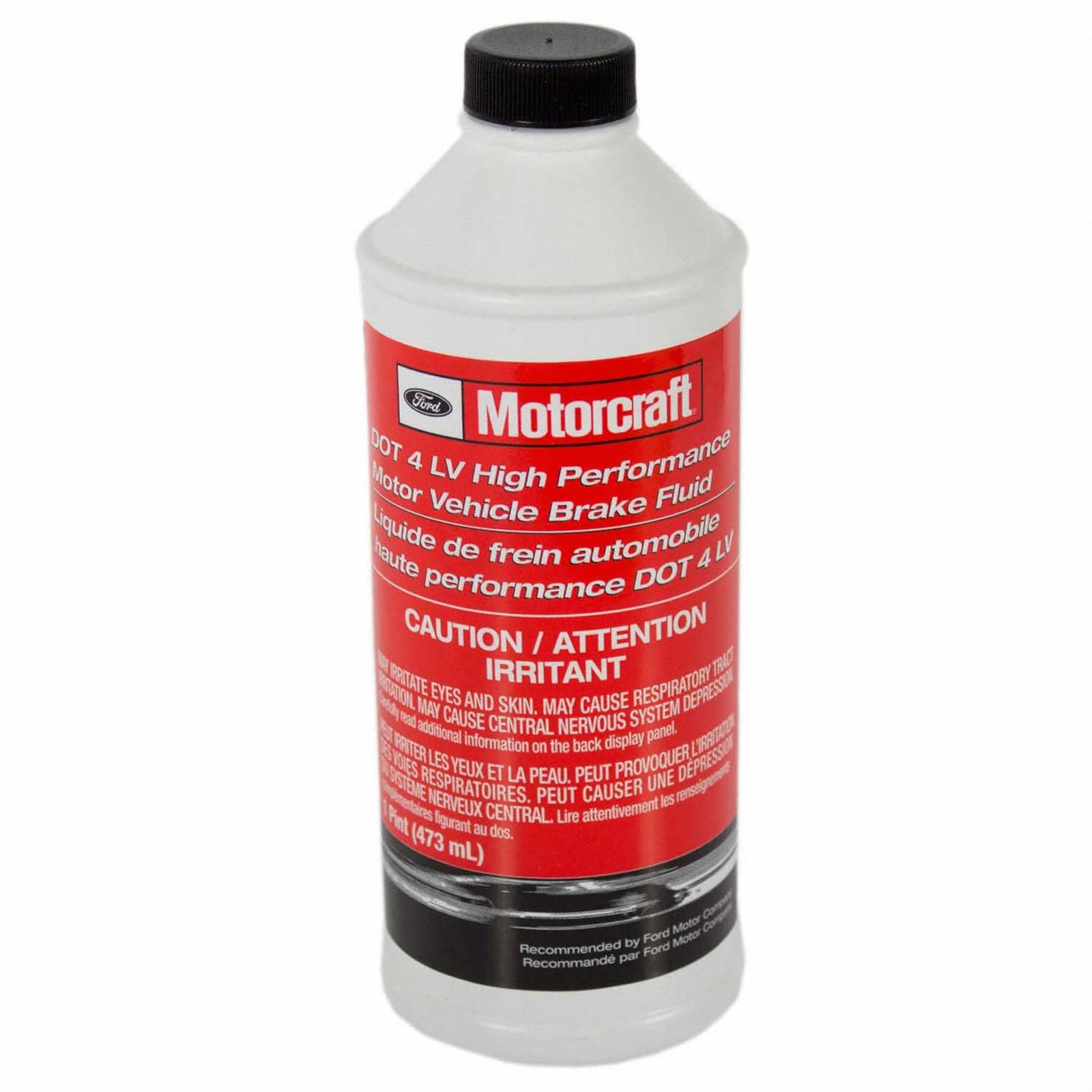
The Motorcraft PM20 is the factory-fill fluid for Ford and Lincoln vehicles specifying WSS-M6C65-A2 (ISO 4925 Class 6) or WSS-M6C65-A1 standards. It is a DOT 4 low-viscosity formulation that meets the demanding requirements of modern ABS and electronic brake distribution systems. Owner reports highlight how the fluid restores pedal modulation after switching from a generic DOT 3 product.
Unlike aftermarket alternatives that must cover a broad compatibility range, the PM20 is tuned specifically for Fords. This means the additive package, viscosity curve, and seal compatibility are precisely matched to the master cylinders and calipers used in the brand’s lineup. The 16-ounce bottle is a convenient size for top-offs between flush intervals, though a full system bleed may require two bottles depending on the vehicle.
Recommendations note that the PM20 can also be used as a replacement for DOT 3 in applications where the manufacturer allows backward compatibility. The low-viscosity nature ensures rapid flow through small-bore ABS passages, reducing the risk of valve delays during emergency stops. For owners who value a direct OEM-spec replacement without guessing, this is a trustworthy pick.
What works
- Exact Ford/Lincoln OEM spec removes compatibility guesswork
- Low viscosity supports quick ABS and ESC cycling
- 12-ounce size works well for routine top-offs
What doesn’t
- Limited brand applicability; not optimized for non-Ford platforms
- Premium pricing compared to generic DOT 4 offerings
3. Liqui Moly DOT 4 Brake Fluid

Liqui Moly’s DOT 4 uses a synthetic formulation based on glycol ethers, alkyl polyglycols, and glycol ether esters. The result is a fluid that offers a noticeably higher wet boiling point than conventional economy options, with specialized scavengers that suppress vapor formation even as moisture accumulates over time. Owner data from forums shows consistent performance past the 12-month service mark without requiring replacement.
The 1-liter bottle provides enough capacity for a complete flush on the majority of sedans and compact crossovers, leaving a small reserve for bleeding trapped air. Corrosion and oxidation inhibitors are blended in to protect internal components at sustained high temperatures. This makes the fluid a solid fit for both daily-driven cars and occasional spirited backroads sessions where heat load is moderate.
Universal fitment allows it to replace DOT 3 or DOT 4 in most conventional hydraulic systems, but it is not recommended for use in systems specifying DOT 5 silicone fluid. The viscosity at low temperature is adequate for standard ABS modules, though owners with performance-oriented vehicles may prefer a dedicated low-viscosity variant. For the price, the thermal protection and additive package punch above the category average.
What works
- Large 1-liter volume covers a full flush with margin
- High wet boiling point resists fade longer than economy fluids
- Corrosion inhibitors protect calipers and master cylinder
What doesn’t
- Standard viscosity, not optimized for cold-weather ABS cycling
- Not labeled as low-viscosity — verify compatibility with demanding ESC systems
4. Ford Genuine PM-1-C DOT 3 Brake Fluid

The Ford PM-1-C is the factory-fill DOT 3 fluid found in millions of Ford, Mercury, and Lincoln vehicles equipped with disc, drum, or ABS systems. It delivers a minimum dry boiling point of 500°F (260°C) and a wet boiling point of 284°F (140°C). Owner feedback from dedicated Ford forums indicates that this fluid provides consistent pedal feel over standard service intervals with no reported compatibility issues across model years.
Because it mirrors exactly what the master cylinder seals were designed for, the risk of swelling or premature wear is virtually eliminated. The 12-ounce bottle is compact and easy to store, making it a practical choice for topping off reservoirs between scheduled flushes. However, DOT 3 fluids naturally have a lower wet boiling point than DOT 4 or DOT 5.1, so drivers who track their cars or tow heavy loads may want to upgrade to a higher-grade alternative.
For the average daily commuter or fleet operator who follows the owner’s manual, the PM-1-C offers the peace of mind of an OE-grade product without the premium price of performance fluids. It is a safe, predictable choice that prioritizes corrosion protection and seal compatibility over maximum thermal headroom.
What works
- OEM-spec formulation eliminates seal-compatibility doubts
- 500°F dry boiling point exceeds basic DOT 3 minimum
- Compact 12-ounce container for easy storage and top-offs
What doesn’t
- DOT 3 grade has lower wet boiling point than DOT 4/5.1
- Not suitable for heavy track use or high-heat applications
5. Wilwood 570 Hi-Temp Racing Brake Fluid

Wilwood’s 570 Hi-Temp Racing fluid is a DOT 3 formulation with an exceptionally high dry boiling point of 570°F (299°C). This puts it well above the standard DOT 3 minimum of 401°F, approaching the thermal performance of many DOT 4 fluids. Enthusiast communities report that this fluid delays pedal softening during autocross runs and light track days, especially on cars with aggressive pad compounds that transfer more heat into the caliper.
The glycol-based composition is compatible with conventional brake system seals, and the 12-ounce bottle is a practical size for bleeding one or two corners during a refresh. However, the wet boiling point — though not directly published — drops faster in humid climates due to the DOT 3 hygroscopic nature. Owners in coastal regions or high-rainfall areas should plan for semi-annual flushes to maintain performance margins.
While labeled a racing fluid, the Wilwood 570 fits best as an entry-level upgrade for drivers who push their street cars occasionally but aren’t ready to step up to a dedicated DOT 4 or DOT 5.1 race fluid. The universal fitment means it works across a wide range of vehicles, including classic cars, hot rods, and modern platforms.
What works
- 570°F dry boiling point provides generous thermal margin
- Compatible with standard glycol-based hydraulic systems
- Compact 12-ounce bottle suits touch-up bleeding
What doesn’t
- DOT 3 base absorbs moisture faster than DOT 4 alternatives
- Published wet boiling point is not listed — requires shorter change intervals
Hardware & Specs Guide
Boiling Points — Dry vs. Wet
The dry boiling point measures fluid performance when fresh and moisture-free. The wet boiling point simulates fluid that has absorbed roughly 3.7% water by volume — a realistic condition after one to two years of service. A high wet boiling point is the more important safety number because it indicates how well the fluid resists vapor lock after it has aged. DOT 4 fluid must have a minimum dry boiling point of 446°F and a minimum wet boiling point of 311°F. DOT 5.1 raises the wet limit further to 356°F. Choosing a fluid with a wet boiling point well above your driving conditions provides a real safety buffer.
Viscosity and ABS Performance
Low-viscosity (LV) brake fluids are rated by kinematic viscosity at -40°C. Standard DOT 4 fluid can thicken significantly in cold weather, causing delayed pressure transmission through ABS valves and potentially longer stopping distances on icy roads. DOT 4 LV fluids are formulated to remain fluid enough at low temperatures to ensure rapid modulation without lag. Vehicles equipped with electronic stability control, traction control, or advanced driver-assistance systems benefit most from LV fluids because those modules rely on fast, repeatable pressure changes. Always check the reservoir cap for the manufacturer’s viscosity recommendation before switching formulations.
FAQ
Can I mix DOT 3 and DOT 4 brake fluid?
How often should I flush my brake fluid?
What happens if I use the wrong DOT rating?
Final Thoughts: The Verdict
For most buyers, the best auto brake fluid winner is the Brembo L04210 because it combines a 260°C flash point with low-viscosity flow that modern ABS and ESC modules demand. If you need a direct OEM-spec fluid for a Ford or Lincoln, grab the Motorcraft PM20. And for solid thermal protection at a reasonable per-liter price, nothing beats the Liqui Moly DOT 4.

Certification: BSc in Mechanical Engineering
Education: Mechanical engineer
Lives In: 539 W Commerce St, Dallas, TX 75208, USA
Md Amir is an auto mechanic student and writer with over half a decade of experience in the automotive field. He has worked with top automotive brands such as Lexus, Quantum, and also owns two automotive blogs autocarneed.com and taxiwiz.com.