A corroded or damaged battery post can turn a reliable daily driver into a no-start frustration overnight. Whether you are chasing down a slow crank or simply refreshing tired connections, the right terminal repair components restore full electrical flow and prevent repeat failure. The market offers everything from military-spec replacement kits to precision-machined compression lugs, and the choice comes down to your vehicle’s cable gauge, terminal type, and how many accessory circuits you plan to run.
I’m Amir — the founder and writer behind Four Wheel Ask. My work focuses on analyzing product specifications, build materials, and owner-reported reliability data to identify which components deliver consistent performance under real-world conditions.
Evaluating terminal material and cable compatibility will lead you to the best possible best battery post repair kit for a secure and lasting connection.
How To Choose The Best Battery Post Repair Kit
Selecting the right terminal repair components requires understanding a few key variables that directly affect electrical performance and longevity. Owners often overlook material composition, clamp design, and cable gauge compatibility, which leads to repeat failures or poor conductivity. Focus on these factors to narrow your options quickly.
Terminal Material: Copper Versus Alloy
Pure copper offers the highest conductivity and lowest resistance, but it is softer and more prone to deformation under clamping force. Brass and bronze alloys are harder and resist corrosion better in wet environments but introduce slightly higher resistance. Military-spec terminals often use a high-copper alloy that balances conductivity with structural strength. For daily-driven vehicles in moderate climates, tinned copper or copper-alloy terminals provide the best trade-off between performance and corrosion resistance.
Clamp Design: Compression versus Set-Screw
Compression-style terminals use a bolt-on clamp that pinches the stripped cable against the terminal body, creating a large contact area without soldering or crimping. Set-screw designs rely on small grub screws that bite into the conductor, which can loosen over time or damage individual strands. Compression clamps generally offer a more reliable long-term connection for higher-amperage applications such as starter circuits and auxiliary fuse blocks.
Cable Gauge and Terminal Compatibility
Battery cable diameters vary widely — common sizes include 2 AWG, 1/0 AWG, and 2/0 AWG. The terminal lug opening and the clamp capacity must match your existing cable. Kits that include multiple lug sizes or adjustable clamping zones accommodate a broader range of installations. Always measure your cable diameter before purchasing, because undersized lugs create hot spots and voltage drop.
Quick Comparison
On smaller screens, swipe sideways to see the full table.
| Model | Category | Best For | Key Spec | Amazon |
|---|---|---|---|---|
| Vgate 8-Way Connector | Premium Terminal | Multi-accessory setups | 8 connection points, 4/0 to 8 AWG | Amazon |
| Bateria Power Pure Copper Kit | Performance Kit | High-conductivity builds | 99.9% pure copper, 2 AWG lugs | Amazon |
| Fastronix Compression Terminal | Compression Design | Simple no-crimp install | 1–2 AWG, solderless clamp | Amazon |
| DLronwey Military-Spec Set | Value Kit | Complete budget-friendly replacement | Alloy terminals, covers, lugs, washers | Amazon |
| Performance Tool 4-Way Cleaner | Cleaning Tool | Post and connector prep | Drill-compatible, 4 cleaning heads | Amazon |
In‑Depth Reviews
1. Vgate 8-Way Lead Acid Battery Terminal Connector

The Vgate 8-Way connector stands apart because it replaces the traditional single-stud terminal with a multi-point distribution hub. Four hole-holders and four threaded studs accommodate cables from 8 AWG up to 4/0 AWG, making it a practical choice for vehicles with aftermarket lighting, audio systems, or auxiliary fuse blocks. The solid aluminum body provides a rigid foundation, and the back pocket is designed to clear the raised lip found on many SAE and DIN post batteries.
Owner reports from Duramax and Tacoma builds highlight the improved stereo noise floor and the ability to consolidate multiple ring terminals into one organized block. The kit includes star washers and uses metric hardware — 13mm nuts and 5mm Allen fasteners — so a standard tool roll covers the installation. The two-year warranty adds confidence for those wiring high-amperage circuits where a loose connection creates real risk.
This terminal is not a direct OEM-style replacement; it requires stripping and securing each cable with the supplied clamp. Vehicles running lithium batteries will need an optional stud-to-post adapter. For owners building a custom electrical system or cleaning up a rat’s nest of accessory wires, the Vgate 8-Way delivers the most flexible platform in this comparison.
What works
- Eight separate connection points eliminate daisy-chaining
- Machined aluminum body with corrosion-resistant finish
- Compatible with multiple cable gauges in one unit
What doesn’t
- Requires adapter for lithium battery posts
- Metric hardware may differ from standard tool sets
2. Bateria Power Pure Copper Battery Terminal Connectors Kit
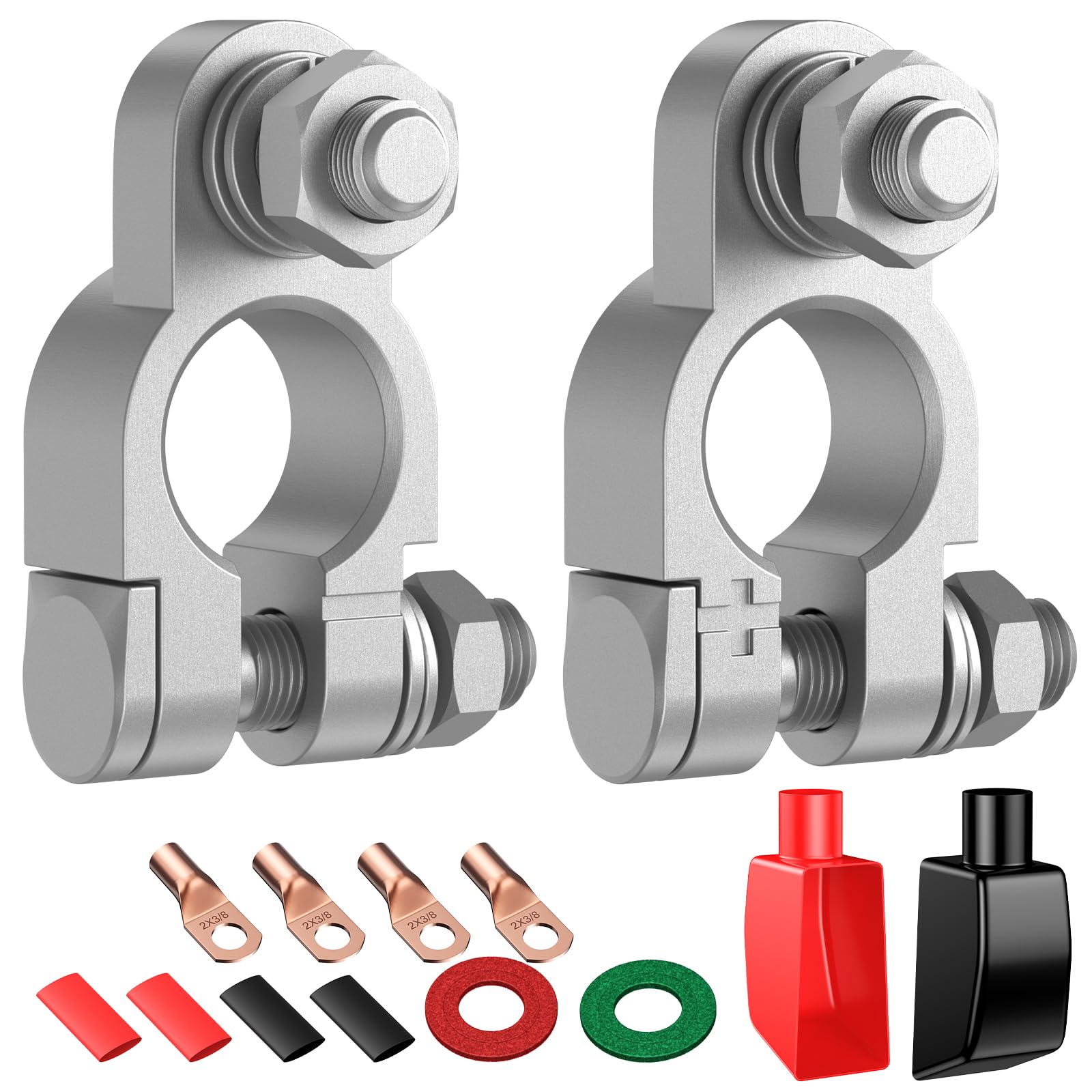
Bateria Power uses 99.9 percent pure copper rather than the brass or bronze alloys found in many budget kits. Pure copper delivers lower electrical resistance and generates less heat under load, which matters for vehicles with high-compression starters or multiple electrical accessories. The terminals are tin-plated to slow oxidation, and the kit includes anti-corrosion washers that sit between the terminal and the battery post to reduce galvanic reaction.
The package supplies two heavy-duty terminals, four 2 AWG 3/8-inch copper lugs, heat shrink tubing, and protective covers. Owners of 2012 Subaru Legacy models reported an excellent fit without needing shims, and multiple buyers noted that the positive terminal is physically larger than the negative to prevent reverse installation. The included lugs are sized for 2 AWG cable, which covers most OEM battery cables and common aftermarket upgrades.
Some users expected a heavier casting based on product photos, though the terminals perform correctly once installed. The kit does not include a crimping tool, so buyers need their own to attach the lugs. For those who prioritize conductivity and corrosion resistance over raw mechanical heft, this pure-copper set represents a strong performance-oriented choice.
What works
- High-purity copper maximizes current flow
- Tin plating and anti-corrosion washers extend service life
- Clearly differentiated positive and negative terminals
What doesn’t
- Terminals feel lighter than cast-alloy alternatives
- No crimping tool included in the kit
3. Fastronix Top Post Battery Compression Terminal (Positive)

The Fastronix compression terminal uses a bolt-on clamp that pinches the cable against the terminal body rather than relying on set screws that can loosen over time. This design eliminates the need for soldering or crimping — strip 3/4 to 1 inch of insulation, insert the conductor, and tighten with a 10mm socket. The solid copper clamp creates a large contact area that handles starter current without voltage drop.
This specific unit is the positive terminal only and is labeled with a raised (+) mark. It accepts 1 or 2 AWG battery cable with a conductor diameter between 0.2576 and 0.2893 inches. Owners of 2000 Ford Explorer and various Alaska-driven vehicles reported a secure fit after years of thermal cycling, though one buyer experienced stripped threads during installation, which suggests careful torque application is necessary.
The compression screw mechanism adds roughly half an inch of net length to the cable, so routing may require adjustment in tight battery boxes. No instructions are included in the package, and the compression nut can twist the cable strands if over-tightened. For a DIY owner who wants a reliable, solderless connection without buying a crimper, this terminal offers a straightforward mechanical solution.
What works
- Compression clamp provides high contact force without crimping
- Installation requires only basic hand tools
- Solid copper construction resists deformation
What doesn’t
- Single terminal sold individually, not a pair
- No installation instructions included
4. DLronwey Military Spec Battery Terminal Connectors Kit
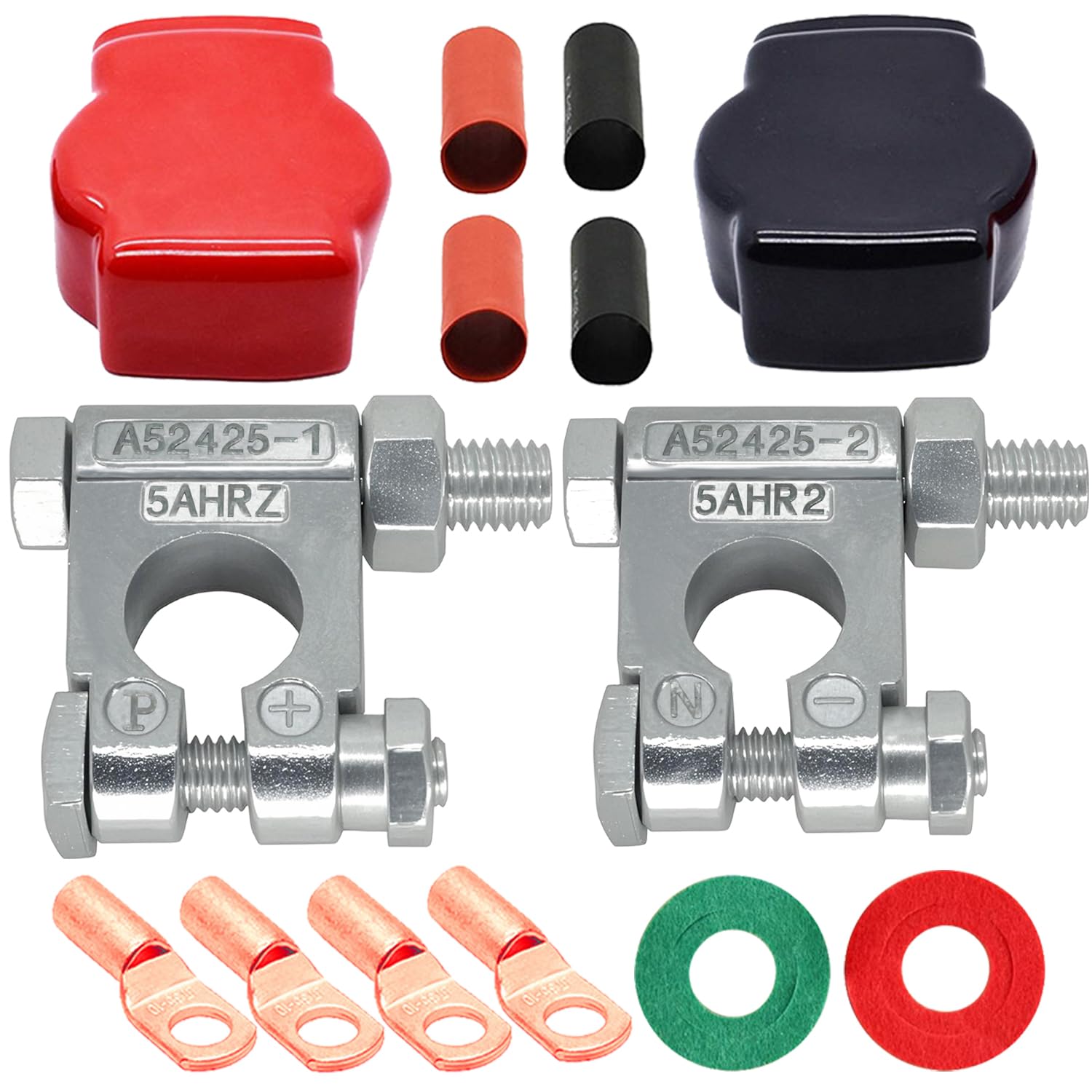
The DLronwey kit delivers a complete terminal replacement package at a entry-level price point without cutting critical components. Inside the storage case are two heavy-duty alloy terminals, red and black protective covers, anti-corrosion gaskets, four pieces of heat shrink tubing, and four 2 AWG 3/8-inch copper lugs. The alloy material provides good conductivity while resisting the corrosion that plagues cheaper zinc or steel terminals.
Each terminal accommodates multiple battery wires, and the positive and negative poles are clearly marked with different sizes to prevent accidental reversal. Owner feedback from multiple installations describes the terminals as solid and well-made, with several users stating they prefer this system over pre-made cables because it allows a custom-length fit. The one-year quality guarantee with 24-hour response adds a safety net for first-time installers.
A point of confusion noted in reviews: the product title lists 2 AWG, while some description text references 2/0 AWG, and the included lugs are confirmed as 2 AWG. Owners needing 2/0 lugs for heavy starter cables on diesel trucks will need to source larger lugs separately. For standard passenger car and light truck applications with 2 AWG cable, this kit offers the most complete value-oriented package in the group.
What works
- Complete kit with covers, lugs, washers, and heat shrink
- Alloy construction resists corrosion effectively
- Compact storage case keeps components organized
What doesn’t
- Lug size discrepancy between listing and included parts
- Alloy material slightly less conductive than pure copper
5. Performance Tool W152C 4-Way Battery Terminal Cleaner
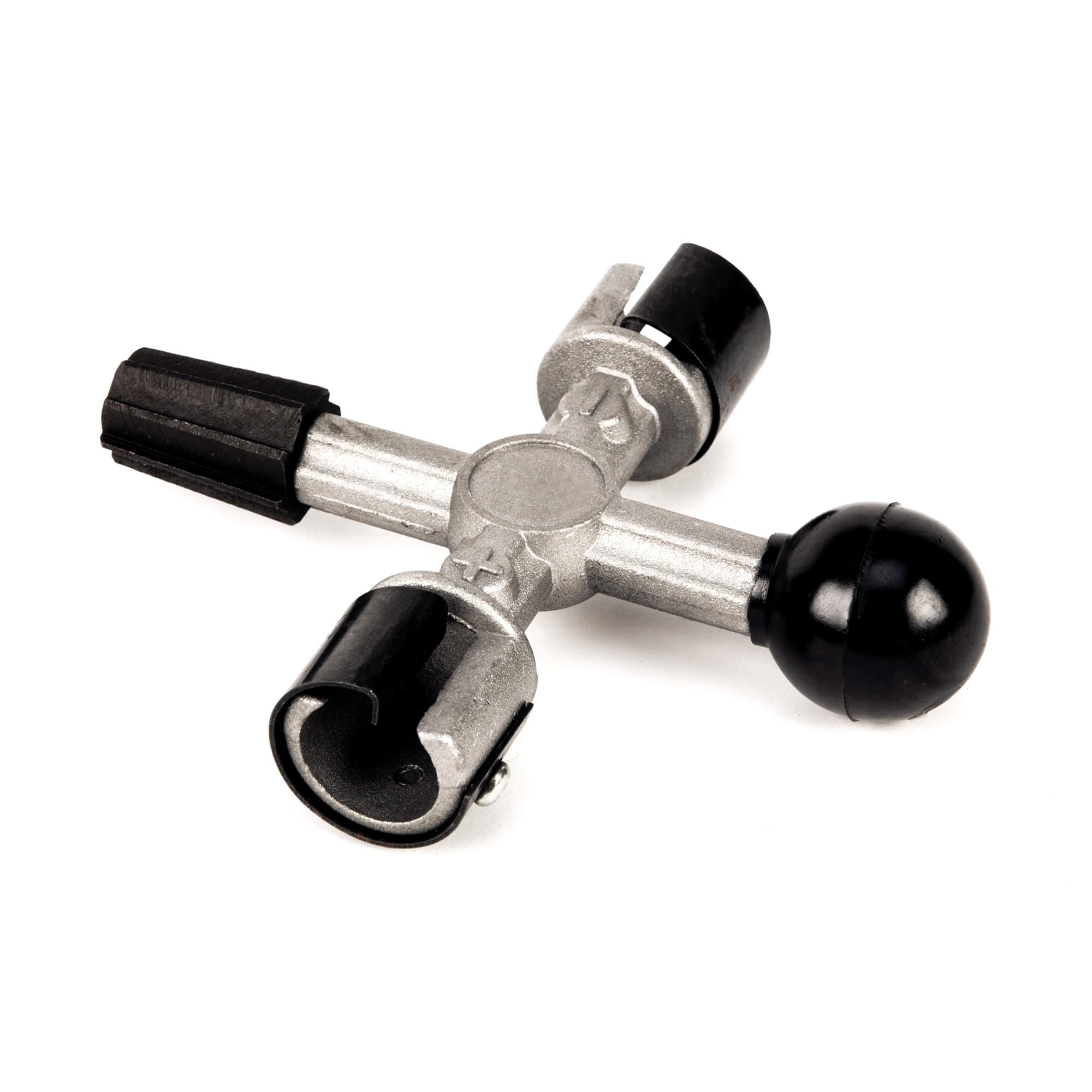
The Performance Tool W152C is a dedicated cleaning tool rather than a terminal replacement component, but it deserves a place in any battery service workflow because corrosion is the primary reason terminals need repair. The tool features four cleaning heads — two conical brushes for cleaning inside cable clamps and two tapered wire brushes for scrubbing battery posts. The cast body is compatible with a standard drill, which transforms a tedious hand-brushing job into a 30-second operation.
Users consistently report that this design reaches corrosion deep inside the terminal clamp that standard wire brushes miss. The tool has been in production since 2005, and the durable cast construction holds up to repeated use in both home garages and professional shops. Reviewers who previously relied on manual wire brushes describe the difference as night and day in terms of contact area and resulting cranking performance.
The tool may have minor mold flash or casting scale out of the box, but this does not affect function. It works on cars, trucks, boats, and RVs with standard SAE post batteries. For anyone replacing terminals, starting with a clean post and clamp interface ensures the new components make full metal-to-metal contact, making this cleaner a budget-friendly complement to any repair kit.
What works
- Drill-powered cleaning saves significant time
- Reaches corrosion inside clamps that brushes miss
- Durable cast-metal body lasts for years
What doesn’t
- Not a terminal replacement — requires a separate kit for new parts
- Minor casting flash may require light deburring
Hardware & Specs Guide
Terminal Material Grades
Pure copper (99.9 percent) offers the lowest resistivity at roughly 1.68 microhm-centimeters, making it ideal for high-current starter and alternator circuits. Brass alloys, typically 60-70 percent copper with zinc, increase resistivity by 20-30 percent but improve hardness and corrosion resistance in wet environments. Tinned copper terminals combine the conductivity of copper with a sacrificial tin layer that prevents oxidation. For most daily-driven vehicles, tinned copper or high-copper alloy terminals provide the best real-world balance of performance and longevity.
Cable Gauge Compatibility
Battery cable sizes follow the American Wire Gauge system where smaller numbers indicate thicker conductors. A 2 AWG cable is common for OEM battery cables in cars and light trucks, while 1/0 and 2/0 AWG are typical for diesel trucks, large RVs, and high-power audio systems. The terminal lug hole diameter must closely match the stripped conductor diameter — an undersized lug creates a hot spot, while an oversized lug prevents proper clamp engagement. Always measure your cable diameter with calipers before selecting a terminal kit.
Clamp Mechanism Types
Compression terminals use a through-bolt that squeezes the cable against the terminal body, creating a large-area mechanical and electrical connection. Set-screw terminals rely on small grub screws that bite into individual strands — these are easier to install but can loosen under thermal cycling and vibration. Military-spec terminals often combine a tapered post with a threaded stud and nut, providing a high-clamping force that resists loosening. Compression-style clamps generally outperform set-screw designs in high-amperage applications.
Anti-Corrosion Features
Galvanic corrosion occurs when dissimilar metals (lead battery post and copper terminal) contact in the presence of electrolyte. Anti-corrosion washers create a physical barrier between the post and the terminal, while tin plating on the terminal itself slows oxidation. Protective rubber or PVC covers shield the connection from moisture and acid fumes. Heat shrink tubing seals the cable-to-lug junction, preventing wicking of acid into the wire strands. Kits that include all four measures provide the most comprehensive corrosion protection.
FAQ
Can I use a battery post repair kit on a side-terminal battery?
How do I know what cable gauge my vehicle uses?
Is soldering necessary when installing compression terminals?
Final Thoughts: The Verdict
For most buyers, the best battery post repair kit winner is the Vgate 8-Way Terminal Connector because it combines a flexible multi-point distribution hub with solid aluminum construction and broad cable-gauge compatibility. If you want maximum conductivity from pure copper, grab the Bateria Power Kit. And for a complete budget-friendly refresh with covers and lugs included, nothing beats the DLronwey Military Spec Set.

Certification: BSc in Mechanical Engineering
Education: Mechanical engineer
Lives In: 539 W Commerce St, Dallas, TX 75208, USA
Md Amir is an auto mechanic student and writer with over half a decade of experience in the automotive field. He has worked with top automotive brands such as Lexus, Quantum, and also owns two automotive blogs autocarneed.com and taxiwiz.com.