That glowing check engine light can turn any drive into a guessing game. A dedicated diagnostic tool strips away the mystery, translating trouble codes into plain language so you know whether it is a loose gas cap or something that needs a professional look.
I’m Amir — the founder and writer behind Four Wheel Ask. My approach involves cross-referencing technical specifications, analyzing build quality across multiple product generations, and synthesizing thousands of owner reports to separate tools that deliver real utility from those that just look the part.
Understanding your car’s check engine light is straightforward with a quality tool, and the best basic code reader delivers accurate diagnostics without overwhelming features or complex setup.
How To Choose The Best Basic Code Reader
Selecting the right code reader comes down to understanding what each model actually does under the hood. The market is filled with devices that all claim to read and clear codes, but the differences in protocol support, display technology, and diagnostic depth separate a genuinely useful tool from one that gathers dust in the glovebox.
OBD2 Protocol Compatibility
Not all code readers communicate with every vehicle. The five standard OBD2 protocols — KWP2000, ISO9141, J1850 VPW, J1850 PWM, and CAN — cover the vast majority of cars built after 1996 in North America and 2000 in Europe and Asia. A reader that supports all five protocols ensures it will work across multiple vehicles in a household, including light trucks and SUVs. Skipping this check is the most common reason a code reader fails to connect.
Display Quality and Readability
A screen that is difficult to read defeats the purpose of a diagnostic tool. Basic readers often use monochrome LCDs with limited resolution, while higher-tier models incorporate color TFT displays that show live data graphs and code definitions more clearly. Screen size matters less than pixel density and viewing angle — a 2.4-inch color display with 320×240 resolution can be far more usable than a larger monochrome panel with low contrast.
Essential Features Versus Extra Capabilities
Core functionality includes reading and clearing engine fault codes, displaying code definitions, and checking I/M readiness for emissions testing. Some budget-friendly readers stop there, which is perfectly adequate for many owners. Upgraded models add live data streaming, freeze frame data, battery voltage testing, and data playback or printing. These extras become valuable when you are diagnosing intermittent issues or preparing a vehicle for a smog check, but they are not necessary for simply identifying why the check engine light is on.
Quick Comparison
On smaller screens, swipe sideways to see the full table.
| Model | Category | Best For | Key Spec | Amazon |
|---|---|---|---|---|
| VDIAGTOOL VD30 Pro | Professional DIY | Comprehensive diagnostics | 2.8-inch color screen, 10 OBD2 tests | Amazon |
| TOPDON AL400 | Premium Entry | DTC lookup & ease of use | 2.4-inch color screen, 10 OBD2 functions | Amazon |
| MOTOPOWER MP69033 Pro | Multi-Function | Battery & alternator testing | 2.8-inch TFT color screen, 6x faster chip | Amazon |
| ANCEL AD310 | Budget Classic | Simple code reading | 128×64 display, all OBD2 protocols | Amazon |
| A-Premium AD200 | Enhanced Value | Detailed data streaming | 2.4-inch color display, 50 data parameters | Amazon |
In-Depth Reviews
1. VDIAGTOOL VD30 Pro
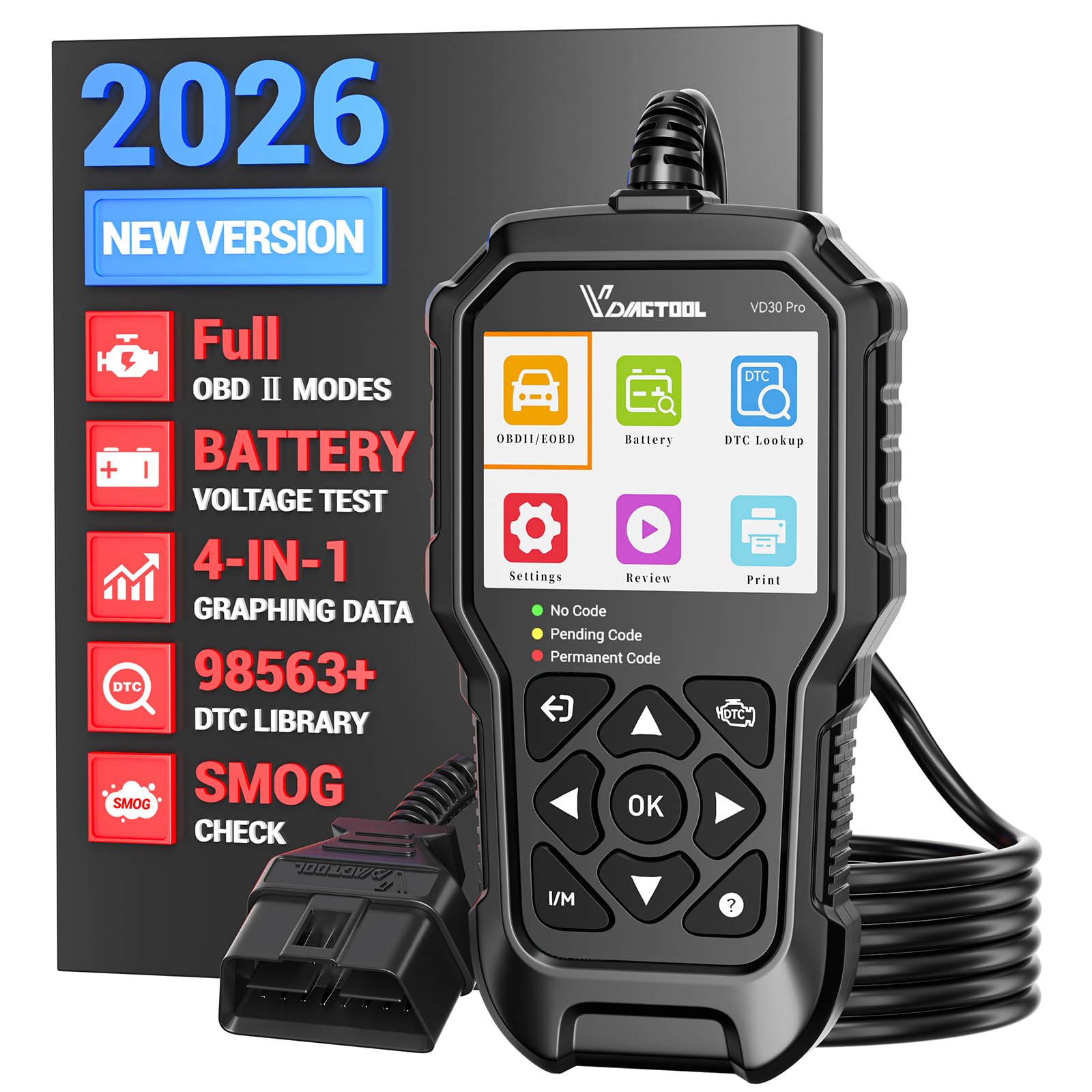
The VDIAGTOOL VD30 Pro punches well above its category position by delivering professional-grade diagnostic depth in a handheld form factor. It performs all ten essential OBD2 tests — reading and clearing fault codes, displaying live data with four-in-one graphing, freeze frame data, one-click I/M readiness, Mode 6 on-board monitor testing, component testing, O2 sensor testing, and vehicle information retrieval. The built-in DTC library covers over 98,000 definitions, so there is no need to reach for a phone or manual after a scan.
Owner feedback consistently highlights the tool’s ability to auto-identify vehicles across multiple brands and model years. Reports from users with 2002 Silverado, 2014 Camry, and 2019 Mustang all confirm seamless communication. The 2.8-inch color screen with 320×240 resolution makes live data curves easy to interpret, and the data playback and printing functions allow service reports to be shared with mechanics. The cable is more flexible than others in this segment, making it easier to route the reader onto the passenger seat during test drives.
The VD30 Pro does not support ABS, SRS, TPMS, or airbag system diagnostics — it focuses strictly on OBD2 engine and emissions systems. The inclusion of battery voltage testing adds practical value for preventing no-start surprises, and the lifetime free updates via USB on Windows ensure the tool stays current. The 3-year warranty and 24/7 tech support provide peace of mind for both DIY owners and shop use.
What works
- Comprehensive 10-test OBD2 suite with graphing
- 98,000-plus DTC definitions on board
- Data playback and printing for service records
What doesn’t
- No ABS or airbag system diagnostics
- Requires Windows PC for firmware updates
2. TOPDON AL400

The TOPDON AL400 is an upgrade over earlier AL200 and AL300 models, adding a DTC lookup library and an expanded set of diagnostic functions that are typically found in more expensive tools. It supports all five OBD2 protocols — KWP2000, ISO9141, J1850 VPW, J1850 PWM, and CAN — and works with most 1996 and newer US vehicles as well as 2000 and newer European and Asian cars. The 2.4-inch color screen is bright enough for use in direct sunlight or a dark garage, and the button layout is designed for intuitive menu navigation.
User reviews emphasize the clarity of the DTC code results menu, which uses a traffic-light LED system — green for no faults, yellow for pending codes, and red for permanent DTCs. This visual cue allows you to assess severity at a glance without scrolling through text. The freeze frame data captures the exact operating conditions when a fault occurred, which helps narrow down intermittent issues. I/M readiness testing is particularly useful for anyone preparing a vehicle for a smog check, as it shows which monitors have run and which are still pending.
Free lifetime updates are included, and the tool supports seven languages — English, French, German, Spanish, Portuguese, Japanese, and Italian. The 1-year warranty and direct phone support (833-956-8335) add a layer of manufacturer backing that is rare at this level. The AL400 draws power directly from the OBD2 port, so there is no need for batteries or chargers. It is a well-rounded choice for the DIY owner who wants more than basic code reading without stepping into professional-tier complexity.
What works
- Traffic-light LED system for quick fault severity assessment
- Free lifetime software updates
- Bright color screen readable in varied lighting
What doesn’t
- No battery or alternator testing
- Screen is 2.4 inches — smaller than some competitors
3. MOTOPOWER MP69033 Pro
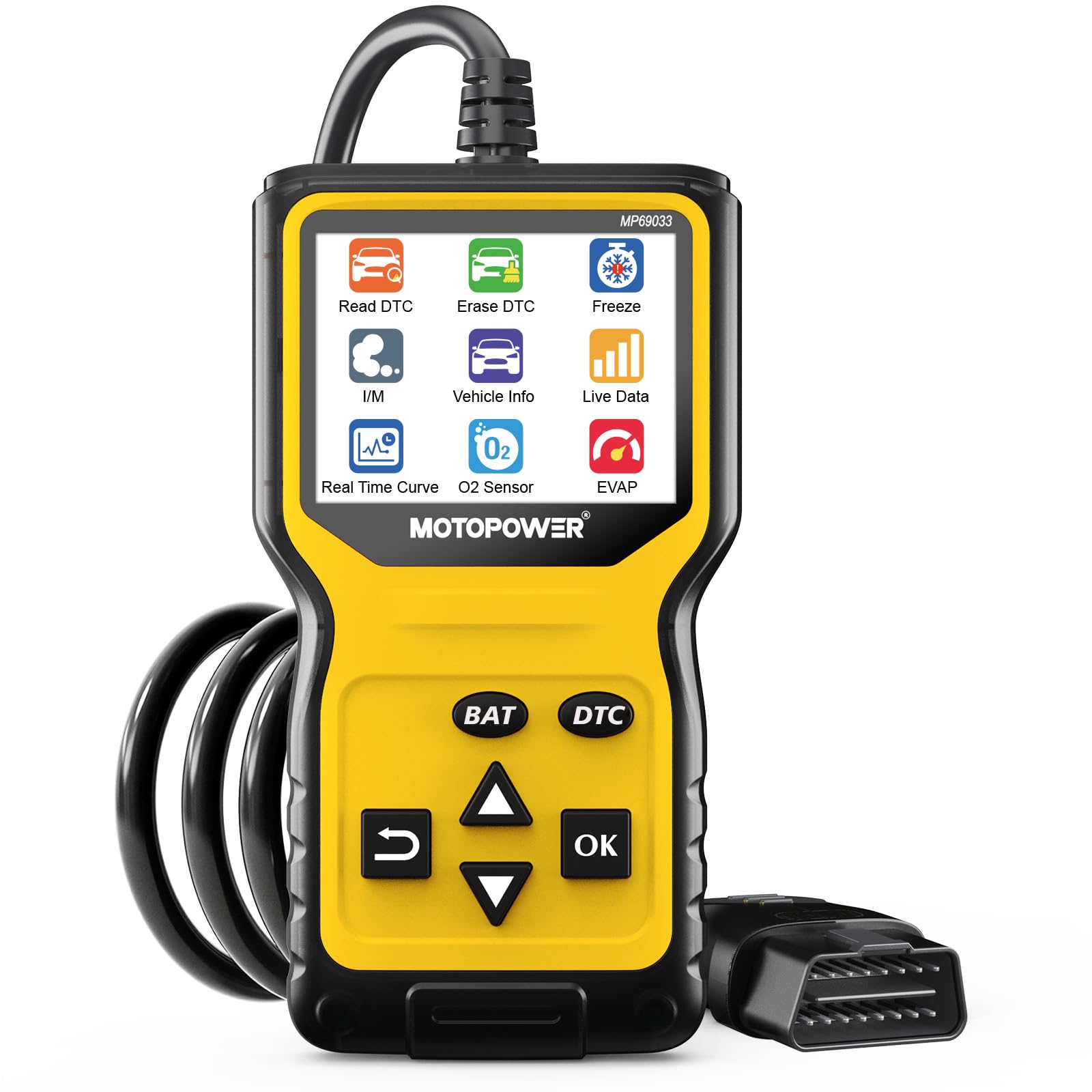
The MOTOPOWER MP69033 Pro distinguishes itself by integrating a battery and alternator test alongside standard OBD2 code reading. This multi-function approach makes it a practical tool for owners who want to check both engine fault codes and the health of their 12V electrical system. The 2.8-inch TFT color screen provides crisp graphics and real-time data curves, and the industrial-grade chip inside delivers scan speeds that are significantly faster than entry-level readers.
Owner reports consistently note the tool’s intuitive menu system and straightforward plug-and-play operation — no apps, no WiFi pairing, no batteries required. The extended cable reaches OBD2 ports in tight spaces, and the compact form factor fits easily into a glove box. The built-in DTC lookup library displays code definitions directly on the screen, so you don’t have to cross-reference a manual or phone. Live data streaming includes vehicle speed, engine coolant temperature, engine RPM, and calculated load value, with real-time curve plotting for trend analysis.
The battery test evaluates voltage and starting performance, while the alternator test includes live ripple analysis to detect diode failures. This functionality is rare in tools at this tier and adds genuine preventative maintenance value. The MP69033 Pro supports all OBD2 protocols and works with 1996 and newer US vehicles, 2000 and newer European and Asian models. It does not support ABS or airbag system diagnostics, and the 2-year manufacturer warranty backs the purchase. A storage bag is included, though some owners wish it had a more robust carry case.
What works
- Integrated battery and alternator testing with ripple analysis
- Fast scanning with upgraded industrial chip
- Large 2.8-inch color display with live data curves
What doesn’t
- No ABS or airbag system coverage
- Included storage bag could be more durable
4. ANCEL AD310

The ANCEL AD310 has earned its reputation as one of the best-selling OBD2 scanners on the market, with recommendations from prominent automotive YouTubers and thousands of positive owner reviews. Its design philosophy is straightforward — read and clear emission-related trouble codes with minimal complexity and maximum reliability. The 2.5-foot cable is made with thick, flexible insulation that withstands the drops and tugs of garage use, and the compact form factor (8.9 x 6.9 x 1.4 inches at 12 ounces) slides easily into a backpack or glove box.
Owner feedback consistently praises the tool’s accuracy and speed. Users report plugging in, reading codes, and clearing them within seconds, with the large display showing results clearly without requiring a manual for interpretation. The AD310 supports all five OBD2 protocols — KWP2000, J1850 VPW, ISO9141, J1850 PWM, and CAN — and is compatible with 1996 and newer US vehicles, 2000 and newer European and Asian cars, light trucks, and SUVs. No batteries or chargers are needed; power comes directly from the OBD2 Data Link Connector.
The key limitation is that the AD310 only diagnoses emission-related issues. If a fault code is unrelated to the emissions system, the reader cannot access it. Additionally, it does not support OBD1 interfaces even with an adapter. The 128×64 monochrome display is functional but basic compared to color-screen alternatives. For the owner who simply wants to know why the check engine light is on and clear the code after a fix, the AD310 delivers exactly that with proven reliability and an established track record.
What works
- Proven reliability with years of positive owner feedback
- Simple one-button operation for code reading and clearing
- Durable cable and compact build for storage
What doesn’t
- Only covers emission-related fault codes
- Monochrome display with limited resolution
5. A-Premium AD200
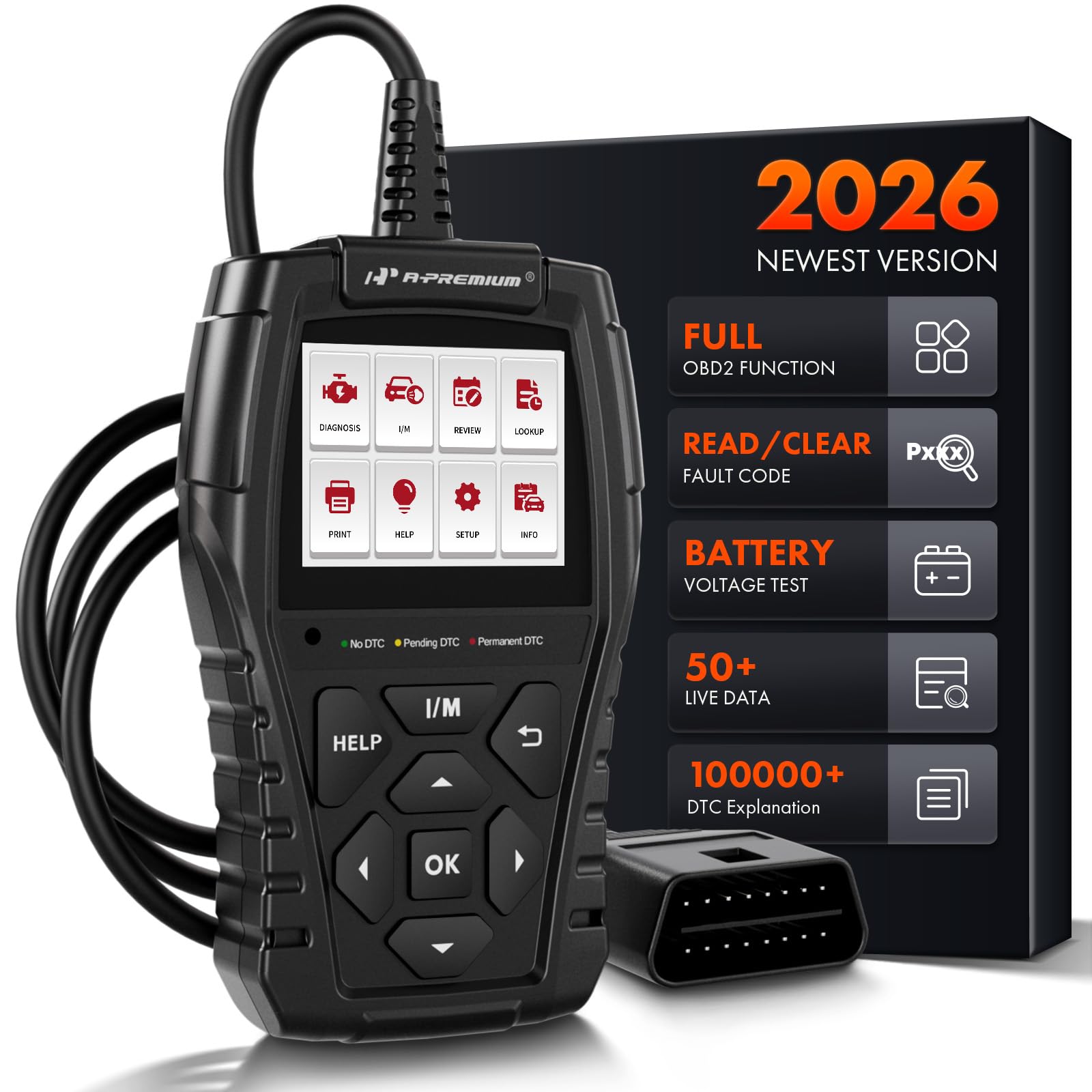
The A-Premium AD200 steps beyond basic code reading by offering deep data stream access across 50 parameters — battery voltage, coolant temperature, engine RPM, calculated load value, air flow rate, oil temperature, fuel rail pressure, and transmission gear status among them. This level of detail is more commonly associated with tools at a higher tier, making the AD200 a strong option for the owner who wants to monitor engine behavior over time or diagnose performance issues that do not trigger a fault code. The 2.4-inch 262K true color display shows live data as real-time visual curves, making abnormal fluctuations easy to spot.
Owner reports confirm that the AD200 works across a wide range of vehicles, including a Mercedes AMG, with clear diagnostics and accurate results. The advanced ARM CPU delivers processing speeds roughly three times faster than entry-level scanners, reducing wait time during scans. The 3.9-foot cable provides ample reach for positioning the reader comfortably, and the rugged plastic shell holds up to accidental drops. The three-color warning light system — green for healthy, yellow for minor issues, red for serious faults — gives an immediate visual read on vehicle condition without having to interpret code numbers.
The one-click vehicle information retrieval function pulls the VIN, CID, and CVN automatically, saving time during diagnostics. The I/M readiness hotkey provides instant access to emissions monitor status, and the tool supports generating and printing diagnostic reports that can be shared with a technician. Some owners note that the instructions are minimal, but the button layout is intuitive enough to figure out quickly. The A-Premium AD200 does not support ABS, SRS, or TPMS diagnostics, but its extensive data streaming and fast processing make it a compelling choice for data-focused DIYers.
What works
- Reads 50 live data parameters with curve graphing
- Three-color warning light for instant fault severity
- Fast ARM processor with one-click VIN retrieval
What doesn’t
- Minimal printed instructions
- No ABS, SRS, or TPMS diagnostics
Hardware & Specs Guide
Display Technology and Resolution
The display is the primary interface between you and the diagnostic data. Budget readers like the ANCEL AD310 use monochrome LCD panels with 128×64 resolution — sufficient for reading code numbers and short text, but limited for graphing or detailed data views. Mid-range and premium models — the MOTOPOWER MP69033 Pro, VDIAGTOOL VD30 Pro, and TOPDON AL400 — employ TFT color displays at 320×240 or 240×320 resolution, which render live data curves, DTC definitions, and menu navigation with much greater clarity. The A-Premium AD200 uses a 262K true color 2.4-inch panel at 160×128 resolution, which is adequate for color-coded fault indicators but noticeably less sharp than the 320×240 panels. Color screens also improve readability in bright sunlight and dark garages alike, reducing eye strain during extended diagnostic sessions.
Processing Power and Scan Speed
The processor inside a code reader determines how quickly it communicates with the vehicle’s ECU and displays results. Entry-level readers typically use basic microcontrollers that prioritize low cost over speed, resulting in scan times of several seconds for a full system check. The MOTOPOWER MP69033 Pro and A-Premium AD200 both advertise upgraded chips — the MP69033 Pro claims six times the speed of standard readers, while the AD200’s ARM CPU is rated at three times faster than entry-level alternatives. The VDIAGTOOL VD30 Pro and TOPDON AL400 use Linux and ARM-based operating systems respectively, which provide stable multitasking for features like live data graphing while simultaneously running DTC lookups. Faster processors are particularly noticeable when reading live data streams or performing I/M readiness tests, where lag can make parameter monitoring frustrating.
FAQ
Will a basic code reader work on any car?
Can I clear check engine codes with a basic reader?
What is the difference between a code reader and a scan tool?
Do I need internet or an app to use a basic code reader?
Final Thoughts: The Verdict
For most buyers, the best basic code reader winner is the VDIAGTOOL VD30 Pro because it packs professional-grade diagnostic depth — ten OBD2 tests, live data graphing, and a 98,000-code DTC library — at a price that undercuts traditional scan tools. If you prioritize battery and alternator health monitoring, grab the MOTOPOWER MP69033 Pro for its integrated electrical system tests and fast scanning. And for straightforward, proven code reading with no learning curve, nothing beats the ANCEL AD310 — a best-seller for good reason.

Certification: BSc in Mechanical Engineering
Education: Mechanical engineer
Lives In: 539 W Commerce St, Dallas, TX 75208, USA
Md Amir is an auto mechanic student and writer with over half a decade of experience in the automotive field. He has worked with top automotive brands such as Lexus, Quantum, and also owns two automotive blogs autocarneed.com and taxiwiz.com.