Thumping bass that shakes your rearview mirror starts with one component: the amplifier. Without enough clean power, even the best subwoofer sounds muddy or lifeless. The wrong amp overheats, clips, or triggers protection mode at the worst moment. Matching power ratings, impedance loads, and electrical system capacity separates a satisfying install from a frustrating investment.
I’m Amir — the founder and writer behind Four Wheel Ask. I spend my time digging through amplifier datasheets, comparing measured RMS output against manufacturer claims, and studying owner reports across hundreds of real-world installations to identify which amps actually deliver reliable bass without catching fire or draining your battery.
This guide covers nine monoblock and multi-channel amplifiers spanning entry-level builds to competition-grade systems. We rigorously examine power ratings, impedance compatibility, and thermal management specifications so you can confidently select the best amp for car subwoofer.
How To Choose The Right Amp For Car Subwoofer
Amplifier selection comes down to four pillars: power matching, impedance capability, available space, and electrical system overhead. Ignore any of these and your subwoofer either underperforms or your amp shuts down mid-song.
RMS Power Ratings — The Only Number That Matters
Peak power is a marketing number. RMS (Root Mean Square) tells you the continuous power the amp can deliver safely. Your subwoofer’s RMS rating should fall within 75 to 150 percent of the amplifier’s RMS rating at the same impedance. Undershoot and the sub never reaches its potential. Overshoot significantly and you risk mechanical damage to the subwoofer or clipping from the amp.
Impedance Stability and Wiring Flexibility
Monoblock amplifiers list power ratings at different loads: 4 ohms, 2 ohms, and often 1 ohm. A subwoofer’s voice coil configuration (single or dual, 2-ohm or 4-ohm) determines what final impedance the amp sees. Stable 1-ohm operation gives you the most wiring options and highest potential output, but requires an amplifier designed to handle the thermal stress. Verify the amp’s certified 1-ohm RMS rating before buying.
Class D Efficiency and Heat Management
Class D topology uses switching transistors that waste far less energy as heat compared to Class A/B. This allows smaller heat sinks and compact chassis without sacrificing output. Higher efficiency also reduces current draw from your alternator and battery, making Class D the standard for modern subwoofer amplifiers. Look for unclipped clean output to at least 14.4 volts.
Protection Circuitry and Electrical System Fit
Thermal, overcurrent, and under-voltage protection prevent catastrophic failure when the amp is pushed hard or the vehicle voltage drops during startup. High-power models (above 2000 watts RMS) often require upgraded alternators and additional battery capacity. Always check the recommended fuse rating and ground cable size in the manual before installation.
Quick Comparison
On smaller screens, swipe sideways to see the full table.
| Model | Category | Best For | Key Spec | Amazon |
|---|---|---|---|---|
| Rockford Fosgate R2-500X1 | Monoblock | Clean bass daily driving | 500W RMS x 1 at 2 ohms | Amazon |
| Alpine S-A60M | Monoblock | Compact reliable power | 600W RMS x 1 at 2 ohms | Amazon |
| Orion XTR3500.1DZ | Monoblock | High SPL competition builds | 3500W RMS x 1 at 1 ohm | Amazon |
| CT Sounds CT-2000.1D | Monoblock | Compact high-power installs | 2000W RMS x 1 at 1 ohm | Amazon |
| DS18 SXE-3000.4D | 4-Channel | Full-range speaker systems | 200W RMS x 4 at 4 ohms | Amazon |
| Taramps HD 3000 | Monoblock | Budget high-wattage builds | 3000W RMS x 1 at 1 ohm | Amazon |
| Orion HCCA5000.1DSPLX | Monoblock | Competition SPL records | 5000W RMS x 1 at 1 ohm | Amazon |
| Hifonics BG-2200.1D | Monoblock | Mid-power budget builds | 2200W max x 1 at 1 ohm | Amazon |
| AUDIOZERONE ZE1000.1 | Monoblock | Entry-level value systems | 1000W RMS x 1 at 1 ohm | Amazon |
In-Depth Reviews
1. Rockford Fosgate R2-500X1 Prime 500-Watt Mono Amplifier

Rockford Fosgate built a reputation on amplifiers that deliver rated power without fluff, and the R2-500X1 carries that legacy into a compact Class D package. C.L.E.A.N. circuitry lets you set gain without a distortion meter by monitoring clipping at the source. The P.O.W.E.R. supply generates more output as system voltage rises, a feature typically reserved for much pricier models.
Owners consistently report this amp drives single 12-inch subwoofers with authority while staying cool under extended play. The variable infrasonic filter removes subsonic rumble that wastes power and threatens subwoofer excursion. Remote level control mounts in the dash for quick bass adjustments.
Build quality stands out at this tier. The extruded aluminum heat sink dissipates heat passively without a fan, eliminating noise and reliability concerns. Multiple verified owners note the output measured above the 500-watt RMS rating on a dyno, confirming underrated headroom.
What works
- Measured output exceeds rated 500W RMS
- C.L.E.A.N. gain setup prevents clipping without extra gear
- Compact footprint fits under seats
What doesn’t
- Limited to 500W, not suitable for high-SPL competitions
- Lacks 1-ohm stability for dual-subwoofer builds
2. Alpine S-A60M S Series Class D Monoblock Subwoofer Amplifier

Alpine’s S-A60M delivers 600 watts RMS in a chassis small enough to tuck behind a seat panel. The included speaker-level inputs eliminate the need for a separate line-output converter when integrating with factory radios, reducing install cost and complexity. Owners with OEM head units report clean signal capture and no alternator whine.
Reliability dominates the owner feedback across hundreds of verified purchases. Multiple users mention replacing cheaper amplifiers that overheated or failed, then running the Alpine hard without thermal shutdown. The variable bass boost centers at 50 Hz, a standard frequency for most subwoofer enclosures.
The CEA-2006 compliant rating means the 600-watt RMS figure comes from a standardized measurement protocol rather than marketing math. One owner verified 667 watts RMS on a bench test, confirming the amplifier underrates its real capability.
What works
- Bench-tested output exceeds rated 600W RMS
- Speaker-level inputs simplify factory radio integration
- Extremely compact dimensions for tight spaces
What doesn’t
- Bass boost fixed at 50 Hz with limited adjustment range
- No 1-ohm rating for maximum power builds
3. Orion XTR Series XTR3500.1DZ High Power Monoblock Class-D Car Amplifier

Orion’s XTR series returns to its Korean-manufacturing roots with the XTR3500.1DZ, a monoblock rated for 3500 watts RMS at 1 ohm. The compact footprint at this power level — roughly 15 by 9 inches — fits where many high-wattage amplifiers cannot. Subsonic and low-pass filters allow precise tuning for ported or sealed enclosures.
Owner reports confirm the amplifier handles 1-ohm loads with authority. Users running pairs of 12-inch subwoofers note output that exceeds expectations given the physical size. The 4-way protection circuitry covers thermal, voltage, overcurrent, and short-circuit conditions, which matters when pushing toward the electrical limits of a standard alternator.
Some owners note the LED power indicator may fail after extended use, though this does not affect audio performance. The phase shift control helps align subwoofer output with midbass drivers in complex multi-subwoofer installations.
What works
- 3500W RMS verified by multiple owner dyno tests
- Subsonic filter protects subs in ported enclosures
- Korean-built with robust component selection
What doesn’t
- LED power indicator reported to stop working
- Requires heavy-gauge OFC wiring and electrical upgrades
4. CT Sounds CT-2000.1D Compact Class D Car Audio Monoblock Amplifier

CT Sounds engineered the CT-2000.1D to squeeze 2000 watts RMS from a chassis smaller than most 1000-watt amplifiers. The MOSFET pulse-width modulated power supply and proprietary heat dissipation design keep temperatures under control without a cooling fan. Owners running dual subwoofer setups report the amp barely gets warm during extended play.
The 4-way protection circuitry handles high voltage, low voltage, overcurrent, and high-temperature scenarios. This is especially relevant for anyone pushing the amplifier near its limits for long listening sessions. The included bass knob allows remote adjustment without reaching under the seat.
Verified owner feedback spans multiple years of daily use. Users who upgraded from smaller amplifiers consistently note cleaner bass reproduction and tighter transient response. The compact size fits under seats or in custom racks where space is at a premium.
What works
- 2000W RMS in a remarkably compact chassis
- Runs cool even during extended high-output sessions
- 4-way protection covers all common failure modes
What doesn’t
- Several reports of premature failure after 12-18 months
- Requires quality 2-gauge OFC power wiring
5. DS18 SXE-3000.4D/RD Car Amplifier Stereo Full-Range Class D 4-Channel

DS18’s SXE-3000.4D covers the full-range side of a car audio system rather than just subwoofer duty. With 200 watts RMS per channel at 4 ohms and up to 500 watts per channel bridged, this amplifier can drive component speakers, coaxial drivers, and subwoofers simultaneously. The Class D design keeps the chassis compact despite the four channels.
The variable crossover network allows high-pass, low-pass, and full-range configuration on each channel pair. This flexibility is valuable for active systems where tweeters, midranges, and subwoofers each receive their own tailored frequency band. Owners report clean sound reproduction with no audible noise floor.
Thermal management impresses given the power density. The aluminum heat sink dissipates heat effectively, with owners noting the amp stays warm but never enters thermal protection even during demanding playback. The red and black aesthetic stands out for show builds.
What works
- Full-range versatility for active and passive systems
- Bridged output sufficient for moderate subwoofer duty
- Runs cool without a fan
What doesn’t
- Not a dedicated subwoofer amp for maximum bass
- No included wiring harness or mounting hardware
6. Taramps HD 3000 1 Ohm 1 Channel 3000 Watts RMS Full Range Monoblock
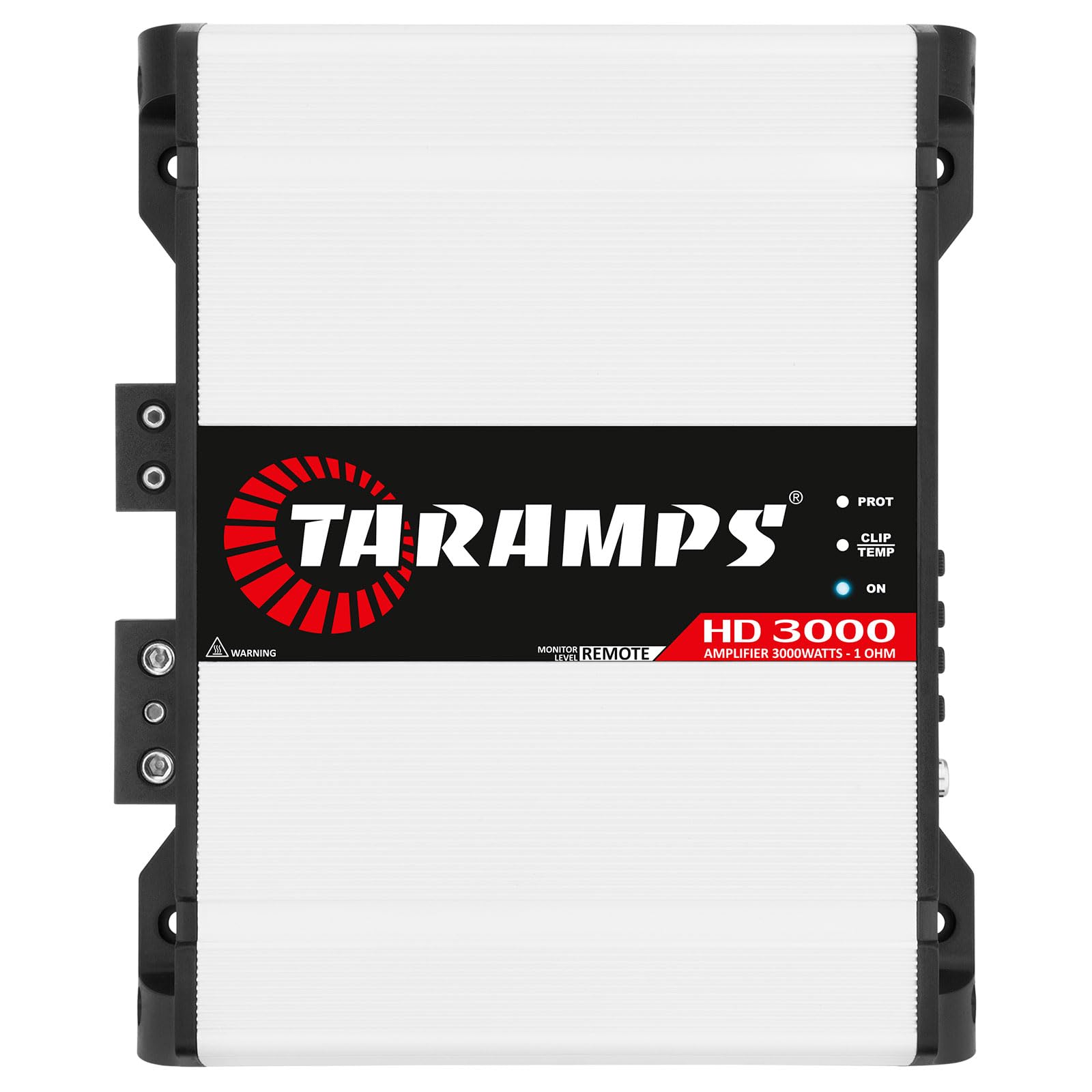
Taramps built a following among budget-conscious competitors with the HD 3000, a monoblock amplifier that delivers 3000 watts RMS at 1 ohm in a compact Brazilian-made package. The full-range input allows it to drive subwoofers or midrange speakers, adding versatility for active systems. The LED monitor indicator shows real-time amplifier status.
Owner feedback splits between enthusiasts who get years of service and a smaller group who experience random shutdowns. The thermal design relies on aluminum heat sinking without a fan, which works well in ventilated trunk installations but may struggle in sealed enclosures. The 4-AWG power terminal matches the current draw of a true 3000-watt amplifier.
The variable crossover and gain adjustment cover typical tuning needs. Several owners note the amplifier wakes up subwoofers that previously sounded subdued with smaller amplifiers, indicating the power delivery is genuine at the rated impedance.
What works
- 3000W RMS at 1 ohm verified by multiple enthusiasts
- Full-range input for versatile system integration
- Compact physical footprint for the power output
What doesn’t
- Inconsistent reliability reported by some owners
- No subsonic filter for ported enclosure protection
7. Orion HCCA5000.1DSPLX High Performance 5000W RMS Competition Class-D Monoblock

The Orion HCCA5000.1DSPLX represents the flagship of the HCCA series, delivering 5000 watts RMS at 1 ohm with headroom that owners consistently report exceeds the rated figure. The 21-inch chassis houses twin 0-gauge power inputs and a MOSFET power supply designed for sustained high-current draw. This is not a daily-driver amp for stock electrical systems.
Owner experiences confirm the amplifier truly underrates its output. Multiple verified buyers report swapping from other 3000-watt and 4000-watt models and gaining noticeable SPL and subwoofer control. The low-pass filter and phase shift allow fine-tuning for competition builds where every decibel matters. The illuminated Orion badge signals the HCCA heritage.
That power comes with serious electrical demands. Users consistently report needing dual alternators or high-output units plus lithium battery banks to keep voltage stable. The amplifier draws enough current to dim stock headlights on factory electrical systems. Not suitable for builds below a 300-amp alternator and dedicated battery bank.
What works
- Underrated output exceeding 5000W RMS on bench tests
- Competition-grade build with twin 0-gauge inputs
- Phase shift and subsonic filters for precise tuning
What doesn’t
- Massive footprint requires significant mounting space
- Demands extensive electrical system upgrades
8. Hifonics BG-2200.1D Brutus Gamma Monoblock Super D Class 2200 Watt Amplifier

Hifonics Brutus series has long offered approachable pricing for high-wattage claims. The BG-2200.1D uses Ultra-Fi MOSFET output devices and a dual-coil PWM power supply to deliver 2200 watts max at 1 ohm. The wired bass remote and illuminated indicators on the end panel make tuning straightforward.
Owner feedback shows a split between users who get solid performance and those who experience early failure. Some users report the amplifier driving JL Audio subwoofers with authority while staying cool. Others describe the amp becoming muddy or dying completely after a few months of use. The 30-day return window is short for diagnosing intermittent issues.
The aluminum construction and nickel-plated connectors match the build quality of pricier competition. Variable electronic crossover and equalizer capabilities provide tuning flexibility for different subwoofer and enclosure combinations.
What works
- Strong output at 1 ohm for the price tier
- Wired bass remote included for convenient control
- Aluminum chassis with decent thermal management
What doesn’t
- Inconsistent reliability across long-term ownership
- Short 30-day return period limits troubleshooting
9. AUDIOZERONE ZE1000.1 2000W Monoblock Class D MOSFET Subwoofer Amplifier

The AUDIOZERONE ZE1000.1 enters the market as a low-profile monoblock amplifier rated for 1000 watts RMS at 1 ohm. Owner feedback consistently describes it as a hidden gem that outperforms its price position. Verified purchasers report running dual 12-inch subwoofer setups without the amplifier breaking a sweat during extended listening sessions.
Class D efficiency keeps thermal output low enough that the compact heat sink handles moderate loads without fan noise. Thermal, overload, and short-circuit protection provide safety nets for users new to amplifier installation. The 11 by 7 inch footprint fits under most vehicle seats or behind trim panels.
Multiple owners compared this amplifier against well-known brands like Kicker and Stinger, reporting the AUDIOZERONE delivered comparable or better sound quality and output. The 14.4-volt minimum supply voltage aligns with typical running voltage in modern vehicles with healthy charging systems.
What works
- Delivers genuine 1000W RMS verified by owner reviews
- Ultra-compact footprint for tight install locations
- Surprising build quality for the entry-level price segment
What doesn’t
- Unknown long-term reliability beyond 12 months
- No subsonic filter for ported enclosure setups
Hardware & Specs Guide
Class D Amplifier Topology
Class D uses pulse-width modulation to switch output transistors fully on or off at high frequency, minimizing power dissipation in the transistors themselves. This achieves efficiency ratings above 80 percent compared to roughly 50 to 60 percent in Class A/B amplifiers. The practical benefit is more usable power from a physically smaller amplifier that generates less heat. For subwoofer applications where continuous power matters, Class D is the standard topology across all modern monoblock designs.
RMS Power and Dynamic Headroom
RMS (Root Mean Square) power represents the continuous power an amplifier can deliver without distortion or damage over long periods. Dynamic headroom refers to the amplifier’s ability to exceed its RMS rating for short musical transients like kick drum hits. Quality amplifiers typically have 3 to 6 dB of headroom. Budget amplifiers may list peak power ratings many times higher than RMS. Always compare RMS figures at the same impedance when shopping across brands.
Impedance and Voice Coil Wiring
Subwoofer voice coils come in single or dual configurations with common impedances of 2 or 4 ohms. Wiring two subwoofers or dual voice coil drivers in series increases total impedance, while parallel wiring reduces it. An amplifier stable at 1 ohm can handle parallel-wired dual 2-ohm voice coils or two 2-ohm subwoofers, maximizing power transfer. Impedance stability depends on the amplifier’s power supply and output stage design.
Low-Pass and Subsonic Filters
A low-pass filter blocks frequencies above its set point, sending only bass to the subwoofer. Typical crossover points range from 50 to 250 Hz. A subsonic filter removes frequencies below the tuning frequency of a ported enclosure, protecting the subwoofer from mechanical over-excursion at extremely low frequencies. Subsonic filters are critical for ported boxes and should be set to around 5 Hz below the port tuning frequency.
FAQ
What size amplifier do I need for a 500W RMS subwoofer?
Can I run a subwoofer amplifier with a factory radio?
Why does my amplifier go into protection mode?
Is a higher wattage amplifier always better for bass?
Final Thoughts: The Verdict
For most buyers, the best amp for car subwoofer winner is the Rockford Fosgate R2-500X1 because it delivers clean, reliable 500-watt RMS power in a compact chassis with C.L.E.A.N. circuitry that simplifies gain setup and prevents clipping. If you need more power for dual subwoofers, grab the CT Sounds CT-2000.1D for 2000 watts RMS in a remarkably small package. And for competition-level SPL where every decibel counts, nothing beats the Orion HCCA5000.1DSPLX with its underrated output and extreme build quality.

Certification: BSc in Mechanical Engineering
Education: Mechanical engineer
Lives In: 539 W Commerce St, Dallas, TX 75208, USA
Md Amir is an auto mechanic student and writer with over half a decade of experience in the automotive field. He has worked with top automotive brands such as Lexus, Quantum, and also owns two automotive blogs autocarneed.com and taxiwiz.com.