Choosing the right automotive paint is the difference between a finish that turns heads and one that flakes, fades, or requires a respray within a year. The sheer variety of formulations — from single-stage enamels to catalyzed 2K urethanes and ceramic coatings — makes it easy to pick wrong for your specific project.
I’m Amir — the founder and writer behind Four Wheel Ask. My approach to reviewing automotive paint centers on analyzing chemical formulations, reading hundreds of verified owner reports, and comparing long-term durability data across every price tier.
After reviewing owner feedback and specs, I created this guide to help you find the best automotive paint that delivers professional results for projects.
How To Choose The Best Automotive Paint
Selecting the right paint for your vehicle or equipment requires understanding how formulation type, finish characteristics, and application method interact. Below are the three most important factors to weigh before making a purchase.
Understand Paint Formulations: 1K vs 2K vs Ceramic
Single-stage (1K) paints like enamel dry by solvent evaporation and remain somewhat softer, making them suitable for farm equipment and budget restorations where extreme gloss is not the priority. Two-stage (2K) paints contain a separate hardener that chemically cross-links during curing, producing a much harder, more chemical-resistant film that holds gloss longer. Ceramic coatings bond at the molecular level to create a semi-permanent sacrificial layer that excels at scratch and UV resistance but requires pristine paint underneath to lock in.
Finish Types and Their Real-World Tradeoffs
High-gloss finishes provide maximum depth and reflectivity but reveal every surface imperfection, demanding meticulous prep work. Matte and satin finishes hide minor defects better and are popular for custom builds and off-road applications, though they require specific clear coat formulations to avoid burnishing or becoming shiny in wear areas. Understanding your tolerance for prep work is just as important as the final look.
Application Methods and Equipment Compatibility
Aerosol cans offer convenience for small touch-ups and DIY users but struggle to lay down the consistent film thickness needed for large panels without orange peel. HVLP spray guns provide professional atomization control and are essential for full-panel resprays, though they require a compressor with adequate CFM output. Disposable cup systems like 3M PPS 2.0 reduce cleanup time and material waste, making them a smart upgrade for anyone spraying multiple coats.
Quick Comparison
On smaller screens, swipe sideways to see the full table.
| Model | Category | Best For | Key Spec | Amazon |
|---|---|---|---|---|
| ERA Paints 2K Clear Coat | Clear Coat | High-Gloss DIY Finishes | 2K Activated Formula | Amazon |
| Eastwood 2K Clear Coat | Clear Coat | Professional Shine | 48hr Pot Life | Amazon |
| Gtechniq Crystal Serum Light | Ceramic Coating | Long-Term Paint Protection | 5 Year Durability | Amazon |
| Moshify SprayMax 2K Clear | Clear Coat | DIY Touch-Up and Repair | Trigger Handle Included | Amazon |
| SprayMax 2K Matte Clear Coat | Clear Coat | Matte Finish Detailing | Chemical Resistant | Amazon |
| NADAMOO Wheel Spray Paint | Wheel Paint | Rim Recolor and Protection | 4 Can Pack | Amazon |
| 3M PPS 2.0 Spray Cup Refill | Spray System | Cleanup Efficiency | 200-Micron Filter | Amazon |
| ENDOZER HVLP Spray Gun Set | Spray Gun | Budget-Friendly Spraying | 3 Nozzle Sizes | Amazon |
| Rust-Oleum Farm & Implement Enamel | Enamel Paint | Farm and Industrial Equipment | Rust Preventive | Amazon |
| Speedokote SMR-870 Reducer | Reducer | Urethane Paint Thinning | 1 Gallon | Amazon |
| DeVilbiss Auto Painting Kit | Spray System | Full-Spectrum Coating Application | 2 Gun System | Amazon |
In‑Depth Reviews
1. ERA Paints 2K High Gloss Clear Coat
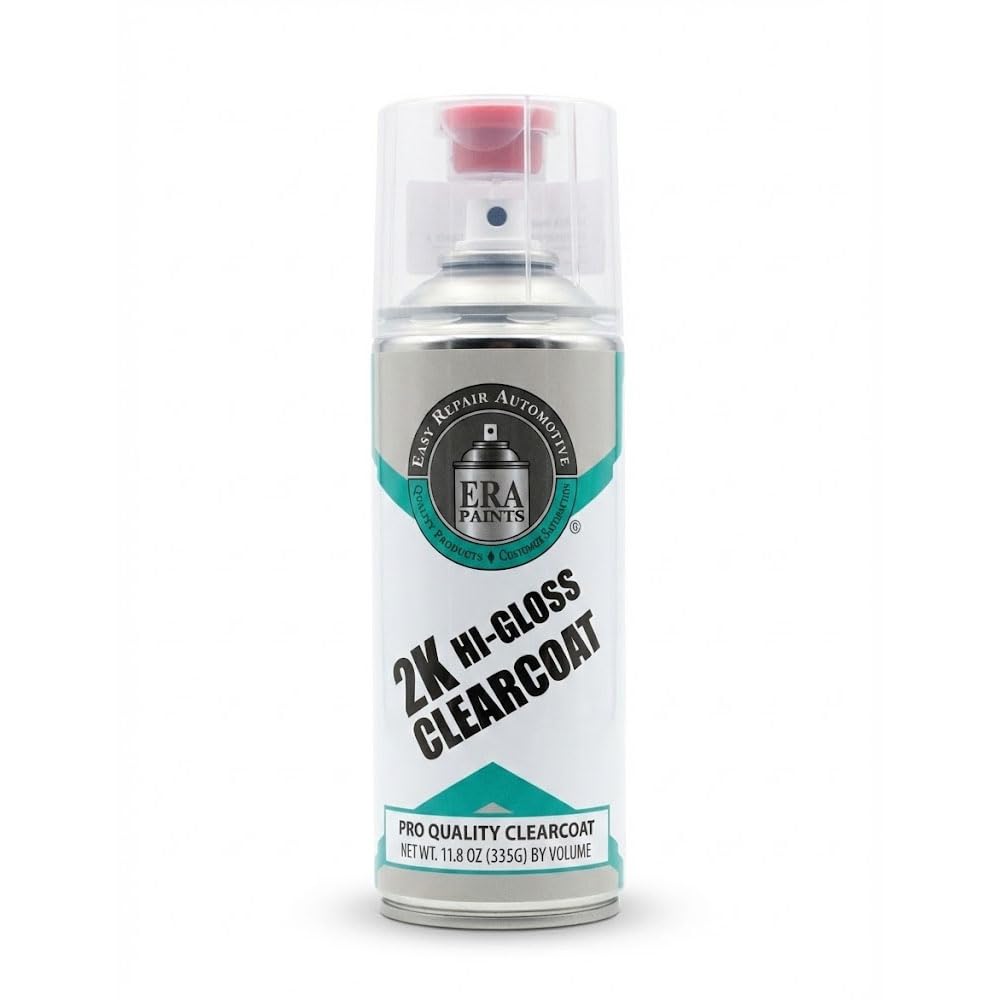
The ERA Paints 2K high gloss clear coat uses a built-in hardener that chemically cross-links during curing, producing a finish that significantly outperforms single-stage aerosols in hardness and chemical resistance. The fan nozzle delivers a wide, even pattern that minimizes runs, making it accessible for DIY users who lack spray booth experience. Multiple owner reports confirm that three light-to-moderate coats applied with proper flash times produce a showroom-quality gloss that requires no wet sanding or buffing to look excellent.
What sets this formula apart is the UV and weather resistance package, which resists yellowing and fading even under prolonged sun exposure. Users who previously relied on 1K clear coats noted a dramatic improvement in film hardness — the ERA clear holds up to car washes and minor abrasion without hazing. The 48-hour pot life after activation allows for flexible scheduling, and the can consistently atomizes without sputtering across the entire usable window.
The main consideration is that achieving the deepest possible gloss still demands disciplined layering: light first coats followed by slightly heavier wet coats with 30-minute flash times. Some owners reported that rushing between coats or spraying in high humidity reduced the final clarity slightly. That said, for a cost well below what a body shop charges for a single panel, this clear coat delivers results that are difficult to distinguish from professional spray gun work.
What works
- Showroom-level gloss without buffing required
- Excellent chemical and UV resistance for long-term durability
- Forgiving fan nozzle reduces drips and orange peel
What doesn’t
- Requires strict adherence to flash times for best results
- Single can may not be enough for a full car panel
2. Eastwood 2K Clear Coat

Eastwood’s 2K aerosol clear coat is engineered for users who need a professionally hard, high-gloss finish without investing in spray gun equipment. The two-part chemistry activates via an internal button, delivering a urethane-grade film that cures to a rock-hard surface in roughly 12 hours at room temperature or faster with infrared drying. Owner feedback from classic car restorations — including a 1960s Ford that looked new after a couple of coats — confirms the depth and clarity rival shop-applied clear coats.
Field reports spanning over a year in harsh Texas sun indicate no yellowing or delamination, a clear advantage over 1K clear coats that tend to degrade under continuous UV exposure. The spray pattern is consistent and allows for 1.2-mil build per pass, making it easy to achieve the recommended film thickness without excessive material waste. Users who previously tried lower-cost aerosols noted that Eastwood’s formulation self-levels noticeably better, reducing the amount of wet sanding needed to eliminate orange peel.
The trade-off is that this is a true isocyanate-containing product, requiring a proper respirator and well-ventilated application area — some owners experienced respiratory irritation even with garage doors open. Additionally, the 48-hour pot life means you must plan your project to avoid wasting activated material. For anyone serious about achieving a factory-level clear coat at home, Eastwood remains a benchmark that budget aerosols cannot replicate.
What works
- Hard, UV-stable finish that resists yellowing
- Excellent self-leveling reduces sanding effort
- Fast cure with IR drying option
What doesn’t
- Requires proper respirator and ventilation due to isocyanates
- 48-hour pot life limits scheduling flexibility
3. Gtechniq Crystal Serum Light Ceramic Coating

Gtechniq Crystal Serum Light represents a fundamentally different approach to paint protection — instead of forming a thick sacrificial layer, this ceramic coating chemically bonds with the clear coat to create a semi-permanent barrier that lasts up to five years. The 50ml bottle, according to owner reports, covers an entire SUV including paint, jambs, wheels, and side glass with careful application. The wipe-on, wipe-off process is straightforward, but the surface preparation window is critical: any contamination trapped under the coating becomes semi-permanent once cured.
The gloss enhancement from Crystal Serum Light is immediately noticeable, producing a deep, wet-look reflection that surpasses conventional waxes and sealants. Owners consistently report that water beading remains aggressive for years, and the coating resists swirl marks from routine washing far better than unprotected clear coat. The hydrophobic effect also makes cleaning significantly easier — dirt and bug residue release with less effort and fewer chemicals.
The main limitation is that this product does not repair or hide existing paint defects; it locks in whatever condition the paint is in at application. Paint correction — compounding and polishing — is a prerequisite for optimal results, adding time and expense to the project. Additionally, the bottle seal design has drawn criticism for allowing the product to harden after opening if not stored properly. For owners willing to invest in proper prep, Crystal Serum Light delivers the longest-lasting protection available in a consumer-applied format.
What works
- Exceptional 5-year durability with proper maintenance
- Superior hydrophobicity and chemical resistance
- Easy wipe-on, wipe-off application
What doesn’t
- Requires thorough paint correction before application
- Bottle seal design can lead to product hardening after opening
4. Moshify SprayMax 2K Clear Coat

Moshify packages the well-regarded SprayMax 2K clear coat formulation with a bundled spray can trigger that improves control and reduces finger fatigue during longer application sessions. The 2K chemistry activates via an internal plunger and delivers a hard, high-gloss finish that owner reports describe as spraying like an air gun and hardening like stone. Users have successfully repaired peeling clear coat on modern vehicles — including a 2020 Camaro and a Maserati GranTurismo — with results that blend seamlessly into the original factory finish.
The 48-hour pot life gives adequate time to apply multiple coats, and users who stored the can in a refrigerator reported extending usability beyond the standard window. The scratch and chemical resistance of the cured film is a clear step above 1K aerosols; owners noted that the finish held up to regular car washes and minor abrasion without hazing. The included trigger handle rotates with the nozzle, allowing for comfortable spraying at various angles without wrist strain.
The bundled handle attachment has received mixed feedback — some users reported paint drips from the handle shortly after starting to spray, recommending that it be discarded in favor of finger pressure on the nozzle. Additionally, achieving a flawless finish requires careful attention to technique: spraying at the wrong angle produces orange peel that requires wet sanding and buffing to correct. For budget-conscious DIYers who want professional-grade clear coat results, this kit delivers excellent value provided the handle limitation is accepted.
What works
- Professional-grade 2K hardness and gloss
- Trigger handle reduces finger fatigue during extended use
- Excellent scratch and chemical resistance
What doesn’t
- Spray handle attachment can drip paint during use
- Requires careful technique to avoid orange peel
5. SprayMax 2K Matte Clear Coat
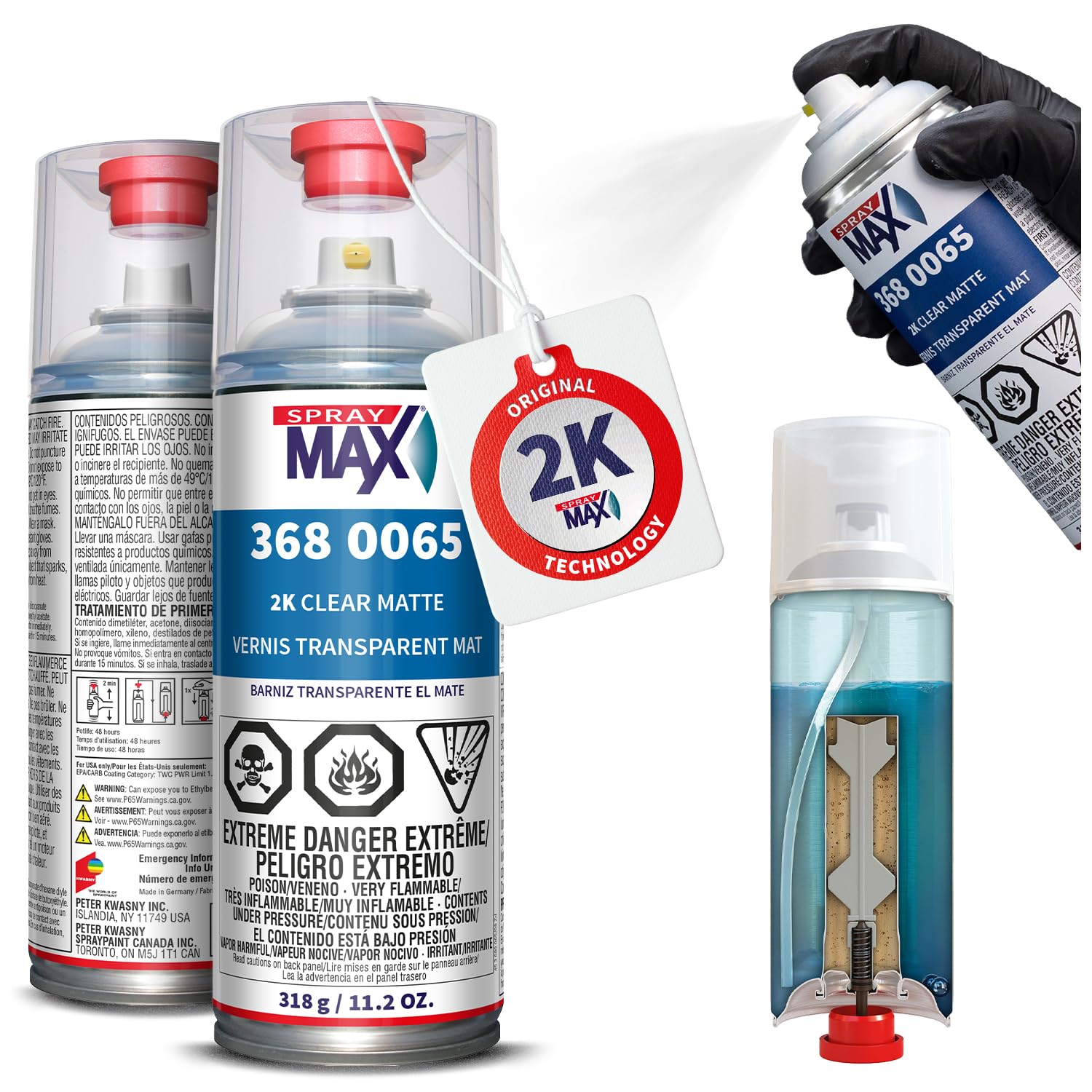
SprayMax 2K Matte Clear Coat solves a persistent problem in automotive refinishing: how to apply a durable, low-gloss protective layer that does not burnish or develop shiny spots over time. This two-part aerosol delivers a consistent flat sheen that works over virtually any base paint type, from factory finishes to custom hydrographic dipping. Owner feedback from hydrographic applicators confirms that it transforms matte-dipped parts into a tough, chemical-resistant surface that withstands handling without marking.
The formulation maintains its matte character across a wide temperature range, and the extended pot life — reported by users to approach three weeks when stored in a refrigerator — provides unmatched flexibility for multi-day projects. The self-leveling behavior is forgiving of amateur application technique, which matters for matte finishes where sanding and polishing to fix mistakes is not an option. Users reported excellent adhesion on primed surfaces and over existing factory clear coats with minimal prep beyond degreasing.
The primary challenge is that matte clear coats are less forgiving of contamination than their gloss counterparts — any dust, oil, or silicone on the surface becomes visibly highlighted in the final finish. Owners emphasize thorough degreasing and a dust-free environment as non-negotiable steps. Additionally, the lack of published application temperature and timing guidelines means users must develop their own technique through trial and error. For anyone building a custom matte project, SprayMax 2K Matte Clear Coat is the most reliable aerosol option available.
What works
- Consistent flat sheen that resists burnishing
- Extended pot life when refrigerated
- Excellent chemical and weather resistance
What doesn’t
- Highly sensitive to surface contamination
- Lacks detailed application temperature guidelines
6. NADAMOO Aluminium Wheel Spray Paint
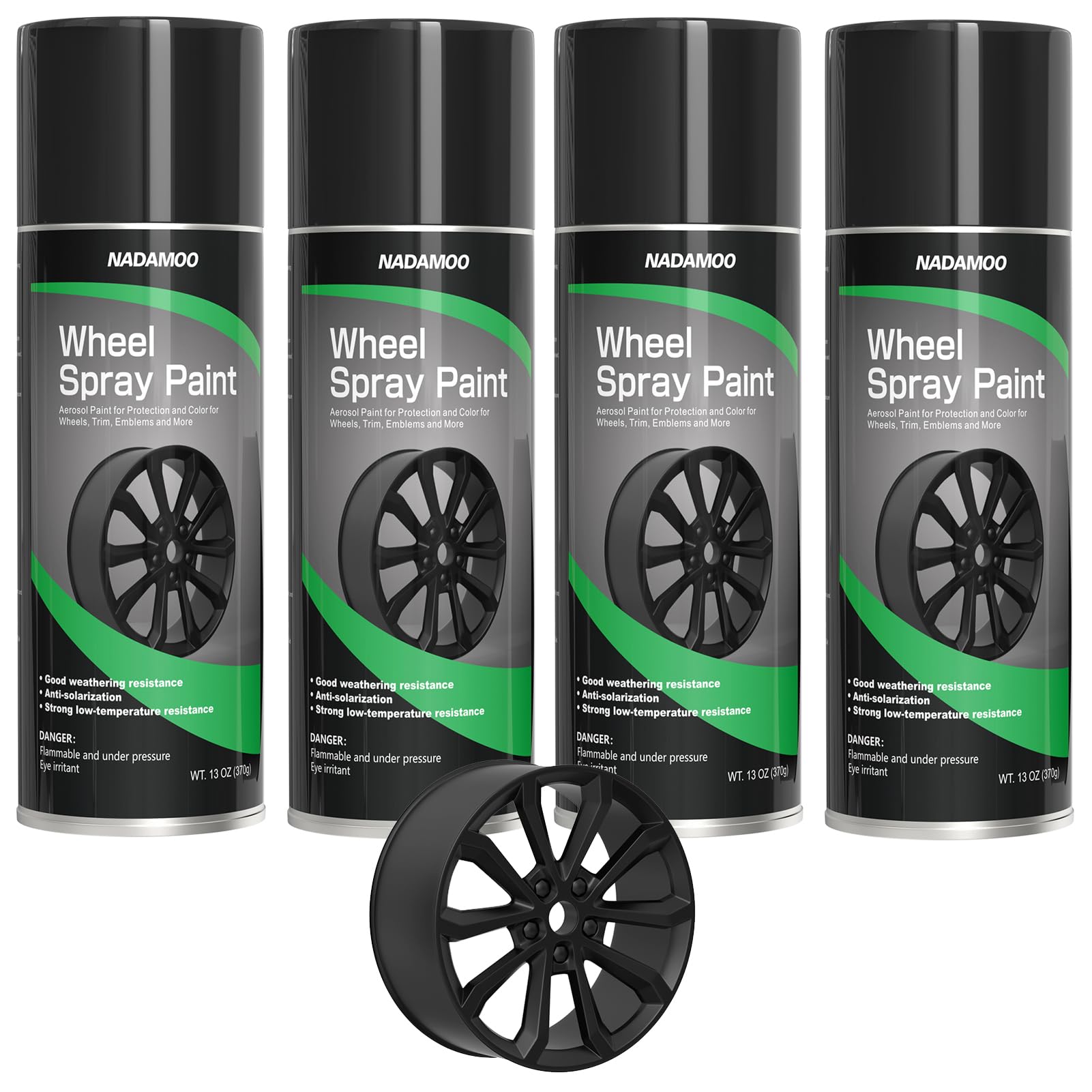
NADAMOO wheel rim spray paint is a modified acrylic formulation specifically engineered for aluminum and steel wheels, with enough flexibility to handle the thermal expansion and road debris impact that wheel finishes endure. The four-can pack provides sufficient material to coat a full set of wheels with multiple coats, and the matte black finish delivers a modern, aggressive look that hides brake dust effectively. Owners report that the paint applies thickly and evenly, with a forgiving nature that resists runs even when applied more heavily than ideal.
The weather resistance package has proven itself across harsh conditions — one owner reported the finish survived an entire Wisconsin winter including road salt exposure without peeling or significant fading. The fast-drying characteristic allows recoating within 30 minutes, making it possible to complete a full wheel set in a single afternoon. The nozzle design delivers a consistent fan pattern without splatter, and the paint bonds well to properly prepared surfaces after thorough degreasing and scuffing.
The main caveat is that surface preparation accounts for roughly 75% of the effort required for a lasting result — wheels must be completely free of grease, old wax, and loose rust before painting begins. The paint also has a strong odor during application, requiring adequate ventilation and respiratory protection. Some owners noted that achieving a truly uniform matte finish requires four thin coats rather than fewer heavy ones, which consumes more material per wheel than the advertised coverage suggests.
What works
- Excellent adhesion and durability on aluminum and steel wheels
- Forgiving application that resists runs
- Good weather and salt resistance
What doesn’t
- Strong odor requires ventilation and mask
- Thorough surface prep is labor-intensive but essential
7. 3M PPS 2.0 Paint Spray Gun System Refill Kit

The 3M PPS 2.0 system transforms the paint spraying workflow by integrating measuring, mixing, filtering, and spraying into a single disposable cup assembly. Each lid incorporates a quarter-turn locking collar that eliminates cross-threading and a built-in 200-micron filter that captures contaminants before they reach the spray gun nozzle. Owner reports consistently highlight that switching to PPS cups reduces cleanup time by roughly half and cuts solvent usage by up to 70% compared to traditional metal cup systems.
The domed lid design holds up to 3 ounces of material below the filter, reducing paint sputter and improving spray consistency, especially during angled spraying. Users painting entire vehicles reported that the ability to pause between coats — by removing air from the liner, capping with a sealing plug, and clearing the gun — allows overnight breaks without wasting mixed material. The clear plastic liner with printed mixing ratios eliminates the guesswork of measuring reducer and hardener ratios.
The primary drawback is the recurring cost of refill kits; while the efficiency gains justify the expense for regular users, casual DIYers may find the per-project cost higher than cleaning a traditional cup. Additionally, the system requires a compatible hard plastic outer cup (sold separately) to function, adding to the initial investment. For anyone spraying more than a few panels per year, the time savings and material efficiency of the PPS 2.0 system quickly recoup the upfront cost.
What works
- Dramatically reduces cleanup time and solvent use
- Integrated filter prevents nozzle clogs
- Allows pausing between coats without wasting material
What doesn’t
- Recurring refill cost adds up for infrequent users
- Requires separate hard plastic outer cup purchase
8. ENDOZER Professional HVLP Spray Gun Set

The ENDOZER HVLP spray gun set provides a complete spraying solution at a fraction of the cost of professional brands, including three stainless steel nozzle sets (1.4mm, 1.7mm, and 2.0mm) to cover everything from thin basecoats to thick primers. The brass air hood with 15 holes delivers uniform atomization that owner reports describe as producing professional-quality results when paired with properly reduced paint. The set includes a 600ml gravity feed cup, air pressure gauge, quick adapters, and a paint filter — everything needed to start spraying immediately.
Users have successfully applied automotive paint, primer, and clear coat with this gun, noting that the spray pattern adjustability allows fine control over fan width and fluid output. The gun performed well for a full trailer repaint and multiple automotive panel projects, with owners reporting that results were indistinguishable from more expensive equipment when paint was properly thinned. The stainless steel needles and nozzles resist the corrosive effects of solvent-based paints better than budget guns with plated components.
The main complaints center on documentation and quality control: the included instructions are unhelpful, and some units experienced the tip loosening during use or the air pressure gauge malfunctioning after limited use. The gun also requires a compressor with adequate CFM output, and thick primers need significant reduction (reportedly around 7:1) to spray effectively. Cleaning requires extra attention with small brushes not included in the set. For budget-constrained DIYers who are willing to dial in their technique, this set delivers remarkable capability at a minimal price.
What works
- Excellent value with three nozzle sizes included
- Good atomization quality for the price point
- Complete accessory set for immediate use
What doesn’t
- Poor documentation and unhelpful instructions
- Quality control issues with gauge and tip retention
9. Rust-Oleum Farm & Implement Enamel Paint

Rust-Oleum Farm & Implement Enamel is a single-stage alkyd enamel formulated for durability on equipment that lives outdoors year-round. The quart-sized twin pack provides generous coverage at a cost that makes it practical for large projects like tractors, trailers, lawn mowers, and metal storage tanks. Owner reports confirm that it adheres well to metal surfaces with minimal prep — cleaning and light scuffing suffice — and dries to a hard, glossy finish that resists chipping and weather exposure for five years or more.
The paint levels smoothly when applied by brush, roller, or spray gun, with a thick consistency that helps prevent drips on vertical surfaces. Users who sprayed it through HVLP equipment after thinning reported good flow and coverage, with the gloss white color matching OEM farm equipment finishes accurately. The rust-preventive formula provides a protective barrier that stands up to outdoor storage, road salt exposure on UTV decks, and the occasional scrape from farming operations.
The trade-off is that this is a conventional enamel, not a catalyzed urethane — the finish remains workable for hours after application and never reaches the same hardness as 2K paints. Owners noted that while it is durable for farm use, it does not achieve the depth or scratch resistance of automotive-grade clear-coated finishes. Cleanup requires mineral spirits, and the oil-based formula has a strong solvent smell during application. For its intended use on heavy equipment and implements, however, this enamel offers unbeatable durability per dollar.
What works
- Excellent adhesion and coverage on metal surfaces
- Long-lasting outdoor durability with minimal prep
- Smooth leveling reduces brush and roller marks
What doesn’t
- Softer than 2K urethane paints, less scratch resistant
- Oil-based formula requires mineral spirits for cleanup
10. Speedokote SMR-870 Universal Urethane Grade Reducer

Speedokote SMR-870 is a universal medium-temperature urethane grade reducer designed for use with a wide range of primers, basecoats, clear coats, and even farm store paints. The gallon size provides ample material for multiple painting sessions, and the 65-80°F temperature range covers the conditions most DIY painters work in. Professional painters who tested it reported that it matches the performance of expensive brand-name reducers when used at the correct ratio, laying down smoothly and drying as advertised without fisheyes or blushing.
The reducer is compatible with metal, plastic, and fiberglass surfaces, making it a versatile addition to any workshop. Owners noted that it works equally well with urethane primers, single-stage paints, and 2K clear coats, simplifying inventory by replacing multiple specialized reducers. The fast-drying characteristic allows for reasonable recoat times without rushing, and the finish remains durable and long-lasting when properly mixed.
The primary limitation is that this is a VOC-compliant formulation, and customers in California, Delaware, or Maryland will receive a 0-VOC alternative (SMR-0075) that may behave differently in terms of flow and drying time. Some users found that the reducer requires precise measurement to achieve optimal spray viscosity — guessing the ratio leads to runs or dry spray. For anyone who already uses Speedokote paints or wants a cost-effective reducer that does not compromise on performance, SMR-870 is a solid choice.
What works
- Compatible with a broad range of urethane paints and primers
- Matches expensive brand reducers in performance
- Good drying characteristics at medium temperatures
What doesn’t
- VOC-restricted states receive a different 0-VOC formula
- Requires precise measurement for best results
11. DeVilbiss 802343 Auto Painting/Priming Kit

The DeVilbiss 802343 kit provides a two-gun system that covers the full spectrum of automotive coatings: one gun optimized for sealing and priming, and a second for basecoat, clear coat, and topcoat application. As a brand with decades of professional finishing heritage, DeVilbiss delivers atomization quality in this kit that owner reports describe as producing professional results from a garage setup. DIY users who tackled full resprays on classic cars like a 1970 Barracuda reported that the guns sprayed high-build 2K primer and subsequent base/clear layers with excellent pattern control.
The gravity feed design provides efficient paint transfer with minimal material waste, and the HVLP (High Volume, Low Pressure) configuration meets regulatory requirements while delivering consistent particle size. Users noted that the gun bodies are durable and the cup foundation does not collapse or twist during use — a common complaint with cheaper kits. The ability to switch between primer and topcoat guns without cleaning in between streamlines the workflow for multi-stage paint jobs.
Some owners reported that thinner paints can leak around the needle when the trigger is depressed, though this is correctable with fine adjustment of the guide nut and application of Vaseline to the needle entry points. The included regulator is of lower quality than the guns themselves, with several users recommending replacement with a higher-grade unit. PPS adapter compatibility should be verified before purchase, as Amazon’s recommendations have been inconsistent. For the DIY enthusiast taking on complete vehicle resprays, this kit offers a clear step up in quality from budget all-in-one sets without reaching professional spray booth pricing.
What works
- Excellent atomization quality for primer and topcoat
- Two-gun setup eliminates between-coat cleaning
- Durable construction from a trusted brand
What doesn’t
- Included regulator is low quality and should be upgraded
- Thinner paints may leak past the needle without adjustment
Hardware & Specs Guide
Understanding 2K Paint Systems
Two-component (2K) paints contain a resin base and a separate hardener (isocyanate) that must be mixed before application. Unlike 1K paints that dry solely by solvent evaporation, 2K finishes undergo a chemical cross-linking reaction that creates a much harder, more durable film. This chemistry provides superior resistance to solvents, UV degradation, and physical abrasion, which is why 2K clear coats are the standard in OEM and collision repair environments. The trade-off is a limited pot life after activation — typically 24 to 48 hours — and the requirement for proper respiratory protection due to isocyanate vapors. The spray pattern and atomization quality of a 2K aerosol depends heavily on the nozzle design; fan nozzles with 15 or more holes produce the most uniform distribution.
Spray Pattern and Atomization
The quality of a paint finish is directly tied to how evenly the material is atomized into fine droplets. HVLP spray guns operate at lower air pressure (typically 10 PSI at the cap) and higher volume, which reduces overspray and paint waste while producing a softer, more controllable pattern. The nozzle size determines the viscosity range the gun can handle: 1.3–1.4mm for thin basecoats and clear coats, 1.7–1.8mm for medium-bodied primers, and 2.0mm or larger for high-build primers and thicker materials. Aerosol cans rely on a fixed nozzle design, so achieving even coverage requires maintaining consistent distance (6–8 inches) and overlap (50%) between passes. The domed lid on modern disposable cup systems like 3M PPS 2.0 reduces sputter by holding material below the filter level, maintaining consistent flow even during angled spraying.
FAQ
What is the difference between 1K and 2K automotive paint?
Can I spray automotive paint without a compressor?
Does automotive paint require a clear coat?
Final Thoughts: The Verdict
For most buyers, the best automotive paint winner is the ERA Paints 2K High Gloss Clear Coat because it delivers professional-grade gloss and durability from an aerosol can at a mid-range price point that undercuts body shop labor costs. If you want the hardest, most UV-stable finish with the best self-leveling behavior, grab the Eastwood 2K Clear Coat. And for long-term paint protection that bonds at the molecular level and lasts years without reapplication, nothing beats the Gtechniq Crystal Serum Light.

Certification: BSc in Mechanical Engineering
Education: Mechanical engineer
Lives In: 539 W Commerce St, Dallas, TX 75208, USA
Md Amir is an auto mechanic student and writer with over half a decade of experience in the automotive field. He has worked with top automotive brands such as Lexus, Quantum, and also owns two automotive blogs autocarneed.com and taxiwiz.com.