Most drivers never think about their cabin air filter until a musty odor hits the vents or the A/C struggles to push air. By then, fine dust, pollen, road grime, and even mold spores have been recirculating through the HVAC system for months. For a 2018 model year vehicle, the original filter is long past its prime, and the difference a quality replacement makes is immediate and measurable.
I’m Amir — the founder and writer behind Four Wheel Ask. My work focuses on cross-referencing OEM specifications, real owner feedback, and material science data to identify which aftermarket filters deliver genuine performance improvements without the dealership markup.
Whether you drive a sedan, SUV, or truck, finding the best 2018 cabin air filter means balancing filtration quality, odor control, and long-term value for your specific vehicle.
How To Choose The Best 2018 Cabin Air Filter
A cabin air filter is a simple component with a critical job: trap contaminants before they enter the passenger compartment. For 2018 vehicles, the right filter reduces allergens, neutralizes odors, and protects the HVAC blower motor from debris buildup. Focus on media type, vehicle-specific fitment, and replacement interval to make the right call.
Media Types: Carbon, HEPA, or Standard
Standard pleated paper filters catch dust and pollen but do little for odors. Activated carbon filters add a layer of charcoal that adsorbs exhaust fumes, VOCs, and musty smells — a meaningful upgrade for urban drivers. HEPA-grade electrostatic media captures sub-micron particles including mold spores and fine particulate matter, making it the top choice for allergy sufferers. Some filters combine carbon with electrostatic layers for dual-action performance.
Fitment and Compatibility Are Non-Negotiable
A filter that is even slightly oversized or undersized will allow unfiltered air to bypass the media. Always verify your vehicle’s exact make, model, year, and engine configuration before purchasing. Cross-reference OEM part numbers (often printed on the original filter frame) with the replacement part to guarantee a proper seal. Many listings include a fitment checker tool — use it.
Replacement Interval and Signs of Wear
Manufacturers typically recommend replacement every 12 months or 12,000 miles, but heavy stop-and-go driving, dusty conditions, or frequent A/C use can shorten that window. Key signs include reduced airflow from the vents, persistent musty odors when the fan runs, foggy windows due to moisture recirculation, or visible debris on the filter face when inspected.
Quick Comparison
On smaller screens, swipe sideways to see the full table.
| Model | Category | Best For | Key Spec | Amazon |
|---|---|---|---|---|
| BOSCH 6029C HEPA | HEPA Cabin Filter | Allergen Relief | HEPA + Multi-Layer Media | Amazon |
| K&N VF2033 | Washable Cabin Filter | Long-Term Value | Lifetime Washable Design | Amazon |
| EPAuto CP211 | Activated Carbon | Audi/VW/Porsche/Bentley | Carbon + Soda Media | Amazon |
| ECOGARD XC10463C | Activated Carbon | VW / Audi Group | 99.5% Particle Removal | Amazon |
| Spearhead Odor Defense | Activated Carbon | GM Trucks and SUVs | 25% Longer Life | Amazon |
| EPAuto CP681 | Activated Carbon | Tesla Model 3 / Y | Pair Pack with Tools | Amazon |
| RICHWEI CF10285 | Activated Carbon | Toyota / Lexus | Wide Vehicle Fitment | Amazon |
| RICHWEI CF12150 | Activated Carbon | Ford Super Duty | Heavy-Duty Build | Amazon |
| ECOGARD XC36115H | Baking Soda | Subaru Models | Triple-Layer + Baking Soda | Amazon |
| RICHWEI CF11809 | Activated Carbon | GM / Cadillac Trucks | Sturdy Sealed Frame | Amazon |
| Forccord Combo Pack | Cabin + Engine | Honda Civic / CR-V | 2-Filter Value Pack | Amazon |
In‑Depth Reviews
1. BOSCH 6029C HEPA Cabin Air Filter

Bosch brings genuine HEPA-grade filtration to the cabin air filter category, using a melt-blown electrostatic layer paired with dense pleated media to capture sub-micron particles without relying on chemical odor neutralizers. The 6029C fits a broad range of Honda and Acura models including the Accord, Civic, CR-V, MDX, RDX, TLX, and Odyssey across multiple generations, making it a versatile pick for households with mixed fleets. Structural ribs along the frame add rigidity, preventing collapse during installation or under heavy airflow.
Owner reports consistently highlight noticeable improvements in air quality, particularly for drivers who navigate traffic-heavy routes or live in high-pollen regions. Multiple verified buyers on Honda CR-V and MDX platforms note that the filter traps fine dust and exhaust odors effectively, with several specifically calling out reduced allergy symptoms after swapping from a standard pleated filter. The initial fuel-like smell reported by a small number of users dissipates after airing the filter out for 30–60 minutes prior to installation.
At roughly the same price point as a basic carbon filter, the 6029C delivers HEPA-level performance without the airflow restriction typical of denser media. The 12-month or 12,000-mile replacement interval is standard, but owners in dusty or urban environments may want to inspect at 6 months. The white-and-blue media color codes the clean side, making visual inspections straightforward during routine maintenance.
What works
- Genuine HEPA-grade media captures allergens and fine particulates
- Reinforced structural ribs prevent frame flex during install
- Broad Honda/Acura platform compatibility across multiple model years
What doesn’t
- Minor initial odor reported by some users; requires pre-airing
- No activated carbon layer for odor adsorption
2. K&N VF2033 Lifetime Cabin Air Filter

K&N takes a fundamentally different approach with the VF2033: instead of a disposable pleated media, this cabin filter uses a washable polyurethane construction that is cleaned and re-oiled every 6 months for the life of the vehicle. The design philosophy prioritizes airflow — the open-media structure allows the HVAC system to move more air with less resistance, which can improve heating and cooling efficiency over time. The VF2033 is compatible with a wide range of 2009–2025 Acura and Honda models including MDX, RDX, TLX, Accord, Civic, CR-V, and the Fit.
Buyers who have made the switch consistently emphasize the long-term economics: the higher upfront investment is recouped after roughly three disposable filter changes, and the Lifetime Limited Warranty adds peace of mind. Multiple verified owners report that the filter installs in under five minutes with no tools, and the edge seal prevents air bypass, a common complaint with ill-fitting aftermarket disposable filters. The odor-control treatment built into the media helps resist the musty smell that develops on disposable filters after prolonged moisture exposure.
Owners should note that the VF2033 requires periodic cleaning with a dedicated recharge kit, which adds a small maintenance step not needed with disposable filters. The filter is pre-oiled and ready to install out of the box, and the oil layer is what traps fine particles rather than a dense physical barrier. For drivers who prefer set-and-forget maintenance or who live in extremely dusty environments, a disposable HEPA or carbon filter may be more practical.
What works
- Washable and reusable for the vehicle lifetime
- Lifetime Limited Warranty backs the investment
- Reduces landfill waste from disposable filters
What doesn’t
- Higher upfront cost requires multiple change cycles to break even
- Requires periodic cleaning and re-oiling for maintained performance
3. EPAuto CP211 Activated Carbon Cabin Air Filter
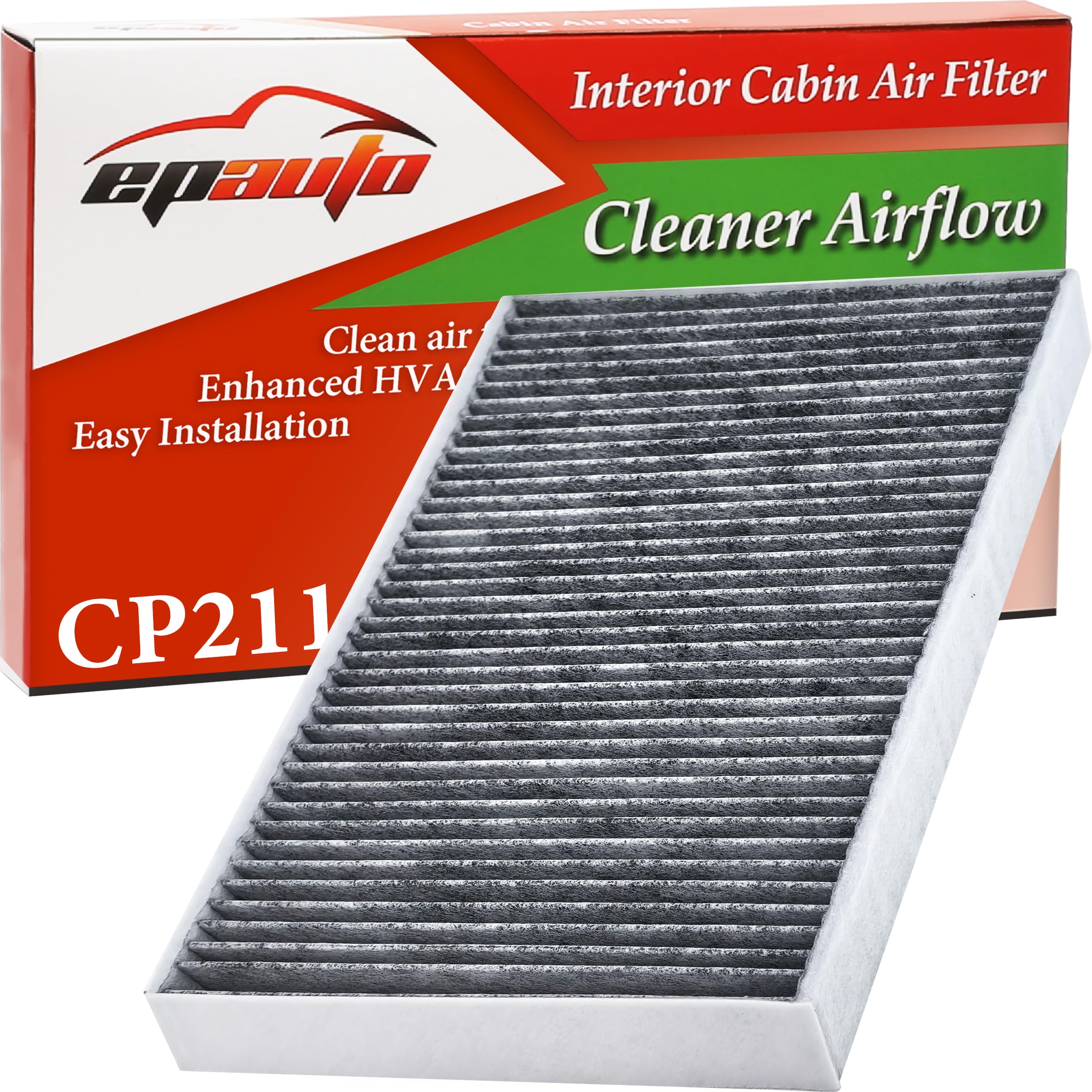
The EPAuto CP211 is engineered for the Volkswagen Group MLB platform, covering Audi Q5, Q7, Q8, A4, A5, e-tron models, plus the Porsche Cayenne and Bentley Bentayga. This is a niche filter with a specific audience: owners of premium German and British SUVs who want carbon-and-soda media odor control without paying the dealer part markup. The filter uses a soda-and-carbon blend that generates what EPAuto describes as a fresh breeze effect, actively neutralizing VOCs and exhaust fumes rather than just passively trapping them.
Owner feedback from Audi SQ5 and A4 owners is overwhelmingly positive, with multiple 5-star reports highlighting perfect fitment and an easy DIY swap that saves significant dealer labor costs. One verified buyer on a 2018 Audi SQ5 specifically notes that the filter bends into the curved compartment without issue — a known pain point with stiffer aftermarket filters. The carbon layer effectively absorbs the musty smell that develops in humid climates, and owners report immediate improvement in cabin air freshness after installation.
The CP211 covers model years 2017 through 2026 across multiple Audi, Porsche, and Bentley platforms, making it a viable long-term replacement for owners who plan to keep their vehicle. The recommended 12-month / 12,000-mile service interval is standard, and the filter dimensions match OEM specifications closely. Buyers should double-check the specific part compatibility list since some early 2017 models may use a different housing design.
What works
- Carbon-plus-soda media actively neutralizes VOCs and odors
- Exact OEM fitment for Audi Q5, Q7, A4, A5, Cayenne, Bentayga
- DIY swap saves substantial dealer markup on premium brands
What doesn’t
- Limited to VAG and Bentley platforms; not a universal fit
- Carbon odor adsorption degrades over 8–10 months in heavy use
4. ECOGARD XC10463C Premium Cabin Air Filter
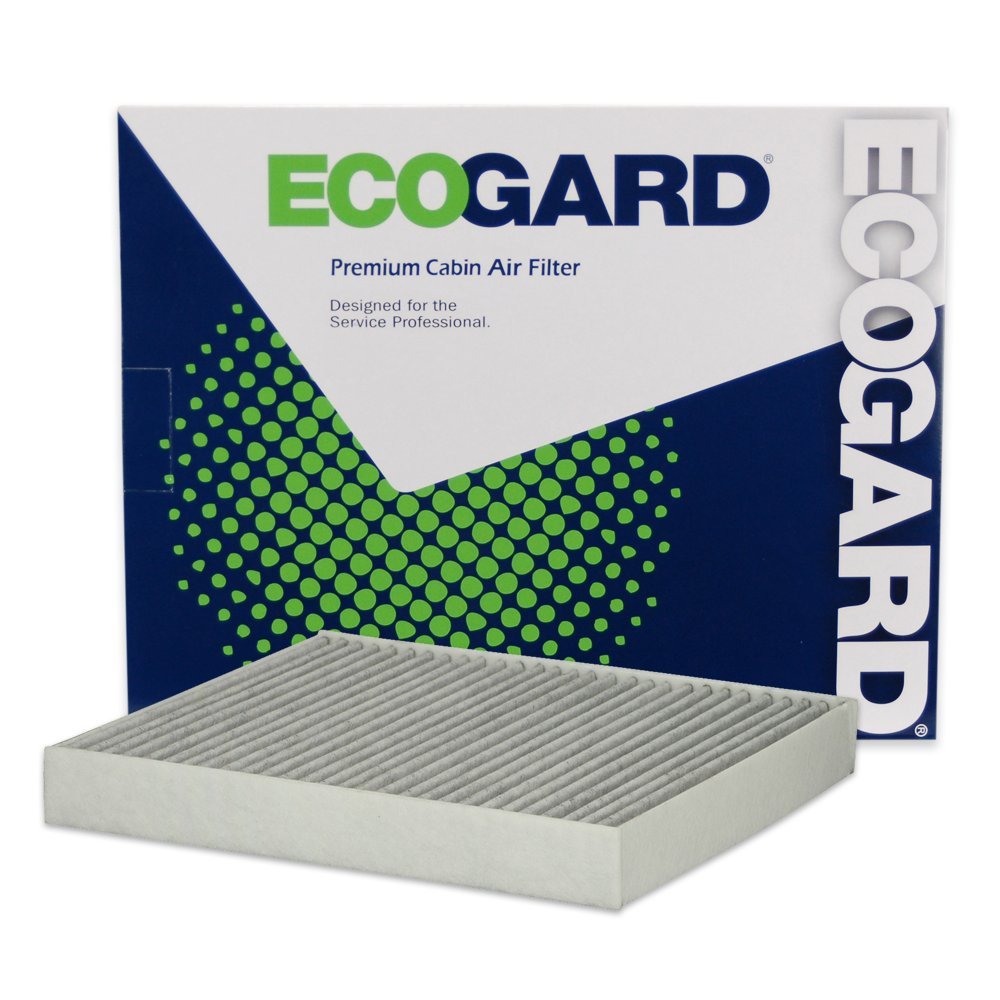
ECOGARD positions the XC10463C as a direct replacement for Volkswagen Group vehicles including the 2018–2024 Tiguan, 2019–2025 Jetta, 2022–2025 Taos, 2019–2025 Audi Q3, and the 2015–2025 GTI. The filter media is impregnated with activated carbon and is rated to remove 99.5 percent of airborne particles before they enter the cabin. This level of efficiency approaches what many drivers expect from a HEPA filter, but without the denser media that can restrict airflow and strain the blower motor.
Verified owners across multiple VW platforms — Atlas, Tiguan, Taos, and GTI — consistently report a perfect factory-grade fit that installs in roughly five minutes. The carbon layer does an effective job of neutralizing exhaust odors and the stale smell that accumulates in the HVAC system over time. Several buyers specifically note that the filter feels sturdier than the OEM unit it replaced, with better edge sealing that prevents air from bypassing the media.
The XC10463C replaces multiple OEM part numbers including 5Q0 129 668, 5Q0 819 653, and 5Q0 819 669, making it easy to cross-reference with the original filter. The filter construction uses pleated media with carbon impregnation, which provides good dust-holding capacity over the standard replacement interval. Owners in dusty or high-pollen regions should inspect at 6-month intervals, as the carbon layer can become saturated faster under heavy load.
What works
- 99.5 percent particle capture rating matches premium filters
- Factory-grade fit for VW Tiguan, Jetta, Taos, Atlas and Audi Q3
- Sturdy frame with effective edge seal against bypass
What doesn’t
- Not compatible with 2017–2018 Subaru Impreza (separate part number)
- Carbon saturation may accelerate in heavy urban driving conditions
5. Spearhead Odor Defense Breathe Easy Cabin Filter
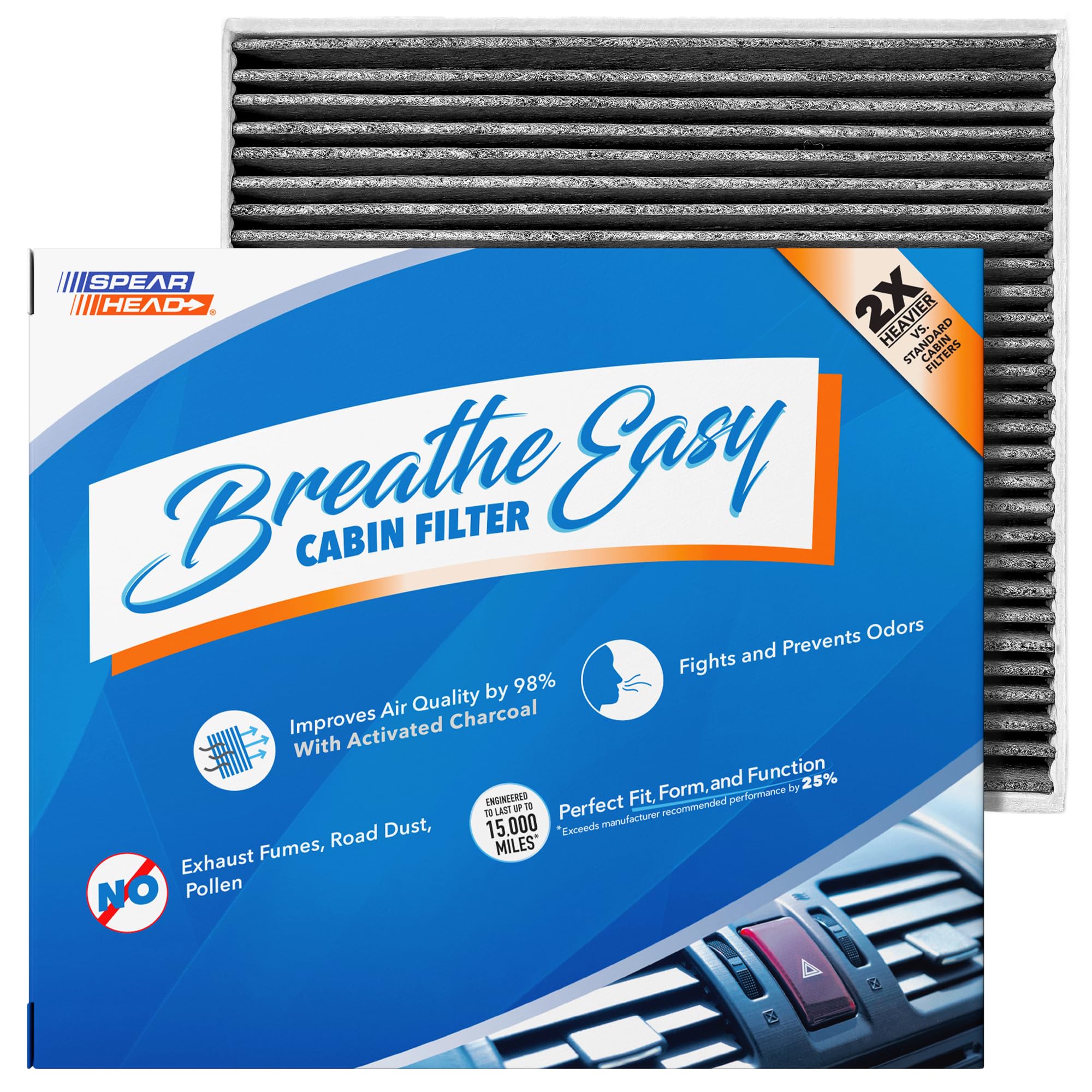
Spearhead targets the full-size GM SUV and truck segment with the Breathe Easy BE-809, covering the 2015–2020 Escalade, Tahoe, Suburban, Yukon, and the 2014–2019 Silverado and Sierra platforms. The filter uses coconut shell activated carbon — a renewable source material — and a dense electrostatic media that Spearhead claims to be twice as heavy as standard cabin filters. The 25 percent longer life claim is based on a 15,000-mile service interval versus the standard 12,000-mile recommendation.
Owner feedback from Silverado, Sierra, and Yukon owners is consistently positive, with multiple buyers noting that the filter significantly reduces the outside exhaust fumes and road dust that plague highway commuters. The thicker media does create a slightly tighter fit in the housing — several owners on Honda Civic and Odyssey platforms recommend careful alignment during installation. The included instruction manual is clear enough for first-time DIYers, and the filter reduces the musty A/C smell that develops after prolonged use.
The coconut shell carbon provides natural odor adsorption without the chemical treatment used in some competitor filters, which matters for owners sensitive to synthetic fragrances. The electrostatic layer attracts fine particles using static charge rather than relying solely on physical density, which helps maintain airflow even as the filter loads with debris. Owners should verify fitment using the vehicle selector tool before purchase, as the BE-809 covers a specific but extensive list of GM platforms.
What works
- Coconut shell activated carbon provides natural, chemical-free odor control
- Electrostatic media attracts fine particles without restricting airflow
- Extended 15,000-mile service interval reduces replacement frequency
What doesn’t
- Tighter fit requires careful alignment during installation
- Higher price point for the extended-life design
6. EPAuto CP681 Premium HVAC Cabin Air Filter
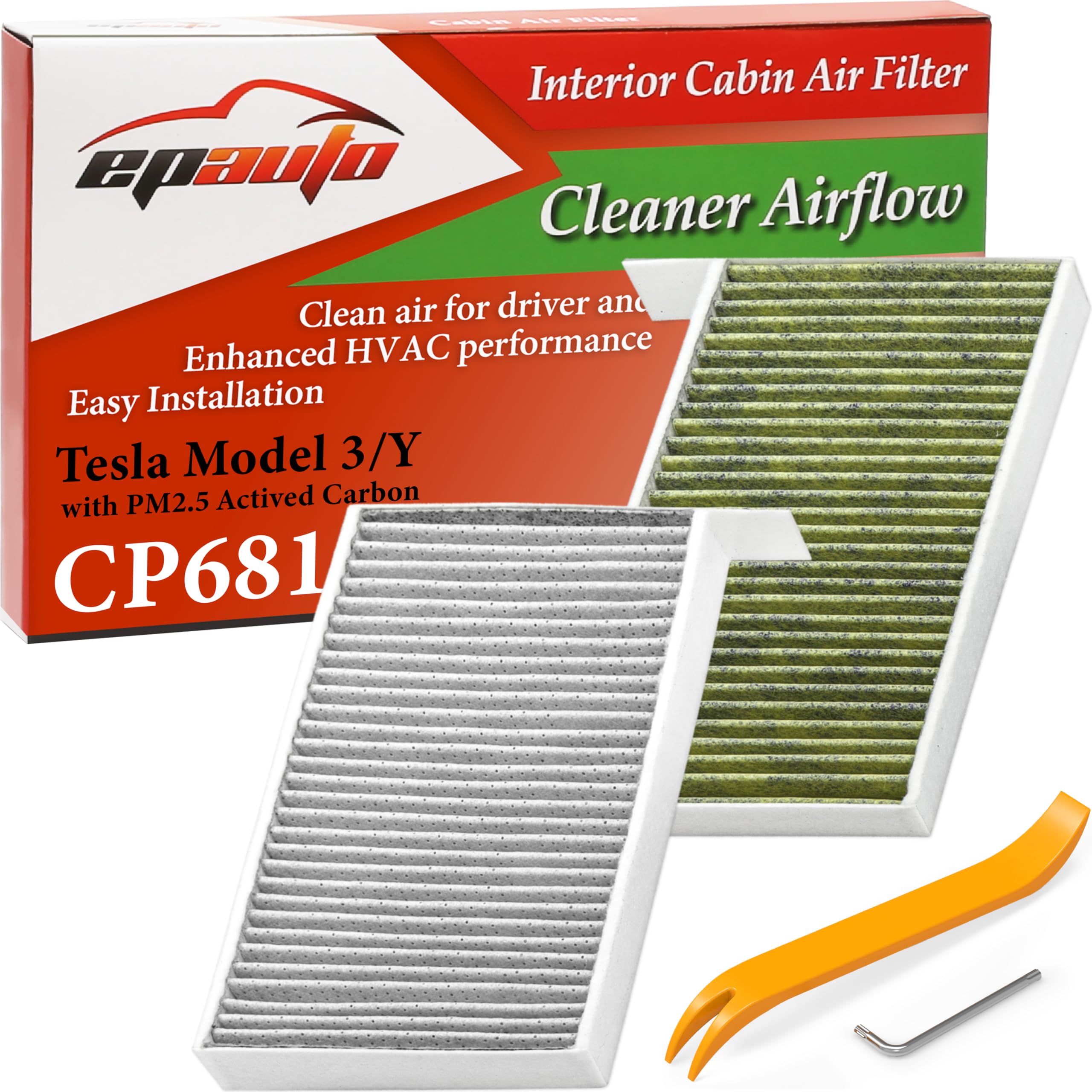
The EPAuto CP681 is purpose-built for the Tesla Model 3 (2017–2026) and Model Y (2020–2026), and it comes as a pair — both Model 3 and Model Y require two filters for full coverage. The filter uses a carbon-and-soda media blend similar to the CP211, targeting odor neutralization alongside particle filtration. EPAuto includes plastic trim tools and screwdrivers in the box, which is a thoughtful addition given the somewhat involved access procedure on older Model 3 units that require removing the center console panel.
Verified Tesla owners consistently rate the CP681 highly, with many noting that the filter costs less than half the price of the OEM or Mahle equivalent while delivering comparable performance. The carbon layer effectively controls the musty smell that Tesla HVAC systems are prone to develop, particularly in humid climates. Several long-term owners report that the odor-fighting capability holds up for 8–12 months before noticeable degradation, which aligns with the standard replacement cycle.
Buyers should confirm that the unit count of one actually refers to one pair — verified owners confirm that the listing includes two filters despite the ambiguous spec sheet. The included trim tools make the installation process smoother on older Model 3 vehicles where the plastic clips can be brittle. For Model Y owners, the procedure is more straightforward, requiring only the glove box drop and filter cover removal.
What works
- Includes two filters plus trim tools for complete installation
- Carbon-and-soda media effectively neutralizes Tesla HVAC odors
- Significant cost savings versus OEM and Mahle alternatives
What doesn’t
- Installation on older Model 3 requires panel removal and patience
- Odor adsorption degrades after 8–12 months of use
7. RICHWEI CF10285 Activated Carbon Cabin Air Filter

The RICHWEI CF10285 casts a very wide net, covering Toyota, Lexus, Scion, Subaru, Land Rover, Jaguar, and even Pontiac platforms with a single filter design. The part number cross-references to OEM numbers like 87139-02020, 87139-02090, and a long list of Toyota and Lexus equivalents. The filter uses a nonwoven activated carbon media designed to trap PM2.5 fine particulate matter, which is a meaningful differentiator for drivers in urban areas with elevated pollution levels.
Owner feedback from Toyota RAV4, 4Runner, Camry, and Highlander platforms is very positive, with multiple verified buyers noting that the filter feels sturdier and better constructed than the Fram or basic paper filters it replaces. The activated charcoal beads are visibly distributed across the media surface, and several owners report that the filter produces an immediately noticeable fresher cabin smell after installation. One owner on a 2013 RAV4 specifically calls out the build quality as comparable to premium home HEPA filters.
A small but consistent theme in reviews mentions a roughly 25 percent reduction in airflow at the highest fan setting when the filter is new, likely due to the dense carbon layer. This is a trade-off inherent in carbon-impregnated filters: better filtration and odor control come at the cost of slightly more resistance. For most drivers the difference is negligible at normal fan speeds, but those who rely on maximum A/C output in extreme heat should be aware.
What works
- Extremely broad vehicle compatibility across Toyota, Lexus, Subaru, and more
- Activated carbon beads provide effective odor and PM2.5 filtration
- Sturdier build quality compared to basic paper filters
What doesn’t
- Dense carbon media can reduce airflow at maximum fan speed
- Fitment must be carefully verified across the broad compatibility list
8. RICHWEI CF12150 Activated Carbon Cabin Air Filter

The CF12150 is built for Ford’s full-size truck and SUV lineup, including the 2015–2024 F-150, 2017–2024 Super Duty (F-250 through F-550), 2018–2024 Expedition, and the 2018–2024 Lincoln Navigator. This is a heavy-duty application where the cabin filter is exposed to more dust, dirt, and road grime than a typical passenger car, and the CF12150 uses a nonwoven activated carbon media that is visibly thicker than standard replacement filters. The part number cross-references to OEM numbers DR3Z19N619A, FP72, and FL3Z19N619A.
Ford and Lincoln owners consistently report that the filter fits the housing perfectly, with several noting that the carbon bead layer is visible on one side and effectively traps the musty smell that develops in the large SUV and truck cabins. Multiple verified buyers on F-150 and Super Duty platforms mention that the filter is noticeably better constructed than the OEM paper unit they removed, with a rigid frame that does not flex during installation. The carbon layer also helps control the diesel exhaust fumes that can enter the cabin in Super Duty trucks.
Owners should note that accessing the cabin filter on many Ford trucks requires removing the glove box, which adds about 10 minutes to the swap. The filter itself is straightforward once the housing is exposed. A small number of owners report a slight airflow reduction at the highest fan setting, consistent with the trade-off of carbon-impregnated media. The 12-month replacement cycle is appropriate for most driving conditions, but heavy-duty truck owners working in dusty environments should inspect at 6 months.
What works
- Heavy-duty build quality suited for truck and SUV environments
- Carbon bead layer effectively controls musty and diesel odors
- Precise OEM fitment for F-150, Super Duty, Expedition, Navigator
What doesn’t
- Installation requires glove box removal on most Ford platforms
- Carbon media can slightly reduce maximum fan airflow
9. ECOGARD XC36115H Premium Cabin Air Filter with Baking Soda

ECOGARD brings a unique approach to the Subaru platform with the XC36115H, which uses natural baking soda (sodium bicarbonate) integrated into a triple-layer media for odor neutralization rather than relying solely on activated carbon. The filter covers the 2009–2018 Subaru Forester, 2008–2016 Impreza, 2013–2015 XV Crosstrek, 2016–2017 Crosstrek, and the 2015–2021 WRX and WRX STI. Importantly, it does not fit the 2017–2018 Impreza — that model uses a different housing and requires ECOGARD XC10622 instead. The triple-layer construction removes more particles than a standard filter while maintaining better airflow than a dense HEPA design, which helps extend the life of the blower motor.
Subaru owners consistently praise the fresh, clean smell the filter produces when the A/C is running — the baking soda actively neutralizes odors rather than just trapping them. Multiple verified buyers on Forester, Impreza, and Crosstrek platforms note that the filter fits perfectly and installs in minutes with minimal packaging waste. One 2018 Forester owner specifically mentions that the old filter was heavily contaminated with debris and leaves, making the upgrade immediately noticeable in terms of air quality.
A small but notable quality concern appears in longer-term reviews: some owners report that the glue holding the pleats can fail over time, allowing the filter media to shift and create an air gap that bypasses filtration. This appears to affect a minority of units, but it is worth inspecting the filter when reinstalling after a cleaning or during regular maintenance. The baking soda odor neutralization is effective for roughly 6–8 months, after which a replacement is recommended for best results.
What works
- Natural baking soda neutralizes odors without chemical fragrances
- Triple-layer media captures more particles than standard filters
- Better airflow than HEPA filters reduces blower motor strain
What doesn’t
- Glue integrity on pleats has failed in some units over time
- Not compatible with 2017–2018 Subaru Impreza
10. RICHWEI CF11809 Activated Carbon Cabin Air Filter
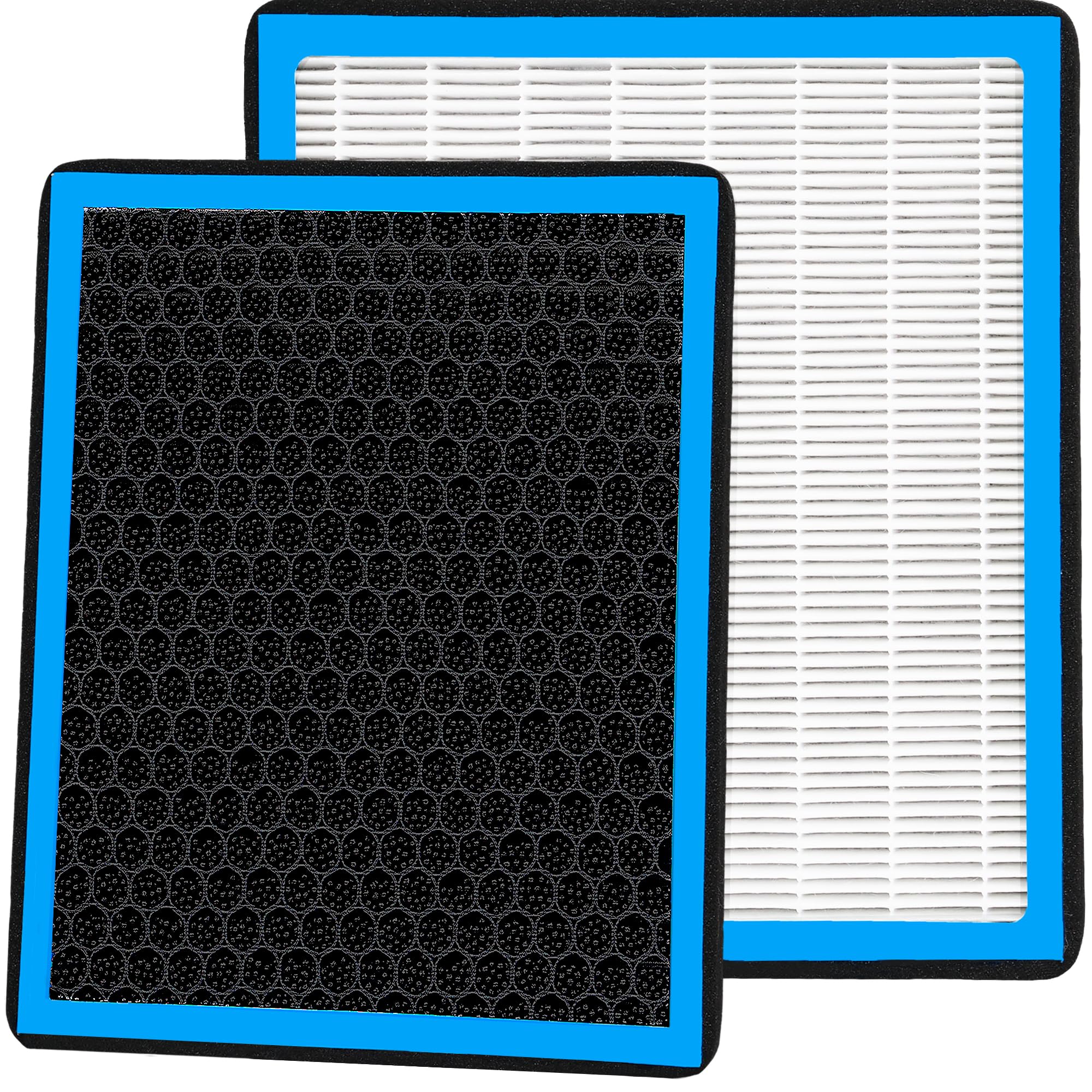
The CF11809 covers GM’s workhorse platforms: the 2014–2019 Silverado and Sierra HD lineup, 2015–2020 Suburban and Tahoe, 2014–2020 Yukon and Yukon XL, and the 2014–2020 Cadillac Escalade and ESV. This is the heavy-duty GM equivalent of the Ford CF12150, built with a nonwoven activated carbon media in a rigid cardboard frame that seals firmly against the filter housing. The part number replaces OEM 22808781, PC9958, C38173, and WP10129, among others.
GM truck and SUV owners report that the filter fits precisely, with the foam edge providing an effective seal that keeps unfiltered air from bypassing the media — an important feature for owners with allergies. Several verified buyers on Sierra 2500 HD and Silverado 3500 HD platforms note that the filter construction is visibly sturdier than the OEM unit, with the carbon pellets embedded in individual circular chambers that prevent dust migration. One owner mentions that a Dremel notch was needed on the plastic frame of a 2016 Sierra for a perfect fit, indicating slight variations in housing design across model years.
The filter lacks an airflow direction arrow on some units, which is a minor oversight that requires the installer to note the orientation of the original filter before removal. The installation on GM HD trucks can be more involved than on passenger cars — the glove box removal and wiring harness routing require careful attention, especially on Duramax diesel models. Despite these quirks, the filter delivers strong odor control and particle filtration at a reasonable cost.
What works
- Rigid cardboard frame with foam edge provides excellent sealing
- Carbon pellets in individual chambers prevent media shifting
- Covers extensive GM truck, SUV, and Cadillac platform range
What doesn’t
- No airflow direction arrow on some units
- Installation on HD trucks may require minor housing modifications
11. Forccord Cabin & Engine Air Filter Combo Pack
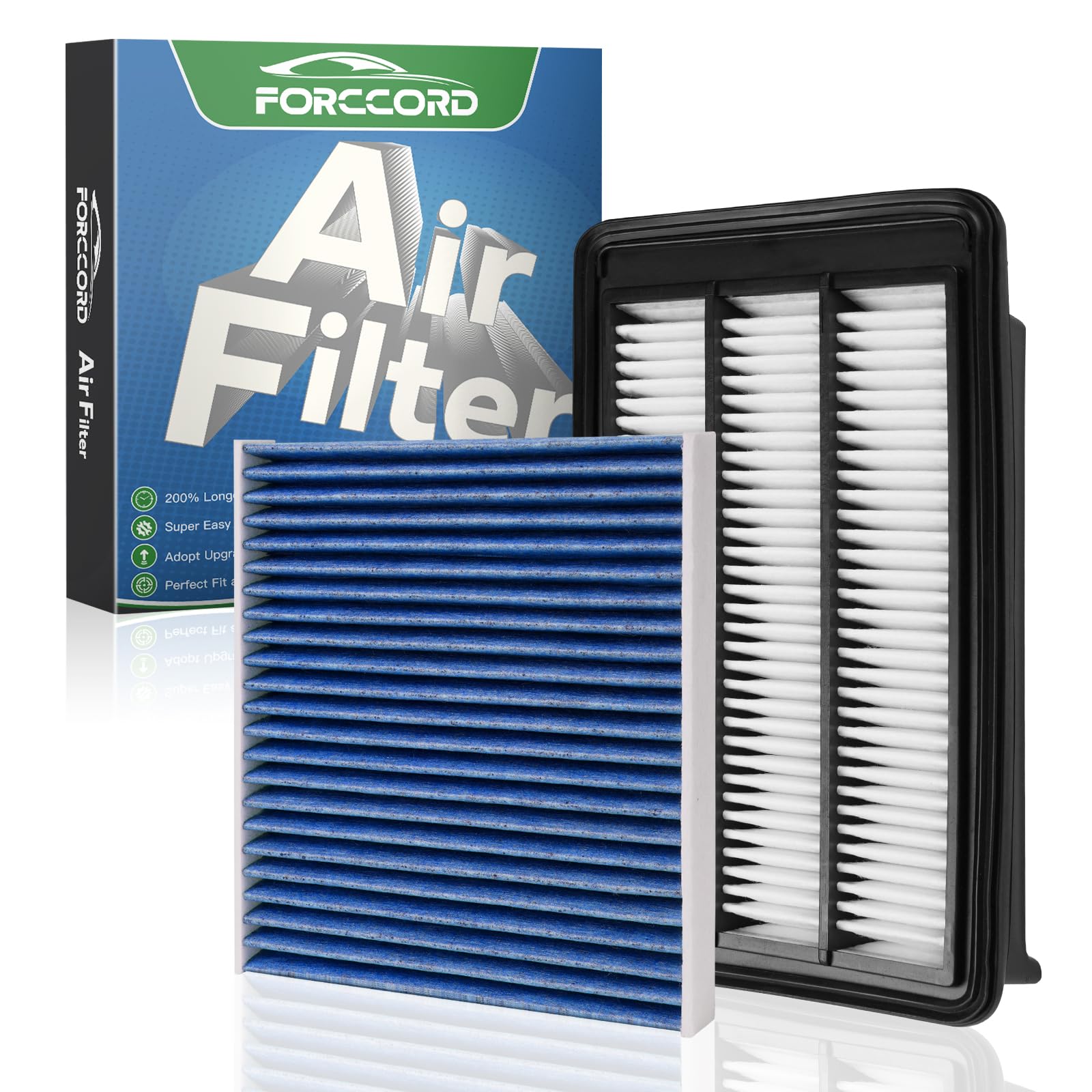
The Forccord combo pack bundles a cabin air filter and an engine air filter into a single purchase, targeting the Honda Civic L4 1.5L (2016–2021) and CR-V L4 1.5L (2017–2022) — non-hybrid models only. The cabin filter replaces OEM numbers CF11182, 80292TF0G01, and 80291-T5R-A01, while the engine filter replaces CA12050 and 172205AAA00. Forccord uses an advanced HV filter paper on the engine side, claiming 200 percent longer service life (up to 20,000 miles) compared to standard media.
Verified Civic and CR-V owners consistently highlight the convenience and cost savings of getting both filters in one package, with several noting that the cabin filter fits perfectly behind the glove box and the engine filter drops into the air box without modification. The cabin filter includes an activated carbon layer for odor control, and the combination of both filters costs less than what many dealerships charge for just the cabin filter replacement labor. One Equinox owner confirms the filters fit their 2024 model with only minor fiddling.
The engine filter media feels slightly thinner than some premium alternatives, but multiple owners confirm it performs well over the standard service interval. The cabin filter provides adequate odor control for normal driving conditions, though heavy urban commuters may want a dedicated carbon filter for stronger odor adsorption. The 1-year warranty adds a layer of protection for a budget-friendly combo that covers the two most common DIY maintenance items.
What works
- Convenient cabin and engine filter combo in one purchase
- Significant cost savings versus dealership replacement pricing
- Easy DIY installation on Civic and CR-V platforms
What doesn’t
- Engine filter media feels thinner than some premium alternatives
- Cabin carbon layer may not be sufficient for heavy odor environments
Hardware & Specs Guide
Filter Media Types
Standard pleated paper filters catch visible dust and pollen but allow gases and VOCs to pass through. Activated carbon filters add a charcoal layer that adsorbs odors, exhaust fumes, and volatile organic compounds — critical for urban and traffic-heavy driving. HEPA-grade electrostatic media uses a charged fiber matrix to capture sub-micron particles including mold spores, bacteria, and PM2.5 particulates. Some premium filters combine carbon with electrostatic layers for dual-action protection.
Fitment and OEM Cross-Reference
Every cabin air filter housing is vehicle-specific. The same 2018 model year can have different housing designs depending on trim level or engine configuration. Always cross-reference the OEM part number printed on the original filter frame against the replacement part number. Major platforms like the Audi Q5, Ford F-150, and Toyota RAV4 have standardized housing designs across multiple model years, but variations exist between pre-facelift and post-facelift versions of the same generation.
FAQ
How often should I replace the cabin air filter in my 2018 vehicle?
What is the difference between a standard and an activated carbon cabin filter?
Can I clean and reuse a disposable cabin air filter?
Will a cabin air filter improve my HVAC system performance?
Final Thoughts: The Verdict
For most buyers, the best 2018 cabin air filter winner is the BOSCH 6029C HEPA because it delivers genuine HEPA-grade filtration without the restrictive airflow of denser media, and its broad Honda/Acura platform coverage makes it accessible to a wide range of owners. If you want a lifetime solution that eliminates recurring replacement costs, grab the K&N VF2033. And for premium German SUV owners who want carbon-level odor control at a fraction of the dealer price, nothing beats the EPAuto CP211.

Certification: BSc in Mechanical Engineering
Education: Mechanical engineer
Lives In: 539 W Commerce St, Dallas, TX 75208, USA
Md Amir is an auto mechanic student and writer with over half a decade of experience in the automotive field. He has worked with top automotive brands such as Lexus, Quantum, and also owns two automotive blogs autocarneed.com and taxiwiz.com.