Pulling a deep vacuum on an automotive AC system isn’t optional—it’s the only way to boil off moisture that destroys compressors from the inside out. A pump that can’t hold below 500 microns leaves water vapor in the lines, turning refrigerant into corrosive acid over a single season. That metal-on-metal grind you hear from a failed compressor often traces back to one bad evacuation job.
I’m Amir — the founder and writer behind Four Wheel Ask. I’ve spent years analyzing automotive AC service equipment, cross-referencing manufacturer specs with real-world owner reports to separate pumps that pull true vacuum from those that just spin a rotor.
Whether you’re servicing a daily driver or a home mini-split, the right auto ac vacuum pump determines whether your refrigerant charge lasts one summer or five. This guide breaks down seven pumps by stage type, CFM rating, and build quality so you can match the tool to the job without overpaying.
How To Choose The Best Auto AC Vacuum Pump
Auto AC vacuum pumps aren’t all the same under the hood. The stage design, free air displacement, and motor protection directly determine how fast you hit deep vacuum and how long the pump survives repeated use. Here are the three specs that matter most.
Single-Stage vs. Dual-Stage Design
A single-stage pump uses one set of rotary vanes to pull vacuum from atmospheric pressure down to roughly 75–100 microns. These are lighter, simpler, and more than sufficient for passenger cars with short refrigerant lines. Dual-stage pumps cascade two rotor chambers in series, pulling the first stage down to an intermediate vacuum and the second stage down to 20 microns or lower. For mini-splits, long truck AC lines, or resin degassing, the deeper pull of a dual-stage removes moisture faster and reduces the chance of ice formation at the expansion valve.
CFM Free Air Displacement
CFM (cubic feet per minute) tells you how quickly the pump moves air during the initial rough vacuum phase. A 3 CFM pump works fine for a compact car’s evaporator but may take 15–20 minutes to pull a 15-foot line set. A 5 CFM pump cuts that time roughly in half. For automotive work where you’re typically evacuating a small closed loop, 3.5 CFM is the practical minimum; 5 CFM is overkill for a sedan but ideal for larger systems with receiver-driers that hold more desiccant.
Oil Management and Motor Protection
Vacuum pump oil is the pump’s blood—it seals the vanes, lubricates the bearings, and carries away heat. A sight glass on the oil reservoir lets you check level and condition without guessing. Oil backflow prevention (check valves) stops oil from creeping back into the AC system when the pump shuts off. Overload-protected motors shut down before heat damages windings during extended pulls. These features separate a pump that lasts five years from one that seizes mid-job.
Quick Comparison
On smaller screens, swipe sideways to see the full table.
| Model | Category | Best For | Key Spec | Amazon |
|---|---|---|---|---|
| Robinair 15310 | Single-Stage | Pro-grade automotive AC | 3 CFM / 75 Microns | Amazon |
| VEVOR 5 CFM Dual Stage | Dual-Stage | Deep vacuum / mini-splits | 5 CFM / 20 Microns | Amazon |
| VIVOHOME 5 CFM Dual Stage | Dual-Stage | Heavy DIY / light pro use | 5 CFM / 0.3 Pa (Ultimate Vacuum) | Amazon |
| VTG VOGTEN 4.5 CFM Kit | Single-Stage | All-in-one AC service | 4.5 CFM / Manifold Included | Amazon |
| Rogvoc 3.5 CFM | Single-Stage | Budget-friendly DIY | 3.5 CFM / 37.5 Microns | Amazon |
| Orion Motor Tech 3.5 CFM | Single-Stage | Entry-level automotive | 3.5 CFM / 37.5 Microns | Amazon |
| ZENY 3.5 CFM Combo | Single-Stage | Bargain beginner bundle | 3.5 CFM / Manifold Included | Amazon |
In‑Depth Reviews
1. Robinair 15310 VacuMaster Single Stage 3 CFM

The Robinair 15310 is the benchmark that other single-stage pumps measure themselves against. Its 3 CFM displacement is modest by modern numbers, but the factory-rated 75 micron pull is consistent pump-to-pump because Robinair tests each unit before shipping. The finned aluminum housing dissipates heat more aggressively than the smooth castings found on budget pumps, so the 1/4 HP thermally protected motor stays cool during the 20-minute evacuation a typical car AC requires.
What sets this pump apart in the service bay is the thoughtful inlet design. The 1/4 inch flare and 1/2 inch ACME fittings are machined for maximum airflow, and the internal check valve prevents oil from siphoning back into your manifold set when the pump cycles off. The angled oil drain valve is a small but real time-saver—it empties the 8.5-ounce reservoir faster than a bottom plug, reducing the mess when you change oil between pulls.
The non-skid feet and integrated handle make it easy to carry, though the 18-pound weight is on par with competitors. Some owners note that the 3 CFM feels slow on larger receiver-driers, and there’s no sight glass on the oil fill port itself—you check level through the side window. For a dedicated automotive pump that holds vacuum year after year, this is the professional’s choice.
What works
- Consistent factory-tested 75 micron rating
- Oil backflow prevention protects manifold gauges
- Finned housing runs cooler than smooth-cast alternatives
What doesn’t
- 3 CFM feels slow on systems with long line sets
- Premium price compared to 3.5 CFM competitors
2. VEVOR 5 CFM Dual Stage Rotary Vane Vacuum Pump

The VEVOR dual-stage 5 CFM pump delivers performance that rivals units costing significantly more, making it the smartest buy for anyone pulling vacuum on multiple system types. Its two-stage design reaches an ultimate vacuum of 20 microns—well below the 500-micron threshold where moisture still boils—and the pure copper motor is rated A2L explosion-proof for use with newer flammable refrigerants like R32 and R1234yf. The T-shaped heat sink combined with a built-in cooling fan allows continuous operation beyond two hours without thermal shutdown, a capability most single-stage pumps can’t match.
The anti-backflow inlet system is exceptionally well executed. A check valve paired with a ball valve switch prevents oil from migrating back into the service hoses, and the oil fume discharge filter reduces visible smoke during operation. The oil capacity is 330 ml and the sight glass with level scale makes monitoring straightforward. Owners who use this pump for vacuum casting report it surviving 80+ cycles in high-temperature environments, which speaks to the thermal resilience of the dual-stage design.
The 22-pound weight makes it heavier than single-stage alternatives, and the included bottles of VG100 oil require careful attention to viscosity—using the wrong weight compromises ultimate vacuum. A small number of users experienced lock-up after a few uses, though VEVOR’s warranty process resolved most cases. For the combination of deep vacuum, refrigerant compatibility, and continuous-duty rating, this pump justifies its mid-range position with real performance.
What works
- 20 micron ultimate vacuum exceeds most automotive needs
- Explosion-proof motor handles R32 and R1234yf
- Continuous operation over 2 hours with heat sink
What doesn’t
- Heavy at 22 pounds
- Some units exhibit lock-up after infrequent use
3. VIVOHOME 110V 1/2 HP 5 CFM Dual Stage Vacuum Pump

The VIVOHOME dual-stage pump leverages a 1/2 HP motor spinning at 2880 r/min to deliver 5 CFM and reach an ultimate vacuum of 0.3 Pa in about three minutes. That’s fast enough to pull a typical automotive system down to moisture-boiling vacuum before the oil even warms up. The integrated motor current protection is a genuine safety feature—it shuts down the pump if it detects overload or phase loss, preventing winding burnout during an unattended evacuation.
The build quality stands out at this price tier. The one-piece die-cast aluminum housing resists warping, and the 304 stainless steel coarse filter at the inlet traps debris before it can score the rotor vanes. The exhaust port uses a cotton layer filter to capture oil mist, keeping the work area cleaner than pumps that vent unfiltered. Noise is rated at roughly 65 dB, quieter than many dual-stage pumps that cross the 70 dB threshold.
The 18.7-pound weight is manageable, and the ergonomic grip handle makes one-handed carries feasible. One limitation: using R410a requires a separate 5/16-inch adapter not included in the box. The bottom oil drain valve simplifies changes, but the reservoir capacity is on the smaller side for extended pulls beyond one hour. For the home mechanic or light-commercial user who wants dual-stage reliability without paying premium prices, this pump hits a sweet spot.
What works
- 0.3 Pa ultimate vacuum achieved in minutes
- Stainless steel inlet filter prevents vane damage
- Overload protection for safe unattended use
What doesn’t
- R410a adapter not included
- Modest oil capacity for extended pulls
4. VTG VOGTEN 4.5 CFM AC Vacuum Pump and Gauge Set
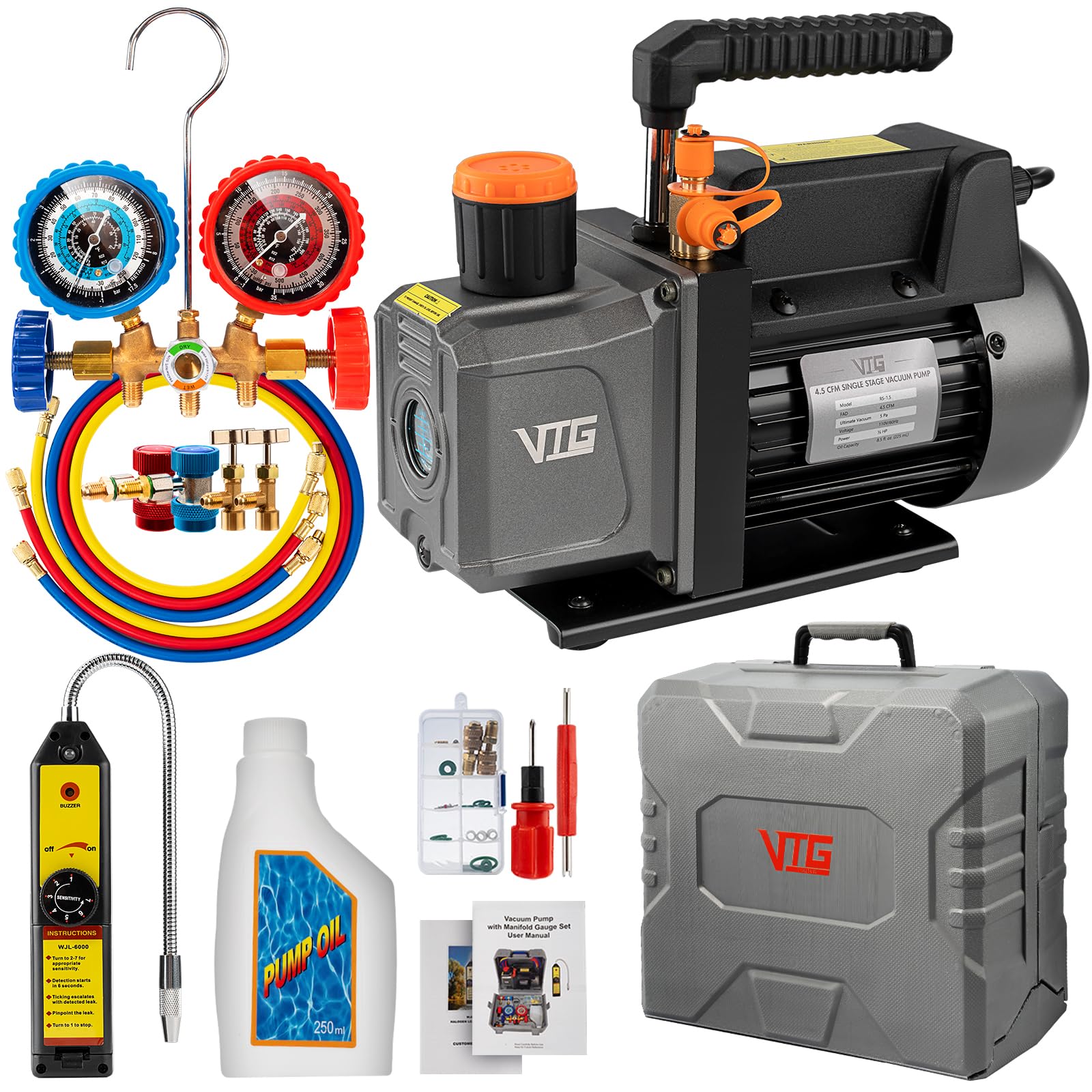
The VTG VOGTEN kit bundles a 4.5 CFM single-stage pump with a three-way manifold gauge set, three color-coded 5-foot rubber hoses, a leak detector, two R134a can taps, and a trifold storage case—everything needed for a full AC service job in one carry handle. The pump itself uses a 1/3 HP all-copper motor inside an aluminum alloy casing that sheds heat efficiently during the 10–15 minute pulls typical of passenger cars. The manifold gauge reads pressure in psi and temperature in Fahrenheit, with a hook on top for hanging while you work.
The hose set is rated for 600 psi working pressure and 3000 psi burst, well above the operating pressures of R134a and R22 systems. The low-pressure and high-pressure quick couplers snap onto Schrader valves without threaded adapters, reducing the chance of cross-threading on older service ports. The included leak detector is a practical bonus for spotting gross leaks before you start the vacuum pull, though it won’t replace a dedicated electronic sniffer for pinpointing microleaks.
Owners consistently praise the organization of the trifold case—each component has a cutout that keeps tools from rattling during transport. Some users note that thread sealant should be applied to every connection, as the dry fittings can seep under deep vacuum. The pump’s 4.5 CFM displacement is adequate for most automotive and mini-split work, and the all-in-one package saves the cost of buying gauges separately. For someone starting from scratch, this kit eliminates the piecemeal shopping headache.
What works
- Complete service kit with gauges, hoses, and case
- 600 psi rated hoses with quick couplers
- Organized trifold storage for transport
What doesn’t
- Dry fittings may seep without thread sealant
- Leak detector is basic—not for microleaks
5. Rogvoc 3.5 CFM 1/4 HP Single Stage Vacuum Pump
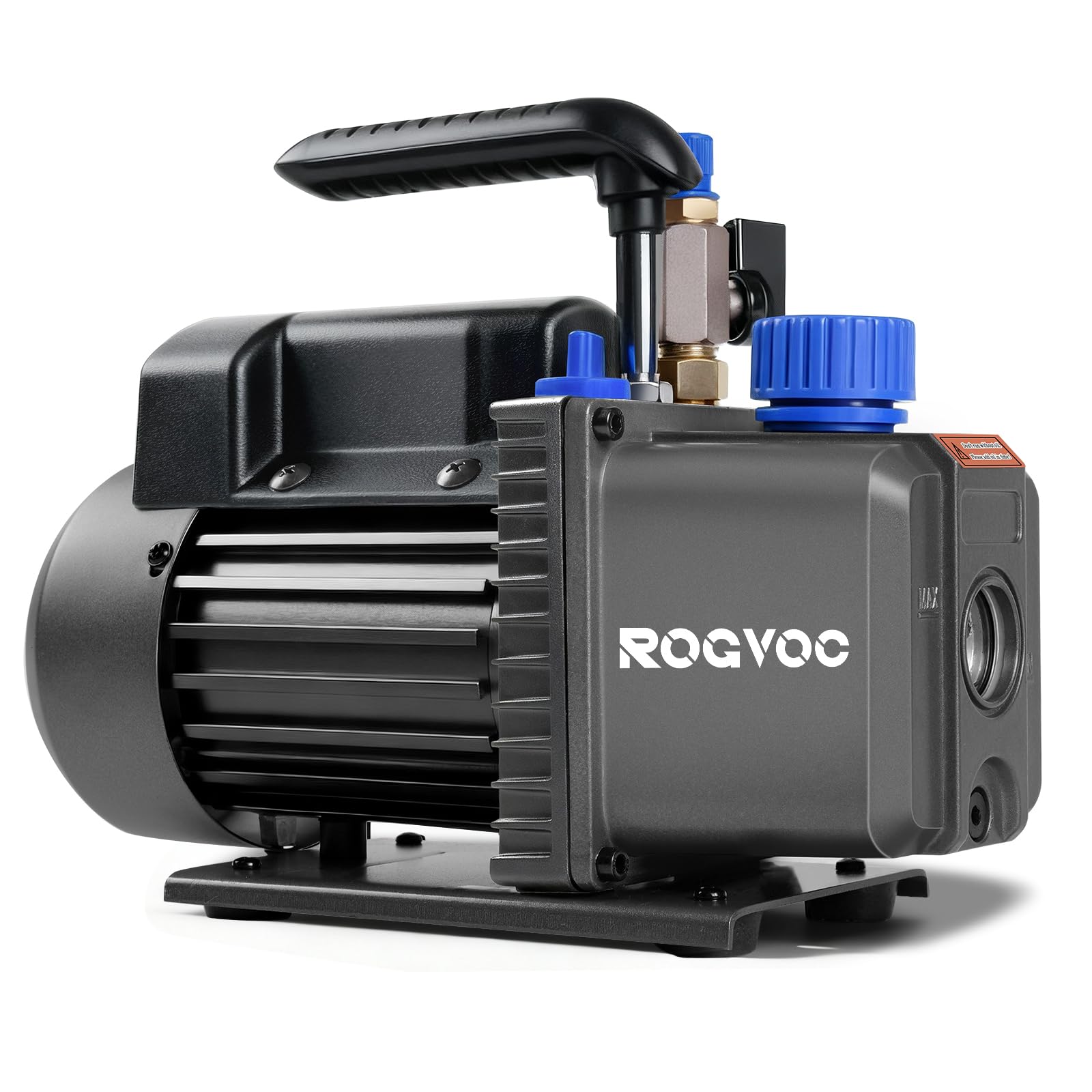
The Rogvoc 3.5 CFM pump delivers a surprising 37.5-micron (5 Pa) ultimate vacuum from a single-stage design, which is more than adequate for any automotive R134a or R1234yf system. The all-copper 1/4 HP motor is paired with a reinforced aluminum alloy casing that uses a high-volume internal cooling fan to keep temperatures down during back-to-back pulls. The low-noise design is noticeable—this pump runs quieter than many competitors in the same CFM class, making it a better choice for residential work where noise matters.
The oil tank includes both a sight glass and a scale, plus a dipstick for checking lubricant condition without guesswork. The ergonomic handle is comfortable for carrying, and the air intake filter combined with the oil mist separator keeps exhaust air cleaner. Owners who use this pump for automotive AC report it pulling vacuum quickly on sedans and light trucks, though the 11.95-pound weight is light enough to be stored on a shelf without dedicated bench space.
A minority of units arrive with a small amount of leaked oil from factory testing—Rogvoc acknowledges this and states it doesn’t affect function. Some owners report a rattling noise that appears intermittently, though the pump continues to hold vacuum. Given the 37.5-micron rating and quiet operation, this is a strong budget-adjacent option that punches above its displacement spec.
What works
- 37.5 microns from a single-stage pump
- Noticeably quieter than comparable 3.5 CFM units
- Oil sight glass and dipstick for easy monitoring
What doesn’t
- Some units arrive with shipping oil leakage
- Intermittent rattling noise reported by some users
6. Orion Motor Tech 3.5 CFM 1/4 HP Single Stage Vacuum Pump

The Orion Motor Tech pump shares the same 3.5 CFM / 37.5-micron rating as the Rogvoc but differentiates itself with a more comprehensive kit that includes a pair of gloves and Teflon tape for sealing connections. The 1/4 HP all-copper motor is housed in a reinforced aluminum casing with an intake filter and trap that shield the rotor chamber from particulates. Compatible with R12, R22, R134a, R410a, and R502, this pump covers the full refrigerant spectrum for automotive and residential systems without needing adapters.
The non-slip handle is rubberized and contoured, offering a secure grip even when your hands are slick with oil or refrigerant residue. The oil sight glass and scale are positioned for easy reading at a glance, and the intake accepts 1/4 inch, 1/2 inch, and 3/8 inch hoses without bushings. Owners who use this for automotive AC note that it holds vacuum reliably for the duration of a typical evacuation, and the inclusion of Teflon tape in the box eliminates one trip to the hardware store.
The 10.78-pound weight is among the lightest in this review, making it easy to move between vehicles or lift onto a workbench. Some users wish the motor included thermal overload protection, as extended pulls beyond 30 minutes risk overheating. For a clean, well-packaged entry-level pump that includes service extras, this model delivers dependable pulls without drama.
What works
- Kit includes Teflon tape and gloves
- Lightest at 10.78 pounds for easy portability
- Accepts 1/4, 3/8, and 1/2 inch hoses directly
What doesn’t
- No thermal overload protection on motor
- Extended pulls beyond 30 minutes risk heat buildup
7. ZENY 3.5 CFM Single-Stage Vacuum Pump with Manifold Gauge Set

The ZENY combo packages a 3.5 CFM single-stage rotary vane pump with a manifold gauge set, two hoses, and a bottle of vacuum oil in one box at an entry-level price point. The heavy-duty aluminum alloy casing houses a direct-drive motor that starts easily without maintenance, and the internal high-volume cooling fan extends operation beyond what a passive housing can manage. The oil drain plug is positioned at the bottom of the reservoir for straightforward changes.
The included manifold gauge reads pressure and temperature for R134a and R22, which covers the majority of automotive systems still on the road. The non-slip cushion handle makes carrying comfortable despite the compact footprint, and the ON/OFF switch is large enough to operate with gloved hands. The pump’s exhaust cap keeps oil mist directed downward, reducing mess on the work surface.
Some owners note that the hoses included with the kit are on the shorter side and the gauge accuracy isn’t lab-grade, but for a home mechanic performing one or two AC services per year, the combination works without issues. A handful of users reported that the pump struggled to maintain vacuum below 500 microns on larger systems, which aligns with the single-stage design’s natural limitation. For the lowest investment to get both a pump and gauge set, this ZENY combo removes barriers to entry.
What works
- Complete pump and gauge bundle at entry price
- Direct-drive motor starts reliably
- Bottom oil drain simplifies changes
What doesn’t
- Struggles to hold vacuum below 500 microns
- Included hoses are shorter than standard
Hardware & Specs Guide
Free Air Displacement (CFM)
CFM measures the volume of air the pump moves per minute at atmospheric pressure. Pumps rated 3–3.5 CFM are sized for passenger car AC loops. Pumps rated 4.5–5 CFM cut evacuation time roughly in half, making them better suited for trucks with dual evaporators or mini-split line sets exceeding 15 feet. Higher CFM also helps overcome restrictions from longer service hoses.
Ultimate Vacuum (Microns / Pa)
This spec tells you the deepest vacuum the pump can achieve when the system is sealed. Automotive AC requires pulling below 500 microns (66.7 Pa) to boil off moisture. Pumps rated 75 microns (10 Pa) or lower ensure complete dehydration. Dual-stage designs typically reach 20–30 microns, while single-stage pumps top out around 37–100 microns depending on oil condition.
Motor Power and Protection
1/4 HP motors are standard for 3–3.5 CFM pumps; 1/2 HP motors drive 5 CFM dual-stage units. Thermally protected motors automatically shut down if the winding temperature exceeds safe limits, which matters for continuous pulls exceeding 30 minutes. All-copper windings conduct heat better than aluminum, extending motor life under repeated use.
Oil System and Filtration
Sight glass windows let you monitor oil level and clarity—dark or milky oil indicates moisture contamination and needs changing. Anti-backflow check valves prevent oil from siphoning into the AC system when the pump stops. Intake filters (stainless steel mesh or cotton) trap debris before it reaches the rotor vanes. Exhaust filters capture oil mist, keeping the work environment cleaner.
FAQ
How deep of a vacuum does an automotive AC system really need?
Can I use a single-stage pump on a mini-split system?
How often should I change the oil in my AC vacuum pump?
Final Thoughts: The Verdict
For most buyers, the auto ac vacuum pump winner is the VEVOR 5 CFM Dual Stage because it combines deep 20-micron vacuum, A2L explosion-proof safety, and continuous-duty heat management at a price that undercuts pro brands. If you want a complete all-in-one kit with gauges and case, grab the VTG VOGTEN 4.5 CFM Set. And for budget-conscious DIYers who only service their own car once a year, the Rogvoc 3.5 CFM delivers quiet, reliable pulls without overspending.

Certification: BSc in Mechanical Engineering
Education: Mechanical engineer
Lives In: 539 W Commerce St, Dallas, TX 75208, USA
Md Amir is an auto mechanic student and writer with over half a decade of experience in the automotive field. He has worked with top automotive brands such as Lexus, Quantum, and also owns two automotive blogs autocarneed.com and taxiwiz.com.