A single 12V socket in the center console no longer cuts it when you need to power a dash cam, charge two phones, and keep a portable fridge running on the same drive. The aftermarket has responded with everything from compact fast-charging inserts to multi-port hubs that turn one outlet into a full power station. Sorting through the wattage claims, connector types, and safety certifications is where most buyers get tripped up — and that is exactly where this guide steps in.
I’m Amir — the founder and writer behind Four Wheel Ask. Over the past several years, I have analyzed hundreds of product listings, cross-referenced technical specifications, and aggregated owner feedback to identify which 12V accessories actually deliver on their promises without introducing electrical noise or reliability concerns.
This guide breaks down the five most capable options on the market right now, covering port configurations, charging standards, and real-world durability. Whether you drive a sedan, truck, or RV, finding the right best auto 12v plug means balancing port count, charging speed, and build quality for your specific setup.
How To Choose The Best Auto 12V Plug
Every 12V accessory plug serves the same basic purpose — draw power from your vehicle’s electrical system to run or charge external devices. But the differences in charging protocol support, total power delivery, connector ergonomics, and safety features separate a reliable daily driver from something that will frustrate you six months in. Focus on these three areas before you click buy.
Port Configuration & Charging Standards
The number of ports matters less than what those ports can actually deliver. A standard USB-A port at 2.4A (roughly 12W) is fine for older phones or low-drain devices, but modern flagship smartphones expect USB-C Power Delivery (PD) at 20W or higher for meaningful fast charging. Quick Charge 3.0 (QC 3.0) remains relevant for Android devices that support Qualcomm’s protocol. Look for at least one USB-C PD port rated 20W or above if you want to top up an iPhone or Samsung Galaxy in under 40 minutes. Multi-port hubs should clearly state whether the wattage is shared or per-port — shared power drops charging speed as you plug in more devices.
Total Power Output & Electrical Safety
Every 12V socket in your vehicle is typically fused at 10A to 15A, which limits total continuous draw to about 120W to 180W at 12V. A splitter or hub that claims 300W across all ports is physically impossible from a single cigarette lighter socket unless it is an inverter that steps up voltage — and even then, the input side is limited by the vehicle fuse. Look for built-in overload protection, short-circuit prevention, and individual port fuses. A real-time voltage display is a useful bonus because it lets you monitor battery level and spot alternator or charging system issues early.
Build Materials & Form Factor
Plastic housings are lightweight and inexpensive, but they dissipate heat less effectively than aluminum or aluminum-alloy enclosures. High-power splitters and hubs generate measurable heat under sustained load, so metal construction or at least a thermally managed design is preferable for anything that will run continuously on a road trip. Corded splitters (with a 3-foot or longer cable) offer more flexible placement than rigid plug-in blocks, which can block adjacent compartments or hang awkwardly from the dash. For off-road or commercial use, look for dust covers, waterproof seals, and reinforced cable strain relief.
Quick Comparison
On smaller screens, swipe sideways to see the full table.
| Model | Category | Best For | Key Spec | Amazon |
|---|---|---|---|---|
| Belkin BoostCharge 42W | USB Charger | Fast phone charging | 30W USB-C PD + 12W USB-A, PPS | Amazon |
| HURMAI 216W Splitter | Power Hub | Heavy-duty multi-device | 4 sockets + 3 USB, 216W, voltmeter | Amazon |
| LIHAN 8-in-1 Splitter | Splitter Hub | Family road trips | 3 sockets + 5 USB, 60W total, voltmeter | Amazon |
| Qidoe 2-in-1 Socket | Panel Mount | Permanent installs | 20W PD + 18W QC3.0, aluminum, voltmeter | Amazon |
| YSOLX 300W Inverter | Power Inverter | AC power on the go | Dual 110V AC + 4 USB, 300W, cooling fan | Amazon |
In‑Depth Reviews
1. Belkin BoostCharge 42W Dual Port Car Charger

The Belkin BoostCharge 42W is the cleanest execution of a simple, focused idea: deliver maximum charging speed to two devices simultaneously without any unnecessary frills. With a 30W USB-C Power Delivery port and a 12W USB-A port, it prioritizes the primary device while keeping a secondary slot available for a passenger or a lower-drain accessory. The addition of PPS (Programmable Power Supply) technology means the charger dynamically adjusts voltage and current to match the precise needs of compatible Samsung Galaxy and Google Pixel devices, which translates to noticeably faster top-offs compared to fixed-profile chargers.
Build quality is where Belkin’s reputation pulls ahead. The housing is made from post-consumer recycled content, and the circuitry has undergone extensive testing to prevent overcurrent, overvoltage, and overheating scenarios. The compact form factor protrudes minimally from the socket, so it does not block adjacent compartments or interfere with shifting in most vehicles. Owner feedback consistently highlights the reliability over years of use — a recurring theme in reviews is that this charger simply works without drama, which is exactly what you want from a device that stays plugged in daily.
The 42W total is a combined rating — the USB-C port tops out at 30W and the USB-A at 12W, so you cannot draw 42W from a single port. This is typical for dual-port designs and clearly stated in the specifications, but buyers expecting a single 42W output should note the split. No cable is included, which is standard for this category but worth mentioning for anyone who does not already own a USB-C to Lightning or USB-C to USB-C cable rated for PD charging. Overall, this is the most polished option for drivers who want premium brand support and genuine fast charging without expanding to a multi-port hub.
What works
- True 30W USB-C PD with PPS for adaptive fast charging
- Compact, low-profile design stays out of the way
- Sustainable materials and strong 2-year warranty
What doesn’t
- No USB-C cable included in the package
- Only two ports — limited for families with multiple devices
2. HURMAI 216W Cigarette Lighter Splitter Adapter
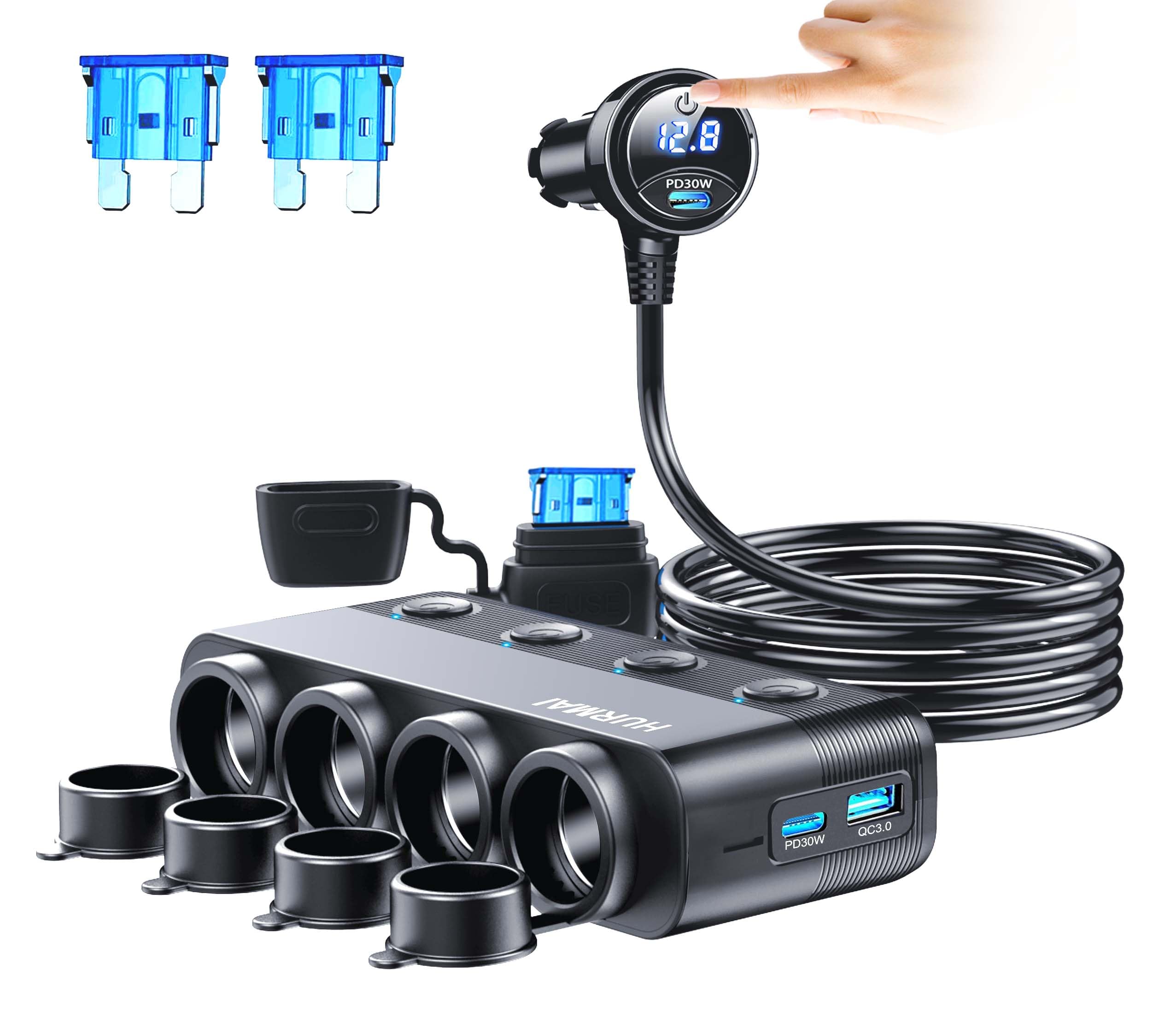
The HURMAI 216W splitter is built for the driver who treats their vehicle as a mobile command center. It expands a single 12V outlet into four cigarette lighter sockets plus three USB ports (including a PD30W USB-C and a QC 3.0 port), for a total of seven simultaneous connection points. The headline 216W rating applies to 24V systems common in trucks and commercial vehicles — on a standard 12V passenger car, the max drops to 108W, which is still ample for running a dash cam, phone charger, heated seat pad, and a small cooler simultaneously.
What sets this hub apart from cheaper splitters is the dual-switch architecture. Each of the four 12V sockets has its own independent On/Off button, plus a master switch that controls the entire unit. This eliminates the need to physically unplug devices when you want to cut power to a specific accessory — a small convenience that matters when your setup includes always-on items like a GPS or radar detector. The real-time LED voltmeter doubles as the master switch and provides a clear readout of battery voltage, which helps you spot a failing alternator or parasitic drain before you get stranded.
Owner reports consistently praise the heavy-duty feel of the components, particularly the reinforced cable and the waterproof dust covers on each socket. The unit is UL and CE certified, and the inclusion of two spare fuses and mounting pads shows attention to long-term usability. The main trade-off is size — this is a substantial block that needs a flat surface and may not fit snugly in every center-console layout. A few users noted that the voltmeter display is bright at night, though it can be dimmed by toggling the master switch in some configurations. For professional drivers or overlanders who need industrial-grade expansion, this is the most complete solution.
What works
- Seven total ports with independent On/Off controls
- Real-time voltmeter with battery health monitoring
- Waterproof dust covers and dual spare fuses included
What doesn’t
- Bulky form factor may not fit all center consoles
- Voltmeter display can be bright in dark cabins
3. LIHAN 8-in-1 Cigarette Lighter Splitter
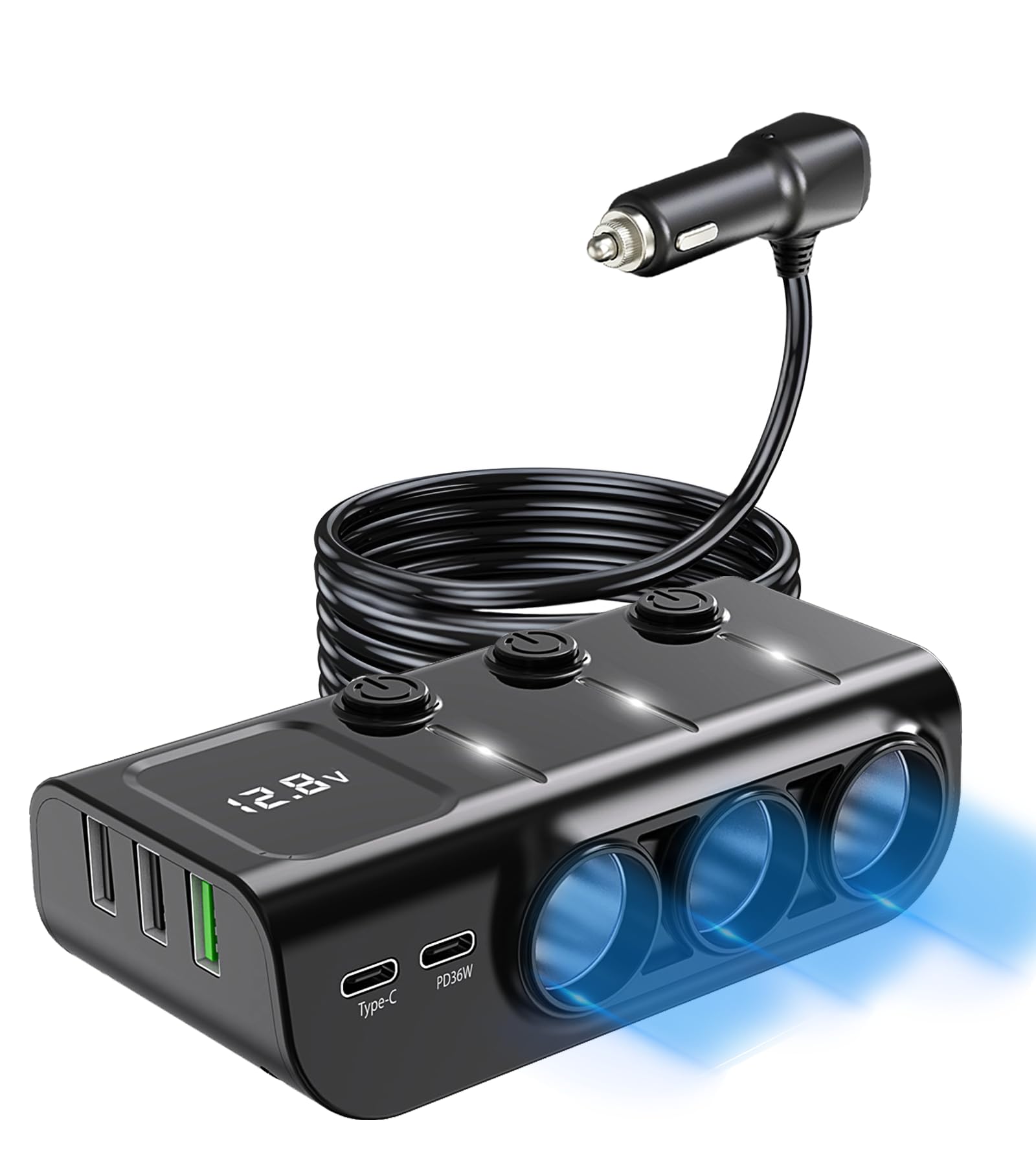
The LIHAN 8-in-1 is the pragmatic choice for families or groups who need to keep multiple devices alive during long drives without spending on premium hardware. It offers three 12V sockets and five USB ports — two USB-C PD, one QC 3.0, and two standard USB-A — all fed through a 3.3-foot cable that lets you place the hub in a cup holder, on the passenger seat, or in the back row where rear-seat passengers can actually reach it. The total USB output is 60W shared across the five ports, which is enough to fast-charge two phones simultaneously while maintaining a trickle charge on additional devices.
Each of the three lighter sockets has its own independent On/Off button, and a master switch controls everything. The built-in LED voltmeter displays battery voltage in real time, giving you the same alternator-monitoring capability found on more expensive units. The enclosure is ABS plastic with a brushed finish, which keeps weight low and cost down without feeling flimsy. Owner reviews frequently mention how well the unit handles being moved between vehicles — the corded design makes it easy to stash in a glove box and deploy whenever needed.
The main drawback noted across multiple owner reports is the absence of a replaceable fuse in the 12V plug itself. While the hub has internal protection circuitry, if the plug experiences a surge severe enough to blow an internal fuse, the entire cable assembly may need replacement rather than a simple fuse swap. A few users also experienced failures after several months of heavy use, though these reports are not the majority. For the price, the feature set is generous — just be aware that the long-term durability may not match the all-metal premium options. This splitter is best suited for occasional family trips or as a backup charging kit.
What works
- Eight total ports with excellent device variety
- Long 3.3-foot cable for flexible placement
- Each socket has its own On/Off switch
What doesn’t
- No user-replaceable fuse in the plug
- ABS plastic build less durable than metal enclosures
4. Qidoe 2-in-1 Cigarette Lighter Socket with USB

The Qidoe 2-in-1 takes a completely different approach from the multi-port splitters — it is designed as a permanent or semi-permanent panel-mount solution for boats, RVs, golf carts, or custom vehicle builds rather than a plug-and-play accessory. The unit combines a 12V cigarette lighter socket with a USB-C PD 20W port and a QC 3.0 18W port in a single aluminum alloy housing that includes a built-in voltage display and a dedicated On/Off rocker switch. The entire assembly is water-resistant, making it suitable for marine and outdoor installations where standard plastic splitters would degrade quickly.
The all-metal construction is the standout feature here. Aluminum dissipates heat far more effectively than plastic, which matters when the 12V socket is used for continuous-draw devices like a dash cam or a small refrigerator. The included 23.6-inch wiring harness comes with a 15A inline fuse, and the faceplate has a professional look that blends well with aftermarket dash panels or marine switch banks. Owner feedback from off-grid cabin installs and solar setups confirms that the USB-C PD port reliably delivers 20W to iPhones and Android devices, and the voltmeter matches readings from standalone digital multimeters within a tenth of a volt.
The trade-off is that this is not a portable solution — it requires cutting a 1.18-inch hole (30mm) and hardwiring the leads, which is straightforward for anyone comfortable with basic 12V electrical work but impractical for a renter or someone who just wants to plug something into the existing socket. Additionally, the total 12V socket output is rated at 150W to 300W depending on input voltage, but the USB ports are fixed at 20W and 18W respectively — there is no higher-wattage PD option for laptops. For builders and DIY enthusiasts who want a clean, durable, and permanent 12V charging station, this is the best option available.
What works
- Machined aluminum body for superior heat dissipation
- Water-resistant design suitable for marine and outdoor use
- Accurate LED voltmeter with integrated power switch
What doesn’t
- Requires hardwiring and panel cutout — not plug-and-play
- USB-C PD limited to 20W, insufficient for laptops
5. YSOLX 300W Car Power Inverter

The YSOLX 300W inverter occupies a different category than the other products in this guide — instead of simply expanding 12V ports, it converts DC power from your vehicle into 110V AC household current, enabling you to run or charge devices that require a standard wall outlet. This includes laptops with proprietary chargers, CPAP machines, small TV sets, game consoles, camera battery chargers, and medical devices like nebulizers or breast pumps. The unit packs two 110V AC outlets (modified sine wave, rated at 300W peak / 250W continuous), along with four USB ports split between USB-A and USB-C that deliver a combined 24W for phones and tablets.
The engineering focus here is on thermal management. A variable-speed cooling fan activates under load and runs quietly enough that it does not become a distraction on the road. The housing is compact at 5.4 x 2.75 x 1.4 inches and weighs just over half a pound, so it stows easily in a glove box or door pocket when not in use. The included DC cable gives you several feet of reach, which allows the inverter to sit on the floor or seat rather than dangling awkwardly from the dash. Owner feedback from van-lifers and long-haul truckers consistently mentions the inverter’s ability to run a laptop and charge multiple devices simultaneously without tripping or overheating.
The main limitation is the modified sine wave output, which is fine for most laptop and device chargers but may cause hum or inefficiency in sensitive audio equipment or devices with universal motors. The 300W peak rating is also the absolute maximum — continuous draw should stay under 250W, and high-draw appliances like hair dryers or electric heaters will immediately blow the fuse. A few users noted that the power button must be toggled each time the vehicle restarts, which is a safety feature but can be slightly inconvenient if you want always-on operation for a dash cam. For anyone who needs genuine AC power on the road, this inverter delivers impressive capability in a portable, well-cooled package.
What works
- Dual 110V AC outlets allow use of standard wall-plug devices
- Compact size and included cable for flexible placement
- Intelligent cooling fan maintains performance under load
What doesn’t
- Modified sine wave not ideal for sensitive audio equipment
- Power switch requires manual reset after each ignition cycle
Hardware & Specs Guide
USB-C Power Delivery (PD)
USB-C PD is a fast-charging protocol that allows higher wattage delivery over a USB-C connection. A PD 20W port can charge an iPhone 13 from 0% to 55% in roughly 35 minutes, while a PD 30W port cuts that time further and can also sustain a tablet or small laptop. Look for PD 3.0 or PD 3.1 certification to ensure compatibility with the latest devices. PPS (Programmable Power Supply) is an enhancement within PD that dynamically adjusts voltage in small increments, improving charging efficiency for Samsung Galaxy and Google Pixel devices that support the standard.
Quick Charge 3.0 (QC 3.0)
Qualcomm’s Quick Charge 3.0 is a legacy fast-charging standard still widely used on mid-range and older Android phones. It negotiates voltage in 200mV increments from 3.6V to 20V to minimize power loss and heat. QC 3.0 ports typically deliver up to 18W, roughly four times the speed of a standard 5W charger. The protocol is backward compatible with QC 2.0 and QC 1.0, so it will still charge older devices at their maximum supported rate. For iPhones and modern flagship Androids that use USB-C PD, QC 3.0 offers no advantage, but it is valuable for households with mixed-device ecosystems.
Total System Power & Vehicle Limitations
Every 12V accessory socket in a passenger vehicle is connected to a fuse rated between 10A and 15A, which caps continuous power at approximately 120W to 180W at nominal system voltage. A splitter that claims 300W total across all ports is physically impossible from a single cigarette lighter socket unless it is an inverter that boosts voltage internally. The input side of any 12V accessory is still limited by the vehicle fuse. Exceeding the fuse rating will blow the fuse and cut power to that socket. Always check the total amp draw of all connected devices against your vehicle’s fuse rating before loading up a multi-port hub.
Modified Sine Wave vs. Pure Sine Wave Inverters
Power inverters convert DC battery power into AC household current. Modified sine wave (MSW) inverters produce a stepped approximation of a true sine wave, which is adequate for most laptop chargers, phone chargers, LED lights, and small appliances. Pure sine wave (PSW) inverters produce a clean, smooth waveform identical to grid power, which is required for sensitive electronics like medical equipment, variable-speed power tools, and high-end audio gear. MSW inverters are significantly more affordable and compact for the same wattage rating — the YSOLX 300W in this guide uses modified sine wave, making it a practical choice for general travel charging.
FAQ
Can I use a 12V splitter in any vehicle?
What is the difference between a splitter and an inverter?
How many watts can I safely draw from a single 12V socket?
Do USB-C PD chargers work with all phones?
Is it safe to leave a 12V splitter plugged in all the time?
Final Thoughts: The Verdict
For most buyers, the best auto 12v plug winner is the Belkin BoostCharge 42W because it delivers genuine fast charging through a proven, compact design with strong safety certifications and brand support. If you need to power multiple 12V accessories and charge phones for an entire family, grab the HURMAI 216W Splitter for its independent switches and professional-grade build. And for anyone who needs genuine AC power on the road — laptops, medical devices, or small appliances — nothing beats the YSOLX 300W Inverter for its portable, well-cooled conversion capability.

Certification: BSc in Mechanical Engineering
Education: Mechanical engineer
Lives In: 539 W Commerce St, Dallas, TX 75208, USA
Md Amir is an auto mechanic student and writer with over half a decade of experience in the automotive field. He has worked with top automotive brands such as Lexus, Quantum, and also owns two automotive blogs autocarneed.com and taxiwiz.com.