Choosing the wrong lubricant for spark plug threads can lead to inaccurate torque readings, stripped cylinder heads, or seized plugs that require a costly extraction. A proper anti-seize compound acts as a controlled friction modifier and a corrosion barrier, ensuring that spark plugs seat correctly and come out years later without a fight.
I’m Amir — the founder and writer behind Four Wheel Ask. My approach combines deep market research with technical specification analysis and owner-feedback synthesis to identify which compounds deliver real protection across different temperature ranges and metal interfaces.
After evaluating thermal limits, base-material chemistry, and real-world owner reports across five leading compounds, the best anti seize for spark plugs balances extreme heat resistance with corrosion prevention to keep threads intact through multiple service intervals.
How To Choose The Best Anti Seize For Spark Plugs
Spark plug threads operate in a harsh environment: extreme heat, combustion pressure, and exposure to moisture and road salts. A suitable anti-seize must handle these conditions without breaking down, causing galvanic corrosion, or altering the spark plug’s installed torque. Here are the critical factors to evaluate before making a purchase.
Temperature Rating
The upper temperature limit determines whether the compound will carbonize, melt, or evaporate inside the combustion chamber. Spark plug wells can reach well over 1000°F under heavy load, and high-performance or turbocharged engines push that even higher. Look for a rating of at least 1600°F; premium compounds rated to 2400°F offer a wider safety margin and longer service life.
Base Material Chemistry
Anti-seize compounds use different suspended solids — nickel, copper, silver, graphite, or ceramic — each with distinct properties. Nickel-based compounds resist oxidation at high temperatures and avoid galvanic corrosion with aluminum cylinder heads. Copper-based pastes offer excellent heat transfer but can cause galvanic issues with certain metal combinations. Silver and graphite formulas provide reliable lubrication but may not match the thermal ceiling of nickel blends.
Consistency and Application Method
The compound’s viscosity affects how easily it applies and whether it stays on the threads during installation. Thicker pastes cling better to vertical spark plug threads, while thin liquids may drip or run. Consider the container type: brush-top bottles allow precise application to individual threads, whereas tubes with nozzle tips are better for coating larger areas without waste.
Quick Comparison
On smaller screens, swipe sideways to see the full table.
| Model | Category | Best For | Key Spec | Amazon |
|---|---|---|---|---|
| Permatex 77124 Nickel | Premium | High-temp spark plug protection | 2400°F temp rating | Amazon |
| LOCTITE Silver 501000 | Mid-Range | Versatile daily-driver use | 1600°F temp rating | Amazon |
| Loctite 51609 Gray | Premium | Extreme heat fleet maintenance | 2400°F temp rating | Amazon |
| Permatex 09127 Copper | Premium | Heat transfer and anti-seize | Copper-based formula | Amazon |
| Sta-Lube SL3331 | Value | Engine assembly lubrication | Moly-graphite grease | Amazon |
In‑Depth Reviews
1. Permatex 77124 Nickel Anti-Seize Lubricant

The Permatex 77124 uses a nickel-based formulation that delivers one of the highest thermal ceilings among spark-plug-rated compounds, resisting degradation up to 2400°F. Nickel is inherently oxidation-resistant, which means the paste maintains its lubricating and anti-corrosion properties across extended service intervals without hardening or turning to carbon. This makes it especially well suited for high-temperature applications where copper or silver alternatives might oxidize or migrate.
Owner feedback consistently highlights the compound’s ability to prevent thread galling in aluminum cylinder heads — a common failure point when dissimilar metals are clamped together under heat and vibration. The 8-ounce container provides enough volume for dozens of spark plug changes, and the paste consistency stays put on vertical threads without dripping during installation. For stainless steel, titanium, and nickel alloy fasteners, this compound is specifically recommended where copper contamination must be avoided.
Field reports note that the nickel base leaves minimal residue compared to graphite-heavy pastes, and it does not catalyze galvanic corrosion when used with aluminum components. Some users mention that the container lid can be difficult to reseal cleanly, but the rust-proofing benefit and high-temperature stability far outweigh that minor packaging concern.
What works
- Exceptional 2400°F temperature rating handles forced-induction and high-load applications
- Nickel formulation avoids galvanic corrosion with aluminum heads and stainless steel
- Thick paste clings to vertical threads without running during installation
What doesn’t
- Premium price point compared to basic graphite or silver compounds
- Can be difficult to find in local auto parts stores for same-day purchase
2. LOCTITE Automotive Silver Anti-Seize 501000

The LOCTITE 501000 is the most widely recognized anti-seize compound in the automotive aftermarket, and its reputation rests on a proven petroleum-based carrier fortified with graphite and metallic silver flakes. Rated to 1600°F, it covers the thermal requirements of virtually all naturally aspirated gasoline engines and many diesel applications. The brush-top bottle design allows direct application to spark plug threads, reducing mess and product waste compared to squeeze tubes.
Customer reports across millions of miles indicate that this compound reliably prevents seizure on spark plugs, oxygen sensors, and exhaust hardware when applied correctly. The graphite content provides a low-friction layer that helps achieve consistent torque readings, though the manufacturer cautions that anti-seize reduces clamping force slightly — a factor to account for during installation. The 8-ounce container offers generous volume for both professional shop use and home DIY maintenance across multiple vehicles.
One trade-off is the 1600°F ceiling, which sits below what some turbocharged or high-compression engines can generate at the spark plug base. While adequate for most passenger cars, owners of heavily modified or racing engines may want a higher-temperature compound. The silver flake residue can also stain hands and clothing more readily than some nickel-based alternatives.
What works
- Trusted brand with decades of proven field performance on spark plug threads
- Brush-top applicator gives precise control and reduces product waste
- Large 8-ounce container provides excellent value for multi-vehicle use
What doesn’t
- 1600°F rating may fall short for highly modified or turbocharged engines
- Silver and graphite residue stains skin and engine components easily
3. Loctite 51609 Gray LB 8009 Heavy Duty Anti-Seize

The Loctite 51609 Gray LB 8009 is engineered for fleet and plant maintenance environments where equipment sees sustained high-temperature operation. Its 2400°F upper limit matches the Permatex Nickel compound, but the base chemistry leans on a calcium fluoride and graphite blend suspended in a heavy naphthenic carrier. The gray paste consistency is noticeably thicker than many consumer-grade anti-seize compounds, which helps it remain in place on coarse threads and vertical fastener surfaces during assembly.
Owner reviews from heavy-equipment technicians and fleet mechanics emphasize that this compound survives repeated heat cycles on exhaust manifold bolts and turbocharger hardware without caking or turning into hard carbon deposits. The 1-ounce tube is compact, which is convenient for toolboxes, but the small volume means it is best treated as a specialized high-heat solution rather than a bulk shop supply. The paste adheres well to both ferrous and non-ferrous substrates, reducing the risk of galling during disassembly of heat-cycled joints.
For spark plug applications specifically, the 2400°F ceiling provides a generous safety margin for any production engine platform. However, the thick consistency can make it slightly more difficult to apply a thin, even layer to fine-pitch spark plug threads compared to brush-on liquids. The tube packaging also requires careful squeezing to avoid extruding more paste than needed.
What works
- Full 2400°F temperature rating suitable for the most demanding engine environments
- Thick paste stays in place on vertical threads and resists washout
- Proven durability through repeated extreme heat cycles in fleet maintenance
What doesn’t
- Small 1-ounce tube offers limited volume for multiple jobs
- Thick consistency can make precise application to spark plug threads tricky
4. Permatex 09127 Copper Anti-Seize
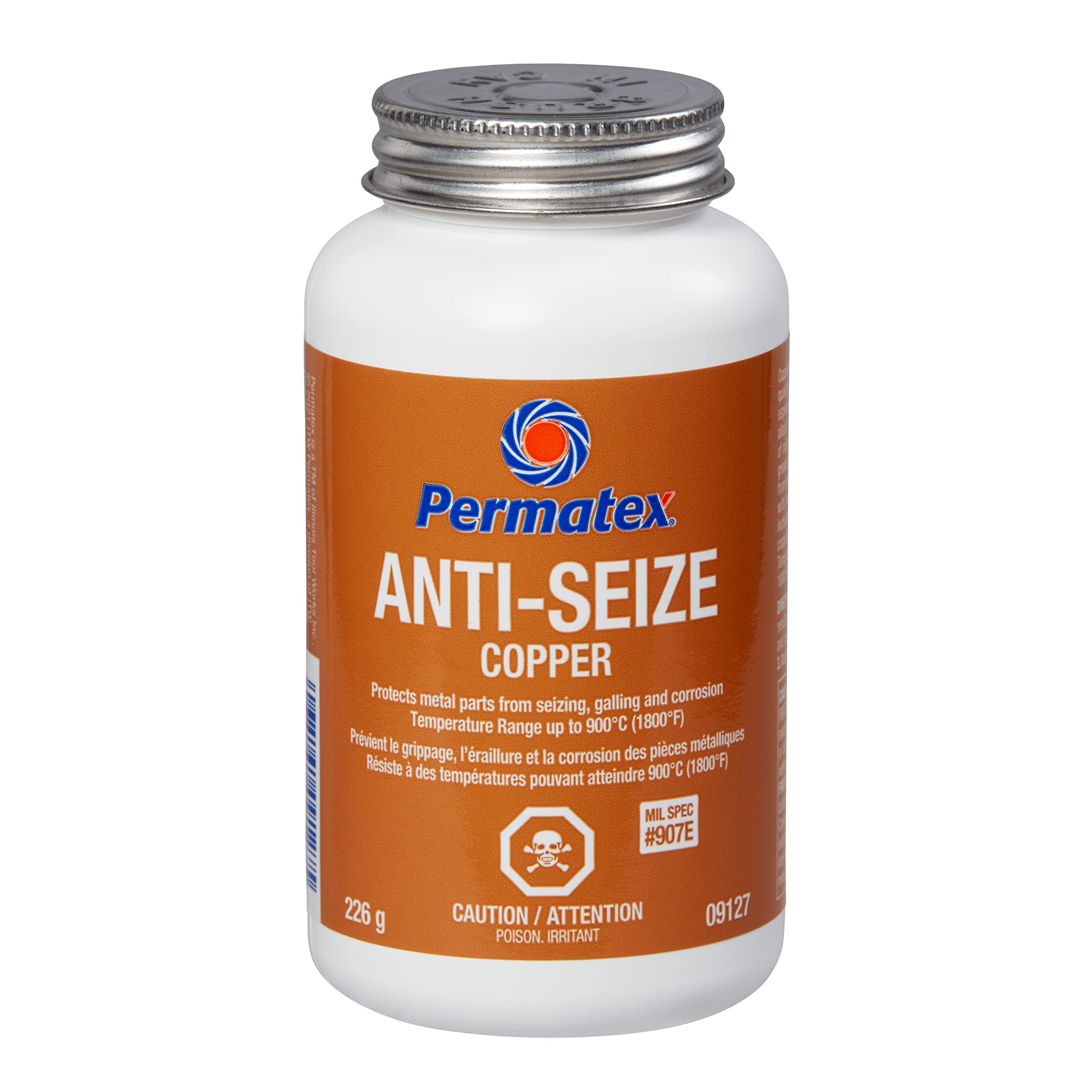
Permatex 09127 is the classic copper-based anti-seize compound that has been a staple in automotive repair for generations. Copper particles suspended in a high-temperature grease carrier provide excellent thermal conductivity, which helps draw heat away from spark plug threads and into the cylinder head. This heat-transfer property is particularly beneficial in engines where spark plug overheating can lead to pre-ignition or electrode erosion.
The 226-gram container offers ample supply for heavy use, and the copper content delivers reliable anti-seize performance on exhaust fasteners, oxygen sensors, and spark plugs across a broad temperature range. Owner feedback frequently cites the product’s ability to break free fasteners that had been in place for five years or more in salt-belt vehicles, confirming its corrosion-inhibiting effectiveness. The copper formulation also tolerates the high side-loading forces found in exhaust system joints without squeezing out.
A key consideration is that copper can promote galvanic corrosion when used with aluminum components or certain stainless steel alloys in the presence of electrolyte. For spark plug applications in aluminum cylinder heads, some experts recommend nickel-based compounds to eliminate this risk entirely. The copper paste is also quite messy to apply, and the metallic particles can be difficult to completely remove from skin and shop rags.
What works
- Excellent thermal conductivity helps dissipate heat from spark plug threads
- Proven long-term corrosion protection even in high-humidity and salt-belt regions
- Large container provides good volume for frequent heavy use
What doesn’t
- Copper can cause galvanic corrosion with aluminum cylinder heads in some conditions
- Messy application with metallic particles that stain surfaces and skin
5. Sta-Lube SL3331 Extreme Pressure Engine Assembly Lube

The Sta-Lube SL3331 is a lithium-based grease fortified with molybdenum disulfide and graphite, formulated primarily for engine assembly rather than as a dedicated spark plug anti-seize. Its intended role is to prevent metal-to-metal contact during initial engine start-up on components like camshafts, crankshafts, and cylinder walls. The moly-graphite blend provides a tenacious film that withstands extreme pressure without squeezing out, which is critical for protecting freshly machined surfaces during the break-in period.
Some automotive enthusiasts have repurposed this assembly lube for spark plug threads, citing the moly-graphite layer’s ability to reduce friction and prevent galling. However, the product lacks a published high-temperature rating for sustained combustion-chamber heat, and the lithium soap thickener may degrade at temperatures above 500°F. This makes it less suitable for spark plug applications compared to purpose-formulated anti-seize compounds with dedicated thermal specs.
For its designed application — engine assembly — the SL3331 performs very well according to builder reviews, offering excellent initial lubrication and corrosion protection during storage. The 10-ounce tube provides generous volume for multiple engine builds, and the thick consistency ensures it stays where applied. For spark plug use, however, owners are better served by a nickel or copper compound with confirmed high-temperature capability and spark-plug-specific testing.
What works
- Outstanding moly-graphite film strength for extreme pressure lubrication during assembly
- Large 10-ounce tube offers excellent volume for engine build projects
- Tenacious adherence to metal surfaces prevents wash-off during initial start-up
What doesn’t
- Not formulated or tested for sustained spark-plug-well temperatures
- Lithium soap base may degrade well below the heat range of combustion chambers
Hardware & Specs Guide
Temperature Classification
Anti-seize compounds are broadly categorized by their upper continuous-service temperature limit. Standard-duty compounds rated to 1600°F suit most naturally aspirated passenger vehicle engines. Heavy-duty compounds rated to 2400°F are designed for turbocharged, supercharged, or high-compression engines where spark plug base temperatures can exceed 1400°F under sustained load. Exceeding the compound’s thermal rating causes the carrier to carbonize, turning the paste into a hard, abrasive deposit that increases removal torque rather than reducing it.
Base Material Types
Nickel-based pastes offer the best combination of high-temperature stability and galvanic compatibility with aluminum, stainless steel, and titanium. Copper-based compounds provide superior thermal conductivity but can initiate galvanic corrosion in certain bi-metal junctions. Silver and graphite blends are effective general-purpose lubricants but generally have lower temperature ceilings and can leave conductive residues that matter for oxygen sensor threads. Ceramic-based compounds exist for extreme applications but are rarely needed for spark plug installation.
Application Method and Coverage
A thin, even layer applied to the spark plug threads — not the first few threads nearest the electrode — is the correct technique. Over-application can cause hydraulic lock, inaccurate torque readings, or migration of excess compound onto the insulator tip, which can cause misfiring. Brush-top bottles offer the most controlled application, while tube packaging requires careful extrusion to avoid waste. The compound should cover the full thread engagement zone without pooling in the thread roots.
Torque Factor Compensation
Anti-seize lubricants reduce the coefficient of friction between threads, which means a standard dry torque specification will over-tighten the fastener if applied without adjustment. Most manufacturers recommend reducing installation torque by 15 to 20 percent when using anti-seize on spark plug threads. Some premium compounds include friction modifiers calibrated to minimize this effect, but the safest practice is always to reference the spark plug manufacturer’s specific torque guidance for lubricated threads.
FAQ
Should I use anti-seize on spark plugs?
Can too much anti-seize cause misfiring?
Does anti-seize affect spark plug torque specifications?
What is the difference between nickel and copper anti-seize for spark plugs?
Can I use regular grease instead of anti-seize on spark plugs?
Final Thoughts: The Verdict
For most buyers, the best anti seize for spark plugs winner is the Permatex 77124 Nickel Anti-Seize because it combines the highest available temperature rating with a nickel formulation that eliminates galvanic corrosion concerns in aluminum heads. If you want a proven value option for daily-driven vehicles, grab the LOCTITE Automotive Silver Anti-Seize with its brush-top applicator and broad thermal coverage. And for extreme heat environments like turbo or supercharged builds, nothing beats the Loctite 51609 Gray LB 8009 for its 2400°F ceiling and heavy-duty staying power.

Certification: BSc in Mechanical Engineering
Education: Mechanical engineer
Lives In: 539 W Commerce St, Dallas, TX 75208, USA
Md Amir is an auto mechanic student and writer with over half a decade of experience in the automotive field. He has worked with top automotive brands such as Lexus, Quantum, and also owns two automotive blogs autocarneed.com and taxiwiz.com.