A fuel pressure regulator that cannot hold a steady setpoint introduces a cascade of driveability problems — lean misfires at cruise, hard hot restarts, and fuel trims that wander outside the ECM’s correction window. For owners of 5.3L engines, whether in a Silverado, Suburban, or an LS swap project, the regulator directly dictates whether the engine idles cleanly under vacuum and delivers full power under load.
I’m Amir — the founder and writer behind Four Wheel Ask. My approach to comparing parts like these involves cross-referencing technical specifications, reviewing owner-reported long-term durability data, and assessing build quality indicators across OEM and aftermarket offerings.
After reviewing owner experiences and technical data, this guide identifies the best 5.3 fuel pressure regulator for reliable engine performance.
How To Choose The Best 5.3 Fuel Pressure Regulator
Selecting the correct regulator for your 5.3L engine requires matching the part to the fuel system architecture, performance goals, and budget. The wrong unit can cause flooding, lean conditions, or a no-start situation that wastes hours of diagnostic time.
Fuel System Architecture — Return vs. Returnless
Gen III 5.3L engines (1999-2007) use a returnless fuel system with the regulator mounted on the fuel pump module inside the tank or on the fuel rail. Gen IV and later engines also use returnless designs. An LS swap often converts to a return-style system with an adjustable regulator mounted in the engine bay. Knowing which architecture your setup uses is the first filter — a returnless regulator will not work in a return-style system and vice versa.
Fixed Pressure vs. Adjustable Regulation
Factory 5.3L regulators are typically fixed at 58 PSI for returnless systems. If the engine is stock or near-stock, an OEM replacement unit delivers reliable performance without tuning. Adjustable regulators, ranging from 30-70 PSI, become necessary when upgrading injectors, adding forced induction, or converting to a return-style system for an LS swap. Adjustable units require a fuel pressure gauge and a basic understanding of how fuel pressure affects injector flow rate.
Build Quality and Material Selection
The regulator’s housing material — billet aluminum, stamped steel, or cast metal — affects both durability and corrosion resistance. Internally, the diaphragm material and spring quality determine how consistently the regulator holds pressure under varying manifold vacuum and fuel pump flow. Units with machined sealing surfaces and quality O-rings reduce the likelihood of external leaks and pressure creep over time.
Compatibility with Fuel Types
Not all regulators handle ethanol blends or E85 equally. The alcohol content in E85 can degrade standard rubber diaphragms and O-rings, leading to pressure loss and internal contamination. If you plan to run E85, verify that the regulator’s internal seals are rated for alcohol-based fuels. Diesel compatibility is another consideration — some regulators explicitly exclude diesel use.
Quick Comparison
On smaller screens, swipe sideways to see the full table.
| Model | Category | Best For | Key Spec | Amazon |
|---|---|---|---|---|
| ACDelco Gold 217-3299 | OEM Grade | Direct replacement on 5.3L trucks & SUVs | OE 58 PSI, includes mounting hardware | Amazon |
| GM Genuine Parts 217-1445 | Premium OEM | Factory-spec restoration or warranty-grade repair | GM OE specification, USA-made | Amazon |
| Delphi FP10004 | Value OEM | Cost-effective replacement for GM V8 applications | 4.3-5.5 PSI range, machined exterior | Amazon |
| EVIL ENERGY Adjustable 30-70 PSI | Performance | LS swap EFI conversions with return-style systems | Adjustable 30-70 PSI, 6AN ports, gauge included | Amazon |
| Holley Adjustable 4.5-9 PSI | Carbureted | Carbureted 5.3L conversions with low-pressure pumps | 4.5-9 PSI range, includes liquid-filled gauge | Amazon |
| Aeromotive SS-Series 13201 | Racing | High-horsepower carbureted race engines | 5-10 PSI, ORB-06 ports, billet construction | Amazon |
| EVIL ENERGY 58 PSI Filter/Regulator | Budget | Budget-conscious LS swaps and EFI conversions | 58 PSI fixed, 10-micron filter integrated | Amazon |
In-Depth Reviews
1. ACDelco Gold 217-3299 Fuel Injection Pressure Regulator
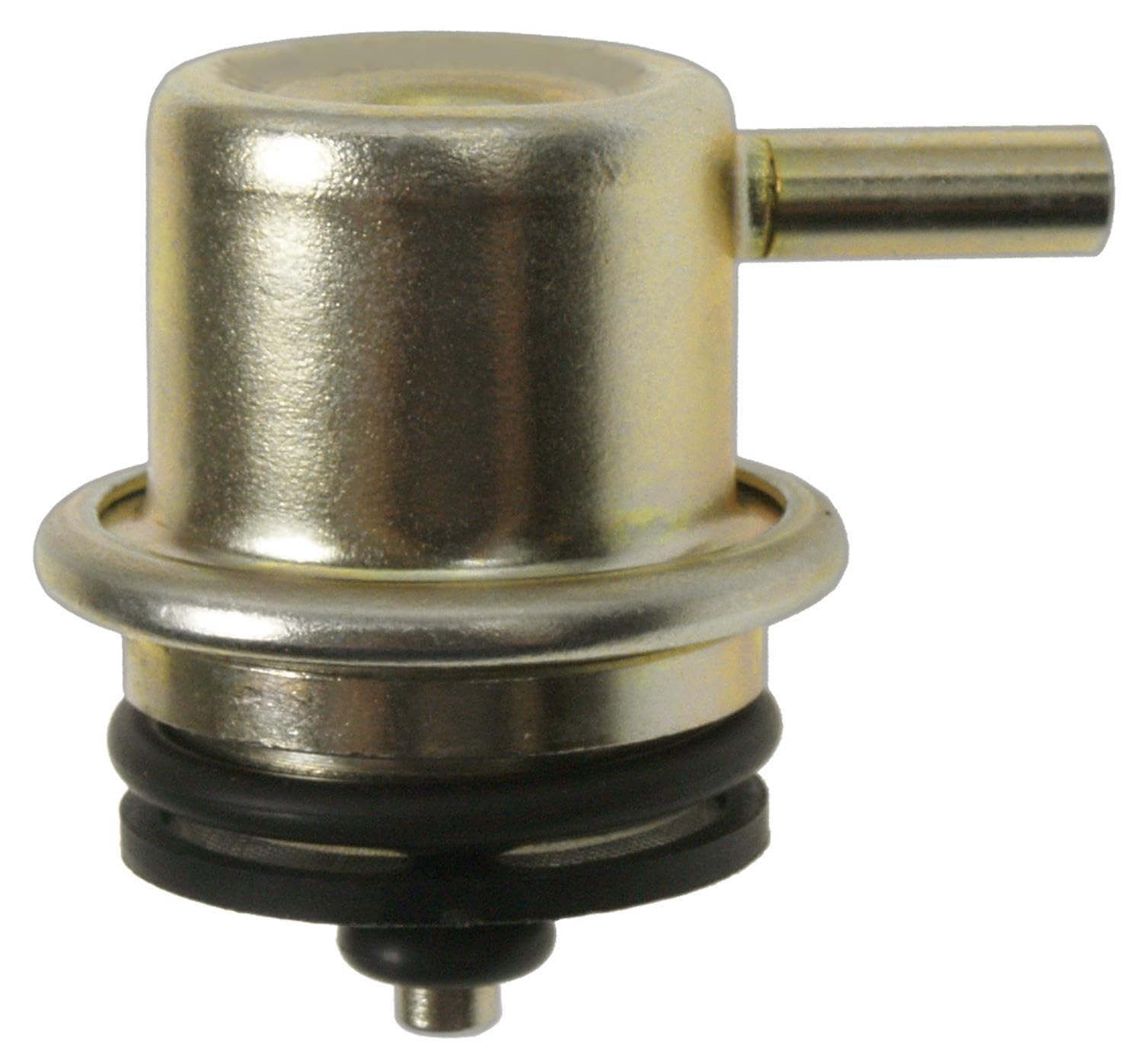
The ACDelco Gold 217-3299 is the regulator that most 5.3L Silverado and Suburban owners should reach for first. As a genuine ACDelco Gold part, it carries the same engineering and material standards as the factory component, which eliminates the compatibility guesswork that plagues universal-fit units. Owner reports consistently confirm that this regulator resolves long-crank hot-start issues and eliminates the buzzing or whistling noise that signals a failing diaphragm. Multiple verified reviews on 2001-2002 5.3L applications describe a return to reliable first-start behavior after replacement.
The regulator’s sealing surfaces and O-ring compatibility are designed to match the stock fuel rail exactly, so installation does not require adapter fittings or aftermarket brackets. The 1.76-ounce weight reflects a compact internal design that fits into the tight space near the intake manifold without interfering with surrounding components. Several owners noted that the included hardware is complete — no need to source additional O-rings or clips. One review on a 6.0L LQ4 application confirmed that the part also resolves warm-start hesitation on larger LS-based engines.
The primary concern surfaced in a review from a 7.4L Vortec 454 owner who reported that this regulator only delivered 45-50 PSI instead of the 60 PSI required by that engine. This does not affect 5.3L applications — the factory spec for Gen III 5.3L engines is 55-60 PSI, and multiple owner confirmations on 5.3L and 6.0L engines show proper pressure delivery. However, the review highlights that cross-referencing part numbers across different engine families requires caution. For 5.3L owners, this remains the most straightforward and proven OEM-level option.
What works
- Direct fit on 5.3L with zero adapter parts needed
- Eliminates long-crank hot-start issues across multiple owner reports
- Includes all required O-rings and hardware
What doesn’t
- Not suitable for engines requiring higher than 58 PSI
- Some cross-reference listings may be inaccurate for non-5.3L engines
2. GM Genuine Parts 217-1445 Fuel Injection Pressure Regulator
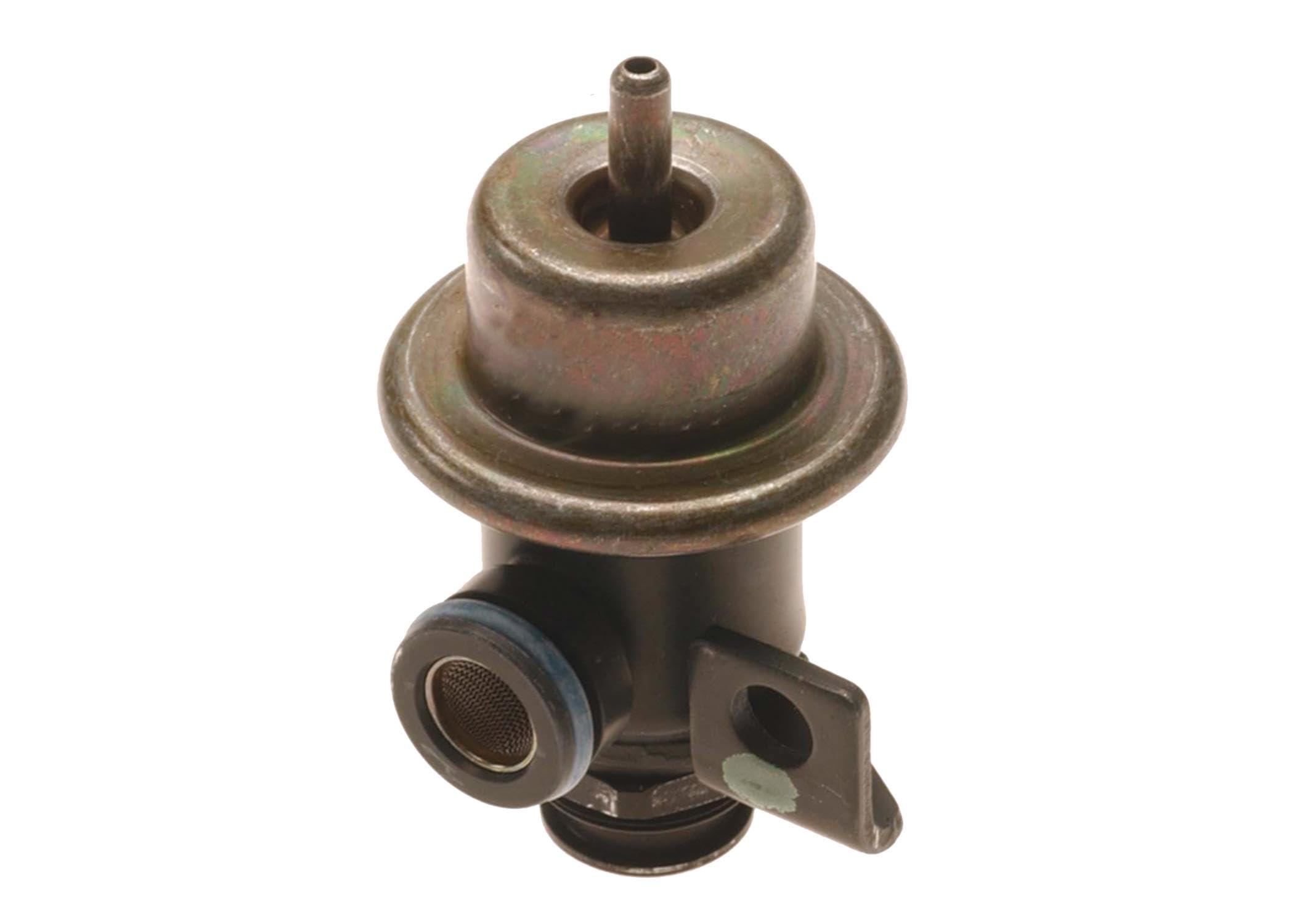
The GM Genuine Parts 217-1445 represents the highest tier of OEM validation — this is the same part number that ships in a GM service package, manufactured to the original engineering specification. For owners who want zero deviation from the factory calibration, this regulator removes all doubt about internal spring rate, diaphragm material, and pressure setpoint accuracy. The part is marked with GM’s OEM number 88894176 and carries the quality-control traceability that comes with genuine GM supply chain parts.
Owner feedback on this regulator is overwhelmingly centered on fit precision and immediate symptom resolution. Multiple reviews on 2003-2004 Trailblazer models with the 4.2L inline-six confirm that the part matches the factory component exactly. One detailed review noted that the Delphi FP10299 cross-reference caused running issues on a standard Trailblazer, while swapping to this GM Genuine part restored correct fuel pressure and idle quality. This pattern suggests that GM Genuine parts maintain tighter manufacturing tolerances than some aftermarket alternatives.
The main limitation is application breadth — the 217-1445 is primarily documented for Trailblazer and related GMT360-platform vehicles with the 4.2L engine. While GM Genuine parts generally carry broader cross-referencing potential, 5.3L owners should verify fitment against their specific year and engine code before purchasing. The part is made in the United States, which appeals to owners who prioritize domestic manufacturing for replacement components. For owners of compatible GM vehicles who want factory-original performance, this is the definitive choice.
What works
- Exact GM OE specification with full traceability
- Resolved driveability issues where aftermarket cross-references failed
- Made in the USA with quality control documentation
What doesn’t
- Fitment is primarily validated on GMT360-platform vehicles
- Higher cost than equivalent aftermarket OEM-grade parts
3. Delphi FP10004 Fuel Injection Pressure Regulator

Delphi is a known quantity in the GM fuel system ecosystem — the company was a Tier 1 supplier for many of the components that shipped on 5.3L engines from the factory. The FP10004 regulator carries a machined exterior finish and the same dimensional specifications as the original Delphi production parts. This means the O-ring grooves, fuel rail mounting interface, and vacuum reference port geometry match the factory dimensions without the fitment issues that can occur with generic replacements.
Owner reviews highlight two distinct application patterns. Several owners report successful use on Gen II LT1 engines in F-body cars, where the regulator resolved fuel pressure instability and restored idle quality. One review on a 1994 Cadillac Fleetwood Brougham noted that replacing the FP10004 eliminated fuel leaking into the oil sump — a symptom that had persisted through hundreds of dollars in misdiagnosed repairs. This type of owner feedback suggests the FP10004 covers a broader range of GM V8 applications than its listing implies.
The FP10004 is a non-adjustable design, so it is not suitable for modified engines requiring higher or lower fuel pressure than the factory setting. The machined exterior is functional but does not offer the visual polish of billet aluminum aftermarket units. For a straightforward OEM-replacement scenario on a 5.3L or compatible GM V8, the FP10004 delivers reliable performance at a lower cost than the GM-branded alternative while maintaining the manufacturing quality of an original supplier.
What works
- Original Tier 1 supplier to GM — dimensions match factory specs
- Resolved hard-to-diagnose fuel leak and pressure issues across multiple owner reports
- Machined exterior finish for corrosion resistance
What doesn’t
- Fixed pressure output — not adjustable for modified engines
- Application cross-referencing requires careful verification by engine family
4. EVIL ENERGY Fuel Pressure Regulator 6AN EFI Bypass Return Adjustable (30-70 PSI)
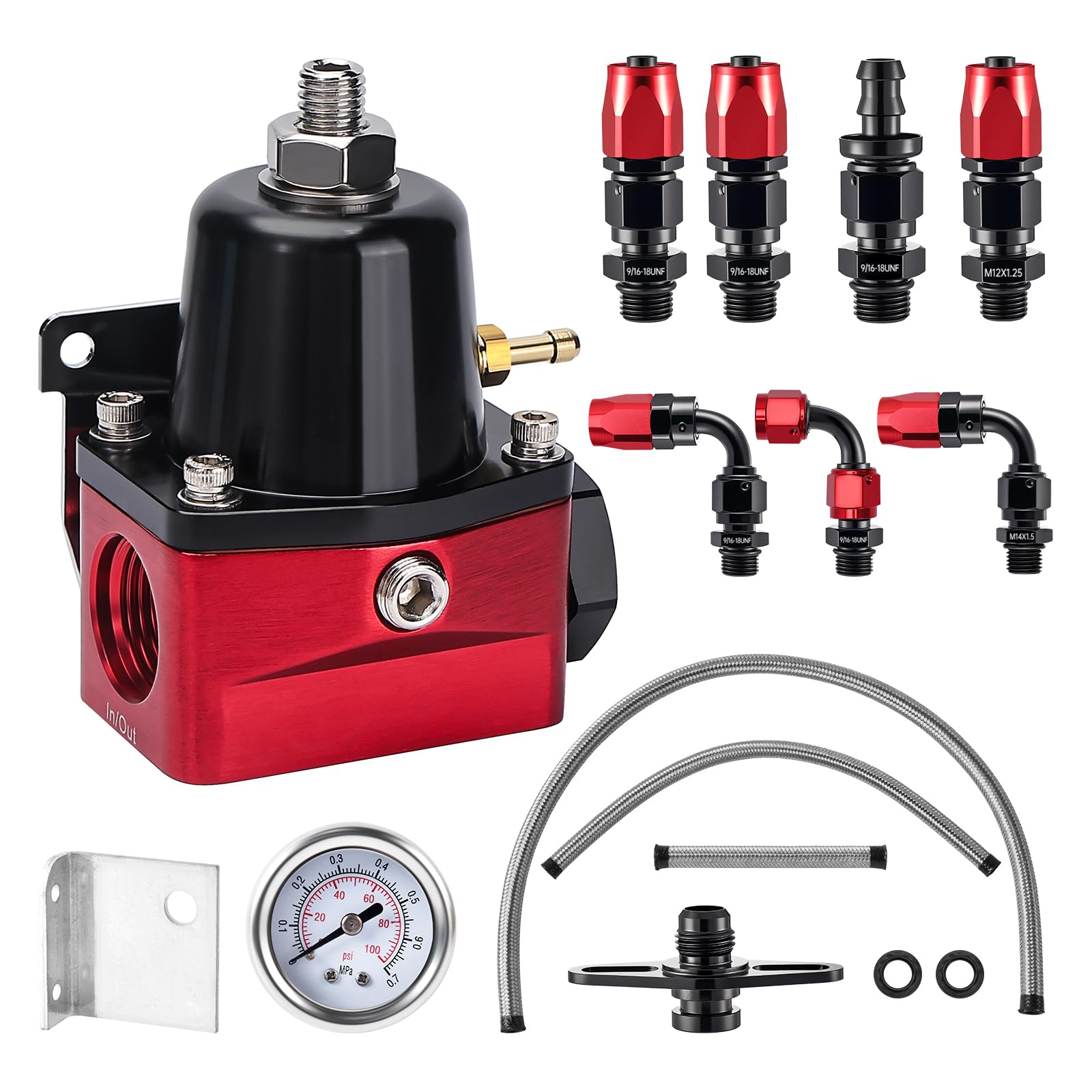
The EVIL ENERGY adjustable regulator is the most popular choice among LS swappers who need a return-style EFI regulator in the 30-70 PSI operating range. The unit includes a pressure gauge, mounting bracket, and a comprehensive set of AN fittings — 6AN to 6AN ORB adapters, 6AN to M12x1.25 and M14x1.5 rail fittings, and barbed fittings for hose connections. This all-in-one approach reduces the number of separate purchases required to complete an EFI fuel system conversion.
Owner feedback on the regulator’s core function is largely positive. Multiple reviews on Holley Sniper and Atomic EFI systems confirm that the regulator holds pressure steadily after adjustment, with smooth and precise adjustment via the top set screw. One owner on a Holley 4150 Sniper setup reported replacing an internal regulator with this unit and dialing in a stable 60 PSI. The billet-style construction and painted finish provide a professional appearance in an engine bay that receives regular attention. Owners also note that the unit is compatible with E85, though the nylon-braided fuel lines included in the kit are not rated for ethanol blends and should be replaced with proper PTFE or nylon-reinforced hose.
The included pressure gauge is the most frequently criticized component — several owners report that the needle bounces erratically and does not provide a trustworthy reading. Replacing the gauge with a known-quality unit resolves this issue. Additionally, one experienced tuner noted that while the regulator holds its setpoint well, the overall design is a functional copy of established AFPR designs, so buyers should inspect sealing surfaces and O-rings before installation. For the price point, the regulator body itself delivers reliable performance, but the ancillary components — gauge and hoses — require upgrading for long-term dependability.
What works
- Wide 30-70 PSI adjustment range suits most EFI applications
- Includes all AN fittings and mounting bracket for complete installation
- Holds setpoint steadily after adjustment per multiple owner reports
What doesn’t
- Included pressure gauge is inaccurate and should be replaced
- Supplied fuel hoses are not rated for E85 or long-term durability
5. Holley Adjustable Fuel Pressure Regulator & Liquid-Filled Gauge Kit, 4.5-9 PSI

For 5.3L owners who have converted their engine to a carbureted intake setup — a common path for budget hot rods and vintage chassis swaps — the Holley adjustable regulator from Speedway Motors provides the correct low-pressure regulation range. Carbureted LS engines typically require 4.5-7 PSI, and this regulator’s 4.5-9 PSI adjustment window covers the full spectrum of Holley, Edelbrock, and Quick Fuel carburetor requirements. The integrated 3/8-inch NPT gauge port allows direct mounting of the included liquid-filled gauge for constant pressure monitoring.
Owner reports on fit and function are generally strong across multiple installations. One verified review noted this was the fourth unit purchased, indicating repeat confidence in the product. The liquid-filled gauge provides vibration-resistant readings that are easier to read than dry gauges on a running engine. However, a significant drawback reported by multiple owners is that the kit does not include the necessary fittings for installation — buyers must source the appropriate barbed or AN fittings separately, which can delay a swap if not anticipated beforehand.
One critical review reported a unit that could not be adjusted below 9.5 PSI regardless of the set screw position, rendering it defective out of the box. This type of failure, while not universal, indicates that quality control on this budget-oriented unit can be inconsistent. Buyers should inspect the regulator and verify the pressure range with a known-good gauge before final installation. For the price, the regulator offers good value when it functions correctly, but the lack of included fittings and the possibility of a defective unit are factors worth considering.
What works
- Correct pressure range for carbureted LS and standard V8 conversions
- Liquid-filled gauge resists vibration for accurate readings
- Compact form factor fits easily in tight engine bays
What doesn’t
- No fittings included — requires separate purchase for installation
- Quality control variability with some units delivered defective
6. Aeromotive SS-Series Carbureted Fuel Pressure Regulator 13201
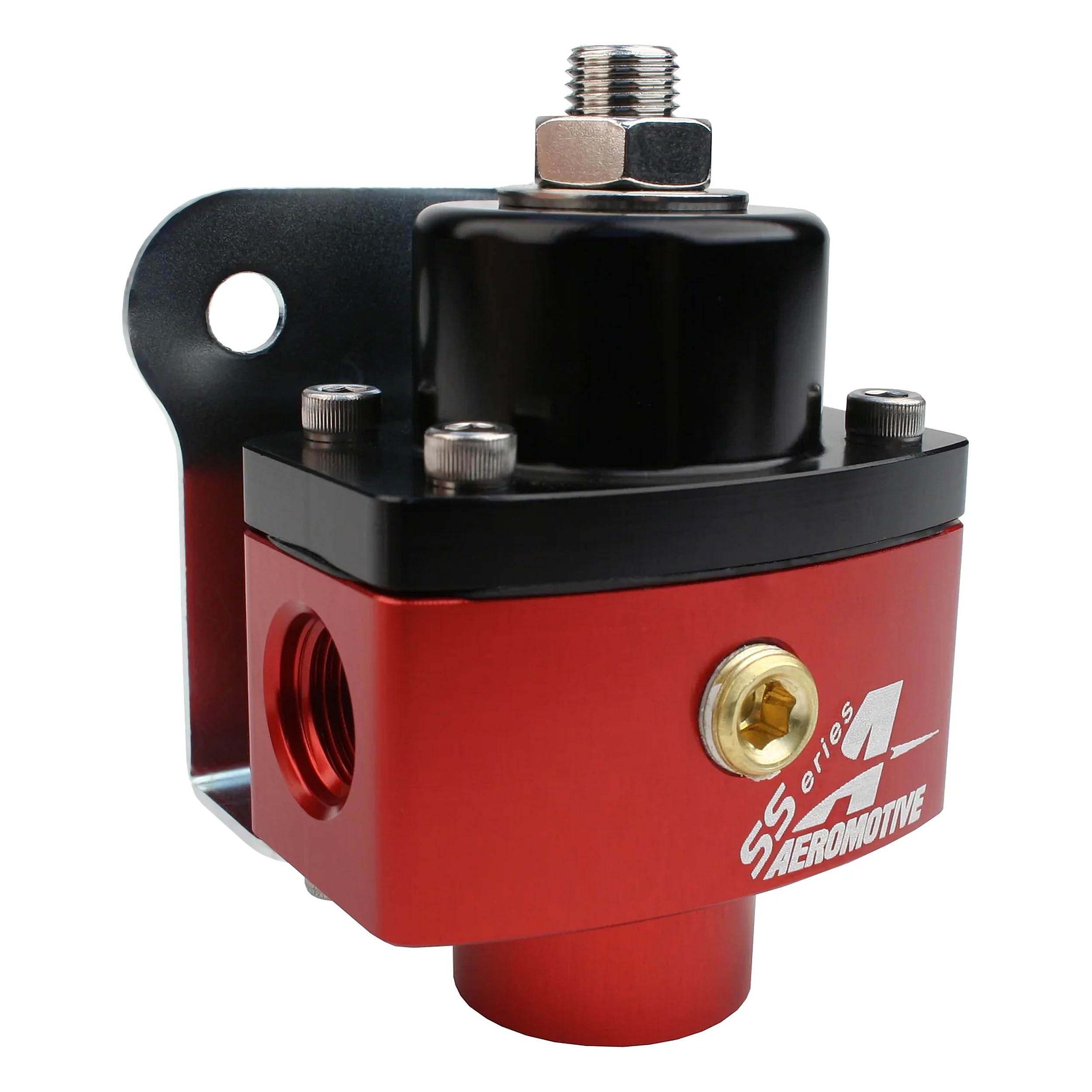
The Aeromotive SS-Series 13201 represents the top tier of carbureted fuel pressure regulation for engines that see sustained high RPM and elevated fuel system demands. Built from billet aluminum with ORB-06 inlet and outlet ports, the regulator uses a dead-head design that reseats when the carburetor needle valve closes — this reduces pressure creep and stabilizes fuel delivery during rapid throttle transitions. Aeromotive rates this regulator for use on carbureted gasoline engines up to 750 flywheel horsepower, making it suitable for serious 5.3L builds with aggressive camshafts and ported cylinder heads.
Owner feedback consistently highlights the regulator’s ability to eliminate pressure fluctuations that cause inconsistent air-fuel ratios. One review on a 1979 Ford F100 with a 460 engine noted that the dead-head regulator smoothed out idle quality and resolved surging caused by an over-powered Edelbrock fuel pump. The 5-10 PSI adjustment range is compatible with standard Holley and Edelbrock carburetors, and the 1/8-inch NPT gauge port allows easy monitoring. The machined billet appearance and compact footprint also receive frequent compliments from builders who prioritize engine bay presentation.
The dead-head design has a known limitation — without return-line circulation, the fuel in the line between the pump and regulator can heat-soak after shutdown, leading to vapor lock in hot environments. One owner explicitly noted this issue and deducted a star for it, acknowledging it as a characteristic of the design rather than a defect. Additionally, the regulator is not rated for alcohol fuels, ethanol blends, or methanol, which limits its use in flex-fuel or dedicated race-ethanol applications. For a carbureted 5.3L running gasoline and demanding race-level pressure stability, the Aeromotive delivers.
What works
- Billet aluminum construction for extreme durability and heat dissipation
- Dead-head design prevents pressure creep for stable idle and transition
- Suited for engines up to 750 FWHP with consistent fuel delivery
What doesn’t
- Dead-head design can promote vapor lock in hot environments
- Not rated for alcohol fuels, E85, or methanol blends
7. EVIL ENERGY Fuel Filter Regulator 58 PSI for LS Swap EFI Conversion

The EVIL ENERGY 58 PSI fuel filter regulator combines regulation and filtration in a single inline housing, simplifying the fuel system plumbing on budget-oriented LS swaps. The internal bypass regulates output to 58 PSI, matching the factory specification for Gen III 5.3L engines, while the built-in 10-micron filter element provides clean fuel delivery to the injectors. The unit is compatible with gasoline, diesel, and E85, which makes it a versatile option for builders who may switch fuel types between projects.
Owner reviews are split between strong satisfaction and notable quality concerns. Several successful installations report that the unit functioned perfectly for LS swaps, with one owner calling it a great product that worked right out of the box. However, a critical review described a failure where the locking tabs on the outlet fitting broke during installation, requiring a replacement unit. Another owner measured output pressure at only 46 PSI instead of the advertised 58 PSI, which would cause lean operation across the entire RPM range. The manufacturer did reach out to address this issue, demonstrating some level of post-sale support.
The price point is the primary advantage — no other new unit on this list combines a regulator and replaceable filter element at this cost. The trade-off is consistency: two out of five verified reviews reported functional defects or pressure deviations. For a low-stakes budget build where a few PSI of variation is acceptable, or as a temporary unit during initial engine fire-up, this regulator can work. For a daily driver or a build where reliable 58 PSI is non-negotiable, the quality variance makes it a higher-risk choice compared to the ACDelco Gold or Delphi options.
What works
- Combines fuel filter and regulator in one inline unit for simple plumbing
- Compatible with gasoline, diesel, and E85 fuels
- Lowest cost entry point for a new LS swap regulator
What doesn’t
- Inconsistent quality control with some units delivering incorrect pressure
- Outlet locking tabs prone to breakage during installation
Hardware & Specs Guide
Fuel Pressure Specifications
Gen III 5.3L engines operate at a nominal fuel pressure of 55-60 PSI at the fuel rail with the engine running and vacuum applied to the regulator. Returnless systems rely on a fixed regulator inside the tank module. Return-style conversions require an adjustable regulator set to match the injector flow rating — 58 PSI is the standard for stock LS injectors. Every 1 PSI deviation changes injector flow by approximately 0.5%, so accurate pressure regulation directly affects air-fuel ratio across the operating range.
Diaphragm and Internal Materials
Fuel pressure regulators use a diaphragm that separates the fuel chamber from the spring chamber. Nitrile rubber diaphragms are standard for gasoline but degrade in E85. Fluorosilicone or PTFE-faced diaphragms are required for alcohol-fuel compatibility. The spring material — typically stainless steel or zinc-plated carbon steel — determines the pressure setpoint stability over thousands of heat cycles. Regulators with machined aluminum or brass seats resist wear better than stamped metal seats when exposed to ethanol-blended fuels.
Port Configuration and Fittings
Return-style EFI regulators require three ports: inlet from the fuel pump, outlet to the fuel rail, and return port back to the tank. Carbureted dead-head regulators use an inlet and outlet only, with the carburetor float bowl acting as the pressure relief. AN fittings (6AN is standard for EFI systems up to 650 HP) provide secure sealing and flexibility in routing. NPT gauge ports are typically 1/8-inch and require thread sealant tape for leak-free gauge installation.
Vacuum Reference and Boost Compensation
EFI regulators include a vacuum reference port that connects to intake manifold vacuum. Under idle vacuum, the regulator reduces fuel pressure proportionally to maintain the same differential pressure across the injector. For forced induction applications, a boost-referenced regulator increases fuel pressure 1:1 with boost pressure to maintain injector flow under positive manifold pressure. Regulators without vacuum reference are suitable only for carbureted or draw-through applications.
FAQ
What fuel pressure should a 5.3L engine have?
What are the symptoms of a bad fuel pressure regulator on a 5.3L?
Can I use an adjustable regulator on a stock 5.3L engine?
How do I test a fuel pressure regulator on a 5.3L?
Final Thoughts: The Verdict
For most buyers, the best 5.3 fuel pressure regulator winner is the ACDelco Gold 217-3299 because it delivers verified OEM-level fit and performance on the most common 5.3L applications without requiring adapter fittings or external gauges. If you need a return-style adjustable regulator for an LS swap with EFI, grab the EVIL ENERGY 30-70 PSI adjustable unit. And for a carbureted 5.3L conversion demanding race-grade durability, nothing beats the Aeromotive SS-Series 13201.

Certification: BSc in Mechanical Engineering
Education: Mechanical engineer
Lives In: 539 W Commerce St, Dallas, TX 75208, USA
Md Amir is an auto mechanic student and writer with over half a decade of experience in the automotive field. He has worked with top automotive brands such as Lexus, Quantum, and also owns two automotive blogs autocarneed.com and taxiwiz.com.