Plastic car parts are notorious for cracking, snapping, and delaminating under heat, vibration, and fluid exposure. Finding an adhesive that actually bonds to polypropylene, ABS, fiberglass, and painted surfaces without yellowing or failing after a week is the real challenge — most household glues simply can’t handle the engine bay or the pressure of a car wash.
I’m Amir — the founder and writer behind Four Wheel Ask. I’ve sifted through the specs, tensile strength ratings, temperature limits, and real owner feedback across dozens of automotive adhesives to separate what actually holds from what just dries out and cracks.
Whether you’re reattaching a cracked bumper, securing a loose emblem, or bonding interior trim, the adhesive for plastic car parts you choose has to resist oil, heat cycles, and vibration without becoming brittle — and these five picks are built to do exactly that.
How To Choose The Best Adhesive For Plastic Car Parts
Not all plastic adhesives are built for automotive conditions. The wrong choice can lead to bonds that snap under engine vibration or soften when exposed to oil. Focus on three key areas to get it right the first time.
Temperature Range & Fluid Resistance
Underhood components and exterior trim face extreme temperature swings — from freezing winter starts to summer heat soaking above the pavement. Look for an adhesive rated for at least -40°F to 230°F. Oil, coolant, and gasoline exposure also matter; a CA or epoxy that resists automotive fluids will outlast general-purpose glue by months or years in real driving conditions.
Consistency: Thin CA vs. Gel CA vs. Two-Part Epoxy
Thin cyanoacrylate wicks into hairline cracks and microgaps, making it ideal for headlight housings and dashboard splits. Gel CA stays put on vertical panels like bumpers and trim without dripping. Two-part epoxy fills larger gaps and dents but requires mixing and a longer cure. Match the consistency to the job — thin for capillary action on tight seams, gel for gravity-defying vertical repairs, epoxy for structural gaps.
Bond Strength & Cure Time
Measured in PSI (pounds per square inch), tensile strength tells you how much force the bond can withstand before pulling apart. Entry-level automotive CAs typically rate around 1000-2000 PSI, while high-strength epoxies can exceed 3000 PSI. Faster cure times (15 minutes to set) are convenient for small clips and emblems, but slower-curing epoxies often form tougher, more impact-resistant bonds for load-bearing parts like bumper brackets.
Quick Comparison
On smaller screens, swipe sideways to see the full table.
| Model | Category | Best For | Key Spec | Amazon |
|---|---|---|---|---|
| KRAFTPROTZ Liquid CA 1.76 oz | Thin CA | Microcracks & headlight housings | -40°F to 230°F range | Amazon |
| KRAFTPROTZ Gel CA 1.76 oz | Gel CA | Vertical trim & bumper repairs | No-drip gel formula | Amazon |
| J-B Weld Plastic Bonder Black | Two-Part Epoxy | Gap-filling & structural repairs | 3770 PSI tensile strength | Amazon |
| Tapsi Double Sided Tape | Mounting Tape | Trim & LED strip attachment | 0.4in x 36ft roll | Amazon |
| 3M Plastic Emblem & Trim Adhesive | Acrylic CA | Emblems & badges | 15-minute set time | Amazon |
In‑Depth Reviews
1. KRAFTPROTZ Automotive Super Glue Liquid 1.76 oz
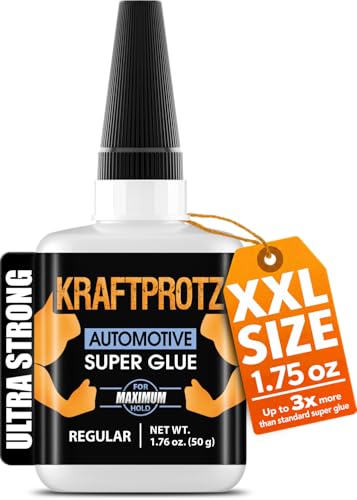
The KRAFTPROTZ Liquid CA uses a thin cyanoacrylate formula designed to flow into hairline cracks and microgaps where thicker adhesives simply can’t penetrate. This capillary action makes it perfect for headlight housings, dashboard splits, and trim seams that need an invisible bond from the inside out. The 1.76-ounce bottle holds roughly three times the volume of standard automotive glue tubes, which translates to fewer reorders and more consistent application across multiple repairs.
With a working temperature range of -40°F to 230°F, this adhesive holds fast through freezing startups and summer engine bay heat. The German-engineered recipe resists oil, vibration, and road grime, so bonds on underhood components and exterior panels stay sound even under constant mechanical stress. The precision dropper tip delivers controlled flow without overspill, and the anti-clog cap keeps the nozzle clear between uses — no crusted tips halfway through a job.
Owners consistently report that this glue outlasts name-brand alternatives in rim cracking and emblem reattachment scenarios. The 4-hour full cure means parts can be handled relatively quickly, but the bond continues to gain strength over the first 24 hours. For anyone tackling multiple plastic repairs in a garage or shop, the value-per-dose is hard to beat.
What works
- Exceptional capillary flow into microcracks
- XXL bottle lasts through many repairs
- Heat and oil resistant to 230°F
What doesn’t
- Liquid consistency not ideal for vertical surfaces
- Requires precise surface alignment before setting
2. 3M Plastic Emblem & Trim Adhesive 03601 (Pack of 3)

The 3M 03601 is a clear, industrial-strength acrylic adhesive formulated specifically for plastic and metal emblems, side trim, and interior panels. It sets in just 15 minutes and reaches full cure in 24 hours, which means you can press a badge into place and trust it to stay during the next wash cycle. The tube format allows precise bead application without over-application, critical for visible parts where squeeze-out would ruin the look.
3M’s weather-resistant formulation handles water, vibration, and automotive fluids without degrading — a common failure point for cheaper adhesives that turn cloudy or brittle after a few months. The pack of three tubes gives you backup for multi-vehicle projects or future repairs, and the clear drying makes it suitable for transparent or painted surfaces where color bleed would be noticeable. Many owners use this for reattaching loose emblems on BMW, Honda, and Ford models with high success rates.
Where this adhesive truly shines is adhesion to painted and clear-coated surfaces without lifting or staining. The quick set time also reduces the need for clamping or taping, though heavier trim pieces may still benefit from temporary support. For emblem-specific repairs where a strong, clean, and weatherproof bond is the end goal, this 3M product is the standard by which others are measured.
What works
- Sets in 15 minutes with no mixing required
- Clear finish works on painted and transparent parts
- Pack of 3 provides excellent project value
What doesn’t
- Not designed for gap-filling or structural repairs
- Tube size is small for multiple large repairs
3. J-B Weld Plastic Bonder Black 25ml Syringe (2 Pack)
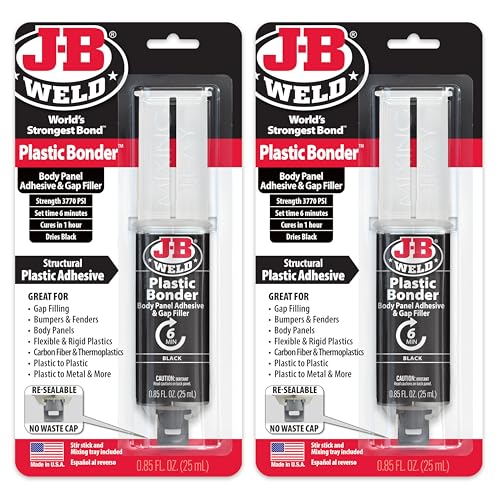
The J-B Weld Plastic Bonder is a two-part urethane adhesive that delivers 3770 PSI tensile strength — far beyond typical cyanoacrylate glues. This makes it the go-to choice for structural repairs like cracked bumper brackets, broken fender liners, or dented trim panels where the part must bear load or absorb impact. The black color blends well with dark plastic interiors and exterior trim, reducing the need for painting after the repair.
The syringe dispenses a 1:1 ratio automatically, eliminating guesswork and mess. After mixing, the material sets in 15 minutes and fully cures in 30 hours, giving you working time to position complex parts correctly. The formula bonds to thermoplastics, thermoset composites, fiberglass, and coated metals — essentially the full range of materials found in modern vehicles. The re-sealable cap keeps the syringe usable for months after opening, which matters for those who rarely tackle bumper-level repairs.
Customer reviews highlight its ability to fill dents and voids on bumper covers where thin glue would just run off. The gap-filling nature also means it works well on parts with mismatched edges or warped plastic. The trade-off is the 30-hour full cure — plan ahead if the repaired part sees immediate use. For anyone rebuilding a cracked bumper or reattaching a load-bearing bracket, this is the most mechanically robust option on the list.
What works
- Extremely high tensile strength at 3770 PSI
- Excellent gap-filling for dents and mismatched parts
- Resealable syringe allows multiple uses
What doesn’t
- 30-hour full cure requires planning
- Not water-resistant, avoid direct moisture exposure
4. KRAFTPROTZ Automotive Super Glue Gel 1.76 oz
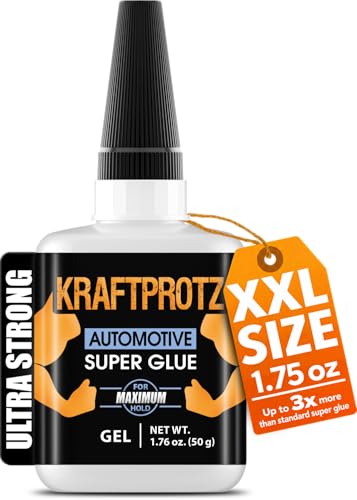
The KRAFTPROTZ Gel CA solves the vertical-surface problem that plagues thin adhesives. Its no-drip formula stays exactly where you apply it, making it ideal for bumper trim, mirror housings, fender clips, and any part that gravity would otherwise pull glue away from. The gel consistency also provides better gap-filling than thin CA, bridging small gaps where surfaces don’t mate perfectly — a common situation with warped plastic parts on older vehicles.
Like its liquid sibling, this gel handles vibration, oil, and temperature swings from -40°F up to 230°F. The 1.76-ounce bottle is again an XXL format that outlasts standard adhesive tubes by a wide margin. The anti-clog tip keeps the nozzle clear even when the bottle sits on a shelf for weeks between uses, which is a real convenience for garage users who don’t glue parts daily. The industrial-grade bond holds on ABS, PVC, fiberglass, and painted metal.
Owners commonly use this for reattaching loose trim pieces on trucks and SUVs where road vibration constantly stresses plastic clips. The gel doesn’t run or wick into unwanted areas, so cleanup stays minimal. The trade-off versus the liquid version is that gel cannot penetrate hairline cracks — choose the gel when you need the glue to stay put on a vertical surface and don’t need capillary flow.
What works
- No-drip gel stays on vertical panels
- Oil and heat resistant to 230°F
- XXL bottle covers multiple repairs
What doesn’t
- Cannot penetrate hairline microcracks
- Gel leaves a slightly thicker visible line
5. Tapsi Double Sided Tape Heavy Duty Automotive-Grade
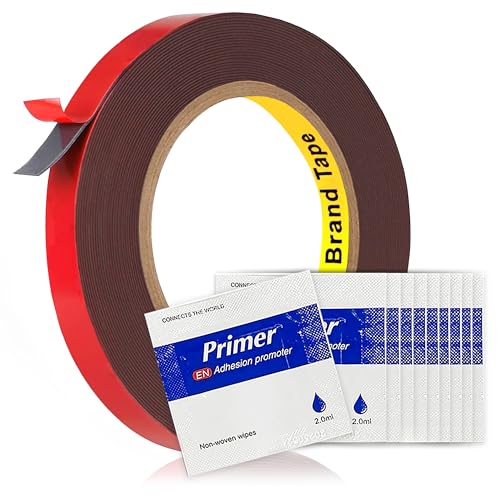
The Tapsi double-sided tape offers a non-chemical alternative for attaching trim, emblems, and LED strip lights without the mess or cure time of liquid adhesives. The 0.4-inch-wide foam tape is 0.03 inches thick with a viscoelastic acrylic core that absorbs vibration and road shock, preventing LED strips from loosening and trim pieces from rattling over time. The 36-foot roll gives you enough length for multiple vehicle projects or a full LED strip installation.
What sets this tape apart is the inclusion of 10 adhesion promoters, which dramatically improve grip on low-energy plastics like ABS, polypropylene, and textured trim surfaces where standard double-sided tape would peel off within weeks. The foam core conforms to irregular contours, which is essential for curved door trims and bumper edges. It resists heat, cold, rain, and repeated car washes, making it suitable for both interior and exterior use.
Customer feedback emphasizes the clean installation process — cut, peel, stick — and the fact that it can be removed cleanly with heat when needed. The main limitation is that it’s purely a mounting solution, not a gap-filler or structural adhesive. It excels for applications where you want to attach something without drilling or clamping, but won’t repair a cracked part. For quick, non-permanent upgrades to trim and lighting, this tape is the most convenient tool in the kit.
What works
- No curing or mixing required
- Included adhesion promoters improve plastic grip
- 36-foot roll covers many projects
What doesn’t
- Not a repair solution for cracks or breaks
- Thicker foam may show under tight trim gaps
Hardware & Specs Guide
Cyanoacrylate (CA) – Thin vs. Gel
Cyanoacrylate adhesives (super glues) cure rapidly when exposed to moisture in the air. Thin CA has a low viscosity that wicks into cracks by capillary action, ideal for tight seams like headlight housings. Gel CA has a thixotropic consistency that resists dripping on vertical panels like bumpers and trim. Both types typically handle -40°F to 230°F, but gel provides better gap-filling for slightly uneven surfaces.
Two-Part Epoxy (Urethane Adhesive)
Epoxies require mixing a resin and hardener before application. They cure via a chemical reaction rather than moisture exposure, which makes them more predictable in dry or humid environments. Tensile strength often ranges from 2000 to 4000+ PSI, significantly higher than CA glues. Epoxies fill gaps up to several millimeters and bond to a wider range of plastics including those that CA won’t grab well, but require 15-30 minutes of set time and up to 30 hours for full strength.
Acrylic Foam Mounting Tape
Acrylic foam tapes use a viscoelastic adhesive core that dissipates vibration energy and conforms to surface texture. They provide immediate bond strength without curing and work well on smooth plastic, painted metal, and glass. The adhesion is enhanced with primers or promoters for low-energy plastics like polypropylene. Temperature resistance typically ranges from -20°F to 200°F, suitable for most automotive exterior uses except direct exhaust heat zones.
Tensile Strength (PSI)
Tensile strength measures how much pulling force the adhesive can withstand before the bond breaks. For interior trim and non-structural parts, 1000-2000 PSI from a typical CA glue is sufficient. For bumper brackets, fender liners, and load-bearing panels, aim for 3000+ PSI from a two-part epoxy. Remember that surface preparation — cleaning with isopropyl alcohol and scuffing smooth plastics — matters as much as the adhesive’s nominal strength.
FAQ
Can I use regular super glue on car plastic parts?
How do I prepare plastic surfaces for automotive adhesive?
Which adhesive works best for reattaching a car emblem?
Will epoxy adhesive crack in cold weather?
Final Thoughts: The Verdict
For most buyers, the adhesive for plastic car parts winner is the KRAFTPROTZ Automotive Super Glue Liquid 1.76 oz because its thin CA formula penetrates microcracks that other adhesives can’t reach, and the XXL bottle covers dozens of repairs without reordering. If you need to reattach emblems with a clear, fast-setting bond, grab the 3M Plastic Emblem & Trim Adhesive 3-pack. And for structural repairs like cracked bumper brackets requiring high tensile strength, nothing beats the J-B Weld Plastic Bonder Black.

Certification: BSc in Mechanical Engineering
Education: Mechanical engineer
Lives In: 539 W Commerce St, Dallas, TX 75208, USA
Md Amir is an auto mechanic student and writer with over half a decade of experience in the automotive field. He has worked with top automotive brands such as Lexus, Quantum, and also owns two automotive blogs autocarneed.com and taxiwiz.com.