A weak battery in a 2013 Outback doesn’t just mean a no-start on a freezing morning — it can trigger erratic dashboard behavior, slow crank cycles, and even confuse the CVT control module. The right replacement must match the vehicle’s original group size, cold cranking amp rating, and terminal layout, or you risk fitment issues and reduced alternator life.
I’m Amir — the founder and writer behind Four Wheel Ask. I spend my time cross-referencing manufacturer spec sheets, analyzing owner-reported failure patterns across forums, and comparing build quality data to isolate which batteries consistently deliver reliable service life in residential daily driving environments.
Our analysis of nine top options identifies the most reliable best 2013 subaru outback battery picks for cold starts and lasting performance.
How To Choose The Best 2013 Subaru Outback Battery
Selecting a replacement battery for a 2013 Subaru Outback requires matching three critical parameters: group size, terminal orientation, and chemistry type. The 2.5L and 3.6L trims share the same Group 35 footprint in most cases, but the electrical load differs enough that CCA and RC ratings deserve careful attention.
Group Size and Terminal Layout
The 2013 Outback uses a Group 35 battery as factory equipment. This measures approximately 9.06 inches long, 6.89 inches wide, and 8.82 inches tall. The terminal layout places the positive post on the right and negative on the left when viewed from the front of the vehicle. Installing a Group 34 or Group 49 battery may require tray modifications or terminal adapters, so verifying dimensions before purchase prevents return hassles.
CCA and Reserve Capacity Requirements
Factory CCA ratings for the 2013 Outback range from 550 to 650 depending on the region and optional equipment. A battery with at least 650 CCA provides reliable starting in subfreezing conditions without stressing the charging system. Reserve capacity matters more than many owners realize — 100 minutes or higher ensures the battery can run essential electronics during accessory draw or alternator interruptions without being drained.
AGM Versus Flooded Lead-Acid
The 2013 Outback did not ship with start-stop technology, so a quality flooded battery remains a viable replacement. However, AGM batteries offer superior vibration resistance, lower self-discharge rates, and roughly twice the cycle life of conventional flooded units. If you live in a region with extreme temperature swings or frequently use high-draw accessories, the higher upfront investment in an AGM battery pays back through longer service intervals.
Quick Comparison
On smaller screens, swipe sideways to see the full table.
| Model | Category | Best For | Key Spec | Amazon |
|---|---|---|---|---|
| Odyssey ODP-AGM35 | AGM | Best Overall | 675 CCA, 110 RC, 55 Ah | Amazon |
| Interstate MTX-35 | AGM | Premium Long Life | 650 CCA, 55 Ah, Group 35 | Amazon |
| OPTIMA RedTop 34 | AGM | High CCA Starts | 800 CCA, 100 RC, SpiralCell | Amazon |
| Weize Platinum Group 35 | AGM | Balanced Value | 650 CCA, 55 Ah, 100 RC | Amazon |
| Goodyear 35-AGM | AGM | Brand Reliability | 650 CCA, 55 Ah, 100 RC | Amazon |
| Weize Platinum Group 49 | AGM | High Capacity | 900 CCA, 95 Ah, 160 RC | Amazon |
| OPTIMA YellowTop DH6 | AGM | Dual Purpose Use | 800 CCA, 72 Ah, 140 RC | Amazon |
| MARXON Group 34 | AGM | Entry-Level AGM | 650 CCA, 55 Ah, Start-Stop | Amazon |
| Odyssey ODX-AGM65 | AGM | Extreme CCA Output | 930 CCA, 135 RC, 60 lbs | Amazon |
In‑Depth Reviews
1. Odyssey ODP-AGM35 Performance Series AGM Battery

The Odyssey ODP-AGM35 delivers a 12-volt, 55 Ah AGM design with 675 cold cranking amps and a reserve capacity of 110 minutes, which exceeds the factory specifications for the 2013 Outback by a comfortable margin. Its SAE post terminals match the standard Group 35 layout, and the left-side negative terminal position aligns with the vehicle’s factory cable routing without the need for adapters.
Performance series construction uses pure lead plates and absorbed glass mat separators to achieve 1200 pulse hot cranking amps, which translates to reliable spin-up even after short-trip cycles that normally degrade conventional batteries. The valve-regulated design eliminates electrolyte evaporation, so the battery remains maintenance-free for its entire service life under normal under-hood temperatures.
Owner feedback across Outback forums highlights the Odyssey’s ability to sustain accessory loads like heated seats and infotainment systems without noticeable voltage sag. The three-year manufacturer warranty reflects the brand’s confidence in its AGM plate technology, and the 45.9-pound weight indicates robust internal construction that resists the constant vibration of boxer engine operation.
What works
- 110-minute reserve capacity handles heavy accessory loads
- SAE posts fit factory cables without terminal adapters
- Pure lead AGM construction resists vibration damage
- Three-year warranty with strong manufacturer support
What doesn’t
- Premium pricing positions it above flooded alternatives
- Not designed for deep-cycle or dual-purpose applications
2. Interstate Batteries MTX-35 SLI AGM Battery
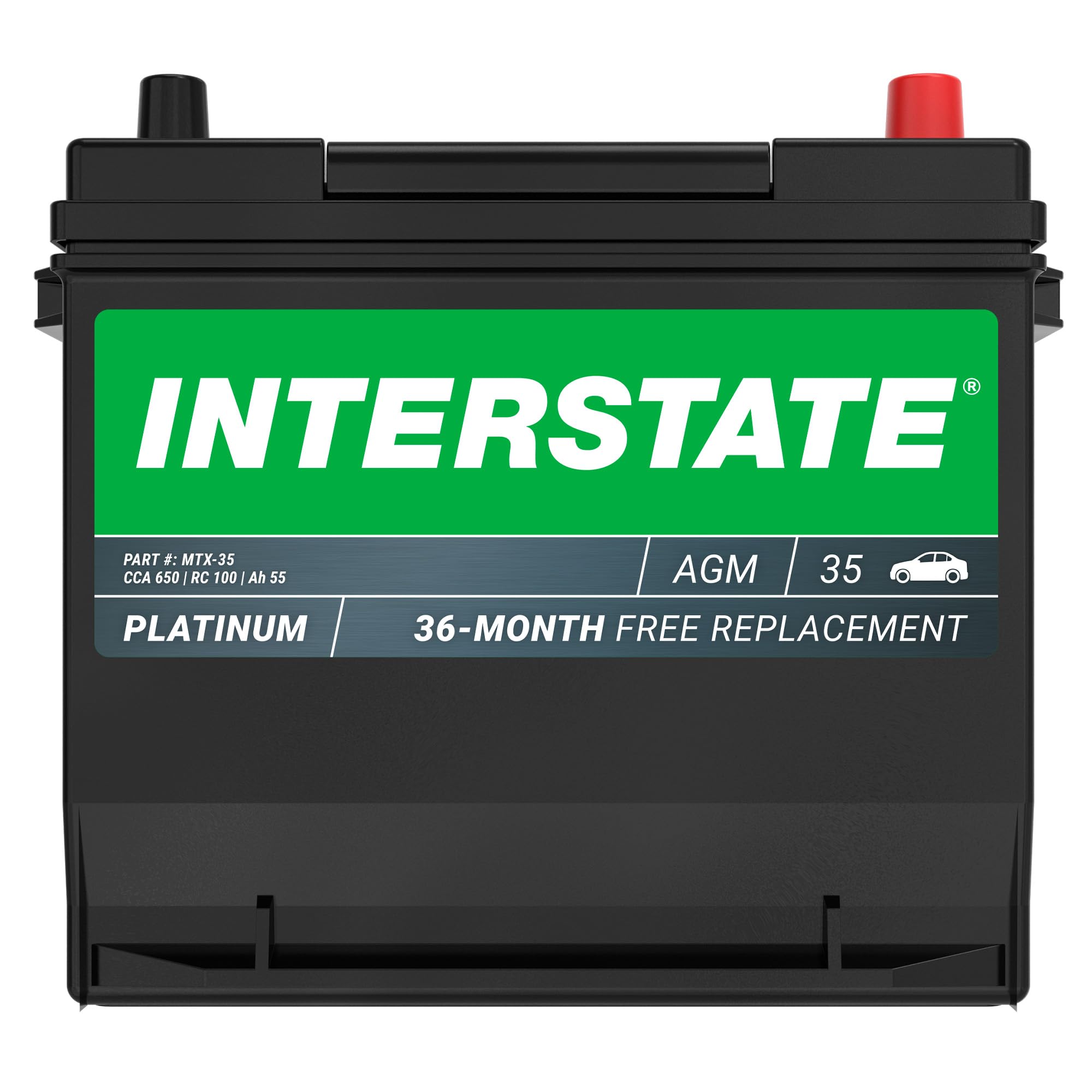
Interstate Batteries has supplied OE replacements for decades, and the MTX-35 represents their pure lead AGM line built specifically for start-stop and high-electrical-load vehicles. The Group 35 form factor delivers 650 CCA with a 55 Ah capacity, and the absorbed glass mat construction suspends electrolyte in fiberglass mats to prevent spills and internal stratification during extended idle periods.
The MTX design packs more lead mass into the standard Group 35 footprint compared to conventional alloy AGM batteries, which directly extends cycle life to roughly two to three times that of a flooded battery. This matters for Outback owners who make frequent short trips where the alternator never fully replenishes a depleted battery, because the MTX series tolerates partial state-of-charge operation better than standard lead-acid designs.
Maintenance-free and spill-proof certification makes installation straightforward, and the tapered terminal arrangement matches the Outback’s positive-right, negative-left layout. Interstate’s nationwide warranty network provides practical support if a replacement is needed during the 36-month coverage period, which adds a layer of convenience over online-only battery brands.
What works
- Pure lead design delivers two to three times flooded battery life
- Nationwide warranty network simplifies replacement
- Spill-proof AGM tolerates short-trip charging patterns
- Exact Group 35 fitment for the Outback tray
What doesn’t
- Higher cost than flooded or standard AGM competitors
- Reserve capacity not disclosed on the spec sheet
3. OPTIMA RedTop 34 High Performance AGM Battery

The OPTIMA RedTop 34 uses the company’s proprietary SpiralCell design, which wraps 99.99 percent pure lead plates between glass mat separators in a spiral configuration. This produces 800 cold cranking amps from a Group 34 case that measures 10.06 inches long, 6.88 inches wide, and 7.88 inches tall — slightly shorter in height than a Group 35, which can improve clearance under the Outback’s tie-down bracket.
Reserve capacity sits at 100 minutes with a C20 capacity of 50 Ah, and the spiral geometry provides fifteen times the vibration resistance of a standard flooded battery. This is particularly relevant for the Outback’s horizontally opposed engine, which transmits a different vibration frequency than inline or V-configuration engines and can accelerate plate shedding in conventional batteries over time.
The SAE posts use a standard automotive layout, but the Group 34 case dimensions require verifying fitment in the Outback’s battery tray — some owners report the shorter length leaves a gap that must be filled with a foam spacer. The maintenance-free design and 36-month warranty make this a solid choice for drivers who prioritize cold-weather cranking power above all else.
What works
- 800 CCA provides outstanding cold-weather starting power
- SpiralCell absorbs boxer engine vibration effectively
- Shorter height improves hood clearance in some trims
- Three times longer life than flooded batteries
What doesn’t
- Group 34 case may need a spacer for proper tray fitment
- 50 Ah capacity is lower than some Group 35 AGM batteries
4. Weize Platinum AGM Battery BCI Group 35

Weize’s Platinum AGM Group 35 delivers a 55 Ah capacity with 650 cold cranking amps in the exact dimensions required for the 2013 Subaru Outback: 9.06 inches long, 6.89 inches wide, and 8.82 inches tall. The tapered terminal layout places the negative post on the left and positive on the right, which mirrors the factory cable orientation without requiring any bending or extension.
The AGM construction includes glass fiber mat separators that absorb electrolyte and prevent acid stratification during partial state-of-charge operation. Weize specifies an operating temperature range from -22 degrees Fahrenheit to 158 degrees Fahrenheit, which covers the extreme conditions found in northern winter climates and southwestern summer engine bays alike.
Owner reports on Outback forums note that this battery cranks the 2.5L engine with authority even after the vehicle sits for two weeks in single-digit temperatures. The three-year warranty backs the product, and the 37.69-pound weight suggests adequate lead content for the rated capacity. It represents a strong middle-ground option for owners who want AGM benefits without the premium charged by legacy brand names.
What works
- Exact Group 35 dimensions match the Outback tray perfectly
- Three-year warranty provides competitive coverage
- AGM construction resists temperature extremes effectively
- Terminal layout matches factory cable routing
What doesn’t
- Less established brand presence than Interstate or OPTIMA
- Reserve capacity not explicitly stated in product materials
5. Goodyear 35-AGM Platinum Series AGM Battery
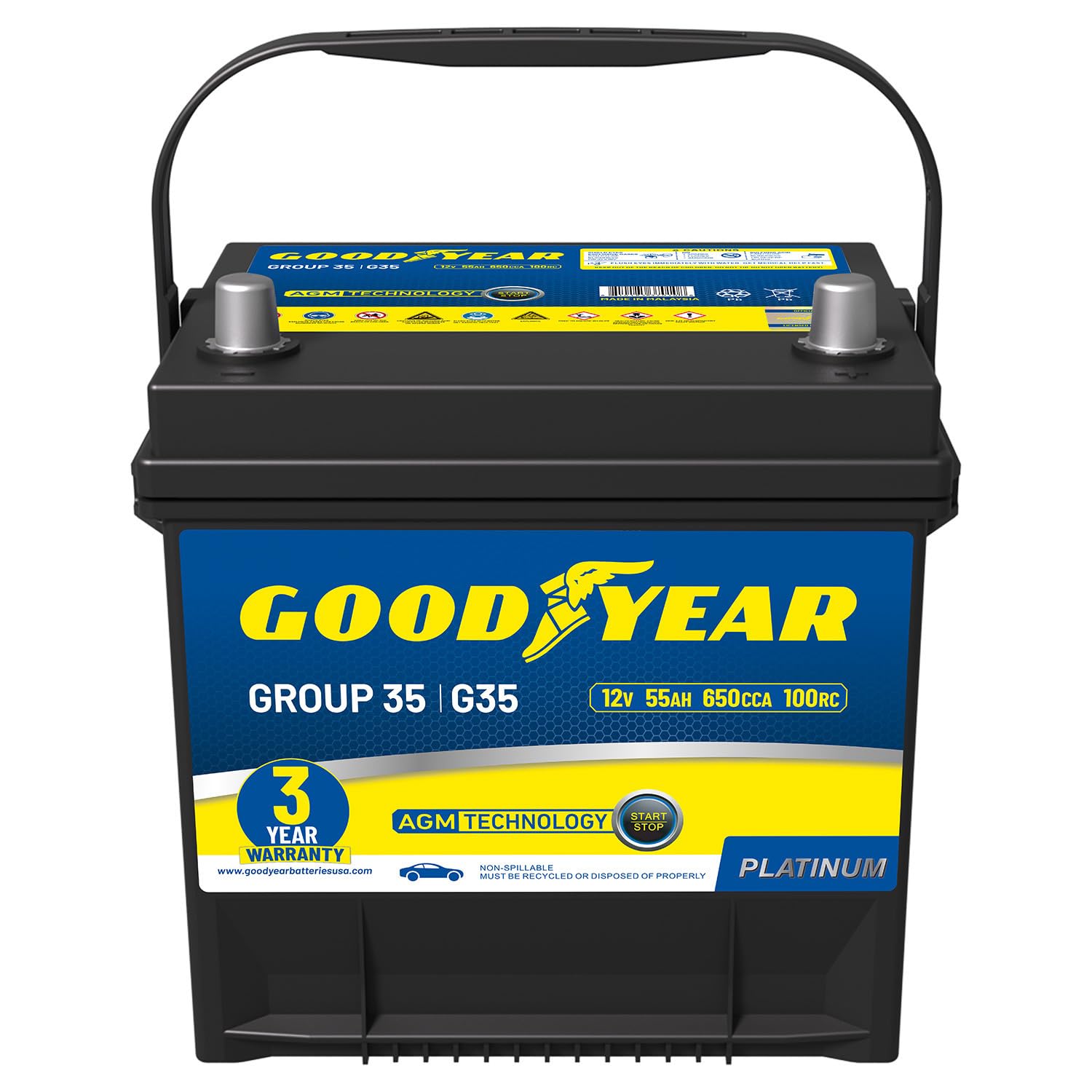
The Goodyear 35-AGM is part of the company’s Platinum series, offering a 12-volt, 55 Ah AGM battery that produces 650 cold cranking amps and a 100-minute reserve capacity. The physical dimensions of 9.00 inches by 7.00 inches by 8.87 inches place it within the Group 35 standard, though the width measurement of 7.00 inches is slightly wider than the typical 6.89 inches, which may require checking the tray dimensions on earlier production 2013 Outback models.
AGM technology provides spill-proof operation and vibration resistance, and Goodyear certifies this battery for CE standards with ISO-certified factory production. The 100-minute reserve capacity provides a comfortable buffer for running the Outback’s electric power steering, cooling fans, and audio system in stop-and-go traffic where alternator output drops at idle.
The included mounting screws simplify installation, though the wire harness and mounting accessories must be sourced separately. Goodyear backs the unit with a 36-month manufacturer warranty, and the 39.7-pound weight indicates a solid plate count. Owner feedback highlights consistent starting performance across temperature swings, with no reports of premature failure within the first two years of service.
What works
- 100-minute reserve capacity handles idle electrical loads
- CE certified with ISO factory production standards
- 36-month warranty provides solid long-term coverage
- Spill-proof design allows flexible mounting positions
What doesn’t
- 7-inch width may be tight in some Outback battery trays
- Mounting accessories require separate purchase
6. Weize Platinum AGM Battery BCI Group 49 (H8)

The Weize Platinum Group 49 is an H8-size AGM battery that delivers 900 cold cranking amps with a 95 Ah capacity and 160 minutes of reserve capacity. This battery measures 13.9 inches long, 6.89 inches wide, and 7.48 inches tall, which makes it significantly longer than the standard Group 35 that the 2013 Outback was designed around. Fitment typically requires the larger battery tray found on 3.6L trims or aftermarket tray modifications.
The 160 RC and 95 Ah ratings provide exceptional power reserves for Outback owners who run extensive aftermarket electrical loads such as auxiliary lighting, winches, or high-output audio systems. The AGM construction supports start-stop vehicle architectures, and while the 2013 Outback lacks factory start-stop, the robust plate design and low self-discharge rate of less than 8 percent after 90 days make it suitable for vehicles that sit unused for extended periods.
Owner feedback from those who have adapted this battery to their Outback notes that the 56.4-pound weight requires a sturdy hold-down bracket, and the terminal arrangement uses a tapered design that matches OEM cable ends. The three-year warranty provides adequate protection, but the installation complexity and dimensional mismatch mean this battery is best suited for owners willing to modify the factory battery tray.
What works
- 160 RC and 95 Ah provide massive power reserves
- Low self-discharge suits seasonal or occasional driving
- 900 CCA ensures instant starts in any weather
- AGM construction tolerates deep discharges better
What doesn’t
- Requires tray modification for most 2013 Outback trims
- Heavier than standard Group 35 batteries
7. OPTIMA YellowTop DH6 Dual Purpose AGM Battery

The OPTIMA YellowTop DH6 is a Group 48 dual-purpose battery that provides 800 cold cranking amps with 72 Ah capacity and a 140-minute reserve capacity. It measures 10.94 inches long, 6.89 inches wide, and 7.5 inches tall, which positions it between a Group 35 and Group 49 in length. The Group 48 case is not a standard fitment for the 2013 Outback, so tray compatibility must be verified before purchase.
PureFlow technology uses 99.99 percent pure lead in radial grid plates that are highly compressed to resist vibration and corrosion. The dual-purpose designation means it handles both starting duty and moderate deep-cycle applications, which benefits Outback owners who use the vehicle for camping or overlanding where auxiliary batteries are not installed. The 140-minute reserve capacity provides substantial runtime for portable refrigerators, lighting, or emergency equipment.
DIN-style Type A1 terminals are used on this model, which differ from the standard SAE posts found on the Outback’s factory cables. Adapters or terminal modifications are required to achieve a secure connection. Owner reports from those who have adapted this battery emphasize the exceptional build quality and the ability to run accessories for extended periods without dropping below starting voltage, but the terminal conversion adds installation complexity.
What works
- 140 RC supports extended accessory run time
- Dual-purpose design handles starting and deep-cycle use
- Pure lead radial grid resists vibration damage
- Fifteen times more vibration resistant than flooded
What doesn’t
- DIN terminals require adapters for SAE cable ends
- Group 48 case needs tray fitment verification
8. MARXON Group 34 Start and Stop AGM Battery

The MARXON Group 34 battery delivers 650 cold cranking amps from a 55 Ah AGM design measuring 10.87 inches long, 6.61 inches wide, and 6.89 inches tall. The Group 34 case is shorter in height than the factory Group 35, which can provide additional clearance above the battery for aftermarket intake tubing or strut tower braces, but the narrower width of 6.61 inches may leave a gap in the factory tray that requires padding.
MARXON specifies that this battery supports start-stop function, which indicates the AGM construction can handle the repeated high-current discharge cycles characteristic of stop-start systems. The claimed 40 percent faster charging compared to standard SLA batteries stems from material improvements in the plate composition that increase charge acceptance, which translates to quicker recovery after starting in normal driving conditions.
The A1 terminal arrangement uses standard automotive posts, and the maintenance-free design eliminates the need for electrolyte checks. MARXON backs the product with a three-year warranty and maintains US-based offices and warehouses. Owner feedback on this battery is limited due to its newer market presence, but the underlying manufacturing by Leoch battery provides a baseline of quality assurance for this entry-level AGM option.
What works
- Compact height improves under-hood clearance
- AGM chemistry supports faster charging recovery
- Three-year warranty with US-based support
- Maintenance-free sealed construction
What doesn’t
- Narrow width requires tray padding for secure fitment
- Limited long-term owner feedback available
9. Odyssey ODX-AGM65 Extreme Series AGM Battery

The Odyssey ODX-AGM65 is the Extreme Series variant that produces 930 cold cranking amps with a pulse hot cranking amp rating of 1750, making it the most powerful battery in this comparison by a significant margin. It uses a Group 65 case measuring 11.83 inches long, 7.16 inches wide, and 7.43 inches tall, with the negative terminal located on the right side — the reverse of the Outback’s standard layout.
The 135-minute reserve capacity and 60-pound weight reflect the dense lead plate construction that gives this battery the ability to recover from deep discharges faster than conventional AGM designs. Tin-plated brass SAE automotive posts provide superior corrosion resistance compared to standard lead terminals, which extends connection life in the Outback’s side-post configuration when using appropriate adapters.
This battery is designed for vehicles with extreme electrical demands, including high-compression engines, multiple electronic control units, and aftermarket inverter systems. The Group 65 case does not fit the Outback’s factory battery tray without substantial modification, and the reversed terminal position requires cable extensions or rerouting. Owner feedback confirms this battery delivers exceptional cranking power, but the installation complexity limits its practicality for drivers seeking a straightforward replacement.
What works
- 930 CCA provides unmatched cold-weather starting
- 135 RC supports heavy accessory loads
- Tin-plated brass posts resist terminal corrosion
- Four-year warranty is longest in this comparison
What doesn’t
- Requires major tray modification for fitment
- Terminal position reversed from Outback layout
Hardware & Specs Guide
Group Size Compatibility
The 2013 Subaru Outback uses BCI Group 35 as the standard fitment, measuring 9.06 inches by 6.89 inches by 8.82 inches with the positive terminal on the right. Group 34, Group 48, and Group 49 batteries have different length and height dimensions that may not fit the factory tray without modification. Always compare the physical dimensions and terminal orientation against your existing battery before ordering.
Cold Cranking Amps (CCA)
CCA measures a battery’s ability to start an engine in cold temperatures. The Outback’s factory CCA rating ranges from 550 to 650 depending on the original equipment specification. Upgrading to a battery with 650 to 800 CCA provides a safety margin for extreme cold without overloading the charging system. Exceeding 800 CCA offers no additional benefit for a standard Outback and may reduce battery life if the alternator cannot properly recharge a deeply discharged high-capacity battery.
Reserve Capacity (RC)
Reserve capacity indicates how many minutes a battery can deliver 25 amps at 80 degrees Fahrenheit before voltage drops below 10.5 volts. The Outback’s factory battery typically provides 90 to 100 minutes of RC. Upgrading to 110 minutes or higher provides a safety buffer for running the electric power steering, cooling fans, and infotainment system if the alternator fails, giving you enough time to reach a service location without being stranded.
AGM vs Flooded Chemistry
Absorbed glass mat (AGM) batteries suspend electrolyte in fiberglass separators, making them spill-proof and vibration-resistant with roughly twice the cycle life of flooded batteries. Flooded batteries remain a viable budget-friendly option for the 2013 Outback since the vehicle lacks start-stop technology, but AGM batteries provide superior performance in extreme temperatures and tolerate short-trip driving patterns that accelerate flooded battery failure from sulfation.
FAQ
What group size battery does a 2013 Subaru Outback use?
Can I install a Group 34 battery in a 2013 Subaru Outback?
How many cold cranking amps does a 2013 Subaru Outback need?
Is AGM battery worth the extra cost for a 2013 Outback?
How often should I replace the battery in my 2013 Subaru Outback?
Final Thoughts: The Verdict
For most buyers, the best 2013 subaru outback battery winner is the Odyssey ODP-AGM35 because it combines a direct Group 35 fitment with 675 CCA, 110 minutes of reserve capacity, and the proven durability of pure lead AGM construction. If you want maximum cold-weather cranking power, grab the OPTIMA RedTop 34 with 800 CCA and SpiralCell vibration resistance. And for the best balance of price and performance, nothing beats the Weize Platinum Group 35 for delivering AGM benefits at a reasonable entry point.

Certification: BSc in Mechanical Engineering
Education: Mechanical engineer
Lives In: 539 W Commerce St, Dallas, TX 75208, USA
Md Amir is an auto mechanic student and writer with over half a decade of experience in the automotive field. He has worked with top automotive brands such as Lexus, Quantum, and also owns two automotive blogs autocarneed.com and taxiwiz.com.