A dual-bank lithium charger does more than just fill two batteries — it manages voltage curves, compensates for temperature shifts, and prevents the parasitic drain that kills deep-cycle systems during off-season storage. Get the profile wrong, and even a premium LiFePO4 pack degrades faster than a flooded lead-acid unit left unattended. That makes the charger selection just as critical as the battery itself.
I’m Amir — the founder and writer behind Four Wheel Ask. I analyze product specifications, build quality metrics, and real owner feedback to separate marketing claims from genuine performance in the marine and RV charging market.
Understanding how charging profiles, waterproof ratings, and per-bank amperage interact is essential before making a purchase. A well-chosen best 2 bank lithium battery charger keeps your marine or RV batteries charged, maintained, and ready for action without overcharging or damage.
How To Choose The Best 2 Bank Lithium Battery Charger
Selecting a dual-bank charger requires matching the electrical demands of your battery chemistry with the environmental conditions of the installation location. Overlooking per-bank current, voltage precision, or ingress protection leads to undercharging, premature battery aging, or outright failure in wet compartments.
Per-Bank Amperage and Charging Speed
The total amperage rating of a dual-bank charger is split across both outputs. A 10-amp unit delivers 5 amps per bank, while a 20-amp unit delivers 10 amps per bank. Higher per-bank current reduces charge time but requires thicker wiring and adequate ventilation. For deep-cycle LiFePO4 batteries above 50 amp-hours, a minimum of 5 amps per bank is recommended to complete a full charge cycle within a reasonable window.
Waterproof and Dust Ingress Protection
Chargers installed in bilges, engine compartments, or exposed deck areas demand a high ingress protection rating. IP68 certification indicates the unit is fully sealed against dust and can withstand continuous submersion beyond one meter. IP65 offers splash protection suitable for drier compartments. Choosing a lower rating in a wet environment risks corrosion and internal short circuits.
Battery Chemistry Compatibility and Charging Profiles
Lithium iron phosphate batteries require a constant current/constant voltage profile with an absorption voltage around 14.4 to 14.6 volts and a termination current that drops to near zero. Chargers that offer selectable modes for LiFePO4, lead-acid, AGM, and calcium allow you to optimize the charge curve for each battery type independently on each bank, which is critical when mixing chemistries across banks.
Safety Protections and Diagnostic Features
Reverse polarity protection, over-temperature shutdown, overcurrent limiting, and short-circuit prevention are non-negotiable for permanent installations. Advanced diagnostics with LED indicators for fault conditions such as bad battery, over-voltage, or reverse connection speed up troubleshooting and prevent damage to connected equipment. Force mode capability, which allows charging from zero volts, is valuable for reviving deeply depleted lithium batteries.
Quick Comparison
On smaller screens, swipe sideways to see the full table.
| Model | Category | Best For | Key Spec | Amazon |
|---|---|---|---|---|
| NOCO Genius GEN5X2 | Onboard | Premium marine systems | 5A per bank, IP68 | Amazon |
| LiTime 2-Bank 10A | High-Current | Large deep-cycle banks | 10A per bank, 14.6V | Amazon |
| Tecmate Optimate 2 Duo | Maintainer | Long-term storage | 2A per bank, SAE | Amazon |
| Schumacher SC1410 | Maintainer | Light-duty power sports | 2A, auto detect 6V/12V | Amazon |
| FirstPower Pro 5X2 | Onboard | Harsh marine environments | 5A per bank, 3-year warranty | Amazon |
| ECO-Worthy 2 Bank | Onboard | Value marine installs | 5A per bank, IP68 | Amazon |
| VEVOR 2 Bank | Budget | Entry-level dual charging | 5A per bank, IP68 | Amazon |
In‑Depth Reviews
1. NOCO Genius GEN5X2

The NOCO Genius GEN5X2 delivers 5 amps per bank in a package that is 37 percent smaller and 43 percent more powerful than its predecessor. Its IP68 rating ensures full submersion protection, making it one of the most durable onboard chargers for marine environments where moisture and salt exposure are constant threats.
Selectable charging modes for 12V standard, 12V AGM, 12V Lithium, and Repair Mode allow independent optimization on each bank. The integrated thermal sensor adjusts voltage based on ambient temperature, preventing overcharge in hot climates and undercharge in cold conditions — a feature that directly preserves LiFePO4 cycle life during seasonal transitions.
Force Mode enables charging from zero volts, recovering deeply depleted batteries that standard chargers would reject. The anti-vibration mounting backing isolates shock and reduces noise, and the 72-inch DC cables with 3/8-inch eyelets simplify installation in tight compartments. A 3-year warranty backs the build quality.
What works
- Compact footprint with exceptional marine-grade sealing
- Thermal compensation prevents overcharge in high heat
- Force Mode revives zero-volt lithium batteries
What doesn’t
- Per-bank amperage limited to 5 amps
- No display screen for real-time voltage readout
2. LiTime 2-Bank 10A
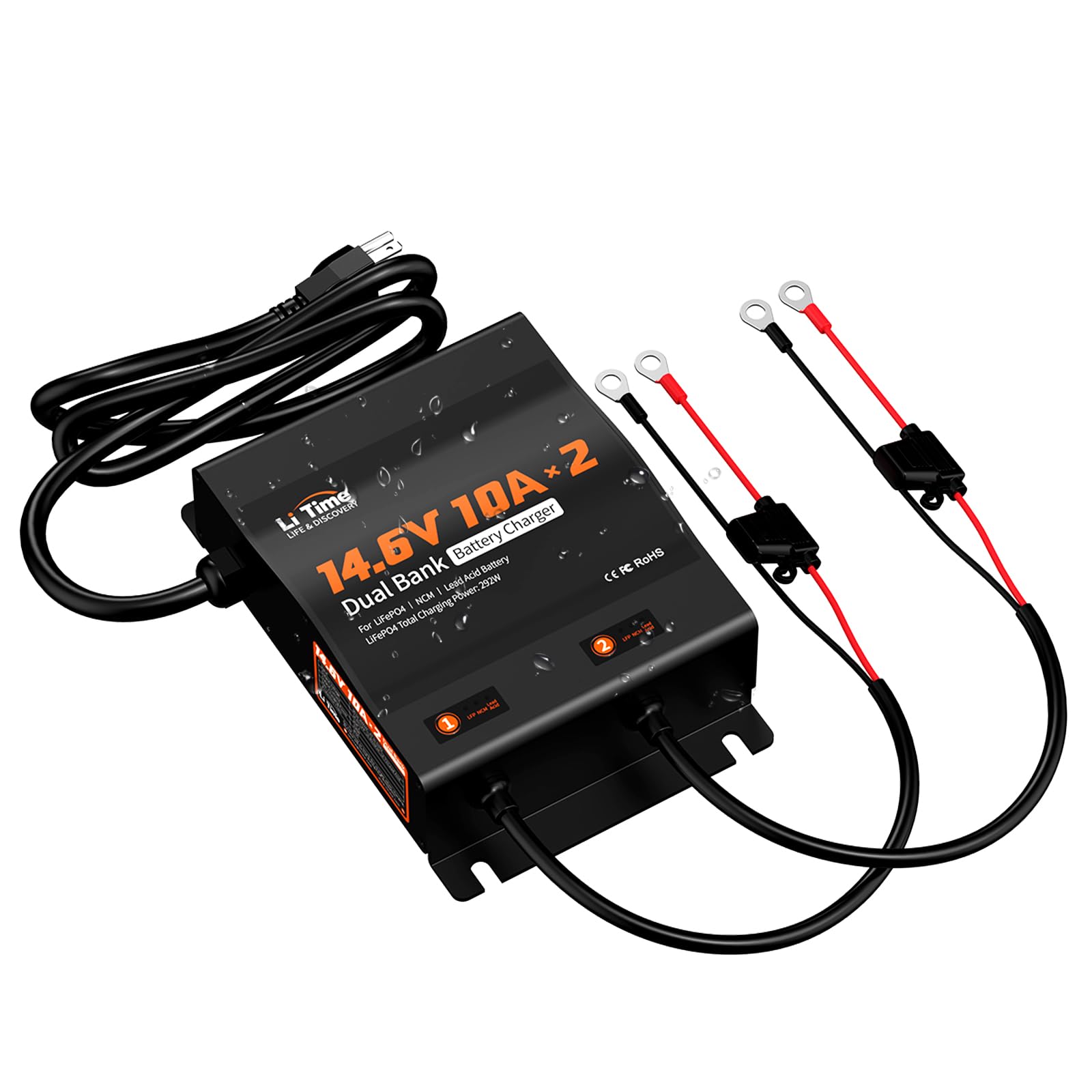
The LiTime 2-Bank 10A stands out with a full 10 amps per bank, delivering double the per-channel current of most competitors in this class. That translates to significantly reduced charge times for large deep-cycle LiFePO4 banks commonly found in RVs, trolling motor setups, and backup generator systems.
Charging specs are tuned to 14.6 volts, which matches the absorption requirement of four-cell LiFePO4 chemistry. The unit accepts 90-to-260-volt AC input, making it suitable for global use, and includes 15-amp fuses on the wall cord for added safety. The M8 ring terminals provide a secure, low-resistance connection suitable for permanent installation.
IP65 splash protection covers drier compartments, though it does not match the full submersion rating of IP68 units. CE, FCC, and RoHS certifications back the electrical safety design. A 2-year warranty covers manufacturing defects, and the compact 6.6-pound chassis fits into confined spaces without difficulty.
What works
- Highest per-bank amperage at 10 amps
- 14.6V output aligns with LiFePO4 absorption curve
- M8 terminals ensure robust permanent connections
What doesn’t
- IP65 rating limits wet-environment installation
- No dedicated AGM or calcium mode
3. Tecmate Optimate 2 Duo TM-571

The Tecmate Optimate 2 Duo is a 5-step sealed charger and maintainer designed for independent charging of two 12-volt lead-acid or 12.8-volt lithium batteries. Each bank delivers 2 amps, which positions it as a maintenance and recovery tool rather than a rapid bulk charger for large-capacity banks.
This unit is recommended by Honda, Yamaha, Kawasaki, KTM, and Husqvarna, as well as battery manufacturers Antigravity, Super-B, and Earth-X — an endorsement that reflects consistency in charge algorithm accuracy. The fully automatic operation switches to continuous maintenance when the battery reaches full charge and halts charging if a fault is detected.
The SAE connector system allows quick swapping between battery clips and permanent ring terminal leads. A fully sealed case protects against spillage and light rain, though the unit is not rated for continuous submersion. Recovery capability extends to deeply discharged batteries that other chargers cannot revive.
What works
- OEM-level endorsements from major vehicle and battery brands
- 5-step adaptive charge algorithm preserves battery health
- Compact sealed design for storage applications
What doesn’t
- 2 amps per bank is slow for large deep-cycle batteries
- No IP rating for submersion environments
4. Schumacher Electric SC1410

The Schumacher SC1410 is a 2-amp dual-bank charger and maintainer that automatically detects 6-volt and 12-volt batteries. Its microprocessor-controlled charging adjusts voltage and current based on battery condition, providing a smart maintenance solution for power sports, automotive, and marine batteries without requiring manual mode selection.
When the battery reaches full charge, the unit automatically shifts to float mode, preventing overcharge while keeping the battery ready. Reverse hook-up protection safeguards the charger and battery if the clamps are connected with incorrect polarity — a common point of failure with budget chargers.
The included wall-mount hook allows installation outside the work area, keeping the charger dry and out of the way. The SC1410 supports standard, AGM, and gel cell batteries, but its 2-amp output makes it best suited for maintaining batteries that are already near full charge rather than bulk charging deeply depleted units.
What works
- Automatic 6V/12V detection simplifies operation
- Reverse hook-up protection prevents damage
- Compact and wall-mountable for convenient storage
What doesn’t
- 2-amp output inadequate for large deep-cycle batteries
- No lithium-specific charge profile available
5. FirstPower Pro 5X2

The FirstPower Pro 5X2 delivers 5 amps per bank in a fully IP68-sealed chassis rated for continuous onboard charging. Three independent modes — SLA/AGM, Lithium, and Calcium — allow each bank to use a different charging profile simultaneously, which is useful for dual-battery systems that mix chemistries.
Force Mode manually initiates charging for batteries below 1 volt by holding the MODE button for 5 seconds, recovering deeply discharged LiFePO4 packs that would otherwise appear dead. The 5-grid power display shows 20, 40, 60, 80, and 100 percent charge status, giving a clear visual reference without needing a multimeter.
Integrated diagnostics detect over-voltage, bad battery, over-temperature, and reverse connection, with dedicated LED indicators for each fault. An ambient thermal sensor adjusts the charge rate to prevent overcharge in hot weather and undercharge in cold conditions. The 3-year warranty exceeds the industry average for this price tier.
What works
- Independent chemistry selection per bank
- 5-grid power display for at-a-glance status
- 3-year warranty provides long-term coverage
What doesn’t
- 5 amps per bank limits charging speed for large banks
- Gray chassis may show marine grime more readily
6. ECO-Worthy 2 Bank Marine Battery Charger
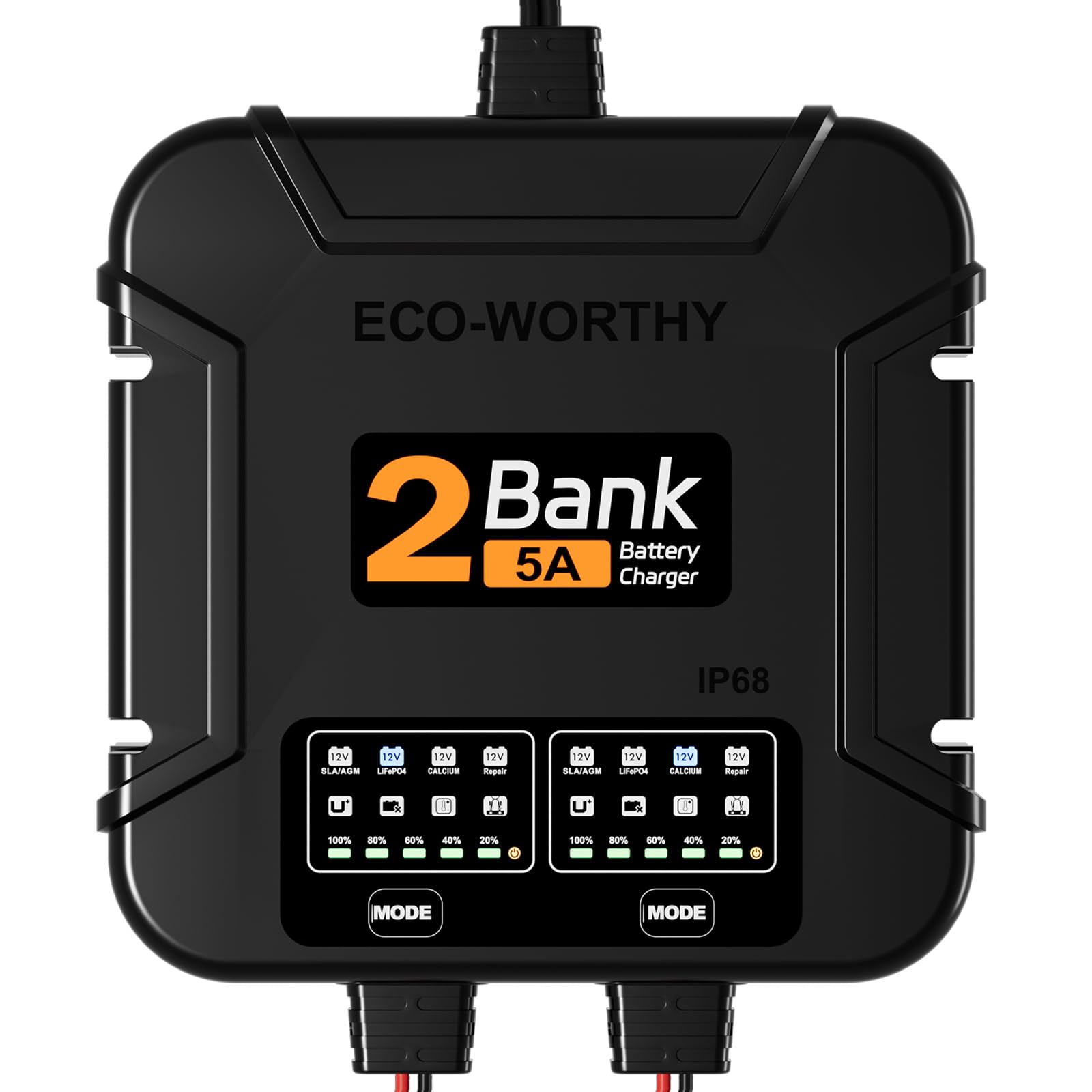
The ECO-Worthy 2 Bank charger offers 5 amps per bank with full IP68 sealing against water, dust, and corrosion. Three charging modes — SLA/AGM, Lithium, and Calcium — enable independent chemistry selection on each bank, and the unit automatically detects battery health through its advanced diagnostic LED system.
Force Mode revives lithium batteries below 1 volt by pressing and holding the MODE button for 5 seconds. The automatic repair mode targets sulfated lead-acid batteries, using a dedicated 12V Repair indicator that activates when stratification or sulfation is detected, restoring lost performance and extending service life.
Comprehensive multi-protection covers over-voltage, over-temperature, overcurrent, short-circuits, and reverse polarity. The 10-amp total output is split evenly across both banks, and the included alligator clips provide a convenient connection for temporary setups. A 1-year warranty covers the unit for manufacturing defects.
What works
- Full IP68 sealing for harsh marine environments
- Automatic lead-acid repair mode extends battery life
- Independent chemistry selection per bank
What doesn’t
- 1-year warranty is shorter than some competitors
- Alligator clips less secure than ring terminals for permanent install
7. VEVOR 2 Bank Marine Battery Charger
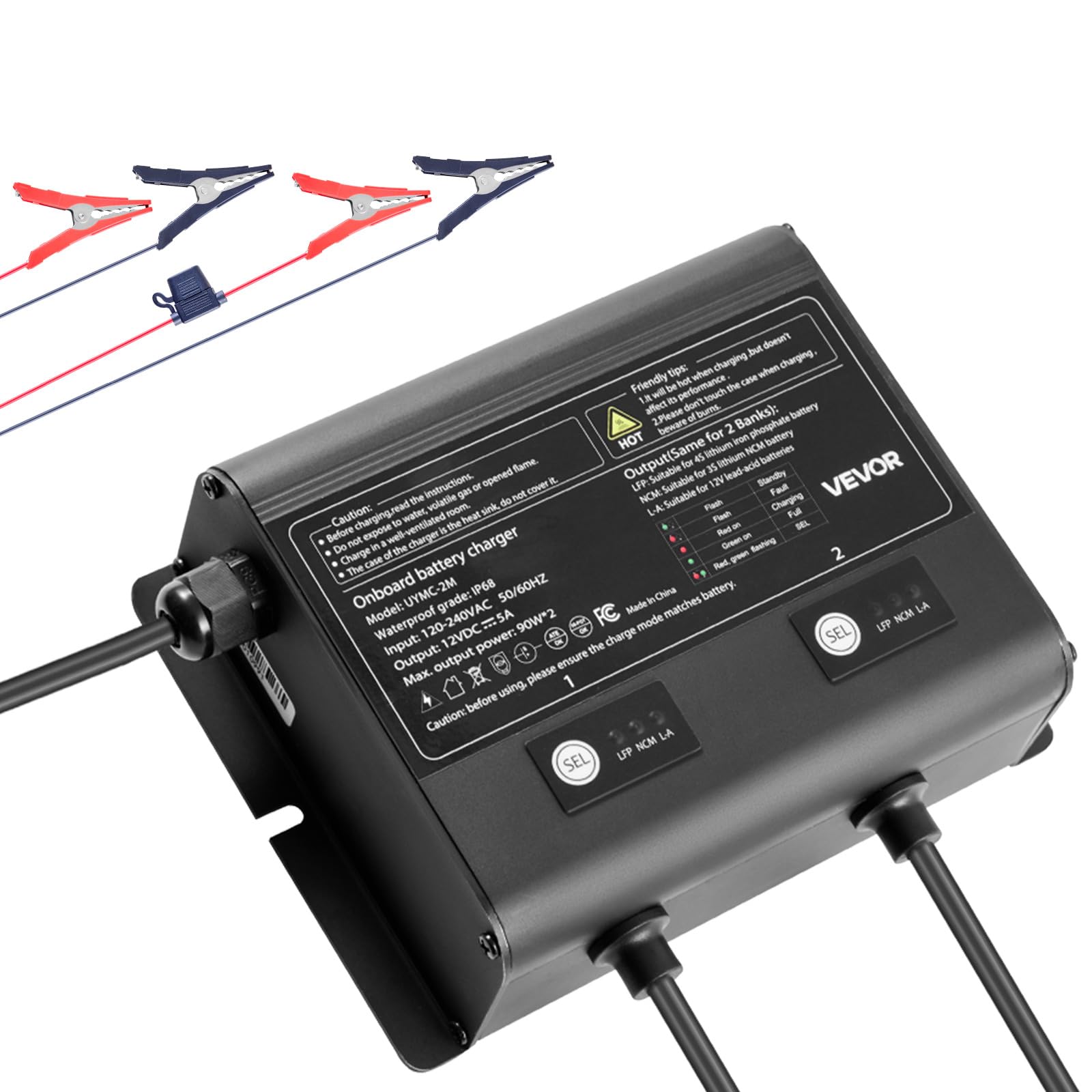
The VEVOR 2 Bank Marine Battery Charger provides 5 amps per bank in an IP68-rated sealed chassis designed for marine, yacht, RV, and trailer applications. Three charging modes — LFP, NCM, and Lead-Acid — cover the most common lithium and lead-acid chemistries, making it a versatile entry point into dual-bank charging.
Multi-stage intelligent charging adjusts power delivery based on battery status, transitioning through bulk, absorption, and float stages automatically. The unit supports charging from zero volts, recovering batteries that have been fully discharged and preventing unnecessary replacement due to charging failure.
Safety monitoring covers over-voltage, short circuit, overcurrent, spark, overheating, and reverse connection. UL, CE, FCC, IEC, and RoHS certifications provide regulatory assurance for the electrical design. The 4.85-pound chassis includes ring terminals suitable for permanent wiring, though the included cable length may require extension in larger vessels.
What works
- IP68 sealing at an accessible price point
- Three charging modes cover LFP, NCM, and lead-acid
- Zero-volt recovery saves deeply discharged batteries
What doesn’t
- 5 amps per bank limits bulk charging speed
- No separate AGM or calcium mode
Hardware & Specs Guide
Per-Bank Amperage and Total Output
A 2-bank charger rating of 10 amps total means each bank delivers 5 amps. Models with 20 amps total provide 10 amps per bank. Higher per-bank current reduces charge time proportionally but requires heavier gauge DC wiring and adequate ventilation to dissipate heat. For LiFePO4 batteries above 100 amp-hours, 10 amps per bank is recommended to complete a full charge within 5 to 6 hours.
IP Waterproof Ratings Explained
IP68 certification confirms the charger is dust-tight and can withstand continuous submersion in water beyond 1 meter depth — essential for bilge or deck installations. IP65 offers protection against water jets and splashes but not submersion. Choosing a charger with an IP rating that matches the installation environment prevents premature corrosion and electrical failure.
Lithium Charging Voltage and Profiles
LiFePO4 batteries require a constant current/constant voltage profile with an absorption voltage of 14.4 to 14.6 volts for a 12-volt nominal system. Chargers with selectable lithium modes deliver this curve and terminate charging when current drops to near zero. Units without a dedicated lithium mode may overcharge or undercharge, reducing cycle life by hundreds of cycles.
Force Mode and Dead Battery Recovery
Lithium batteries that discharge below 1 volt per cell enter protection mode and appear dead to standard chargers. Force Mode bypasses this by applying a low-current wake-up pulse to reactivate the battery management system. Chargers with this feature can recover batteries that would otherwise be discarded, providing significant cost savings over replacement.
FAQ
Can I charge a lead-acid and a lithium battery at the same time with a 2-bank charger?
What amp rating do I need for a 100Ah lithium battery?
Is IP68 waterproofing necessary for a boat charger?
Can a 2-bank charger stay connected 24/7?
What does Force Mode do on a lithium battery charger?
Final Thoughts: The Verdict
For most buyers, the best 2 bank lithium battery charger winner is the NOCO Genius GEN5X2 because it combines IP68 waterproofing, temperature-compensated charging, and independent mode selection in a compact footprint with strong warranty coverage. If you need higher per-bank amperage for large deep-cycle banks, grab the LiTime 2-Bank 10A. And for long-term maintenance and storage applications with OEM-level reliability, nothing beats the Tecmate Optimate 2 Duo TM-571.

Certification: BSc in Mechanical Engineering
Education: Mechanical engineer
Lives In: 539 W Commerce St, Dallas, TX 75208, USA
Md Amir is an auto mechanic student and writer with over half a decade of experience in the automotive field. He has worked with top automotive brands such as Lexus, Quantum, and also owns two automotive blogs autocarneed.com and taxiwiz.com.