Motorcycle street tires are the single most critical interface between your machine and the asphalt, yet most riders choose based on brand loyalty rather than understanding construction type, compound silica content, and tread siping density. A mismatched tire profile or incorrect load index can transform confident cornering into a white-knuckle slide, particularly when pavement temperatures drop or rain hits the tarmac. The difference between a great day and a bad day in the twisties often comes down to how aggressively the carcass flexes under heavy braking.
I’m Amir — the founder and writer behind Four Wheel Ask. My market research involves analyzing the material science behind rubber compounds, comparing belt construction types across bias-ply and radial designs, and aggregating thousands of owner-reported mileage figures and wet-grip evaluations from dedicated riding forums.
The modern tire market offers incredible depth, but narrowing down your choices requires understanding specific performance metrics. This guide breaks down nine of the most compelling options to help you confidently select the precise set of motorcycle street tires that match your riding style and machine’s demands.
How To Choose The Best Motorcycle Street Tires
Choosing the right set of street tires involves understanding three key areas: construction type, rubber compound, and size rating. Beginners often focus solely on brand reputation or tread pattern aesthetics, but the real performance differentiator lies in the carcass design and the material formulation that determines how the tire transfers force to the road.
Construction Type: Bias-Ply vs Radial
Bias-ply tires use overlapping cord layers running at diagonal angles, creating a stiffer sidewall that works well on cruisers and lighter bikes. Radial construction employs cords that run straight across the tire, allowing the sidewall to flex independently from the tread. Radials dissipate heat more effectively and provide superior wet grip, making them the dominant choice for modern sport and touring machines. For heavy bikes exceeding 700 pounds, the load capacity of a reinforced radial becomes non-negotiable.
Rubber Compound and Tread Sipe Density
The silica content in the compound directly impacts wet-grip performance. Tires with high-silica formulations heat up faster and maintain grip even on painted road lines and manhole covers. Sipes (the small slits cut into tread blocks) help evacuate water and allow the rubber to deform around pavement irregularities. Look for tires with siping that extends across the full contact patch, especially if you ride in variable weather conditions, as this design delays hydroplaning at highway speeds.
Load Index and Speed Rating
Every motorcycle tire carries a load index number that indicates the maximum weight it can support at rated inflation pressure. Under-specifying the load index leads to premature sidewall fatigue and reduced cornering clearance. Speed ratings (H, V, W, Y) correspond to maximum sustained velocity; a sport rider hitting the highway regularly should match or exceed the bike’s published top speed rating. Choosing a tire with a higher speed rating than your bike demands ensures a safety margin during high-speed sweepers.
Quick Comparison
On smaller screens, swipe sideways to see the full table.
| Model | Category | Best For | Key Spec | Amazon |
|---|---|---|---|---|
| Michelin Road 6 | Sport-Touring | Wet-weather confidence | 15% more wet grip vs Road 5 | Amazon |
| Michelin Road 5 | Sport-Touring | Longevity with wet grip | XST Evo siping technology | Amazon |
| Bridgestone S22 | Hypersport | Dry and wet track days | Fine grain Silica compound | Amazon |
| Pirelli Diablo Rosso III | Sport | Aggressive cornering | Dual-compound construction | Amazon |
| Pirelli Angel GT | Sport-Touring | High-mileage touring | W-rated for 168+ mph | Amazon |
| Shinko SR777 HD | Cruiser | Heavy-duty cruiser use | Reinforced carcass, 805-lb load | Amazon |
| Kenda KM1 Set | Sport-Touring | Budget-friendly set | 4-ply radial, dual apex | Amazon |
| Continental ContiMotion | Entry Radial | Daily commuting value | 0° steel-belt rear, 694-lb load | Amazon |
| Tusk Dsport Adventure Set | Dual-Sport | On/Off road versatility | 10-ply, 992-lb load capacity | Amazon |
In‑Depth Reviews
1. Michelin Road 6 Rear Tire (180/55ZR-17)
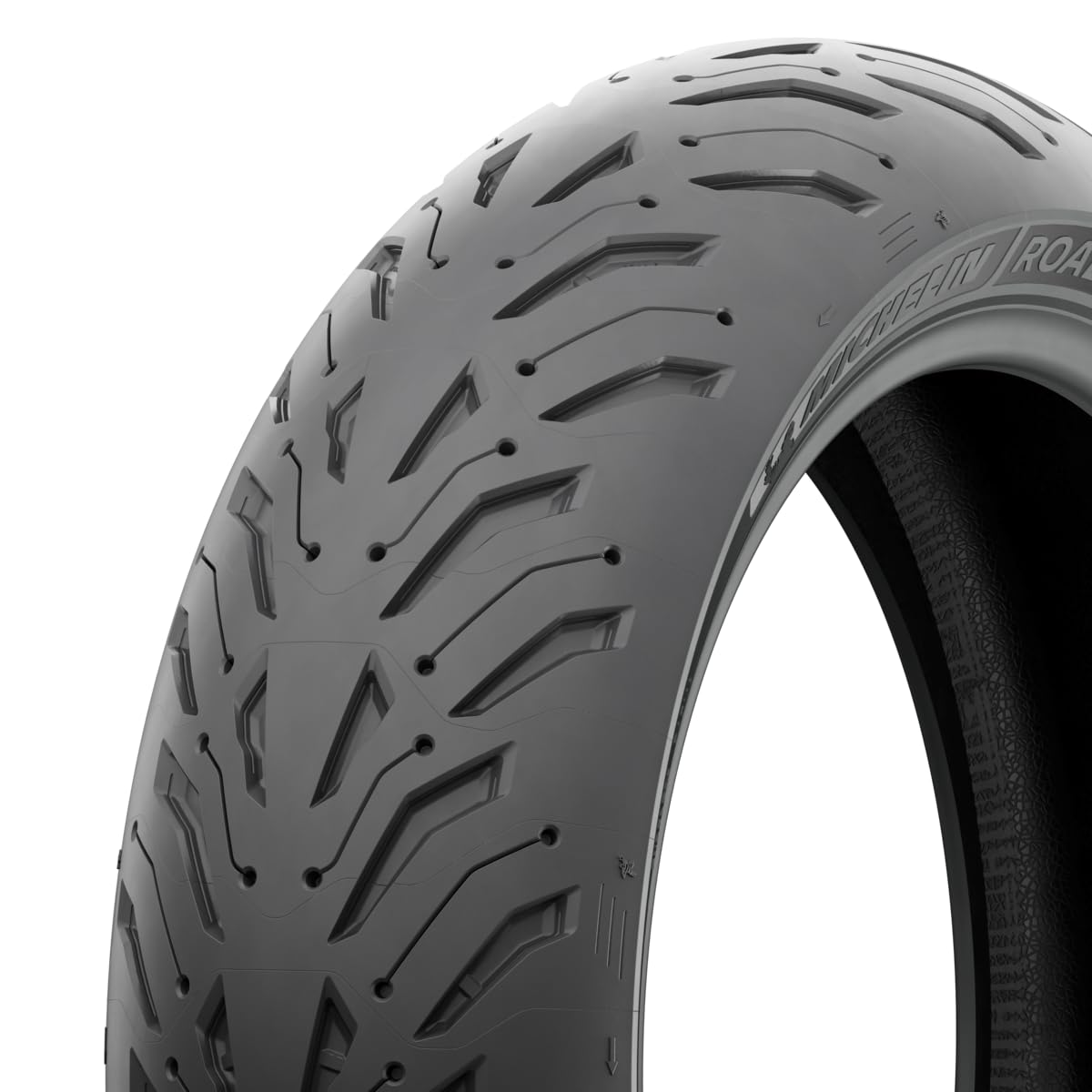
The Michelin Road 6 represents two decades of tire evolution, and its engineering priority is clear: keep the rider planted in the wet. Michelin’s Water Evergrip Technology uses a directional tread pattern that actively pumps water away from the contact patch, delivering a 15% improvement in wet grip compared to the already-excellent Road 5. The 2CT+ dual-compound construction places a harder rubber layer in the center for straight-line stability and a softer compound at the shoulders for cornering bite.
Riders report that the Road 6 feels planted from the first mile, requiring no prolonged scrubbing-in period to reach full grip. The tread life improvement of 10% over the previous generation means that heavy-touring riders on bikes like the BMW R1100RT or Honda ST1300 can expect 12,000 to 14,000 miles from a rear tire before hitting the wear bars. The silica-rich formulation also reduces warm-up time, providing confidence during early morning rides when pavement temperatures hover around 50°F.
The handling characteristics are biased toward stability without sacrificing agility. The Michelin Road 6 tracks through sweepers with a neutral steering feel, and the carcass construction maintains its shape even when the bike is loaded with saddlebags and a passenger. For riders who prioritize all-weather capability and long-distance touring, this tire sets the benchmark for the sport-touring segment.
What works
- Exceptional wet-weather grip from Water Evergrip Technology
- Extended tread life reduces replacement frequency
- Quick warm-up without aggressive scrubbing
What doesn’t
- Premium cost reflects advanced construction
- Limited size availability for smaller displacement bikes
2. Michelin Road 5 Touring Radial Tire

The Michelin Road 5 earned its reputation by proving that a tire can maintain wet-weather stopping performance even after 3,500 miles of wear. The patented XST Evo siping technology creates self-locking tread blocks that remain flexible as the tire wears, preventing the loss of grip that typically plagues aging tires. Owners of heavy sport-tourers like the BMW R1100RT report achieving 13,000 miles on a set, with the rear square-edge wear pattern remaining slow and predictable.
The ACT+ casing technology provides a wider contact patch under load, which translates to stable corner-entry braking and planted mid-corner line holding. Riders note that the tire communicates grip levels clearly through the bars, allowing for progressive lean angle buildup without surprises. The compound formulation includes materials designed to adhere to painted road markings and pedestrian crossings, reducing the nervous sliding sensation those surfaces often cause.
While the Road 5 has been superseded by the Road 6, it remains a strong choice for riders looking to save on initial cost without sacrificing the core Michelin wet-grip DNA. The dual-compound construction uses a harder center strip for commuting mileage and softer shoulders for weekend canyon carving. For mixed-weather touring riders who cover high annual mileage, the Road 5 is a proven performer that continues to earn praise from the community.
What works
- Exceptional wet-braking performance throughout tire life
- High mileage potential even on heavy tourers
- Clear grip feedback through handlebars
What doesn’t
- Rear tire square-edge wear can be felt in deep corners
- Premium pricing puts it outside entry-level budgets
3. Bridgestone Battlax Hypersport S22

Bridgestone engineered the Battlax S22 as a hypersport tire that refuses to compromise wet performance for the sake of peak dry grip. The fine grain silica compound is distributed across both the front and rear, creating a contact patch that maintains adhesion even as the tire approaches its maximum lean angle. The redesigned tread pattern features an increased rigidity in the pattern blocks, which reduces the squirm sensation under heavy braking into corners, a common complaint in earlier hypersport designs.
Owners riding SV1000S and similar naked sport bikes report that the S22 delivers immediate grip without the typical cold-tire hesitation during the first few corners of a ride. The rear compound formulation includes a higher silica density that helps the tire reach operating temperature in approximately two miles of moderate riding. The wear characteristics are predictable, with sport riders averaging around 5,000 miles on the rear before the shoulders begin showing significant wear.
The S22’s dry grip performance is its headline feature, with multiple owners describing it as “stickier than glue” during aggressive leaning. The handling response is sharp and direct thanks to the increased pattern rigidity, making it an excellent choice for riders who prioritize canyon carving and track day participation. However, the relatively soft compound means this tire is best suited for riders who value cornering performance over maximizing mileage between changes.
What works
- Outstanding dry grip ideal for sport riding
- Fine silica compound delivers confident wet performance
- Sharp steering response with predictable slip angles
What doesn’t
- Lower tread life compared to sport-touring alternatives
- Warm-up time is fast but still requires caution in cold weather
4. Pirelli Diablo Rosso III 180/55-17

The Pirelli Diablo Rosso III is a dual-compound radial designed to deliver a progressive grip feel that builds confidence as lean angle increases. The dual-compound construction places a softer rubber formulation on the shoulder edges, where cornering forces are highest, while maintaining a harder center strip for straight-line stability. Riders on sport bikes like the 2001 Buell M2 report that the tire completely transforms the bike’s character, offering a level of cornering bite that feels glued to the pavement.
The construction includes a zero-degree steel belt that reduces centrifugal growth at high speeds, maintaining a consistent contact patch shape. The tread pattern features wide circumferential grooves that channel water effectively, preventing hydroplaning during sudden downpours. Owners note that the tires warm up quickly and maintain grip throughout aggressive riding sessions without overheating and becoming greasy.
The Rosso III is a dedicated sport tire, and its compound prioritizes grip over longevity. Riders can typically expect between 6,000 and 8,000 miles from a rear set, depending on riding style and bike weight. The handling characteristics are biased toward immediate turn-in response, making it a favorite for riders who enjoy quick direction changes through tight switchbacks. For pure street aggression without compromise, the Diablo Rosso III remains a top performer.
What works
- Superb cornering grip with progressive feedback
- Fast warm-up reaches full grip quickly
- Stable at high speeds with consistent contact patch
What doesn’t
- Tread life is shorter than sport-touring options
- Wet performance is good but not class-leading
5. Pirelli Angel GT Rear Motorcycle Tire 180/55ZR-17

The Pirelli Angel GT uses Extended Mileage Sport (EMS) compound technology that balances grip with longevity, making it a dominant choice for the sport-touring segment. The tread pattern features an optimized arrangement of grooves that ensure excellent water drainage, reducing the risk of hydroplaning during sustained highway cruising in rain. The W-speed rating (168+ mph) provides a comfortable margin for bikes capable of high-speed touring, such as the Aprilia Caponord 1200 and large-displacement sport-tourers.
Owners consistently report achieving high mileage figures from the Angel GT, with many riders exceeding 10,000 miles on the rear before replacement. The compound formulation resists the flat-spotting that often plagues high-mileage tires used for commuting, maintaining a rounder profile longer. The handling balance leans toward stability, with a neutral feel that avoids the heavy steering often associated with long-distance tires.
The carcass construction uses a reinforced sidewall design that provides additional support under loaded touring conditions. Riders carrying saddlebags and a passenger will notice a significant improvement in cornering clearance and overall stability compared to softer sport tires. The Angel GT is an excellent choice for riders who cover cross-country distances and want predictable, trustworthy performance that doesn’t require frequent tire changes.
What works
- Excellent tread life for touring mileage
- Resists flat-spotting from highway commuting
- Stable handling under loaded touring conditions
What doesn’t
- Warm-up requires more distance than hypersport tires
- Cornering grip is good but not track-focused
6. Shinko SR777 HD Black Wall Bias Rear Tire 160/70-17

The Shinko SR777 HD is a bias-ply tire specifically engineered for heavier cruiser motorcycles, featuring a reinforced carcass that provides a stable planted feel under significant load. The Heavy Duty version uses extra plies in the sidewall to resist flexing under the torque of large-displacement V-Twins, which reduces the wandering sensation often experienced with softer tires on heavy bikes. The tread design incorporates functional siping and circumferential grooves that evacuate water effectively for wet-road traction.
The rubber compound is formulated to deliver maximum grip and comfort, which is particularly noticeable during acceleration and braking on cruiser-style bikes. Riders appreciate the confidence-inspiring traction when cornering, as the reinforced carcass maintains its shape and prevents the tire from folding under aggressive lean angles. The load capacity of 805 pounds ensures compatibility with heavy touring cruisers carrying cargo.
Being a bias-ply design, the SR777 HD does not offer the same heat dissipation characteristics as a radial, but for cruiser applications where speeds rarely exceed 100 mph, the trade-off is negligible. The tire is available in multiple sizes to fit a wide range of V-Twin and metric cruiser models, making it a versatile choice for the aftermarket. For riders with heavy bikes who prioritize stability and load capacity over ultimate cornering speed, the SR777 HD delivers exactly what it promises.
What works
- Reinforced carcass resists sidewall flex on heavy bikes
- Excellent load capacity for touring cruisers
- Stable feel during acceleration and braking
What doesn’t
- Bias-ply construction runs hotter than radials
- Not designed for high-speed cornering agility
7. Kenda KM1 Sport Touring Set (120/70-17 & 180/55-17)

The Kenda KM1 is a radial tire that brings performance-oriented construction to a more accessible price point, making it an excellent choice for riders who want the benefits of radial technology without the premium cost. The optimized apex geometry provides a balance of high-speed stability and agile handling, which is particularly noticeable when transitioning between straight-line cruising and corner entry. The 4-ply construction delivers a comfortable ride while maintaining structural integrity under load.
Riders on sport-touring bikes appreciate the KM1’s ability to heat up quickly from cold temperatures, which reduces the nervous feeling during the first few miles of a ride. The advanced rubber compound formulation provides consistent grip across varying road surfaces, and the newly designed tread pattern promotes even wear over time. Owners report that the tires deliver quiet, smooth operation at freeway speeds with minimal road noise intrusion.
While the KM1 does not match the ultimate wet grip or lifespan of premium options like the Michelin Road series, it offers a compelling value proposition for riders who need a reliable, predictable set of tires for daily commuting and weekend touring. Some riders note a slight slipping sensation in extreme wet conditions, but the tire maintains composure under normal riding circumstances. The included two-pack simplifies the purchasing process by delivering both front and rear tires together.
What works
- Affordable radial construction for budget-conscious riders
- Quick warm-up from cold temperatures
- Quiet and smooth at freeway speeds
What doesn’t
- Wet grip is not as strong as premium competitors
- Less tread life compared to high-end sport-touring tires
8. Continental ContiMotion Sport/Touring Rear 180/55-17

The Continental ContiMotion is designed as an entry-level radial tire that provides safe and reliable feedback in both dry and wet conditions. The 0° steel-belt construction on the rear tire delivers excellent stability and ride comfort, helping to reduce the vibration and wandering that cheaper tires often transmit through the chassis. The compound uses newly formulated polymers that improve mileage without sacrificing the grip levels needed for daily commuting.
With a load capacity of 694.5 pounds and a 4-ply rating, the ContiMotion is capable of handling most mid-weight sport and naked bikes. Riders who install this tire report that it feels predictable during moderate cornering and provides adequate stopping traction under normal braking conditions. The bias-ply construction (listed in specs) gives it a slightly stiffer feel compared to true radials, which some riders prefer for its direct feedback.
The ContiMotion is not designed for aggressive canyon carving or track use, and its limits become apparent when pushed hard into corners. However, for the rider who primarily uses their bike for commuting, errands, and casual weekend rides, this tire offers a capable and confidence-inspiring solution. The relatively low initial cost makes it an attractive option for budget-focused riders who want a known brand with solid engineering.
What works
- Stable and comfortable ride from steel-belt construction
- Predictable handling suitable for commuting
- Good value for budget-conscious buyers
What doesn’t
- Cornering grip is limited compared to sport-focused tires
- Not suitable for aggressive or track riding
9. Tusk Dsport Adventure Tire Set (90/90-21 & 120/90-18)

The Tusk Dsport Adventure tire is a DOT-compliant dual-sport tire that offers aggressive off-road tread pattern combined with a rubber compound designed for extended pavement wear. The tall knobbies provide bite in loose terrain while the compound resists chunking during highway miles. With a 10-ply rating and a load capacity of 992 pounds, this tire is built to handle the demands of heavy adventure bikes like the KTM 690 Enduro and similar dual-sport machines.
Owners report that the Dsport delivers impressive durability, with riders stating they can cover thousands of highway miles without significant lug wear. The aggressive tread pattern handles mud, gravel, and hardpack with confidence, and the tire remains stable during high-speed pavement transitions. Some users note that balancing can be challenging due to the heavy construction, but once properly balanced with bead locks, the tire runs smoothly even at highway speeds.
The Dsport is a specialized tire that excels in its intended dual-sport application but offers limited appeal for pure street riders. The aggressive knobs generate noticeable road noise and vibration on smooth asphalt. However, for the adventure rider who splits their time between pavement and dirt, this tire offers exceptional value, with multiple owners rating it as the best tire for the money in the dual-sport category. The included two-pack simplifies the purchasing process by delivering both front and rear tires together.
What works
- Exceptional durability for aggressive dual-sport riding
- Tall knobbies provide excellent off-road traction
- 10-ply construction supports heavy adventure bikes
What doesn’t
- Significant road noise and vibration on pavement
- Balancing can be difficult due to heavy construction
Hardware & Specs Guide
Bias-Ply vs Radial Construction
The construction type dictates how the tire carcass behaves under load and at speed. Bias-ply tires use cords running at 30-45 degree angles to the centerline, creating a stiff sidewall that resists flexing. This design works well for cruiser and dual-sport applications where the tire sees high torque loads or mixed-terrain use. Radial tires have cords running perpendicular to the centerline, allowing the sidewall to flex independently from the tread. This separates the damping and grip functions, delivering superior heat dissipation and wet traction. Modern sport and sport-touring bikes overwhelmingly use radial construction because the higher cornering loads demand the tread stability that radials provide.
Load Index and Speed Rating
The load index is a numeric code that corresponds to the maximum weight a tire can support at its recommended pressure. For example, a load index of 73 equals approximately 805 pounds, while 79 equals around 963 pounds. Running a tire at or near its maximum load capacity generates more heat and accelerates wear. The speed rating is a letter (H, V, W, Y) that indicates the tire’s maximum sustained speed capability. A W-rated tire (168 mph) provides a safety margin for bikes that regularly travel at triple-digit speeds. Matching or exceeding the bike manufacturer’s original spec is critical; under-rating either parameter compromises safety at high speeds or under heavy braking.
FAQ
How many miles can I expect from a set of street tires?
What does the speed rating on a motorcycle tire mean?
Can I mix a radial front tire with a bias-ply rear tire?
Final Thoughts: The Verdict
For most buyers, the motorcycle street tires winner is the Michelin Road 6 because it combines 15% more wet grip than its predecessor with a 10% tread life improvement, making it the most balanced all-weather option for serious sport-touring riders. If you want aggressive cornering performance for weekend canyon carving, grab the Pirelli Diablo Rosso III. And for a value-driven radial set that delivers reliable daily performance without stretching the budget, nothing beats the Kenda KM1.

Certification: BSc in Mechanical Engineering
Education: Mechanical engineer
Lives In: 539 W Commerce St, Dallas, TX 75208, USA
Md Amir is an auto mechanic student and writer with over half a decade of experience in the automotive field. He has worked with top automotive brands such as Lexus, Quantum, and also owns two automotive blogs autocarneed.com and taxiwiz.com.